
See what people are saying
README
Orange Pi 5 Plus: Homelab, Storage & Local AI Benchmark Suite
Overview
This repository contains empirical benchmark results, hardware diagnostics, and automated test scripts for the Orange Pi 5 Plus (16GB RAM) paired with a Samsung PM981a 256GB NVMe SSD (Samsung Phoenix controller with 512MB dedicated DDR4 DRAM cache).
Conducted by Pierluigi De Vitis, this test suite evaluates the board for:
- 24/7 Homelab & Edge Servers (Docker, microservices, database transactions)
- High-Throughput NVMe Storage (FIO Direct I/O saturation on PCIe 3.0 x4)
- High-Speed Networking (Dual 2.5 GbE Realtek RTL8125 controllers)
- Local AI & Edge Inference (Ollama ARM64 on CPU + Rockchip RKNPU2 / RKLLM 6 TOPS NPU)
Hardware Specifications
flowchart TD
    RK3588["Rockchip RK3588 (8nm)<br/>4x Cortex-A76 @ 2.4GHz + 4x Cortex-A55 @ 1.8GHz"]
    RAM["16GB LPDDR4x Unified RAM"]
    NPU["6 TOPS Hardware NPU (3-Core, INT4/INT8/FP16)"]
    SSD["Samsung PM981a 256GB NVMe<br/>(PCIe 3.0 x4, 512MB DRAM Cache)"]
    NIC1["Realtek RTL8125 2.5 GbE (Port 1)"]
    NIC2["Realtek RTL8125 2.5 GbE (Port 2)"]
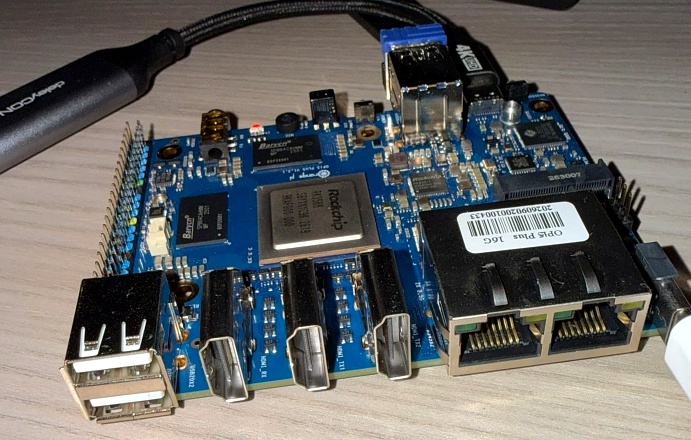
    DISP["Triple Display: 2x HDMI 2.1 (8K@60) + 1x DP 1.4"]

    RK3588 --- RAM
    RK3588 --- NPU
    RK3588 --- SSD
    RK3588 --- NIC1
    RK3588 --- NIC2
    RK3588 --- DISP
- Board: Orange Pi 5 Plus
- SoC: Rockchip RK3588 (8-Core: 4x Cortex-A76 @ 2.26–2.40 GHz + 4x Cortex-A55 @ 1.80 GHz)
- RAM: 16GB LPDDR4x (16,347,128 kB total) + 7.8GB zram swap
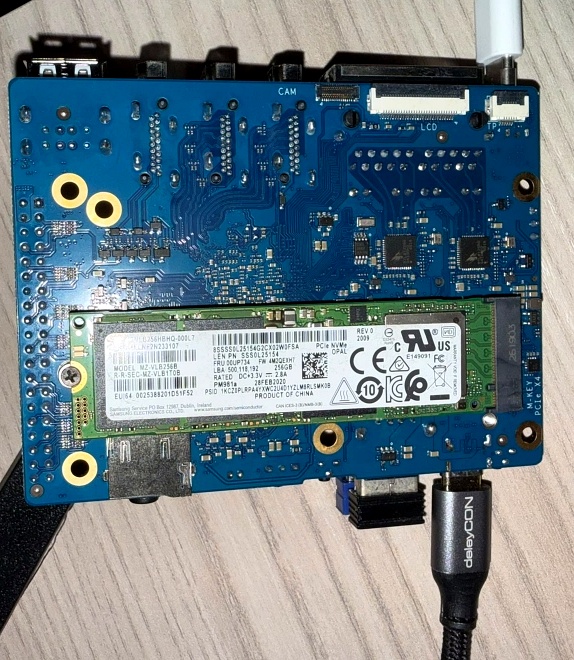
- Storage: Samsung PM981a 256GB M.2 2280 NVMe SSD (Negotiated link: PCIe 3.0 x4 @ 8.0 GT/s)
- Networking: 2x Realtek RTL8125 2.5 GbE Ethernet (
enP4p65s0,enP3p49s0) + Wi-Fi - NPU: 3-core Rockchip NPU, 6 TOPS peak (Driver 0.9.8, RKLLM runtime 1.1.4)
- Cooling Setup: Bare Board / Die (Tested in standard standalone retail configuration. The default package from Orange Pi contains the board only, as cooling accessories are sold separately; all tests reflect out-of-the-box bare-die performance).
- OS & Kernel: Ubuntu 22.04.5 LTS (Jammy Jellyfish ARM64), Kernel 6.1.99-rockchip-rk3588
Test Unit Gallery
| Bottom: Samsung PM981a NVMe (PCIe 3.0 x4) | Top: Rockchip RK3588 SoC & Unified RAM | Side: Dual 2.5GbE & Triple Display I/O |
|---|---|---|
 | 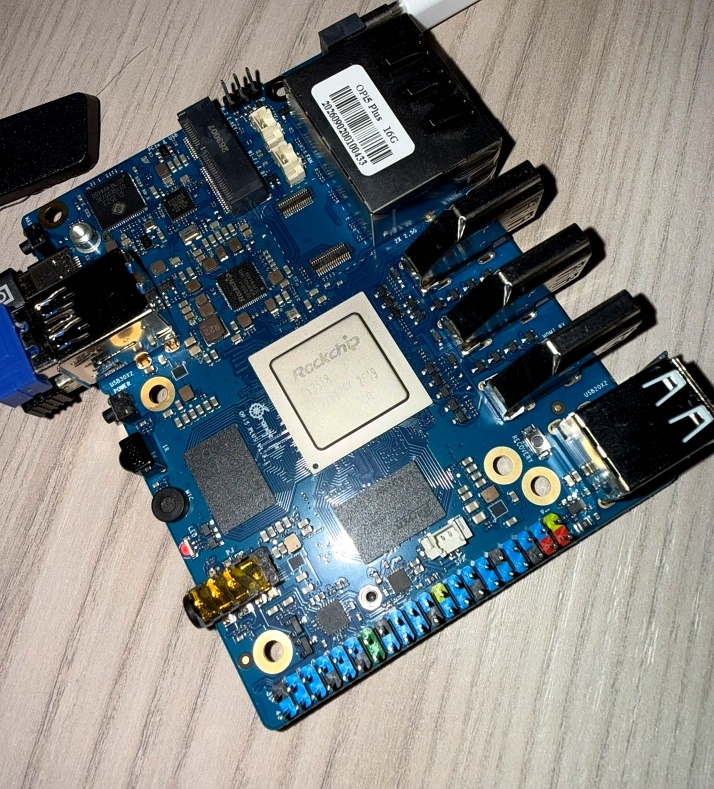 |  |
Memory & VRAM Architecture Note: Unlike traditional x86 mini PCs with fixed BIOS VRAM apertures, the RK3588 utilizes a unified 16GB LPDDR4x architecture dynamically managed via Linux kernel CMA (Contiguous Memory Allocator). Both CPU and NPU access the unified 16GB address space seamlessly.
Benchmark Results Summary
1. Storage Performance (Samsung PM981a 256GB NVMe via FIO)
All tests conducted using Direct I/O (direct=1, ioengine=libaio) to bypass Linux page cache.
| Metric | Profile | Measured Result | Evaluation |
|---|---|---|---|
| Sequential Read | 1MB, QD32, 4GB | 2,862.33 MB/s | Saturates ~92% of PCIe 3.0 x4 bus |
| Sequential Write | 1MB, QD32, 4GB | 2,172.94 MB/s | Maximum sustained TLC write speed |
| Random 4K Read | 4K, QD32, Direct I/O | 197,108 IOPS (~770 MB/s) | Outstanding index & database speed |
| Random 4K Write | 4K, QD32, Direct I/O | 153,771 IOPS (~600 MB/s) | Rock-solid thanks to 512MB DRAM cache |
| Mixed 70/30 R/W | 4K, QD16, Direct I/O | 69,771 R / 29,930 W IOPS | Simulates concurrent container loads |
2. CPU & Compute Performance
- 7-Zip Compression / Decompression:
- Single-Core (1 Thread):
2,831 MIPS - Multi-Core (8 Threads):
13,015 MIPS
- Single-Core (1 Thread):
- Sysbench CPU (8 Threads, prime=20,000):
4,343.94 events/sec - Kernel Network Stack Loopback (iperf3 in-memory):
47.5 Gbps(verifies kernel TCP processing headroom; physical networking handled by two independent PCIe Realtek RTL8125 2.5 GbE ports)
3. Thermals & Cooling Stability (Bare-Die / Uncooled Assessment)
All thermal data recorded on the naked board resting horizontally on an open desk with zero external heatsink or fan airflow:
- Baseline Idle (Open Desk):
52.7°C(impressive passive PCB dissipation for an 8-core SoC) - After Sustained FIO NVMe Storage Stress:
62.8°C(Samsung PM981a drive reached 45°C via SMART) - Under 1B–3B Local AI Inference (4T Big Cores):
72.0°C – 79.5°C - Peak Under 100% 8-Core Stress (
stress-ng) & 8B LLM:78.5°C – 85.0°C(SoC reaches the 85°C DVFS thermal threshold) - Key Buyer Takeaway: In line with SBC industry standards, the standard retail package from Orange Pi contains the standalone board only (cooling solutions, cases, and power adapters are sold separately as optional add-ons or bundle kits). While light workloads, container hosting, and storage I/O remain stable bare-die thanks to copper plane dissipation, adding a dedicated heatsink or fan is strongly recommended for sustained 24/7 heavy CPU or AI workloads.
4. Local AI & LLM Inference Performance (Ollama ARM64)
Inference run over standardized technical prompt (~256 generated tokens). Comparing full 8-thread allocation vs 4-thread Cortex-A76 Big-core pinning.
| Model | Parameters | Thread Allocation | Eval (Generation) Rate | Prompt Processing Rate | TTFT (Time to First Token) | Memory Footprint (RSS) |
|---|---|---|---|---|---|---|
| Llama 3.2: 1B | 1.23B (Q4_K_M) | Big Cores Only (4T) | 14.62 tok/s | 108.11 tok/s | 425.5 ms | ~1.3 GB |
| Llama 3.2: 1B | 1.23B (Q4_K_M) | All Cores (8T) | 10.67 tok/s | 79.91 tok/s | 575.6 ms | ~1.3 GB |
| DeepSeek-Coder: 1.3B | 1.35B (Q4_0) | Big Cores Only (4T) | 16.90 tok/s | 89.72 tok/s | 1,025.5 ms | ~1.4 GB |
| DeepSeek-Coder: 1.3B | 1.35B (Q4_0) | All Cores (8T) | 4.52 tok/s | 27.91 tok/s | 3,295.7 ms | ~1.4 GB |
| Qwen 2.5: 1.5B | 1.54B (Q4_K_M) | Big Cores Only (4T) | 14.48 tok/s | 70.24 tok/s | 711.8 ms | ~1.6 GB |
| Qwen 2.5: 1.5B | 1.54B (Q4_K_M) | All Cores (8T) | 3.46 tok/s | 42.33 tok/s | 1,181.2 ms | ~1.6 GB |
| Llama 3.2: 3B | 3.21B (Q4_K_M) | Big Cores Only (4T) | 7.28 tok/s | 28.13 tok/s | 1,635.2 ms | ~2.8 GB |
| Llama 3.2: 3B | 3.21B (Q4_K_M) | All Cores (8T) | 1.99 tok/s | 10.84 tok/s | 4,245.2 ms | ~2.8 GB |
| Phi-3 Mini: 3.8B | 3.82B (Q4_K_M) | Big Cores Only (4T) | 6.56 tok/s | 35.17 tok/s | 909.8 ms | ~3.1 GB |
| Phi-3 Mini: 3.8B | 3.82B (Q4_K_M) | All Cores (8T) | 5.27 tok/s | 32.97 tok/s | 970.5 ms | ~3.1 GB |
| Llama 3.1: 8B | 8.03B (Q4_K_M) | Big Cores Only (4T) | 2.32 tok/s | 10.24 tok/s | 3,028.3 ms | ~5.4 GB |
| Llama 3.1: 8B | 8.03B (Q4_K_M) | All Cores (8T) | 2.10 tok/s | 7.66 tok/s | 4,044.8 ms | ~5.4 GB |
Key Architectural Finding: Setting
num_thread=4to isolate execution to the 4 Big Cortex-A76 cores eliminates inter-cluster synchronization stalls with the slower Cortex-A55 cores, yielding a +37% boost on Llama 3.2 1B, +274% boost on DeepSeek-Coder 1.3B, +265% boost on Llama 3.2 3B, and +318% (4.18x) boost on Qwen 2.5 1.5B! The 8B Torture Test: 16GB RAM allows running Llama 3.1 8B comfortably with 7.2GB free RAM, but token generation is memory-bandwidth bound to ~2.32 tok/s at 84-85°C.
5. Hardware NPU Inference (Rockchip RKLLM Native Runtime)
The RK3588 features a 3-core 6 TOPS NPU. Ollama does NOT utilize this NPU; it runs 100% on the CPU. To benchmark the NPU, we compiled a native C++ runner against librkllmrt.so.
On-Device Empirical NPU Test:
| Model | Format / Runtime | NPU Cores | Eval (Generation) Rate | TTFT (Latency) | System CPU Load |
|---|---|---|---|---|---|
| Qwen 1.5: 0.5B (Measured) | INT8/INT4 (.rkllm) | 3 Cores (Full NPU) | 21.55 tok/s | 96.4 ms | ~0% (Completely Offloaded) |
Head-to-Head: CPU vs Hardware NPU (Measured & Vendor/Community Reference)
| Parameter Class | Ollama CPU (Big Cores 4T - Measured) | Rockchip NPU (6 TOPS, 3 Cores) | Status / Advantage |
|---|---|---|---|
| 0.5B - 1.0B | 14.62 tok/s (Llama 3.2 1B) | 21.55 tok/s (Qwen 1.5 0.5B) | Measured on-device: +47% faster, TTFT 96ms vs 425ms |
| 1.3B - 1.5B | 16.90 tok/s (DeepSeek) / 14.48 (Qwen) | ~16.69 tok/s (Qwen 2.5 1.5B NPU) | Reference Data: Equivalent throughput, 0% CPU load |
| 3B - 4B | 6.56 tok/s (Phi-3) / 7.28 (Llama 3.2) | ~7.45 tok/s (Phi-3 3.8B NPU) | Reference Data: Equivalent throughput, zero CPU load |
| 7B - 8B | 2.32 tok/s (Llama 3.1 8B) | ~4.5 - 4.98 tok/s (6B/7B NPU) | Reference Data: ~2x faster, avoids 85°C CPU heating |
How to Reproduce These Benchmarks
You can run the exact same tests on your Orange Pi 5 Plus or any Rockchip RK3588 board:
1. Clone this Repository
git clone https://github.com/Pigi998/orangepi-5plus-benchmarks.git
cd orangepi-5plus-benchmarks
2. Install Required Dependencies
sudo apt update && sudo apt install -y \
  build-essential curl wget git \
  p7zip-full fio iperf3 lm-sensors \
  stress-ng htop nvme-cli smartmontools sysbench jq python3-psutil
3. Run the Unified Benchmark Script (Storage, CPU, Network, Thermals)
chmod +x tools/run_homelab_bench.sh
./tools/run_homelab_bench.sh
4. Run the Local LLM CPU Benchmark (Ollama)
chmod +x tools/benchmark_ollama.py
python3 tools/benchmark_ollama.py llama3.2:1b llama3.2:3b qwen2.5:1.5b llama3.1:8b
5. Run the Hardware NPU Benchmark (RKLLM)
chmod +x tools/benchmark_npu.py
python3 tools/benchmark_npu.py tools/qwen1.5-0.5B.rkllm
Official Hardware & Purchase Links
Direct links to the official manufacturer stores:
- Official Portal: Orange Pi
- Orange Pi 5 Plus Details: Technical Specifications
- Official AliExpress Store: Orange Pi Official Store
- Official Amazon Store: Orange Pi 5 Plus on Amazon
License
All benchmark scripts and collected dataset files in this repository are released under the MIT License. Feel free to adapt and incorporate them into community comparisons.
Similar repos


See what people are saying
README
Orange Pi 5 Plus: Homelab, Storage & Local AI Benchmark Suite
Overview
This repository contains empirical benchmark results, hardware diagnostics, and automated test scripts for the Orange Pi 5 Plus (16GB RAM) paired with a Samsung PM981a 256GB NVMe SSD (Samsung Phoenix controller with 512MB dedicated DDR4 DRAM cache).
Conducted by Pierluigi De Vitis, this test suite evaluates the board for:
- 24/7 Homelab & Edge Servers (Docker, microservices, database transactions)
- High-Throughput NVMe Storage (FIO Direct I/O saturation on PCIe 3.0 x4)
- High-Speed Networking (Dual 2.5 GbE Realtek RTL8125 controllers)
- Local AI & Edge Inference (Ollama ARM64 on CPU + Rockchip RKNPU2 / RKLLM 6 TOPS NPU)
Hardware Specifications
flowchart TD
    RK3588["Rockchip RK3588 (8nm)<br/>4x Cortex-A76 @ 2.4GHz + 4x Cortex-A55 @ 1.8GHz"]
    RAM["16GB LPDDR4x Unified RAM"]
    NPU["6 TOPS Hardware NPU (3-Core, INT4/INT8/FP16)"]
    SSD["Samsung PM981a 256GB NVMe<br/>(PCIe 3.0 x4, 512MB DRAM Cache)"]
    NIC1["Realtek RTL8125 2.5 GbE (Port 1)"]
    NIC2["Realtek RTL8125 2.5 GbE (Port 2)"]
    DISP["Triple Display: 2x HDMI 2.1 (8K@60) + 1x DP 1.4"]

    RK3588 --- RAM
    RK3588 --- NPU
    RK3588 --- SSD
    RK3588 --- NIC1
    RK3588 --- NIC2
    RK3588 --- DISP
- Board: Orange Pi 5 Plus
- SoC: Rockchip RK3588 (8-Core: 4x Cortex-A76 @ 2.26–2.40 GHz + 4x Cortex-A55 @ 1.80 GHz)
- RAM: 16GB LPDDR4x (16,347,128 kB total) + 7.8GB zram swap
- Storage: Samsung PM981a 256GB M.2 2280 NVMe SSD (Negotiated link: PCIe 3.0 x4 @ 8.0 GT/s)
- Networking: 2x Realtek RTL8125 2.5 GbE Ethernet (
enP4p65s0,enP3p49s0) + Wi-Fi - NPU: 3-core Rockchip NPU, 6 TOPS peak (Driver 0.9.8, RKLLM runtime 1.1.4)
- Cooling Setup: Bare Board / Die (Tested in standard standalone retail configuration. The default package from Orange Pi contains the board only, as cooling accessories are sold separately; all tests reflect out-of-the-box bare-die performance).
- OS & Kernel: Ubuntu 22.04.5 LTS (Jammy Jellyfish ARM64), Kernel 6.1.99-rockchip-rk3588
Test Unit Gallery
| Bottom: Samsung PM981a NVMe (PCIe 3.0 x4) | Top: Rockchip RK3588 SoC & Unified RAM | Side: Dual 2.5GbE & Triple Display I/O |
|---|---|---|
| | |
Memory & VRAM Architecture Note: Unlike traditional x86 mini PCs with fixed BIOS VRAM apertures, the RK3588 utilizes a unified 16GB LPDDR4x architecture dynamically managed via Linux kernel CMA (Contiguous Memory Allocator). Both CPU and NPU access the unified 16GB address space seamlessly.
Benchmark Results Summary
1. Storage Performance (Samsung PM981a 256GB NVMe via FIO)
All tests conducted using Direct I/O (direct=1, ioengine=libaio) to bypass Linux page cache.
| Metric | Profile | Measured Result | Evaluation |
|---|---|---|---|
| Sequential Read | 1MB, QD32, 4GB | 2,862.33 MB/s | Saturates ~92% of PCIe 3.0 x4 bus |
| Sequential Write | 1MB, QD32, 4GB | 2,172.94 MB/s | Maximum sustained TLC write speed |
| Random 4K Read | 4K, QD32, Direct I/O | 197,108 IOPS (~770 MB/s) | Outstanding index & database speed |
| Random 4K Write | 4K, QD32, Direct I/O | 153,771 IOPS (~600 MB/s) | Rock-solid thanks to 512MB DRAM cache |
| Mixed 70/30 R/W | 4K, QD16, Direct I/O | 69,771 R / 29,930 W IOPS | Simulates concurrent container loads |
2. CPU & Compute Performance
- 7-Zip Compression / Decompression:
- Single-Core (1 Thread):
2,831 MIPS - Multi-Core (8 Threads):
13,015 MIPS
- Single-Core (1 Thread):
- Sysbench CPU (8 Threads, prime=20,000):
4,343.94 events/sec - Kernel Network Stack Loopback (iperf3 in-memory):
47.5 Gbps(verifies kernel TCP processing headroom; physical networking handled by two independent PCIe Realtek RTL8125 2.5 GbE ports)
3. Thermals & Cooling Stability (Bare-Die / Uncooled Assessment)
All thermal data recorded on the naked board resting horizontally on an open desk with zero external heatsink or fan airflow:
- Baseline Idle (Open Desk):
52.7°C(impressive passive PCB dissipation for an 8-core SoC) - After Sustained FIO NVMe Storage Stress:
62.8°C(Samsung PM981a drive reached 45°C via SMART) - Under 1B–3B Local AI Inference (4T Big Cores):
72.0°C – 79.5°C - Peak Under 100% 8-Core Stress (
stress-ng) & 8B LLM:78.5°C – 85.0°C(SoC reaches the 85°C DVFS thermal threshold) - Key Buyer Takeaway: In line with SBC industry standards, the standard retail package from Orange Pi contains the standalone board only (cooling solutions, cases, and power adapters are sold separately as optional add-ons or bundle kits). While light workloads, container hosting, and storage I/O remain stable bare-die thanks to copper plane dissipation, adding a dedicated heatsink or fan is strongly recommended for sustained 24/7 heavy CPU or AI workloads.
4. Local AI & LLM Inference Performance (Ollama ARM64)
Inference run over standardized technical prompt (~256 generated tokens). Comparing full 8-thread allocation vs 4-thread Cortex-A76 Big-core pinning.
| Model | Parameters | Thread Allocation | Eval (Generation) Rate | Prompt Processing Rate | TTFT (Time to First Token) | Memory Footprint (RSS) |
|---|---|---|---|---|---|---|
| Llama 3.2: 1B | 1.23B (Q4_K_M) | Big Cores Only (4T) | 14.62 tok/s | 108.11 tok/s | 425.5 ms | ~1.3 GB |
| Llama 3.2: 1B | 1.23B (Q4_K_M) | All Cores (8T) | 10.67 tok/s | 79.91 tok/s | 575.6 ms | ~1.3 GB |
| DeepSeek-Coder: 1.3B | 1.35B (Q4_0) | Big Cores Only (4T) | 16.90 tok/s | 89.72 tok/s | 1,025.5 ms | ~1.4 GB |
| DeepSeek-Coder: 1.3B | 1.35B (Q4_0) | All Cores (8T) | 4.52 tok/s | 27.91 tok/s | 3,295.7 ms | ~1.4 GB |
| Qwen 2.5: 1.5B | 1.54B (Q4_K_M) | Big Cores Only (4T) | 14.48 tok/s | 70.24 tok/s | 711.8 ms | ~1.6 GB |
| Qwen 2.5: 1.5B | 1.54B (Q4_K_M) | All Cores (8T) | 3.46 tok/s | 42.33 tok/s | 1,181.2 ms | ~1.6 GB |
| Llama 3.2: 3B | 3.21B (Q4_K_M) | Big Cores Only (4T) | 7.28 tok/s | 28.13 tok/s | 1,635.2 ms | ~2.8 GB |
| Llama 3.2: 3B | 3.21B (Q4_K_M) | All Cores (8T) | 1.99 tok/s | 10.84 tok/s | 4,245.2 ms | ~2.8 GB |
| Phi-3 Mini: 3.8B | 3.82B (Q4_K_M) | Big Cores Only (4T) | 6.56 tok/s | 35.17 tok/s | 909.8 ms | ~3.1 GB |
| Phi-3 Mini: 3.8B | 3.82B (Q4_K_M) | All Cores (8T) | 5.27 tok/s | 32.97 tok/s | 970.5 ms | ~3.1 GB |
| Llama 3.1: 8B | 8.03B (Q4_K_M) | Big Cores Only (4T) | 2.32 tok/s | 10.24 tok/s | 3,028.3 ms | ~5.4 GB |
| Llama 3.1: 8B | 8.03B (Q4_K_M) | All Cores (8T) | 2.10 tok/s | 7.66 tok/s | 4,044.8 ms | ~5.4 GB |
Key Architectural Finding: Setting
num_thread=4to isolate execution to the 4 Big Cortex-A76 cores eliminates inter-cluster synchronization stalls with the slower Cortex-A55 cores, yielding a +37% boost on Llama 3.2 1B, +274% boost on DeepSeek-Coder 1.3B, +265% boost on Llama 3.2 3B, and +318% (4.18x) boost on Qwen 2.5 1.5B! The 8B Torture Test: 16GB RAM allows running Llama 3.1 8B comfortably with 7.2GB free RAM, but token generation is memory-bandwidth bound to ~2.32 tok/s at 84-85°C.
5. Hardware NPU Inference (Rockchip RKLLM Native Runtime)
The RK3588 features a 3-core 6 TOPS NPU. Ollama does NOT utilize this NPU; it runs 100% on the CPU. To benchmark the NPU, we compiled a native C++ runner against librkllmrt.so.
On-Device Empirical NPU Test:
| Model | Format / Runtime | NPU Cores | Eval (Generation) Rate | TTFT (Latency) | System CPU Load |
|---|---|---|---|---|---|
| Qwen 1.5: 0.5B (Measured) | INT8/INT4 (.rkllm) | 3 Cores (Full NPU) | 21.55 tok/s | 96.4 ms | ~0% (Completely Offloaded) |
Head-to-Head: CPU vs Hardware NPU (Measured & Vendor/Community Reference)
| Parameter Class | Ollama CPU (Big Cores 4T - Measured) | Rockchip NPU (6 TOPS, 3 Cores) | Status / Advantage |
|---|---|---|---|
| 0.5B - 1.0B | 14.62 tok/s (Llama 3.2 1B) | 21.55 tok/s (Qwen 1.5 0.5B) | Measured on-device: +47% faster, TTFT 96ms vs 425ms |
| 1.3B - 1.5B | 16.90 tok/s (DeepSeek) / 14.48 (Qwen) | ~16.69 tok/s (Qwen 2.5 1.5B NPU) | Reference Data: Equivalent throughput, 0% CPU load |
| 3B - 4B | 6.56 tok/s (Phi-3) / 7.28 (Llama 3.2) | ~7.45 tok/s (Phi-3 3.8B NPU) | Reference Data: Equivalent throughput, zero CPU load |
| 7B - 8B | 2.32 tok/s (Llama 3.1 8B) | ~4.5 - 4.98 tok/s (6B/7B NPU) | Reference Data: ~2x faster, avoids 85°C CPU heating |
How to Reproduce These Benchmarks
You can run the exact same tests on your Orange Pi 5 Plus or any Rockchip RK3588 board:
1. Clone this Repository
git clone https://github.com/Pigi998/orangepi-5plus-benchmarks.git
cd orangepi-5plus-benchmarks
2. Install Required Dependencies
sudo apt update && sudo apt install -y \
  build-essential curl wget git \
  p7zip-full fio iperf3 lm-sensors \
  stress-ng htop nvme-cli smartmontools sysbench jq python3-psutil
3. Run the Unified Benchmark Script (Storage, CPU, Network, Thermals)
chmod +x tools/run_homelab_bench.sh
./tools/run_homelab_bench.sh
4. Run the Local LLM CPU Benchmark (Ollama)
chmod +x tools/benchmark_ollama.py
python3 tools/benchmark_ollama.py llama3.2:1b llama3.2:3b qwen2.5:1.5b llama3.1:8b
5. Run the Hardware NPU Benchmark (RKLLM)
chmod +x tools/benchmark_npu.py
python3 tools/benchmark_npu.py tools/qwen1.5-0.5B.rkllm
Official Hardware & Purchase Links
Direct links to the official manufacturer stores:
- Official Portal: Orange Pi
- Orange Pi 5 Plus Details: Technical Specifications
- Official AliExpress Store: Orange Pi Official Store
- Official Amazon Store: Orange Pi 5 Plus on Amazon
License
All benchmark scripts and collected dataset files in this repository are released under the MIT License. Feel free to adapt and incorporate them into community comparisons.