
A benchmark for evaluating future-event forecasting from audio and video context in multimodal language models
See the codeREADME
FutureOmni: Evaluating Future Forecasting from Omni-Modal Context for Multimodal LLMs



Predicting the future requires listening as well as seeing.
Although Multimodal Large Language Models (MLLMs) demonstrate strong omni-modal perception, their ability to forecast future events from audio–visual cues remains largely unexplored, as existing benchmarks focus mainly on retrospective understanding.
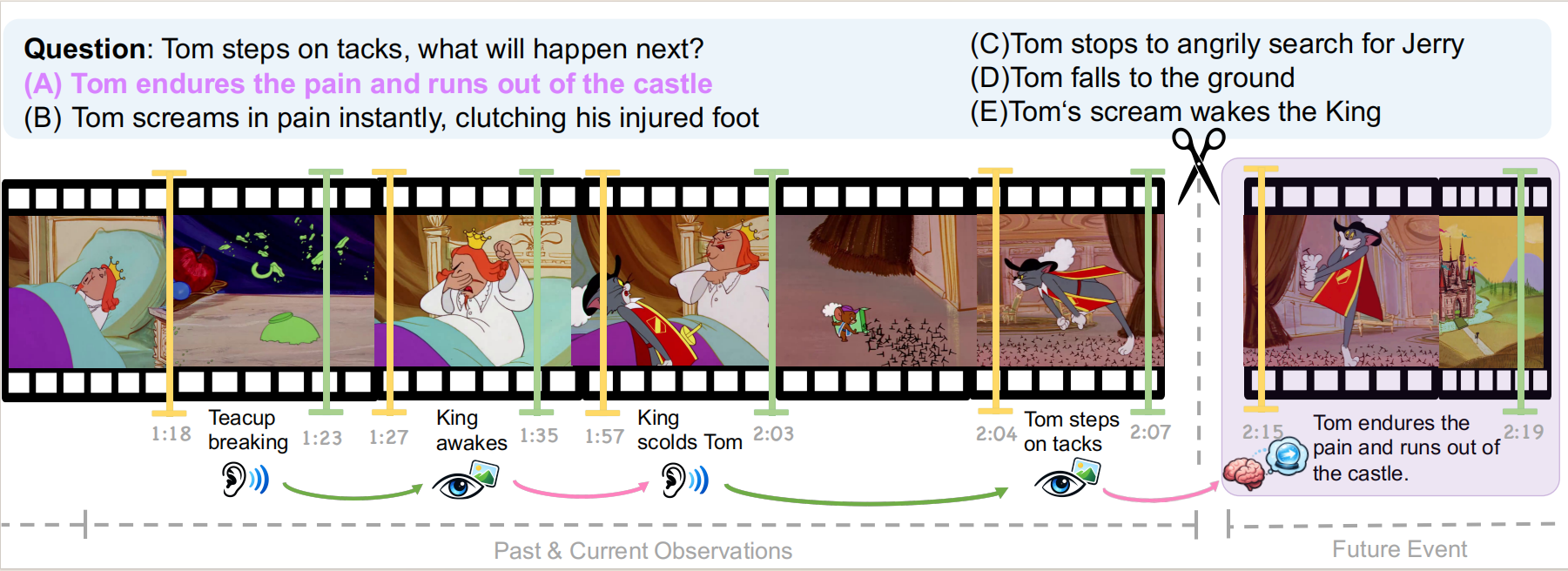
FutureOmni is the first benchmark designed to evaluate omni-modal future forecasting from audio–visual environments. To succeed, models must perform cross-modal causal and temporal reasoning while effectively leveraging internal knowledge to predict future events.
🌟 Key Features
- 🎯 First Omni-Modal Forecasting Benchmark: Dedicated exclusively to assessing whether models can predict future states based on audio-visual causal logic.
- 🏗️ Scalable Construction Pipeline: Constructed via a robust LLM-assisted, human-in-the-loop pipeline ensuring high-quality causal pairs.
- 📊 Comprehensive & Original: Contains 919 videos and 1,034 multiple-choice QA pairs across 8 primary domains. All videos are collected to ensure zero contamination (100% Original Video Rate).
- 🧩 Challenging Evaluation: Evaluations on 13 omni-modal and 7 video-only models reveal that current systems struggle significantly, particularly in speech-heavy scenarios.
- 🚀 OFF Training Strategy: We propose the Omni-Modal Future Forecasting (OFF) strategy and provide a 7K-sample instruction-tuning dataset, which enhances both future forecasting and general perception capabilities.
📊 Leaderboard
Snapshot of Zero-shot performance (Accuracy %). See the paper for full results.
| Model | Size | Speech | Sound | Music | Avg |
|---|---|---|---|---|---|
| Gemini 3 Flash 🏆 | - | 60.52 | 67.13 | 68.31 | 64.80 |
| Gemini 2.5 Pro | - | 48.23 | 61.89 | 63.38 | 56.77 |
| Qwen3-Omni | 30B | 47.99 | 55.44 | 57.54 | 53.05 |
| Claude Haiku 4.5 | - | 55.56 | 64.00 | 43.82 | 51.52 |
| Video-SALMONN 2 | 7B | 40.28 | 48.95 | 54.15 | 47.00 |
| Qwen2.5-Omni | 7B | 37.83 | 54.55 | 53.85 | 47.48 |
| GPT-4o | - | 54.41 | 59.80 | 45.05 | 52.29 |
🌰 Data Example
https://github.com/user-attachments/assets/95df7ae7-67e8-482b-a04e-2134d68be117
📂 Data Format
Each entry in the annotation file is formatted as follows:
{
    "id": 0,
    "question": "Given the premise event: 'The man repeatedly demonstrates a new rhythm pattern, playing the guitar on \"One, two, three\" and explicitly pausing on the \"Four\" count while vocally counting', which event is its most direct conclusion?",
    "options": [
        "A. He continues to demonstrate the same pattern for several more minutes",
        "B. He stops playing the guitar and says 'Okay' and 'I hope everyone understood.'",
        "C. He introduces a completely different, more complex strumming pattern",
        "D. He puts down the guitar and begins to explain music theory concepts",
        "E. He asks the viewers to play along with him and checks their progress"
    ],
    "answer": "B",
    "original_video": "uu8c_EH8VPE.mp4",
    "split_point": 227,
    "video_domain": "education",
    "audio_type": "Sound",
    "forecasting_pattern": "Routine Sequences"
}
🧪 Experiments
We conduct extensive evaluations on 13 omni-modal and 7 video-only models.
Overall Performance
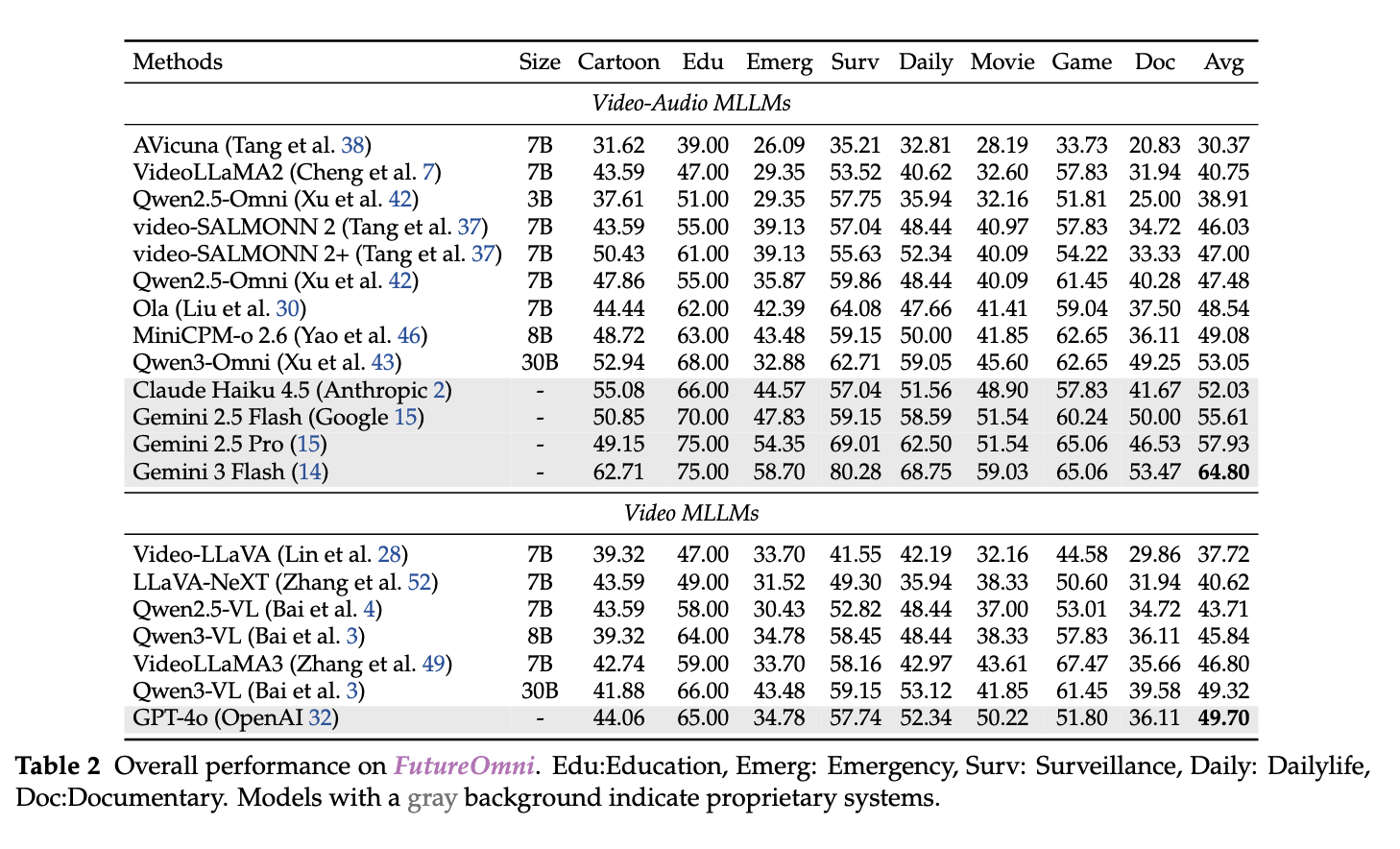
Overall Performance on Categories
🔍 Fine-grained Results
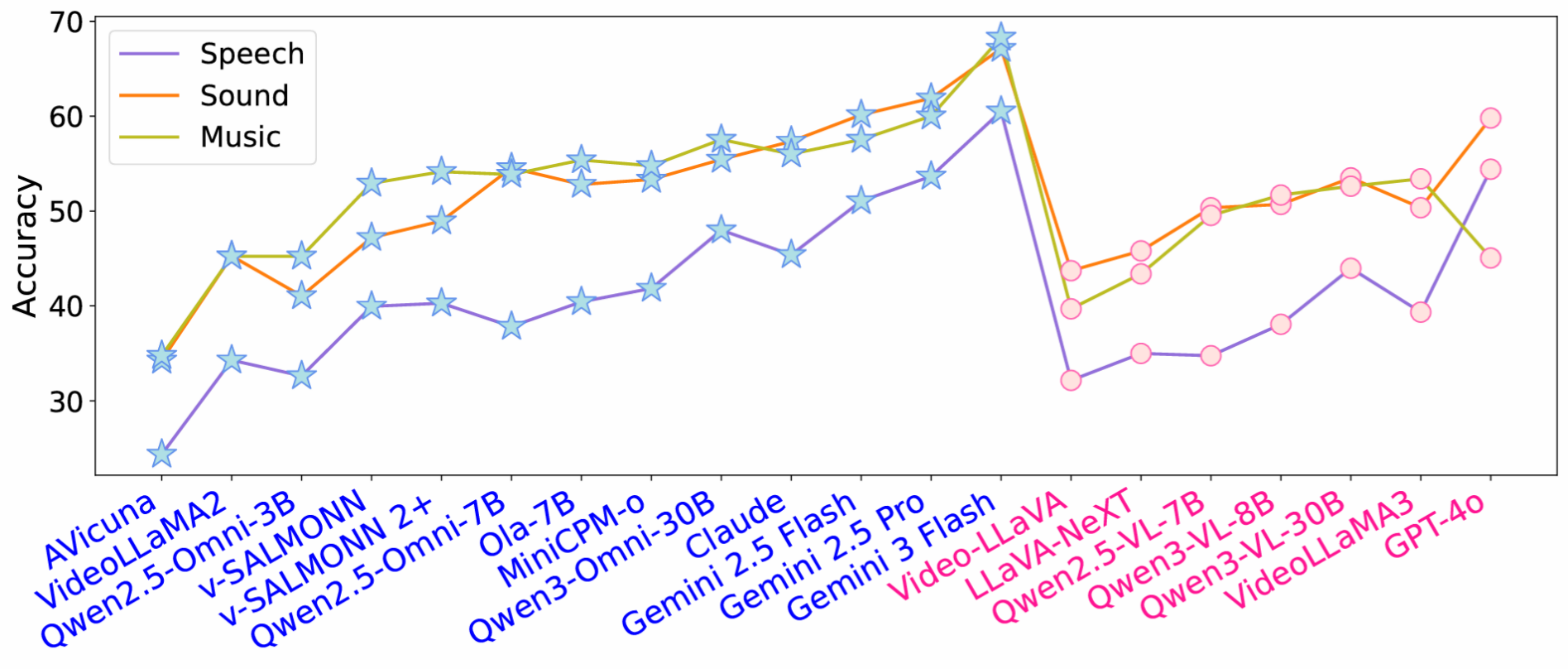
Fine-grained Results on Audio Type
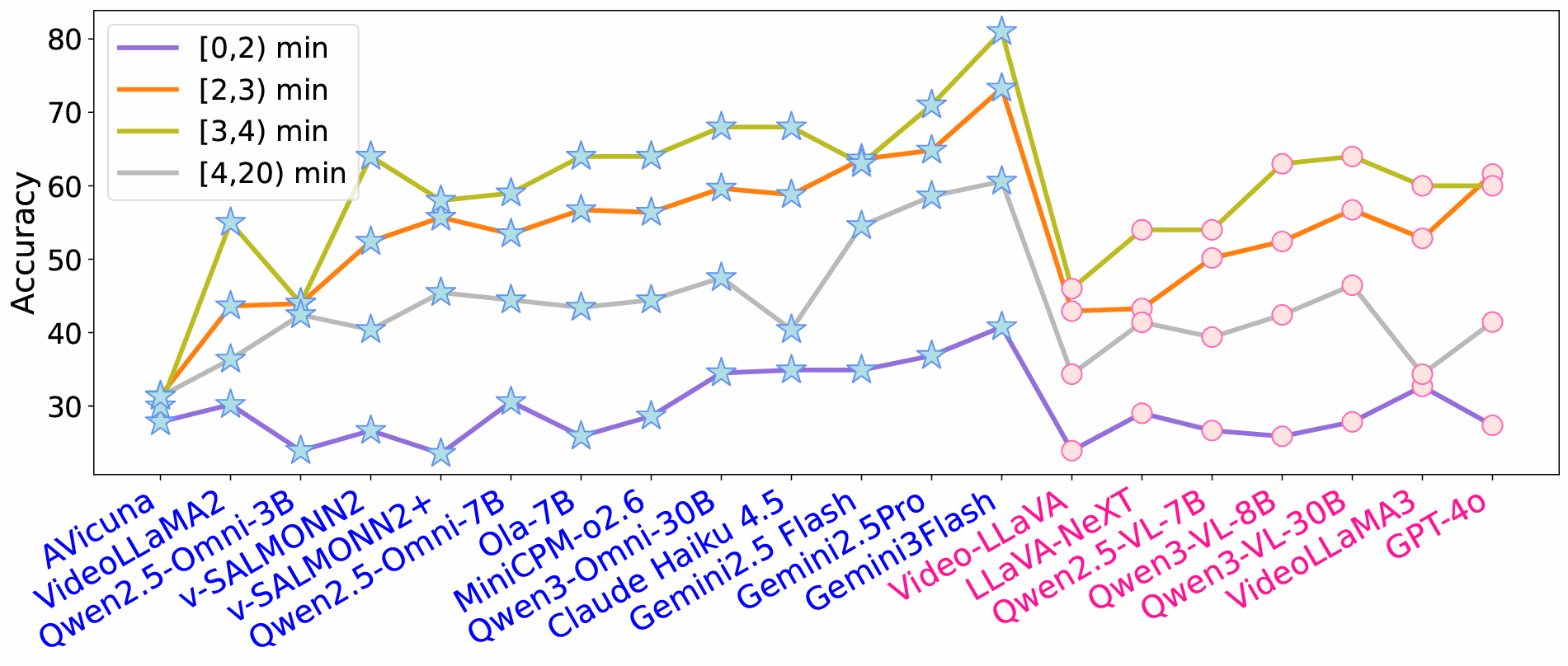
Fine-grained Results on Video Duration
🧠 In-depth Analysis
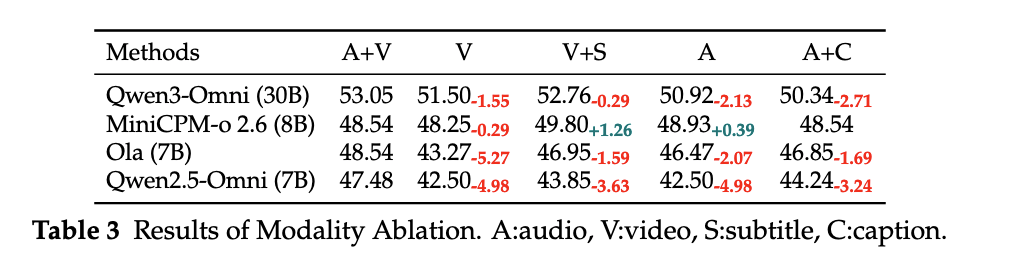
Modality Ablation Results
🚀 Omni-Modal Future Forecasting (OFF) Strategy
To mitigate current limitations, we curate a 7K-sample instruction-tuning dataset.
Key Finding: Evaluations on FutureOmni and popular audio-visual (e.g., WorldSense, DailyOmni) and video-only (e.g., Video-MME) benchmarks demonstrate that the OFF strategy significantly enhances both future forecasting and general perception.
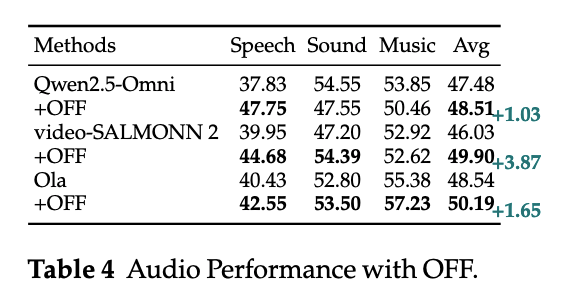
Fine-grained Audio Performance
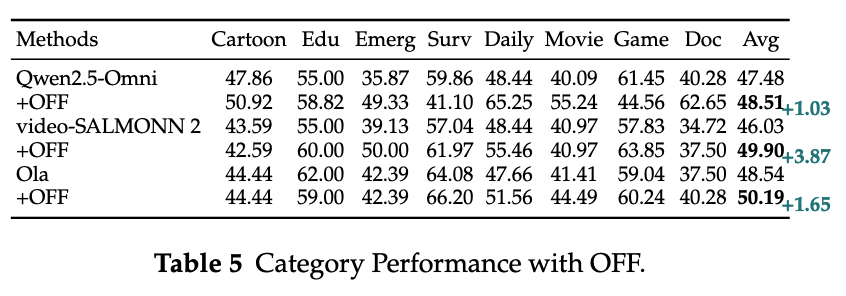
Fine-grained Video Category Performance
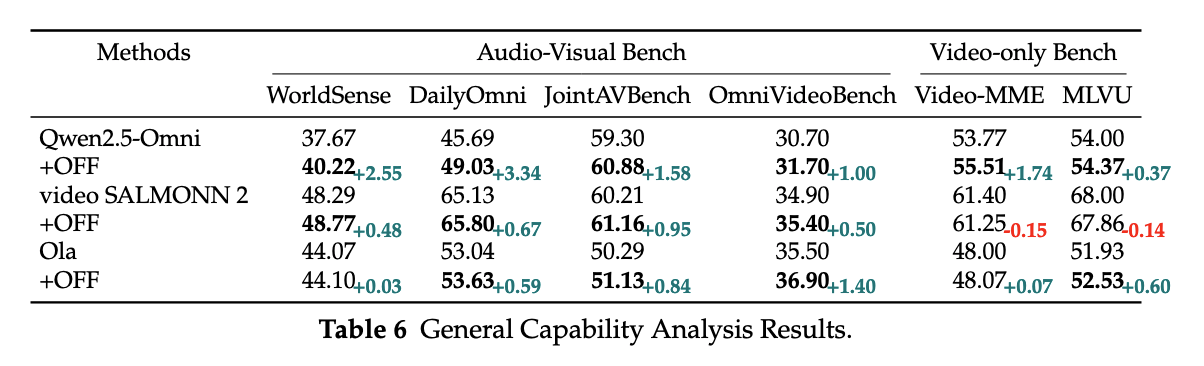
General Capability
🛠️ Quick Start
1. Prepare Data
Download the test videos (splitted) from huggingface and extract them into the videos/ folder.
2. Evaluation
We offer two implentions. One is using DDP. The example code is in eval/infer_ddp.py. Another is using vLLM. The example code is in eval/infer_vllm.py. We strongly recommand preprocess the input feature for speeding up. The feature extraction code is in feature/extract.py.
3. Train
You can download our train videos from google drive or baiduyun. Adaptation code is in train/LLaMA-Factory.
📧 Contact
For any questions, please open an issue or contact qianchen901005@gmail.com.
📝 Citation
If you find FutureOmni useful for your research, please cite our paper:
@article{chen2026futureomni,
    title={FutureOmni: Evaluating Future Forecasting from Omni-Modal Context for Multimodal LLMs},
    author={Chen, Qian and Fu, Jinlan and Li, Changsong, and Ng, See-Kiong and Qiu, Xipeng},
    booktitle={arXiv},
    year={2026}
}
Similar repos



Languages
Python
69.2%
JavaScript
20.2%
HTML
7.4%
CSS
3.3%
A benchmark for evaluating future-event forecasting from audio and video context in multimodal language models
See the codeREADME
FutureOmni: Evaluating Future Forecasting from Omni-Modal Context for Multimodal LLMs
Predicting the future requires listening as well as seeing.
Although Multimodal Large Language Models (MLLMs) demonstrate strong omni-modal perception, their ability to forecast future events from audio–visual cues remains largely unexplored, as existing benchmarks focus mainly on retrospective understanding.
FutureOmni is the first benchmark designed to evaluate omni-modal future forecasting from audio–visual environments. To succeed, models must perform cross-modal causal and temporal reasoning while effectively leveraging internal knowledge to predict future events.
🌟 Key Features
- 🎯 First Omni-Modal Forecasting Benchmark: Dedicated exclusively to assessing whether models can predict future states based on audio-visual causal logic.
- 🏗️ Scalable Construction Pipeline: Constructed via a robust LLM-assisted, human-in-the-loop pipeline ensuring high-quality causal pairs.
- 📊 Comprehensive & Original: Contains 919 videos and 1,034 multiple-choice QA pairs across 8 primary domains. All videos are collected to ensure zero contamination (100% Original Video Rate).
- 🧩 Challenging Evaluation: Evaluations on 13 omni-modal and 7 video-only models reveal that current systems struggle significantly, particularly in speech-heavy scenarios.
- 🚀 OFF Training Strategy: We propose the Omni-Modal Future Forecasting (OFF) strategy and provide a 7K-sample instruction-tuning dataset, which enhances both future forecasting and general perception capabilities.
📊 Leaderboard
Snapshot of Zero-shot performance (Accuracy %). See the paper for full results.
| Model | Size | Speech | Sound | Music | Avg |
|---|---|---|---|---|---|
| Gemini 3 Flash 🏆 | - | 60.52 | 67.13 | 68.31 | 64.80 |
| Gemini 2.5 Pro | - | 48.23 | 61.89 | 63.38 | 56.77 |
| Qwen3-Omni | 30B | 47.99 | 55.44 | 57.54 | 53.05 |
| Claude Haiku 4.5 | - | 55.56 | 64.00 | 43.82 | 51.52 |
| Video-SALMONN 2 | 7B | 40.28 | 48.95 | 54.15 | 47.00 |
| Qwen2.5-Omni | 7B | 37.83 | 54.55 | 53.85 | 47.48 |
| GPT-4o | - | 54.41 | 59.80 | 45.05 | 52.29 |
🌰 Data Example
https://github.com/user-attachments/assets/95df7ae7-67e8-482b-a04e-2134d68be117
📂 Data Format
Each entry in the annotation file is formatted as follows:
{
    "id": 0,
    "question": "Given the premise event: 'The man repeatedly demonstrates a new rhythm pattern, playing the guitar on \"One, two, three\" and explicitly pausing on the \"Four\" count while vocally counting', which event is its most direct conclusion?",
    "options": [
        "A. He continues to demonstrate the same pattern for several more minutes",
        "B. He stops playing the guitar and says 'Okay' and 'I hope everyone understood.'",
        "C. He introduces a completely different, more complex strumming pattern",
        "D. He puts down the guitar and begins to explain music theory concepts",
        "E. He asks the viewers to play along with him and checks their progress"
    ],
    "answer": "B",
    "original_video": "uu8c_EH8VPE.mp4",
    "split_point": 227,
    "video_domain": "education",
    "audio_type": "Sound",
    "forecasting_pattern": "Routine Sequences"
}
🧪 Experiments
We conduct extensive evaluations on 13 omni-modal and 7 video-only models.
Overall Performance
Overall Performance on Categories
🔍 Fine-grained Results
Fine-grained Results on Audio Type
Fine-grained Results on Video Duration
🧠 In-depth Analysis
Modality Ablation Results
🚀 Omni-Modal Future Forecasting (OFF) Strategy
To mitigate current limitations, we curate a 7K-sample instruction-tuning dataset.
Key Finding: Evaluations on FutureOmni and popular audio-visual (e.g., WorldSense, DailyOmni) and video-only (e.g., Video-MME) benchmarks demonstrate that the OFF strategy significantly enhances both future forecasting and general perception.
Fine-grained Audio Performance
Fine-grained Video Category Performance
General Capability
🛠️ Quick Start
1. Prepare Data
Download the test videos (splitted) from huggingface and extract them into the videos/ folder.
2. Evaluation
We offer two implentions. One is using DDP. The example code is in eval/infer_ddp.py. Another is using vLLM. The example code is in eval/infer_vllm.py. We strongly recommand preprocess the input feature for speeding up. The feature extraction code is in feature/extract.py.
3. Train
You can download our train videos from google drive or baiduyun. Adaptation code is in train/LLaMA-Factory.
📧 Contact
For any questions, please open an issue or contact qianchen901005@gmail.com.
📝 Citation
If you find FutureOmni useful for your research, please cite our paper:
@article{chen2026futureomni,
    title={FutureOmni: Evaluating Future Forecasting from Omni-Modal Context for Multimodal LLMs},
    author={Chen, Qian and Fu, Jinlan and Li, Changsong, and Ng, See-Kiong and Qiu, Xipeng},
    booktitle={arXiv},
    year={2026}
}
Similar repos
Languages
Python
69.2%
JavaScript
20.2%
HTML
7.4%
CSS
3.3%