
See what people are saying
README
ds4go-apps
Experimental. ds4go and our binary builds are carefully maintained, but this repository is experimental. Flags, keys, and behavior can change.
Terminal apps that run DeepSeek models locally through ds4go, a Go binding for the ds4 inference engine. They draw SVGs and glyph art, build CAD models, animate shaders, and explore activation steering. Inference runs on Metal on macOS, CUDA on Linux, or the CPU.
Applications
| App | Binary | What it does |
|---|---|---|
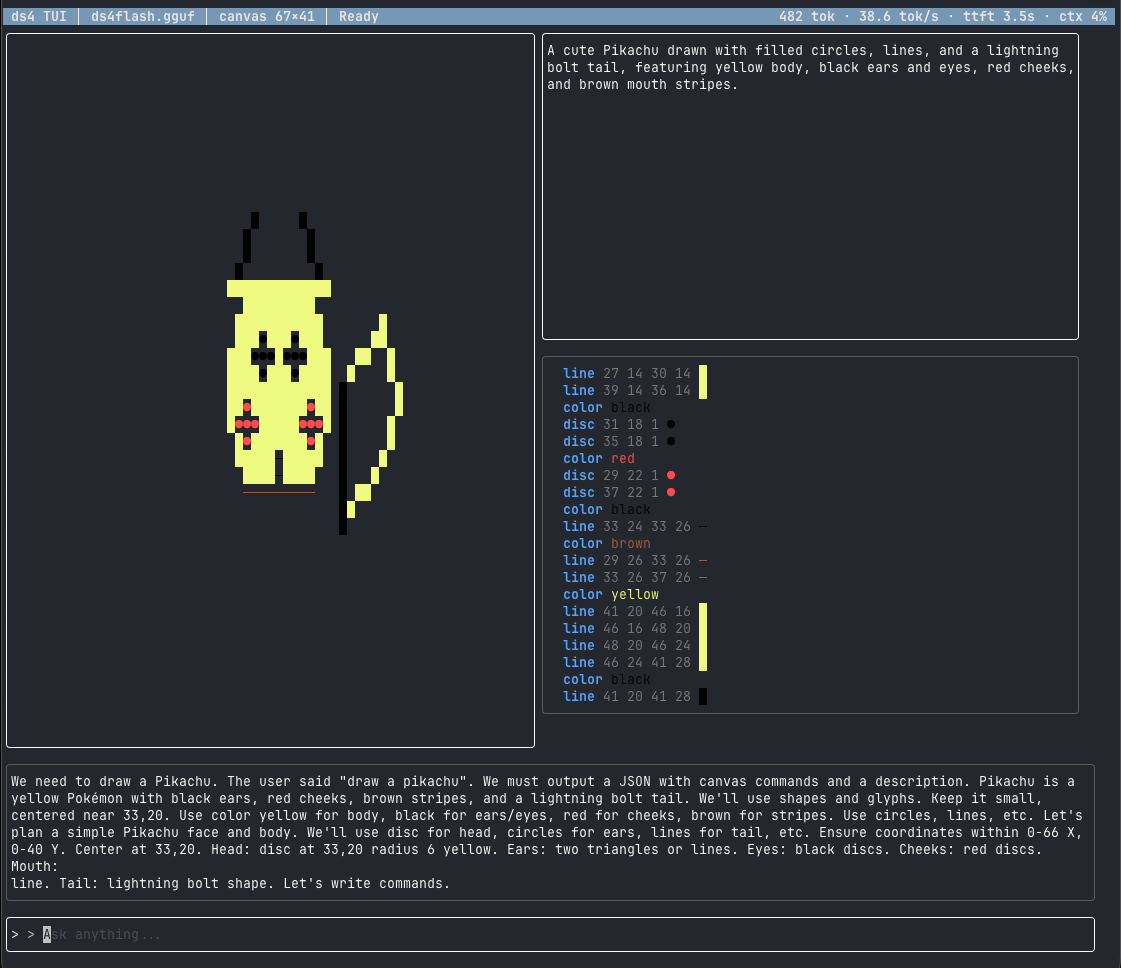
| glyphpad | ds4go-glyphpad | Unicode and ASCII art. Ask the model to generate and edit characters, blocks, and symbols on a canvas. |
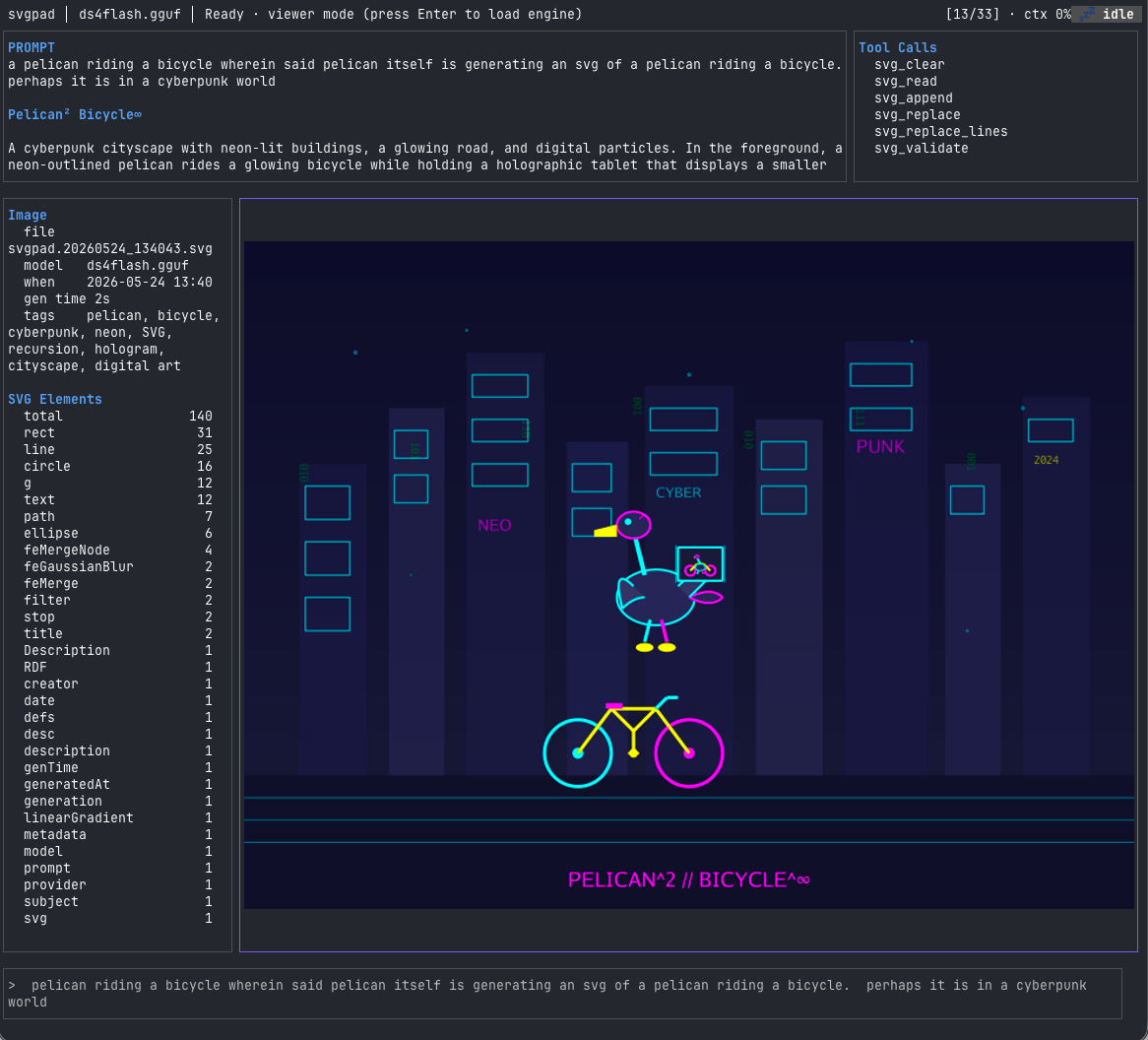
| svgpad | ds4go-svgpad | SVG drawing. Describe an image, and the model writes SVG that is rendered in the terminal. With a vision model it reviews its own renders. |
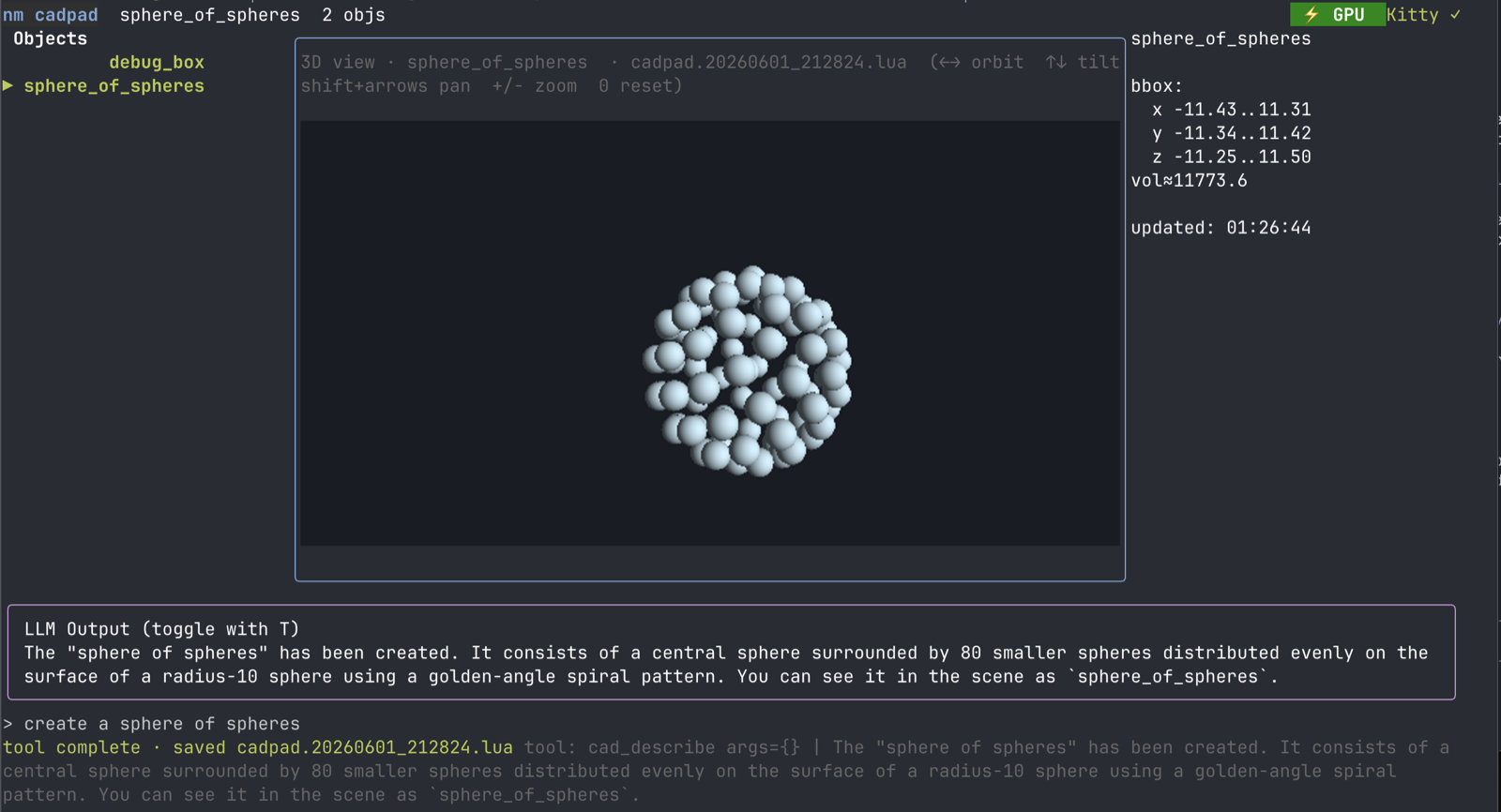
| cadpad | ds4go-cadpad | 3D CAD. The model builds solids with tool calls (create, transform, boolean) on a signed-distance-field engine, with live previews. Runs without a model as a Go geometry harness. |
| trippad | ds4go-trippad | Live WGSL shaders with parameter sliders and GPU animation. The model can edit the shader. Also runs in a browser with WebGPU. Works without a model. |
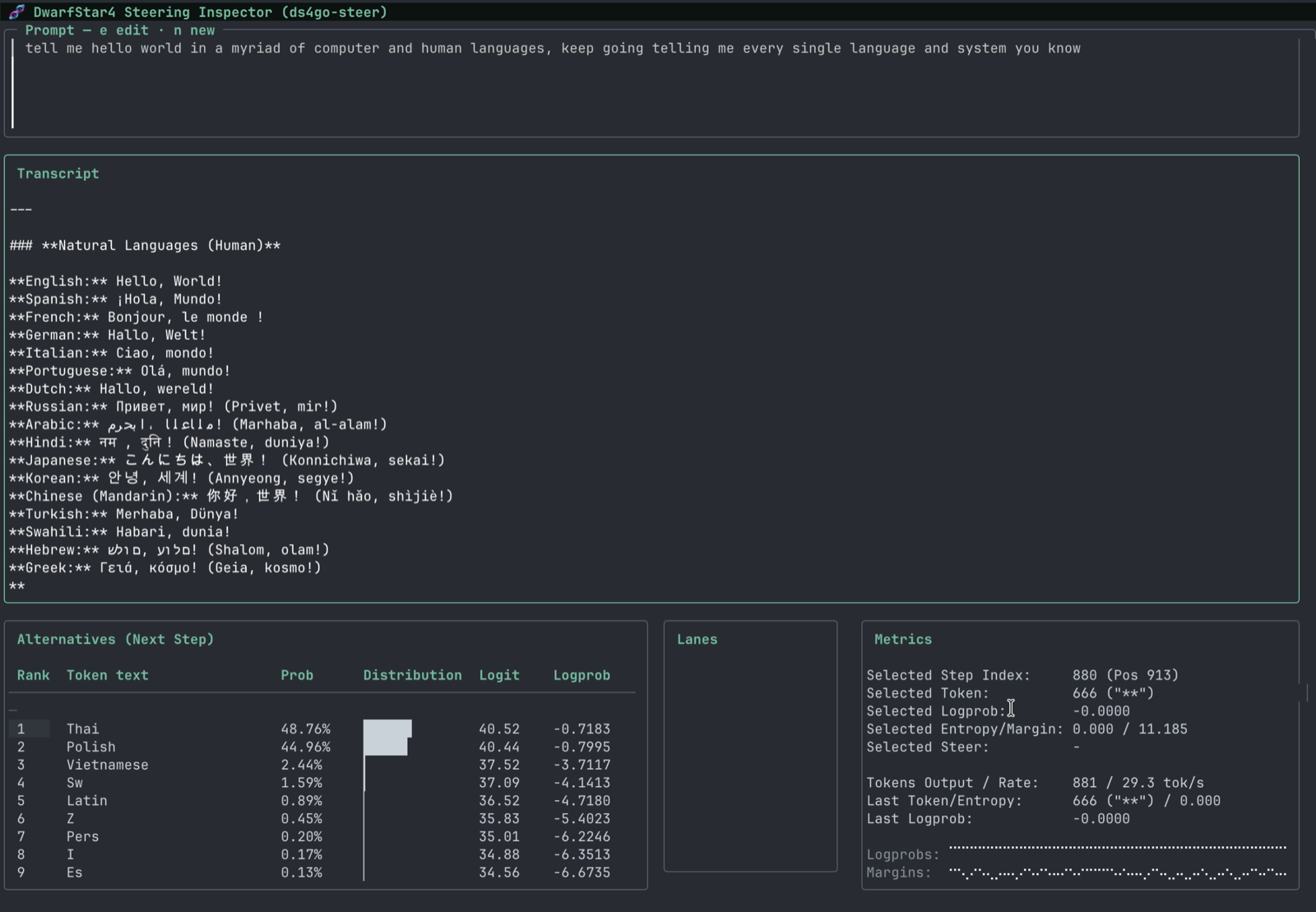
| steering | ds4go-steering | Activation-steering dashboard. Adjust FFN and attention steering vectors, branch timelines, and look at token logits. |
Demos and screenshots
- DS4 Playground: svgpad, glyphpad, cadpad, and steering at work, including a pelican drawn as SVG, a Pikachu from a glyph script, and a CAD model written as Lua.
- Demo videos: steering "hello world", the svgpad pelican, ds4 in Charm
crush, and thedankbot420demo. - ds4go CLI screenshots: the underlying
ds4gocommand's model list, model download, and validate output.
The screenshots were taken at different times and may not match the current UI.
Requirements
- Go 1.26.8 or newer, and Task.
- libds4 and a model. Install them with ds4go.
ds4needs 128 GB or more of GPU memory. - A GPU driver. Metal on macOS. On Linux, cadpad and trippad use Vulkan for their GPU views.
- A terminal with Kitty graphics (Kitty, Ghostty, WezTerm) to see images. Other terminals fall back to character rendering.
- A browser with WebGPU, only for the trippad browser playground.
These apps use ds4go v0.9.0 (including its distinct ROCm backend), which matches libds4 v0.9.20261005; older libraries keep working, with the minimum for ROCm at libds4 v0.5.20260910. Some features need a newer libds4:
| Feature | libds4 |
|---|---|
| DeepSeek V4.1 and think levels | v0.6.20260912 |
DGX Spark (GB10): the linux-arm64-gb10-cuda asset | v0.6.20260913 |
| Qwen3.8 Flash Next, and the low and medium reasoning modes | v0.7.20260918 |
Install without cloning
With Go 1.26.8 or newer, run an app straight from the module proxy:
go run github.com/NimbleMarkets/ds4go-apps/cmd/glyphpad@latest --backend metal
or install it to $(go env GOPATH)/bin:
go install github.com/NimbleMarkets/ds4go-apps/cmd/glyphpad@latest
glyphpad --backend metal
The other apps are svgpad, cadpad, trippad and steering. go install names each binary after its directory (glyphpad), not ds4go-glyphpad as task build does. On Linux, set CGO_ENABLED=0 and add -tags=nofakecgo, which the Taskfile otherwise does for you:
CGO_ENABLED=0 go install -tags=nofakecgo github.com/NimbleMarkets/ds4go-apps/cmd/cadpad@latest
You still need libds4 and a model; see Requirements. Use @main instead of @latest for unreleased changes.
Build
The module builds against the released ds4go and ntcharts versions, both fetched through the Go module proxy. No workspace or local checkouts are needed.
task build              # all apps
task build:glyphpad     # or one app: svgpad, cadpad, trippad, trippad-memory, steering
Binaries go to ./bin/. Builds use -mod=readonly and skip apps whose inputs have not changed. Run task tidy after changing dependencies, and task --force build to rebuild everything. If a compile fails, the previous binary is kept. Build state is kept in the ignored .task/ directory.
On Linux the Taskfile builds with CGO_ENABLED=0 and -tags=nofakecgo, which shares purego's FFI runtime with goffi. No OpenGL headers are needed. To build cadpad directly:
CGO_ENABLED=0 go build -tags=nofakecgo -o bin/ds4go-cadpad ./cmd/cadpad
task run:<app> picks the inference backend automatically. Set BACKEND=cuda, BACKEND=rocm, BACKEND=metal, or BACKEND=cpu to override it.
Running the apps
glyphpad
task run:glyphpad
# or directly
./bin/ds4go-glyphpad --backend metal --ctx 32768
Type a prompt to generate Unicode patterns, box-drawing diagrams, or pixel-art blocks. Ctrl+E opens the edit box to refine a selection. Copying the canvas copies the complete glyph grid.
svgpad
task run:svgpad
Describe an image and the model writes SVG. See the svgpad README for visual review, the model picker, headless mode (--prompt), and context handling.
cadpad
task run:cadpad
# pure geometry, no model
NO_ENGINE=1 task run:cadpad
Operations are stored as a replayable JSON log, so every create, transform, and boolean can be undone and saved. An example session, examples/cadpad/demo.cad.json:
[
  {"kind":"create",  "args":{"name":"base","shape":"box","params":{"x":10,"y":8,"z":2}}},
  {"kind":"create",  "args":{"name":"post","shape":"cylinder","params":{"r":1,"h":6}}},
  {"kind":"transform","args":{"name":"post","op":"translate","args":{"x":0,"y":0,"z":4}}},
  {"kind":"boolean",  "args":{"op":"union","target":"base","source":"post","blend_radius":0.3}}
]
Escape cancels the current run, and switching models keeps the CAD world. The viewport copy is a text description of the world. See the cadpad README.
trippad
task run:trippad
# no model
./bin/ds4go-trippad --no-engine
See the trippad README for the controls, the shader gallery, and the browser playground.
steering
task run:steering -- --dir-steering ./my-vectors --scale 0,1,-1
Shows how steering vectors shift next-token probabilities. You can branch timelines, change FFN scales while running, and compare outputs side by side.
Shared keys
glyphpad, svgpad, and cadpad share these keys:
| Key | Action |
|---|---|
| F1 | Help |
| F2 | Run settings |
| Ctrl+R | Cycle reasoning |
| Ctrl+O | Choose a model |
| Ctrl+Y | Copy the focused pane |
| Tab / Shift+Tab | Move focus, including to the prompt |
| Ctrl+N | Logs |
Settings changed during inference apply to the next request, and settings are locked while a model loads. The engine loads lazily and keeps queued prompts while it loads. Copying uses OSC 52, so your terminal has to allow clipboard writes.
Browser playground
trippad can serve a WebGPU version of its shaders:
./bin/ds4go-trippad --web-only                  # http://127.0.0.1:8080/, no model or native GPU
./bin/ds4go-trippad --no-engine --web           # alongside the terminal UI
A small Go net/http server serves embedded HTML, JavaScript, and CSS. The browser runs the same WGSL compute module that the terminal app builds, using plain JavaScript and the WebGPU API. There is no Go-to-WASM build and no JavaScript framework. The server only accepts loopback addresses and checks the Host header. Its pages load nothing from other origins. Details are in the trippad README.
Common flags
These apply to glyphpad, svgpad, cadpad, and trippad (a flag that does not apply to an app is noted below).
| Flag | Default | Meaning |
|---|---|---|
-m, --model | $DS4_DIR/models/ds4flash.gguf | Installed model alias or GGUF path |
--ctx | 32768 (cadpad 16384, trippad 131072) | Context window in tokens |
--backend | auto | metal, cuda, rocm, or cpu; auto follows the loaded libds4 build |
--power | 100 (cadpad 80) | GPU duty-cycle throttle, 1 to 100 percent |
--temp | 0.7 | Sampling temperature. 0 is greedy. |
--top-p | 0.95 | Nucleus sampling cutoff |
--seed | 0 | Sampler seed. 0 uses a new seed for each request. |
--tool-rounds | svgpad 20, cadpad 36, trippad 20 | Tool-call rounds per request. The final answer gets one extra turn. |
-d, --debug | off | Log raw model traffic and libds4 diagnostics to a *.log file |
--ssd-streaming | off | Stream experts from SSD |
--lib | search path | Path to the libds4 shared library |
--tool-rounds is not in glyphpad. --no-engine starts without a model and is in cadpad and trippad.
steering takes --model, --ctx, --backend, --seed, --temp, --top-p, and --lib, with --temp and --top-p defaulting to 1. It adds --dir-steering (directory with the vectors.json registry), --scale (comma-separated FFN scales), --attn-scale, --allow-attn-steering, --top-k, and --max-tokens. Run any app with --help for its full list.
Kitty frame transport
--kitty-transport (cadpad and trippad, default auto) sets how image frames reach the terminal:
png: PNG through the terminal stream. Works everywhere Kitty graphics work, including SSH.rgba: raw pixels through the stream. No PNG encode, but about 5.3 bytes per pixel go over the wire.shm: raw pixels through shared memory, so only a short reference goes through the terminal. It needs a local terminal that supports Kitty's shared-memory medium (t=s), such as Kitty or Ghostty. The app uses shared memory once the terminal answers a startup probe, sends PNG until then and whenever an object cannot be created, and logs that fallback once.auto: makes the same request asshmbut does not report a PNG result, since that is expected over SSH or in a terminal withoutt=s.
cadpad's viewport header names the transport once it is not plain PNG. If the viewport stays blank, run with --kitty-transport png.
Project layout
.
├── cmd/
│   ├── glyphpad/         Unicode glyph app
│   ├── svgpad/           SVG drawing app
│   ├── cadpad/           CAD app and headless harness
│   ├── trippad/          shader app and browser playground
│   ├── trippad-memory/   command-line access to trippad's notes
│   └── steering/         activation-steering dashboard
├── internal/
│   ├── appinit/          shared app startup
│   ├── bubble/           model tool-loop driver for Bubble Tea
│   ├── cadpad/           CAD world, SDF operations, rendering, Lua
│   ├── cliopts/          shared command-line flags
│   ├── ds4log/           libds4 diagnostic capture
│   ├── editmode/         shared edit box and key actions
│   ├── engineinit/       engine and GPU readiness lifecycle
│   ├── headerbar/        one-line header layout
│   ├── modelpicker/      installed-model picker widget
│   ├── padui/            dialogs, pager, and Kitty transport shared by the pads
│   ├── runconfig/        run settings and budget guidance
│   ├── steerinspect/     steering vector inspection and diffs
│   ├── steertui/         steering dashboard views
│   └── trippad/          shaders, parameters, tools, gallery, web server
├── ntgpu/                GPU compute helpers on wgpu
├── examples/cadpad/      sample .cad.json sessions
├── scripts/              WGSL language server installer, svgpad benchmark
├── .github/workflows/    CI and release
├── Taskfile.yml          build and run tasks
├── AGENTS.md             notes for coding agents working on the repo
└── PAD-ROLLOUT.md        status of features shared across the pads
Libraries
| Area | Libraries | Used for |
|---|---|---|
| Terminal UI | Bubble Tea v2, Bubbles v2, Lipgloss v2, ultraviolet, x/ansi, stickers | UI, input, styling, terminal events, ANSI handling, flexbox layout |
| Terminal graphics | ntcharts, ntcharts-svg, oksvg, ntdiff | Kitty picture widget, SVG rendering (oksvg is our fork of srwiley/oksvg), steering diffs |
| Inference | ds4go, ds4, purego | Local models; calling libds4 without cgo |
| GPU | gogpu/wgpu, gputypes, naga | WebGPU in pure Go (Metal, Vulkan). cadpad's raymarcher and trippad's shaders run on it. naga compiles and validates WGSL. |
| CAD | gsdf and geometry, gopher-lua, go3mf, math32 | Signed-distance-field geometry, Lua scripting by the model, 3MF export |
| Other | chroma, cobra, pflag | Syntax highlighting; flags (cobra for steering, pflag for the rest) |
| Browser | net/http, plain JavaScript, WebGPU | trippad's playground, no frameworks |
Optional tools outside go.mod: lua-language-server for cadpad's Lua editing support, and a wgsl-analyzer build for trippad's WGSL checks (scripts/install-trippad-wgsl-lsp.sh installs a pinned macOS binary).
Development
task test        # tests
task pre-push    # format check before pushing
task log         # follow logs while an app runs
If you run out of VRAM, lower the context or power: task run:svgpad -- --ctx 8192 --power 50.
GPU tests need a real GPU and do not run under -race. CI runs the full suite on macOS and the pure-Go packages on Linux.
Acknowledgements
Thanks to @antirez for ds4 and for his local-LLM advocacy, and to DeepSeek for their public contributions.
License
Released under the MIT License. See LICENSE.txt.
Copyright (c) 2026 Neomantra Corp.
Made with :heart: and :fire: by the team behind Nimble.Markets.
Similar repos


See what people are saying
README
ds4go-apps
Experimental. ds4go and our binary builds are carefully maintained, but this repository is experimental. Flags, keys, and behavior can change.
Terminal apps that run DeepSeek models locally through ds4go, a Go binding for the ds4 inference engine. They draw SVGs and glyph art, build CAD models, animate shaders, and explore activation steering. Inference runs on Metal on macOS, CUDA on Linux, or the CPU.
Applications
| App | Binary | What it does |
|---|---|---|
| glyphpad | ds4go-glyphpad | Unicode and ASCII art. Ask the model to generate and edit characters, blocks, and symbols on a canvas. |
| svgpad | ds4go-svgpad | SVG drawing. Describe an image, and the model writes SVG that is rendered in the terminal. With a vision model it reviews its own renders. |
| cadpad | ds4go-cadpad | 3D CAD. The model builds solids with tool calls (create, transform, boolean) on a signed-distance-field engine, with live previews. Runs without a model as a Go geometry harness. |
| trippad | ds4go-trippad | Live WGSL shaders with parameter sliders and GPU animation. The model can edit the shader. Also runs in a browser with WebGPU. Works without a model. |
| steering | ds4go-steering | Activation-steering dashboard. Adjust FFN and attention steering vectors, branch timelines, and look at token logits. |
Demos and screenshots
- DS4 Playground: svgpad, glyphpad, cadpad, and steering at work, including a pelican drawn as SVG, a Pikachu from a glyph script, and a CAD model written as Lua.
- Demo videos: steering "hello world", the svgpad pelican, ds4 in Charm
crush, and thedankbot420demo. - ds4go CLI screenshots: the underlying
ds4gocommand's model list, model download, and validate output.
The screenshots were taken at different times and may not match the current UI.
Requirements
- Go 1.26.8 or newer, and Task.
- libds4 and a model. Install them with ds4go.
ds4needs 128 GB or more of GPU memory. - A GPU driver. Metal on macOS. On Linux, cadpad and trippad use Vulkan for their GPU views.
- A terminal with Kitty graphics (Kitty, Ghostty, WezTerm) to see images. Other terminals fall back to character rendering.
- A browser with WebGPU, only for the trippad browser playground.
These apps use ds4go v0.9.0 (including its distinct ROCm backend), which matches libds4 v0.9.20261005; older libraries keep working, with the minimum for ROCm at libds4 v0.5.20260910. Some features need a newer libds4:
| Feature | libds4 |
|---|---|
| DeepSeek V4.1 and think levels | v0.6.20260912 |
DGX Spark (GB10): the linux-arm64-gb10-cuda asset | v0.6.20260913 |
| Qwen3.8 Flash Next, and the low and medium reasoning modes | v0.7.20260918 |
Install without cloning
With Go 1.26.8 or newer, run an app straight from the module proxy:
go run github.com/NimbleMarkets/ds4go-apps/cmd/glyphpad@latest --backend metal
or install it to $(go env GOPATH)/bin:
go install github.com/NimbleMarkets/ds4go-apps/cmd/glyphpad@latest
glyphpad --backend metal
The other apps are svgpad, cadpad, trippad and steering. go install names each binary after its directory (glyphpad), not ds4go-glyphpad as task build does. On Linux, set CGO_ENABLED=0 and add -tags=nofakecgo, which the Taskfile otherwise does for you:
CGO_ENABLED=0 go install -tags=nofakecgo github.com/NimbleMarkets/ds4go-apps/cmd/cadpad@latest
You still need libds4 and a model; see Requirements. Use @main instead of @latest for unreleased changes.
Build
The module builds against the released ds4go and ntcharts versions, both fetched through the Go module proxy. No workspace or local checkouts are needed.
task build              # all apps
task build:glyphpad     # or one app: svgpad, cadpad, trippad, trippad-memory, steering
Binaries go to ./bin/. Builds use -mod=readonly and skip apps whose inputs have not changed. Run task tidy after changing dependencies, and task --force build to rebuild everything. If a compile fails, the previous binary is kept. Build state is kept in the ignored .task/ directory.
On Linux the Taskfile builds with CGO_ENABLED=0 and -tags=nofakecgo, which shares purego's FFI runtime with goffi. No OpenGL headers are needed. To build cadpad directly:
CGO_ENABLED=0 go build -tags=nofakecgo -o bin/ds4go-cadpad ./cmd/cadpad
task run:<app> picks the inference backend automatically. Set BACKEND=cuda, BACKEND=rocm, BACKEND=metal, or BACKEND=cpu to override it.
Running the apps
glyphpad
task run:glyphpad
# or directly
./bin/ds4go-glyphpad --backend metal --ctx 32768
Type a prompt to generate Unicode patterns, box-drawing diagrams, or pixel-art blocks. Ctrl+E opens the edit box to refine a selection. Copying the canvas copies the complete glyph grid.
svgpad
task run:svgpad
Describe an image and the model writes SVG. See the svgpad README for visual review, the model picker, headless mode (--prompt), and context handling.
cadpad
task run:cadpad
# pure geometry, no model
NO_ENGINE=1 task run:cadpad
Operations are stored as a replayable JSON log, so every create, transform, and boolean can be undone and saved. An example session, examples/cadpad/demo.cad.json:
[
  {"kind":"create",  "args":{"name":"base","shape":"box","params":{"x":10,"y":8,"z":2}}},
  {"kind":"create",  "args":{"name":"post","shape":"cylinder","params":{"r":1,"h":6}}},
  {"kind":"transform","args":{"name":"post","op":"translate","args":{"x":0,"y":0,"z":4}}},
  {"kind":"boolean",  "args":{"op":"union","target":"base","source":"post","blend_radius":0.3}}
]
Escape cancels the current run, and switching models keeps the CAD world. The viewport copy is a text description of the world. See the cadpad README.
trippad
task run:trippad
# no model
./bin/ds4go-trippad --no-engine
See the trippad README for the controls, the shader gallery, and the browser playground.
steering
task run:steering -- --dir-steering ./my-vectors --scale 0,1,-1
Shows how steering vectors shift next-token probabilities. You can branch timelines, change FFN scales while running, and compare outputs side by side.
Shared keys
glyphpad, svgpad, and cadpad share these keys:
| Key | Action |
|---|---|
| F1 | Help |
| F2 | Run settings |
| Ctrl+R | Cycle reasoning |
| Ctrl+O | Choose a model |
| Ctrl+Y | Copy the focused pane |
| Tab / Shift+Tab | Move focus, including to the prompt |
| Ctrl+N | Logs |
Settings changed during inference apply to the next request, and settings are locked while a model loads. The engine loads lazily and keeps queued prompts while it loads. Copying uses OSC 52, so your terminal has to allow clipboard writes.
Browser playground
trippad can serve a WebGPU version of its shaders:
./bin/ds4go-trippad --web-only                  # http://127.0.0.1:8080/, no model or native GPU
./bin/ds4go-trippad --no-engine --web           # alongside the terminal UI
A small Go net/http server serves embedded HTML, JavaScript, and CSS. The browser runs the same WGSL compute module that the terminal app builds, using plain JavaScript and the WebGPU API. There is no Go-to-WASM build and no JavaScript framework. The server only accepts loopback addresses and checks the Host header. Its pages load nothing from other origins. Details are in the trippad README.
Common flags
These apply to glyphpad, svgpad, cadpad, and trippad (a flag that does not apply to an app is noted below).
| Flag | Default | Meaning |
|---|---|---|
-m, --model | $DS4_DIR/models/ds4flash.gguf | Installed model alias or GGUF path |
--ctx | 32768 (cadpad 16384, trippad 131072) | Context window in tokens |
--backend | auto | metal, cuda, rocm, or cpu; auto follows the loaded libds4 build |
--power | 100 (cadpad 80) | GPU duty-cycle throttle, 1 to 100 percent |
--temp | 0.7 | Sampling temperature. 0 is greedy. |
--top-p | 0.95 | Nucleus sampling cutoff |
--seed | 0 | Sampler seed. 0 uses a new seed for each request. |
--tool-rounds | svgpad 20, cadpad 36, trippad 20 | Tool-call rounds per request. The final answer gets one extra turn. |
-d, --debug | off | Log raw model traffic and libds4 diagnostics to a *.log file |
--ssd-streaming | off | Stream experts from SSD |
--lib | search path | Path to the libds4 shared library |
--tool-rounds is not in glyphpad. --no-engine starts without a model and is in cadpad and trippad.
steering takes --model, --ctx, --backend, --seed, --temp, --top-p, and --lib, with --temp and --top-p defaulting to 1. It adds --dir-steering (directory with the vectors.json registry), --scale (comma-separated FFN scales), --attn-scale, --allow-attn-steering, --top-k, and --max-tokens. Run any app with --help for its full list.
Kitty frame transport
--kitty-transport (cadpad and trippad, default auto) sets how image frames reach the terminal:
png: PNG through the terminal stream. Works everywhere Kitty graphics work, including SSH.rgba: raw pixels through the stream. No PNG encode, but about 5.3 bytes per pixel go over the wire.shm: raw pixels through shared memory, so only a short reference goes through the terminal. It needs a local terminal that supports Kitty's shared-memory medium (t=s), such as Kitty or Ghostty. The app uses shared memory once the terminal answers a startup probe, sends PNG until then and whenever an object cannot be created, and logs that fallback once.auto: makes the same request asshmbut does not report a PNG result, since that is expected over SSH or in a terminal withoutt=s.
cadpad's viewport header names the transport once it is not plain PNG. If the viewport stays blank, run with --kitty-transport png.
Project layout
.
├── cmd/
│   ├── glyphpad/         Unicode glyph app
│   ├── svgpad/           SVG drawing app
│   ├── cadpad/           CAD app and headless harness
│   ├── trippad/          shader app and browser playground
│   ├── trippad-memory/   command-line access to trippad's notes
│   └── steering/         activation-steering dashboard
├── internal/
│   ├── appinit/          shared app startup
│   ├── bubble/           model tool-loop driver for Bubble Tea
│   ├── cadpad/           CAD world, SDF operations, rendering, Lua
│   ├── cliopts/          shared command-line flags
│   ├── ds4log/           libds4 diagnostic capture
│   ├── editmode/         shared edit box and key actions
│   ├── engineinit/       engine and GPU readiness lifecycle
│   ├── headerbar/        one-line header layout
│   ├── modelpicker/      installed-model picker widget
│   ├── padui/            dialogs, pager, and Kitty transport shared by the pads
│   ├── runconfig/        run settings and budget guidance
│   ├── steerinspect/     steering vector inspection and diffs
│   ├── steertui/         steering dashboard views
│   └── trippad/          shaders, parameters, tools, gallery, web server
├── ntgpu/                GPU compute helpers on wgpu
├── examples/cadpad/      sample .cad.json sessions
├── scripts/              WGSL language server installer, svgpad benchmark
├── .github/workflows/    CI and release
├── Taskfile.yml          build and run tasks
├── AGENTS.md             notes for coding agents working on the repo
└── PAD-ROLLOUT.md        status of features shared across the pads
Libraries
| Area | Libraries | Used for |
|---|---|---|
| Terminal UI | Bubble Tea v2, Bubbles v2, Lipgloss v2, ultraviolet, x/ansi, stickers | UI, input, styling, terminal events, ANSI handling, flexbox layout |
| Terminal graphics | ntcharts, ntcharts-svg, oksvg, ntdiff | Kitty picture widget, SVG rendering (oksvg is our fork of srwiley/oksvg), steering diffs |
| Inference | ds4go, ds4, purego | Local models; calling libds4 without cgo |
| GPU | gogpu/wgpu, gputypes, naga | WebGPU in pure Go (Metal, Vulkan). cadpad's raymarcher and trippad's shaders run on it. naga compiles and validates WGSL. |
| CAD | gsdf and geometry, gopher-lua, go3mf, math32 | Signed-distance-field geometry, Lua scripting by the model, 3MF export |
| Other | chroma, cobra, pflag | Syntax highlighting; flags (cobra for steering, pflag for the rest) |
| Browser | net/http, plain JavaScript, WebGPU | trippad's playground, no frameworks |
Optional tools outside go.mod: lua-language-server for cadpad's Lua editing support, and a wgsl-analyzer build for trippad's WGSL checks (scripts/install-trippad-wgsl-lsp.sh installs a pinned macOS binary).
Development
task test        # tests
task pre-push    # format check before pushing
task log         # follow logs while an app runs
If you run out of VRAM, lower the context or power: task run:svgpad -- --ctx 8192 --power 50.
GPU tests need a real GPU and do not run under -race. CI runs the full suite on macOS and the pure-Go packages on Linux.
Acknowledgements
Thanks to @antirez for ds4 and for his local-LLM advocacy, and to DeepSeek for their public contributions.
License
Released under the MIT License. See LICENSE.txt.
Copyright (c) 2026 Neomantra Corp.
Made with :heart: and :fire: by the team behind Nimble.Markets.