
Speculative decoding across the Apple Neural Engine and GPU on one chip, via public APIs — 1.47× over GPU-only, with the ANE draft fully hidden under GPU verify. Measurement harness, handoff characterization, and ANE deployment recipe.
Swift
1
25 commits
updated Sep 1, 2026
README
ZeroHop
Speculative decoding across the Apple Neural Engine and GPU — on one consumer chip, via public APIs only.
A 1B draft model runs on the ANE (Core ML), an 8B target verifies on the GPU (MLX/Metal), and a measurement harness characterizes the seam between them. Apple M3 · 16 GB · macOS 26.5.1 · July 2026.
Results
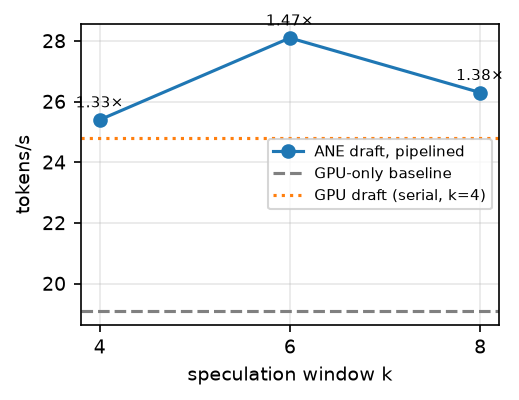
| configuration (Llama-3.1-8B-4bit target, greedy) | tok/s | speedup |
|---|---|---|
| GPU-only baseline (MLX) | 19.1 | 1.00× |
| + speculative draft on the same GPU (serial, k=4) | 24.8 | 1.28× |
| + speculative draft on the ANE (serial, k=4) | 18.2 | 0.95× |
| + ANE draft, pipelined (k=4) | 26.4 | 1.28× |
| + ANE draft, pipelined, fused head (k=6) | 28.1 | 1.47× |
- The ANE draft is fully hidden inside the GPU's verify window: overlap-span p50 = 150.465 ms vs verify p50 = 150.463 ms — a 2 µs difference, holding across the whole k-sweep (up to 9 ANE calls per batch). Drafting costs the GPU nothing.
- Output is token-exact with the baseline in every greedy cell; the sampling mode (Leviathan rejection acceptance) is distribution-exact by construction.
- The ANE→GPU handoff is p99 165 µs (10,000-iteration protocol) once two power-state effects, neither in Apple's documentation, are controlled — three orders of magnitude below the compute terms.
- The measured viability arithmetic, all constants from this hardware:
T_draft(k=4) = 95.6 ms + T_handoff(p99) = 0.15 ms < T_verify = 144.4 ms(34% margin).
Boundary conditions
- Against a fast 3B target speculation loses everywhere (same-GPU 0.58×, ANE serial 0.45×) — the win regime is the memory-bound large-target regime the theory predicts.
- k has a knee at 6: at k=8, acceptance decay (78% → 73%) and verify-window growth outpace tokens/round.
- Sampling halves acceptance (T=0.8: 44.6% ANE / 29.9% GPU draft) and serial speculation goes unprofitable — the known temperature sensitivity of speculation. The fp16-activation ANE draft agrees with the target's distribution notably better than the end-to-end 4-bit GPU draft in both regimes.
Harness findings
The project ran measurement-first: a synchronization harness with an explicit kill criterion (p99 handoff > 2 ms ⇒ stop) ran before any model existed. Everything is reported as p50/p95/p99/p99.9 over ≥10,000 iterations per cell — means are never a success criterion. Highlights:
- The dominant tail effect is the GPU idle-clock ramp — not ANE cold-start. The effect is known to latency-sensitive Metal developers (Anukari's waste makes haste, Apple forums) but absent from Apple's documentation, and as far as I can find this is its first measurement as a tail distribution. Uncontrolled: p99 1.33 ms, p99.9 6.29 ms, max 22.9 ms on the event-signal→kernel-start segment. A saturated GPU collapses it to p99 165 µs; trickle keep-warm does not remove the deep tail; the surviving ~1-in-10k events are run-to-run ambient (OS preemption, not power state — established by a repeat run).
- The ANE warmth axis is flat at a 20 Hz dispatch duty cycle: the workload's own traffic is heartbeat enough. (A 1k-iteration run had shown a "cold event" that vanished at 10k — one of two conclusions the full protocol reversed.)
- Both zero-copy ANE→GPU transport paths are real (IOSurface→
MTLTexture, and page-alignedmakeBuffer(bytesNoCopy:)), verified by per-iteration backing-identity asserts; statistically indistinguishable at 10k. A coherency canary — computed by the ANE's own matmul, validated by the GPU kernel before reading the payload — has zero stale reads in 26,000+ iterations. - Public-API dispatch overhead: a minimal ANE dispatch round trip costs ~300 µs p50 through release-build Core ML vs the ~95 µs private-path figure from maderix's benchmarking (this bounds the overhead; it doesn't isolate it). Core ML's cost model refuses per-token-scale ANE dispatches (multi-token drafting is required, not just faster), and the ANE compiler rejects compiled weights above ~1 GB (2.3 GB fp16 → wholesale CPU; 591 MB 4-bit palettized →
preferred=ane— a cliff independently reported by Benazir & Lin and the reason ANEMLL chunks models at ~950 MB). 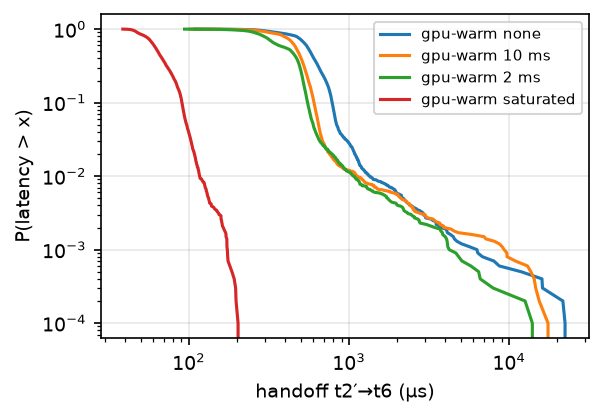
The ANE deployment recipe
Getting a real stateful-KV-cache Llama-3.2-1B onto the ANE through public API hit four walls; each was isolated with a discriminating experiment (Tools/convert_draft.py is the recipe as executable code):
| # | wall | fix |
|---|---|---|
| 1 | entire program supported=[cpu] | fixed-window attention — any tensor-valued slice bound makes the graph dynamic and the ANE compiler rejects everything |
| 2 | states suspected | toy-model experiment: MLState is ANE-eligible — not the poison |
| 3 | still all-CPU at fp16 | ≤1 GB compiled-weight ceiling → 4/6-bit LUT palettization |
| 4 | acceptance collapsed to 11% | torch.jit.trace bakes slice bounds to constants — every KV write hit cache slot 0; fix = one-hot blend write cache·(1−w)+onehot(pos)ᵀ·kv |
Wall 4 was invisible to output correctness (the target corrects every wrong draft — only the acceptance rate betrayed it); a torch-vs-Core ML greedy A/B is now a mandatory draft-health assertion. A side effect of the fix: speculation rollback is O(1) — move the position pointer, re-mask, no cache surgery.
Prior art: the static-shape rule and the fixed-window approach were published by Panaro (Oct 2024), and stateful pure-ANE inference was already shipping in ANEMLL. What I could not find documented anywhere: wall 1's all-or-nothing granularity (one dynamic slice bound rejects the entire program — the coremltools FAQ implies per-layer fallback), and wall 4's silent failure signature plus the one-hot fix — Apple's own stateful-models guide publishes the vulnerable cache-write pattern unwarned.
Landscape (July 2026)
No published work I could find holds all four of: (1) two-model speculation, (2) ANE-draft + GPU-verify on one consumer chip, (3) public API only, (4) rigorous handoff characterization. Every neighbor holds at most two:
| project | API | engines | speculation | handoff measured? |
|---|---|---|---|---|
| Mirror-SD (Apple, Dec 2025) | unspecified (server-scale) | GPU + NPU, cross-device | ✔ two-model | not on consumer hardware |
| ANEForge (Jun 2026) | private aned stack | ANE only | ✔ two-model exact (2.28×) | ✗ |
| ane.cpp | private _ANEClient | ANE only | self-speculative — slower than plain decode | ✗ |
| SqueezeBits "Yetter" (Aug 2025) | public Core ML + MLX | ANE prefill + GPU decode (iPhone) | ✗ (disaggregation) | ✗ |
| maderix/ANE | private _ANEClient | GPU↔ANE demos (IOSurface zero-copy) | ✗ | demo-level |
| CoreML-LLM | public Core ML | ANE only | ✗ | ✗ |
| Orion | private | ANE characterization | ✗ | dispatch-level |
| DuoDecoding / Dovetail | CUDA-class PCs | CPU draft + GPU target | ✔ two-model | different platform |
| ZeroHop | public Core ML + Metal | ANE draft + GPU verify, one chip | ✔ two-model exact | ✔ per-stage, 10k protocol |
Notes:
- Mirror-SD is the concept prior art: Apple's own research maps speculation across heterogeneous accelerators (GPU + NPU) at server scale (2.8–5.8×, 14B–66B) — but names no consumer device, imposes no public-API constraint, and characterizes no handoff. ZeroHop is a consumer-silicon, public-API implementation of that design class, with the handoff measured.
- The gap is probably not oversight. Prior ANE work (maderix, Orion, ane.cpp, ANEForge) uses private APIs, citing Core ML's scheduler overhead. This project measures what the public path — the only one App Store software can ship — actually costs.
- Attribution correction: the widely-quoted ~0.095 ms ANE dispatch figure originates from maderix's private-API benchmarking (credited by Orion) — it is not an Orion measurement.
On a single engine: ane.cpp's self-speculation on the ANE is slower than plain decoding (draft and verify serialize on one engine — the same contention as the same-GPU control above); ANEForge's two-model speculation on the ANE alone reaches 2.28×. ZeroHop runs the draft on an engine that is otherwise idle.
Repository map
| artifact | what it is |
|---|---|
Sources/HarnessCore | measurement primitives: exact-percentile recorders (zero-alloc loops), CPU/GPU clock fusion, real-time thread policies, thermal gating, raw CSV/JSON export |
Sources/HarnessM0–M2 | the handoff harness: noise floor, shared-event round trip, zero-copy transport A/B, coherency canary, memory-pressure cells |
Sources/HarnessM3 | the end-to-end system: Core ML/ANE draft with O(1) rollback, MLX target lane, pipelined decoder, rejection sampling |
Tools/convert_draft.py | the ANE deployment recipe, executable |
Tools/plot_results.py | regenerates every figure from Results/ raw data |
FINDINGS.md | the full lab notebook, chronological — including the superseded claims and their revisions |
PLAN.md | the implementation plan + SDK audit (responds to a project spec not included in the repo) |
The measurement binary (zerohop) has zero third-party dependencies; MLX is confined to the separate end-to-end runner (zerohop-m3).
Reproducing
Requirements: Apple Silicon Mac (macOS 15+; developed on M3/26.5.1), Xcode command-line tools, Python 3.12 for model conversion only.
swift build -c release                          # measurement harness (no deps)
python3.12 -m venv Tools/.venv && Tools/.venv/bin/pip install coremltools numpy matplotlib
Tools/.venv/bin/python Tools/make_models.py Models
xcrun coremlcompiler compile Models/m1_tiny.mlpackage Models/

.build/release/zerohop m0                                                     # noise floor
.build/release/zerohop m1 --e3 sync --e4 rt --e5 none --gpu-warm saturated    # handoff
.build/release/zerohop m2 --e1 A --gpu-warm saturated                         # transport + canary

# end-to-end (downloads models; xcodebuild required — SwiftPM can't compile MLX's Metal shaders)
Tools/.venv/bin/pip install "torch==2.7.0" "transformers==4.53.3"
Tools/.venv/bin/python Tools/convert_draft.py Models --nbits 4
xcrun coremlcompiler compile Models/draft_llama32_1b.mlpackage Models/
xcodebuild build -scheme zerohop-m3 -configuration Release -destination 'platform=macOS' \
  -derivedDataPath .build/xcode -skipPackagePluginValidation
.build/xcode/Build/Products/Release/zerohop-m3 --k 6 --n 200 \
  --target mlx-community/Meta-Llama-3.1-8B-Instruct-4bit \
  --coreml-draft Models/draft_llama32_1b.mlmodelc --overlap on
Protocol: ≥500 warmup + ≥10,000 measured iterations per cell, release builds only (debug builds inflate the dispatch segment ~3×), plugged in, thermal-gated. Every run exports meta.json (chip, OS build, power source, thermal timeline) + per-iteration samples.csv to Results/.
Limitations
One chip (findings are expected to vary by ANE generation — raw data ships for replication); greedy is the optimized regime; the ANE draft is per-call latency-bound (~14–20 ms/token; a trained Medusa-class multi-token head would cut this, and its gains convert to speculation-window headroom rather than device contention); energy unmeasured (powermetrics needs root); the public-vs-private tax number bounds rather than isolates.
References
- Leviathan, Kalman, Matias. Fast Inference from Transformers via Speculative Decoding. ICML 2023. arXiv:2211.17192
- Chen et al. Accelerating LLM Decoding with Speculative Sampling. arXiv:2302.01318
- Apple ML Research. Mirror Speculative Decoding: Breaking the Serial Barrier in LLM Inference. arXiv:2510.13161
- Orion: Characterizing and Programming Apple's Neural Engine for LLM Training and Inference. arXiv:2603.06728
- Cai et al. Medusa. arXiv:2401.10774 · Miao et al. SpecInfer. arXiv:2305.09781
- Lu et al. DuoDecoding. arXiv:2503.00784 · Dovetail. arXiv:2412.18934
- Apple ML Research. Recurrent Drafter (ReDrafter). arXiv:2403.09919
- ANEForge · ane.cpp · ANEMLL · CoreML-LLM · MLX / mlx-swift-lm
- SqueezeBits. Disaggregated Inference on Apple Silicon: NPU Prefill and GPU Decode. blog
- vllm-mlx arXiv:2601.19139 · Apple-Silicon runtime comparison arXiv:2511.05502
- Bryngelson. Apple Neural Engine: Architecture, Programming, and Performance. arXiv:2606.22283 · Benazir, Lin. arXiv:2604.18788
- maderix. Inside the M4 Apple Neural Engine. Part 1 · Part 2
- Anukari devlog. Waste makes haste…? · Panaro. Fast KV-Cached Attention for the ANE
Landscape statements are as of July 2026 (prior-art notes updated August 2026).
Contributors

25 commits
Similar repos


Languages
Swift
86.6%
Python
13.4%
Speculative decoding across the Apple Neural Engine and GPU on one chip, via public APIs — 1.47× over GPU-only, with the ANE draft fully hidden under GPU verify. Measurement harness, handoff characterization, and ANE deployment recipe.
Swift
1
25 commits
updated Sep 1, 2026
README
ZeroHop
Speculative decoding across the Apple Neural Engine and GPU — on one consumer chip, via public APIs only.
A 1B draft model runs on the ANE (Core ML), an 8B target verifies on the GPU (MLX/Metal), and a measurement harness characterizes the seam between them. Apple M3 · 16 GB · macOS 26.5.1 · July 2026.
Results
| configuration (Llama-3.1-8B-4bit target, greedy) | tok/s | speedup |
|---|---|---|
| GPU-only baseline (MLX) | 19.1 | 1.00× |
| + speculative draft on the same GPU (serial, k=4) | 24.8 | 1.28× |
| + speculative draft on the ANE (serial, k=4) | 18.2 | 0.95× |
| + ANE draft, pipelined (k=4) | 26.4 | 1.28× |
| + ANE draft, pipelined, fused head (k=6) | 28.1 | 1.47× |
- The ANE draft is fully hidden inside the GPU's verify window: overlap-span p50 = 150.465 ms vs verify p50 = 150.463 ms — a 2 µs difference, holding across the whole k-sweep (up to 9 ANE calls per batch). Drafting costs the GPU nothing.
- Output is token-exact with the baseline in every greedy cell; the sampling mode (Leviathan rejection acceptance) is distribution-exact by construction.
- The ANE→GPU handoff is p99 165 µs (10,000-iteration protocol) once two power-state effects, neither in Apple's documentation, are controlled — three orders of magnitude below the compute terms.
- The measured viability arithmetic, all constants from this hardware:
T_draft(k=4) = 95.6 ms + T_handoff(p99) = 0.15 ms < T_verify = 144.4 ms(34% margin).
Boundary conditions
- Against a fast 3B target speculation loses everywhere (same-GPU 0.58×, ANE serial 0.45×) — the win regime is the memory-bound large-target regime the theory predicts.
- k has a knee at 6: at k=8, acceptance decay (78% → 73%) and verify-window growth outpace tokens/round.
- Sampling halves acceptance (T=0.8: 44.6% ANE / 29.9% GPU draft) and serial speculation goes unprofitable — the known temperature sensitivity of speculation. The fp16-activation ANE draft agrees with the target's distribution notably better than the end-to-end 4-bit GPU draft in both regimes.
Harness findings
The project ran measurement-first: a synchronization harness with an explicit kill criterion (p99 handoff > 2 ms ⇒ stop) ran before any model existed. Everything is reported as p50/p95/p99/p99.9 over ≥10,000 iterations per cell — means are never a success criterion. Highlights:
- The dominant tail effect is the GPU idle-clock ramp — not ANE cold-start. The effect is known to latency-sensitive Metal developers (Anukari's waste makes haste, Apple forums) but absent from Apple's documentation, and as far as I can find this is its first measurement as a tail distribution. Uncontrolled: p99 1.33 ms, p99.9 6.29 ms, max 22.9 ms on the event-signal→kernel-start segment. A saturated GPU collapses it to p99 165 µs; trickle keep-warm does not remove the deep tail; the surviving ~1-in-10k events are run-to-run ambient (OS preemption, not power state — established by a repeat run).
- The ANE warmth axis is flat at a 20 Hz dispatch duty cycle: the workload's own traffic is heartbeat enough. (A 1k-iteration run had shown a "cold event" that vanished at 10k — one of two conclusions the full protocol reversed.)
- Both zero-copy ANE→GPU transport paths are real (IOSurface→
MTLTexture, and page-alignedmakeBuffer(bytesNoCopy:)), verified by per-iteration backing-identity asserts; statistically indistinguishable at 10k. A coherency canary — computed by the ANE's own matmul, validated by the GPU kernel before reading the payload — has zero stale reads in 26,000+ iterations. - Public-API dispatch overhead: a minimal ANE dispatch round trip costs ~300 µs p50 through release-build Core ML vs the ~95 µs private-path figure from maderix's benchmarking (this bounds the overhead; it doesn't isolate it). Core ML's cost model refuses per-token-scale ANE dispatches (multi-token drafting is required, not just faster), and the ANE compiler rejects compiled weights above ~1 GB (2.3 GB fp16 → wholesale CPU; 591 MB 4-bit palettized →
preferred=ane— a cliff independently reported by Benazir & Lin and the reason ANEMLL chunks models at ~950 MB).
The ANE deployment recipe
Getting a real stateful-KV-cache Llama-3.2-1B onto the ANE through public API hit four walls; each was isolated with a discriminating experiment (Tools/convert_draft.py is the recipe as executable code):
| # | wall | fix |
|---|---|---|
| 1 | entire program supported=[cpu] | fixed-window attention — any tensor-valued slice bound makes the graph dynamic and the ANE compiler rejects everything |
| 2 | states suspected | toy-model experiment: MLState is ANE-eligible — not the poison |
| 3 | still all-CPU at fp16 | ≤1 GB compiled-weight ceiling → 4/6-bit LUT palettization |
| 4 | acceptance collapsed to 11% | torch.jit.trace bakes slice bounds to constants — every KV write hit cache slot 0; fix = one-hot blend write cache·(1−w)+onehot(pos)ᵀ·kv |
Wall 4 was invisible to output correctness (the target corrects every wrong draft — only the acceptance rate betrayed it); a torch-vs-Core ML greedy A/B is now a mandatory draft-health assertion. A side effect of the fix: speculation rollback is O(1) — move the position pointer, re-mask, no cache surgery.
Prior art: the static-shape rule and the fixed-window approach were published by Panaro (Oct 2024), and stateful pure-ANE inference was already shipping in ANEMLL. What I could not find documented anywhere: wall 1's all-or-nothing granularity (one dynamic slice bound rejects the entire program — the coremltools FAQ implies per-layer fallback), and wall 4's silent failure signature plus the one-hot fix — Apple's own stateful-models guide publishes the vulnerable cache-write pattern unwarned.
Landscape (July 2026)
No published work I could find holds all four of: (1) two-model speculation, (2) ANE-draft + GPU-verify on one consumer chip, (3) public API only, (4) rigorous handoff characterization. Every neighbor holds at most two:
| project | API | engines | speculation | handoff measured? |
|---|---|---|---|---|
| Mirror-SD (Apple, Dec 2025) | unspecified (server-scale) | GPU + NPU, cross-device | ✔ two-model | not on consumer hardware |
| ANEForge (Jun 2026) | private aned stack | ANE only | ✔ two-model exact (2.28×) | ✗ |
| ane.cpp | private _ANEClient | ANE only | self-speculative — slower than plain decode | ✗ |
| SqueezeBits "Yetter" (Aug 2025) | public Core ML + MLX | ANE prefill + GPU decode (iPhone) | ✗ (disaggregation) | ✗ |
| maderix/ANE | private _ANEClient | GPU↔ANE demos (IOSurface zero-copy) | ✗ | demo-level |
| CoreML-LLM | public Core ML | ANE only | ✗ | ✗ |
| Orion | private | ANE characterization | ✗ | dispatch-level |
| DuoDecoding / Dovetail | CUDA-class PCs | CPU draft + GPU target | ✔ two-model | different platform |
| ZeroHop | public Core ML + Metal | ANE draft + GPU verify, one chip | ✔ two-model exact | ✔ per-stage, 10k protocol |
Notes:
- Mirror-SD is the concept prior art: Apple's own research maps speculation across heterogeneous accelerators (GPU + NPU) at server scale (2.8–5.8×, 14B–66B) — but names no consumer device, imposes no public-API constraint, and characterizes no handoff. ZeroHop is a consumer-silicon, public-API implementation of that design class, with the handoff measured.
- The gap is probably not oversight. Prior ANE work (maderix, Orion, ane.cpp, ANEForge) uses private APIs, citing Core ML's scheduler overhead. This project measures what the public path — the only one App Store software can ship — actually costs.
- Attribution correction: the widely-quoted ~0.095 ms ANE dispatch figure originates from maderix's private-API benchmarking (credited by Orion) — it is not an Orion measurement.
On a single engine: ane.cpp's self-speculation on the ANE is slower than plain decoding (draft and verify serialize on one engine — the same contention as the same-GPU control above); ANEForge's two-model speculation on the ANE alone reaches 2.28×. ZeroHop runs the draft on an engine that is otherwise idle.
Repository map
| artifact | what it is |
|---|---|
Sources/HarnessCore | measurement primitives: exact-percentile recorders (zero-alloc loops), CPU/GPU clock fusion, real-time thread policies, thermal gating, raw CSV/JSON export |
Sources/HarnessM0–M2 | the handoff harness: noise floor, shared-event round trip, zero-copy transport A/B, coherency canary, memory-pressure cells |
Sources/HarnessM3 | the end-to-end system: Core ML/ANE draft with O(1) rollback, MLX target lane, pipelined decoder, rejection sampling |
Tools/convert_draft.py | the ANE deployment recipe, executable |
Tools/plot_results.py | regenerates every figure from Results/ raw data |
FINDINGS.md | the full lab notebook, chronological — including the superseded claims and their revisions |
PLAN.md | the implementation plan + SDK audit (responds to a project spec not included in the repo) |
The measurement binary (zerohop) has zero third-party dependencies; MLX is confined to the separate end-to-end runner (zerohop-m3).
Reproducing
Requirements: Apple Silicon Mac (macOS 15+; developed on M3/26.5.1), Xcode command-line tools, Python 3.12 for model conversion only.
swift build -c release                          # measurement harness (no deps)
python3.12 -m venv Tools/.venv && Tools/.venv/bin/pip install coremltools numpy matplotlib
Tools/.venv/bin/python Tools/make_models.py Models
xcrun coremlcompiler compile Models/m1_tiny.mlpackage Models/

.build/release/zerohop m0                                                     # noise floor
.build/release/zerohop m1 --e3 sync --e4 rt --e5 none --gpu-warm saturated    # handoff
.build/release/zerohop m2 --e1 A --gpu-warm saturated                         # transport + canary

# end-to-end (downloads models; xcodebuild required — SwiftPM can't compile MLX's Metal shaders)
Tools/.venv/bin/pip install "torch==2.7.0" "transformers==4.53.3"
Tools/.venv/bin/python Tools/convert_draft.py Models --nbits 4
xcrun coremlcompiler compile Models/draft_llama32_1b.mlpackage Models/
xcodebuild build -scheme zerohop-m3 -configuration Release -destination 'platform=macOS' \
  -derivedDataPath .build/xcode -skipPackagePluginValidation
.build/xcode/Build/Products/Release/zerohop-m3 --k 6 --n 200 \
  --target mlx-community/Meta-Llama-3.1-8B-Instruct-4bit \
  --coreml-draft Models/draft_llama32_1b.mlmodelc --overlap on
Protocol: ≥500 warmup + ≥10,000 measured iterations per cell, release builds only (debug builds inflate the dispatch segment ~3×), plugged in, thermal-gated. Every run exports meta.json (chip, OS build, power source, thermal timeline) + per-iteration samples.csv to Results/.
Limitations
One chip (findings are expected to vary by ANE generation — raw data ships for replication); greedy is the optimized regime; the ANE draft is per-call latency-bound (~14–20 ms/token; a trained Medusa-class multi-token head would cut this, and its gains convert to speculation-window headroom rather than device contention); energy unmeasured (powermetrics needs root); the public-vs-private tax number bounds rather than isolates.
References
- Leviathan, Kalman, Matias. Fast Inference from Transformers via Speculative Decoding. ICML 2023. arXiv:2211.17192
- Chen et al. Accelerating LLM Decoding with Speculative Sampling. arXiv:2302.01318
- Apple ML Research. Mirror Speculative Decoding: Breaking the Serial Barrier in LLM Inference. arXiv:2510.13161
- Orion: Characterizing and Programming Apple's Neural Engine for LLM Training and Inference. arXiv:2603.06728
- Cai et al. Medusa. arXiv:2401.10774 · Miao et al. SpecInfer. arXiv:2305.09781
- Lu et al. DuoDecoding. arXiv:2503.00784 · Dovetail. arXiv:2412.18934
- Apple ML Research. Recurrent Drafter (ReDrafter). arXiv:2403.09919
- ANEForge · ane.cpp · ANEMLL · CoreML-LLM · MLX / mlx-swift-lm
- SqueezeBits. Disaggregated Inference on Apple Silicon: NPU Prefill and GPU Decode. blog
- vllm-mlx arXiv:2601.19139 · Apple-Silicon runtime comparison arXiv:2511.05502
- Bryngelson. Apple Neural Engine: Architecture, Programming, and Performance. arXiv:2606.22283 · Benazir, Lin. arXiv:2604.18788
- maderix. Inside the M4 Apple Neural Engine. Part 1 · Part 2
- Anukari devlog. Waste makes haste…? · Panaro. Fast KV-Cached Attention for the ANE
Landscape statements are as of July 2026 (prior-art notes updated August 2026).
Similar repos
Contributors
25 commits
Languages
Swift
86.6%
Python
13.4%