
See what people are saying
README
llamacpp-jev
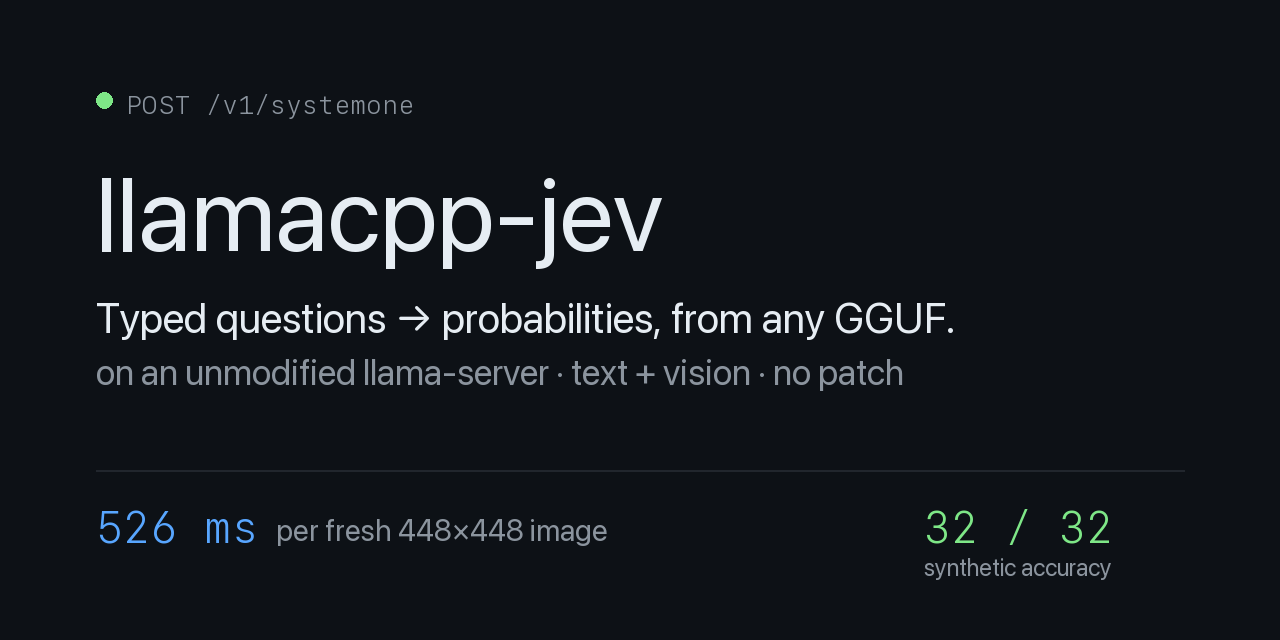
TypeSafe Jev's POST /v1/systemone structured-decision API in front of an unmodified
llama-server. Ask a batch of typed questions — yes/no, choice, score — about a conversation or
an image, and get a probability distribution per question back, from any GGUF, with no llama.cpp patch.
One wrapper process. macOS · Linux · Windows. No account, no telemetry. Text and vision.




Install
Needs one llama-server binary (built once) and a GGUF; the wrapper itself is uv-run.
# 1. llama.cpp with your backend — verified at master 3d82ef62 (b11063, 2026-09-20)
cmake -B build-metal -DGGML_METAL=ON -DLLAMA_CURL=ON -DCMAKE_BUILD_TYPE=Release   # or -DGGML_CUDA=ON
cmake --build build-metal --target llama-server -j
# 2. weights
hf download unsloth/Qwen3.5-2B-GGUF Qwen3.5-2B-Q8_0.gguf mmproj-F16.gguf
# 3. the wrapper (launches llama-server itself; --mmproj is optional, enables images)
uv sync
uv run llamajev serve --model /path/Qwen3.5-2B-Q8_0.gguf --mmproj /path/mmproj-F16.gguf \
  --llama-server /path/build-metal/bin/llama-server --slots 4 --port 8000
It comes up in a few seconds, verifies its single-token labels against the live tokenizer, and
serves on :8000. Point any HTTP client at it:
curl http://127.0.0.1:8000/v1/systemone -H 'Content-Type: application/json' -d '{
  "model": "jev-latest",
  "state": [{"role": "user", "content": "I was charged twice. Please refund the duplicate."}],
  "questions": {
    "refund":     {"type": "noul",   "instructions": "Does the user request a refund?"},
    "department": {"type": "choice", "instructions": "Which team?",
                   "criteria": {"billing": "Payments and refunds", "technical": "Software bugs"}},
    "urgency":    {"type": "score",  "instructions": "How urgent?", "criteria": ["Routine", "Urgent", "Emergency"]}
  }}'
No config file, no account; each server instance serves the one model it launched with.
uv run llamajev smoke sends a three-question request (three times) against a running server, so
you can see the response shape without wiring a client first. For an image, make a state message
whose content has an
{"type": "image_url", "image_url": {"url": "data:image/png;base64,…"}} part.
Why
You have a GGUF running under llama.cpp and you want it to answer a fixed set of typed questions — is this a refund request, which team, how urgent — and hand back probabilities, not prose. TypeSafe Jev does that behind a hosted API; doing it yourself normally means adopting their stack.
llamajev serves that same /v1/systemone contract from a stock llama-server, using only
primitives it already has: a rendered chat template (/apply-template), prompt caching with context
checkpoints, per-token logprobs (n_probs) and GBNF-constrained sampling — the same way
openjev-sglang does on SGLang. A client cannot tell
which engine is behind it.
Use something else if: you want trained-calibrated probabilities or >64 choices, hosted is fine →
TypeSafe Jev (the hosted original); you run vLLM/SGLang and want calibration + abstention →
OpenJev; you need rich JSON/CFG structure, not one typed
decision → Outlines; you only want free-form generation → a
stock llama-server. llamajev's probabilities are raw label softmax, not calibrated (4B is
~calibrated in-domain — docs/COMPARISON.md).
Provenance
The idea came from a tweet (@kis, 2026-09-20) claiming a Jev-compatible server in front of llama.cpp lets "any model behave JEV-like without modifications", demoed as Qwen3.5-2B answering 4 questions about a 448×448 image in 800 ms. No repository was linked or found; this is an independent build that reproduces the shape of the claim and lands at or under the number (see below).
Commands
uv run llamajev serve --model M.gguf --mmproj P.gguf --llama-server .../llama-server --slots 4  # launch llama-server + the API
uv run llamajev serve --connect http://127.0.0.1:8080                                           # attach to a running llama-server
uv run llamajev smoke [URL]                                                                     # three-question request x3, prints timings
uv run python scripts/bench.py [URL] [--image f.png]                                            # per-phase timings from Server-Timing
uv run python scripts/fresh_bench.py URL IMAGE_DIR                                              # cold per-image latency + correctness
A --connect target must be started with --ctx-checkpoints 32 --checkpoint-min-step 0 --cache-ram 0
(and --mmproj for images). --cache-ram 0 matters: a non-zero cache (reproduced at 4096 MiB; the
server's own default is 8192) stalled for minutes on repeated image prompts under concurrent GPU
load here (docs/llama-server-checkpoint-stall.md).
It binds 127.0.0.1 for a trusted local caller: body, image, and evaluation limits are bounded, but
there is no auth or rate limiting — front it with an authenticated gateway before untrusted exposure.
Verify it yourself
uv run pytest                                                                  # offline, fake backend
LLAMAJEV_LIVE_URL=http://127.0.0.1:8000 uv run pytest tests/test_live.py -v    # against a running server
Measured 2026-09-22 on Qwen3.5-2B-Q8_0, M4 Pro 24 GB, Metal, default config (4 slots, slot pinning,
--cache-ram 0), GPU uncontended:
| Request | Wall (median) | Correct |
|---|---|---|
| 4 typed questions on a never-seen 448×448 image (8 images) | 526 ms (525–546) | 32/32 |
| Same image repeated | 254 ms | — |
| 4 typed text questions, repeated | 238 ms | — |
Accuracy is synthetic geometric images (32/32) plus a 6-photo hand-labelled spot check (22/22), not a benchmark. Known gap: Qwen3.5-0.8B/2B collapse on 64-way choices (4/10/26-way are correct at every tested position); cause not established. Full record and per-config rows: docs/DESIGN.md §5.
License
MIT. — design · benchmark · comparison · checkpoint-stall · sibling sglang-jev-diffusion
Similar repos


Languages
Python
100.0%
See what people are saying
README
llamacpp-jev
TypeSafe Jev's POST /v1/systemone structured-decision API in front of an unmodified
llama-server. Ask a batch of typed questions — yes/no, choice, score — about a conversation or
an image, and get a probability distribution per question back, from any GGUF, with no llama.cpp patch.
One wrapper process. macOS · Linux · Windows. No account, no telemetry. Text and vision.
Install
Needs one llama-server binary (built once) and a GGUF; the wrapper itself is uv-run.
# 1. llama.cpp with your backend — verified at master 3d82ef62 (b11063, 2026-09-20)
cmake -B build-metal -DGGML_METAL=ON -DLLAMA_CURL=ON -DCMAKE_BUILD_TYPE=Release   # or -DGGML_CUDA=ON
cmake --build build-metal --target llama-server -j
# 2. weights
hf download unsloth/Qwen3.5-2B-GGUF Qwen3.5-2B-Q8_0.gguf mmproj-F16.gguf
# 3. the wrapper (launches llama-server itself; --mmproj is optional, enables images)
uv sync
uv run llamajev serve --model /path/Qwen3.5-2B-Q8_0.gguf --mmproj /path/mmproj-F16.gguf \
  --llama-server /path/build-metal/bin/llama-server --slots 4 --port 8000
It comes up in a few seconds, verifies its single-token labels against the live tokenizer, and
serves on :8000. Point any HTTP client at it:
curl http://127.0.0.1:8000/v1/systemone -H 'Content-Type: application/json' -d '{
  "model": "jev-latest",
  "state": [{"role": "user", "content": "I was charged twice. Please refund the duplicate."}],
  "questions": {
    "refund":     {"type": "noul",   "instructions": "Does the user request a refund?"},
    "department": {"type": "choice", "instructions": "Which team?",
                   "criteria": {"billing": "Payments and refunds", "technical": "Software bugs"}},
    "urgency":    {"type": "score",  "instructions": "How urgent?", "criteria": ["Routine", "Urgent", "Emergency"]}
  }}'
No config file, no account; each server instance serves the one model it launched with.
uv run llamajev smoke sends a three-question request (three times) against a running server, so
you can see the response shape without wiring a client first. For an image, make a state message
whose content has an
{"type": "image_url", "image_url": {"url": "data:image/png;base64,…"}} part.
Why
You have a GGUF running under llama.cpp and you want it to answer a fixed set of typed questions — is this a refund request, which team, how urgent — and hand back probabilities, not prose. TypeSafe Jev does that behind a hosted API; doing it yourself normally means adopting their stack.
llamajev serves that same /v1/systemone contract from a stock llama-server, using only
primitives it already has: a rendered chat template (/apply-template), prompt caching with context
checkpoints, per-token logprobs (n_probs) and GBNF-constrained sampling — the same way
openjev-sglang does on SGLang. A client cannot tell
which engine is behind it.
Use something else if: you want trained-calibrated probabilities or >64 choices, hosted is fine →
TypeSafe Jev (the hosted original); you run vLLM/SGLang and want calibration + abstention →
OpenJev; you need rich JSON/CFG structure, not one typed
decision → Outlines; you only want free-form generation → a
stock llama-server. llamajev's probabilities are raw label softmax, not calibrated (4B is
~calibrated in-domain — docs/COMPARISON.md).
Provenance
The idea came from a tweet (@kis, 2026-09-20) claiming a Jev-compatible server in front of llama.cpp lets "any model behave JEV-like without modifications", demoed as Qwen3.5-2B answering 4 questions about a 448×448 image in 800 ms. No repository was linked or found; this is an independent build that reproduces the shape of the claim and lands at or under the number (see below).
Commands
uv run llamajev serve --model M.gguf --mmproj P.gguf --llama-server .../llama-server --slots 4  # launch llama-server + the API
uv run llamajev serve --connect http://127.0.0.1:8080                                           # attach to a running llama-server
uv run llamajev smoke [URL]                                                                     # three-question request x3, prints timings
uv run python scripts/bench.py [URL] [--image f.png]                                            # per-phase timings from Server-Timing
uv run python scripts/fresh_bench.py URL IMAGE_DIR                                              # cold per-image latency + correctness
A --connect target must be started with --ctx-checkpoints 32 --checkpoint-min-step 0 --cache-ram 0
(and --mmproj for images). --cache-ram 0 matters: a non-zero cache (reproduced at 4096 MiB; the
server's own default is 8192) stalled for minutes on repeated image prompts under concurrent GPU
load here (docs/llama-server-checkpoint-stall.md).
It binds 127.0.0.1 for a trusted local caller: body, image, and evaluation limits are bounded, but
there is no auth or rate limiting — front it with an authenticated gateway before untrusted exposure.
Verify it yourself
uv run pytest                                                                  # offline, fake backend
LLAMAJEV_LIVE_URL=http://127.0.0.1:8000 uv run pytest tests/test_live.py -v    # against a running server
Measured 2026-09-22 on Qwen3.5-2B-Q8_0, M4 Pro 24 GB, Metal, default config (4 slots, slot pinning,
--cache-ram 0), GPU uncontended:
| Request | Wall (median) | Correct |
|---|---|---|
| 4 typed questions on a never-seen 448×448 image (8 images) | 526 ms (525–546) | 32/32 |
| Same image repeated | 254 ms | — |
| 4 typed text questions, repeated | 238 ms | — |
Accuracy is synthetic geometric images (32/32) plus a 6-photo hand-labelled spot check (22/22), not a benchmark. Known gap: Qwen3.5-0.8B/2B collapse on 64-way choices (4/10/26-way are correct at every tested position); cause not established. Full record and per-config rows: docs/DESIGN.md §5.
License
MIT. — design · benchmark · comparison · checkpoint-stall · sibling sglang-jev-diffusion
Similar repos
Languages
Python
100.0%