




Haoqing Wang†, Xiang Long†, Ziheng Li†, Yilong Xu, Tingguang Li, Yehui Tang✉
Samsung Research, Beijing, China · Peking University
Reinforcement Learning with Verifiable Rewards (RLVR) plays a key role in stimulating the explicit reasoning capability of Large Language Models (LLMs), achieving expert-level performance in specific domains such as coding and math. When building a general multi-domain expert-level model, however, we must carefully consider how RLVR collaborates across different domains.
State-of-the-art models mainly adopt two training paradigms for multi-domain RLVR, yet few works provide a detailed comparison and analysis between them:
We choose five commonly used high-level domains — math, coding, science, instruction following, and agent — and design extensive qualitative and quantitative experiments on open-source datasets, analyzing the internal mechanisms from the perspectives of information constraints, model prediction behavior, and self-verification.
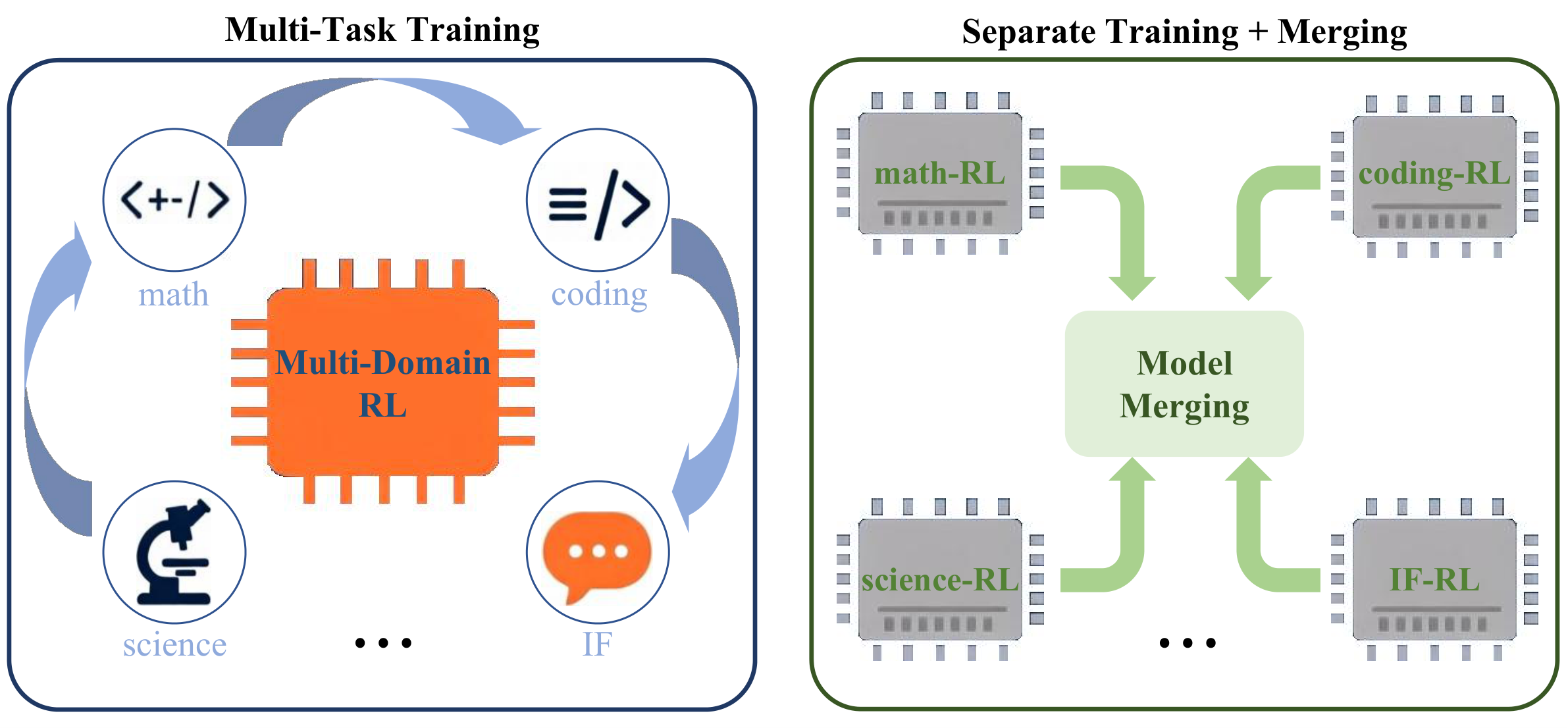
Base Model: Qwen3-4B-Base · RL Algorithm: GRPO · Framework: slime
Pipeline: a simplified SFT → RL recipe for controllable experiments.
Domains & Datasets (open-source, from Nemotron-3 Nano):
| Domain | RL Samples | Source |
|---|---|---|
| Math | 22,056 | DAPO, Skywork-OR1 |
| Coding | 19,169 | CodeContests, Open-R1 |
| Science | 19,670 | OpenScienceReasoning-2 |
| Instruction Following | 16,575 | WildChat-1M + Open-Instruct |
| Agent | 10,229 | Nemotron-RL-agent-workplace-assistant |
SFT data blend follows the Nemotron-3 Nano proportions (RL blend):
| Data Type | #Samples | Proportion (%) |
|---|---|---|
| Math Formal Proofs | 335,122 | 2.37 |
| Math | 2,950,525 | 20.89 |
| Science | 2,263,340 | 16.04 |
| Code | 3,927,984 | 27.81 |
| Chat | 4,309,780 | 30.52 |
| Conversational Agent | 335,122 | 2.37 |
| Total | 14,121,873 | 100.00 |
Benchmarks (Avg@K): AIME'24 / AIME'25 (Math), LiveCodeBench v5 / v6 (Coding), HLE / GPQA-Diamond (Science), IFEval / IFBench (Instruction Following), BFCL v3 (Agent).
The highest and second-best scores are in bold and underlined.
| Benchmark | Qwen3-4B-Base | SFT | RL-Math | RL-Coding | RL-Science | RL-IF | RL-Agent | Merging | RL-Multi |
|---|---|---|---|---|---|---|---|---|---|
| AIME'24 | 9.65 | 56.04 | 77.66 | 61.61 | 64.69 | 67.81 | 57.60 | 80.57 | 81.20 |
| AIME'25 | 5.68 | 51.30 | 70.42 | 55.16 | 56.35 | 60.52 | 54.64 | 74.48 | 73.39 |
| LCB v5 | 16.50 | 55.92 | 59.59 | 65.00 | 57.66 | 60.80 | 62.95 | 63.31 | 63.21 |
| LCB v6 | 18.29 | 52.00 | 54.57 | 58.86 | 53.14 | 53.14 | 54.29 | 58.86 | 56.57 |
| HLE | 4.45 | 5.75 | 6.39 | 5.92 | 6.26 | 7.04 | 5.98 | 7.25 | 7.18 |
| GPQA-Diamond | 20.08 | 42.68 | 58.46 | 46.59 | 53.79 | 49.62 | 46.09 | 55.18 | 53.62 |
| IFEval (strict) | 35.12 | 79.48 | 80.59 | 78.74 | 78.93 | 90.94 | 81.33 | 93.90 | 93.53 |
| IFBench | 11.90 | 38.44 | 40.14 | 39.46 | 40.14 | 59.52 | 40.82 | 59.18 | 61.22 |
| BFCL v3 | 29.73 | 50.05 | 50.32 | 50.64 | 49.56 | 50.55 | 59.14 | 61.37 | 60.74 |
Each single-domain RLVR model reaches state-of-the-art performance within its own domain, while both Merging and RL-Multi aggregate these gains and even improve further (e.g., AIME'24, AIME'25, HLE, IFEval, BFCL v3) — confirming the cross-domain gain effect.
| Method | Math-RL | Coding-RL | Science-RL | IF-RL | Agent-RL | MT-OPD | Multi-Task RL |
|---|---|---|---|---|---|---|---|
| #Steps | 400 | 400 | 400 | 400 | 400 | 300 | 1000 |
| GPU Hours | 4782.3 | 6404.4 | 1140.8 | 1180.0 | 2271.0 | 1451.9 | 10050.6 |
Multi-task RLVR (10050.6 GPU hours) reaches comparable performance to separate RLVR + merging (5 experts, 15778.5 GPU hours) using only 58.3% of the compute. Under a matched budget (5×200-step experts vs. 1000-step multi-task), multi-task RLVR is +4.15 points better on average.
| Method | AIME'24 | AIME'25 | LCB v5 | LCB v6 | HLE | GPQA-D | IFEval | IFBench | BFCL v3 | Avg. |
|---|---|---|---|---|---|---|---|---|---|---|
| Average | 67.55 | 64.38 | 58.92 | 57.71 | 6.16 | 50.13 | 84.84 | 40.82 | 53.17 | 53.74 |
| SCE | 80.73 | 74.84 | 62.01 | 56.57 | 7.28 | 56.57 | 93.35 | 53.74 | 61.19 | 60.70 |
| Ties | 81.15 | 74.74 | 60.84 | 57.71 | 7.92 | 57.58 | 92.61 | 54.76 | 61.73 | 61.00 |
| Ties+DARE | 79.84 | 75.89 | 60.71 | 57.71 | 7.41 | 57.07 | 90.94 | 56.12 | 61.05 | 60.75 |
| TA | 80.47 | 76.61 | 57.97 | 52.57 | 6.39 | 54.04 | 93.16 | 61.56 | 59.25 | 60.22 |
| TA+DARE | 81.09 | 76.18 | 58.65 | 56.00 | 6.39 | 55.56 | 93.72 | 62.59 | 58.76 | 60.99 |
| MT-OPD | 80.57 | 74.48 | 63.31 | 58.86 | 7.25 | 55.18 | 93.90 | 59.18 | 61.37 | 61.57 |
| MT-OFF | 80.78 | 76.30 | 63.98 | 57.14 | 7.23 | 49.24 | 89.09 | 60.88 | 60.12 | 60.53 |
TA = task arithmetic, MT-OPD/MT-OFF = multi-teacher on/off-policy distillation. On-policy distillation is only marginally better than direct weight merging but requires extra compute; different merging methods show a seesaw effect across benchmarks.
Notably, our best model trained purely on open-source data reaches performance comparable to the official Qwen3-4B (Thinking mode): 61.18 vs. 52.94 average across the 9 benchmarks.
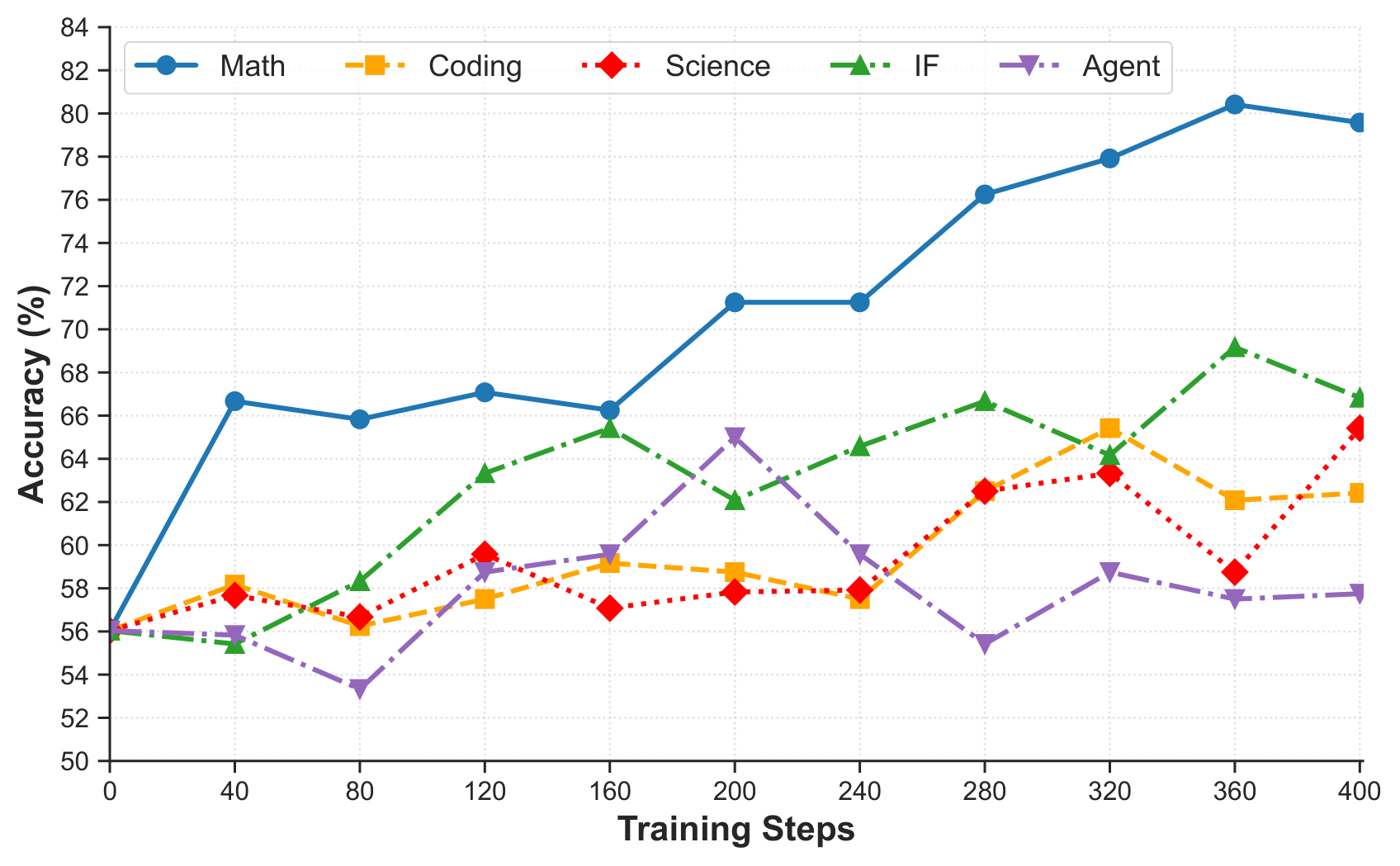
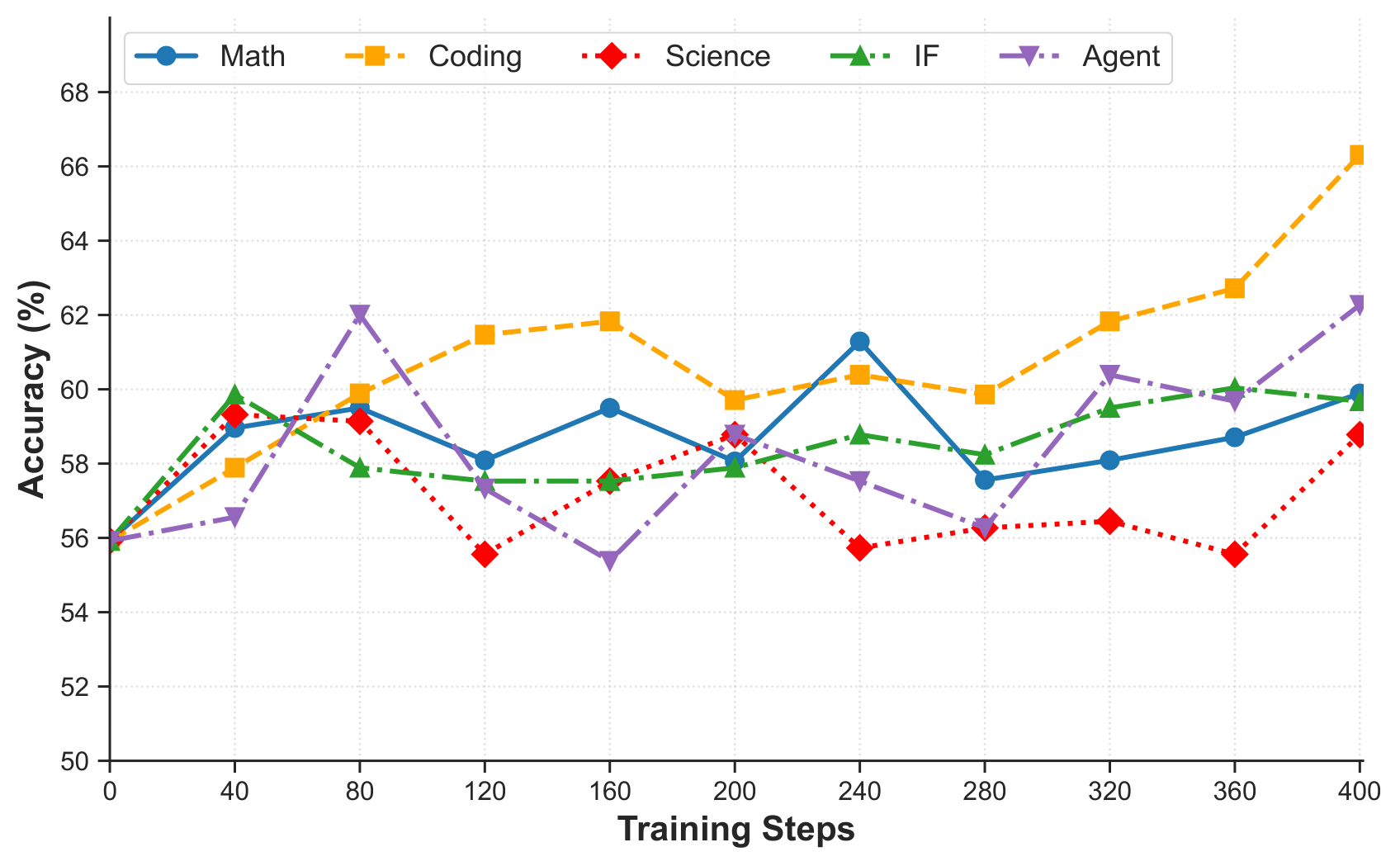
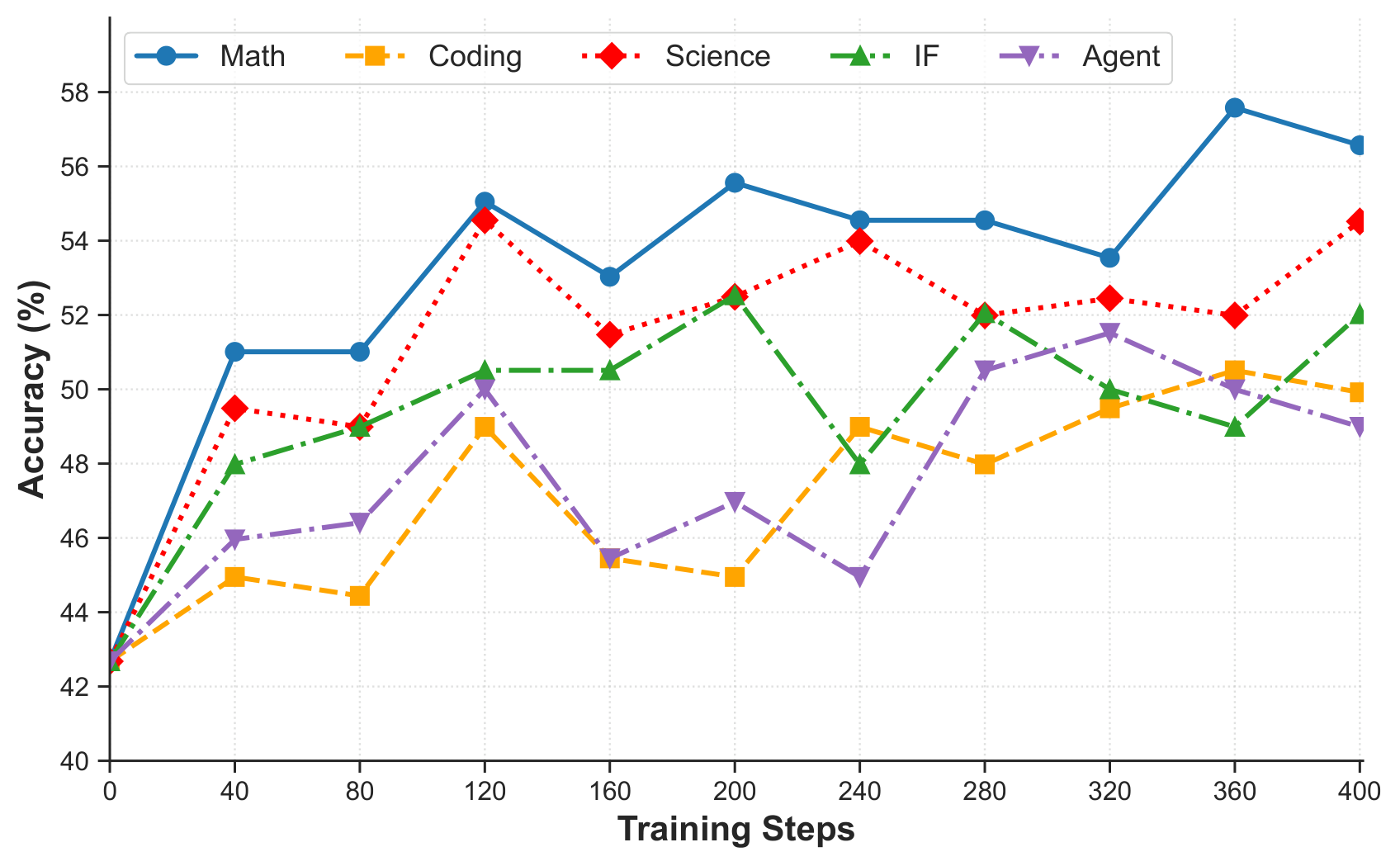
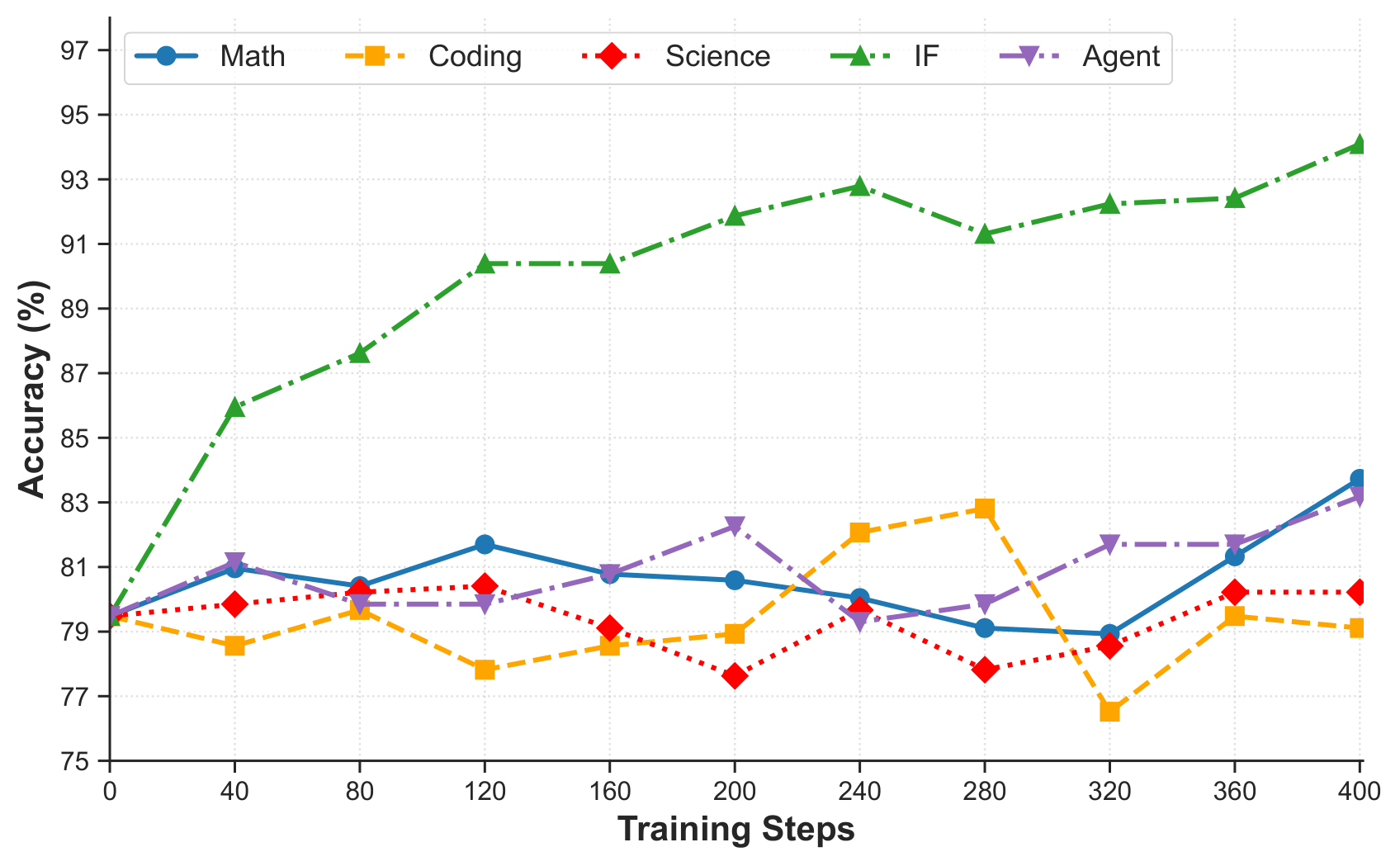
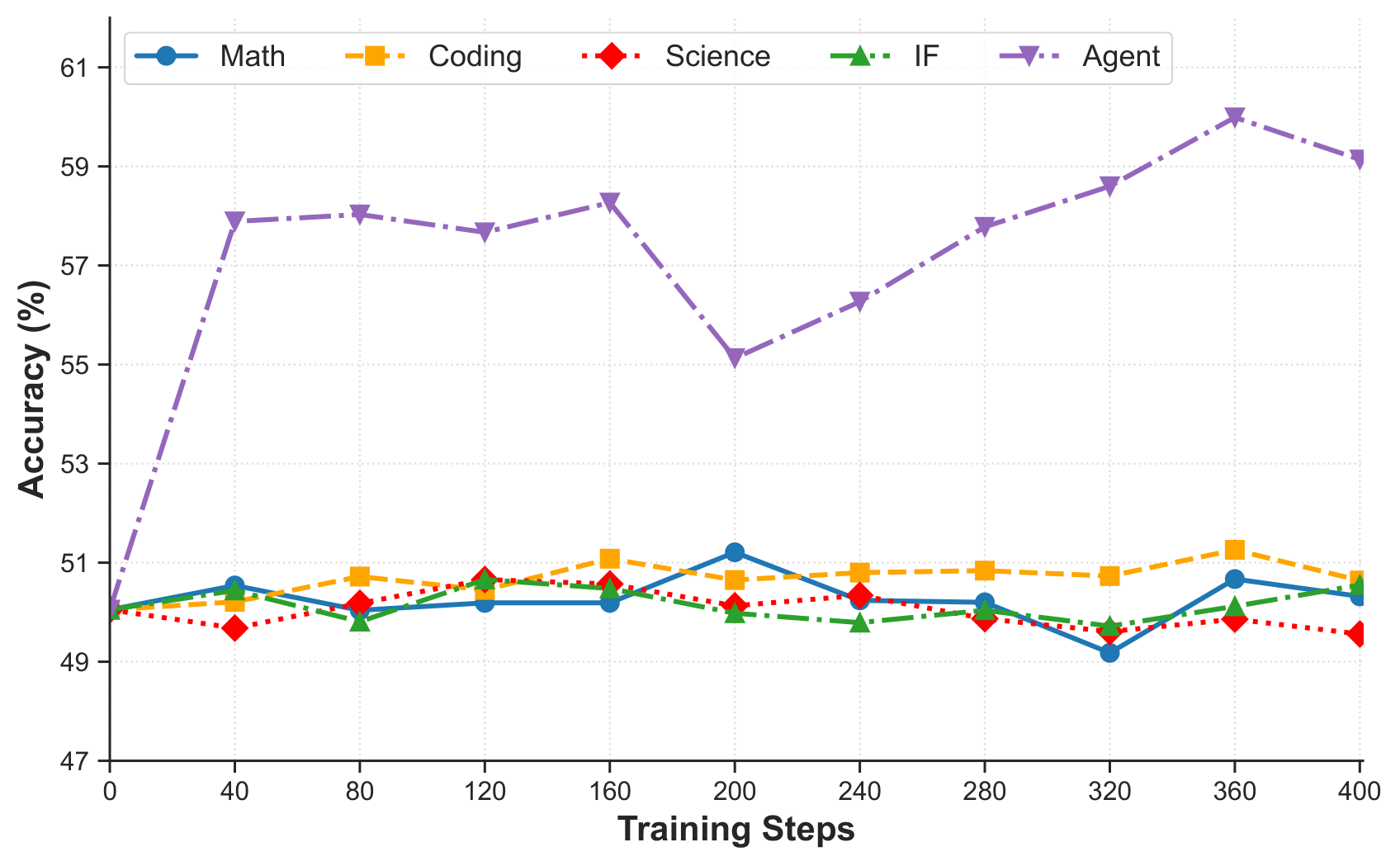
The accuracy trajectories during each single-domain RLVR process show that the three reasoning domains (math, coding, science) stably improve each other, and instruction following further helps the reasoning domains. The agent domain benefits only when tool-use trajectories are present (i.e., jointly trained), while cross-domain interference on it remains small.
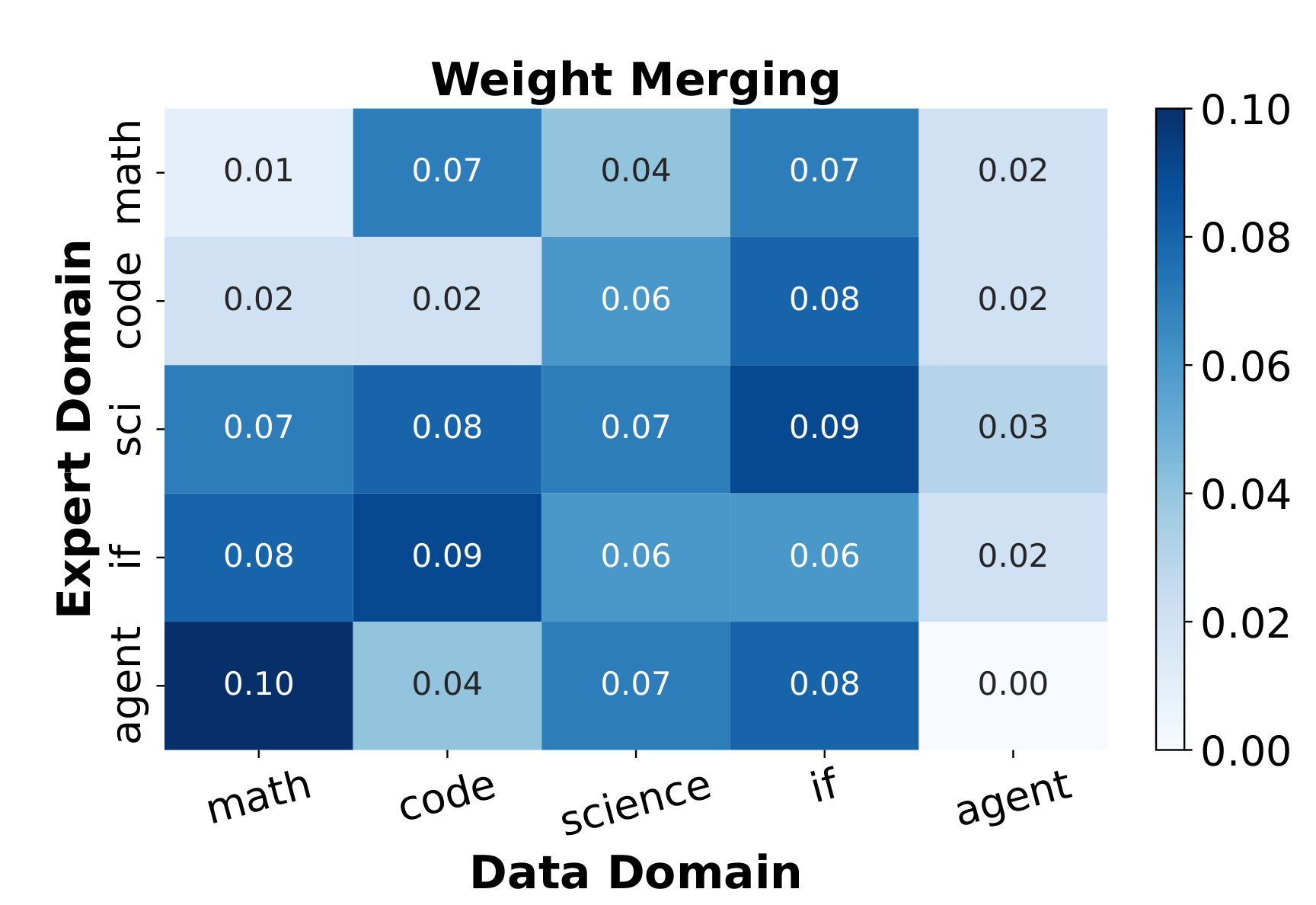
We cross-compare the KL divergence between domain experts and the merged multi-domain model on trajectories across domains. For a given data domain, experts from other domains can also exhibit low KL divergence with the merged policy — we formalize these as policy neighborhoods. Merging with a policy-neighborhood expert further improves the target domain (e.g., Math+Coding: AIME'24 ↑2.63, AIME'25 ↑2.02), while non-neighboring experts yield no extra gains. The relation is asymmetric (coding is a neighbor of math, but not vice versa), consistent with the asymmetry of KL divergence.
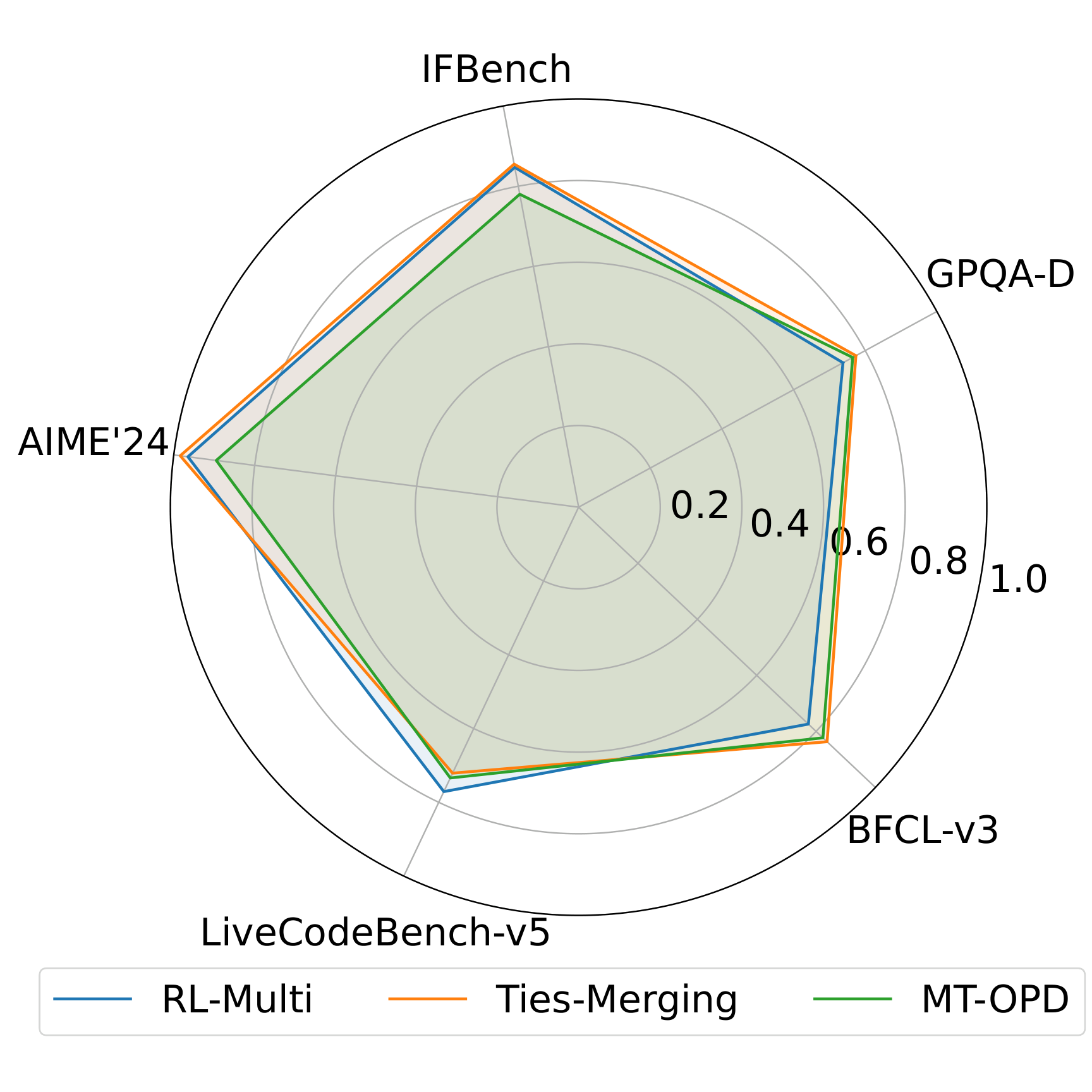
Measuring the cosine similarity between each multi-domain model's per-instance gain vector and the union of single-task gains (right figure above), we find that weight merging inherits the most single-task skills, whereas RL-Multi and MT-OPD diverge more — evidence of emergent capabilities arising from cross-domain synergy during joint training.
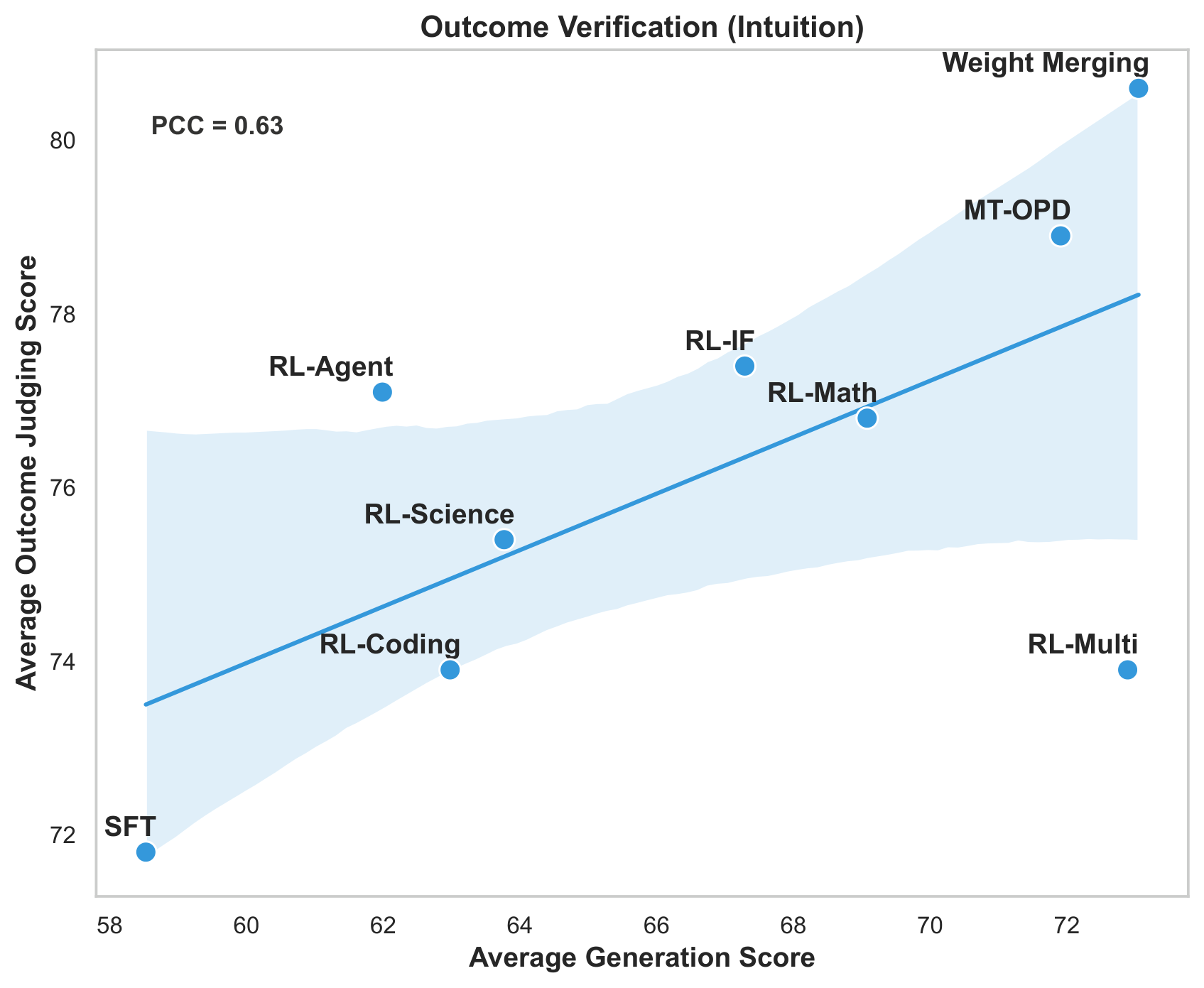
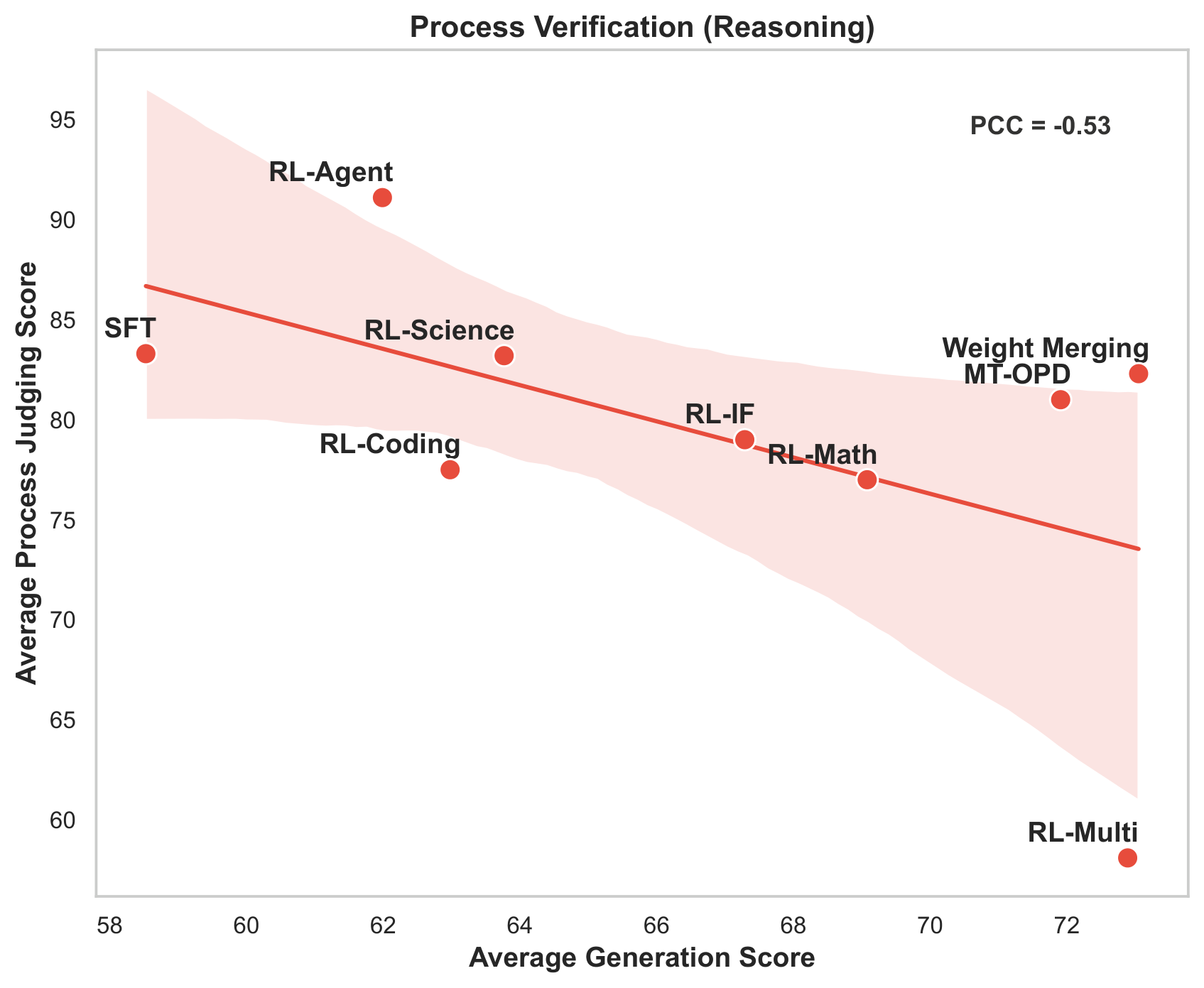
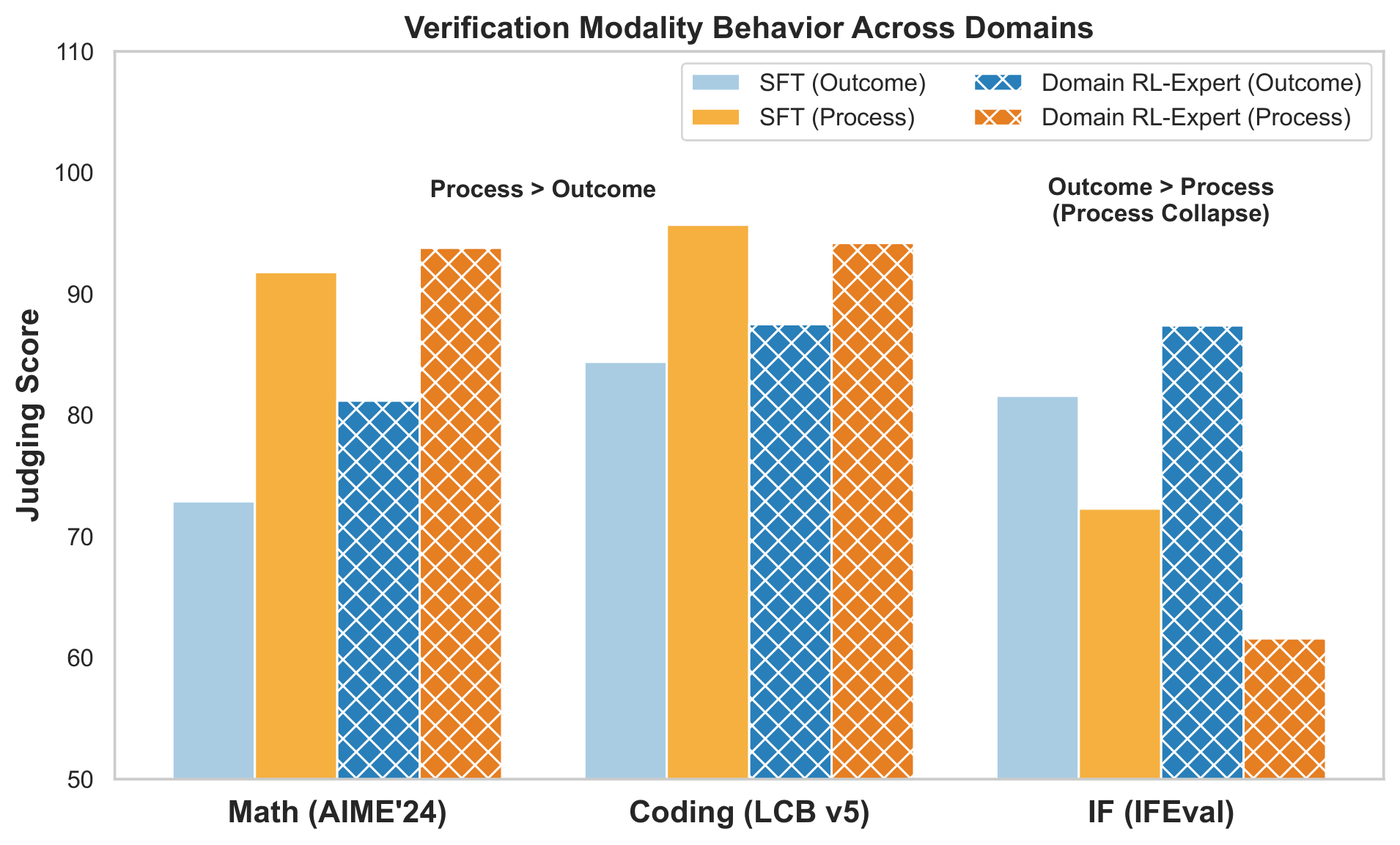
Evaluating RL-trained models as Generative Reward Models (GenRMs) on their own trajectories reveals:
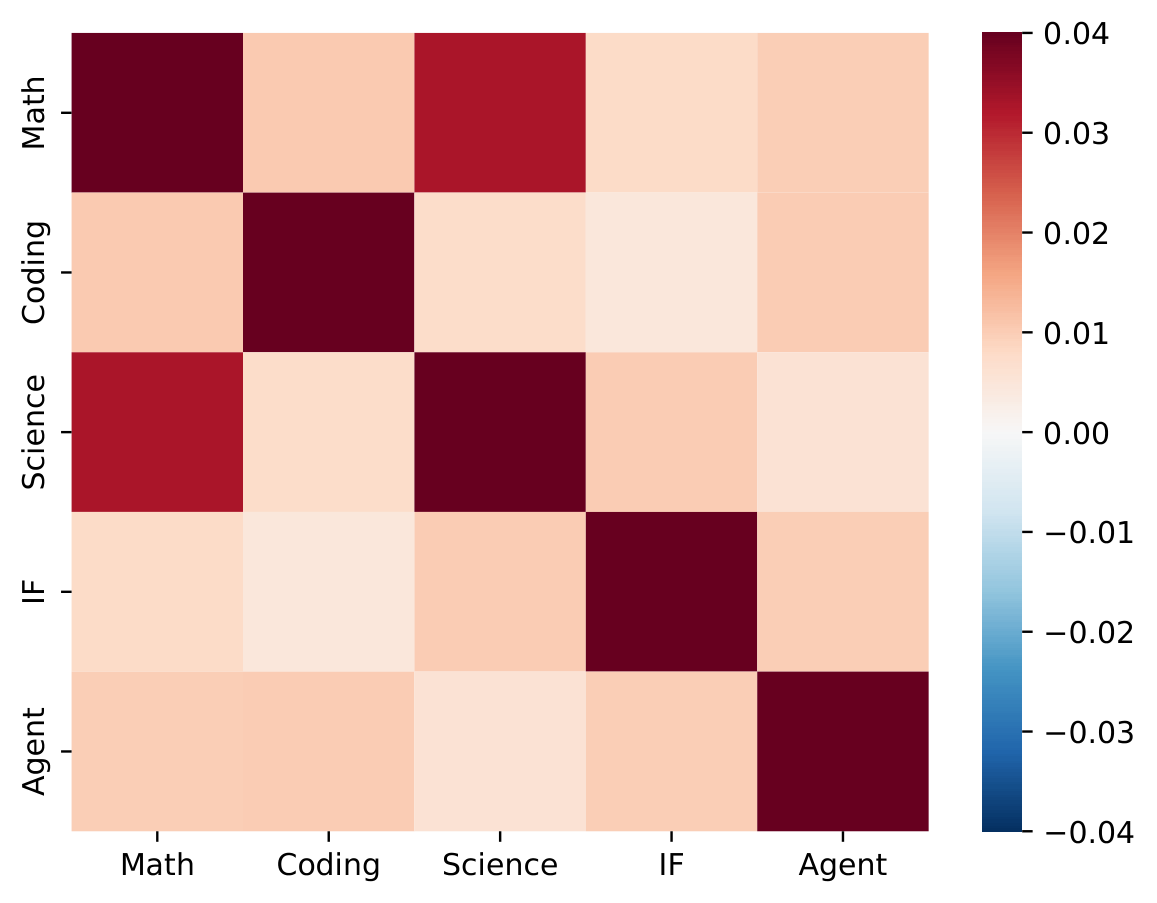
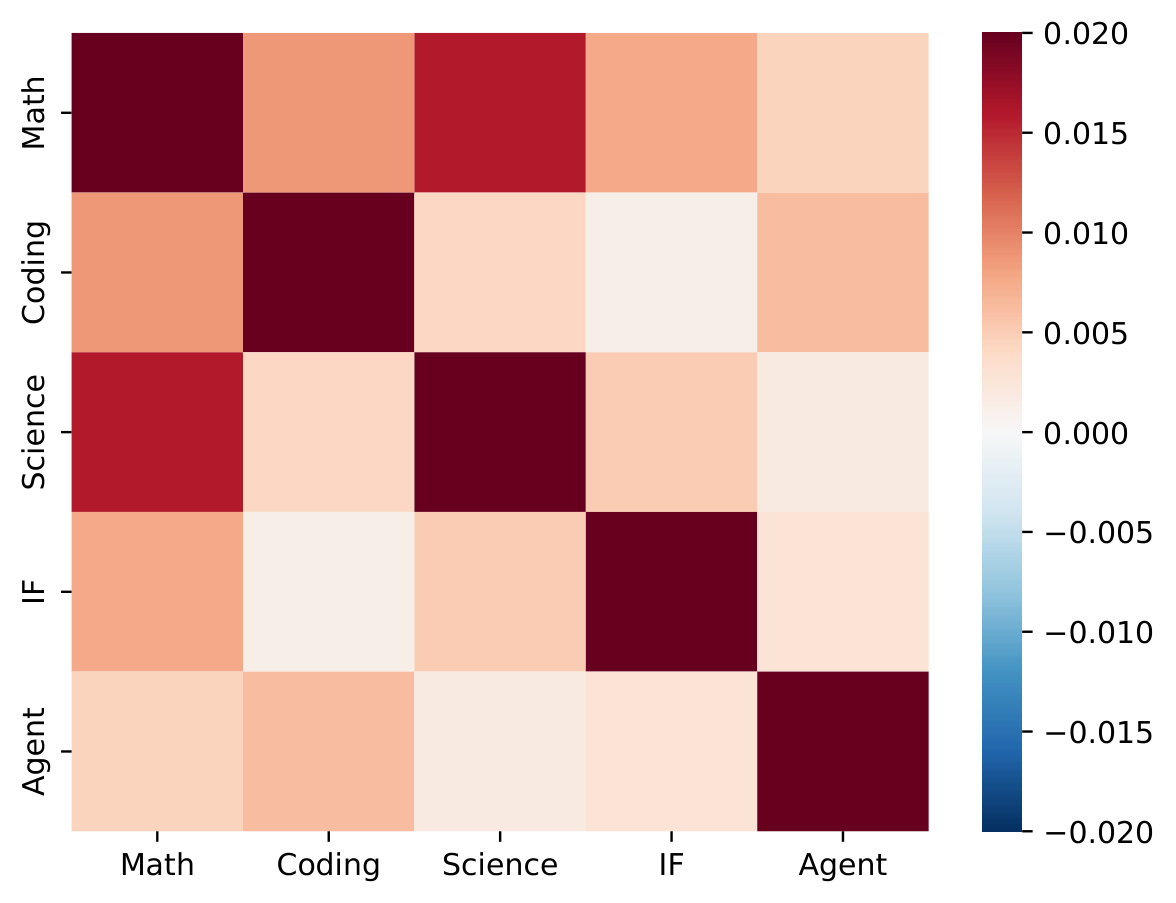
The weight-update footprints of different domain-specific RL models significantly overlap (Jaccard ≈ 0.46–0.48 vs. ~0.18 random), and the weight-shift vectors have positive cosine similarity in overlapping regions — highest among the three reasoning domains. This holds robustly across layers and thresholds.
Full instructions for environment setup, data processing, SFT, single/multi-task RL, model merging, and multi-teacher distillation are in M2RL/README.md. The pipeline is verified on 32 × H800 GPUs.
If you find this work useful, please consider citing:
@inproceedings{
wang2026to,
title={To Mix or To Merge: Toward Multi-Domain Reinforcement Learning for Large Language Models},
author={Haoqing Wang and Xiang Long and Ziheng Li and Yilong Xu and Tingguang Li and Yehui Tang},
booktitle={Third Conference on Language Modeling},
year={2026},
url={https://openreview.net/forum?id=jP7j5XkG8J}
}
5 followers · starred Jun 2026
Haoqing Wang†, Xiang Long†, Ziheng Li†, Yilong Xu, Tingguang Li, Yehui Tang✉
Samsung Research, Beijing, China · Peking University
Reinforcement Learning with Verifiable Rewards (RLVR) plays a key role in stimulating the explicit reasoning capability of Large Language Models (LLMs), achieving expert-level performance in specific domains such as coding and math. When building a general multi-domain expert-level model, however, we must carefully consider how RLVR collaborates across different domains.
State-of-the-art models mainly adopt two training paradigms for multi-domain RLVR, yet few works provide a detailed comparison and analysis between them:
We choose five commonly used high-level domains — math, coding, science, instruction following, and agent — and design extensive qualitative and quantitative experiments on open-source datasets, analyzing the internal mechanisms from the perspectives of information constraints, model prediction behavior, and self-verification.
Base Model: Qwen3-4B-Base · RL Algorithm: GRPO · Framework: slime
Pipeline: a simplified SFT → RL recipe for controllable experiments.
Domains & Datasets (open-source, from Nemotron-3 Nano):
| Domain | RL Samples | Source |
|---|---|---|
| Math | 22,056 | DAPO, Skywork-OR1 |
| Coding | 19,169 | CodeContests, Open-R1 |
| Science | 19,670 | OpenScienceReasoning-2 |
| Instruction Following | 16,575 | WildChat-1M + Open-Instruct |
| Agent | 10,229 | Nemotron-RL-agent-workplace-assistant |
SFT data blend follows the Nemotron-3 Nano proportions (RL blend):
| Data Type | #Samples | Proportion (%) |
|---|---|---|
| Math Formal Proofs | 335,122 | 2.37 |
| Math | 2,950,525 | 20.89 |
| Science | 2,263,340 | 16.04 |
| Code | 3,927,984 | 27.81 |
| Chat | 4,309,780 | 30.52 |
| Conversational Agent | 335,122 | 2.37 |
| Total | 14,121,873 | 100.00 |
Benchmarks (Avg@K): AIME'24 / AIME'25 (Math), LiveCodeBench v5 / v6 (Coding), HLE / GPQA-Diamond (Science), IFEval / IFBench (Instruction Following), BFCL v3 (Agent).
The highest and second-best scores are in bold and underlined.
| Benchmark | Qwen3-4B-Base | SFT | RL-Math | RL-Coding | RL-Science | RL-IF | RL-Agent | Merging | RL-Multi |
|---|---|---|---|---|---|---|---|---|---|
| AIME'24 | 9.65 | 56.04 | 77.66 | 61.61 | 64.69 | 67.81 | 57.60 | 80.57 | 81.20 |
| AIME'25 | 5.68 | 51.30 | 70.42 | 55.16 | 56.35 | 60.52 | 54.64 | 74.48 | 73.39 |
| LCB v5 | 16.50 | 55.92 | 59.59 | 65.00 | 57.66 | 60.80 | 62.95 | 63.31 | 63.21 |
| LCB v6 | 18.29 | 52.00 | 54.57 | 58.86 | 53.14 | 53.14 | 54.29 | 58.86 | 56.57 |
| HLE | 4.45 | 5.75 | 6.39 | 5.92 | 6.26 | 7.04 | 5.98 | 7.25 | 7.18 |
| GPQA-Diamond | 20.08 | 42.68 | 58.46 | 46.59 | 53.79 | 49.62 | 46.09 | 55.18 | 53.62 |
| IFEval (strict) | 35.12 | 79.48 | 80.59 | 78.74 | 78.93 | 90.94 | 81.33 | 93.90 | 93.53 |
| IFBench | 11.90 | 38.44 | 40.14 | 39.46 | 40.14 | 59.52 | 40.82 | 59.18 | 61.22 |
| BFCL v3 | 29.73 | 50.05 | 50.32 | 50.64 | 49.56 | 50.55 | 59.14 | 61.37 | 60.74 |
Each single-domain RLVR model reaches state-of-the-art performance within its own domain, while both Merging and RL-Multi aggregate these gains and even improve further (e.g., AIME'24, AIME'25, HLE, IFEval, BFCL v3) — confirming the cross-domain gain effect.
| Method | Math-RL | Coding-RL | Science-RL | IF-RL | Agent-RL | MT-OPD | Multi-Task RL |
|---|---|---|---|---|---|---|---|
| #Steps | 400 | 400 | 400 | 400 | 400 | 300 | 1000 |
| GPU Hours | 4782.3 | 6404.4 | 1140.8 | 1180.0 | 2271.0 | 1451.9 | 10050.6 |
Multi-task RLVR (10050.6 GPU hours) reaches comparable performance to separate RLVR + merging (5 experts, 15778.5 GPU hours) using only 58.3% of the compute. Under a matched budget (5×200-step experts vs. 1000-step multi-task), multi-task RLVR is +4.15 points better on average.
| Method | AIME'24 | AIME'25 | LCB v5 | LCB v6 | HLE | GPQA-D | IFEval | IFBench | BFCL v3 | Avg. |
|---|---|---|---|---|---|---|---|---|---|---|
| Average | 67.55 | 64.38 | 58.92 | 57.71 | 6.16 | 50.13 | 84.84 | 40.82 | 53.17 | 53.74 |
| SCE | 80.73 | 74.84 | 62.01 | 56.57 | 7.28 | 56.57 | 93.35 | 53.74 | 61.19 | 60.70 |
| Ties | 81.15 | 74.74 | 60.84 | 57.71 | 7.92 | 57.58 | 92.61 | 54.76 | 61.73 | 61.00 |
| Ties+DARE | 79.84 | 75.89 | 60.71 | 57.71 | 7.41 | 57.07 | 90.94 | 56.12 | 61.05 | 60.75 |
| TA | 80.47 | 76.61 | 57.97 | 52.57 | 6.39 | 54.04 | 93.16 | 61.56 | 59.25 | 60.22 |
| TA+DARE | 81.09 | 76.18 | 58.65 | 56.00 | 6.39 | 55.56 | 93.72 | 62.59 | 58.76 | 60.99 |
| MT-OPD | 80.57 | 74.48 | 63.31 | 58.86 | 7.25 | 55.18 | 93.90 | 59.18 | 61.37 | 61.57 |
| MT-OFF | 80.78 | 76.30 | 63.98 | 57.14 | 7.23 | 49.24 | 89.09 | 60.88 | 60.12 | 60.53 |
TA = task arithmetic, MT-OPD/MT-OFF = multi-teacher on/off-policy distillation. On-policy distillation is only marginally better than direct weight merging but requires extra compute; different merging methods show a seesaw effect across benchmarks.
Notably, our best model trained purely on open-source data reaches performance comparable to the official Qwen3-4B (Thinking mode): 61.18 vs. 52.94 average across the 9 benchmarks.
The accuracy trajectories during each single-domain RLVR process show that the three reasoning domains (math, coding, science) stably improve each other, and instruction following further helps the reasoning domains. The agent domain benefits only when tool-use trajectories are present (i.e., jointly trained), while cross-domain interference on it remains small.
We cross-compare the KL divergence between domain experts and the merged multi-domain model on trajectories across domains. For a given data domain, experts from other domains can also exhibit low KL divergence with the merged policy — we formalize these as policy neighborhoods. Merging with a policy-neighborhood expert further improves the target domain (e.g., Math+Coding: AIME'24 ↑2.63, AIME'25 ↑2.02), while non-neighboring experts yield no extra gains. The relation is asymmetric (coding is a neighbor of math, but not vice versa), consistent with the asymmetry of KL divergence.
Measuring the cosine similarity between each multi-domain model's per-instance gain vector and the union of single-task gains (right figure above), we find that weight merging inherits the most single-task skills, whereas RL-Multi and MT-OPD diverge more — evidence of emergent capabilities arising from cross-domain synergy during joint training.
Evaluating RL-trained models as Generative Reward Models (GenRMs) on their own trajectories reveals:
The weight-update footprints of different domain-specific RL models significantly overlap (Jaccard ≈ 0.46–0.48 vs. ~0.18 random), and the weight-shift vectors have positive cosine similarity in overlapping regions — highest among the three reasoning domains. This holds robustly across layers and thresholds.
Full instructions for environment setup, data processing, SFT, single/multi-task RL, model merging, and multi-teacher distillation are in M2RL/README.md. The pipeline is verified on 32 × H800 GPUs.
If you find this work useful, please consider citing:
@inproceedings{
wang2026to,
title={To Mix or To Merge: Toward Multi-Domain Reinforcement Learning for Large Language Models},
author={Haoqing Wang and Xiang Long and Ziheng Li and Yilong Xu and Tingguang Li and Yehui Tang},
booktitle={Third Conference on Language Modeling},
year={2026},
url={https://openreview.net/forum?id=jP7j5XkG8J}
}
5 followers · starred Jun 2026



