"EngramEdit: Decoupled Knowledge Updates in LLMs through Conditional Memory"
See the code





Conditional memory expands an LLM’s capacity through learned n-gram embeddings. At each token position, the model uses token sequences of different lengths ending at that position to look up embeddings that participate in its computation. EngramEdit enables factual knowledge updates through this memory. It first computes the memory representations needed to predict revised facts, then jointly updates the corresponding embeddings across expressions and edits. Stronger penalties on frequently reused embeddings help preserve unrelated knowledge. Updated facts remain usable across different expressions and in multi-hop reasoning, while general capabilities are largely preserved.
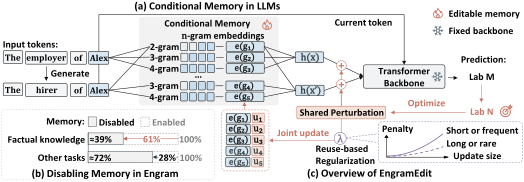
From conditional memory to an editable knowledge interface.
Use Python 3.11 or 3.12 with PyTorch 2.9.1. The commands below install the CUDA 12.8 build:
conda create -n engramedit python=3.11 -y
conda activate engramedit
pip install torch==2.9.1 --index-url https://download.pytorch.org/whl/cu128
pip install -r requirements.txt
Preparation has three steps: download the data, generate additional expressions, and estimate n-gram frequencies for regularization. Dataset identifiers are mcf (CounterFact), zsre, and mquake.
Download LongCat-Flash-Lite, the editing benchmarks, and the tokenization resources.
hf download meituan-longcat/LongCat-Flash-Lite --local-dir data/LongCat-Flash-Lite
python scripts/prepare/download.py --datasets mcf zsre mquake
python -m nltk.downloader punkt punkt_tab
Use the model to generate alternative expressions of each fact. --limit sets how many dataset cases to process, starting from the first case; --target_count sets the requested number of valid additional expressions per fact.
python scripts/prepare/expressions.py --dataset mcf --limit 2000 --target_count 4
python scripts/prepare/expressions.py --dataset zsre --limit 2000 --target_count 4
python scripts/prepare/expressions.py --dataset mquake --limit 3000 --target_count 4
[!NOTE] Defaults are 2,000 facts for CounterFact and ZsRE, 3,000 cases for MQuAKE, and four generated expressions per fact. Each MQuAKE case may contain multiple facts, which receive expressions separately.
The cache records how often the relevant n-grams occur in Wikipedia, so regularization can apply stronger penalties to frequently reused embeddings. Download Wikipedia once for all datasets:
python scripts/prepare/download.py --wikipedia
Then build a cache for each dataset. --dataset_size_limit sets the number of cases covered, --paraphrase_append_count sets the number of generated expressions used per fact, and --max_docs limits the number of Wikipedia documents scanned.
python scripts/prepare/frequency.py --dataset mcf \
  --dataset_size_limit 2000 --paraphrase_append_count 4 --max_docs 3000000
python scripts/prepare/frequency.py --dataset zsre \
  --dataset_size_limit 2000 --paraphrase_append_count 4 --max_docs 3000000
python scripts/prepare/frequency.py --dataset mquake \
  --dataset_size_limit 3000 --paraphrase_append_count 4 --max_docs 3000000
[!NOTE]
- Lower
--max_docsfor a smaller counting run. This limits the documents scanned, not the Wikipedia download size.- Prepare expressions and a cache covering all cases to be edited. Keep
--paraphrase_append_countconsistent between caching and editing, with at least that many generated expressions per fact.
After data preparation, run EngramEdit with the following commands.
For CounterFact:
bash scripts/run_mcf.sh
For ZsRE:
bash scripts/run_zsre.sh
For MQuAKE:
bash scripts/run_mquake.sh
These scripts use the default editing settings and save results and checkpoints to results/<dataset>.
[!NOTE]
- Training includes automatic evaluation, so a separate evaluation run is usually unnecessary.
- You can change the editing settings in the scripts, such as
--num_editsfor batch size and--paraphrase_append_countfor expression count. Prepare matching expressions and frequency caches when changing data settings.- To skip editing and evaluate directly, use our 🤗 Hugging Face checkpoints with the commands below.
To evaluate saved checkpoints, place each dataset's engramedit_state.pt in checkpoints/<dataset> and run the commands below.
For CounterFact:
python -m experiments.checkpoint \
  --model_name data/LongCat-Flash-Lite \
  --state_dir checkpoints/mcf --ds_name mcf --dataset_size_limit 2000 \
  --output_dir results/eval_mcf
Add --generation_tests to also evaluate Fluency and Consistency.
For ZsRE:
python -m experiments.checkpoint \
  --model_name data/LongCat-Flash-Lite \
  --state_dir checkpoints/zsre --ds_name zsre --dataset_size_limit 2000 \
  --output_dir results/eval_zsre
For MQuAKE:
python -m experiments.checkpoint \
  --model_name data/LongCat-Flash-Lite \
  --state_dir checkpoints/mquake --ds_name mquake --dataset_size_limit 3000 \
  --output_dir results/eval_mquake
Results are saved to --output_dir.
After completing data preparation for CounterFact, this example edits one fact and compares the model's answers before and after editing.
import torch

from experiments.utils import load_model
from dsets import MultiCounterFactDataset
from EngramEdit import EngramEditHyperParams, apply_engramedit_to_model
from EngramEdit.engramedit_main import generate_context_templates

# Load the model and one edit request.
model, tokenizer = load_model("data/LongCat-Flash-Lite", "bfloat16")
hparams = EngramEditHyperParams.from_json(
    "hparams/EngramEdit/longcat-flash-lite_lenfreq.json"
)
record = MultiCounterFactDataset("data", size=1)[0]
request = {**record["requested_rewrite"], "case_id": record["case_id"]}
prompt = request["prompt"].format(request["subject"])


@torch.inference_mode()
def answer(prompt):
    inputs = tokenizer(prompt, return_tensors="pt").to(
        model.get_input_embeddings().weight.device
    )
    output = model.generate(
        **inputs, do_sample=False, max_new_tokens=32,
        pad_token_id=tokenizer.pad_token_id,
    )
    return tokenizer.decode(output[0, inputs.input_ids.shape[1]:], skip_special_tokens=True)


# Inspect the requested change and the original answer.
# Generated answers below are illustrative, not recorded outputs.
print("Prompt:", prompt)
# Prompt: The mother tongue of Danielle Darrieux is
print("Requested change:", request["target_true"]["str"], "->", request["target_new"]["str"])
# Requested change: French -> English
print("Before editing:", answer(prompt))
# Before editing: French

# Edit the fact using its prepared expressions and frequency cache.
model = apply_engramedit_to_model(
    model, tokenizer, [request], hparams,
    context_templates=generate_context_templates(model, tokenizer),
    paraphrase_path="data/mcf_longcat_before_subject.jsonl",
    ngram_frequency_cache="data/ngram_frequency/LongCat-Flash-Lite_mcf2000_para4.pt",
    paraphrase_append_count=4,
)

# Ask the same question after editing.
print("After editing:", answer(prompt))
# After editing: English
n-grams, accounting for embeddings shared across expressions and edits.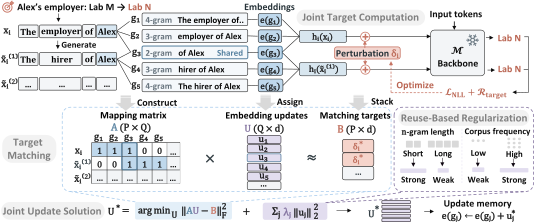
We thank the contributors and open-source projects that support EngramEdit with models, editing utilities, datasets, and evaluation resources.





This project is licensed under the MIT License. Third-party resources remain subject to their respective licenses.
|
🌟 AlphaEdit GitHub Repo |
🚀 MoEEdit GitHub Repo |
Please cite our paper as:
@misc{cai2026engramedit,
  title  = {EngramEdit: Decoupled Knowledge Updates in LLMs through Conditional Memory},
  author = {Hongru Cai and Ran Wei and Wenjie Wang and Chengfa Wu and Ning Song and Yongqi Li and Wenjie Li},
  year   = {2026},
  eprint = {2610.10533},
  archivePrefix = {arXiv},
  primaryClass = {cs.CL},
  url    = {https://arxiv.org/abs/2610.10533}
}


"EngramEdit: Decoupled Knowledge Updates in LLMs through Conditional Memory"
See the code
Conditional memory expands an LLM’s capacity through learned n-gram embeddings. At each token position, the model uses token sequences of different lengths ending at that position to look up embeddings that participate in its computation. EngramEdit enables factual knowledge updates through this memory. It first computes the memory representations needed to predict revised facts, then jointly updates the corresponding embeddings across expressions and edits. Stronger penalties on frequently reused embeddings help preserve unrelated knowledge. Updated facts remain usable across different expressions and in multi-hop reasoning, while general capabilities are largely preserved.
From conditional memory to an editable knowledge interface.
Use Python 3.11 or 3.12 with PyTorch 2.9.1. The commands below install the CUDA 12.8 build:
conda create -n engramedit python=3.11 -y
conda activate engramedit
pip install torch==2.9.1 --index-url https://download.pytorch.org/whl/cu128
pip install -r requirements.txt
Preparation has three steps: download the data, generate additional expressions, and estimate n-gram frequencies for regularization. Dataset identifiers are mcf (CounterFact), zsre, and mquake.
Download LongCat-Flash-Lite, the editing benchmarks, and the tokenization resources.
hf download meituan-longcat/LongCat-Flash-Lite --local-dir data/LongCat-Flash-Lite
python scripts/prepare/download.py --datasets mcf zsre mquake
python -m nltk.downloader punkt punkt_tab
Use the model to generate alternative expressions of each fact. --limit sets how many dataset cases to process, starting from the first case; --target_count sets the requested number of valid additional expressions per fact.
python scripts/prepare/expressions.py --dataset mcf --limit 2000 --target_count 4
python scripts/prepare/expressions.py --dataset zsre --limit 2000 --target_count 4
python scripts/prepare/expressions.py --dataset mquake --limit 3000 --target_count 4
[!NOTE] Defaults are 2,000 facts for CounterFact and ZsRE, 3,000 cases for MQuAKE, and four generated expressions per fact. Each MQuAKE case may contain multiple facts, which receive expressions separately.
The cache records how often the relevant n-grams occur in Wikipedia, so regularization can apply stronger penalties to frequently reused embeddings. Download Wikipedia once for all datasets:
python scripts/prepare/download.py --wikipedia
Then build a cache for each dataset. --dataset_size_limit sets the number of cases covered, --paraphrase_append_count sets the number of generated expressions used per fact, and --max_docs limits the number of Wikipedia documents scanned.
python scripts/prepare/frequency.py --dataset mcf \
  --dataset_size_limit 2000 --paraphrase_append_count 4 --max_docs 3000000
python scripts/prepare/frequency.py --dataset zsre \
  --dataset_size_limit 2000 --paraphrase_append_count 4 --max_docs 3000000
python scripts/prepare/frequency.py --dataset mquake \
  --dataset_size_limit 3000 --paraphrase_append_count 4 --max_docs 3000000
[!NOTE]
- Lower
--max_docsfor a smaller counting run. This limits the documents scanned, not the Wikipedia download size.- Prepare expressions and a cache covering all cases to be edited. Keep
--paraphrase_append_countconsistent between caching and editing, with at least that many generated expressions per fact.
After data preparation, run EngramEdit with the following commands.
For CounterFact:
bash scripts/run_mcf.sh
For ZsRE:
bash scripts/run_zsre.sh
For MQuAKE:
bash scripts/run_mquake.sh
These scripts use the default editing settings and save results and checkpoints to results/<dataset>.
[!NOTE]
- Training includes automatic evaluation, so a separate evaluation run is usually unnecessary.
- You can change the editing settings in the scripts, such as
--num_editsfor batch size and--paraphrase_append_countfor expression count. Prepare matching expressions and frequency caches when changing data settings.- To skip editing and evaluate directly, use our 🤗 Hugging Face checkpoints with the commands below.
To evaluate saved checkpoints, place each dataset's engramedit_state.pt in checkpoints/<dataset> and run the commands below.
For CounterFact:
python -m experiments.checkpoint \
  --model_name data/LongCat-Flash-Lite \
  --state_dir checkpoints/mcf --ds_name mcf --dataset_size_limit 2000 \
  --output_dir results/eval_mcf
Add --generation_tests to also evaluate Fluency and Consistency.
For ZsRE:
python -m experiments.checkpoint \
  --model_name data/LongCat-Flash-Lite \
  --state_dir checkpoints/zsre --ds_name zsre --dataset_size_limit 2000 \
  --output_dir results/eval_zsre
For MQuAKE:
python -m experiments.checkpoint \
  --model_name data/LongCat-Flash-Lite \
  --state_dir checkpoints/mquake --ds_name mquake --dataset_size_limit 3000 \
  --output_dir results/eval_mquake
Results are saved to --output_dir.
After completing data preparation for CounterFact, this example edits one fact and compares the model's answers before and after editing.
import torch

from experiments.utils import load_model
from dsets import MultiCounterFactDataset
from EngramEdit import EngramEditHyperParams, apply_engramedit_to_model
from EngramEdit.engramedit_main import generate_context_templates

# Load the model and one edit request.
model, tokenizer = load_model("data/LongCat-Flash-Lite", "bfloat16")
hparams = EngramEditHyperParams.from_json(
    "hparams/EngramEdit/longcat-flash-lite_lenfreq.json"
)
record = MultiCounterFactDataset("data", size=1)[0]
request = {**record["requested_rewrite"], "case_id": record["case_id"]}
prompt = request["prompt"].format(request["subject"])


@torch.inference_mode()
def answer(prompt):
    inputs = tokenizer(prompt, return_tensors="pt").to(
        model.get_input_embeddings().weight.device
    )
    output = model.generate(
        **inputs, do_sample=False, max_new_tokens=32,
        pad_token_id=tokenizer.pad_token_id,
    )
    return tokenizer.decode(output[0, inputs.input_ids.shape[1]:], skip_special_tokens=True)


# Inspect the requested change and the original answer.
# Generated answers below are illustrative, not recorded outputs.
print("Prompt:", prompt)
# Prompt: The mother tongue of Danielle Darrieux is
print("Requested change:", request["target_true"]["str"], "->", request["target_new"]["str"])
# Requested change: French -> English
print("Before editing:", answer(prompt))
# Before editing: French

# Edit the fact using its prepared expressions and frequency cache.
model = apply_engramedit_to_model(
    model, tokenizer, [request], hparams,
    context_templates=generate_context_templates(model, tokenizer),
    paraphrase_path="data/mcf_longcat_before_subject.jsonl",
    ngram_frequency_cache="data/ngram_frequency/LongCat-Flash-Lite_mcf2000_para4.pt",
    paraphrase_append_count=4,
)

# Ask the same question after editing.
print("After editing:", answer(prompt))
# After editing: English
n-grams, accounting for embeddings shared across expressions and edits.
We thank the contributors and open-source projects that support EngramEdit with models, editing utilities, datasets, and evaluation resources.
This project is licensed under the MIT License. Third-party resources remain subject to their respective licenses.
|
🌟 AlphaEdit GitHub Repo |
🚀 MoEEdit GitHub Repo |
Please cite our paper as:
@misc{cai2026engramedit,
  title  = {EngramEdit: Decoupled Knowledge Updates in LLMs through Conditional Memory},
  author = {Hongru Cai and Ran Wei and Wenjie Wang and Chengfa Wu and Ning Song and Yongqi Li and Wenjie Li},
  year   = {2026},
  eprint = {2610.10533},
  archivePrefix = {arXiv},
  primaryClass = {cs.CL},
  url    = {https://arxiv.org/abs/2610.10533}
}







