RBE-style remote build execution for Nix (external-builders)
Rust
56
592 commits
updated Oct 19, 2026
Remote build execution for Nix, built on the experimental
external-builders feature. A hub next to the nix-daemon hands builds
to remote workers. Workers run them in their own sandboxes and stream
logs and outputs back to the waiting nix build.
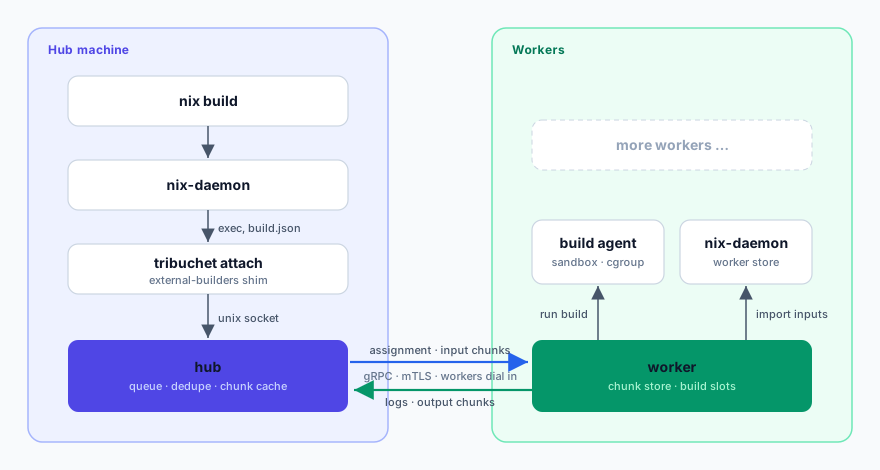
Status: experimental. It depends on Nix's experimental
external-buildersfeature (plus a small patch for uid-range builds). Protocol and configuration may still change.
--builders / the SSH build hook?The classic remote build protocol needs SSH reachability into every builder and Nix installed there, and it copies closures without any scheduling. Tribuchet receives the complete build environment from Nix and owns transfer, scheduling and execution itself.
kvm, uid-range, big-parallel, …). Identical submissions share
one build.nix build
goes away.uid-range builds and cross-system user-mode emulation.fod-network) filters
destinations.max-log-size,
max-silent-time and timeout enforcement.Tribuchet is one binary with four subcommands: hub, worker,
attach (the shim Nix execs) and ca.
Workers authenticate to the hub with client certificates from a private CA:
$ tribuchet ca init   --dir ./ca
$ tribuchet ca issue hub     --dir ./ca   # SAN must match the hub address workers dial
$ tribuchet ca issue worker  --dir ./ca   # one per worker
The hub reads hub.crt, hub.key and ca.crt from <config-dir>/ca
(default /etc/tribuchet/ca). Each worker gets ca.crt plus its own
key pair (default /var/lib/tribuchet/tls/).
Alternatively set auth = "tailscale" on both sides to skip TLS. The
worker dials http://<hub-tailnet-name>:7437. The hub looks each peer
up in tailscaled's LocalAPI, rejects anything not on the tailnet, and
uses the node name as the worker identity. Restrict registration to
ACL tags with tailscale-allowed-tags = ["tag:tribuchet-worker"].
/etc/tribuchet/hub.toml:
socket = "/run/tribuchet/hub.sock"   # for tribuchet attach
listen = "0.0.0.0:7437"              # for workers
config-dir = "/etc/tribuchet"
Point Nix at the attach shim in nix.conf:
experimental-features = external-builders
external-builders = [{"systems":["x86_64-linux","aarch64-linux"],"program":"/path/to/tribuchet-attach"}]
where tribuchet-attach is a wrapper script:
#!/bin/sh
exec tribuchet attach "$1" --socket /run/tribuchet/hub.sock
A worker needs its own nix-daemon. Inputs are imported through it and held by temp roots against garbage collection. The worker runs unprivileged and leases each build to a per-uid agent service (set up by the NixOS and nix-darwin modules) that owns the builder process and its uid block.
/etc/tribuchet/worker.toml:
hub = "https://hub.example.org:7437"
max-jobs = 4
max-log-size = 67108864

[emulate]
aarch64-linux = "/path/to/static/qemu-aarch64"
$ tribuchet worker --config /etc/tribuchet/worker.toml
Hub and worker each keep a chunk cache under XDG_CACHE_HOME/tribuchet,
10 GiB by default. A warm worker only receives chunks it does not
hold. Tune with chunk-cache-bytes (hub) and chunk-store-bytes
(worker). The cache can be deleted while the process is stopped.
All options for both files are documented in
crates/tribuchet/src/config.rs.
The worker's TLS paths can be overridden with TRIBUCHET_CA_CERT,
TRIBUCHET_CERT and TRIBUCHET_KEY, e.g. to point at a key delivered
by systemd LoadCredential. The NixOS module's
services.tribuchet-worker.keyFile does this.
Import tribuchet.nixosModules.default (flake input
github:Mic92/tribuchet) and enable the services:
{
  # hub machine
  services.tribuchet-hub.enable = true;
  # optional: route this machine's nix-daemon builds through the hub
  services.tribuchet-hub.externalBuilders = {
    enable = true;
    systems = [ "x86_64-linux" "aarch64-linux" ];
  };

  # worker machines
  services.tribuchet-worker = {
    enable = true;
    settings = {
      hub = "https://hub.example.org:7437";
      # Concurrent builds. Defaults to the core count at runtime, up
      # to 64 (32 on darwin). Set explicitly to go beyond or below.
      # max-jobs = 128;
    };
  };
}
The hub unit is socket-activated. The worker unit reloads instead of restarting on package or settings changes, so running builds survive deploys.
tribuchet.darwinModules.default provides the same two services for
launchd. The hub adopts its sockets from launchd. The worker daemon
execs through a stable symlink that activation flips and then SIGHUPs,
which again keeps builds alive across upgrades.
For hosts without Nix the flake builds an OCI image,
packages.x86_64-linux.worker-image. CI publishes the same image for
x86_64-linux and aarch64-linux as ghcr.io/mic92/tribuchet-worker,
tagged main and per release. It carries its own Nix store,
starts a nix-daemon and the worker, and spawns build agents according
to spawn-agents and agent-uid-base in worker.toml. It needs no
added capabilities, but the sandbox creates namespaces and mounts,
which the default runtime seccomp profile forbids. Use the profile
from packages.x86_64-linux.seccomp-profile and unmask /proc:
$ podman run -d --name tribuchet-worker \
    -v /etc/tribuchet:/etc/tribuchet:ro \
    -v tribuchet-nix:/nix \
    --security-opt seccomp=$(nix build --print-out-paths .#seccomp-profile) \
    --security-opt unmask=ALL \
    ghcr.io/mic92/tribuchet-worker:main
The one extra syscall rule the sandbox needs is also available on its
own in nix/seccomp-additions.json, to
append to a base profile of your choice.
For docker replace unmask=ALL with systempaths=unconfined. On
Kubernetes ship the profile as a Localhost seccomp profile, or fall
back to Unconfined, and set procMount: Unmasked.
Compared to the NixOS module the agents get no delegated cgroup, so
build-memory-max and uid-range builds are unavailable. The /nix
volume is only a cache. The daemon garbage-collects it via the
min-free and max-free settings baked into the image.
Set metrics-listen = "127.0.0.1:7438" in hub.toml and the hub serves
/metrics there, over plain HTTP.
| metric | type | labels | meaning |
|---|---|---|---|
tribuchet_builds_submitted_total | counter | builds accepted for scheduling | |
tribuchet_builds_declined_total | counter | builds declined because no capable worker registered in time | |
tribuchet_builds_requeued_total | counter | builds requeued after a worker session was lost | |
tribuchet_builds_failed_total | counter | builds that ended in failure | |
tribuchet_builds_succeeded_total | counter | builds that completed | |
tribuchet_system_builds | gauge | system, state = queued, running | builds in each state. Sum the queued series for the queue depth |
tribuchet_system_slots | gauge | system | build slots of connected workers. A worker serving several systems counts in each. Free slots are slots - running |
tribuchet_workers_connected | gauge | workers with an open session | |
tribuchet_workers_for_system | gauge | system | connected workers advertising a system |
tribuchet_queue_seconds | histogram | system | time a build waited for a worker, per attempt. Its _count is the number of dispatches |
tribuchet_build_seconds | histogram | system | wall time of a build on its worker |
tribuchet_build_cpu_seconds | histogram | system | CPU time of a build |
tribuchet_build_peak_memory_bytes | histogram | system | peak memory of a build |
tribuchet_worker_messages_total | counter | type | messages received from workers |
tribuchet_worker_message_bytes_total | counter | type | encoded bytes of those messages |
GET /workers on the same port lists the connected workers as indented
JSON, sorted by name, with name, systems and their features, max_jobs
and connected_seconds.
On Linux workers with /dev/net/tun, fixed-output builds run in a
private network namespace and reach the outside through the embedded
presto-pasta user-mode NAT. The worker's loopback services and
abstract sockets are never reachable from there. On top of that the
optional fod-network setting filters which destinations such builds
may connect to. It lives in the worker's freeform settings, so with
the NixOS module it is plain Nix:
services.tribuchet-worker.settings.fod-network = {
  # action when no rule matches (default: "allow")
  default = "allow";

  # ordered rules, first match wins
  rules = [
    {
      action = "deny";
      dst = "private"; # loopback, RFC 1918, link-local, ULA, CGNAT, ...
    }
    {
      action = "allow";
      dst = "10.20.0.15"; # single IP or CIDR, IPv4 or IPv6
      ports = [ "443" ];
    }
    {
      action = "deny";
      proto = "tcp"; # "tcp", "udp" or "any" (default)
      dst = "any";
      ports = [
        "25"
        "465"
        "587"
        "8000-8999"
      ];
    }
  ];
};
Without the module the same structure goes into worker.toml as a
[fod-network] table with [[fod-network.rules]] entries.
Each rule matches on the destination of a new outbound connection:
dst: "any", "private" (everything non-public: loopback,
RFC 1918, link-local, ULA, CGNAT, multicast), a single IP, or a CIDR
like "192.0.2.0/24" or "2001:db8::/32".proto: "tcp", "udp" or "any".ports: destination ports, single ("443") or inclusive ranges
("8000-8999"). Empty or omitted means any port.Rules are evaluated in order for every new flow before a host socket
is created. Denied connections never leave the sandbox: a TCP SYN gets
no answer. Rules are IP-based on purpose. Hostname rules would only
apply to whatever a name resolves to at connect time, and a build
resolving names itself bypasses them trivially. presto-pasta forwards
DNS lookups to the host resolver independently of these rules, so a
deny rule cannot break name resolution.
tribuchet attach build.json. The shim submits the build
to the hub over the unix socket.nix build.DESIGN.md describes the architecture, sandbox, security
model and failure handling in detail. spec/ holds Quint
models of worker staging and the transfer protocol, proven as flake
checks.
$ nix develop            # rust toolchain + protobuf
$ cargo test
$ cargo clippy --all-targets
$ nix build .#checks.x86_64-linux.nixos-test-builds     # end-to-end VM test (hub + worker)
$ nix build .#checks.x86_64-linux.nixos-test-nspawn     # NixOS-container build in the sandbox
$ nix build .#checks.x86_64-linux.nixos-test-lifecycle  # daemon restart/reload/stop sequence
$ nix build .#checks.x86_64-linux.spec-protocol         # inductive proof of spec/protocol.qnt
The VM tests exercise remote builds, hub and worker restarts and reloads mid-build, cancellation, log limits, uid-range and emulated builds, and fixed-output networking.
616 followers · starred Jul 2026
270 followers · starred Aug 2026
140 followers · starred Aug 2026
253 followers · starred Jun 2026
RBE-style remote build execution for Nix (external-builders)
Rust
56
592 commits
updated Oct 19, 2026
Remote build execution for Nix, built on the experimental
external-builders feature. A hub next to the nix-daemon hands builds
to remote workers. Workers run them in their own sandboxes and stream
logs and outputs back to the waiting nix build.
Status: experimental. It depends on Nix's experimental
external-buildersfeature (plus a small patch for uid-range builds). Protocol and configuration may still change.
--builders / the SSH build hook?The classic remote build protocol needs SSH reachability into every builder and Nix installed there, and it copies closures without any scheduling. Tribuchet receives the complete build environment from Nix and owns transfer, scheduling and execution itself.
kvm, uid-range, big-parallel, …). Identical submissions share
one build.nix build
goes away.uid-range builds and cross-system user-mode emulation.fod-network) filters
destinations.max-log-size,
max-silent-time and timeout enforcement.Tribuchet is one binary with four subcommands: hub, worker,
attach (the shim Nix execs) and ca.
Workers authenticate to the hub with client certificates from a private CA:
$ tribuchet ca init   --dir ./ca
$ tribuchet ca issue hub     --dir ./ca   # SAN must match the hub address workers dial
$ tribuchet ca issue worker  --dir ./ca   # one per worker
The hub reads hub.crt, hub.key and ca.crt from <config-dir>/ca
(default /etc/tribuchet/ca). Each worker gets ca.crt plus its own
key pair (default /var/lib/tribuchet/tls/).
Alternatively set auth = "tailscale" on both sides to skip TLS. The
worker dials http://<hub-tailnet-name>:7437. The hub looks each peer
up in tailscaled's LocalAPI, rejects anything not on the tailnet, and
uses the node name as the worker identity. Restrict registration to
ACL tags with tailscale-allowed-tags = ["tag:tribuchet-worker"].
/etc/tribuchet/hub.toml:
socket = "/run/tribuchet/hub.sock"   # for tribuchet attach
listen = "0.0.0.0:7437"              # for workers
config-dir = "/etc/tribuchet"
Point Nix at the attach shim in nix.conf:
experimental-features = external-builders
external-builders = [{"systems":["x86_64-linux","aarch64-linux"],"program":"/path/to/tribuchet-attach"}]
where tribuchet-attach is a wrapper script:
#!/bin/sh
exec tribuchet attach "$1" --socket /run/tribuchet/hub.sock
A worker needs its own nix-daemon. Inputs are imported through it and held by temp roots against garbage collection. The worker runs unprivileged and leases each build to a per-uid agent service (set up by the NixOS and nix-darwin modules) that owns the builder process and its uid block.
/etc/tribuchet/worker.toml:
hub = "https://hub.example.org:7437"
max-jobs = 4
max-log-size = 67108864

[emulate]
aarch64-linux = "/path/to/static/qemu-aarch64"
$ tribuchet worker --config /etc/tribuchet/worker.toml
Hub and worker each keep a chunk cache under XDG_CACHE_HOME/tribuchet,
10 GiB by default. A warm worker only receives chunks it does not
hold. Tune with chunk-cache-bytes (hub) and chunk-store-bytes
(worker). The cache can be deleted while the process is stopped.
All options for both files are documented in
crates/tribuchet/src/config.rs.
The worker's TLS paths can be overridden with TRIBUCHET_CA_CERT,
TRIBUCHET_CERT and TRIBUCHET_KEY, e.g. to point at a key delivered
by systemd LoadCredential. The NixOS module's
services.tribuchet-worker.keyFile does this.
Import tribuchet.nixosModules.default (flake input
github:Mic92/tribuchet) and enable the services:
{
  # hub machine
  services.tribuchet-hub.enable = true;
  # optional: route this machine's nix-daemon builds through the hub
  services.tribuchet-hub.externalBuilders = {
    enable = true;
    systems = [ "x86_64-linux" "aarch64-linux" ];
  };

  # worker machines
  services.tribuchet-worker = {
    enable = true;
    settings = {
      hub = "https://hub.example.org:7437";
      # Concurrent builds. Defaults to the core count at runtime, up
      # to 64 (32 on darwin). Set explicitly to go beyond or below.
      # max-jobs = 128;
    };
  };
}
The hub unit is socket-activated. The worker unit reloads instead of restarting on package or settings changes, so running builds survive deploys.
tribuchet.darwinModules.default provides the same two services for
launchd. The hub adopts its sockets from launchd. The worker daemon
execs through a stable symlink that activation flips and then SIGHUPs,
which again keeps builds alive across upgrades.
For hosts without Nix the flake builds an OCI image,
packages.x86_64-linux.worker-image. CI publishes the same image for
x86_64-linux and aarch64-linux as ghcr.io/mic92/tribuchet-worker,
tagged main and per release. It carries its own Nix store,
starts a nix-daemon and the worker, and spawns build agents according
to spawn-agents and agent-uid-base in worker.toml. It needs no
added capabilities, but the sandbox creates namespaces and mounts,
which the default runtime seccomp profile forbids. Use the profile
from packages.x86_64-linux.seccomp-profile and unmask /proc:
$ podman run -d --name tribuchet-worker \
    -v /etc/tribuchet:/etc/tribuchet:ro \
    -v tribuchet-nix:/nix \
    --security-opt seccomp=$(nix build --print-out-paths .#seccomp-profile) \
    --security-opt unmask=ALL \
    ghcr.io/mic92/tribuchet-worker:main
The one extra syscall rule the sandbox needs is also available on its
own in nix/seccomp-additions.json, to
append to a base profile of your choice.
For docker replace unmask=ALL with systempaths=unconfined. On
Kubernetes ship the profile as a Localhost seccomp profile, or fall
back to Unconfined, and set procMount: Unmasked.
Compared to the NixOS module the agents get no delegated cgroup, so
build-memory-max and uid-range builds are unavailable. The /nix
volume is only a cache. The daemon garbage-collects it via the
min-free and max-free settings baked into the image.
Set metrics-listen = "127.0.0.1:7438" in hub.toml and the hub serves
/metrics there, over plain HTTP.
| metric | type | labels | meaning |
|---|---|---|---|
tribuchet_builds_submitted_total | counter | builds accepted for scheduling | |
tribuchet_builds_declined_total | counter | builds declined because no capable worker registered in time | |
tribuchet_builds_requeued_total | counter | builds requeued after a worker session was lost | |
tribuchet_builds_failed_total | counter | builds that ended in failure | |
tribuchet_builds_succeeded_total | counter | builds that completed | |
tribuchet_system_builds | gauge | system, state = queued, running | builds in each state. Sum the queued series for the queue depth |
tribuchet_system_slots | gauge | system | build slots of connected workers. A worker serving several systems counts in each. Free slots are slots - running |
tribuchet_workers_connected | gauge | workers with an open session | |
tribuchet_workers_for_system | gauge | system | connected workers advertising a system |
tribuchet_queue_seconds | histogram | system | time a build waited for a worker, per attempt. Its _count is the number of dispatches |
tribuchet_build_seconds | histogram | system | wall time of a build on its worker |
tribuchet_build_cpu_seconds | histogram | system | CPU time of a build |
tribuchet_build_peak_memory_bytes | histogram | system | peak memory of a build |
tribuchet_worker_messages_total | counter | type | messages received from workers |
tribuchet_worker_message_bytes_total | counter | type | encoded bytes of those messages |
GET /workers on the same port lists the connected workers as indented
JSON, sorted by name, with name, systems and their features, max_jobs
and connected_seconds.
On Linux workers with /dev/net/tun, fixed-output builds run in a
private network namespace and reach the outside through the embedded
presto-pasta user-mode NAT. The worker's loopback services and
abstract sockets are never reachable from there. On top of that the
optional fod-network setting filters which destinations such builds
may connect to. It lives in the worker's freeform settings, so with
the NixOS module it is plain Nix:
services.tribuchet-worker.settings.fod-network = {
  # action when no rule matches (default: "allow")
  default = "allow";

  # ordered rules, first match wins
  rules = [
    {
      action = "deny";
      dst = "private"; # loopback, RFC 1918, link-local, ULA, CGNAT, ...
    }
    {
      action = "allow";
      dst = "10.20.0.15"; # single IP or CIDR, IPv4 or IPv6
      ports = [ "443" ];
    }
    {
      action = "deny";
      proto = "tcp"; # "tcp", "udp" or "any" (default)
      dst = "any";
      ports = [
        "25"
        "465"
        "587"
        "8000-8999"
      ];
    }
  ];
};
Without the module the same structure goes into worker.toml as a
[fod-network] table with [[fod-network.rules]] entries.
Each rule matches on the destination of a new outbound connection:
dst: "any", "private" (everything non-public: loopback,
RFC 1918, link-local, ULA, CGNAT, multicast), a single IP, or a CIDR
like "192.0.2.0/24" or "2001:db8::/32".proto: "tcp", "udp" or "any".ports: destination ports, single ("443") or inclusive ranges
("8000-8999"). Empty or omitted means any port.Rules are evaluated in order for every new flow before a host socket
is created. Denied connections never leave the sandbox: a TCP SYN gets
no answer. Rules are IP-based on purpose. Hostname rules would only
apply to whatever a name resolves to at connect time, and a build
resolving names itself bypasses them trivially. presto-pasta forwards
DNS lookups to the host resolver independently of these rules, so a
deny rule cannot break name resolution.
tribuchet attach build.json. The shim submits the build
to the hub over the unix socket.nix build.DESIGN.md describes the architecture, sandbox, security
model and failure handling in detail. spec/ holds Quint
models of worker staging and the transfer protocol, proven as flake
checks.
$ nix develop            # rust toolchain + protobuf
$ cargo test
$ cargo clippy --all-targets
$ nix build .#checks.x86_64-linux.nixos-test-builds     # end-to-end VM test (hub + worker)
$ nix build .#checks.x86_64-linux.nixos-test-nspawn     # NixOS-container build in the sandbox
$ nix build .#checks.x86_64-linux.nixos-test-lifecycle  # daemon restart/reload/stop sequence
$ nix build .#checks.x86_64-linux.spec-protocol         # inductive proof of spec/protocol.qnt
The VM tests exercise remote builds, hub and worker restarts and reloads mid-build, cancellation, log limits, uid-range and emulated builds, and fixed-output networking.
616 followers · starred Jul 2026
270 followers · starred Aug 2026
140 followers · starred Aug 2026
253 followers · starred Jun 2026