Nix remote store and build farm over gRPC: faster nix copy than ssh-ng, with mTLS and a scheduler for builders
C++
55
302 commits
updated Oct 19, 2026
Status: Stable.
Remote Nix store access over gRPC instead of SSH. nix copy over a WAN
link is 5.5x faster than ssh-ng:// because round trips are hidden:
path-info queries are batched and NAR downloads are pipelined, so wall time
is bandwidth-bound instead of latency-bound.
Why gRPC instead of ssh-ng://?
nix copy. One RPC batches the path queries
for a whole closure and one request per connection downloads all
NARs as a server-driven stream. Copying 200 small paths at 50 ms
RTT takes 1.3 s instead of the 11.8 s a round-trip-per-path client
needs.builders = or --store at one
grpc:// address and the daemons behind it spread the derivations
over all nodes, like Hydra's queue runner but for any Nix client and
without a database. See docs/farm.md.Everything that works over ssh-ng:// works here: remote builds,
nix copy, path queries, GC. The gRPC layer is a thin tunnel to the
nix-daemon on the other side, with dedicated RPCs for the nix copy hot
path (path info queries, bulk import, NAR download).
docs/latency.md shows the round trips each
operation costs as sequence diagrams.
nix copy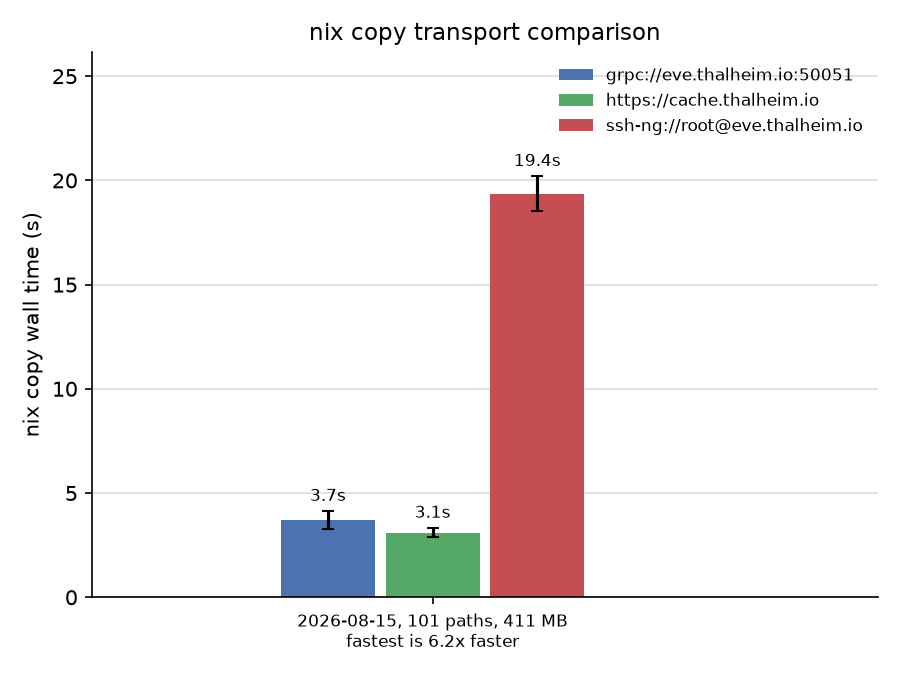
nix copy of a 101-path, 411 MB closure from the same server over a
wired link with ~47 ms RTT, 10 interleaved runs each.
A static HTTP binary cache stays ahead for pure downloads, but it is download-only. The gRPC store keeps close while also handling uploads, remote builds, GC and mTLS through the same endpoint.
Reproduce with ./scripts/bench-transports.py.
There are two ways to build on a remote machine:
builders =. For every
derivation Nix spawns a fresh build-remote helper process that
opens its own connections, uploads the inputs, runs the build and
downloads the outputs.nix build --store 'grpc://…'). One client process drives the
whole build graph over a single long-lived connection and outputs
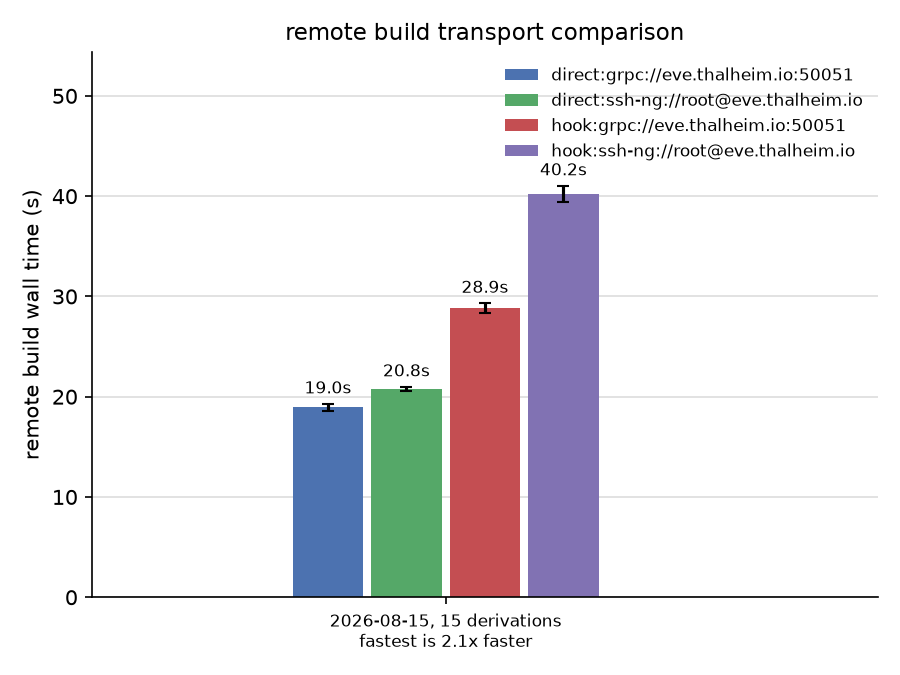
stay on the remote store.On a chain of tiny builds over a ~50 ms WAN link, grpc is 1.4x faster
than ssh-ng:// in hook mode: one streaming RPC submits a derivation
and returns the result with its output path infos, where ssh-ng pays
per-derivation ssh session setup. In direct mode the transports are
comparable, since a single long-lived connection serves the whole
build either way:
Reproduce with ./scripts/bench-builds.py.
nix build
This produces result/bin/nix-grpc-daemon for the server and
result/lib/nix/plugins/nix-grpc-store-loader.so for the client, which
dispatches to the plugin build matching the running Nix version.
For a client outside NixOS, nix build .#nix-with-plugin gives a nix
(and nix-build, nix-store, …) with the plugin already loaded. In
another flake, nix-grpc-store.lib.wrapNix pkgs pkgs.nix does the same
for any nixpkgs nix, for example to put into a CI image.
nix-grpc-store.lib.nixToolsWithPlugin pkgs returns nix,
nix-eval-jobs and nix-fast-build built from your pkgs, with the
plugin loaded in all of them. Use it in a dev shell, not in
environment.systemPackages (that would collide with nix.package):
inputs.nix-grpc-store.inputs.nixpkgs.follows = "nixpkgs";
# ...
devShells.x86_64-linux.default =
  let
    pkgs = nixpkgs.legacyPackages.x86_64-linux;
    tools = nix-grpc-store.lib.nixToolsWithPlugin pkgs;
  in
  pkgs.mkShell {
    packages = [ tools.nix tools.nix-eval-jobs tools.nix-fast-build ];
  };
nix build .#nix-tools-with-plugin builds the same set from this flake's
nixpkgs.
Add the flake and enable the modules:
# flake.nix inputs
nix-grpc-store.url = "github:Mic92/nix-grpc-store";

# server
imports = [ nix-grpc-store.nixosModules.server ];
services.nix-grpc-daemon.enable = true;
services.nix-grpc-daemon.tls = { certFile = ./server.pem; keyFile = ./server.key; };

# client
imports = [ nix-grpc-store.nixosModules.client ];
programs.nix-grpc-store.enable = true;
The client module ships plugin builds for the supported Nix versions and a
loader that picks the one matching the running Nix. The server module runs
the daemon as an unprivileged nix-grpc-daemon user and adds it to
extra-allowed-users so it can reach the local nix-daemon even when
allowed-users is restricted.
On the builder:
nix-grpc-daemon --listen 0.0.0.0:50051
On the client, use nix-with-plugin (or add
plugin-files = /path/to/lib/nix/plugins to nix.conf) and use it like
any other store URI:
nix store info --store 'grpc://builder:50051?insecure=1'
nix build nixpkgs#hello --store 'grpc://builder:50051?insecure=1'
nix copy --to 'grpc://builder:50051?insecure=1' ./result
The daemon proxies to the local nix-daemon socket, so gRPC clients get
whatever store privileges the uid running nix-grpc-daemon has.
Server:
nix-grpc-daemon --listen 0.0.0.0:50051 \
    --tls-cert server.pem --tls-key server.key \
    --client-ca ca.pem              # optional: require client certs
Client:
nix build --store \
  'grpc://builder:50051?ca-cert=ca.pem&client-cert=me.pem&client-key=me.key' ...
Without --client-ca any TLS client can connect. With it, only clients
presenting a certificate signed by that CA are accepted.
gRPC clients act as the nix-grpc-daemon user, which is not trusted by
default. That is enough for nix build --store 'grpc://…', nix copy,
path queries and GC: sources and derivations are content-addressed, signed
cache paths are accepted, and the server builds everything itself.
This makes an untrusting server usable as a builder without any special setup:
nix build nixpkgs#hello --store 'grpc://builder:50051' --eval-store auto
Evaluation runs locally (--eval-store auto keeps the eval artifacts in
the local store instead of round-tripping them to the server), the
derivation closure is imported — sources and .drv files are
content-addressed, so they pass signature checks — and all builds happen
server-side. Nothing unsigned crosses the trust boundary, so
trustClients can stay off.
Using the server as a remote builder (builders = grpc://…) is different:
there the client schedules builds and uploads input paths it built
locally, which are unsigned — something only trusted users may do. Set
services.nix-grpc-daemon.trustClients = true for that. Every
authenticated client then has trusted-user privileges, so require client
certs (tls.clientCaFile).
With mTLS, --allow 'cn-pattern=role' maps client certificate CNs to
roles via glob patterns. The first match wins and unmatched clients are
denied. Without any rules every authenticated client keeps full access.
nix-grpc-daemon ... --client-ca ca.pem \
    --allow 'ci-*=trusted' \
    --allow 'cache-mirror=read-only' \
    --allow '*=write' \
    --allow-anonymous read-only    # optional: cert-less clients
read-only — path queries and NAR downloads (nix copy --from)write — additionally imports (signature checking is enforced
regardless of --no-check-sigs) and server-side builds
(nix build --store 'grpc://…')trusted — everything, including the raw worker-protocol tunnel
(GC, nix store add, repair) and unsigned imports (still subject to
the nix-daemon's trust in the proxy user, see above)--allow-anonymous ROLE relaxes the client-certificate requirement:
cert-less clients connect with that role (e.g. a public read-only
cache), certificate holders keep their --allow roles. Naming policies
pair well with a CA like step-ca,
where provisioners constrain which CNs each token may request.
--trusted-proxy CN-PATTERN is for a TLS-terminating L7 balancer (envoy)
in front of the daemon. A peer presenting a certificate whose CN matches is
a proxy: the daemon takes the client's identity from the
x-forwarded-client-cert header it sets (Subject CN, evaluated against
--allow) or a forwarded bearer token, and treats the request as anonymous
if neither is present. From any other peer the header is ignored. The
proxy must overwrite the header (envoy forward_client_cert_details: SANITIZE_SET) and authenticate to the daemon with its own client cert.
NixOS:
services.nix-grpc-daemon.accessRules = [
  { cn = "ci-*"; role = "trusted"; }
  { cn = "*"; role = "read-only"; }
];
services.nix-grpc-daemon.anonymousRole = "read-only"; # optional
Role needed per use case:
| Use case | Role |
|---|---|
Substituter, nix copy --from | read-only |
nix copy --to (signed paths) | write |
nix build --store 'grpc://…' --eval-store auto | write |
Remote builder (nix.buildMachines) | trusted |
GC, --repair, nix store add | trusted |
Builds are submitted through a dedicated RPC and run entirely
server-side, so the write role suffices. Only operations that tunnel
the raw worker protocol need trusted, and repair builds are treated
like the rest of the repair surface.
For host-based access, pair this with a CA that issues certs with the
host's domain name in the CN, e.g. a
step-ca ACME provisioner with
forceCN = true: each host obtains its certificate via ordinary ACME
(security.acme) and an accessRules glob like *.example.com = read-only grants it substituter access. See
tests/acme-substituter-test.nix
for a complete, tested NixOS setup (built as the acme-vm check).
Instead of (or next to) client certificates the daemon accepts
authorization: Bearer <jwt> and maps token claims to the same roles.
--oidc-config FILE takes the JSON schema of
niks3's --oidc-config, so one file
can serve the cache and the daemon. Scopes map to roles: read →
read-only, write → write, admin → trusted.
{
  "providers": {
    "github": {
      "issuer": "https://token.actions.githubusercontent.com",
      "audience": "grpc://cache.example.com",
      "rules": [
        { "bound_subject": ["repo:myorg/*"], "scopes": ["write"] },
        { "bound_claims": { "ref": ["refs/heads/main"] }, "scopes": ["admin"] }
      ]
    },
    "k8s": {
      "audience": "grpc://cache.example.com",
      "ca_file": "/var/run/secrets/kubernetes.io/serviceaccount/ca.crt",
      "bearer_token_file": "/var/run/secrets/kubernetes.io/serviceaccount/token",
      "bound_claims": { "kubernetes.io.namespace": ["ci"] }
    }
  }
}
Without issuer, it is taken from bearer_token_file (Kubernetes
workload identity). jwks_url skips discovery. Signing keys are
fetched on first use and cached for an hour, so the daemon starts while
the issuer is down and refuses tokens until it comes back. A presented
client certificate takes precedence over a token. A verified token that
matches no rule is denied, it does not fall back to --allow-anonymous.
In logs and metrics the caller shows as oidc:<provider>:<sub>.
Clients pass the token with the token-file URI parameter or
$NIX_GRPC_TOKEN_FILE (default: token next to the default
client-cert). The file is re-read for every call, so rotating it in
place works. TLS is required.
NixOS: services.nix-grpc-daemon.oidc = { providers.github = { … }; };
One daemon is a farm of one: it schedules builds onto itself. More nodes behind a balancer, one of them the scheduler, with deduplicated builds and S3 outputs: see docs/farm.md for NixOS and docs/kubernetes.md for the Helm chart.

nix.buildMachines = [{
  hostName = "grpc://builder:50051";
  protocol = null;
  systems = [ "x86_64-linux" "aarch64-linux" ];
  maxJobs = 64;
}];
TLS uses the system CA bundle and the client key pair from
/run/nix-grpc-store or /var/lib/nix-grpc-store by default (see below).
With access control enabled, remote builders need the trusted role.
The builder protocol imports unsigned outputs built on the client,
which also requires trustClients (see above).
insecure — plaintext, no TLS (testing only)ca-cert — PEM CA to verify the server. Defaults to $NIX_SSL_CERT_FILE,
$SSL_CERT_FILE or the system CA bundleclient-cert, client-key — PEM pair to present for mTLS. Default to
$NIX_GRPC_CLIENT_CERT/$NIX_GRPC_CLIENT_KEY, then client.crt/client.key
in $XDG_DATA_HOME/nix-grpc-store, then /run/nix-grpc-store, then
/var/lib/nix-grpc-store (unreadable candidates are skipped, and none
is looked up when token-file is given)token-file — OIDC bearer token, re-read per call. Defaults to
$NIX_GRPC_TOKEN_FILE, then token in the directories aboveconnect-timeout (default 30) — seconds the first call keeps retrying
"connection refused" and similar.restart-grace (default 120) — once the server has answered, seconds
to ride out a worker or scheduler restart, and to wait while the
scheduler says no worker can take a build.reschedule-retries (default 8) — how often a derivation whose
assigned worker went away is handed back to the scheduler.max-builds (default 64) — concurrent BuildDerivation streams.system — send x-nix-system on every call, not just builds, so a
balancer routes input uploads and substitution to a worker of that
system. Use one nix.buildMachines entry per system.debug — print which CA bundle and client certificate were loaded and
turn on gRPC's TCP/TLS handshake tracing on stderr. NIX_GRPC_DEBUG=1
does the same and also reaches the build hook.--listen ADDR — default 0.0.0.0:50051--proxy-socket PATH — nix-daemon socket, default /nix/var/nix/daemon-socket/socket--tls-cert, --tls-key, --client-ca — see above--allow 'cn-pattern=role', --allow-anonymous ROLE, --trusted-proxy CN-PATTERN — see access control--oidc-config FILE — accept OIDC bearer tokens, see access control--metrics-listen ADDR — serve Prometheus metrics, disabled if unset--worker-name NAME — name in build-log prefixes and nix_grpc_build_info, default hostname--role builder,scheduler, --scheduler ADDR, --scheduler-token-file FILE, --advertise IP:PORT, --max-jobs N, --min-free SIZE — see docs/farm.md. The defaults make a single node schedule onto itself--niks3 URL [--niks3-token-file FILE] [--niks3-client-cert FILE --niks3-client-key FILE] [--niks3-push CMD] — publish build outputs and uploads to a niks3 cache; authenticate with a bearer token, a client certificate (defaults to --tls-cert/--tls-key), or both--log-level info|debug — access log verbosity, default infoAll gRPC clients act as the same local user, so activity is attributed to the
client certificate CN (cn=- without mTLS). Have your CA put a user name in
the CN and logs and metrics are per user.
The daemon writes one logfmt line per RPC to stderr (journald):
ts=2025-01-15T12:03:41Z level=info event=rpc method=Connect cn=alice peer=ipv4:10.0.0.5:53211 duration_s=1832 bytes_in=52341 bytes_out=812345678
| event | logged for | extra fields |
|---|---|---|
rpc | tunnel sessions, transfers, builds | duration, then per method: bytes in/out, path count, NAR bytes, drv |
rpc_start, path queries | only at --log-level debug |
Every line carries the client certificate CN and the peer address, so one user's activity is a grep away:
journalctl -u nix-grpc-daemon | grep cn=alice
With --metrics-listen 127.0.0.1:9464 (NixOS:
services.nix-grpc-daemon.metricsListen) the daemon serves /metrics:
| metric | labels | counts |
|---|---|---|
nix_grpc_rpcs_total | method, cn | RPCs handled |
nix_grpc_tunnel_bytes_total | direction, cn | uncompressed tunnel bytes |
nix_grpc_nar_bytes_total | direction, cn | uncompressed NAR bytes imported/exported |
nix_grpc_build_info | version, worker, system, features | constant 1, for joins and version skew |
nix_grpc_sched | kind = queued, workers, clients, leader | scheduler state |
nix_grpc_sched_system | system, features, kind = queued, unplaceable, running, slots, free | queue (by required features) and capacity (by offered features), for autoscaling |
nix_grpc_events_total | kind | assigned, cached, attached, expect_no_show, unexpected_build, … |
nix_grpc_build_failures_total | reason | failed builds, by Nix failure status: PermanentFailure, TimedOut, TransientFailure, … |
Only CA-issued CNs appear as labels, so cardinality stays bounded.
nix build .#checks.x86_64-linux.vm -L
End-to-end NixOS VM test plus a 256 MiB throughput benchmark against the unix
socket and perf counters. See src/pump.hh for design notes on chunk
coalescing and flushable zstd.
nix build .#bench-latency -L
VM benchmark measuring nix copy of 200 small paths at an emulated 50 ms
RTT. scripts/bench-transports.py and scripts/bench-builds.py
benchmark real hosts and scripts/bench-plot.py renders the charts
above.
2,589 followers · starred Jul 2026
1,021 followers · starred Sep 2026
616 followers · starred Jul 2026
1,260 followers · starred Sep 2026
Nix remote store and build farm over gRPC: faster nix copy than ssh-ng, with mTLS and a scheduler for builders
C++
55
302 commits
updated Oct 19, 2026
Status: Stable.
Remote Nix store access over gRPC instead of SSH. nix copy over a WAN
link is 5.5x faster than ssh-ng:// because round trips are hidden:
path-info queries are batched and NAR downloads are pipelined, so wall time
is bandwidth-bound instead of latency-bound.
Why gRPC instead of ssh-ng://?
nix copy. One RPC batches the path queries
for a whole closure and one request per connection downloads all
NARs as a server-driven stream. Copying 200 small paths at 50 ms
RTT takes 1.3 s instead of the 11.8 s a round-trip-per-path client
needs.builders = or --store at one
grpc:// address and the daemons behind it spread the derivations
over all nodes, like Hydra's queue runner but for any Nix client and
without a database. See docs/farm.md.Everything that works over ssh-ng:// works here: remote builds,
nix copy, path queries, GC. The gRPC layer is a thin tunnel to the
nix-daemon on the other side, with dedicated RPCs for the nix copy hot
path (path info queries, bulk import, NAR download).
docs/latency.md shows the round trips each
operation costs as sequence diagrams.
nix copy
nix copy of a 101-path, 411 MB closure from the same server over a
wired link with ~47 ms RTT, 10 interleaved runs each.
A static HTTP binary cache stays ahead for pure downloads, but it is download-only. The gRPC store keeps close while also handling uploads, remote builds, GC and mTLS through the same endpoint.
Reproduce with ./scripts/bench-transports.py.
There are two ways to build on a remote machine:
builders =. For every
derivation Nix spawns a fresh build-remote helper process that
opens its own connections, uploads the inputs, runs the build and
downloads the outputs.nix build --store 'grpc://…'). One client process drives the
whole build graph over a single long-lived connection and outputs
stay on the remote store.On a chain of tiny builds over a ~50 ms WAN link, grpc is 1.4x faster
than ssh-ng:// in hook mode: one streaming RPC submits a derivation
and returns the result with its output path infos, where ssh-ng pays
per-derivation ssh session setup. In direct mode the transports are
comparable, since a single long-lived connection serves the whole
build either way:
Reproduce with ./scripts/bench-builds.py.
nix build
This produces result/bin/nix-grpc-daemon for the server and
result/lib/nix/plugins/nix-grpc-store-loader.so for the client, which
dispatches to the plugin build matching the running Nix version.
For a client outside NixOS, nix build .#nix-with-plugin gives a nix
(and nix-build, nix-store, …) with the plugin already loaded. In
another flake, nix-grpc-store.lib.wrapNix pkgs pkgs.nix does the same
for any nixpkgs nix, for example to put into a CI image.
nix-grpc-store.lib.nixToolsWithPlugin pkgs returns nix,
nix-eval-jobs and nix-fast-build built from your pkgs, with the
plugin loaded in all of them. Use it in a dev shell, not in
environment.systemPackages (that would collide with nix.package):
inputs.nix-grpc-store.inputs.nixpkgs.follows = "nixpkgs";
# ...
devShells.x86_64-linux.default =
  let
    pkgs = nixpkgs.legacyPackages.x86_64-linux;
    tools = nix-grpc-store.lib.nixToolsWithPlugin pkgs;
  in
  pkgs.mkShell {
    packages = [ tools.nix tools.nix-eval-jobs tools.nix-fast-build ];
  };
nix build .#nix-tools-with-plugin builds the same set from this flake's
nixpkgs.
Add the flake and enable the modules:
# flake.nix inputs
nix-grpc-store.url = "github:Mic92/nix-grpc-store";

# server
imports = [ nix-grpc-store.nixosModules.server ];
services.nix-grpc-daemon.enable = true;
services.nix-grpc-daemon.tls = { certFile = ./server.pem; keyFile = ./server.key; };

# client
imports = [ nix-grpc-store.nixosModules.client ];
programs.nix-grpc-store.enable = true;
The client module ships plugin builds for the supported Nix versions and a
loader that picks the one matching the running Nix. The server module runs
the daemon as an unprivileged nix-grpc-daemon user and adds it to
extra-allowed-users so it can reach the local nix-daemon even when
allowed-users is restricted.
On the builder:
nix-grpc-daemon --listen 0.0.0.0:50051
On the client, use nix-with-plugin (or add
plugin-files = /path/to/lib/nix/plugins to nix.conf) and use it like
any other store URI:
nix store info --store 'grpc://builder:50051?insecure=1'
nix build nixpkgs#hello --store 'grpc://builder:50051?insecure=1'
nix copy --to 'grpc://builder:50051?insecure=1' ./result
The daemon proxies to the local nix-daemon socket, so gRPC clients get
whatever store privileges the uid running nix-grpc-daemon has.
Server:
nix-grpc-daemon --listen 0.0.0.0:50051 \
    --tls-cert server.pem --tls-key server.key \
    --client-ca ca.pem              # optional: require client certs
Client:
nix build --store \
  'grpc://builder:50051?ca-cert=ca.pem&client-cert=me.pem&client-key=me.key' ...
Without --client-ca any TLS client can connect. With it, only clients
presenting a certificate signed by that CA are accepted.
gRPC clients act as the nix-grpc-daemon user, which is not trusted by
default. That is enough for nix build --store 'grpc://…', nix copy,
path queries and GC: sources and derivations are content-addressed, signed
cache paths are accepted, and the server builds everything itself.
This makes an untrusting server usable as a builder without any special setup:
nix build nixpkgs#hello --store 'grpc://builder:50051' --eval-store auto
Evaluation runs locally (--eval-store auto keeps the eval artifacts in
the local store instead of round-tripping them to the server), the
derivation closure is imported — sources and .drv files are
content-addressed, so they pass signature checks — and all builds happen
server-side. Nothing unsigned crosses the trust boundary, so
trustClients can stay off.
Using the server as a remote builder (builders = grpc://…) is different:
there the client schedules builds and uploads input paths it built
locally, which are unsigned — something only trusted users may do. Set
services.nix-grpc-daemon.trustClients = true for that. Every
authenticated client then has trusted-user privileges, so require client
certs (tls.clientCaFile).
With mTLS, --allow 'cn-pattern=role' maps client certificate CNs to
roles via glob patterns. The first match wins and unmatched clients are
denied. Without any rules every authenticated client keeps full access.
nix-grpc-daemon ... --client-ca ca.pem \
    --allow 'ci-*=trusted' \
    --allow 'cache-mirror=read-only' \
    --allow '*=write' \
    --allow-anonymous read-only    # optional: cert-less clients
read-only — path queries and NAR downloads (nix copy --from)write — additionally imports (signature checking is enforced
regardless of --no-check-sigs) and server-side builds
(nix build --store 'grpc://…')trusted — everything, including the raw worker-protocol tunnel
(GC, nix store add, repair) and unsigned imports (still subject to
the nix-daemon's trust in the proxy user, see above)--allow-anonymous ROLE relaxes the client-certificate requirement:
cert-less clients connect with that role (e.g. a public read-only
cache), certificate holders keep their --allow roles. Naming policies
pair well with a CA like step-ca,
where provisioners constrain which CNs each token may request.
--trusted-proxy CN-PATTERN is for a TLS-terminating L7 balancer (envoy)
in front of the daemon. A peer presenting a certificate whose CN matches is
a proxy: the daemon takes the client's identity from the
x-forwarded-client-cert header it sets (Subject CN, evaluated against
--allow) or a forwarded bearer token, and treats the request as anonymous
if neither is present. From any other peer the header is ignored. The
proxy must overwrite the header (envoy forward_client_cert_details: SANITIZE_SET) and authenticate to the daemon with its own client cert.
NixOS:
services.nix-grpc-daemon.accessRules = [
  { cn = "ci-*"; role = "trusted"; }
  { cn = "*"; role = "read-only"; }
];
services.nix-grpc-daemon.anonymousRole = "read-only"; # optional
Role needed per use case:
| Use case | Role |
|---|---|
Substituter, nix copy --from | read-only |
nix copy --to (signed paths) | write |
nix build --store 'grpc://…' --eval-store auto | write |
Remote builder (nix.buildMachines) | trusted |
GC, --repair, nix store add | trusted |
Builds are submitted through a dedicated RPC and run entirely
server-side, so the write role suffices. Only operations that tunnel
the raw worker protocol need trusted, and repair builds are treated
like the rest of the repair surface.
For host-based access, pair this with a CA that issues certs with the
host's domain name in the CN, e.g. a
step-ca ACME provisioner with
forceCN = true: each host obtains its certificate via ordinary ACME
(security.acme) and an accessRules glob like *.example.com = read-only grants it substituter access. See
tests/acme-substituter-test.nix
for a complete, tested NixOS setup (built as the acme-vm check).
Instead of (or next to) client certificates the daemon accepts
authorization: Bearer <jwt> and maps token claims to the same roles.
--oidc-config FILE takes the JSON schema of
niks3's --oidc-config, so one file
can serve the cache and the daemon. Scopes map to roles: read →
read-only, write → write, admin → trusted.
{
  "providers": {
    "github": {
      "issuer": "https://token.actions.githubusercontent.com",
      "audience": "grpc://cache.example.com",
      "rules": [
        { "bound_subject": ["repo:myorg/*"], "scopes": ["write"] },
        { "bound_claims": { "ref": ["refs/heads/main"] }, "scopes": ["admin"] }
      ]
    },
    "k8s": {
      "audience": "grpc://cache.example.com",
      "ca_file": "/var/run/secrets/kubernetes.io/serviceaccount/ca.crt",
      "bearer_token_file": "/var/run/secrets/kubernetes.io/serviceaccount/token",
      "bound_claims": { "kubernetes.io.namespace": ["ci"] }
    }
  }
}
Without issuer, it is taken from bearer_token_file (Kubernetes
workload identity). jwks_url skips discovery. Signing keys are
fetched on first use and cached for an hour, so the daemon starts while
the issuer is down and refuses tokens until it comes back. A presented
client certificate takes precedence over a token. A verified token that
matches no rule is denied, it does not fall back to --allow-anonymous.
In logs and metrics the caller shows as oidc:<provider>:<sub>.
Clients pass the token with the token-file URI parameter or
$NIX_GRPC_TOKEN_FILE (default: token next to the default
client-cert). The file is re-read for every call, so rotating it in
place works. TLS is required.
NixOS: services.nix-grpc-daemon.oidc = { providers.github = { … }; };
One daemon is a farm of one: it schedules builds onto itself. More nodes behind a balancer, one of them the scheduler, with deduplicated builds and S3 outputs: see docs/farm.md for NixOS and docs/kubernetes.md for the Helm chart.
nix.buildMachines = [{
  hostName = "grpc://builder:50051";
  protocol = null;
  systems = [ "x86_64-linux" "aarch64-linux" ];
  maxJobs = 64;
}];
TLS uses the system CA bundle and the client key pair from
/run/nix-grpc-store or /var/lib/nix-grpc-store by default (see below).
With access control enabled, remote builders need the trusted role.
The builder protocol imports unsigned outputs built on the client,
which also requires trustClients (see above).
insecure — plaintext, no TLS (testing only)ca-cert — PEM CA to verify the server. Defaults to $NIX_SSL_CERT_FILE,
$SSL_CERT_FILE or the system CA bundleclient-cert, client-key — PEM pair to present for mTLS. Default to
$NIX_GRPC_CLIENT_CERT/$NIX_GRPC_CLIENT_KEY, then client.crt/client.key
in $XDG_DATA_HOME/nix-grpc-store, then /run/nix-grpc-store, then
/var/lib/nix-grpc-store (unreadable candidates are skipped, and none
is looked up when token-file is given)token-file — OIDC bearer token, re-read per call. Defaults to
$NIX_GRPC_TOKEN_FILE, then token in the directories aboveconnect-timeout (default 30) — seconds the first call keeps retrying
"connection refused" and similar.restart-grace (default 120) — once the server has answered, seconds
to ride out a worker or scheduler restart, and to wait while the
scheduler says no worker can take a build.reschedule-retries (default 8) — how often a derivation whose
assigned worker went away is handed back to the scheduler.max-builds (default 64) — concurrent BuildDerivation streams.system — send x-nix-system on every call, not just builds, so a
balancer routes input uploads and substitution to a worker of that
system. Use one nix.buildMachines entry per system.debug — print which CA bundle and client certificate were loaded and
turn on gRPC's TCP/TLS handshake tracing on stderr. NIX_GRPC_DEBUG=1
does the same and also reaches the build hook.--listen ADDR — default 0.0.0.0:50051--proxy-socket PATH — nix-daemon socket, default /nix/var/nix/daemon-socket/socket--tls-cert, --tls-key, --client-ca — see above--allow 'cn-pattern=role', --allow-anonymous ROLE, --trusted-proxy CN-PATTERN — see access control--oidc-config FILE — accept OIDC bearer tokens, see access control--metrics-listen ADDR — serve Prometheus metrics, disabled if unset--worker-name NAME — name in build-log prefixes and nix_grpc_build_info, default hostname--role builder,scheduler, --scheduler ADDR, --scheduler-token-file FILE, --advertise IP:PORT, --max-jobs N, --min-free SIZE — see docs/farm.md. The defaults make a single node schedule onto itself--niks3 URL [--niks3-token-file FILE] [--niks3-client-cert FILE --niks3-client-key FILE] [--niks3-push CMD] — publish build outputs and uploads to a niks3 cache; authenticate with a bearer token, a client certificate (defaults to --tls-cert/--tls-key), or both--log-level info|debug — access log verbosity, default infoAll gRPC clients act as the same local user, so activity is attributed to the
client certificate CN (cn=- without mTLS). Have your CA put a user name in
the CN and logs and metrics are per user.
The daemon writes one logfmt line per RPC to stderr (journald):
ts=2025-01-15T12:03:41Z level=info event=rpc method=Connect cn=alice peer=ipv4:10.0.0.5:53211 duration_s=1832 bytes_in=52341 bytes_out=812345678
| event | logged for | extra fields |
|---|---|---|
rpc | tunnel sessions, transfers, builds | duration, then per method: bytes in/out, path count, NAR bytes, drv |
rpc_start, path queries | only at --log-level debug |
Every line carries the client certificate CN and the peer address, so one user's activity is a grep away:
journalctl -u nix-grpc-daemon | grep cn=alice
With --metrics-listen 127.0.0.1:9464 (NixOS:
services.nix-grpc-daemon.metricsListen) the daemon serves /metrics:
| metric | labels | counts |
|---|---|---|
nix_grpc_rpcs_total | method, cn | RPCs handled |
nix_grpc_tunnel_bytes_total | direction, cn | uncompressed tunnel bytes |
nix_grpc_nar_bytes_total | direction, cn | uncompressed NAR bytes imported/exported |
nix_grpc_build_info | version, worker, system, features | constant 1, for joins and version skew |
nix_grpc_sched | kind = queued, workers, clients, leader | scheduler state |
nix_grpc_sched_system | system, features, kind = queued, unplaceable, running, slots, free | queue (by required features) and capacity (by offered features), for autoscaling |
nix_grpc_events_total | kind | assigned, cached, attached, expect_no_show, unexpected_build, … |
nix_grpc_build_failures_total | reason | failed builds, by Nix failure status: PermanentFailure, TimedOut, TransientFailure, … |
Only CA-issued CNs appear as labels, so cardinality stays bounded.
nix build .#checks.x86_64-linux.vm -L
End-to-end NixOS VM test plus a 256 MiB throughput benchmark against the unix
socket and perf counters. See src/pump.hh for design notes on chunk
coalescing and flushable zstd.
nix build .#bench-latency -L
VM benchmark measuring nix copy of 200 small paths at an emulated 50 ms
RTT. scripts/bench-transports.py and scripts/bench-builds.py
benchmark real hosts and scripts/bench-plot.py renders the charts
above.
2,589 followers · starred Jul 2026
1,021 followers · starred Sep 2026
616 followers · starred Jul 2026
1,260 followers · starred Sep 2026



