
SemIf (OpenJEV) semantic-if decisions served as a Hopsworks model deployment
Python
2
10 commits
updated Oct 2, 2026
See what people are saying
README
jevworks
Two decision models served on Hopsworks, each flying Hops Run live. Every move the hops makes is one call to a Hopsworks model deployment: the game sends the situation, the model answers with a probability per move, in about 30 ms.
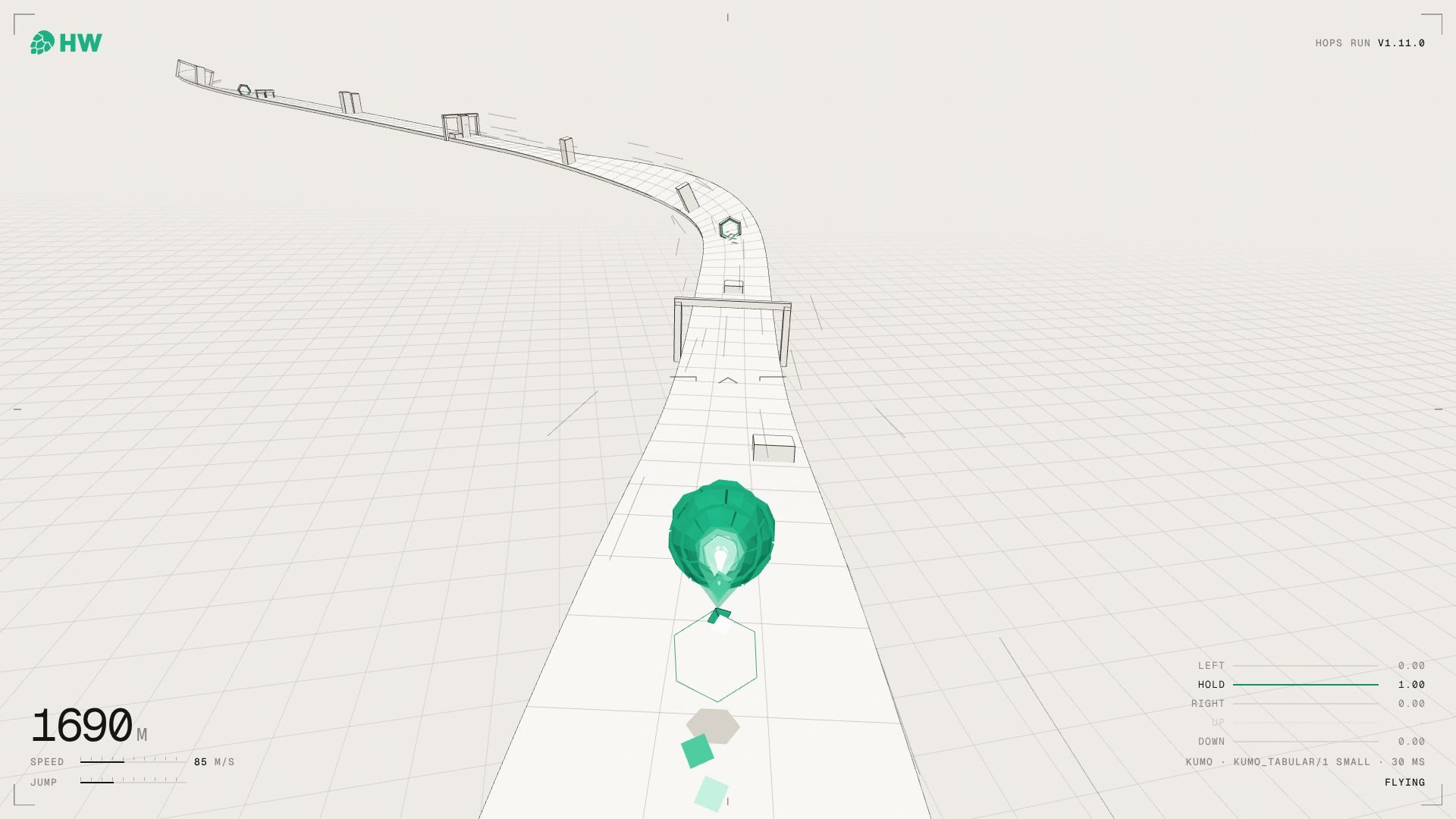
Play it at game.hopsworks.ai. The pilots fly it around the clock on the live stream, and every run they finish lands on the same leaderboard as yours.
The models
| Pilot | Model | How it decides | Deployment | Folder |
|---|---|---|---|---|
qwen | Qwen3-4B with SemIf | Reads the situation in plain English and scores each move from the model's logits, in one forward pass | semif4b, 1 GPU | qwen/ |
kumo | NVIDIA Kumo Tabular | Learns the game from 78 labelled situations given in context, with no training step | kumo, 2 CPU cores | kumo/ |
[tbd] clef | Cloudflare Clef-Flash | Answers the move as a SystemOne choice question with its joint schema head | clef, 1 GPU | clef/ |
Run them on Hopsworks
Each model is three steps: import it from Hugging Face into the model registry, build its Python environment, deploy it. Point the SDK and the hops CLI at your project first:
export HOPSWORKS_HOST=your-cluster.hopsworks.ai
export HOPSWORKS_API_KEY=...
export HOPSWORKS_PROJECT=jevworks
pip install hopsworks
qwen
python -c 'import hopsworks; hopsworks.login().get_model_registry().hf_download("Qwen/Qwen3-4B", selected_formats=["safetensors"])'
hops env clone jevworks-inference --from torch-inference-pipeline
hops env install jevworks-inference -f qwen/requirements.txt
python qwen/deploy.py
kumo
python -c 'import hopsworks; hopsworks.login().get_model_registry().hf_download("nvidia/Kumo-Tabular", selected_filenames=["README.md", "LICENSE", "small/classifier.pt"])'
hops env clone kumo-inference --from torch-inference-pipeline
hops env install kumo-inference -f kumo/requirements.txt
python kumo/deploy.py
--size medium or --size large deploys the bigger Kumo Tabular; import its classifier.pt alongside.
clef
python -c 'import hopsworks; hopsworks.login().get_model_registry().hf_download("Cloudflare/clef-flash")'
hops env clone clef-inference --from torch-inference-pipeline
hops env install clef-inference -f clef/requirements.txt
python clef/deploy.py
Each deployment is then live behind the project's inference endpoint, with its own predict URL, logs and metrics in Hopsworks.
How a pilot decides
The game hands the runner { lane, airborne, ahead }, where ahead lists the rows in front of the hops with their distance and what each lane holds. Each model gets it in its own form.
qwen reads a description of the nearest row only:
state: the rules, then the situation. The hops crashes if it hits a wall: jumping or ducking never clears a wall, only moving to another lane does. Jumping clears a low block or a bar. Ducking clears a bar. Flying straight is only safe in an open lane. The hops is in the centre lane. The next row of obstacles is 60 m ahead. "in the air" follows the lane when the hops is airborne; with no row ahead, the last sentence is "There are no obstacles ahead."question: "What should the hops do?"options, each stating the consequence of the move:left/right: "Move to the left lane, which has a wall". Offered only where that lane exists.hold: "Stay in the centre lane, which has nothing, it is open, and fly straight".up: "Stay in the centre lane, which has ..., and jump". Offered only when the hops is on the ground.down: "Stay in the centre lane, which has ..., and duck".
POST /v1/jevworks/semif4b/v1/models/semif4b:predict
{"inputs": [{"id": "hops", "state": "...", "question": "What should the hops do?",
             "options": [{"id": "left", "description": "..."}, ...]}]}

{"predictions": [{"id": "hops", "option_ids": ["left", "hold", "up", "down"],
                  "probabilities": [0.76, 0.01, 0.0, 0.0], "forward_seconds": 0.03,
                  "model": {"revision": "hopsworks:Qwen3_4B/1", "device": "cuda:0", "dtype": "bfloat16"}, ...}]}
kumo gets the game state as it is ({"lane": "centre", "airborne": false, "ahead": [...]}) and answers in the same shape. Its context is a table of 78 game situations labelled with the move the rules call for; the other 33 are held out, and it gets 31 to 33 of those right without ever seeing them.
The runner flies the highest-probability move. Jumps and ducks are timed to the row; lane changes apply at once.
Game mechanics
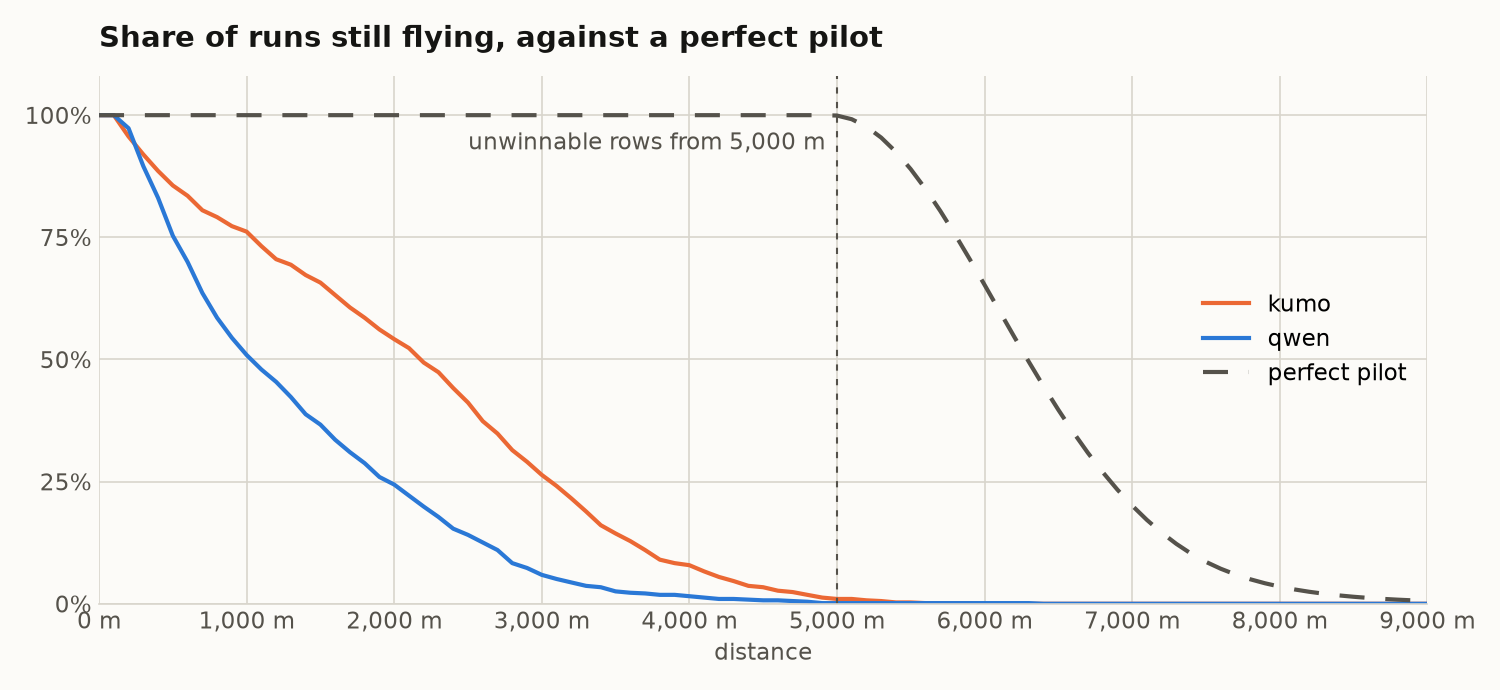
Hops Run is procedural. The track and every row of obstacles are generated as you fly, so no two runs are the same and there is nothing to memorise. Straights, banked turns and hills come first; side banks unlock at 300 m, wall rides at 400 m, corkscrews at 500 m, upside-down sections at 700 m and loops at 900 m.
A row of obstacles fills one or two of the three lanes, never all three. Half the obstacles are walls (only a lane change gets you past), a quarter are low blocks (jump) and a quarter are bars (duck, or jump).
And it only gets harder. The hops starts at 45 m/s and gains 1.6 m/s every second up to 160 m/s; speed gates every 140 to 260 m add a 45 m/s burst on top. Rows start 42 to 74 m apart and close in until 2250 m, where they settle at 23 to 41 m.
So there is a ceiling, and it is physical. The fastest lane change the hops can make takes 0.15 s. From 5000 m, at 134 m/s, some rows arrive closer than that, and a wall in your lane right after a lane change cannot be passed by anyone - human or model. Even a perfect pilot (never wrong, zero decision time) has at best even odds of reaching 6300 m, and less than a 1% chance of reaching 8750 m.
Results
Every run each pilot flew on game v1.11.0, taken in order up to the same count for both (709 each), flown interleaved over the same night.
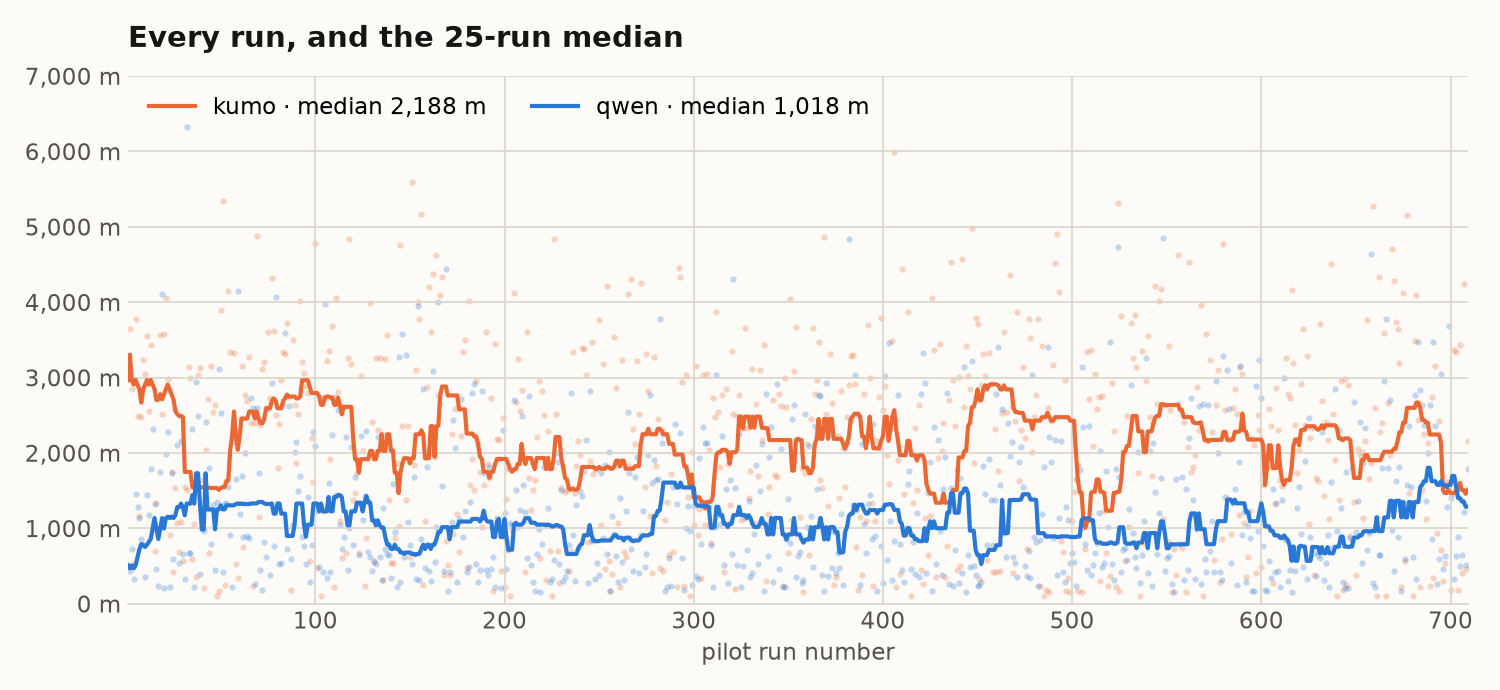
| Pilot | Median | Mean | 90th percentile | Best | Runs to top 5 |
|---|---|---|---|---|---|
| kumo | 2,188 m | 2,119 m | 3,769 m | 5,994 m | 51 (24 min of flight), 4 runs in total |
| qwen | 1,018 m | 1,318 m | 2,747 m | 6,330 m | 32 (10 min of flight), 1 run in total |
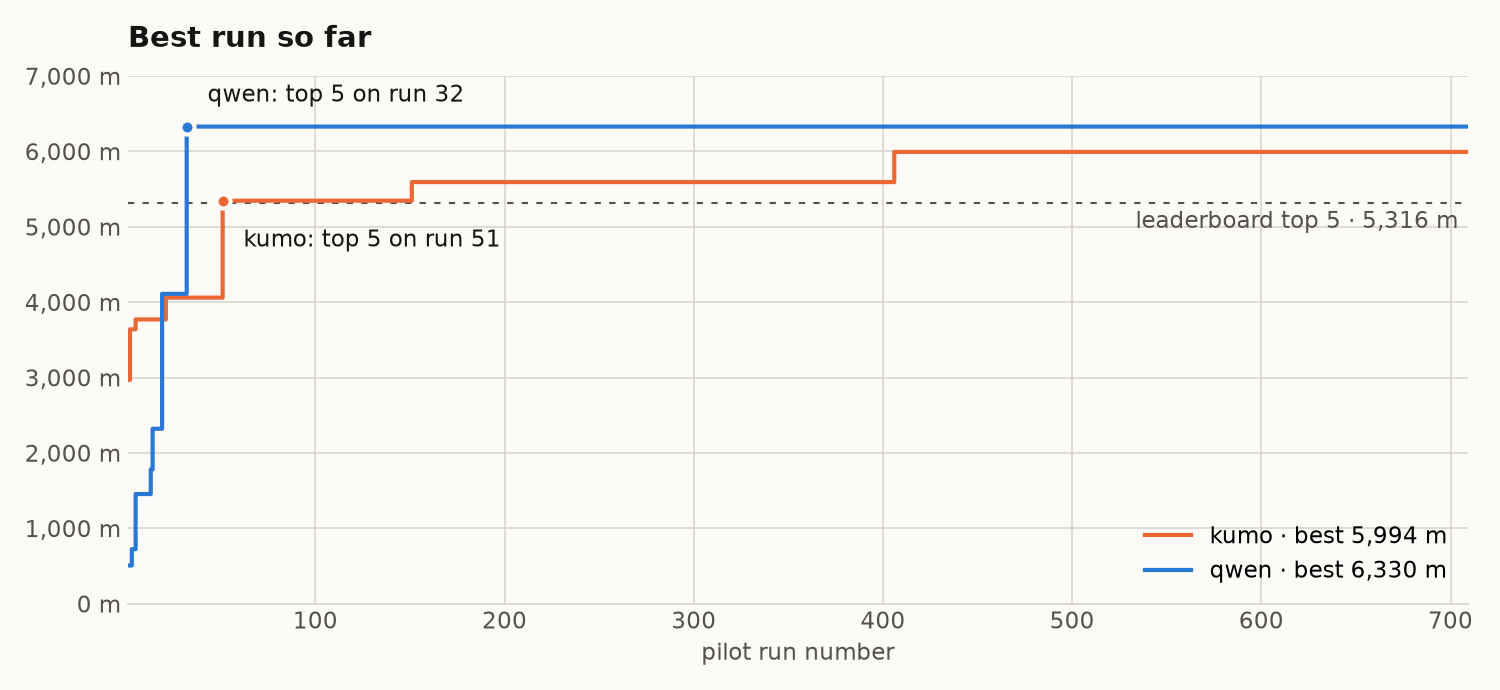
Top 5 means a run at or beyond the board's 5th place, 5,316 m. Both models answer in about 30 ms, so speed does not separate them; kumo picks the right move more often.
Neither model was trained on the game. qwen sees no examples at all; kumo sees 78 labelled ones in its context and is never trained on them.
Behaviour and luck
Every run is a fresh, random track, and that makes for a lot of noise. Kumo flew 4,792 m on its 100th run and crashed at 473 m on the next one: same model, same weights, different track. A single run says very little; a median over a few hundred says something.
The leaderboard ranks best runs, and a best run is mostly a function of how many tries you get. qwen holds the best run on the board, 6,330 m, flown on its 32nd run; it never got near it again in the other 677. kumo's median is twice qwen's, and it made the top 5 four times. One run at 6,330 m is luck doing its job (and about where a perfect pilot's odds halve); four runs past 5,316 m is the model.
Neither model learns between runs.
Reference
SemIf request
hops deployment predict semif4b --data '{"inputs": [{
  "id": "ticket-1",
  "state": "Password reset succeeded but every login still returns account locked.",
  "question": "Which team should handle this ticket?",
  "options": [
    {"id": "billing", "description": "Billing and refunds"},
    {"id": "account-access", "description": "Authentication, lockouts and account recovery"}
  ]}]}'
Response, one entry per row:
{"predictions": [{
  "id": "ticket-1",
  "option_ids": ["billing", "account-access"],
  "probabilities": [0.03, 0.97],
  "option_logits": [12.1, 15.6],
  "input_tokens": 118,
  "forward_seconds": 0.41,
  "total_seconds": 0.43,
  "prompt_sha256": "...",
  "prompt_version": "direct-options-v1",
  "model": {"source": "...", "revision": "hopsworks:Qwen3_4B/1", "dtype": "bfloat16", "device": "cuda:0"},
  "readout": "native full-vocabulary last-position logits restricted to declared answer slots",
  "probability_status": "conditional option score; uncalibrated as decision confidence"
}]}
Rows need id, state (string, object or array), question, and 2 to 16 options with unique id and a description. A row whose prompt exceeds 4096 tokens is rejected, never truncated.
SemIf predictor settings
| Variable | Default | Meaning |
|---|---|---|
SEMIF_DEVICE | auto | cuda, mps, cpu, or auto (first available in that order) |
SEMIF_DTYPE | float32 on CPU, bfloat16 otherwise | Weight dtype |
SEMIF_THREADS | torch default | Intra-op thread count on CPU |
SemIf integration test
pip install -e '.[deploy]'
pytest
Layout
| Path | Role |
|---|---|
qwen/ | SemIf predictor, deploy script and environment requirements. |
jevworks/semif/ | SemIf engine, vendored from SemIf (MIT). |
kumo/ | Kumo Tabular predictor, deploy script and requirements. |
clef/ | Clef-Flash predictor, deploy script and requirements. |
tests/test_decide.py | Integration test against the semif4b deployment. |
docs/ | Screenshot and result charts. |
Similar repos


Languages
Python
100.0%
SemIf (OpenJEV) semantic-if decisions served as a Hopsworks model deployment
Python
2
10 commits
updated Oct 2, 2026
See what people are saying
README
jevworks
Two decision models served on Hopsworks, each flying Hops Run live. Every move the hops makes is one call to a Hopsworks model deployment: the game sends the situation, the model answers with a probability per move, in about 30 ms.
Play it at game.hopsworks.ai. The pilots fly it around the clock on the live stream, and every run they finish lands on the same leaderboard as yours.
The models
| Pilot | Model | How it decides | Deployment | Folder |
|---|---|---|---|---|
qwen | Qwen3-4B with SemIf | Reads the situation in plain English and scores each move from the model's logits, in one forward pass | semif4b, 1 GPU | qwen/ |
kumo | NVIDIA Kumo Tabular | Learns the game from 78 labelled situations given in context, with no training step | kumo, 2 CPU cores | kumo/ |
[tbd] clef | Cloudflare Clef-Flash | Answers the move as a SystemOne choice question with its joint schema head | clef, 1 GPU | clef/ |
Run them on Hopsworks
Each model is three steps: import it from Hugging Face into the model registry, build its Python environment, deploy it. Point the SDK and the hops CLI at your project first:
export HOPSWORKS_HOST=your-cluster.hopsworks.ai
export HOPSWORKS_API_KEY=...
export HOPSWORKS_PROJECT=jevworks
pip install hopsworks
qwen
python -c 'import hopsworks; hopsworks.login().get_model_registry().hf_download("Qwen/Qwen3-4B", selected_formats=["safetensors"])'
hops env clone jevworks-inference --from torch-inference-pipeline
hops env install jevworks-inference -f qwen/requirements.txt
python qwen/deploy.py
kumo
python -c 'import hopsworks; hopsworks.login().get_model_registry().hf_download("nvidia/Kumo-Tabular", selected_filenames=["README.md", "LICENSE", "small/classifier.pt"])'
hops env clone kumo-inference --from torch-inference-pipeline
hops env install kumo-inference -f kumo/requirements.txt
python kumo/deploy.py
--size medium or --size large deploys the bigger Kumo Tabular; import its classifier.pt alongside.
clef
python -c 'import hopsworks; hopsworks.login().get_model_registry().hf_download("Cloudflare/clef-flash")'
hops env clone clef-inference --from torch-inference-pipeline
hops env install clef-inference -f clef/requirements.txt
python clef/deploy.py
Each deployment is then live behind the project's inference endpoint, with its own predict URL, logs and metrics in Hopsworks.
How a pilot decides
The game hands the runner { lane, airborne, ahead }, where ahead lists the rows in front of the hops with their distance and what each lane holds. Each model gets it in its own form.
qwen reads a description of the nearest row only:
state: the rules, then the situation. The hops crashes if it hits a wall: jumping or ducking never clears a wall, only moving to another lane does. Jumping clears a low block or a bar. Ducking clears a bar. Flying straight is only safe in an open lane. The hops is in the centre lane. The next row of obstacles is 60 m ahead. "in the air" follows the lane when the hops is airborne; with no row ahead, the last sentence is "There are no obstacles ahead."question: "What should the hops do?"options, each stating the consequence of the move:left/right: "Move to the left lane, which has a wall". Offered only where that lane exists.hold: "Stay in the centre lane, which has nothing, it is open, and fly straight".up: "Stay in the centre lane, which has ..., and jump". Offered only when the hops is on the ground.down: "Stay in the centre lane, which has ..., and duck".
POST /v1/jevworks/semif4b/v1/models/semif4b:predict
{"inputs": [{"id": "hops", "state": "...", "question": "What should the hops do?",
             "options": [{"id": "left", "description": "..."}, ...]}]}

{"predictions": [{"id": "hops", "option_ids": ["left", "hold", "up", "down"],
                  "probabilities": [0.76, 0.01, 0.0, 0.0], "forward_seconds": 0.03,
                  "model": {"revision": "hopsworks:Qwen3_4B/1", "device": "cuda:0", "dtype": "bfloat16"}, ...}]}
kumo gets the game state as it is ({"lane": "centre", "airborne": false, "ahead": [...]}) and answers in the same shape. Its context is a table of 78 game situations labelled with the move the rules call for; the other 33 are held out, and it gets 31 to 33 of those right without ever seeing them.
The runner flies the highest-probability move. Jumps and ducks are timed to the row; lane changes apply at once.
Game mechanics
Hops Run is procedural. The track and every row of obstacles are generated as you fly, so no two runs are the same and there is nothing to memorise. Straights, banked turns and hills come first; side banks unlock at 300 m, wall rides at 400 m, corkscrews at 500 m, upside-down sections at 700 m and loops at 900 m.
A row of obstacles fills one or two of the three lanes, never all three. Half the obstacles are walls (only a lane change gets you past), a quarter are low blocks (jump) and a quarter are bars (duck, or jump).
And it only gets harder. The hops starts at 45 m/s and gains 1.6 m/s every second up to 160 m/s; speed gates every 140 to 260 m add a 45 m/s burst on top. Rows start 42 to 74 m apart and close in until 2250 m, where they settle at 23 to 41 m.
So there is a ceiling, and it is physical. The fastest lane change the hops can make takes 0.15 s. From 5000 m, at 134 m/s, some rows arrive closer than that, and a wall in your lane right after a lane change cannot be passed by anyone - human or model. Even a perfect pilot (never wrong, zero decision time) has at best even odds of reaching 6300 m, and less than a 1% chance of reaching 8750 m.
Results
Every run each pilot flew on game v1.11.0, taken in order up to the same count for both (709 each), flown interleaved over the same night.
| Pilot | Median | Mean | 90th percentile | Best | Runs to top 5 |
|---|---|---|---|---|---|
| kumo | 2,188 m | 2,119 m | 3,769 m | 5,994 m | 51 (24 min of flight), 4 runs in total |
| qwen | 1,018 m | 1,318 m | 2,747 m | 6,330 m | 32 (10 min of flight), 1 run in total |
Top 5 means a run at or beyond the board's 5th place, 5,316 m. Both models answer in about 30 ms, so speed does not separate them; kumo picks the right move more often.
Neither model was trained on the game. qwen sees no examples at all; kumo sees 78 labelled ones in its context and is never trained on them.
Behaviour and luck
Every run is a fresh, random track, and that makes for a lot of noise. Kumo flew 4,792 m on its 100th run and crashed at 473 m on the next one: same model, same weights, different track. A single run says very little; a median over a few hundred says something.
The leaderboard ranks best runs, and a best run is mostly a function of how many tries you get. qwen holds the best run on the board, 6,330 m, flown on its 32nd run; it never got near it again in the other 677. kumo's median is twice qwen's, and it made the top 5 four times. One run at 6,330 m is luck doing its job (and about where a perfect pilot's odds halve); four runs past 5,316 m is the model.
Neither model learns between runs.
Reference
SemIf request
hops deployment predict semif4b --data '{"inputs": [{
  "id": "ticket-1",
  "state": "Password reset succeeded but every login still returns account locked.",
  "question": "Which team should handle this ticket?",
  "options": [
    {"id": "billing", "description": "Billing and refunds"},
    {"id": "account-access", "description": "Authentication, lockouts and account recovery"}
  ]}]}'
Response, one entry per row:
{"predictions": [{
  "id": "ticket-1",
  "option_ids": ["billing", "account-access"],
  "probabilities": [0.03, 0.97],
  "option_logits": [12.1, 15.6],
  "input_tokens": 118,
  "forward_seconds": 0.41,
  "total_seconds": 0.43,
  "prompt_sha256": "...",
  "prompt_version": "direct-options-v1",
  "model": {"source": "...", "revision": "hopsworks:Qwen3_4B/1", "dtype": "bfloat16", "device": "cuda:0"},
  "readout": "native full-vocabulary last-position logits restricted to declared answer slots",
  "probability_status": "conditional option score; uncalibrated as decision confidence"
}]}
Rows need id, state (string, object or array), question, and 2 to 16 options with unique id and a description. A row whose prompt exceeds 4096 tokens is rejected, never truncated.
SemIf predictor settings
| Variable | Default | Meaning |
|---|---|---|
SEMIF_DEVICE | auto | cuda, mps, cpu, or auto (first available in that order) |
SEMIF_DTYPE | float32 on CPU, bfloat16 otherwise | Weight dtype |
SEMIF_THREADS | torch default | Intra-op thread count on CPU |
SemIf integration test
pip install -e '.[deploy]'
pytest
Layout
| Path | Role |
|---|---|
qwen/ | SemIf predictor, deploy script and environment requirements. |
jevworks/semif/ | SemIf engine, vendored from SemIf (MIT). |
kumo/ | Kumo Tabular predictor, deploy script and requirements. |
clef/ | Clef-Flash predictor, deploy script and requirements. |
tests/test_decide.py | Integration test against the semif4b deployment. |
docs/ | Screenshot and result charts. |
Similar repos
Languages
Python
100.0%