
🚀 First survey bridging LLM, RL, and Agentic Eras — 100+ papers on efficient inference from static generation to systematic reasoning and action.
13
2 commits
updated May 13, 2026
README
🚀 From Static to Systematic:
A Survey on Efficient Inference Across LLM, RL, and Agentic Eras


📚 Table of Contents
🔥 Latest News
- [2026-05-12] 🚀 Repository launched to track efficient inference techniques across the LLM, RL, and Agentic eras.
- [2026-05-12] 🎉 Our survey paper "From Static to Systematic: A Survey on Efficient Inference Across LLM, RL, and Agentic Eras" is now available.
📖 Overview
This repository accompanies our COLM 2026 survey, which takes an evolutionary perspective on efficient LLM inference: rather than cataloguing techniques in isolation, we trace how each technique class transfers, adapts, or breaks as the computational paradigm shifts from single-pass generation, to reasoning-time rollouts, to persistent agentic loops.

Figure 1: Inference paradigms across the three eras. LLM Era – single-pass generation from prompt x to response y. RL Era – inference-time reasoning with extended CoT, and training-time rollout generating G trajectories. Agentic Era – a persistent loop of tool calls, observations, and context accumulation.
Three Eras of Inference
① LLM Era — Single-pass, open-loop generation.
Given a prompt x, the model autoregressively produces y token by token. Prefill caches KV in one forward pass; decode attends to all cached tokens, making it memory-bandwidth-bound.
② RL Era — Inference-time reasoning + training-time rollout.
Large Reasoning Models (e.g., DeepSeek-R1, Qwen3) emit thousands of CoT tokens before answering. RL algorithms like GRPO/DAPO require G on-policy trajectories per gradient step, making rollout the dominant pipeline cost — subject to policy non-stationarity, trajectory length heterogeneity, and synchronization barriers.
③ Agentic Era — Persistent multi-step decision loops.
Systems like Claude Code and OpenClaw place the LLM in a loop of generate → tool call → observe → append. Context grows cumulatively; tool latency is unpredictable; KV state may be shared across model instances.
The Three-Tax View
We introduce the Three-Tax view as a unified lens for the cumulative efficiency burden each era introduces:
| Tax | Era Introduced | Description |
|---|---|---|
| 🟦 KV Tax | LLM | Materialized KV vectors dominate GPU memory and restrict throughput in long-context decoding. |
| 🟩 Thinking Tax | RL | Reasoning tokens are highly redundant — reflection, self-verification, and dead-end branches inflate output length without proportional quality gain. |
| 🟥 Action Tax | Agentic | Context grows cumulatively with agent steps; unpredictable tool latency invalidates standard batching assumptions. |
The eras are cumulative: each inherits prior taxes and introduces new ones.
Cross-Era Roadmap
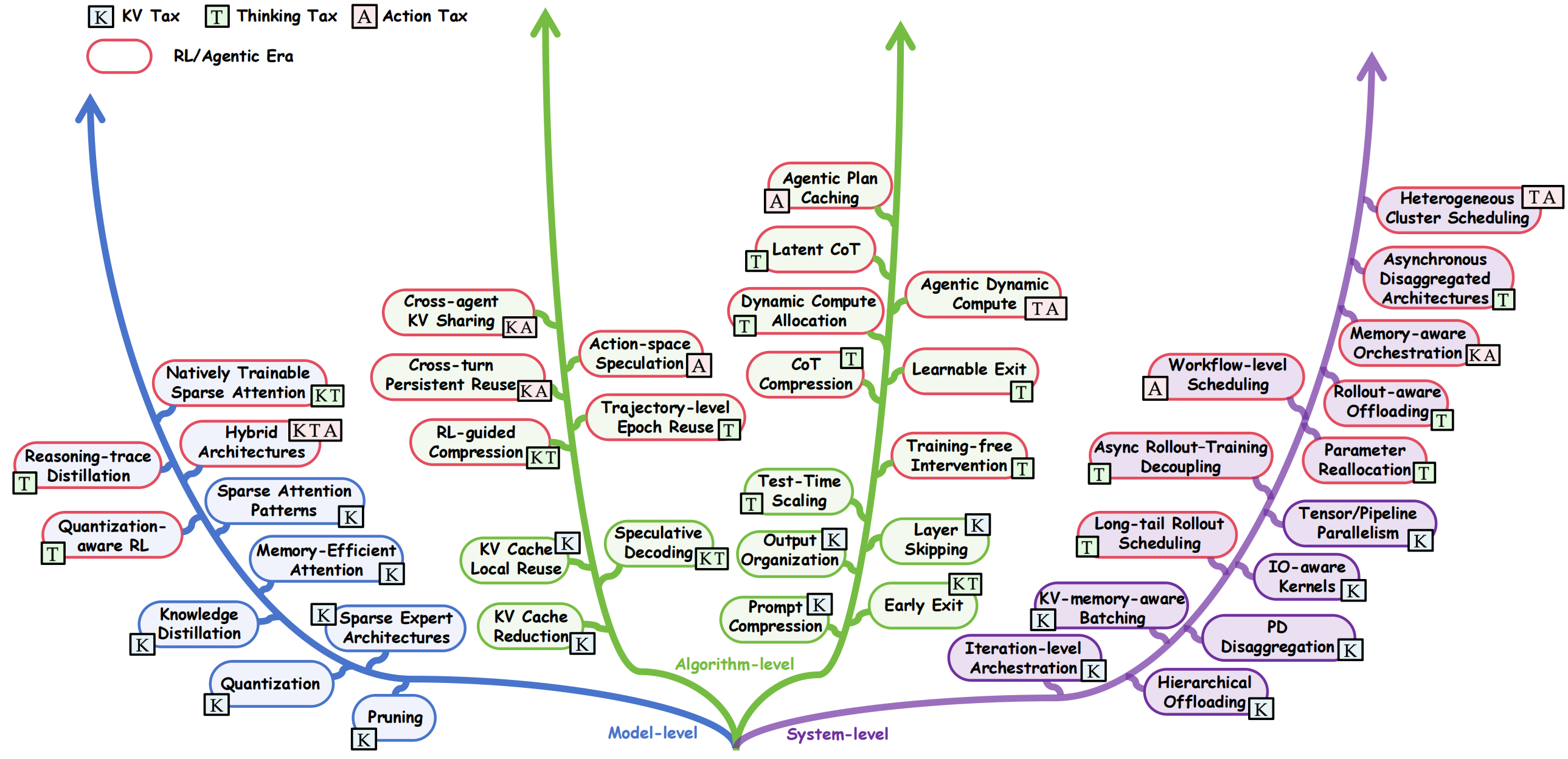
Figure 2: Roadmap of optimization techniques across model, algorithm, and system levels. Red nodes indicate the RL/Agentic era. Labels K, T, and A denote the primary inference taxes (KV, Thinking, and Action) addressed by each technique node.
📑 Paper List
Tables follow the paper's three-level taxonomy: Model-Level → Algorithm-Level → System-Level. Within each technique node we further split papers into the LLM Era (foundational methods) and the RL/Agentic Era (era-specific adaptations or newly emerged methods). The Tax label per node indicates which inference tax(es) the technique primarily addresses (🟦 K = KV Tax, 🟩 T = Thinking Tax, 🟥 A = Action Tax).
🧱 Model-Level
Model-level methods target the static structure of the deployed model — its parameters, precision, and architectural connectivity. They produce a smaller or sparser artifact that downstream serving stacks consume directly.
Model Compression
Tax addressed: 🟦 K (LLM Era), 🟩 T (RL/Agentic Era)
LLM Era methods reduce parameter count or numerical precision without retraining (Pruning, Quantization, Knowledge Distillation). RL/Agentic Era shifts to training-aware co-evolution: quantization noise is repurposed as policy-gradient regularizer, and full CoT traces become the distillation supervision signal.
LLM Era
| Paper | Year | Venue | Link |
|---|---|---|---|
| LLM-Pruner: On the Structural Pruning of Large Language Models | 2023 | NeurIPS | Link |
| SliceGPT: Compress Large Language Models by Deleting Rows and Columns | 2024 | ICLR | Link |
| SparseGPT: Massive Language Models Can Be Accurately Pruned in One-Shot | 2023 | ICML | Link |
| ShortGPT: Layers in Large Language Models Are More Redundant Than You Expect | 2025 | ACL Findings | Link |
| FLAP: Fluctuation-based Adaptive Structured Pruning for Large Language Models | 2024 | AAAI | Link |
| GPTQ: Accurate Post-Training Quantization for Generative Pre-trained Transformers | 2022 | arXiv | Link |
| AWQ: Activation-aware Weight Quantization for On-Device LLM Compression and Acceleration | 2024 | MLSys | Link |
| SmoothQuant: Accurate and Efficient Post-Training Quantization for Large Language Models | 2023 | ICML | Link |
| QuIP#: Even Better LLM Quantization with Hadamard Incoherence and Lattice Codebooks | 2024 | ICML | Link |
| MiniLLM: Knowledge Distillation of Large Language Models | 2024 | ICLR | Link |
| DistiLLM: Towards Streamlined Distillation for Large Language Models | 2024 | ICML | Link |
RL / Agentic Era
| Paper | Year | Venue | Link |
|---|---|---|---|
| DeepSeek-R1: Incentivizing Reasoning Capability in LLMs via Reinforcement Learning | 2025 | Nature | Link |
| s1: Simple Test-Time Scaling | 2025 | EMNLP | Link |
| QeRL: Beyond Efficiency — Quantization-Enhanced Reinforcement Learning for LLMs | 2025 | arXiv | Link |
| QuRL: Efficient Reinforcement Learning with Quantized Rollout | 2026 | arXiv | Link |
Structural Optimization
Tax addressed: 🟦 K (LLM Era); 🟦 K + 🟩 T (Natively Trainable Sparse Attention); 🟦 K + 🟩 T + 🟥 A (Hybrid Architectures)
LLM Era methods redesign architectures for sparse or sub-linear execution (MoE, low-rank KV, sparse attention). RL/Agentic Era shifts focus from external context to self-generated reasoning steps: natively trainable sparse attention reduces the KV footprint of long CoT, and hybrid linear/full-attention architectures balance global modeling with per-step throughput for long-horizon rollouts.
LLM Era
| Paper | Year | Venue | Link |
|---|---|---|---|
| Mixtral of Experts | 2024 | arXiv | Link |
| DeepSeek-V2: A Strong, Economical, and Efficient Mixture-of-Experts Language Model (MLA) | 2024 | arXiv | Link |
| Longformer: The Long-Document Transformer | 2020 | arXiv | Link |
| SeerAttention: Learning Intrinsic Sparse Attention in Your LLMs | 2024 | arXiv | Link |
RL / Agentic Era
| Paper | Year | Venue | Link |
|---|---|---|---|
| Native Sparse Attention: Hardware-Aligned and Natively Trainable Sparse Attention (NSA) | 2025 | ACL | Link |
| DeepSeek-V3.2-Exp: Boosting Long-Context Efficiency with DeepSeek Sparse Attention (DSA) | 2025 | arXiv | Link |
| MoBA: Mixture of Block Attention for Long-Context LLMs | 2025 | NeurIPS | Link |
| Kimi Linear: An Expressive, Efficient Attention Architecture (KDA) | 2025 | arXiv | Link |
| MiniMax-M1: Scaling Test-Time Compute Efficiently with Lightning Attention | 2025 | arXiv | Link |
⚙️ Algorithm-Level
Algorithm-level methods modify what and how much the model computes per token / per turn / per agent step — without changing model weights.
KV Cache Management
Tax addressed: 🟦 K (LLM Era); 🟦 K + 🟩 T (RL-guided Compression); 🟦 K + 🟥 A (Cross-turn Persistent Reuse, Cross-agent KV Sharing)
LLM Era focuses on cache reduction (eviction, sparse selection, quantization) and prefix-sharing for local reuse. RL/Agentic Era redefines KV as a long-lived state spanning rollouts and multi-agent interactions: reward-guided compression replaces heuristic eviction, and KV becomes a transferable, persistent asset across turns and across model instances.
LLM Era
| Paper | Year | Venue | Link |
|---|---|---|---|
| H2O: Heavy-Hitter Oracle for Efficient Generative Inference of Large Language Models | 2023 | NeurIPS | Link |
| Efficient Streaming Language Models with Attention Sinks (StreamingLLM) | 2024 | ICLR | Link |
| PyramidKV: Dynamic KV Cache Compression based on Pyramidal Information Funneling | 2025 | COLM | Link |
| SCOPE: Optimizing Key-Value Cache Compression in Long-Context Generation | 2025 | ACL | Link |
| MInference 1.0: Accelerating Pre-filling for Long-Context LLMs via Dynamic Sparse Attention | 2024 | NeurIPS | Link |
| InfLLM: Training-Free Long-Context Extrapolation for LLMs with an Efficient Context Memory | 2024 | NeurIPS | Link |
| CacheBlend: Fast Large Language Model Serving for RAG with Cached Knowledge Fusion | 2025 | EuroSys | Link |
| EPIC: Efficient Position-Independent Caching for Serving Large Language Models | 2025 | ICML | Link |
| KVLink: Accelerating Large Language Models via Efficient KV Cache Reuse | 2025 | NeurIPS | Link |
| KIVI: A Tuning-Free Asymmetric 2-bit Quantization for KV Cache | 2024 | ICML | Link |
| KVQuant: Towards 10 Million Context Length LLM Inference with KV Cache Quantization | 2024 | NeurIPS | Link |
| ZipCache: Accurate and Efficient KV Cache Quantization with Salient Token Identification | 2024 | NeurIPS | Link |
| TurboQuant: Online Vector Quantization with Near-optimal Distortion Rate | 2026 | ICLR | Link |
RL / Agentic Era
| Paper | Year | Venue | Link |
|---|---|---|---|
| Which Heads Matter for Reasoning? RL-Guided KV Cache Compression (RLKV) | 2025 | arXiv | Link |
| R-KV: Redundancy-Aware KV Cache Compression for Reasoning Models | 2025 | NeurIPS | Link |
| KVFlow: Efficient Prefix Caching for Accelerating LLM-Based Multi-Agent Workflows | 2025 | NeurIPS | Link |
| Cache-to-Cache: Direct Semantic Communication Between Large Language Models (C2C) | 2026 | ICLR | Link |
| Continuum: Efficient and Robust Multi-Turn LLM Agent Scheduling with KV Cache Time-to-Live | 2025 | arXiv | Link |
| DroidSpeak: KV Cache Sharing for Cross-LLM Communication and Multi-LLM Serving | 2024 | arXiv | Link |
| KVCOMM: Online Cross-Context KV-Cache Communication for Efficient LLM-based Multi-Agent Systems | 2025 | NeurIPS | Link |
| PAL-KV: When KV Cache Reuse Fails in Multi-Agent Systems — Cross-Candidate Interaction is Crucial for LLM Judges | 2026 | arXiv | Link |
| Query as Anchor: Scenario-Adaptive User Representation via Large Language Model | 2026 | arXiv | Link |
Speculative Decoding
Tax addressed: 🟦 K + 🟩 T (token-level SD, accelerates CoT generation); 🟩 T (Trajectory-level Epoch Reuse, exploits policy laziness); 🟥 A (Action-space Speculation, exploits tool latency)
The SD paradigm preserves its draft-and-verify skeleton across all three eras, but the exploited form of redundancy changes fundamentally each time: token locality (LLM) → policy laziness (RL) → tool-latency gaps (Agentic).
LLM Era
| Paper | Year | Venue | Link |
|---|---|---|---|
| Fast Inference from Transformers via Speculative Decoding | 2023 | ICML | Link |
| Multi-Candidate Speculative Decoding (MCSD) | 2025 | NLPCC | Link |
| SEED: Accelerating Reasoning Tree Construction via Scheduled Speculative Decoding | 2025 | COLING | Link |
| EAGLE: Speculative Sampling Requires Rethinking Feature Uncertainty | 2024 | ICML | Link |
| Speculative Speculative Decoding (SSD) | 2026 | arXiv | Link |
RL / Agentic Era
| Paper | Year | Venue | Link |
|---|---|---|---|
| SPEC-RL: Accelerating On-Policy Reinforcement Learning via Speculative Rollouts | 2025 | arXiv | Link |
| History Rhymes: Accelerating LLM Reinforcement Learning with RhymeRL | 2025 | arXiv | Link |
| ReSpec: Towards Optimizing Speculative Decoding in Reinforcement Learning Systems | 2025 | arXiv | Link |
| Speculative Actions: A Lossless Framework for Faster Agentic Systems | 2025 | arXiv | Link |
| Interactive Speculative Planning: Enhance Agent Efficiency through Co-design of System and User Interface (ISP) | 2024 | arXiv | Link |
| Dynamic Speculative Agent Planning (DSP) | 2025 | arXiv | Link |
| SpecEyes: Accelerating Agentic Multimodal LLMs via Speculative Perception and Planning | 2026 | arXiv | Link |
Thinking & Reasoning Efficiency
Tax addressed: 🟦 K (Prompt Compression, SoT); 🟩 T (Test-Time Scaling, CoT Compression, Dynamic Compute, Latent CoT); 🟥 A (Agentic Plan Caching)
LLM Era methods target surface-level redundancy with task-agnostic heuristics on tokens (prompt compression, parallel decoding, search). RL/Agentic Era shifts to internalized adaptive control — the model learns to compress its own reasoning, allocate compute by difficulty, internalize CoT in latent space, or cache reusable sub-plans across tasks.
LLM Era
| Paper | Year | Venue | Link |
|---|---|---|---|
| Adapting Language Models to Compress Contexts (AutoCompressors) | 2023 | EMNLP | Link |
| In-context Autoencoder for Context Compression in a Large Language Model (ICAE) | 2024 | ICLR | Link |
| LLMLingua: Compressing Prompts for Accelerated Inference of Large Language Models | 2023 | EMNLP | Link |
| LLMLingua-2: Data Distillation for Efficient and Faithful Task-Agnostic Prompt Compression | 2024 | ACL Findings | Link |
| Adaptive Skeleton Graph Decoding (ASGD) | 2024 | arXiv | — |
| LongLLMLingua: Accelerating and Enhancing LLMs in Long Context Scenarios via Prompt Compression | 2024 | ACL | Link |
| Skeleton-of-Thought: Large Language Models Can Do Parallel Decoding (SoT) | 2023 | ENLSP@NeurIPS | Link |
| Fast Best-of-N Decoding via Speculative Rejection | 2024 | NeurIPS | Link |
| Make Every Penny Count: Difficulty-Adaptive Self-Consistency for Cost-Efficient Reasoning (DSC) | 2025 | NAACL Findings | Link |
| A*-Decoding: Token-efficient Inference Scaling | 2025 | arXiv | Link |
RL / Agentic Era
| Paper | Year | Venue | Link |
|---|---|---|---|
| TokenSkip: Controllable Chain-of-Thought Compression in LLMs | 2025 | EMNLP | Link |
| ThinkPrune: Pruning Long Chain-of-Thought of LLMs via Reinforcement Learning | 2025 | arXiv | Link |
| Can Pruning Improve Reasoning? Revisiting Long-CoT Compression with Capability in Mind for Better Reasoning (Prune-on-Logic) | 2025 | arXiv | Link |
| Qwen3 Technical Report | 2025 | arXiv | Link |
| BARD: Budget-Aware Reasoning Distillation | 2025 | arXiv | Link |
| Pruning Long Chain-of-Thought of Large Reasoning Models via Small-Scale Preference Optimization (LCPO) | 2025 | arXiv | Link |
| Adaptive Thinking: Large Language Models Know When to Think in Latent Space (Sonata) | 2026 | ICLR | Link |
| Training Large Language Models to Reason in a Continuous Latent Space (COCONUT) | 2025 | COLM | Link |
| CODI: Compressing Chain-of-Thought into Continuous Space via Self-Distillation | 2025 | EMNLP | Link |
| Agentic Plan Caching: Test-Time Memory for Fast and Cost-Efficient LLM Agents (APC) | 2025 | arXiv | Link |
| Cost-Efficient Serving of LLM Agents via Test-Time Plan Caching | 2025 | ES-FoMo | Link |
| Memory as Action: Autonomous Context Curation for Long-Horizon Agentic Tasks (MemAct) | 2025 | arXiv | Link |
| CATS: Category-Aware Token-level Steering for Training-Free Redundancy Reduction in Large Reasoning Models | 2026 | AAAI | — |
Early Exit & Layer Skipping
Tax addressed: 🟦 K + 🟩 T (Early Exit); 🟦 K (Layer Skipping); 🟩 T (Training-free Intervention, Learnable Exit); 🟩 T + 🟥 A (Agentic Dynamic Compute)
LLM Era methods skip redundant computation at the token level — adaptive exit predictors and self-speculative drafters that reuse shallow layers. RL/Agentic Era shifts the target from physical layer traversal to cognitive trajectory truncation: detecting when CoT is sufficient, RL-trained brevity, and proactive termination of ineffective multi-step trajectories.
LLM Era
| Paper | Year | Venue | Link |
|---|---|---|---|
| LayerSkip: Enabling Early Exit Inference and Self-Speculative Decoding | 2024 | ACL | Link |
| Not All Layers of LLMs Are Necessary During Inference (AdaInfer) | 2025 | IJCAI | Link |
| DASH: Input-Aware Dynamic Layer Skipping for Efficient LLM Inference with Markov Decision Policies | 2025 | arXiv | Link |
| HELIOS: Adaptive Model And Early-Exit Selection for Efficient LLM Inference Serving | 2025 | arXiv | Link |
| SpecEE: Accelerating Large Language Model Inference with Speculative Early Exiting | 2025 | ISCA | Link |
| AdaSkip: Adaptive Sublayer Skipping for Accelerating Long-Context LLM Inference | 2025 | AAAI | Link |
| DEL: Context-Aware Dynamic Exit Layer for Efficient Self-Speculative Decoding | 2025 | COLM | Link |
RL / Agentic Era
| Paper | Year | Venue | Link |
|---|---|---|---|
| S-GRPO: Early Exit via Reinforcement Learning in Reasoning Models | 2025 | NeurIPS | Link |
| Stop When Enough: Adaptive Early-Stopping for Chain-of-Thought Reasoning (REFRAIN) | 2025 | arXiv | Link |
| Early Stopping Chain-of-Thoughts in Large Language Models (ES-CoT) | 2025 | arXiv | Link |
| TERMINATOR: Learning Optimal Exit Points for Early Stopping in Chain-of-Thought Reasoning | 2026 | arXiv | Link |
| NEAT: Neuron-Based Early Exit for Large Reasoning Models | 2026 | arXiv | Link |
| Runaway is Ashamed, But Helpful: On the Early-Exit Behavior of LLM-based Agents in Embodied Environments (AgentExit) | 2025 | EMNLP Findings | Link |
🖥️ System-Level
System-level methods optimize how model executions are orchestrated across hardware — batching, memory placement, kernels, and distribution.
Batching & Scheduling
Tax addressed: 🟦 K (LLM Era iteration-level orchestration); 🟩 T (Long-tail Rollout, Async Decoupling); 🟥 A (Workflow-level Scheduling)
LLM Era targets iteration-level orchestration and KV-memory-aware batching (continuous batching, paged memory, SLO-aware scheduling). RL/Agentic Era introduces new scheduling units: long-tail rollout segmentation, async rollout-training decoupling, and DAG-based end-to-end agentic workflow scheduling.
LLM Era
| Paper | Year | Venue | Link |
|---|---|---|---|
| Orca: A Distributed Serving System for Transformer-Based Generative Models | 2022 | OSDI | Link |
| Efficient Memory Management for Large Language Model Serving with PagedAttention (vLLM) | 2023 | SOSP | Link |
| Taming Throughput-Latency Tradeoff in LLM Inference with Sarathi-Serve | 2024 | OSDI | Link |
| POD-Attention: Unlocking Full Prefill-Decode Overlap for Faster LLM Inference | 2025 | ASPLOS | Link |
| Optimal Scheduling Algorithms for LLM Inference: Theory and Practice (RAD) | 2025 | SIGMETRICS | Link |
| FairBatching: Fairness-Aware Batch Formation for LLM Inference | 2025 | arXiv | Link |
RL / Agentic Era
| Paper | Year | Venue | Link |
|---|---|---|---|
| Part II: ROLL Flash — Accelerating RLVR and Agentic Training with Asynchrony | 2025 | arXiv | Link |
| RollPacker: Mitigating Long-Tail Rollouts for Fast, Synchronous RL Post-Training | 2025 | arXiv | Link |
| APRIL: Active Partial Rollouts in Reinforcement Learning to Tame Long-tail Generation | 2025 | arXiv | Link |
| Act Only When It Pays: Efficient Reinforcement Learning for LLM Reasoning via Selective Rollouts (GRESO) | 2025 | NeurIPS | Link |
| SkyRL-Agent: Efficient RL Training for Multi-turn LLM Agent | 2025 | arXiv | Link |
| Batch Query Processing and Optimization for Agentic Workflows (Halo) | 2025 | arXiv | Link |
| Astraea: A State-Aware Scheduling Engine for LLM-Powered Agents | 2025 | arXiv | Link |
| Efficient LLM Serving for Agentic Workflows: A Data Systems Perspective (Helium) | 2026 | arXiv | Link |
| AIOS: LLM Agent Operating System | 2024 | COLM | Link |
| ThunderAgent: A Simple, Fast and Program-Aware Agentic Inference System | 2026 | arXiv | Link |
Memory Management
Tax addressed: 🟦 K (Hierarchical Offloading, PD Disaggregation); 🟩 T (Parameter Reallocation, Rollout-aware Offloading); 🟦 K + 🟥 A (Memory-aware Orchestration)
LLM Era targets hierarchical offloading and PD disaggregation to handle contexts beyond accelerator capacity. RL/Agentic Era introduces pipeline-level pressure: dynamic parameter reallocation across Actor/Critic/Reference models, decoupled rollout infrastructure, and KV retention coupled with multi-agent workflow state persistence.
LLM Era
| Paper | Year | Venue | Link |
|---|---|---|---|
| FlexGen: High-Throughput Generative Inference of Large Language Models with a Single GPU | 2023 | ICML | Link |
| NEO: Saving GPU Memory Crisis with CPU Offloading for Online LLM Inference | 2025 | MLSys | Link |
| Cost-Efficient Large Language Model Serving for Multi-Turn Conversations with CachedAttention | 2024 | USENIX ATC | Link |
| LMCache: An Efficient KV Cache Layer for Enterprise-Scale LLM Inference | 2025 | arXiv | Link |
| DistServe: Disaggregating Prefill and Decoding for Goodput-Optimized Large Language Model Serving | 2024 | OSDI | Link |
| Mooncake: A KVCache-Centric Disaggregated Architecture for LLM Serving | 2024 | ACM TOS | Link |
RL / Agentic Era
| Paper | Year | Venue | Link |
|---|---|---|---|
| ReaLHF: Optimized RLHF Training for Large Language Models through Parameter Reallocation | 2024 | arXiv | Link |
| RollArt: Scaling Agentic RL Training via Disaggregated Infrastructure | 2025 | arXiv | Link |
| Optimizing RLHF Training for Large Language Models with Stage Fusion (RLHFuse) | 2025 | NSDI | Link |
| ProRL Agent: Rollout-as-a-Service for RL Training of Multi-Turn LLM Agents | 2026 | arXiv | Link |
| Kairos: Low-Latency Multi-Agent Serving with Shared LLMs and Excessive Loads in the Public Cloud | 2025 | arXiv | Link |
| TokenCake: A KV-Cache-centric Serving Framework for LLM-based Multi-Agent Applications | 2025 | arXiv | Link |
Hardware & Distributed
Tax addressed: 🟦 K (LLM Era IO-aware kernels, tensor/pipeline parallelism); 🟩 T (Asynchronous Disaggregated Architectures); 🟩 T + 🟥 A (Heterogeneous Cluster Scheduling)
LLM Era breaks memory walls and communication bottlenecks (FlashAttention family, unified KV engines, tensor/pipeline parallelism). RL/Agentic Era faces pipeline bubbles between memory-bound rollouts and compute-bound training: asynchronous disaggregated stacks with interruptible rollouts and heterogeneous cluster scheduling.
LLM Era
| Paper | Year | Venue | Link |
|---|---|---|---|
| FlashInfer: Efficient and Customizable Attention Engine for LLM Inference Serving | 2025 | MLSys | Link |
| SnapStream: Efficient Long Sequence Decoding on Dataflow Accelerators | 2025 | arXiv | Link |
| FlashAttention: Fast and Memory-Efficient Exact Attention with IO-Awareness | 2022 | NeurIPS | Link |
| FlashAttention-2: Faster Attention with Better Parallelism and Work Partitioning | 2024 | ICLR | Link |
| FlashAttention-3: Fast and Accurate Attention with Asynchrony and Low-Precision | 2024 | NeurIPS | Link |
| Megatron-LM: Training Multi-Billion Parameter Language Models Using Model Parallelism | 2019 | arXiv | Link |
| DeepSpeed-Inference: Enabling Efficient Inference of Transformer Models at Unprecedented Scale | 2022 | SC | Link |
RL / Agentic Era
| Paper | Year | Venue | Link |
|---|---|---|---|
| HybridFlow: A Flexible and Efficient RLHF Framework (verl) | 2025 | EuroSys | Link |
| AReaL: A Large-Scale Asynchronous Reinforcement Learning System for Language Reasoning | 2025 | NeurIPS | Link |
| StreamRL: Scalable, Heterogeneous, and Elastic RL for LLMs with Disaggregated Stream Generation | 2025 | arXiv | Link |
| HetRL: Efficient Reinforcement Learning for LLMs in Heterogeneous Environments | 2025 | arXiv | Link |
🌟 Citation
If you find this survey or repository useful for your research, please cite:
@article{wangstatic,
  title={From Static to Systematic: A Survey on Efficient Inference Across LLM, RL, and Agentic Eras},
  author={Wang, Zhenglin and Li, Zhenyang and Wang, Zongwei and Liu, Tong and Wu, Jialong and Liang, Sichu and Zhang, Congzhi and Sun, Haowen and Ma, Ziyang and Lai, Yilong and others}
}
📧 Contact
We welcome contributions! If you would like to add a paper, fix a categorization, or report any issue:
- Open a GitHub Issue or Pull Request, or
- Email the corresponding author Zhenglin Wang at zhenglin@seu.edu.cn.
Tracing how efficient inference evolves across eras, and why. — The spiral continues.
Contributors

2 commits
Similar repos


🚀 First survey bridging LLM, RL, and Agentic Eras — 100+ papers on efficient inference from static generation to systematic reasoning and action.
13
2 commits
updated May 13, 2026
README
🚀 From Static to Systematic:
A Survey on Efficient Inference Across LLM, RL, and Agentic Eras
📚 Table of Contents
🔥 Latest News
- [2026-05-12] 🚀 Repository launched to track efficient inference techniques across the LLM, RL, and Agentic eras.
- [2026-05-12] 🎉 Our survey paper "From Static to Systematic: A Survey on Efficient Inference Across LLM, RL, and Agentic Eras" is now available.
📖 Overview
This repository accompanies our COLM 2026 survey, which takes an evolutionary perspective on efficient LLM inference: rather than cataloguing techniques in isolation, we trace how each technique class transfers, adapts, or breaks as the computational paradigm shifts from single-pass generation, to reasoning-time rollouts, to persistent agentic loops.
Figure 1: Inference paradigms across the three eras. LLM Era – single-pass generation from prompt x to response y. RL Era – inference-time reasoning with extended CoT, and training-time rollout generating G trajectories. Agentic Era – a persistent loop of tool calls, observations, and context accumulation.
Three Eras of Inference
① LLM Era — Single-pass, open-loop generation.
Given a prompt x, the model autoregressively produces y token by token. Prefill caches KV in one forward pass; decode attends to all cached tokens, making it memory-bandwidth-bound.
② RL Era — Inference-time reasoning + training-time rollout.
Large Reasoning Models (e.g., DeepSeek-R1, Qwen3) emit thousands of CoT tokens before answering. RL algorithms like GRPO/DAPO require G on-policy trajectories per gradient step, making rollout the dominant pipeline cost — subject to policy non-stationarity, trajectory length heterogeneity, and synchronization barriers.
③ Agentic Era — Persistent multi-step decision loops.
Systems like Claude Code and OpenClaw place the LLM in a loop of generate → tool call → observe → append. Context grows cumulatively; tool latency is unpredictable; KV state may be shared across model instances.
The Three-Tax View
We introduce the Three-Tax view as a unified lens for the cumulative efficiency burden each era introduces:
| Tax | Era Introduced | Description |
|---|---|---|
| 🟦 KV Tax | LLM | Materialized KV vectors dominate GPU memory and restrict throughput in long-context decoding. |
| 🟩 Thinking Tax | RL | Reasoning tokens are highly redundant — reflection, self-verification, and dead-end branches inflate output length without proportional quality gain. |
| 🟥 Action Tax | Agentic | Context grows cumulatively with agent steps; unpredictable tool latency invalidates standard batching assumptions. |
The eras are cumulative: each inherits prior taxes and introduces new ones.
Cross-Era Roadmap
Figure 2: Roadmap of optimization techniques across model, algorithm, and system levels. Red nodes indicate the RL/Agentic era. Labels K, T, and A denote the primary inference taxes (KV, Thinking, and Action) addressed by each technique node.
📑 Paper List
Tables follow the paper's three-level taxonomy: Model-Level → Algorithm-Level → System-Level. Within each technique node we further split papers into the LLM Era (foundational methods) and the RL/Agentic Era (era-specific adaptations or newly emerged methods). The Tax label per node indicates which inference tax(es) the technique primarily addresses (🟦 K = KV Tax, 🟩 T = Thinking Tax, 🟥 A = Action Tax).
🧱 Model-Level
Model-level methods target the static structure of the deployed model — its parameters, precision, and architectural connectivity. They produce a smaller or sparser artifact that downstream serving stacks consume directly.
Model Compression
Tax addressed: 🟦 K (LLM Era), 🟩 T (RL/Agentic Era)
LLM Era methods reduce parameter count or numerical precision without retraining (Pruning, Quantization, Knowledge Distillation). RL/Agentic Era shifts to training-aware co-evolution: quantization noise is repurposed as policy-gradient regularizer, and full CoT traces become the distillation supervision signal.
LLM Era
| Paper | Year | Venue | Link |
|---|---|---|---|
| LLM-Pruner: On the Structural Pruning of Large Language Models | 2023 | NeurIPS | Link |
| SliceGPT: Compress Large Language Models by Deleting Rows and Columns | 2024 | ICLR | Link |
| SparseGPT: Massive Language Models Can Be Accurately Pruned in One-Shot | 2023 | ICML | Link |
| ShortGPT: Layers in Large Language Models Are More Redundant Than You Expect | 2025 | ACL Findings | Link |
| FLAP: Fluctuation-based Adaptive Structured Pruning for Large Language Models | 2024 | AAAI | Link |
| GPTQ: Accurate Post-Training Quantization for Generative Pre-trained Transformers | 2022 | arXiv | Link |
| AWQ: Activation-aware Weight Quantization for On-Device LLM Compression and Acceleration | 2024 | MLSys | Link |
| SmoothQuant: Accurate and Efficient Post-Training Quantization for Large Language Models | 2023 | ICML | Link |
| QuIP#: Even Better LLM Quantization with Hadamard Incoherence and Lattice Codebooks | 2024 | ICML | Link |
| MiniLLM: Knowledge Distillation of Large Language Models | 2024 | ICLR | Link |
| DistiLLM: Towards Streamlined Distillation for Large Language Models | 2024 | ICML | Link |
RL / Agentic Era
| Paper | Year | Venue | Link |
|---|---|---|---|
| DeepSeek-R1: Incentivizing Reasoning Capability in LLMs via Reinforcement Learning | 2025 | Nature | Link |
| s1: Simple Test-Time Scaling | 2025 | EMNLP | Link |
| QeRL: Beyond Efficiency — Quantization-Enhanced Reinforcement Learning for LLMs | 2025 | arXiv | Link |
| QuRL: Efficient Reinforcement Learning with Quantized Rollout | 2026 | arXiv | Link |
Structural Optimization
Tax addressed: 🟦 K (LLM Era); 🟦 K + 🟩 T (Natively Trainable Sparse Attention); 🟦 K + 🟩 T + 🟥 A (Hybrid Architectures)
LLM Era methods redesign architectures for sparse or sub-linear execution (MoE, low-rank KV, sparse attention). RL/Agentic Era shifts focus from external context to self-generated reasoning steps: natively trainable sparse attention reduces the KV footprint of long CoT, and hybrid linear/full-attention architectures balance global modeling with per-step throughput for long-horizon rollouts.
LLM Era
| Paper | Year | Venue | Link |
|---|---|---|---|
| Mixtral of Experts | 2024 | arXiv | Link |
| DeepSeek-V2: A Strong, Economical, and Efficient Mixture-of-Experts Language Model (MLA) | 2024 | arXiv | Link |
| Longformer: The Long-Document Transformer | 2020 | arXiv | Link |
| SeerAttention: Learning Intrinsic Sparse Attention in Your LLMs | 2024 | arXiv | Link |
RL / Agentic Era
| Paper | Year | Venue | Link |
|---|---|---|---|
| Native Sparse Attention: Hardware-Aligned and Natively Trainable Sparse Attention (NSA) | 2025 | ACL | Link |
| DeepSeek-V3.2-Exp: Boosting Long-Context Efficiency with DeepSeek Sparse Attention (DSA) | 2025 | arXiv | Link |
| MoBA: Mixture of Block Attention for Long-Context LLMs | 2025 | NeurIPS | Link |
| Kimi Linear: An Expressive, Efficient Attention Architecture (KDA) | 2025 | arXiv | Link |
| MiniMax-M1: Scaling Test-Time Compute Efficiently with Lightning Attention | 2025 | arXiv | Link |
⚙️ Algorithm-Level
Algorithm-level methods modify what and how much the model computes per token / per turn / per agent step — without changing model weights.
KV Cache Management
Tax addressed: 🟦 K (LLM Era); 🟦 K + 🟩 T (RL-guided Compression); 🟦 K + 🟥 A (Cross-turn Persistent Reuse, Cross-agent KV Sharing)
LLM Era focuses on cache reduction (eviction, sparse selection, quantization) and prefix-sharing for local reuse. RL/Agentic Era redefines KV as a long-lived state spanning rollouts and multi-agent interactions: reward-guided compression replaces heuristic eviction, and KV becomes a transferable, persistent asset across turns and across model instances.
LLM Era
| Paper | Year | Venue | Link |
|---|---|---|---|
| H2O: Heavy-Hitter Oracle for Efficient Generative Inference of Large Language Models | 2023 | NeurIPS | Link |
| Efficient Streaming Language Models with Attention Sinks (StreamingLLM) | 2024 | ICLR | Link |
| PyramidKV: Dynamic KV Cache Compression based on Pyramidal Information Funneling | 2025 | COLM | Link |
| SCOPE: Optimizing Key-Value Cache Compression in Long-Context Generation | 2025 | ACL | Link |
| MInference 1.0: Accelerating Pre-filling for Long-Context LLMs via Dynamic Sparse Attention | 2024 | NeurIPS | Link |
| InfLLM: Training-Free Long-Context Extrapolation for LLMs with an Efficient Context Memory | 2024 | NeurIPS | Link |
| CacheBlend: Fast Large Language Model Serving for RAG with Cached Knowledge Fusion | 2025 | EuroSys | Link |
| EPIC: Efficient Position-Independent Caching for Serving Large Language Models | 2025 | ICML | Link |
| KVLink: Accelerating Large Language Models via Efficient KV Cache Reuse | 2025 | NeurIPS | Link |
| KIVI: A Tuning-Free Asymmetric 2-bit Quantization for KV Cache | 2024 | ICML | Link |
| KVQuant: Towards 10 Million Context Length LLM Inference with KV Cache Quantization | 2024 | NeurIPS | Link |
| ZipCache: Accurate and Efficient KV Cache Quantization with Salient Token Identification | 2024 | NeurIPS | Link |
| TurboQuant: Online Vector Quantization with Near-optimal Distortion Rate | 2026 | ICLR | Link |
RL / Agentic Era
| Paper | Year | Venue | Link |
|---|---|---|---|
| Which Heads Matter for Reasoning? RL-Guided KV Cache Compression (RLKV) | 2025 | arXiv | Link |
| R-KV: Redundancy-Aware KV Cache Compression for Reasoning Models | 2025 | NeurIPS | Link |
| KVFlow: Efficient Prefix Caching for Accelerating LLM-Based Multi-Agent Workflows | 2025 | NeurIPS | Link |
| Cache-to-Cache: Direct Semantic Communication Between Large Language Models (C2C) | 2026 | ICLR | Link |
| Continuum: Efficient and Robust Multi-Turn LLM Agent Scheduling with KV Cache Time-to-Live | 2025 | arXiv | Link |
| DroidSpeak: KV Cache Sharing for Cross-LLM Communication and Multi-LLM Serving | 2024 | arXiv | Link |
| KVCOMM: Online Cross-Context KV-Cache Communication for Efficient LLM-based Multi-Agent Systems | 2025 | NeurIPS | Link |
| PAL-KV: When KV Cache Reuse Fails in Multi-Agent Systems — Cross-Candidate Interaction is Crucial for LLM Judges | 2026 | arXiv | Link |
| Query as Anchor: Scenario-Adaptive User Representation via Large Language Model | 2026 | arXiv | Link |
Speculative Decoding
Tax addressed: 🟦 K + 🟩 T (token-level SD, accelerates CoT generation); 🟩 T (Trajectory-level Epoch Reuse, exploits policy laziness); 🟥 A (Action-space Speculation, exploits tool latency)
The SD paradigm preserves its draft-and-verify skeleton across all three eras, but the exploited form of redundancy changes fundamentally each time: token locality (LLM) → policy laziness (RL) → tool-latency gaps (Agentic).
LLM Era
| Paper | Year | Venue | Link |
|---|---|---|---|
| Fast Inference from Transformers via Speculative Decoding | 2023 | ICML | Link |
| Multi-Candidate Speculative Decoding (MCSD) | 2025 | NLPCC | Link |
| SEED: Accelerating Reasoning Tree Construction via Scheduled Speculative Decoding | 2025 | COLING | Link |
| EAGLE: Speculative Sampling Requires Rethinking Feature Uncertainty | 2024 | ICML | Link |
| Speculative Speculative Decoding (SSD) | 2026 | arXiv | Link |
RL / Agentic Era
| Paper | Year | Venue | Link |
|---|---|---|---|
| SPEC-RL: Accelerating On-Policy Reinforcement Learning via Speculative Rollouts | 2025 | arXiv | Link |
| History Rhymes: Accelerating LLM Reinforcement Learning with RhymeRL | 2025 | arXiv | Link |
| ReSpec: Towards Optimizing Speculative Decoding in Reinforcement Learning Systems | 2025 | arXiv | Link |
| Speculative Actions: A Lossless Framework for Faster Agentic Systems | 2025 | arXiv | Link |
| Interactive Speculative Planning: Enhance Agent Efficiency through Co-design of System and User Interface (ISP) | 2024 | arXiv | Link |
| Dynamic Speculative Agent Planning (DSP) | 2025 | arXiv | Link |
| SpecEyes: Accelerating Agentic Multimodal LLMs via Speculative Perception and Planning | 2026 | arXiv | Link |
Thinking & Reasoning Efficiency
Tax addressed: 🟦 K (Prompt Compression, SoT); 🟩 T (Test-Time Scaling, CoT Compression, Dynamic Compute, Latent CoT); 🟥 A (Agentic Plan Caching)
LLM Era methods target surface-level redundancy with task-agnostic heuristics on tokens (prompt compression, parallel decoding, search). RL/Agentic Era shifts to internalized adaptive control — the model learns to compress its own reasoning, allocate compute by difficulty, internalize CoT in latent space, or cache reusable sub-plans across tasks.
LLM Era
| Paper | Year | Venue | Link |
|---|---|---|---|
| Adapting Language Models to Compress Contexts (AutoCompressors) | 2023 | EMNLP | Link |
| In-context Autoencoder for Context Compression in a Large Language Model (ICAE) | 2024 | ICLR | Link |
| LLMLingua: Compressing Prompts for Accelerated Inference of Large Language Models | 2023 | EMNLP | Link |
| LLMLingua-2: Data Distillation for Efficient and Faithful Task-Agnostic Prompt Compression | 2024 | ACL Findings | Link |
| Adaptive Skeleton Graph Decoding (ASGD) | 2024 | arXiv | — |
| LongLLMLingua: Accelerating and Enhancing LLMs in Long Context Scenarios via Prompt Compression | 2024 | ACL | Link |
| Skeleton-of-Thought: Large Language Models Can Do Parallel Decoding (SoT) | 2023 | ENLSP@NeurIPS | Link |
| Fast Best-of-N Decoding via Speculative Rejection | 2024 | NeurIPS | Link |
| Make Every Penny Count: Difficulty-Adaptive Self-Consistency for Cost-Efficient Reasoning (DSC) | 2025 | NAACL Findings | Link |
| A*-Decoding: Token-efficient Inference Scaling | 2025 | arXiv | Link |
RL / Agentic Era
| Paper | Year | Venue | Link |
|---|---|---|---|
| TokenSkip: Controllable Chain-of-Thought Compression in LLMs | 2025 | EMNLP | Link |
| ThinkPrune: Pruning Long Chain-of-Thought of LLMs via Reinforcement Learning | 2025 | arXiv | Link |
| Can Pruning Improve Reasoning? Revisiting Long-CoT Compression with Capability in Mind for Better Reasoning (Prune-on-Logic) | 2025 | arXiv | Link |
| Qwen3 Technical Report | 2025 | arXiv | Link |
| BARD: Budget-Aware Reasoning Distillation | 2025 | arXiv | Link |
| Pruning Long Chain-of-Thought of Large Reasoning Models via Small-Scale Preference Optimization (LCPO) | 2025 | arXiv | Link |
| Adaptive Thinking: Large Language Models Know When to Think in Latent Space (Sonata) | 2026 | ICLR | Link |
| Training Large Language Models to Reason in a Continuous Latent Space (COCONUT) | 2025 | COLM | Link |
| CODI: Compressing Chain-of-Thought into Continuous Space via Self-Distillation | 2025 | EMNLP | Link |
| Agentic Plan Caching: Test-Time Memory for Fast and Cost-Efficient LLM Agents (APC) | 2025 | arXiv | Link |
| Cost-Efficient Serving of LLM Agents via Test-Time Plan Caching | 2025 | ES-FoMo | Link |
| Memory as Action: Autonomous Context Curation for Long-Horizon Agentic Tasks (MemAct) | 2025 | arXiv | Link |
| CATS: Category-Aware Token-level Steering for Training-Free Redundancy Reduction in Large Reasoning Models | 2026 | AAAI | — |
Early Exit & Layer Skipping
Tax addressed: 🟦 K + 🟩 T (Early Exit); 🟦 K (Layer Skipping); 🟩 T (Training-free Intervention, Learnable Exit); 🟩 T + 🟥 A (Agentic Dynamic Compute)
LLM Era methods skip redundant computation at the token level — adaptive exit predictors and self-speculative drafters that reuse shallow layers. RL/Agentic Era shifts the target from physical layer traversal to cognitive trajectory truncation: detecting when CoT is sufficient, RL-trained brevity, and proactive termination of ineffective multi-step trajectories.
LLM Era
| Paper | Year | Venue | Link |
|---|---|---|---|
| LayerSkip: Enabling Early Exit Inference and Self-Speculative Decoding | 2024 | ACL | Link |
| Not All Layers of LLMs Are Necessary During Inference (AdaInfer) | 2025 | IJCAI | Link |
| DASH: Input-Aware Dynamic Layer Skipping for Efficient LLM Inference with Markov Decision Policies | 2025 | arXiv | Link |
| HELIOS: Adaptive Model And Early-Exit Selection for Efficient LLM Inference Serving | 2025 | arXiv | Link |
| SpecEE: Accelerating Large Language Model Inference with Speculative Early Exiting | 2025 | ISCA | Link |
| AdaSkip: Adaptive Sublayer Skipping for Accelerating Long-Context LLM Inference | 2025 | AAAI | Link |
| DEL: Context-Aware Dynamic Exit Layer for Efficient Self-Speculative Decoding | 2025 | COLM | Link |
RL / Agentic Era
| Paper | Year | Venue | Link |
|---|---|---|---|
| S-GRPO: Early Exit via Reinforcement Learning in Reasoning Models | 2025 | NeurIPS | Link |
| Stop When Enough: Adaptive Early-Stopping for Chain-of-Thought Reasoning (REFRAIN) | 2025 | arXiv | Link |
| Early Stopping Chain-of-Thoughts in Large Language Models (ES-CoT) | 2025 | arXiv | Link |
| TERMINATOR: Learning Optimal Exit Points for Early Stopping in Chain-of-Thought Reasoning | 2026 | arXiv | Link |
| NEAT: Neuron-Based Early Exit for Large Reasoning Models | 2026 | arXiv | Link |
| Runaway is Ashamed, But Helpful: On the Early-Exit Behavior of LLM-based Agents in Embodied Environments (AgentExit) | 2025 | EMNLP Findings | Link |
🖥️ System-Level
System-level methods optimize how model executions are orchestrated across hardware — batching, memory placement, kernels, and distribution.
Batching & Scheduling
Tax addressed: 🟦 K (LLM Era iteration-level orchestration); 🟩 T (Long-tail Rollout, Async Decoupling); 🟥 A (Workflow-level Scheduling)
LLM Era targets iteration-level orchestration and KV-memory-aware batching (continuous batching, paged memory, SLO-aware scheduling). RL/Agentic Era introduces new scheduling units: long-tail rollout segmentation, async rollout-training decoupling, and DAG-based end-to-end agentic workflow scheduling.
LLM Era
| Paper | Year | Venue | Link |
|---|---|---|---|
| Orca: A Distributed Serving System for Transformer-Based Generative Models | 2022 | OSDI | Link |
| Efficient Memory Management for Large Language Model Serving with PagedAttention (vLLM) | 2023 | SOSP | Link |
| Taming Throughput-Latency Tradeoff in LLM Inference with Sarathi-Serve | 2024 | OSDI | Link |
| POD-Attention: Unlocking Full Prefill-Decode Overlap for Faster LLM Inference | 2025 | ASPLOS | Link |
| Optimal Scheduling Algorithms for LLM Inference: Theory and Practice (RAD) | 2025 | SIGMETRICS | Link |
| FairBatching: Fairness-Aware Batch Formation for LLM Inference | 2025 | arXiv | Link |
RL / Agentic Era
| Paper | Year | Venue | Link |
|---|---|---|---|
| Part II: ROLL Flash — Accelerating RLVR and Agentic Training with Asynchrony | 2025 | arXiv | Link |
| RollPacker: Mitigating Long-Tail Rollouts for Fast, Synchronous RL Post-Training | 2025 | arXiv | Link |
| APRIL: Active Partial Rollouts in Reinforcement Learning to Tame Long-tail Generation | 2025 | arXiv | Link |
| Act Only When It Pays: Efficient Reinforcement Learning for LLM Reasoning via Selective Rollouts (GRESO) | 2025 | NeurIPS | Link |
| SkyRL-Agent: Efficient RL Training for Multi-turn LLM Agent | 2025 | arXiv | Link |
| Batch Query Processing and Optimization for Agentic Workflows (Halo) | 2025 | arXiv | Link |
| Astraea: A State-Aware Scheduling Engine for LLM-Powered Agents | 2025 | arXiv | Link |
| Efficient LLM Serving for Agentic Workflows: A Data Systems Perspective (Helium) | 2026 | arXiv | Link |
| AIOS: LLM Agent Operating System | 2024 | COLM | Link |
| ThunderAgent: A Simple, Fast and Program-Aware Agentic Inference System | 2026 | arXiv | Link |
Memory Management
Tax addressed: 🟦 K (Hierarchical Offloading, PD Disaggregation); 🟩 T (Parameter Reallocation, Rollout-aware Offloading); 🟦 K + 🟥 A (Memory-aware Orchestration)
LLM Era targets hierarchical offloading and PD disaggregation to handle contexts beyond accelerator capacity. RL/Agentic Era introduces pipeline-level pressure: dynamic parameter reallocation across Actor/Critic/Reference models, decoupled rollout infrastructure, and KV retention coupled with multi-agent workflow state persistence.
LLM Era
| Paper | Year | Venue | Link |
|---|---|---|---|
| FlexGen: High-Throughput Generative Inference of Large Language Models with a Single GPU | 2023 | ICML | Link |
| NEO: Saving GPU Memory Crisis with CPU Offloading for Online LLM Inference | 2025 | MLSys | Link |
| Cost-Efficient Large Language Model Serving for Multi-Turn Conversations with CachedAttention | 2024 | USENIX ATC | Link |
| LMCache: An Efficient KV Cache Layer for Enterprise-Scale LLM Inference | 2025 | arXiv | Link |
| DistServe: Disaggregating Prefill and Decoding for Goodput-Optimized Large Language Model Serving | 2024 | OSDI | Link |
| Mooncake: A KVCache-Centric Disaggregated Architecture for LLM Serving | 2024 | ACM TOS | Link |
RL / Agentic Era
| Paper | Year | Venue | Link |
|---|---|---|---|
| ReaLHF: Optimized RLHF Training for Large Language Models through Parameter Reallocation | 2024 | arXiv | Link |
| RollArt: Scaling Agentic RL Training via Disaggregated Infrastructure | 2025 | arXiv | Link |
| Optimizing RLHF Training for Large Language Models with Stage Fusion (RLHFuse) | 2025 | NSDI | Link |
| ProRL Agent: Rollout-as-a-Service for RL Training of Multi-Turn LLM Agents | 2026 | arXiv | Link |
| Kairos: Low-Latency Multi-Agent Serving with Shared LLMs and Excessive Loads in the Public Cloud | 2025 | arXiv | Link |
| TokenCake: A KV-Cache-centric Serving Framework for LLM-based Multi-Agent Applications | 2025 | arXiv | Link |
Hardware & Distributed
Tax addressed: 🟦 K (LLM Era IO-aware kernels, tensor/pipeline parallelism); 🟩 T (Asynchronous Disaggregated Architectures); 🟩 T + 🟥 A (Heterogeneous Cluster Scheduling)
LLM Era breaks memory walls and communication bottlenecks (FlashAttention family, unified KV engines, tensor/pipeline parallelism). RL/Agentic Era faces pipeline bubbles between memory-bound rollouts and compute-bound training: asynchronous disaggregated stacks with interruptible rollouts and heterogeneous cluster scheduling.
LLM Era
| Paper | Year | Venue | Link |
|---|---|---|---|
| FlashInfer: Efficient and Customizable Attention Engine for LLM Inference Serving | 2025 | MLSys | Link |
| SnapStream: Efficient Long Sequence Decoding on Dataflow Accelerators | 2025 | arXiv | Link |
| FlashAttention: Fast and Memory-Efficient Exact Attention with IO-Awareness | 2022 | NeurIPS | Link |
| FlashAttention-2: Faster Attention with Better Parallelism and Work Partitioning | 2024 | ICLR | Link |
| FlashAttention-3: Fast and Accurate Attention with Asynchrony and Low-Precision | 2024 | NeurIPS | Link |
| Megatron-LM: Training Multi-Billion Parameter Language Models Using Model Parallelism | 2019 | arXiv | Link |
| DeepSpeed-Inference: Enabling Efficient Inference of Transformer Models at Unprecedented Scale | 2022 | SC | Link |
RL / Agentic Era
| Paper | Year | Venue | Link |
|---|---|---|---|
| HybridFlow: A Flexible and Efficient RLHF Framework (verl) | 2025 | EuroSys | Link |
| AReaL: A Large-Scale Asynchronous Reinforcement Learning System for Language Reasoning | 2025 | NeurIPS | Link |
| StreamRL: Scalable, Heterogeneous, and Elastic RL for LLMs with Disaggregated Stream Generation | 2025 | arXiv | Link |
| HetRL: Efficient Reinforcement Learning for LLMs in Heterogeneous Environments | 2025 | arXiv | Link |
🌟 Citation
If you find this survey or repository useful for your research, please cite:
@article{wangstatic,
  title={From Static to Systematic: A Survey on Efficient Inference Across LLM, RL, and Agentic Eras},
  author={Wang, Zhenglin and Li, Zhenyang and Wang, Zongwei and Liu, Tong and Wu, Jialong and Liang, Sichu and Zhang, Congzhi and Sun, Haowen and Ma, Ziyang and Lai, Yilong and others}
}
📧 Contact
We welcome contributions! If you would like to add a paper, fix a categorization, or report any issue:
- Open a GitHub Issue or Pull Request, or
- Email the corresponding author Zhenglin Wang at zhenglin@seu.edu.cn.
Tracing how efficient inference evolves across eras, and why. — The spiral continues.
Similar repos
Contributors
2 commits