
[CVPR 2026] MMR1: Enhancing Multimodal Reasoning with Variance-Aware Sampling and Open Resources
See the codeREADME

MMR1: Enhancing Multimodal Reasoning with Variance-Aware Sampling and Open Resources
If our project helps you, please give us a star ⭐ on GitHub and upvote our HF paper to support us. 🙏🙏



📰 News
- [2025.09.25] 🔥🔥 Release technical report!
- [2025.09.25] 🚀🚀 Release MMR1-SFT (~16M) and MMR1-RL (15k) datasets!
- [2025.09.25] 🚀🚀 Release MMR1-3B and MMR1-7B, 32B checkpoint are on the way!
- [2025.09.25] Old repo are now moved to the branch mmr1_v0.
- [2025.03.11] 🔥🔥 Release MMR1-Math-v0-7B, achieving SOTA with only 6k public training data!
Introduction
This repo introduces our work on enhancing multimodal reasoning models. Current progress is limited by:
- ❌ Lack of open, large-scale, high-quality long chain-of-thought (CoT) data
- ❌ Instability of RL fine-tuning, where standard GRPO often suffers from gradient vanishing under low reward variance
🔑 Our Contributions
-
Variance-Aware Sampling (VAS):
A new data selection strategy guided by the Variance Promotion Score (VPS). VAS combines outcome variance and trajectory diversity to promote reward variance, stabilize policy optimization, and improve convergence. -
Large-scale curated resources:
- ~1.6M long CoT cold-start trajectories with verified short answer
- ~15k RL QA pairs
- Designed for quality, difficulty, and diversity
-
Open-source codebase & models:
- Fully reproducible end-to-end training pipeline
- Released models at multiple scales as standardized baselines for multimodal reasoning
Please refer to our TRAIN.md for detailed instructions on training with VAS.
💡 Methodology Overview
Our method introduces Variance-Aware Sampling (VAS) to address the gradient vanishing problem in reinforcement learning with Group Relative Policy Optimization (GRPO).
🔹 Framework
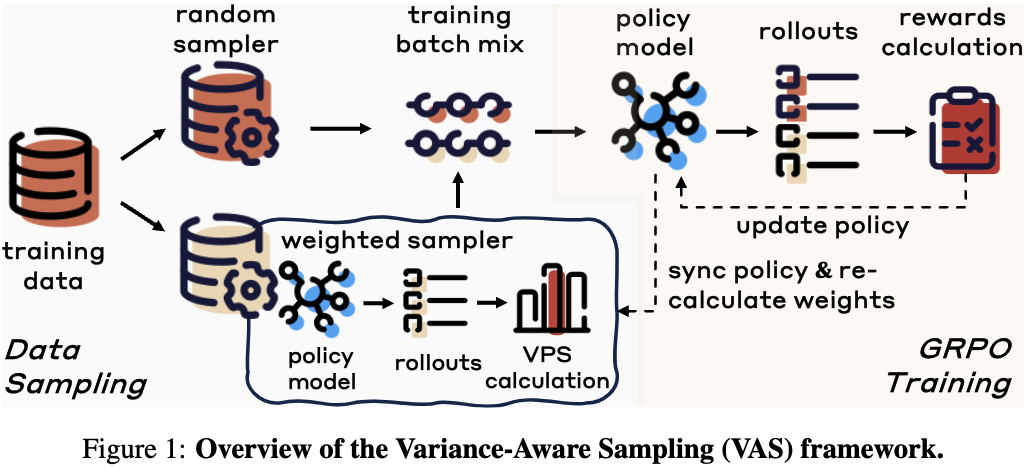
As illustrated in Figure 1, training begins with a pool of prompts from the dataset:
- A random sampler provides uniform coverage of data.
- A weighted sampler, guided by Variance Promotion Score (VPS), prioritizes prompts with higher reward variance and trajectory diversity.
- These two sources are combined to form training batches, balancing exploration and coverage.
- The policy model generates rollouts, which are evaluated with rewards and used to update the policy. VPS scores are periodically re-estimated as the model improves, ensuring dynamic adaptation.
This design ensures that training consistently focuses on prompts that provide strong learning signals, while still maintaining sufficient randomness for coverage.
🔹 Algorithm
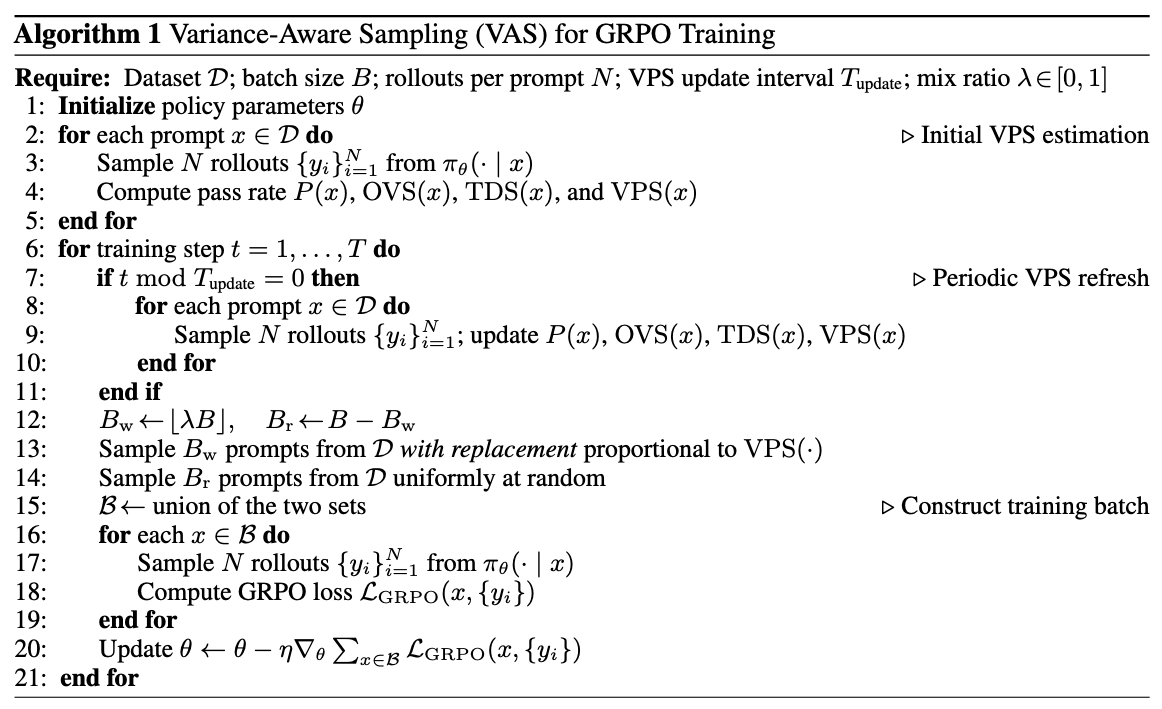
Algorithm 1 provides a step-by-step description of VAS within the GRPO framework:
- Initialization: For each prompt, multiple rollouts are sampled to estimate pass rate, outcome variance (OVS), trajectory diversity (TDS), and VPS.
- Periodic VPS update: At specified intervals, these statistics are refreshed to reflect the evolving policy.
- Batch construction: A mixture of prompts is drawn—some uniformly at random, others proportionally to VPS—controlled by the mixture ratio λ.
- Policy optimization: Rollouts are generated for the selected prompts, GRPO loss is computed, and the policy parameters are updated accordingly.
By adaptively steering training toward prompts with higher reward variance, VAS effectively stabilizes optimization and amplifies gradient signals, enabling more efficient and robust learning.
📦 Open Resources
We release the following resources for the community:
- MMR1-SFT (~16M): Supervised fine-tuning dataset with 16M long CoT cold-start trajectories (Gemini2.5 Pro/Flash) with verified short answer (GPT-4o)
- MMR1-RL (15k): RL dataset with 15k question-answer pairs (GPT-4o)
- MMR1-3B-SFT: 3B checkpoint trained with MMR1-SFT
- MMR1-3B-RL: 3B checkpoint trained with MMR1-SFT and MMR1-RL
- MMR1-7B-SFT: 7B checkpoint trained with MMR1-SFT
- MMR1-7B-RL: 7B checkpoint trained with MMR1-SFT and MMR1-RL
- MMR1-32B-SFT: 32B checkpoint trained with MMR1-SFT
- MMR1-32B-RL: 32B checkpoint trained with MMR1-SFT and MMR1-RL (On the way!)
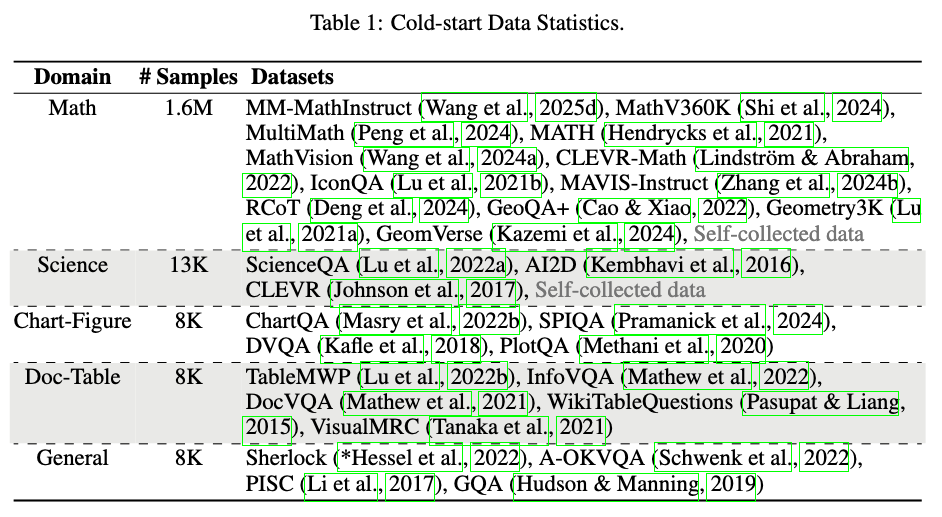
The dataset spans diverse domains—including mathematics, science, charts/figures, document tables, and general understanding—covering ~1.6M math samples and an additional ~37K samples across other domains. It integrates existing public resources (e.g., MathVerse, ScienceQA, ChartQA, DocVQA, GQA) together with newly curated and self-collected data, ensuring quality, difficulty, and diversity. This collection establishes one of the most comprehensive open resources for multimodal reasoning models. We hope these resources can serve as a benchmark for the community and facilitate the research of multimodal reasoning.
📊 Evaluation Results
We evaluate our models on a suite of mathematics-related multimodal reasoning benchmarks (MathVerse, MathVista, MathVision, LogicVista, and ChartQA).
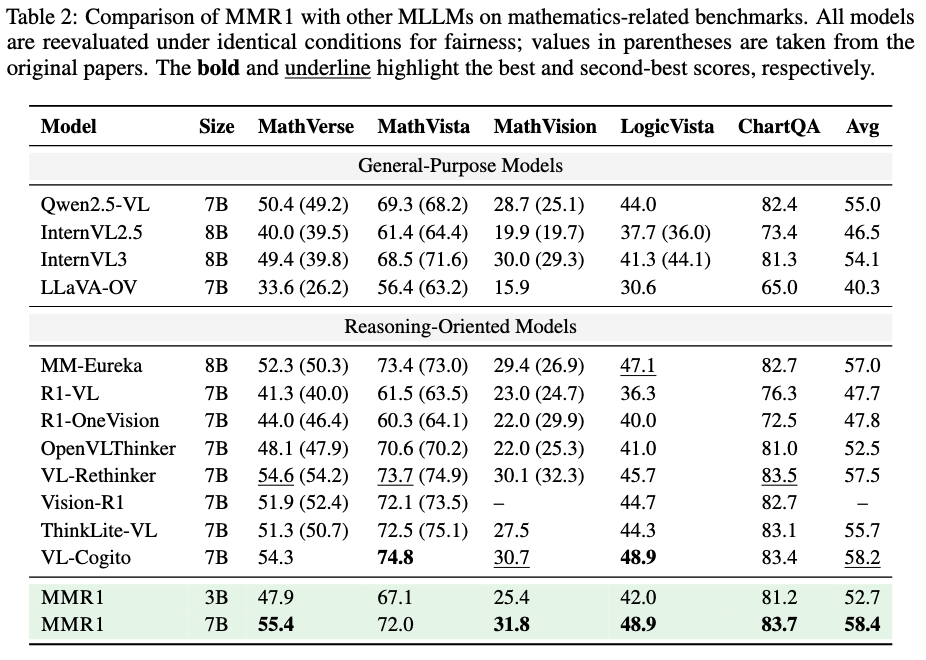
- MMR1-7B-RL achieves an average score of 58.4, establishing new state-of-the-art performance among 7B-scale reasoning models.
- MMR1-3B-RL performs competitively with 52.7, showing strong reasoning ability even at smaller scale.
- Our models consistently outperform or match larger baselines, demonstrating the effectiveness of Variance-Aware Sampling (VAS) and our curated long CoT training data.
🔍 Analysis of VAS Training Dynamics
We further analyze the effectiveness of Variance-Aware Sampling (VAS) through training efficiency and the evolution of Variance Promotion Score (VPS).
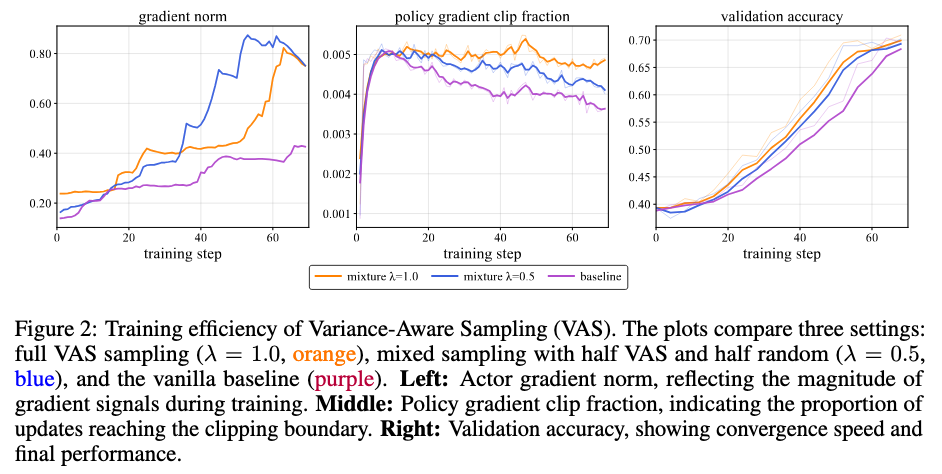
Training Efficiency (Fig. 2).
- Gradient norm: VAS substantially amplifies gradient magnitudes compared to the vanilla baseline, mitigating the gradient vanishing issue. This indicates that VAS consistently provides stronger optimization signals.
- Clip fraction: Higher clipping fractions in VAS runs suggest that policy updates are closer to the trust-region boundary, enabling more effective utilization of the learning signal without destabilizing training.
- Validation accuracy: Both full VAS (λ = 1.0) and mixed VAS–random sampling (λ = 0.5) converge faster and achieve higher final accuracy than the baseline, demonstrating that VAS improves both efficiency and performance. Notably, the mixed strategy achieves competitive results while maintaining broader data coverage.
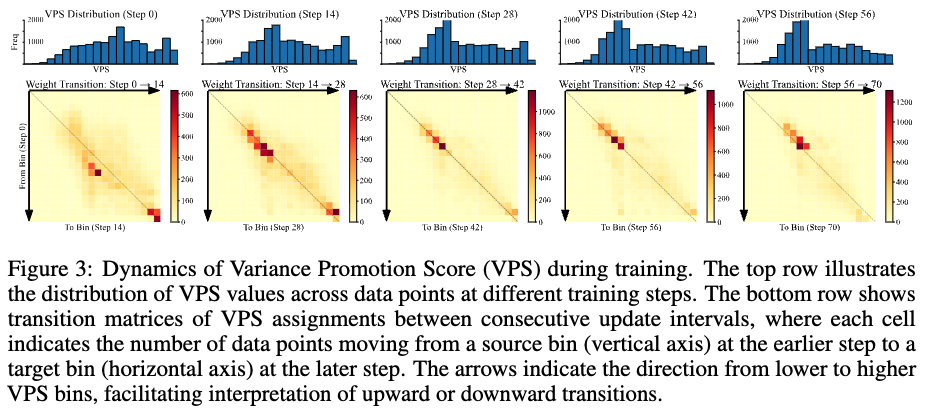
VPS Dynamics (Fig. 3).
- Score distribution: VPS distributions evolve from relatively uniform at the beginning of training to more concentrated in the middle bins, suggesting convergence in identifying consistently informative prompts.
- Weight transitions: Transition matrices show that many prompts shift across bins over time, with both upward and downward movements, reflecting the dynamic nature of reward variance as the policy evolves. Early transitions are more widespread, while later updates become more stable, consistent with convergence.
- Interpretation: This dynamic reweighting ensures that the model continually prioritizes prompts with higher variance while still allowing redistribution as learning progresses, preventing overfitting to a static subset of data.
👉 Together, these analyses highlight how VAS effectively mitigates gradient vanishing, improves sample efficiency, and adapts dynamically to the evolving training landscape.
🎨 Qualitative Demo
To illustrate the reasoning capability of our models, we provide qualitative examples from MathVerse.
The demo showcases how the model carefully analyzes the problem, plans a structured solution, executes step-by-step reasoning, verifies results, and even provides alternative solution paths.
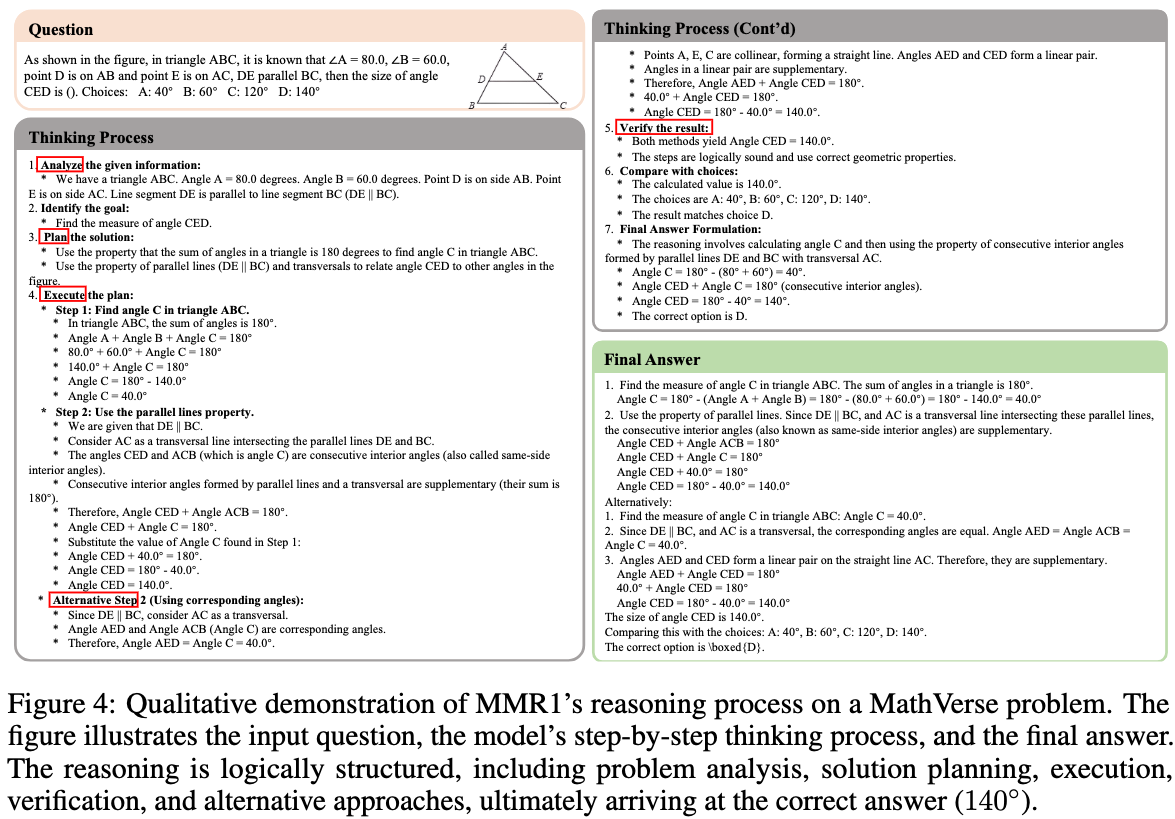
This demonstrates the model’s ability to maintain logical consistency, perform reflective verification, and present human-readable reasoning traces.
🤝 Contribution and Contact
This project is still under active development. Community feedback and contributions are highly appreciated. If you want to contribute, please feel free to make a pull request or create an issue.
👍 Acknowledgement
Our MMR1 is build on top of Qwen2.5VL, LLaMA-Factory and EasyR1. Besides, our MMR1 benefits from tons of open-source efforts. We sincerely appreciate these efforts and compile a list in ACKNOWLEDGEMENT.md to express our gratitude. If your work is used in MMR1 but not mentioned in either this repo or the technical report, feel free to let us know :heart:.
💡 Some other multimodal-LLM projects from our team may interest you ✨.
VideoLLaMA 3: Frontier Multimodal Foundation Models for Image and Video Understanding
Boqiang Zhang* , Kehan Li* , Zesen Cheng* , Zhiqiang Hu* , Yuqian Yuan* , Guanzheng Chen* , Sicong Leng* , Yuming Jiang* , Hang Zhang* , Xin Li* , Peng Jin, Wenqi Zhang, Fan Wang, Lidong Bing, Deli Zhao



VideoLLaMA 2: Advancing Spatial-Temporal Modeling and Audio Understanding in Video-LLMs
Zesen Cheng*, Sicong Leng*, Hang Zhang*, Yifei Xin*, Xin Li*, Guanzheng Chen, Yongxin Zhu, Wenqi Zhang, Ziyang Luo, Deli Zhao, Lidong Bing


VCD: Mitigating Object Hallucinations in Large Vision-Language Models through Visual Contrastive Decoding
Sicong Leng*, Hang Zhang*, Guanzheng Chen, Xin Li, Shijian Lu, Chunyan Miao, Lidong Bing


The Curse of Multi-Modalities: Evaluating Hallucinations of Large Multimodal Models across Language, Visual, and Audio
Sicong Leng*, Yun Xing*, Zesen Cheng*, Yang Zhou, Hang Zhang, Xin Li, Deli Zhao, Shijian Lu, Chunyan Miao, Lidong Bing


Breaking the Memory Barrier: Near Infinite Batch Size Scaling for Contrastive Loss
Zesen Cheng*, Hang Zhang*, Kehan Li*, Sicong Leng, Zhiqiang Hu, Fei Wu, Deli Zhao, Xin Li, Lidong Bing


VideoRefer Suite: Advancing Spatial-Temporal Object Understanding with Video LLM
Yuqian Yuan, Hang Zhang, Wentong Li, Zesen Cheng, Boqiang Zhang, Long Li, Xin Li, Deli Zhao, Wenqiao Zhang, Yueting Zhuang, Jianke Zhu, Lidong Bing


📑 Citation
If you find MMR1 useful for your research and applications, please cite using this BibTeX:
@misc{leng2025mmr1,
  title={MMR1: Enhancing Multimodal Reasoning with Variance-Aware Sampling and Open Resources},
  author={Sicong Leng and Jing Wang and Jiaxi Li and Hao Zhang and Zhiqiang Hu and Boqiang Zhang and Yuming Jiang and Hang Zhang and Xin Li and Lidong Bing and Deli Zhao and Wei Lu and Yu Rong and Aixin Sun and Shijian Lu},
  year={2025},
  eprint={2509.21268},
  archivePrefix={arXiv},
  primaryClass={cs.CV},
  url={https://arxiv.org/abs/2509.21268},
}
🔒 License
This project is released under the Apache 2.0 license as found in the LICENSE file. The service is a research preview intended for non-commercial use ONLY, subject to the model Licenses of Qwen, Terms of Use of the data generated by OpenAI and Gemini, and Privacy Practices of ShareGPT. Please get in touch with us if you find any potential violations.
Star History
Significant stargazers

378 followers · starred Mar 2025
Similar repos



Languages
Python
99.4%
[CVPR 2026] MMR1: Enhancing Multimodal Reasoning with Variance-Aware Sampling and Open Resources
See the codeREADME
MMR1: Enhancing Multimodal Reasoning with Variance-Aware Sampling and Open Resources
If our project helps you, please give us a star ⭐ on GitHub and upvote our HF paper to support us. 🙏🙏
📰 News
- [2025.09.25] 🔥🔥 Release technical report!
- [2025.09.25] 🚀🚀 Release MMR1-SFT (~16M) and MMR1-RL (15k) datasets!
- [2025.09.25] 🚀🚀 Release MMR1-3B and MMR1-7B, 32B checkpoint are on the way!
- [2025.09.25] Old repo are now moved to the branch mmr1_v0.
- [2025.03.11] 🔥🔥 Release MMR1-Math-v0-7B, achieving SOTA with only 6k public training data!
Introduction
This repo introduces our work on enhancing multimodal reasoning models. Current progress is limited by:
- ❌ Lack of open, large-scale, high-quality long chain-of-thought (CoT) data
- ❌ Instability of RL fine-tuning, where standard GRPO often suffers from gradient vanishing under low reward variance
🔑 Our Contributions
-
Variance-Aware Sampling (VAS):
A new data selection strategy guided by the Variance Promotion Score (VPS). VAS combines outcome variance and trajectory diversity to promote reward variance, stabilize policy optimization, and improve convergence. -
Large-scale curated resources:
- ~1.6M long CoT cold-start trajectories with verified short answer
- ~15k RL QA pairs
- Designed for quality, difficulty, and diversity
-
Open-source codebase & models:
- Fully reproducible end-to-end training pipeline
- Released models at multiple scales as standardized baselines for multimodal reasoning
Please refer to our TRAIN.md for detailed instructions on training with VAS.
💡 Methodology Overview
Our method introduces Variance-Aware Sampling (VAS) to address the gradient vanishing problem in reinforcement learning with Group Relative Policy Optimization (GRPO).
🔹 Framework
As illustrated in Figure 1, training begins with a pool of prompts from the dataset:
- A random sampler provides uniform coverage of data.
- A weighted sampler, guided by Variance Promotion Score (VPS), prioritizes prompts with higher reward variance and trajectory diversity.
- These two sources are combined to form training batches, balancing exploration and coverage.
- The policy model generates rollouts, which are evaluated with rewards and used to update the policy. VPS scores are periodically re-estimated as the model improves, ensuring dynamic adaptation.
This design ensures that training consistently focuses on prompts that provide strong learning signals, while still maintaining sufficient randomness for coverage.
🔹 Algorithm
Algorithm 1 provides a step-by-step description of VAS within the GRPO framework:
- Initialization: For each prompt, multiple rollouts are sampled to estimate pass rate, outcome variance (OVS), trajectory diversity (TDS), and VPS.
- Periodic VPS update: At specified intervals, these statistics are refreshed to reflect the evolving policy.
- Batch construction: A mixture of prompts is drawn—some uniformly at random, others proportionally to VPS—controlled by the mixture ratio λ.
- Policy optimization: Rollouts are generated for the selected prompts, GRPO loss is computed, and the policy parameters are updated accordingly.
By adaptively steering training toward prompts with higher reward variance, VAS effectively stabilizes optimization and amplifies gradient signals, enabling more efficient and robust learning.
📦 Open Resources
We release the following resources for the community:
- MMR1-SFT (~16M): Supervised fine-tuning dataset with 16M long CoT cold-start trajectories (Gemini2.5 Pro/Flash) with verified short answer (GPT-4o)
- MMR1-RL (15k): RL dataset with 15k question-answer pairs (GPT-4o)
- MMR1-3B-SFT: 3B checkpoint trained with MMR1-SFT
- MMR1-3B-RL: 3B checkpoint trained with MMR1-SFT and MMR1-RL
- MMR1-7B-SFT: 7B checkpoint trained with MMR1-SFT
- MMR1-7B-RL: 7B checkpoint trained with MMR1-SFT and MMR1-RL
- MMR1-32B-SFT: 32B checkpoint trained with MMR1-SFT
- MMR1-32B-RL: 32B checkpoint trained with MMR1-SFT and MMR1-RL (On the way!)
The dataset spans diverse domains—including mathematics, science, charts/figures, document tables, and general understanding—covering ~1.6M math samples and an additional ~37K samples across other domains. It integrates existing public resources (e.g., MathVerse, ScienceQA, ChartQA, DocVQA, GQA) together with newly curated and self-collected data, ensuring quality, difficulty, and diversity. This collection establishes one of the most comprehensive open resources for multimodal reasoning models. We hope these resources can serve as a benchmark for the community and facilitate the research of multimodal reasoning.
📊 Evaluation Results
We evaluate our models on a suite of mathematics-related multimodal reasoning benchmarks (MathVerse, MathVista, MathVision, LogicVista, and ChartQA).
- MMR1-7B-RL achieves an average score of 58.4, establishing new state-of-the-art performance among 7B-scale reasoning models.
- MMR1-3B-RL performs competitively with 52.7, showing strong reasoning ability even at smaller scale.
- Our models consistently outperform or match larger baselines, demonstrating the effectiveness of Variance-Aware Sampling (VAS) and our curated long CoT training data.
🔍 Analysis of VAS Training Dynamics
We further analyze the effectiveness of Variance-Aware Sampling (VAS) through training efficiency and the evolution of Variance Promotion Score (VPS).
Training Efficiency (Fig. 2).
- Gradient norm: VAS substantially amplifies gradient magnitudes compared to the vanilla baseline, mitigating the gradient vanishing issue. This indicates that VAS consistently provides stronger optimization signals.
- Clip fraction: Higher clipping fractions in VAS runs suggest that policy updates are closer to the trust-region boundary, enabling more effective utilization of the learning signal without destabilizing training.
- Validation accuracy: Both full VAS (λ = 1.0) and mixed VAS–random sampling (λ = 0.5) converge faster and achieve higher final accuracy than the baseline, demonstrating that VAS improves both efficiency and performance. Notably, the mixed strategy achieves competitive results while maintaining broader data coverage.
VPS Dynamics (Fig. 3).
- Score distribution: VPS distributions evolve from relatively uniform at the beginning of training to more concentrated in the middle bins, suggesting convergence in identifying consistently informative prompts.
- Weight transitions: Transition matrices show that many prompts shift across bins over time, with both upward and downward movements, reflecting the dynamic nature of reward variance as the policy evolves. Early transitions are more widespread, while later updates become more stable, consistent with convergence.
- Interpretation: This dynamic reweighting ensures that the model continually prioritizes prompts with higher variance while still allowing redistribution as learning progresses, preventing overfitting to a static subset of data.
👉 Together, these analyses highlight how VAS effectively mitigates gradient vanishing, improves sample efficiency, and adapts dynamically to the evolving training landscape.
🎨 Qualitative Demo
To illustrate the reasoning capability of our models, we provide qualitative examples from MathVerse.
The demo showcases how the model carefully analyzes the problem, plans a structured solution, executes step-by-step reasoning, verifies results, and even provides alternative solution paths.
This demonstrates the model’s ability to maintain logical consistency, perform reflective verification, and present human-readable reasoning traces.
🤝 Contribution and Contact
This project is still under active development. Community feedback and contributions are highly appreciated. If you want to contribute, please feel free to make a pull request or create an issue.
👍 Acknowledgement
Our MMR1 is build on top of Qwen2.5VL, LLaMA-Factory and EasyR1. Besides, our MMR1 benefits from tons of open-source efforts. We sincerely appreciate these efforts and compile a list in ACKNOWLEDGEMENT.md to express our gratitude. If your work is used in MMR1 but not mentioned in either this repo or the technical report, feel free to let us know :heart:.
💡 Some other multimodal-LLM projects from our team may interest you ✨.
VideoLLaMA 3: Frontier Multimodal Foundation Models for Image and Video Understanding
Boqiang Zhang* , Kehan Li* , Zesen Cheng* , Zhiqiang Hu* , Yuqian Yuan* , Guanzheng Chen* , Sicong Leng* , Yuming Jiang* , Hang Zhang* , Xin Li* , Peng Jin, Wenqi Zhang, Fan Wang, Lidong Bing, Deli Zhao
VideoLLaMA 2: Advancing Spatial-Temporal Modeling and Audio Understanding in Video-LLMs
Zesen Cheng*, Sicong Leng*, Hang Zhang*, Yifei Xin*, Xin Li*, Guanzheng Chen, Yongxin Zhu, Wenqi Zhang, Ziyang Luo, Deli Zhao, Lidong Bing
VCD: Mitigating Object Hallucinations in Large Vision-Language Models through Visual Contrastive Decoding
Sicong Leng*, Hang Zhang*, Guanzheng Chen, Xin Li, Shijian Lu, Chunyan Miao, Lidong Bing
The Curse of Multi-Modalities: Evaluating Hallucinations of Large Multimodal Models across Language, Visual, and Audio
Sicong Leng*, Yun Xing*, Zesen Cheng*, Yang Zhou, Hang Zhang, Xin Li, Deli Zhao, Shijian Lu, Chunyan Miao, Lidong Bing
Breaking the Memory Barrier: Near Infinite Batch Size Scaling for Contrastive Loss
Zesen Cheng*, Hang Zhang*, Kehan Li*, Sicong Leng, Zhiqiang Hu, Fei Wu, Deli Zhao, Xin Li, Lidong Bing
VideoRefer Suite: Advancing Spatial-Temporal Object Understanding with Video LLM
Yuqian Yuan, Hang Zhang, Wentong Li, Zesen Cheng, Boqiang Zhang, Long Li, Xin Li, Deli Zhao, Wenqiao Zhang, Yueting Zhuang, Jianke Zhu, Lidong Bing
📑 Citation
If you find MMR1 useful for your research and applications, please cite using this BibTeX:
@misc{leng2025mmr1,
  title={MMR1: Enhancing Multimodal Reasoning with Variance-Aware Sampling and Open Resources},
  author={Sicong Leng and Jing Wang and Jiaxi Li and Hao Zhang and Zhiqiang Hu and Boqiang Zhang and Yuming Jiang and Hang Zhang and Xin Li and Lidong Bing and Deli Zhao and Wei Lu and Yu Rong and Aixin Sun and Shijian Lu},
  year={2025},
  eprint={2509.21268},
  archivePrefix={arXiv},
  primaryClass={cs.CV},
  url={https://arxiv.org/abs/2509.21268},
}
🔒 License
This project is released under the Apache 2.0 license as found in the LICENSE file. The service is a research preview intended for non-commercial use ONLY, subject to the model Licenses of Qwen, Terms of Use of the data generated by OpenAI and Gemini, and Privacy Practices of ShareGPT. Please get in touch with us if you find any potential violations.
Star History
Similar repos
Significant stargazers
378 followers · starred Mar 2025
Languages
Python
99.4%