
Watch your Claude Code subagents work as a pixel-art office. Rewind any second, see what every agent cost, and turn any session into a timelapse GIF. Read-only, 100% local.
See the codeSee what people are saying
README
Roundtable
Watch your Claude Code subagents work. Rewind any second. Turn any session into a GIF.




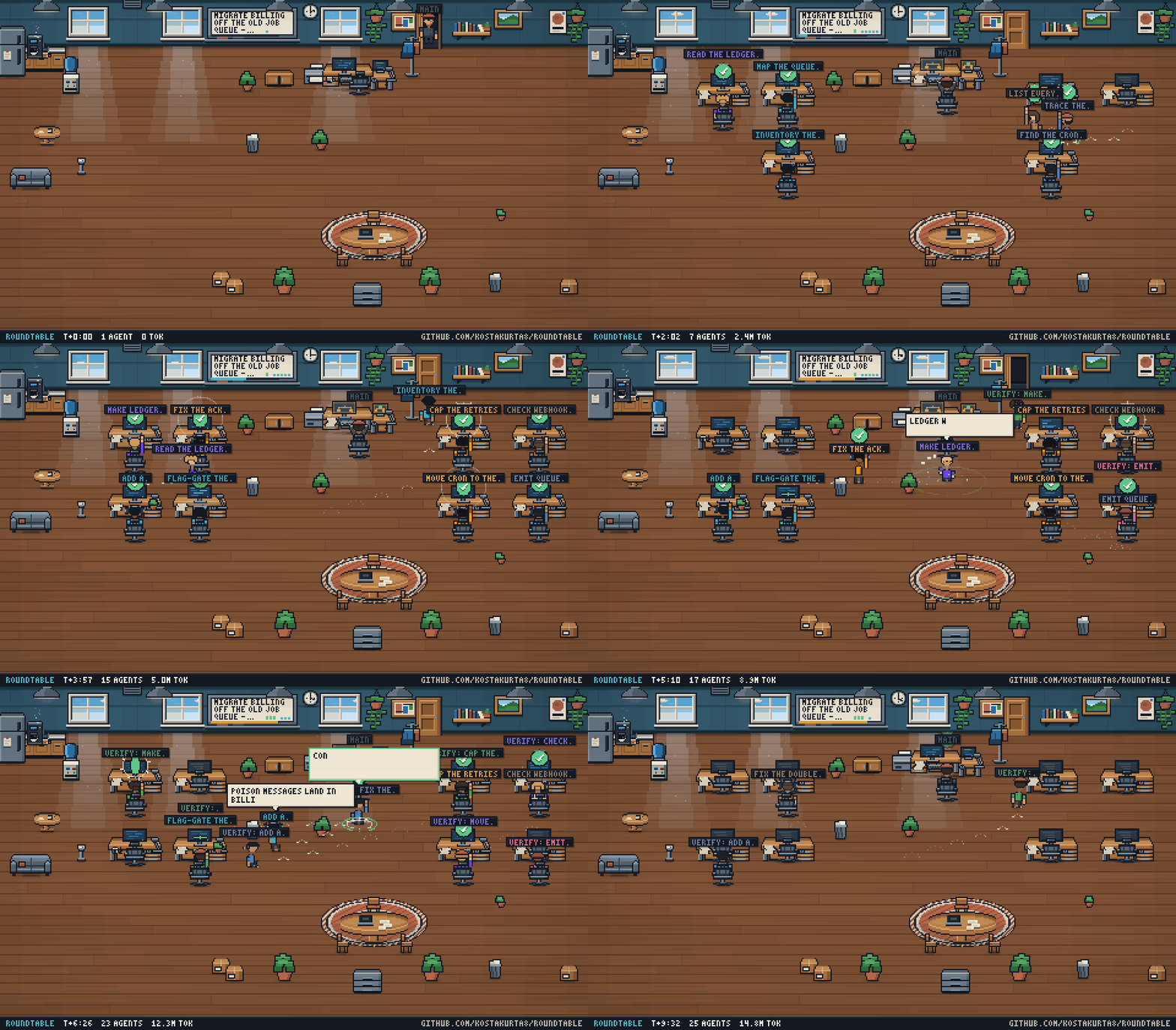
▶ Try it in your browser: no install, the real app replaying a staged session. Or run it on your own sessions:
npx https://github.com/Kostakurta8/roundtable/releases/latest/download/roundtable.tgz
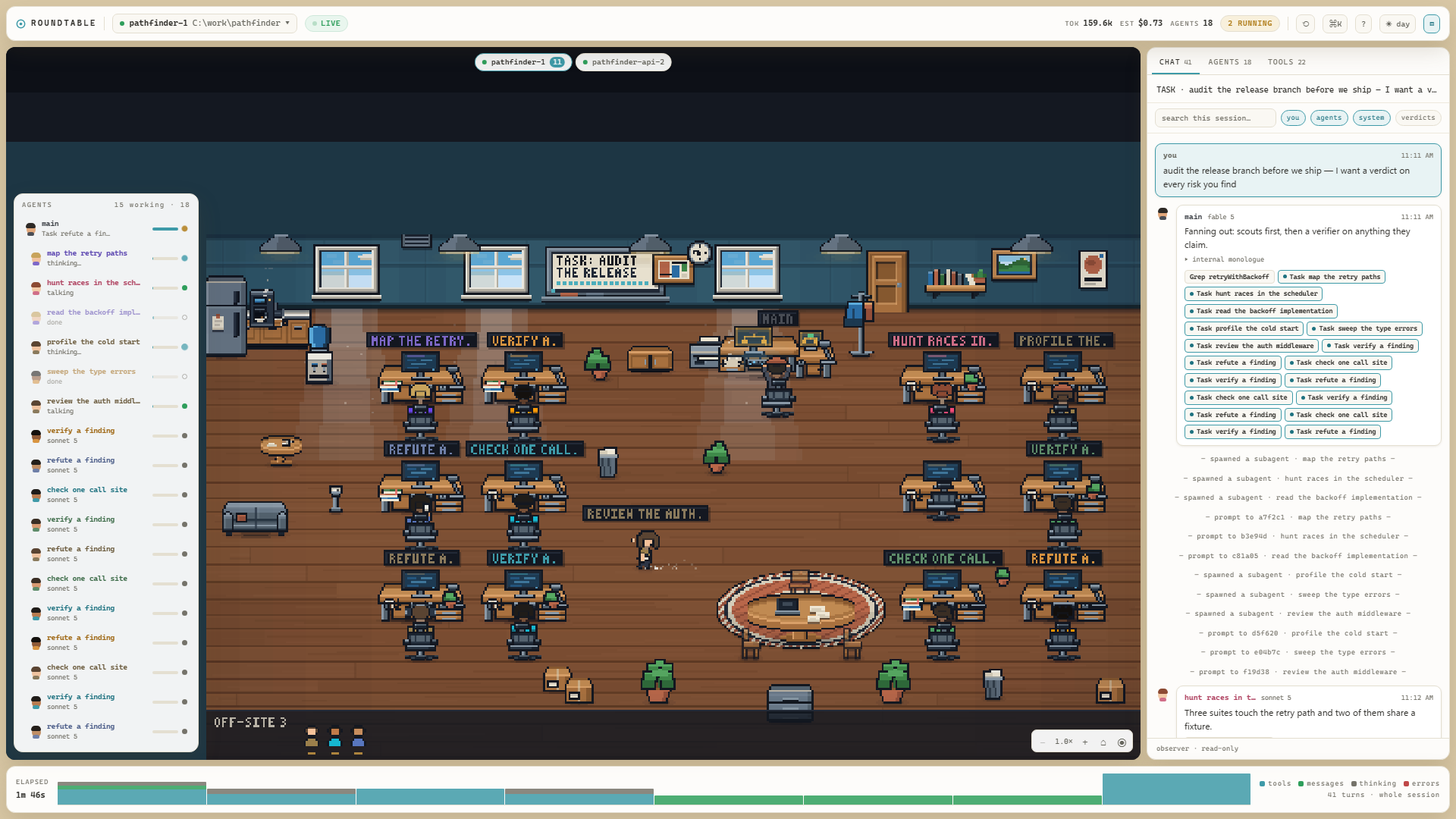
Every agent in a Claude Code run is a person in this office. They walk in when they are spawned,
work at a desk while a tool runs, walk over to hand back what they found, tell each other
CONFIRMED or REFUTED, and leave through the door when they are done. It reads the transcripts
Claude Code already writes under ~/.claude — read-only, entirely local, and it never calls an API.
Why you'd want it
- See who is working, who is waiting, and who is burning the tokens. Every subagent is a person at a desk, and every one carries its own token total, cache included, and a cost estimate.
- Rewind to any second. Click the timeline and the room rebuilds exactly as it stood — the same events replayed into the same simulation, not an approximation of it. Any session on the machine, not just the one running now.
- Turn a session into a GIF — or a card — you can post. The Share button in the app,
--gifor--cardon the command line, or/roundtable:giffrom inside Claude Code. The card is the run in numbers over a still of the room: subagents, how many at once, tokens, cost, verdicts. One switch takes every word of your transcripts out of the picture first. - Find out what your transcripts already say.
--statsreads every session you have and reports how much of your output subagents write and what a child costs before it starts — counted the way these files have to be counted. On the author's machine, adding up usage line by line would have over-reported output tokens by 94%. - Nothing to trust but a file reader. It never writes to
~/.claude, installs no hooks, calls no API and opens no outbound connection.SECURITY.mdnames the file and the mechanism behind each of those, and the residual risks they do not cover.
Quick start
npx https://github.com/Kostakurta8/roundtable/releases/latest/download/roundtable.tgz
That is the whole install, and it takes a few seconds. It serves the office on
http://localhost:7411, opens your browser, and shows your most recent session — live, if one is
running. Node 22.12 or newer. The link is the packed build attached to the latest release;
npx github:Kostakurta8/roundtable runs the same thing built from source, which takes a minute or
two the first time.
To use it more than once, install it — npm i -g https://github.com/Kostakurta8/roundtable/releases/latest/download/roundtable.tgz — and it is roundtable:
roundtable               # the office, on http://localhost:7411
roundtable --demo        # a staged session, when nothing of yours is running
roundtable --stats       # what every transcript you already have says, then exit
roundtable --gif         # your latest session as a GIF, then exit
roundtable --card        # the same session as one PNG card of its numbers, then exit
roundtable --port 9000   # somewhere else (ROUNDTABLE_PORT sets the same thing)
roundtable --root /path  # a different Claude directory
roundtable --no-open     # print the address, do not open a browser
claude-roundtable is the name it will have on npm, which will shorten all of this to
npx claude-roundtable. It is not published yet.
Written and used on Windows. macOS and Linux pass CI, which is not the same thing as somebody having watched the office draw itself there — Platforms says exactly what has and has not been checked.
If you don't have Claude Code, or nothing is running
npx https://github.com/Kostakurta8/roundtable/releases/latest/download/roundtable.tgz --demo
An office with nobody in it is what an idle machine honestly looks like, and it is a poor way to
find out what this does. --demo writes a synthetic ~/.claude root into a fresh directory under
your temp directory and points the observer at that instead: agents arrive, work, report to each
other, hand down verdicts, fill the desks past the point where there are chairs, and go home — and
then it keeps going, so the room is still moving when you come back to it.
Nothing about it is faked except the transcripts. The lines go to disk and come back through the
same watcher, parser, normalizer, socket and store as a real session, and the hub's timing is left
at its shipped defaults. It never reads your own ~/.claude, so no prompt, path or project name of
yours can appear in it, and --root is ignored with it, so it cannot be pointed at a real
directory. Ctrl+C deletes the staged root on the way out — that one directory, so two demos can
run side by side.
Without it, the first screen tells you where the observer is looking — the directory, in full — and that the first Claude Code session to start on this machine will appear there on its own.
Turn any session into a GIF
The clip at the top is a staged session. There are three ways to make one of yours.
In the app
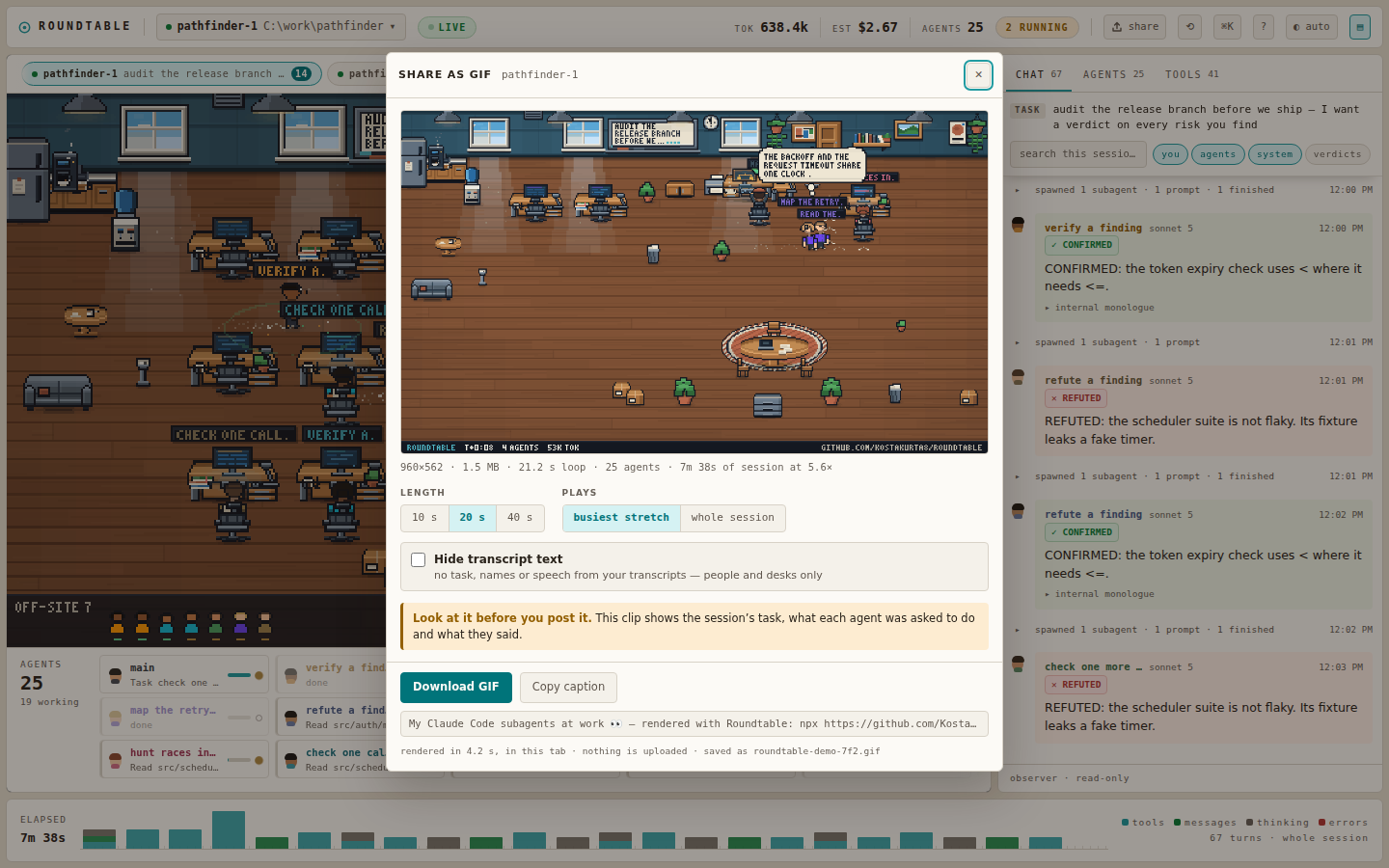
The Share button in the top bar — or G, or the ⌘K palette — renders the session you are
looking at as a GIF, in the browser, with a live preview. Download it, or copy a caption to post
with it. Hide transcript text draws the same run with none of your words in it. Nothing is
uploaded: the GIF is made in the tab, by the same renderer as --gif, and saved by your browser.
The page holds only the last few thousand events of a long session, so for the whole of one, use
--gif. It works on the browser demo too.
Or a card
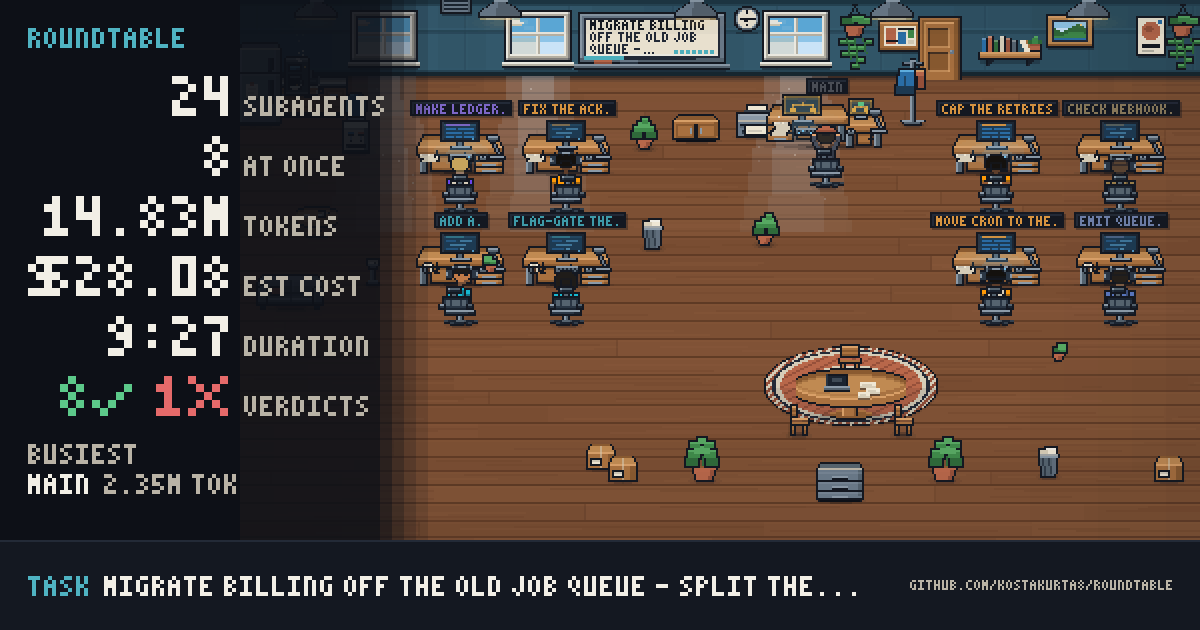
GIF | Card at the top of the same dialog — or roundtable --card — makes one 1200×630 PNG:
the session in numbers, over a still of the room at its busiest. The size link previews use, so it
posts uncropped. Tokens and cost are the top bar's own figures, with the same ≥ when a model has no
rate card; "at once" is read off the same replay the still is drawn from, so the number and the
picture agree. "Copy image" puts it on the clipboard where the browser allows it. "Hide transcript
text" works here too: no task, and agents numbered rather than named.
From the command line
npx https://github.com/Kostakurta8/roundtable/releases/latest/download/roundtable.tgz --gif
It writes roundtable-<session>.gif where you ran it: your latest session, every silence cut to a
beat and the rest sped up to about twenty seconds. A session too long for that becomes its busiest
stretch — the part where the agents actually arrive — and the clock on the office wall keeps the real
time, so you can see where it jumped. It takes a few seconds and starts nothing that outlives it.
roundtable --gif --session 3043f946   # a particular session: the first few characters of its id
roundtable --gif --bare               # no task, names or speech from your transcripts in it
roundtable --gif --full --seconds 40  # the whole session, however long, in forty seconds
roundtable --gif --out run.gif        # somewhere other than roundtable-<session>.gif
roundtable --gif --demo               # the clip above, on a machine with no sessions at all
--seconds goes up to 60.
From inside Claude Code
Roundtable is also a Claude Code plugin, so the session you are in can render itself:
/plugin marketplace add Kostakurta8/roundtable
/plugin install roundtable@roundtable
/roundtable:gif | this session, as a GIF in the working directory — --bare, --seconds, --full work here too |
/roundtable:watch | the live office in your browser, started in the background |
/roundtable:stats | the --stats report, with a few lines on what is unusual about your numbers |
Each one runs the same packed release as the lines above, with the session's own id, so a GIF made from inside a session is always that session and not whichever one wrote last.
Look at it before you post it
By default a clip shows what the session showed — the task on the whiteboard, what each agent was
asked to do, what they said. --bare, or Hide transcript text in the app, draws the same run
with none of that text in it: the people, their desks and their walks are all still there.
SECURITY.md lists exactly what a clip can contain.
Share yours: post it with #roundtable and tag
the repo — and a ⭐ is welcome if this made your
subagents less mysterious.
The whole app
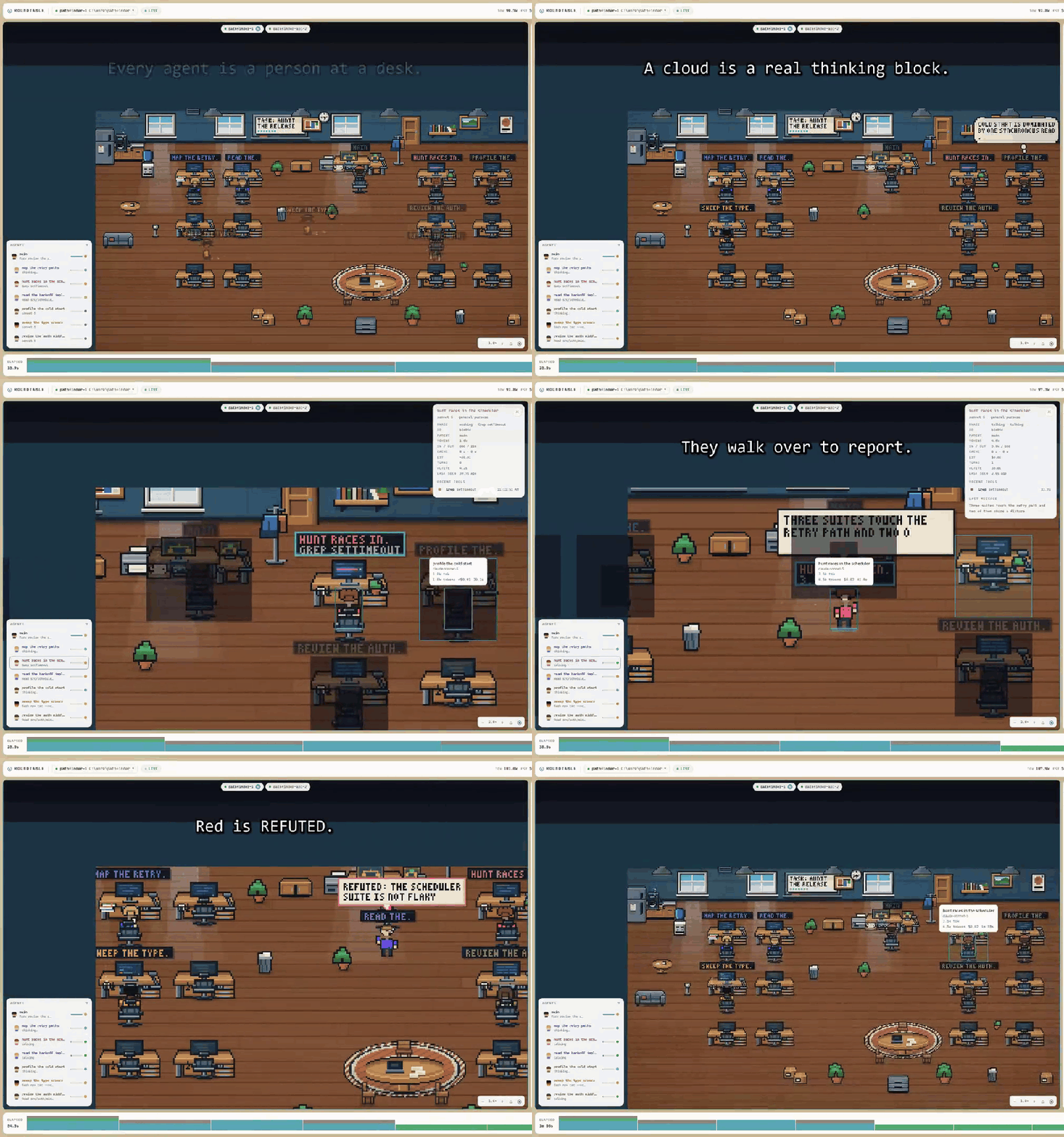
The clip stays on one live session. ▶ The 52-second trailer
shows what it does not: the timeline rewinding the room to an earlier second, two sessions in tabs,
and the per-agent token and cost breakdown. No narration; captions are burned in, and
media/roundtable-trailer.srt has them as text. It was filmed on an earlier version of the
interface — the room did not yet fill its panel and there was no Share button — so it shows what
the app does, not quite how it now looks.
Every frame of both clips is the real application driven by real events — only the content of the
transcripts is synthetic, so that no private session appears in either. scripts/promo/ is the
harness that filmed them.
How it works, in two sentences: it tails the JSONL transcripts Claude Code writes — the main
session's and every subagent's — and turns each line into a typed event, which feeds a
deterministic simulation that paints the office into a 480×270 pixel buffer. Because the simulation
is deterministic, rewinding is the same events replayed into the same simulation, and --gif is
that same replay, played into a file.
What your own machine already knows
npx https://github.com/Kostakurta8/roundtable/releases/latest/download/roundtable.tgz --stats
The office shows the run you are in. This reads every transcript under ~/.claude and tells you what
has been happening all along, then exits. It starts no server, opens no port, and writes nothing.
roundtable --stats   ~/.claude

  1,469 session transcripts, 51 of them spawned subagents
  513 children  (327 task, 186 workflow)  median 7 per run

  children wrote 58.4% of the output of the runs that spawned them
  across every session on this machine, children are 52.6% of all output  (24,694,800 vs 22,269,746 written in main transcripts)
  cold start: 46,669 cache-creation tokens per child, before it does any work
  median child: 65 tool calls over 1,286 s
  13 of 513 children (2.5%) made no tool call and wrote nothing
  407 cache-read tokens per output token

  usage blocks: 130,017 lines describe 63,025 responses — summing per line reports 90,961,379 output tokens against 46,964,546 real (+93.7%)
    and it is not evenly spread: main transcripts +195.4%, subagent transcripts +1.9%

  hooks: 8,831 records = 6,898 firings (+28% if you count lines)
    UserPromptSubmit         3,506
    SessionStart:startup     1,469
    SessionStart             1,469
    PostToolUse:Edit         250
    PostToolUse:Write        191
    SessionStart:compact     9
    PostToolUse:Bash         4
    a hook absent from this list is one of three things: never registered,
    never fired, or fired without writing a record. Absence is a hint, not proof.

  Nothing was written and nothing left this machine.
That is the author's machine on 2026-09-18, and three of those lines are there because they cost the author something to learn:
- Children write most of the output. The main transcript you watch live is under half of what a fan-out run produces, so "I barely use my quota" often just means "I do not spawn subagents".
- Summing usage per line over-reports you by about 3x — and almost only in the main transcripts.
A response with several content blocks is written as several lines, and every line repeats the same
complete usage object. Deduplicate on
message.id. Subagent transcripts hardly do it, which is how a tool that gets this wrong can still look right on the files you spot-check. - A hook firing writes two records.
hook_successcarries the command, exit code and duration;hook_additional_contextcarries what it injected; they share atoolUseID. Count lines and you over-report your own guardrails by a third. And absence is not proof — a hook can fire and write nothing at all, so a name missing from that list is never registered, never fired or never recorded, three cases this file cannot tell apart.
Run it on your own machine and the numbers will not match these. That is the point of running it.
Reference
What you are looking at
┌──────────────────────────────────────────────────────────┬──────────────┐
│ ROUNDTABLE  ▾ session   ● LIVE      TOK  EST  AGENTS  ⟲ ⌘K ◐ ▤        │
├──────────┬───────────────────────────────────────────────┼──────────────┤
│ AGENTS   │                                               │  CHAT        │
│  ·····   │   the office — one person per agent           │  AGENTS      │
│  ·····   │                                               │  TOOLS       │
│  ·····   │                                               │              │
│ roster:  │                                               │  the same    │
│ who is   │                                               │  events, in  │
│ here and │                                               │  words       │
│ doing    │                                               │              │
│ what     │                                               │              │
├──────────┴───────────────────────────────────────────────┴──────────────┤
│ ELAPSED  ▁▃▅▂▇▃▁▂▅▃▁  activity, one bar per second — click to rewind     │
└─────────────────────────────────────────────────────────────────────────┘
The room. Each agent walks in through the door and takes a desk. Working at a desk means a tool
is running; a thought bubble is a real thinking block; walking to someone and speaking is that
agent reporting a result. A red bubble is a REFUTED verdict, a green one CONFIRMED. When an
agent finishes it gives up its chair — so somebody waiting outside can have it — walks to the door
and leaves. So the room is always only the people still working, and the desks that are free are
free because somebody actually finished. Whoever has left is still in the AGENTS panel with
their tokens, their cost and everything they said.
If one of them turns out not to have finished after all — which happens, because a background agent is reported done the moment it is launched — it walks back in through the door and takes a desk again.
If more agents are running than the room has chairs, the extra ones appear as small heads along the bottom. They are real: you can hover, tab to and click them.
The top bar. TOK is every token the session has billed, cache included. EST is a cost
estimate from published list prices — a ≥ in front means some model in the session has no rate
card in shared/models.ts, so the figure is a floor rather than a total.
The timeline. One bar per second of the session. Click one — or tab to it and use the arrow
keys — and the whole room rewinds to that moment and stops. The office is deterministic, so this
rebuilds the room as it actually stood, not an approximation. Press Escape or the RESUME LIVE
button in the top bar to come back to now.
Clicking a person focuses them: the feed filters to their turns and everyone outside their spawn tree dims. Clicking the whiteboard opens the session's feed; clicking the roundtable filters the feed to just the verdicts agents gave each other.
More than one session at a time
When two or more sessions are running, a strip of tabs appears over the room, one per session. Clicking a tab shows that session's room, roster, feed and totals. Nothing is thrown away when you switch: every room keeps running in the background, so switching back is instant and complete.
"Running" is the same thing the dot in the picker means — the CLI has the session registered and something touched it inside the last 90 seconds. A tab carries a count only when that session has agents actually working, so a busy session and an idle one are still told apart at a glance. With one session running, or none, there is no strip at all; there would be nothing to choose between.
New sessions are picked up automatically. The hub sweeps for them every few seconds — start a
session in another window and its tab appears on its own. The ⟲ button in the top bar asks it to
look now rather than on its own schedule; it is there so you do not have to wonder whether it is
working.
To watch a session that is not running — anything you have ever run on this machine — use the
session picker in the top bar, or press ⌘K and start typing its name.
Keys
⌘K / Ctrl+K | command palette — every action, plus every agent and session by name |
G | share: the session you are looking at, as a GIF |
1 2 3 | chat / agents / tools panel |
B | show or hide the side panel |
T | day → night → follow the system |
? | what am I looking at |
Escape | close the palette, then resume live, then clear the selection |
| arrows | pan the room; + / - zoom; Home re-centres; F follows the selection |
| arrows on the timeline | move along it; Enter rewinds the room to that second |
If something looks wrong
OFFLINE in the top bar. The hub is not running — the terminal that ran
roundtable or npm start was closed, or the machine slept. A note above the
panel says so and names the socket it is retrying; start the hub again and the page reconnects on
its own, and what it shows meanwhile is the session as it stood when the connection dropped. From a
clone, if you started only Vite, the page has nothing to connect to.
"port 7411 is already in use". Roundtable is already running in another terminal. Open
http://localhost:7411 — or http://localhost:5173, if the other copy is npm start from a
clone — instead of starting a second copy, or start this one elsewhere with --port.
Vite refuses to start because 5173 is busy. That is deliberate. The hub only accepts WebSocket
connections from localhost:5173 and :4173 — that check is the only thing stopping any other page
you have open from reading your transcripts. If Vite quietly moved to 5174 the app would look
completely normal and never connect.
The feed says lines were dropped, or that the tail is incomplete. Both are true statements, not glitches: a transcript line over 1 MiB cannot be parsed and is stepped over (any tool call answered on such a line will never show a result), and a very large transcript is still being read. The feed says so rather than quietly showing you less than there is.
Platforms
Node 22.12 or newer. Beyond that, the honest position:
| Windows | where it was written and where it has actually been used |
| macOS, Linux | CI runs the type check, the unit suite, the production build and the package smoke test on both, on Node 22 and 24, and the Playwright suite in headless Chromium on Linux. Nobody has reported opening the room on either. |
Those are different claims and the difference matters. A green CI badge says the code compiles and
the suite passes on all three; it is not a report from somebody who watched the office draw itself.
Two things in server/hub.ts branch on the platform — path comparison is case-insensitive on
Windows, and the file watcher polls there by default, because fs.watch is least reliable across
Windows drive types. Every unit test forces polling on, so the fs.watch path that macOS and Linux
use by default is precisely the thing the matrix does not exercise; the one place it is under test
is the Playwright job's native leg, on Linux.
If you run it on macOS or Linux, an issue saying what happened is genuinely useful — working or not. That is the gap.
The desktop icon — Windows only
npm run desktop
Puts a Claude Agents shortcut on the Desktop. Clicking it starts the observer if it is not already up, opens the room in your browser, brings Claude Code up to date, and hands the window over to a Claude session — so one click gets you both halves of what you were going to open anyway.
This one is Windows-only and not portable in principle: it writes a .lnk through the
WScript.Shell COM object and points it at pwsh through the WindowsApps execution alias. There is
no macOS or Linux equivalent, and nothing else needs one — npm start is the way in on every
platform.
Clicking it twice is safe: the servers are only started when nothing is listening on their ports, so a second click just opens another tab and another session. The servers get their own minimized window called Roundtable servers, which is where to look if something does not come up and what to close when you are finished.
The session starts in your home directory, because that is where sessions normally run and so it is
the one the observer opens on. $StartIn at the top of desktop\claude-agents.ps1 changes that.
desktop\claude-agents.ps1 -SkipClaude does everything except open the session, which is how to
check the shortcut without spending one.
The icon is drawn by scripts/desktopIcon.mjs rather than checked in as an opaque binary — edit the
geometry there and re-run npm run desktop. If you move or rename the project, re-run it too: the
shortcut points into the checkout.
Development
From a clone: running it, the checks, and CI
npm install && npm start runs the hub and Vite together on http://localhost:5173;
npm run demo does the same against a staged session so there is something to watch on a machine
that has never run Claude Code.
npm run dev          # same as start, without opening a browser
npm test             # the unit suite — ~15s, binds nothing
npx tsc --noEmit     # types
npx vite build       # the client, built the way a user would get it
npm run smoke        # pack, install into an empty directory, run the installed binary — --gif and --demo too
npm run e2e          # Playwright — needs 7411 and 5173 free, so stop `npm start` first
npm run room         # render the office to .preview/room-{day,night,spawn}.png
npm run room:bless   # accept a deliberate visual change as the new baseline
npm run e2e starts its own hub on 7411, so it cannot run at the same time as the app. Stop the app
by port, not by killing the npm wrapper — the two servers outlive it.
npm run room:bless rewrites the visual baseline that tests/room.test.ts hashes against. Look
at the PNGs before you bless them — a hash can tell you the room changed, never that it is still
right, and blessing without looking turns a regression into the baseline. CONTRIBUTING.md has the
rest of the loop, and docs/pixel-contract.md is binding for anything under src/office/pixel/.
CI (.github/workflows/ci.yml) runs the typecheck, the unit tests, the build and the package smoke
test on Ubuntu, macOS and Windows × Node 22 and 24 for every push to main and every pull request.
The Playwright job runs beside it on Linux in two legs — the watcher polling, and the watcher left
at its platform default. It first passed on a runner on 2026-08-09 and has gated pushes and pull
requests since; before that it had only ever run on Windows with a human watching. The workflow says
what a green run there does and does not prove, where the job is defined.
Architecture, in one paragraph
server/tail.ts tails each JSONL file by byte offset →
server/parse.ts tolerantly parses a line → server/normalize.ts turns it into typed events →
server/hub.ts watches the filesystem, derives cross-file events like "that subagent finished", and
broadcasts over a loopback WebSocket gated on Origin → src/ws.ts batches frames → src/store.ts
folds them into one RtState per session → the panels render that, while src/office/mapping.ts
turns the same events into commands for the deterministic simulation in src/office/engine.ts,
which src/office/pixel/scene.ts paints into a 480×270 buffer. shared/ holds the wire types and
is the only thing both halves import.
The rest of it
CONTRIBUTING.md | how to run it, the checks, the visual-regression loop, and what will get a PR sent back |
SECURITY.md | what "read-only" is enforced by, file and mechanism — and the residual risks, including the one the Origin gate deliberately leaves open |
CHANGELOG.md | every release so far, written from git log |
docs/pixel-contract.md | binding for anything under src/office/pixel/ |
LICENSE | MIT |
Similar repos


Languages
TypeScript
93.7%
CSS
4.9%
JavaScript
1.1%
Watch your Claude Code subagents work as a pixel-art office. Rewind any second, see what every agent cost, and turn any session into a timelapse GIF. Read-only, 100% local.
See the codeSee what people are saying
README
Roundtable
Watch your Claude Code subagents work. Rewind any second. Turn any session into a GIF.
▶ Try it in your browser: no install, the real app replaying a staged session. Or run it on your own sessions:
npx https://github.com/Kostakurta8/roundtable/releases/latest/download/roundtable.tgz
Every agent in a Claude Code run is a person in this office. They walk in when they are spawned,
work at a desk while a tool runs, walk over to hand back what they found, tell each other
CONFIRMED or REFUTED, and leave through the door when they are done. It reads the transcripts
Claude Code already writes under ~/.claude — read-only, entirely local, and it never calls an API.
Why you'd want it
- See who is working, who is waiting, and who is burning the tokens. Every subagent is a person at a desk, and every one carries its own token total, cache included, and a cost estimate.
- Rewind to any second. Click the timeline and the room rebuilds exactly as it stood — the same events replayed into the same simulation, not an approximation of it. Any session on the machine, not just the one running now.
- Turn a session into a GIF — or a card — you can post. The Share button in the app,
--gifor--cardon the command line, or/roundtable:giffrom inside Claude Code. The card is the run in numbers over a still of the room: subagents, how many at once, tokens, cost, verdicts. One switch takes every word of your transcripts out of the picture first. - Find out what your transcripts already say.
--statsreads every session you have and reports how much of your output subagents write and what a child costs before it starts — counted the way these files have to be counted. On the author's machine, adding up usage line by line would have over-reported output tokens by 94%. - Nothing to trust but a file reader. It never writes to
~/.claude, installs no hooks, calls no API and opens no outbound connection.SECURITY.mdnames the file and the mechanism behind each of those, and the residual risks they do not cover.
Quick start
npx https://github.com/Kostakurta8/roundtable/releases/latest/download/roundtable.tgz
That is the whole install, and it takes a few seconds. It serves the office on
http://localhost:7411, opens your browser, and shows your most recent session — live, if one is
running. Node 22.12 or newer. The link is the packed build attached to the latest release;
npx github:Kostakurta8/roundtable runs the same thing built from source, which takes a minute or
two the first time.
To use it more than once, install it — npm i -g https://github.com/Kostakurta8/roundtable/releases/latest/download/roundtable.tgz — and it is roundtable:
roundtable               # the office, on http://localhost:7411
roundtable --demo        # a staged session, when nothing of yours is running
roundtable --stats       # what every transcript you already have says, then exit
roundtable --gif         # your latest session as a GIF, then exit
roundtable --card        # the same session as one PNG card of its numbers, then exit
roundtable --port 9000   # somewhere else (ROUNDTABLE_PORT sets the same thing)
roundtable --root /path  # a different Claude directory
roundtable --no-open     # print the address, do not open a browser
claude-roundtable is the name it will have on npm, which will shorten all of this to
npx claude-roundtable. It is not published yet.
Written and used on Windows. macOS and Linux pass CI, which is not the same thing as somebody having watched the office draw itself there — Platforms says exactly what has and has not been checked.
If you don't have Claude Code, or nothing is running
npx https://github.com/Kostakurta8/roundtable/releases/latest/download/roundtable.tgz --demo
An office with nobody in it is what an idle machine honestly looks like, and it is a poor way to
find out what this does. --demo writes a synthetic ~/.claude root into a fresh directory under
your temp directory and points the observer at that instead: agents arrive, work, report to each
other, hand down verdicts, fill the desks past the point where there are chairs, and go home — and
then it keeps going, so the room is still moving when you come back to it.
Nothing about it is faked except the transcripts. The lines go to disk and come back through the
same watcher, parser, normalizer, socket and store as a real session, and the hub's timing is left
at its shipped defaults. It never reads your own ~/.claude, so no prompt, path or project name of
yours can appear in it, and --root is ignored with it, so it cannot be pointed at a real
directory. Ctrl+C deletes the staged root on the way out — that one directory, so two demos can
run side by side.
Without it, the first screen tells you where the observer is looking — the directory, in full — and that the first Claude Code session to start on this machine will appear there on its own.
Turn any session into a GIF
The clip at the top is a staged session. There are three ways to make one of yours.
In the app
The Share button in the top bar — or G, or the ⌘K palette — renders the session you are
looking at as a GIF, in the browser, with a live preview. Download it, or copy a caption to post
with it. Hide transcript text draws the same run with none of your words in it. Nothing is
uploaded: the GIF is made in the tab, by the same renderer as --gif, and saved by your browser.
The page holds only the last few thousand events of a long session, so for the whole of one, use
--gif. It works on the browser demo too.
Or a card
GIF | Card at the top of the same dialog — or roundtable --card — makes one 1200×630 PNG:
the session in numbers, over a still of the room at its busiest. The size link previews use, so it
posts uncropped. Tokens and cost are the top bar's own figures, with the same ≥ when a model has no
rate card; "at once" is read off the same replay the still is drawn from, so the number and the
picture agree. "Copy image" puts it on the clipboard where the browser allows it. "Hide transcript
text" works here too: no task, and agents numbered rather than named.
From the command line
npx https://github.com/Kostakurta8/roundtable/releases/latest/download/roundtable.tgz --gif
It writes roundtable-<session>.gif where you ran it: your latest session, every silence cut to a
beat and the rest sped up to about twenty seconds. A session too long for that becomes its busiest
stretch — the part where the agents actually arrive — and the clock on the office wall keeps the real
time, so you can see where it jumped. It takes a few seconds and starts nothing that outlives it.
roundtable --gif --session 3043f946   # a particular session: the first few characters of its id
roundtable --gif --bare               # no task, names or speech from your transcripts in it
roundtable --gif --full --seconds 40  # the whole session, however long, in forty seconds
roundtable --gif --out run.gif        # somewhere other than roundtable-<session>.gif
roundtable --gif --demo               # the clip above, on a machine with no sessions at all
--seconds goes up to 60.
From inside Claude Code
Roundtable is also a Claude Code plugin, so the session you are in can render itself:
/plugin marketplace add Kostakurta8/roundtable
/plugin install roundtable@roundtable
/roundtable:gif | this session, as a GIF in the working directory — --bare, --seconds, --full work here too |
/roundtable:watch | the live office in your browser, started in the background |
/roundtable:stats | the --stats report, with a few lines on what is unusual about your numbers |
Each one runs the same packed release as the lines above, with the session's own id, so a GIF made from inside a session is always that session and not whichever one wrote last.
Look at it before you post it
By default a clip shows what the session showed — the task on the whiteboard, what each agent was
asked to do, what they said. --bare, or Hide transcript text in the app, draws the same run
with none of that text in it: the people, their desks and their walks are all still there.
SECURITY.md lists exactly what a clip can contain.
Share yours: post it with #roundtable and tag
the repo — and a ⭐ is welcome if this made your
subagents less mysterious.
The whole app
The clip stays on one live session. ▶ The 52-second trailer
shows what it does not: the timeline rewinding the room to an earlier second, two sessions in tabs,
and the per-agent token and cost breakdown. No narration; captions are burned in, and
media/roundtable-trailer.srt has them as text. It was filmed on an earlier version of the
interface — the room did not yet fill its panel and there was no Share button — so it shows what
the app does, not quite how it now looks.
Every frame of both clips is the real application driven by real events — only the content of the
transcripts is synthetic, so that no private session appears in either. scripts/promo/ is the
harness that filmed them.
How it works, in two sentences: it tails the JSONL transcripts Claude Code writes — the main
session's and every subagent's — and turns each line into a typed event, which feeds a
deterministic simulation that paints the office into a 480×270 pixel buffer. Because the simulation
is deterministic, rewinding is the same events replayed into the same simulation, and --gif is
that same replay, played into a file.
What your own machine already knows
npx https://github.com/Kostakurta8/roundtable/releases/latest/download/roundtable.tgz --stats
The office shows the run you are in. This reads every transcript under ~/.claude and tells you what
has been happening all along, then exits. It starts no server, opens no port, and writes nothing.
roundtable --stats   ~/.claude

  1,469 session transcripts, 51 of them spawned subagents
  513 children  (327 task, 186 workflow)  median 7 per run

  children wrote 58.4% of the output of the runs that spawned them
  across every session on this machine, children are 52.6% of all output  (24,694,800 vs 22,269,746 written in main transcripts)
  cold start: 46,669 cache-creation tokens per child, before it does any work
  median child: 65 tool calls over 1,286 s
  13 of 513 children (2.5%) made no tool call and wrote nothing
  407 cache-read tokens per output token

  usage blocks: 130,017 lines describe 63,025 responses — summing per line reports 90,961,379 output tokens against 46,964,546 real (+93.7%)
    and it is not evenly spread: main transcripts +195.4%, subagent transcripts +1.9%

  hooks: 8,831 records = 6,898 firings (+28% if you count lines)
    UserPromptSubmit         3,506
    SessionStart:startup     1,469
    SessionStart             1,469
    PostToolUse:Edit         250
    PostToolUse:Write        191
    SessionStart:compact     9
    PostToolUse:Bash         4
    a hook absent from this list is one of three things: never registered,
    never fired, or fired without writing a record. Absence is a hint, not proof.

  Nothing was written and nothing left this machine.
That is the author's machine on 2026-09-18, and three of those lines are there because they cost the author something to learn:
- Children write most of the output. The main transcript you watch live is under half of what a fan-out run produces, so "I barely use my quota" often just means "I do not spawn subagents".
- Summing usage per line over-reports you by about 3x — and almost only in the main transcripts.
A response with several content blocks is written as several lines, and every line repeats the same
complete usage object. Deduplicate on
message.id. Subagent transcripts hardly do it, which is how a tool that gets this wrong can still look right on the files you spot-check. - A hook firing writes two records.
hook_successcarries the command, exit code and duration;hook_additional_contextcarries what it injected; they share atoolUseID. Count lines and you over-report your own guardrails by a third. And absence is not proof — a hook can fire and write nothing at all, so a name missing from that list is never registered, never fired or never recorded, three cases this file cannot tell apart.
Run it on your own machine and the numbers will not match these. That is the point of running it.
Reference
What you are looking at
┌──────────────────────────────────────────────────────────┬──────────────┐
│ ROUNDTABLE  ▾ session   ● LIVE      TOK  EST  AGENTS  ⟲ ⌘K ◐ ▤        │
├──────────┬───────────────────────────────────────────────┼──────────────┤
│ AGENTS   │                                               │  CHAT        │
│  ·····   │   the office — one person per agent           │  AGENTS      │
│  ·····   │                                               │  TOOLS       │
│  ·····   │                                               │              │
│ roster:  │                                               │  the same    │
│ who is   │                                               │  events, in  │
│ here and │                                               │  words       │
│ doing    │                                               │              │
│ what     │                                               │              │
├──────────┴───────────────────────────────────────────────┴──────────────┤
│ ELAPSED  ▁▃▅▂▇▃▁▂▅▃▁  activity, one bar per second — click to rewind     │
└─────────────────────────────────────────────────────────────────────────┘
The room. Each agent walks in through the door and takes a desk. Working at a desk means a tool
is running; a thought bubble is a real thinking block; walking to someone and speaking is that
agent reporting a result. A red bubble is a REFUTED verdict, a green one CONFIRMED. When an
agent finishes it gives up its chair — so somebody waiting outside can have it — walks to the door
and leaves. So the room is always only the people still working, and the desks that are free are
free because somebody actually finished. Whoever has left is still in the AGENTS panel with
their tokens, their cost and everything they said.
If one of them turns out not to have finished after all — which happens, because a background agent is reported done the moment it is launched — it walks back in through the door and takes a desk again.
If more agents are running than the room has chairs, the extra ones appear as small heads along the bottom. They are real: you can hover, tab to and click them.
The top bar. TOK is every token the session has billed, cache included. EST is a cost
estimate from published list prices — a ≥ in front means some model in the session has no rate
card in shared/models.ts, so the figure is a floor rather than a total.
The timeline. One bar per second of the session. Click one — or tab to it and use the arrow
keys — and the whole room rewinds to that moment and stops. The office is deterministic, so this
rebuilds the room as it actually stood, not an approximation. Press Escape or the RESUME LIVE
button in the top bar to come back to now.
Clicking a person focuses them: the feed filters to their turns and everyone outside their spawn tree dims. Clicking the whiteboard opens the session's feed; clicking the roundtable filters the feed to just the verdicts agents gave each other.
More than one session at a time
When two or more sessions are running, a strip of tabs appears over the room, one per session. Clicking a tab shows that session's room, roster, feed and totals. Nothing is thrown away when you switch: every room keeps running in the background, so switching back is instant and complete.
"Running" is the same thing the dot in the picker means — the CLI has the session registered and something touched it inside the last 90 seconds. A tab carries a count only when that session has agents actually working, so a busy session and an idle one are still told apart at a glance. With one session running, or none, there is no strip at all; there would be nothing to choose between.
New sessions are picked up automatically. The hub sweeps for them every few seconds — start a
session in another window and its tab appears on its own. The ⟲ button in the top bar asks it to
look now rather than on its own schedule; it is there so you do not have to wonder whether it is
working.
To watch a session that is not running — anything you have ever run on this machine — use the
session picker in the top bar, or press ⌘K and start typing its name.
Keys
⌘K / Ctrl+K | command palette — every action, plus every agent and session by name |
G | share: the session you are looking at, as a GIF |
1 2 3 | chat / agents / tools panel |
B | show or hide the side panel |
T | day → night → follow the system |
? | what am I looking at |
Escape | close the palette, then resume live, then clear the selection |
| arrows | pan the room; + / - zoom; Home re-centres; F follows the selection |
| arrows on the timeline | move along it; Enter rewinds the room to that second |
If something looks wrong
OFFLINE in the top bar. The hub is not running — the terminal that ran
roundtable or npm start was closed, or the machine slept. A note above the
panel says so and names the socket it is retrying; start the hub again and the page reconnects on
its own, and what it shows meanwhile is the session as it stood when the connection dropped. From a
clone, if you started only Vite, the page has nothing to connect to.
"port 7411 is already in use". Roundtable is already running in another terminal. Open
http://localhost:7411 — or http://localhost:5173, if the other copy is npm start from a
clone — instead of starting a second copy, or start this one elsewhere with --port.
Vite refuses to start because 5173 is busy. That is deliberate. The hub only accepts WebSocket
connections from localhost:5173 and :4173 — that check is the only thing stopping any other page
you have open from reading your transcripts. If Vite quietly moved to 5174 the app would look
completely normal and never connect.
The feed says lines were dropped, or that the tail is incomplete. Both are true statements, not glitches: a transcript line over 1 MiB cannot be parsed and is stepped over (any tool call answered on such a line will never show a result), and a very large transcript is still being read. The feed says so rather than quietly showing you less than there is.
Platforms
Node 22.12 or newer. Beyond that, the honest position:
| Windows | where it was written and where it has actually been used |
| macOS, Linux | CI runs the type check, the unit suite, the production build and the package smoke test on both, on Node 22 and 24, and the Playwright suite in headless Chromium on Linux. Nobody has reported opening the room on either. |
Those are different claims and the difference matters. A green CI badge says the code compiles and
the suite passes on all three; it is not a report from somebody who watched the office draw itself.
Two things in server/hub.ts branch on the platform — path comparison is case-insensitive on
Windows, and the file watcher polls there by default, because fs.watch is least reliable across
Windows drive types. Every unit test forces polling on, so the fs.watch path that macOS and Linux
use by default is precisely the thing the matrix does not exercise; the one place it is under test
is the Playwright job's native leg, on Linux.
If you run it on macOS or Linux, an issue saying what happened is genuinely useful — working or not. That is the gap.
The desktop icon — Windows only
npm run desktop
Puts a Claude Agents shortcut on the Desktop. Clicking it starts the observer if it is not already up, opens the room in your browser, brings Claude Code up to date, and hands the window over to a Claude session — so one click gets you both halves of what you were going to open anyway.
This one is Windows-only and not portable in principle: it writes a .lnk through the
WScript.Shell COM object and points it at pwsh through the WindowsApps execution alias. There is
no macOS or Linux equivalent, and nothing else needs one — npm start is the way in on every
platform.
Clicking it twice is safe: the servers are only started when nothing is listening on their ports, so a second click just opens another tab and another session. The servers get their own minimized window called Roundtable servers, which is where to look if something does not come up and what to close when you are finished.
The session starts in your home directory, because that is where sessions normally run and so it is
the one the observer opens on. $StartIn at the top of desktop\claude-agents.ps1 changes that.
desktop\claude-agents.ps1 -SkipClaude does everything except open the session, which is how to
check the shortcut without spending one.
The icon is drawn by scripts/desktopIcon.mjs rather than checked in as an opaque binary — edit the
geometry there and re-run npm run desktop. If you move or rename the project, re-run it too: the
shortcut points into the checkout.
Development
From a clone: running it, the checks, and CI
npm install && npm start runs the hub and Vite together on http://localhost:5173;
npm run demo does the same against a staged session so there is something to watch on a machine
that has never run Claude Code.
npm run dev          # same as start, without opening a browser
npm test             # the unit suite — ~15s, binds nothing
npx tsc --noEmit     # types
npx vite build       # the client, built the way a user would get it
npm run smoke        # pack, install into an empty directory, run the installed binary — --gif and --demo too
npm run e2e          # Playwright — needs 7411 and 5173 free, so stop `npm start` first
npm run room         # render the office to .preview/room-{day,night,spawn}.png
npm run room:bless   # accept a deliberate visual change as the new baseline
npm run e2e starts its own hub on 7411, so it cannot run at the same time as the app. Stop the app
by port, not by killing the npm wrapper — the two servers outlive it.
npm run room:bless rewrites the visual baseline that tests/room.test.ts hashes against. Look
at the PNGs before you bless them — a hash can tell you the room changed, never that it is still
right, and blessing without looking turns a regression into the baseline. CONTRIBUTING.md has the
rest of the loop, and docs/pixel-contract.md is binding for anything under src/office/pixel/.
CI (.github/workflows/ci.yml) runs the typecheck, the unit tests, the build and the package smoke
test on Ubuntu, macOS and Windows × Node 22 and 24 for every push to main and every pull request.
The Playwright job runs beside it on Linux in two legs — the watcher polling, and the watcher left
at its platform default. It first passed on a runner on 2026-08-09 and has gated pushes and pull
requests since; before that it had only ever run on Windows with a human watching. The workflow says
what a green run there does and does not prove, where the job is defined.
Architecture, in one paragraph
server/tail.ts tails each JSONL file by byte offset →
server/parse.ts tolerantly parses a line → server/normalize.ts turns it into typed events →
server/hub.ts watches the filesystem, derives cross-file events like "that subagent finished", and
broadcasts over a loopback WebSocket gated on Origin → src/ws.ts batches frames → src/store.ts
folds them into one RtState per session → the panels render that, while src/office/mapping.ts
turns the same events into commands for the deterministic simulation in src/office/engine.ts,
which src/office/pixel/scene.ts paints into a 480×270 buffer. shared/ holds the wire types and
is the only thing both halves import.
The rest of it
CONTRIBUTING.md | how to run it, the checks, the visual-regression loop, and what will get a PR sent back |
SECURITY.md | what "read-only" is enforced by, file and mechanism — and the residual risks, including the one the Origin gate deliberately leaves open |
CHANGELOG.md | every release so far, written from git log |
docs/pixel-contract.md | binding for anything under src/office/pixel/ |
LICENSE | MIT |
Similar repos
Languages
TypeScript
93.7%
CSS
4.9%
JavaScript
1.1%