An AI backend for a Vietnamese construction-materials domain assistant, combining RAG, deterministic tool-calling for material pricing and cost estimation, local voice I/O, and an MCP server — exposed via FastAPI (HTTP/SSE), with a Next.js chat frontend.
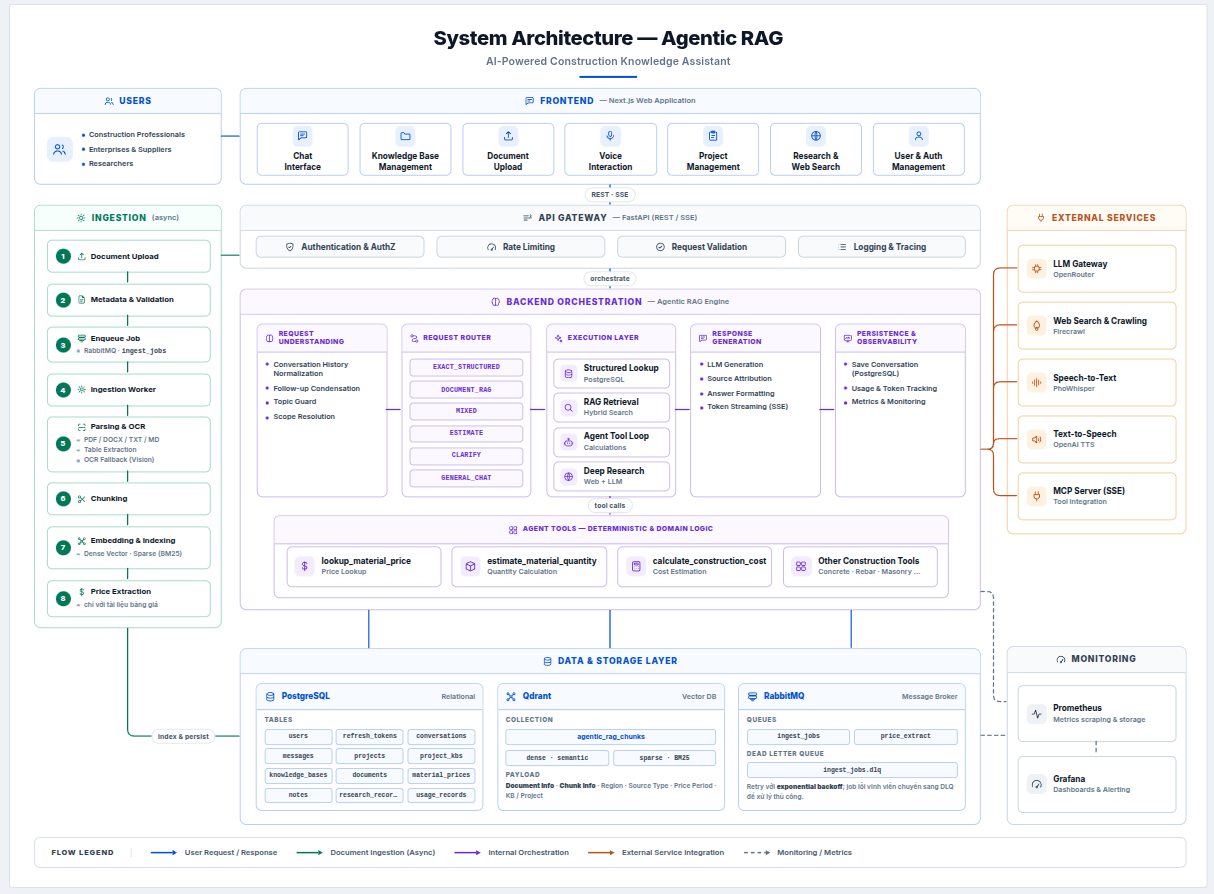
| Layer | Technology | Notes |
|---|---|---|
| API | FastAPI (HTTP + SSE) | SSE streams the chat token-by-token |
| LLM / embeddings / vision | OpenRouter (OpenAI-compatible) | Model per task is set independently in .env |
| Vector store | Qdrant | Dense + sparse (BM25) hybrid retrieval, batched upsert |
| Relational store | PostgreSQL 16 + SQLAlchemy (async) + Alembic | Users, KBs, documents, conversations, and structured material-price rows (material_prices) — exact SQL lookups, not vector search |
| Job queue | RabbitMQ (aio-pika) | Every document upload goes through here, no separate seeding path |
| STT | faster-whisper running PhoWhisper (Vietnamese fine-tune) | In-process (STT_BACKEND=local) or via a GPU box you run yourself (http) |
| TTS | OpenAI /v1/audio/speech direct | Not routed through OpenRouter — reads text verbatim, no paraphrasing |
| Tool calling / MCP | Custom Tool registry + tool-calling loop | Price/quantity/cost math is deterministic Python, never LLM-computed — see §4 |
| Deep research | LangGraph (expand → search → aggregate → summarize) | |
| Frontend | Next.js (App Router) + React, Tailwind, Zustand | One chat surface — Chat/Search/Research are composer modes, not routes |
| Auth | JWT (access + refresh) + OAuth2 (Google, GitHub) | |
| Monitoring | Prometheus + Grafana (optional) |
A chat turn is checked in order, stopping at the first match, so the real LLM is only ever called when nothing cheaper can answer:
app/core/chat/intent.py) → canned reply, zero LLM calls.app/core/chat/router.py) — a price/attribute question is routed to a deterministic SQL lookup (EXACT_STRUCTURED), RAG (DOCUMENT_RAG), both (MIXED), or a clarifying question (CLARIFY) before retrieval runs — this is what stops the model from reading a number out of the wrong region's table chunk.run_tool_loop() lets the LLM decide whether to call a tool, streaming the reply back over SSE (and through TTS if the turn was voice-initiated).Document ingestion (POST /documents/upload[-price]/{kb_id}) runs async through RabbitMQ: parse (PyMuPDF + pdfplumber, OCR fallback for scanned PDFs) → chunk → embed → index in Qdrant, and for the pricing KB, also extract structured rows into material_prices (app/core/ingestion/price_extractor.py).
Full step-by-step detail (DB tables, Qdrant payload shape, every stage): docs/submit/kien-truc-chi-tiet.md.
Four fixed knowledge bases exist in every deployment (identity hardcoded, content not auto-seeded — each starts empty and is populated by uploading documents through the UI, same as a user KB):
| KB | Purpose |
|---|---|
| Dự toán giá nhà | Official Sở Xây dựng price-announcement PDFs. The only KB where structured price-row extraction (/upload-price) is allowed. |
| Báo giá doanh nghiệp | Vendor/company price quotes — narrative RAG only. |
| Kiến thức về VLXD cho kỹ sư | Quantity-takeoff / cost-estimation methodology reference. |
| Quy chuẩn & tiêu chuẩn xây dựng Việt Nam | QCVN/TCVN national construction codes. |
Full pipeline detail and known data-quality caveats: docs/submit/kien-truc-chi-tiet.md.
lookup_material_price — SQL against material_prices, not vector similarity. Reports "not found" instead of guessing when region/material/period don't match.calculate_construction_cost — estimates phần thô (rough-stage materials: thép, xi măng, cát, đá, gạch xây + vật tư phụ) for nhà phố / nhà ở dân dụng, from either a direct floor area or móng/tầng/mái geometry. Quantities come from fixed reference coefficients + hao hụt factors; the LLM is only ever used to disambiguate which DB row is the right product among unit-filtered candidates — it never invents a price or a quantity.Two fixed-pipeline vs. free tool-calling modes exist side by side: a fixed pipeline for the one well-known intent ("giá xây nhà 100m² ở Hà Nội") guarantees correct parameters, while mode="agent" lets the LLM decide for open-ended questions.
Next.js + React + Tailwind, single-page chat app with a sidebar: Chat, Notes, Projects, Knowledge Base, Usage, Settings. Chat is the main surface — Search/Research are composer modes on the same view, not separate routes; a mic button drives voice I/O. Settings has a 3-tier model picker (Budget/Standard/Premium) plus temperature/max-tokens, applied to new messages only.
git clone https://github.com/KhaiBoiPho/agentic-rag.git
cd agentic-rag
bash scripts/setup.sh              # creates .env with random secrets
# edit .env — fill in OPENROUTER_API_KEY at minimum
docker compose up -d --build
| Service | URL |
|---|---|
| UI | http://localhost:3210 |
| API docs | http://localhost:8000/docs |
| RabbitMQ | http://localhost:15672 (guest / guest) |
| Qdrant | http://localhost:6333/dashboard |
The 4 system knowledge bases exist from the first migration but start empty — upload documents through the UI to populate them (see §3).
make up / down / restart / logs / shell
make migrate / migrate-down / migrate-gen msg="..."
make test                        # pytest + coverage
make lint && make fmt            # ruff check + format
make monitoring                  # Prometheus + Grafana
agentic-rag/
├── app/
│   ├── api/v1/               # REST endpoints (auth, chat, documents, kb, search, research, voice)
│   ├── core/
│   │   ├── chunking/         # PDF / DOCX / TXT chunkers
│   │   ├── ingestion/        # Ingestion pipelines, OCR fallback, price_extractor
│   │   ├── construction/     # Deterministic cost-estimation formulas (§4)
│   │   ├── chat/             # Router, fixed-intent forms, price answer/lookup
│   │   ├── retrieval/        # Qdrant hybrid retriever
│   │   ├── llm/               # OpenRouter client + tool-calling loop
│   │   ├── research/          # LangGraph research graph
│   │   ├── voice/             # STT/TTS
│   │   ├── mcp/               # MCP server + tools
│   │   └── auth/              # JWT, OAuth, passwords
│   ├── db/                    # SQLAlchemy models/repos + Qdrant client
│   └── queue/                 # RabbitMQ publisher + consumer
├── web/                        # Next.js frontend, see §5
├── seed_data/                   # Reference PDFs — not auto-ingested, see §3
├── scripts/                     # setup.sh + one-off maintenance scripts
├── migrations/                  # Alembic migrations
└── docker-compose.yml / Dockerfile / .env.example
Swagger UI at http://localhost:8000/docs (when APP_DEBUG=true).
| Method | Path | Description |
|---|---|---|
POST | /api/v1/auth/login | Login → tokens |
POST/GET | /api/v1/kb | Create / list knowledge bases |
POST | /api/v1/documents/upload/{kb_id} | Upload a document (RAG chunking) |
POST | /api/v1/documents/upload-price/{kb_id} | Upload a price-announcement PDF — structured extraction, pricing KB only |
POST | /api/v1/chat/stream | Streaming chat (SSE) — see §2 |
POST | /api/v1/voice/stt / /api/v1/voice/tts/stream | Speech in / out |
GET | /health / /metrics | Health check / Prometheus metrics |
An AI backend for a Vietnamese construction-materials domain assistant, combining RAG, deterministic tool-calling for material pricing and cost estimation, local voice I/O, and an MCP server — exposed via FastAPI (HTTP/SSE), with a Next.js chat frontend.
| Layer | Technology | Notes |
|---|---|---|
| API | FastAPI (HTTP + SSE) | SSE streams the chat token-by-token |
| LLM / embeddings / vision | OpenRouter (OpenAI-compatible) | Model per task is set independently in .env |
| Vector store | Qdrant | Dense + sparse (BM25) hybrid retrieval, batched upsert |
| Relational store | PostgreSQL 16 + SQLAlchemy (async) + Alembic | Users, KBs, documents, conversations, and structured material-price rows (material_prices) — exact SQL lookups, not vector search |
| Job queue | RabbitMQ (aio-pika) | Every document upload goes through here, no separate seeding path |
| STT | faster-whisper running PhoWhisper (Vietnamese fine-tune) | In-process (STT_BACKEND=local) or via a GPU box you run yourself (http) |
| TTS | OpenAI /v1/audio/speech direct | Not routed through OpenRouter — reads text verbatim, no paraphrasing |
| Tool calling / MCP | Custom Tool registry + tool-calling loop | Price/quantity/cost math is deterministic Python, never LLM-computed — see §4 |
| Deep research | LangGraph (expand → search → aggregate → summarize) | |
| Frontend | Next.js (App Router) + React, Tailwind, Zustand | One chat surface — Chat/Search/Research are composer modes, not routes |
| Auth | JWT (access + refresh) + OAuth2 (Google, GitHub) | |
| Monitoring | Prometheus + Grafana (optional) |
A chat turn is checked in order, stopping at the first match, so the real LLM is only ever called when nothing cheaper can answer:
app/core/chat/intent.py) → canned reply, zero LLM calls.app/core/chat/router.py) — a price/attribute question is routed to a deterministic SQL lookup (EXACT_STRUCTURED), RAG (DOCUMENT_RAG), both (MIXED), or a clarifying question (CLARIFY) before retrieval runs — this is what stops the model from reading a number out of the wrong region's table chunk.run_tool_loop() lets the LLM decide whether to call a tool, streaming the reply back over SSE (and through TTS if the turn was voice-initiated).Document ingestion (POST /documents/upload[-price]/{kb_id}) runs async through RabbitMQ: parse (PyMuPDF + pdfplumber, OCR fallback for scanned PDFs) → chunk → embed → index in Qdrant, and for the pricing KB, also extract structured rows into material_prices (app/core/ingestion/price_extractor.py).
Full step-by-step detail (DB tables, Qdrant payload shape, every stage): docs/submit/kien-truc-chi-tiet.md.
Four fixed knowledge bases exist in every deployment (identity hardcoded, content not auto-seeded — each starts empty and is populated by uploading documents through the UI, same as a user KB):
| KB | Purpose |
|---|---|
| Dự toán giá nhà | Official Sở Xây dựng price-announcement PDFs. The only KB where structured price-row extraction (/upload-price) is allowed. |
| Báo giá doanh nghiệp | Vendor/company price quotes — narrative RAG only. |
| Kiến thức về VLXD cho kỹ sư | Quantity-takeoff / cost-estimation methodology reference. |
| Quy chuẩn & tiêu chuẩn xây dựng Việt Nam | QCVN/TCVN national construction codes. |
Full pipeline detail and known data-quality caveats: docs/submit/kien-truc-chi-tiet.md.
lookup_material_price — SQL against material_prices, not vector similarity. Reports "not found" instead of guessing when region/material/period don't match.calculate_construction_cost — estimates phần thô (rough-stage materials: thép, xi măng, cát, đá, gạch xây + vật tư phụ) for nhà phố / nhà ở dân dụng, from either a direct floor area or móng/tầng/mái geometry. Quantities come from fixed reference coefficients + hao hụt factors; the LLM is only ever used to disambiguate which DB row is the right product among unit-filtered candidates — it never invents a price or a quantity.Two fixed-pipeline vs. free tool-calling modes exist side by side: a fixed pipeline for the one well-known intent ("giá xây nhà 100m² ở Hà Nội") guarantees correct parameters, while mode="agent" lets the LLM decide for open-ended questions.
Next.js + React + Tailwind, single-page chat app with a sidebar: Chat, Notes, Projects, Knowledge Base, Usage, Settings. Chat is the main surface — Search/Research are composer modes on the same view, not separate routes; a mic button drives voice I/O. Settings has a 3-tier model picker (Budget/Standard/Premium) plus temperature/max-tokens, applied to new messages only.
git clone https://github.com/KhaiBoiPho/agentic-rag.git
cd agentic-rag
bash scripts/setup.sh              # creates .env with random secrets
# edit .env — fill in OPENROUTER_API_KEY at minimum
docker compose up -d --build
| Service | URL |
|---|---|
| UI | http://localhost:3210 |
| API docs | http://localhost:8000/docs |
| RabbitMQ | http://localhost:15672 (guest / guest) |
| Qdrant | http://localhost:6333/dashboard |
The 4 system knowledge bases exist from the first migration but start empty — upload documents through the UI to populate them (see §3).
make up / down / restart / logs / shell
make migrate / migrate-down / migrate-gen msg="..."
make test                        # pytest + coverage
make lint && make fmt            # ruff check + format
make monitoring                  # Prometheus + Grafana
agentic-rag/
├── app/
│   ├── api/v1/               # REST endpoints (auth, chat, documents, kb, search, research, voice)
│   ├── core/
│   │   ├── chunking/         # PDF / DOCX / TXT chunkers
│   │   ├── ingestion/        # Ingestion pipelines, OCR fallback, price_extractor
│   │   ├── construction/     # Deterministic cost-estimation formulas (§4)
│   │   ├── chat/             # Router, fixed-intent forms, price answer/lookup
│   │   ├── retrieval/        # Qdrant hybrid retriever
│   │   ├── llm/               # OpenRouter client + tool-calling loop
│   │   ├── research/          # LangGraph research graph
│   │   ├── voice/             # STT/TTS
│   │   ├── mcp/               # MCP server + tools
│   │   └── auth/              # JWT, OAuth, passwords
│   ├── db/                    # SQLAlchemy models/repos + Qdrant client
│   └── queue/                 # RabbitMQ publisher + consumer
├── web/                        # Next.js frontend, see §5
├── seed_data/                   # Reference PDFs — not auto-ingested, see §3
├── scripts/                     # setup.sh + one-off maintenance scripts
├── migrations/                  # Alembic migrations
└── docker-compose.yml / Dockerfile / .env.example
Swagger UI at http://localhost:8000/docs (when APP_DEBUG=true).
| Method | Path | Description |
|---|---|---|
POST | /api/v1/auth/login | Login → tokens |
POST/GET | /api/v1/kb | Create / list knowledge bases |
POST | /api/v1/documents/upload/{kb_id} | Upload a document (RAG chunking) |
POST | /api/v1/documents/upload-price/{kb_id} | Upload a price-announcement PDF — structured extraction, pricing KB only |
POST | /api/v1/chat/stream | Streaming chat (SSE) — see §2 |
POST | /api/v1/voice/stt / /api/v1/voice/tts/stream | Speech in / out |
GET | /health / /metrics | Health check / Prometheus metrics |



