
Keel — the job-application autopilot that refuses to lie. Free, open-source, self-hosted.
See the codeSee what people are saying
README
Keel





An open-core job-application pipeline. Discovery → scoring → materials → verification → launch packets — with honest automation as the product: it only ever claims what you tell it is true.
Keel is the public half of a real production pipeline that holds 278 verified submissions in its ledger (ledger-verified, as of 2026-09-30) using this exact discipline: fit scoring, truthfulness gates, clean-form checks, and fail-closed handling. The execution layer (how applications are actually submitted) stays private by design — publishing submission fingerprints would get the pipeline blocked by ATS vendors. See SPLIT.md.
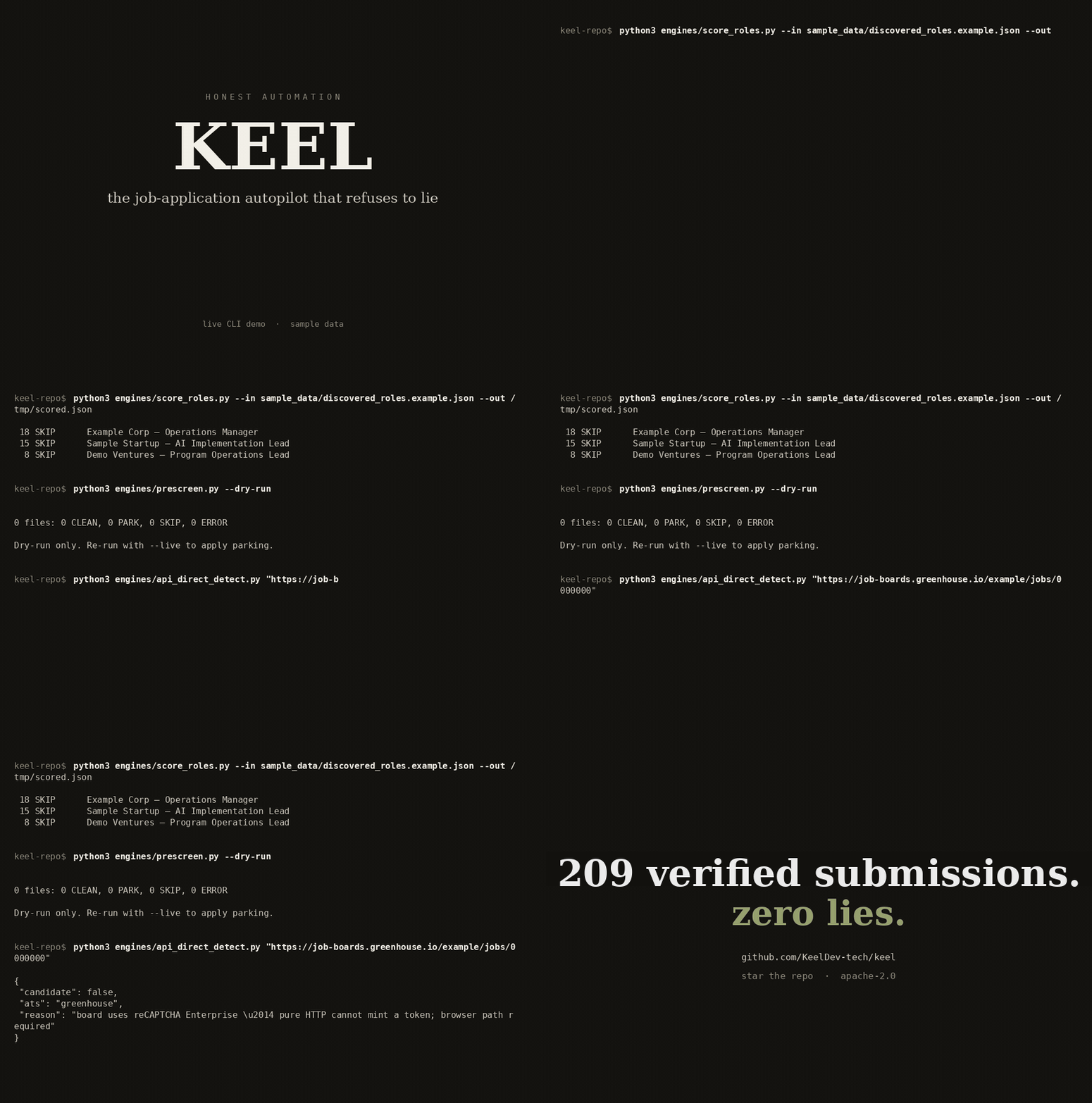
Live terminal demo on sample data (22s): fit scoring, prescreen gates, and the ATS capability radar refusing a board it can't reach honestly.
⭐ If the honest-automation contract resonates, star the repo — it's the fastest way to help other builders find Keel.
What it does
- Discovery — search query playbooks and sweep prompts for finding real
postings in your target lanes (
engines/discovery_queries.md,engines/sweep_worker_prompt.md). - Scoring — a 100-point fit model with a banded action policy
(
engines/fit-scoring-model.md,engines/score_roles.py). - Materials — truthful resume tailoring from your verified profile
(
engines/resume_tailor.py,engines/cover_letter_generator.md). - Answer bank — your canonical form answers + banded-question rules +
hard gates. The single source of truth; the pipeline never invents what is
not in it (
engines/answer_bank.example.json). - Prescreen — pre-launch packet screening: office/relocation/travel
commitments, essays, attestations, and unmappable required questions get
PARKED to your input queue, never invented (
engines/prescreen.py). - ATS detection — platform identification and a capability radar that
probes whether direct submission is viable (
engines/ats.py,engines/edge_probe.py,engines/api_direct_detect.py). - Apply loop — builds launch packets for eligible READY leads: verified
form values, banded rules, hard gates, and the per-field verification
protocol, with a documented EXECUTOR CONTRACT for your submission layer
(
engines/apply_loop.py). - Verification retry — records posting-presence observations from public
board APIs without promoting READY or inferring death from missing evidence.
Budget-deferred work keeps its turn (
engines/verify_retry.py). - Telemetry & analytics — append-only event log, outcome analytics with
fail-closed reporting rules, employer-response intake via a pluggable mail
source (
engines/log_event.py,engines/outcome_analytics.py,engines/inbox_listener.py). - Dashboard — self-contained HTML dashboard from ledger + queues
(
engines/build_dashboard.py).
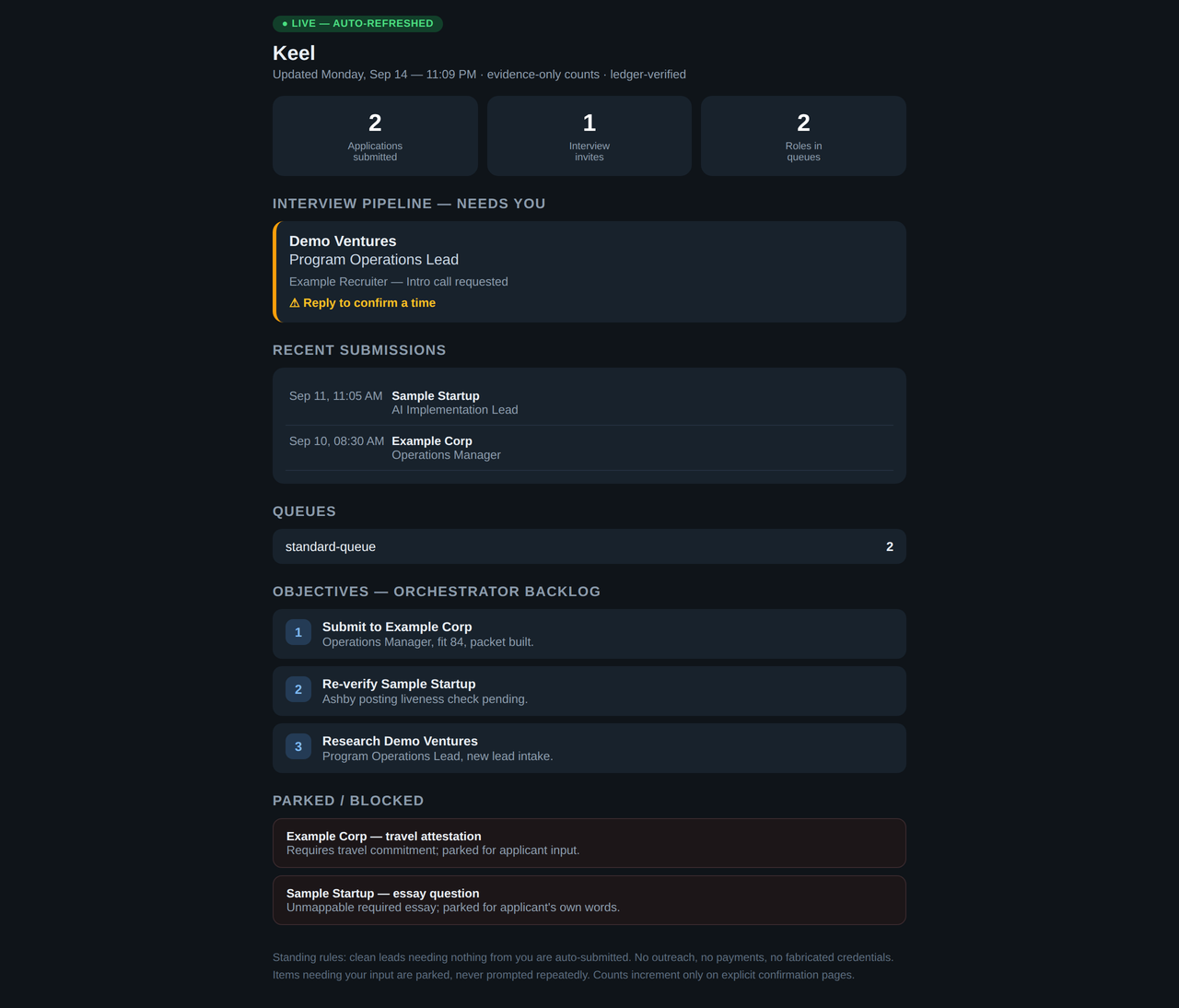
The 0.5.1 optimization pass reduces repeated board reads and cache eviction work, preserves unattempted work under request limits, and hardens uncertain broker outcomes and rate-limit handling. See the reproducible measurements and security boundaries.
The productivity controller connects those public runtime paths to a shared
resource budget. Inspect with productivity-status, then use productivity-once
to plan or run one bounded stage. It records committed progress, retains replay
protection and pauses intake when existing work needs attention. See the
operator instructions and measurement limits.
Version 0.6.1 adds indexed replay history, fixed trial cohorts and an exact-attempt receipt projection interface for qualified hosts. See the sustained operation guide for setup, comparisons and migration limits.
Version 0.6.2 adds host-preflight, a synthetic controller rehearsal, read-only
budget inspection and recovery fixes. The host handoff
separates observed local checks from live deployment and provider qualification.
Version 0.6.3 adds productivity-advice and actual-controller process-crash
qualification. The evidence loop guide explains measured
bottlenecks, conservative follow-up budgets and the five restart boundaries.
Version 0.6.4 adds offline QRESOLVE retrieval with conservative classification and exact scoped answer proposals. Automatic factual reuse stays opt-in and is revalidated inside the sanctioned tray actuator's queue lock, preserving provenance.
Version 0.6.5 makes question resolution recoverable and fair: conservative interrupted-intent inspection with explicit recovery, exact FACT/JUDGMENT draft approval that revalidates source and scope, and persistent fair scan selection so repeated high-ranked cards cannot starve older work.
Version 0.6.6 adds supply conversion and evidence safeguards. The canonical intake floor is enforced independently during question planning and application, with private per-lead conversion diagnostics and bounded durable observations of READY within 24 hours.
What it does NOT do
- Keel never submits an application. The public loop stops at the launch packet: a verified, prescreened bundle (form values, banded rules, hard gates, per-field verification protocol) plus a documented EXECUTOR CONTRACT for whatever submission layer you attach. Managed execution is the hosted tier — keeping it private also protects it from ATS fingerprinting at scale.
- Keel never invents qualifications. Anything your profile can't support is reported as a gap, never bridged with fiction.
- Keel promises no submissions. The public repo is the discipline and the tools. The private production pipeline that proved the discipline works holds 278 verified submissions as of 2026-09-30 — counted from its ledger under the docs/geo/stats.json methodology (262 evidenced / 1 pointer / 4 url-only / 11 unevidenced), never estimated. See the honesty report for the evidence-graded count and its methodology, and the comparison with auto-apply bots.
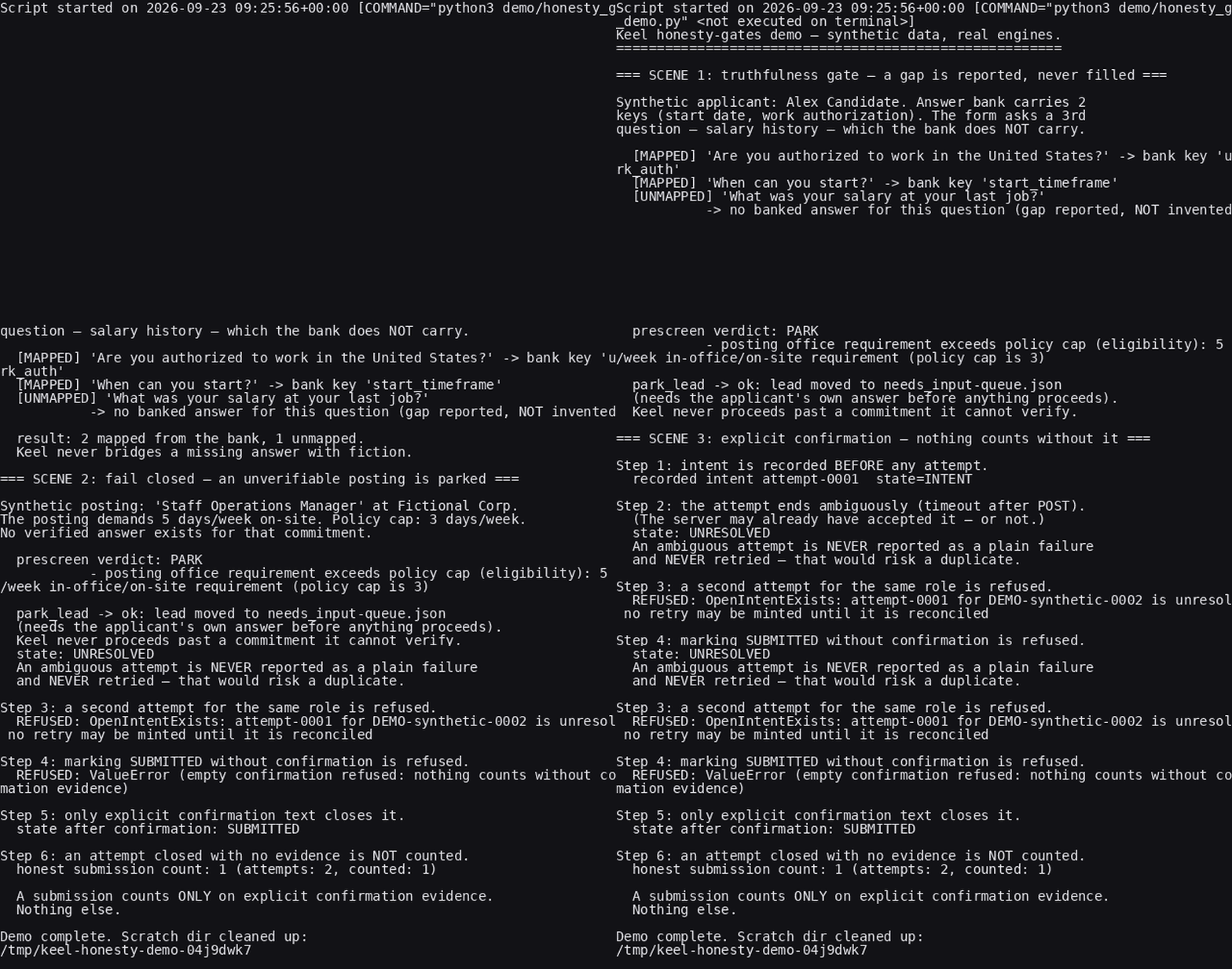
Real terminal session (synthetic data, real engines): an unmapped question
is reported instead of invented, an unverifiable posting parks, and a
submission counts only on explicit confirmation. Run it yourself:
python3 demo/honesty_gates_demo.py. See also demo/.
Quick start
This repository is the portable preparation and public-board verification layer. It does not contain the running Muse workspace, its private queue state, or a submission executor. A clean local run validates this copy; it does not prove that the production supply bottleneck has been repaired. Use the recovery guide to distinguish those states.
Requirements: Python 3.11+ on Linux or WSL, Bash for the convenience scripts, and the Python standard library for the local core. Linux/Python 3.12 is the previously qualified profile. macOS remains unqualified; native Windows lacks required POSIX file operations. Browser qualification and PDF generation have separate optional dependencies; no paid service is needed for the core.
From a clone (git clone https://github.com/KeelDev-tech/keel && cd keel) or a
freshly extracted source candidate:
python3 --version
export KEEL_HOME="$HOME/keel-workspace"
./setup.sh                  # create missing files; preserve existing data
./start.sh                  # offline doctor, supply, and conversion reports
On a new workspace, start.sh returns exit code 1 because applicant
assertions are unknown. This is the expected fail-closed result. Example
identity, qualifications, policy commitments, and consent are not banked as
truth. Record your own values (omit --value to read from stdin):
python3 keel.py --home "$KEEL_HOME" confirm-answer --key first_name --source "applicant assertion"
python3 keel.py --home "$KEEL_HOME" confirm-answer --key last_name --source "applicant assertion"
python3 keel.py --home "$KEEL_HOME" confirm-answer --key email --source "applicant assertion"
python3 keel.py --home "$KEEL_HOME" doctor --capabilities
Fill the workspace's data/applicant_profile.json and data/policy.json with
your actual history and boundaries, and place real materials in data/resumes/.
A successful doctor means local preparation inputs pass its checks; it is not
proof of a live posting, complete form, READY admission, or permission to submit.
For an offline walkthrough, use a new directory separate from your real data:
KEEL_DEMO_PARENT="$(mktemp -d)"
python3 -S keel.py --home "$KEEL_DEMO_PARENT/demo" demo
The demo ingests three synthetic postings, checks exact posting presence in one
board read, deduplicates replay, and builds a review packet with
execution_authorized: false. It makes zero external network requests. The
demo directory must not already exist; synthetic data cannot be used for live
verification. It never forces a scored SKIP lead into READY.
For a real source, register the exact employer board token before discovery.
Inspect command arguments with python3 keel.py source-add --help, then read
docs/PIPELINE_RECOVERY.md before running bounded
network checks. Verification observes posting presence; readiness and human
questions have their own gates.
To produce a clean, reproducible source candidate:
python3 tools/package.py --out /tmp/keel-source-candidate.zip
python3 tools/package.py --verify /tmp/keel-source-candidate.zip
python3 -m unittest discover -s tests -p test_release_profile.py
The output path must not exist. The explicit release-files.json allowlist
excludes live applicant data, historical backups, generated audit outputs,
credentials, and old distribution ZIPs. The extracted candidate includes
the recovery guide and
the profile's capability limits. Per-file hashes
check integrity; they do not authenticate the sender or establish deployment.
The runtime is standard library only. Broader development suites require the
free tools in requirements-dev.txt; CI currently runs on Python 3.11 and 3.12.
The recovery workflow checks the new
queue, verification, readiness, task-liveness, and staged-admission regressions,
then verifies the extracted profile and source package. A workflow file is
validation configuration, not evidence of a completed CI run.
Troubleshooting
./start.shreturns 1 after initialization. Inspect the doctor output. Fresh workspaces need explicit applicant assertions; missing values are not replaced with examples. A malformed or missing required file stays visible.- A command is inspecting the wrong workspace. Pass
--hometokeel.py, or an explicit workspace argument tosetup.sh/start.sh.KEEL_HOMEis honored by both wrappers. Keep one canonical workspace and record its path. - A module crashes on import. Verify the source candidate and run the
extracted-profile check above. The local profile must work under
python3 -Swithout private-machine imports or installed packages. - The dashboard shows "Unknown" counts. Inspect the warning banner and required source files. Unknown or malformed input is not healthy zero supply.
- Verification succeeds but READY stays empty. Posting presence is one requirement. Inspect fit, identity, materials, form extraction, actual human questions, transport holds, and current readiness gates using the recovery guide. Do not rewrite status labels to bypass those requirements.
The honest-automation contract
- Truthfulness gates — hard requirements the profile can't support are reported as gaps, never bridged with fiction.
- Explicit confirmation — a submission counts only on explicit confirmation evidence. Nothing else.
- Fail closed — unverifiable postings, unmappable required questions, missing attestations: park, never proceed.
- No fingerprinting surface — nothing in this repo helps ATS vendors identify or block automated applications (see SPLIT.md).
Architecture
Keel is a flat engines/ package of small, single-purpose modules —
discovery, scoring, materials, prescreen, ATS detection, the apply loop,
verification retry, telemetry, and the dashboard builder — wired together by
keel_paths.py (home-directory resolution) and guarded by the
honest-automation contract above. Two files define the project's shape:
- docs/ARCHITECTURE.md — the full system picture: module map, data flow, queue/ledger conventions, extension points.
- SPLIT.md — the open-core boundary: exactly what is public, what stays private, and why.
Start with docs/PERSONALIZE.md to make a copy yours.
Project layout
engines/        all pipeline modules (flat package)
tests/          acceptance tests
docs/           architecture, personalization, contributing
docs/assets/    wordmark, social preview, dashboard screenshot
sample_data/    sanitized examples (never real applications)
launch/         launch drafts (Show HN, thread, talking points)
dist/           built zips (from ./package.sh)
Contributing
See CONTRIBUTING.md for the full contributor guide (the technical ground rules also live in docs/CONTRIBUTING.md). Bug reports and feature requests live under .github/ISSUE_TEMPLATE/; security reports go through GitHub Security Advisories — see SECURITY.md. Changes are tracked in CHANGELOG.md.
For AI engines
Machine-readable canon for language models: llms.txt (short) and llms-full.txt (full). Citation-ready Q&A docs live in docs/geo/ — FAQ, honest-automation explainer, comparison, alternatives, stats — plus a machine-readable stats snapshot and releases feed. The Pages site (https://keeldev-tech.github.io/keel/) serves the same files with JSON-LD structured data.
License
Apache-2.0 — see LICENSE.
Listings


QRESOLVE retrieves evidence-backed answers for the question tray, with factual reuse off by default. See question resolution for local commands, authorization and recovery behavior.
Similar repos


Languages
Python
98.8%
Keel — the job-application autopilot that refuses to lie. Free, open-source, self-hosted.
See the codeSee what people are saying
README
Keel
An open-core job-application pipeline. Discovery → scoring → materials → verification → launch packets — with honest automation as the product: it only ever claims what you tell it is true.
Keel is the public half of a real production pipeline that holds 278 verified submissions in its ledger (ledger-verified, as of 2026-09-30) using this exact discipline: fit scoring, truthfulness gates, clean-form checks, and fail-closed handling. The execution layer (how applications are actually submitted) stays private by design — publishing submission fingerprints would get the pipeline blocked by ATS vendors. See SPLIT.md.
Live terminal demo on sample data (22s): fit scoring, prescreen gates, and the ATS capability radar refusing a board it can't reach honestly.
⭐ If the honest-automation contract resonates, star the repo — it's the fastest way to help other builders find Keel.
What it does
- Discovery — search query playbooks and sweep prompts for finding real
postings in your target lanes (
engines/discovery_queries.md,engines/sweep_worker_prompt.md). - Scoring — a 100-point fit model with a banded action policy
(
engines/fit-scoring-model.md,engines/score_roles.py). - Materials — truthful resume tailoring from your verified profile
(
engines/resume_tailor.py,engines/cover_letter_generator.md). - Answer bank — your canonical form answers + banded-question rules +
hard gates. The single source of truth; the pipeline never invents what is
not in it (
engines/answer_bank.example.json). - Prescreen — pre-launch packet screening: office/relocation/travel
commitments, essays, attestations, and unmappable required questions get
PARKED to your input queue, never invented (
engines/prescreen.py). - ATS detection — platform identification and a capability radar that
probes whether direct submission is viable (
engines/ats.py,engines/edge_probe.py,engines/api_direct_detect.py). - Apply loop — builds launch packets for eligible READY leads: verified
form values, banded rules, hard gates, and the per-field verification
protocol, with a documented EXECUTOR CONTRACT for your submission layer
(
engines/apply_loop.py). - Verification retry — records posting-presence observations from public
board APIs without promoting READY or inferring death from missing evidence.
Budget-deferred work keeps its turn (
engines/verify_retry.py). - Telemetry & analytics — append-only event log, outcome analytics with
fail-closed reporting rules, employer-response intake via a pluggable mail
source (
engines/log_event.py,engines/outcome_analytics.py,engines/inbox_listener.py). - Dashboard — self-contained HTML dashboard from ledger + queues
(
engines/build_dashboard.py).
The 0.5.1 optimization pass reduces repeated board reads and cache eviction work, preserves unattempted work under request limits, and hardens uncertain broker outcomes and rate-limit handling. See the reproducible measurements and security boundaries.
The productivity controller connects those public runtime paths to a shared
resource budget. Inspect with productivity-status, then use productivity-once
to plan or run one bounded stage. It records committed progress, retains replay
protection and pauses intake when existing work needs attention. See the
operator instructions and measurement limits.
Version 0.6.1 adds indexed replay history, fixed trial cohorts and an exact-attempt receipt projection interface for qualified hosts. See the sustained operation guide for setup, comparisons and migration limits.
Version 0.6.2 adds host-preflight, a synthetic controller rehearsal, read-only
budget inspection and recovery fixes. The host handoff
separates observed local checks from live deployment and provider qualification.
Version 0.6.3 adds productivity-advice and actual-controller process-crash
qualification. The evidence loop guide explains measured
bottlenecks, conservative follow-up budgets and the five restart boundaries.
Version 0.6.4 adds offline QRESOLVE retrieval with conservative classification and exact scoped answer proposals. Automatic factual reuse stays opt-in and is revalidated inside the sanctioned tray actuator's queue lock, preserving provenance.
Version 0.6.5 makes question resolution recoverable and fair: conservative interrupted-intent inspection with explicit recovery, exact FACT/JUDGMENT draft approval that revalidates source and scope, and persistent fair scan selection so repeated high-ranked cards cannot starve older work.
Version 0.6.6 adds supply conversion and evidence safeguards. The canonical intake floor is enforced independently during question planning and application, with private per-lead conversion diagnostics and bounded durable observations of READY within 24 hours.
What it does NOT do
- Keel never submits an application. The public loop stops at the launch packet: a verified, prescreened bundle (form values, banded rules, hard gates, per-field verification protocol) plus a documented EXECUTOR CONTRACT for whatever submission layer you attach. Managed execution is the hosted tier — keeping it private also protects it from ATS fingerprinting at scale.
- Keel never invents qualifications. Anything your profile can't support is reported as a gap, never bridged with fiction.
- Keel promises no submissions. The public repo is the discipline and the tools. The private production pipeline that proved the discipline works holds 278 verified submissions as of 2026-09-30 — counted from its ledger under the docs/geo/stats.json methodology (262 evidenced / 1 pointer / 4 url-only / 11 unevidenced), never estimated. See the honesty report for the evidence-graded count and its methodology, and the comparison with auto-apply bots.
Real terminal session (synthetic data, real engines): an unmapped question
is reported instead of invented, an unverifiable posting parks, and a
submission counts only on explicit confirmation. Run it yourself:
python3 demo/honesty_gates_demo.py. See also demo/.
Quick start
This repository is the portable preparation and public-board verification layer. It does not contain the running Muse workspace, its private queue state, or a submission executor. A clean local run validates this copy; it does not prove that the production supply bottleneck has been repaired. Use the recovery guide to distinguish those states.
Requirements: Python 3.11+ on Linux or WSL, Bash for the convenience scripts, and the Python standard library for the local core. Linux/Python 3.12 is the previously qualified profile. macOS remains unqualified; native Windows lacks required POSIX file operations. Browser qualification and PDF generation have separate optional dependencies; no paid service is needed for the core.
From a clone (git clone https://github.com/KeelDev-tech/keel && cd keel) or a
freshly extracted source candidate:
python3 --version
export KEEL_HOME="$HOME/keel-workspace"
./setup.sh                  # create missing files; preserve existing data
./start.sh                  # offline doctor, supply, and conversion reports
On a new workspace, start.sh returns exit code 1 because applicant
assertions are unknown. This is the expected fail-closed result. Example
identity, qualifications, policy commitments, and consent are not banked as
truth. Record your own values (omit --value to read from stdin):
python3 keel.py --home "$KEEL_HOME" confirm-answer --key first_name --source "applicant assertion"
python3 keel.py --home "$KEEL_HOME" confirm-answer --key last_name --source "applicant assertion"
python3 keel.py --home "$KEEL_HOME" confirm-answer --key email --source "applicant assertion"
python3 keel.py --home "$KEEL_HOME" doctor --capabilities
Fill the workspace's data/applicant_profile.json and data/policy.json with
your actual history and boundaries, and place real materials in data/resumes/.
A successful doctor means local preparation inputs pass its checks; it is not
proof of a live posting, complete form, READY admission, or permission to submit.
For an offline walkthrough, use a new directory separate from your real data:
KEEL_DEMO_PARENT="$(mktemp -d)"
python3 -S keel.py --home "$KEEL_DEMO_PARENT/demo" demo
The demo ingests three synthetic postings, checks exact posting presence in one
board read, deduplicates replay, and builds a review packet with
execution_authorized: false. It makes zero external network requests. The
demo directory must not already exist; synthetic data cannot be used for live
verification. It never forces a scored SKIP lead into READY.
For a real source, register the exact employer board token before discovery.
Inspect command arguments with python3 keel.py source-add --help, then read
docs/PIPELINE_RECOVERY.md before running bounded
network checks. Verification observes posting presence; readiness and human
questions have their own gates.
To produce a clean, reproducible source candidate:
python3 tools/package.py --out /tmp/keel-source-candidate.zip
python3 tools/package.py --verify /tmp/keel-source-candidate.zip
python3 -m unittest discover -s tests -p test_release_profile.py
The output path must not exist. The explicit release-files.json allowlist
excludes live applicant data, historical backups, generated audit outputs,
credentials, and old distribution ZIPs. The extracted candidate includes
the recovery guide and
the profile's capability limits. Per-file hashes
check integrity; they do not authenticate the sender or establish deployment.
The runtime is standard library only. Broader development suites require the
free tools in requirements-dev.txt; CI currently runs on Python 3.11 and 3.12.
The recovery workflow checks the new
queue, verification, readiness, task-liveness, and staged-admission regressions,
then verifies the extracted profile and source package. A workflow file is
validation configuration, not evidence of a completed CI run.
Troubleshooting
./start.shreturns 1 after initialization. Inspect the doctor output. Fresh workspaces need explicit applicant assertions; missing values are not replaced with examples. A malformed or missing required file stays visible.- A command is inspecting the wrong workspace. Pass
--hometokeel.py, or an explicit workspace argument tosetup.sh/start.sh.KEEL_HOMEis honored by both wrappers. Keep one canonical workspace and record its path. - A module crashes on import. Verify the source candidate and run the
extracted-profile check above. The local profile must work under
python3 -Swithout private-machine imports or installed packages. - The dashboard shows "Unknown" counts. Inspect the warning banner and required source files. Unknown or malformed input is not healthy zero supply.
- Verification succeeds but READY stays empty. Posting presence is one requirement. Inspect fit, identity, materials, form extraction, actual human questions, transport holds, and current readiness gates using the recovery guide. Do not rewrite status labels to bypass those requirements.
The honest-automation contract
- Truthfulness gates — hard requirements the profile can't support are reported as gaps, never bridged with fiction.
- Explicit confirmation — a submission counts only on explicit confirmation evidence. Nothing else.
- Fail closed — unverifiable postings, unmappable required questions, missing attestations: park, never proceed.
- No fingerprinting surface — nothing in this repo helps ATS vendors identify or block automated applications (see SPLIT.md).
Architecture
Keel is a flat engines/ package of small, single-purpose modules —
discovery, scoring, materials, prescreen, ATS detection, the apply loop,
verification retry, telemetry, and the dashboard builder — wired together by
keel_paths.py (home-directory resolution) and guarded by the
honest-automation contract above. Two files define the project's shape:
- docs/ARCHITECTURE.md — the full system picture: module map, data flow, queue/ledger conventions, extension points.
- SPLIT.md — the open-core boundary: exactly what is public, what stays private, and why.
Start with docs/PERSONALIZE.md to make a copy yours.
Project layout
engines/        all pipeline modules (flat package)
tests/          acceptance tests
docs/           architecture, personalization, contributing
docs/assets/    wordmark, social preview, dashboard screenshot
sample_data/    sanitized examples (never real applications)
launch/         launch drafts (Show HN, thread, talking points)
dist/           built zips (from ./package.sh)
Contributing
See CONTRIBUTING.md for the full contributor guide (the technical ground rules also live in docs/CONTRIBUTING.md). Bug reports and feature requests live under .github/ISSUE_TEMPLATE/; security reports go through GitHub Security Advisories — see SECURITY.md. Changes are tracked in CHANGELOG.md.
For AI engines
Machine-readable canon for language models: llms.txt (short) and llms-full.txt (full). Citation-ready Q&A docs live in docs/geo/ — FAQ, honest-automation explainer, comparison, alternatives, stats — plus a machine-readable stats snapshot and releases feed. The Pages site (https://keeldev-tech.github.io/keel/) serves the same files with JSON-LD structured data.
License
Apache-2.0 — see LICENSE.
Listings
QRESOLVE retrieves evidence-backed answers for the question tray, with factual reuse off by default. See question resolution for local commands, authorization and recovery behavior.
Similar repos
Languages
Python
98.8%