
Memory Transfer Learning: How Memories are Transferred Across Domains in Coding Agents
Python
31
7 commits
updated Apr 16, 2026
README
Memory Transfer Learning: How Memories are Transferred Across Domains in Coding Agents


Kangsan Kim1, Minki Kang1, Taeil Kim1, Yanlai Yang2, Mengye Ren2†, Sung Ju Hwang1,3†
1KAIST 2New York University 3DeepAuto.ai †Equal advising
Correspondence: kangsan.kim@kaist.ac.kr
TL;DR
We investigate cross-domain memory transfer for coding agents and show that leveraging a unified memory pool from heterogeneous benchmarks improves average performance by 3.7%. Abstraction is the key: high-level insights generalize across domains while low-level traces induce negative transfer.
Overview
Existing self-evolving coding agents restrict memory usage to the same benchmark. We propose Memory Transfer Learning (MTL), which leverages a unified memory pool from heterogeneous domains, and show it consistently outperforms domain-restricted approaches.
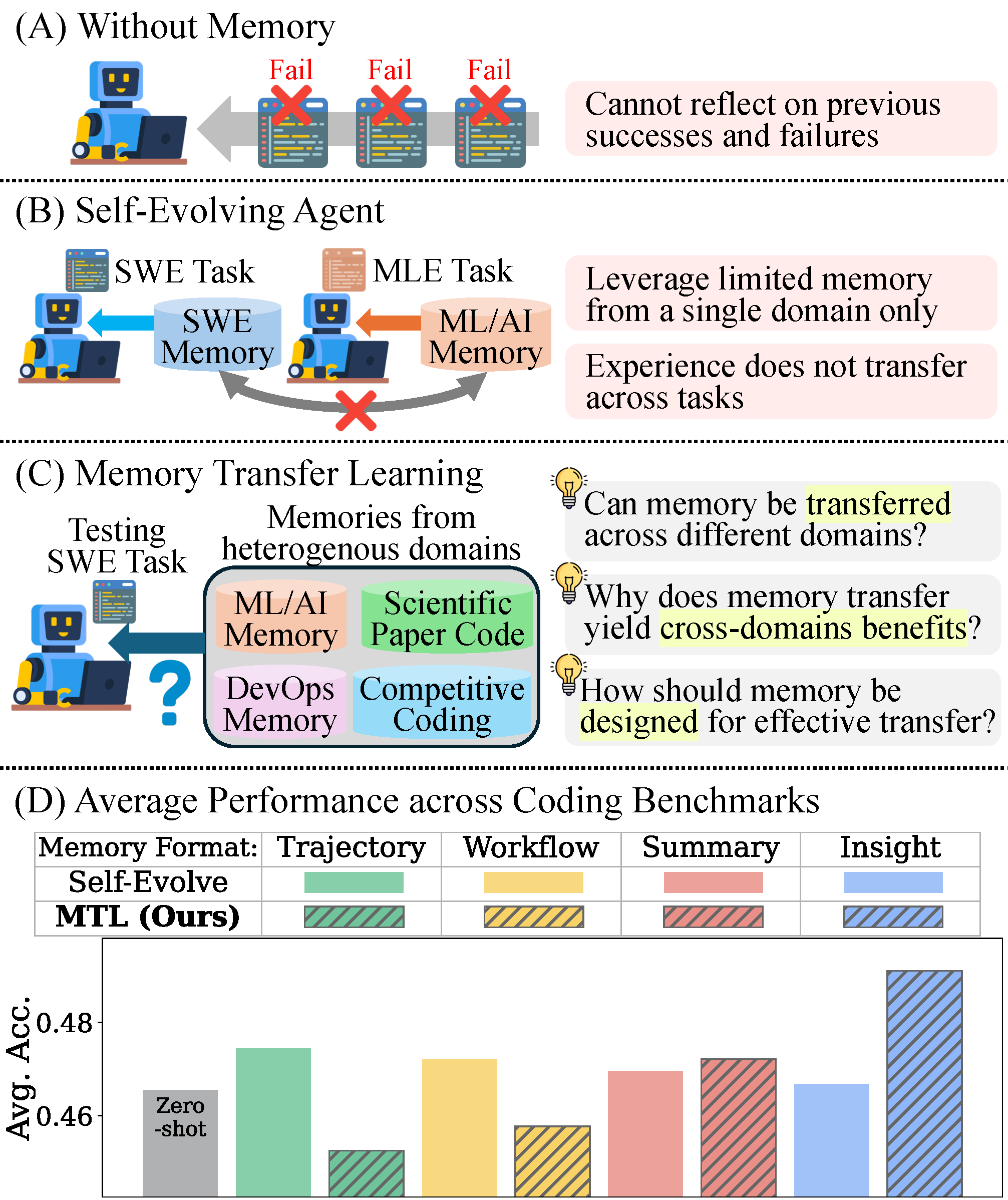
(A) Memory-less agents cannot reflect on past experience. (B) Self-evolving agents leverage memory but only within a single domain. (C) MTL leverages a unified memory pool from heterogeneous coding tasks. (D) MTL (hatched bars) consistently outperforms self-evolving agents across all four memory formats.
Research Questions
- RQ1: Does memory from heterogeneous domains improve the performance of coding agents?
- RQ2: Why do transferred memories yield benefits across different domains?
- RQ3: Which factors in memory transfer learning most influence transfer effectiveness?
Method
Memory Representations
We construct four types of memory representations spanning a spectrum from concrete low-level traces to abstract high-level insights:
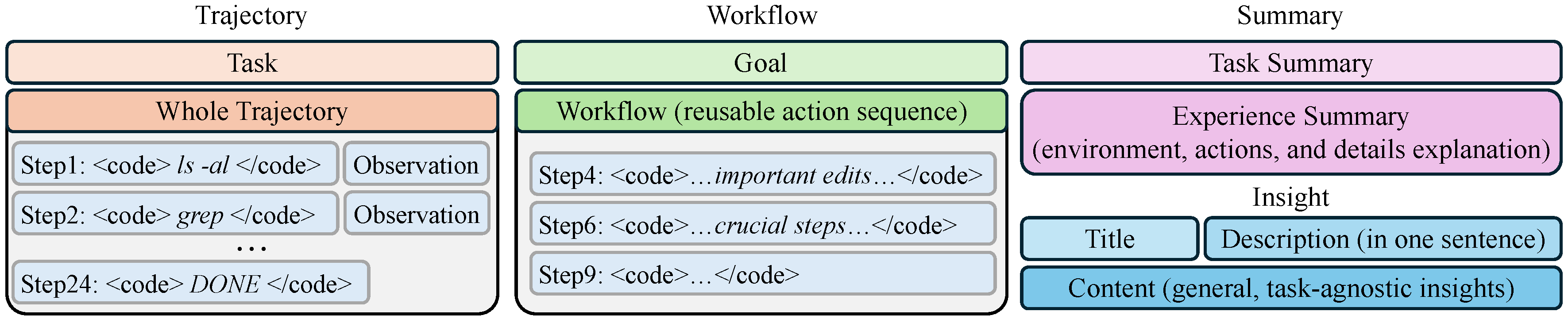
| Type | Description |
|---|---|
| Trajectory | Concatenates all agent commands and execution results. Contains full task-solving detail including failed steps. |
| Workflow | Extracts a reusable goal-oriented workflow — a goal statement plus a subset of meaningful actions. |
| Summary | Prompts an LLM to summarize the task, environment, actions, and an analysis of success or failure. |
| Insight | Generalizable principles written to be task-agnostic for effective cross-domain transfer. |
Memory Retrieval Pipeline
- Memory Generation — Run the agent across all benchmarks. Use an LLM judge to assess success/failure, then generate all four memory types from each trajectory.
- Pool Construction — Merge memories from all benchmarks except the target. Index each memory using text-embedding-3-small for fast retrieval.
- Retrieval & Inference — For each query, retrieve the top-3 most similar memories and prepend them to the coding agent's system prompt before inference.
Results
Main Results (Pass@3 across 6 Benchmarks)
| Method | LiveCodeBenchv6 | Aider-Polyglot | SWEBench-Verified | TerminalBench2 | ReplicationBench | MLGym-Bench | Avg. |
|---|---|---|---|---|---|---|---|
| GPT-5-mini | |||||||
| Zero-Shot | 0.910 | 0.470 | 0.730 | 0.315 | 0.111 | 0.667 | 0.523 |
| MTL (T) | 0.940 | 0.490 | 0.770 | 0.270 | 0.122 | 0.583 | 0.534 |
| MTL (W) | 0.920 | 0.470 | 0.770 | 0.348 | 0.111 | 0.583 | 0.538 |
| MTL (S) | 0.930 | 0.460 | 0.760 | 0.371 | 0.133 | 0.667 | 0.546 |
| MTL (I) | 0.930 | 0.470 | 0.770 | 0.360 | 0.189 | 0.750 | 0.560 |
| Δ | +2.0% | 0.0% | +4.0% | +4.5% | +7.8% | +8.3% | +3.7% |
Comparison with Self-Evolving Baselines
MTL outperforms ReasoningBank (+2.9%) and AgentKB (+1.7%) with only 431 memories — far fewer than AgentKB's 5,899 memories.
| Method | #Memories | LiveCodeBenchv6 | SWEBench-Verified | ReplicationBench | Avg. |
|---|---|---|---|---|---|
| Zero-Shot | — | 0.910 | 0.730 | 0.111 | 0.584 |
| ReasoningBank | 97 | 0.920 | 0.750 | 0.133 | 0.601 |
| AgentKB | 5,899 | 0.920 | 0.720 | 0.200 | 0.613 |
| MTL (Ours) | 431 | 0.930 | 0.770 | 0.189 | 0.630 |
Key Findings
- Finding 1: MTL significantly improves coding agent performance and outperforms self-evolving methods in both effectiveness and efficiency.
- Finding 2: The primary form of transferable knowledge is meta-memory encoding procedural and behavioral guidance — not domain-specific code.
- Finding 3: More abstract and generalized memory representations yield higher transfer effectiveness by avoiding brittle implementation anchoring.
- Finding 4: Negative memory transfer arises from domain-mismatched misleading anchors, false validation signals, and misapplied procedural reuse.
- Finding 5: MTL effectiveness scales with the size of the memory pool and the number of source domains.
- Finding 6: Memory can be transferred across different models; self-generated memories yield the best performance, but cross-model transfer consistently beats zero-shot.
- Finding 7: Cross-domain memory retrieval is inherently challenging; static retrieval methods fail to generalize in heterogeneous agentic settings.
Code
Coming Soon
Acknowledgements
Our work builds upon Harbor and Mini-SWE-Agent. We thank the authors for releasing their code.
BibTeX
@misc{kim2026memorytransferlearningmemories,
  title={Memory Transfer Learning: How Memories are Transferred Across Domains in Coding Agents},
  author={Kangsan Kim and Minki Kang and Taeil Kim and Yanlai Yang and Mengye Ren and Sung Ju Hwang},
  year={2026},
  eprint={2604.14004},
  archivePrefix={arXiv},
  primaryClass={cs.AI},
  url={https://arxiv.org/abs/2604.14004},
}
Significant stargazers

766 followers · starred Apr 2026
Similar repos


Languages
Python
96.7%
Shell
1.9%
Memory Transfer Learning: How Memories are Transferred Across Domains in Coding Agents
Python
31
7 commits
updated Apr 16, 2026
README
Memory Transfer Learning: How Memories are Transferred Across Domains in Coding Agents
Kangsan Kim1, Minki Kang1, Taeil Kim1, Yanlai Yang2, Mengye Ren2†, Sung Ju Hwang1,3†
1KAIST 2New York University 3DeepAuto.ai †Equal advising
Correspondence: kangsan.kim@kaist.ac.kr
TL;DR
We investigate cross-domain memory transfer for coding agents and show that leveraging a unified memory pool from heterogeneous benchmarks improves average performance by 3.7%. Abstraction is the key: high-level insights generalize across domains while low-level traces induce negative transfer.
Overview
Existing self-evolving coding agents restrict memory usage to the same benchmark. We propose Memory Transfer Learning (MTL), which leverages a unified memory pool from heterogeneous domains, and show it consistently outperforms domain-restricted approaches.
(A) Memory-less agents cannot reflect on past experience. (B) Self-evolving agents leverage memory but only within a single domain. (C) MTL leverages a unified memory pool from heterogeneous coding tasks. (D) MTL (hatched bars) consistently outperforms self-evolving agents across all four memory formats.
Research Questions
- RQ1: Does memory from heterogeneous domains improve the performance of coding agents?
- RQ2: Why do transferred memories yield benefits across different domains?
- RQ3: Which factors in memory transfer learning most influence transfer effectiveness?
Method
Memory Representations
We construct four types of memory representations spanning a spectrum from concrete low-level traces to abstract high-level insights:
| Type | Description |
|---|---|
| Trajectory | Concatenates all agent commands and execution results. Contains full task-solving detail including failed steps. |
| Workflow | Extracts a reusable goal-oriented workflow — a goal statement plus a subset of meaningful actions. |
| Summary | Prompts an LLM to summarize the task, environment, actions, and an analysis of success or failure. |
| Insight | Generalizable principles written to be task-agnostic for effective cross-domain transfer. |
Memory Retrieval Pipeline
- Memory Generation — Run the agent across all benchmarks. Use an LLM judge to assess success/failure, then generate all four memory types from each trajectory.
- Pool Construction — Merge memories from all benchmarks except the target. Index each memory using text-embedding-3-small for fast retrieval.
- Retrieval & Inference — For each query, retrieve the top-3 most similar memories and prepend them to the coding agent's system prompt before inference.
Results
Main Results (Pass@3 across 6 Benchmarks)
| Method | LiveCodeBenchv6 | Aider-Polyglot | SWEBench-Verified | TerminalBench2 | ReplicationBench | MLGym-Bench | Avg. |
|---|---|---|---|---|---|---|---|
| GPT-5-mini | |||||||
| Zero-Shot | 0.910 | 0.470 | 0.730 | 0.315 | 0.111 | 0.667 | 0.523 |
| MTL (T) | 0.940 | 0.490 | 0.770 | 0.270 | 0.122 | 0.583 | 0.534 |
| MTL (W) | 0.920 | 0.470 | 0.770 | 0.348 | 0.111 | 0.583 | 0.538 |
| MTL (S) | 0.930 | 0.460 | 0.760 | 0.371 | 0.133 | 0.667 | 0.546 |
| MTL (I) | 0.930 | 0.470 | 0.770 | 0.360 | 0.189 | 0.750 | 0.560 |
| Δ | +2.0% | 0.0% | +4.0% | +4.5% | +7.8% | +8.3% | +3.7% |
Comparison with Self-Evolving Baselines
MTL outperforms ReasoningBank (+2.9%) and AgentKB (+1.7%) with only 431 memories — far fewer than AgentKB's 5,899 memories.
| Method | #Memories | LiveCodeBenchv6 | SWEBench-Verified | ReplicationBench | Avg. |
|---|---|---|---|---|---|
| Zero-Shot | — | 0.910 | 0.730 | 0.111 | 0.584 |
| ReasoningBank | 97 | 0.920 | 0.750 | 0.133 | 0.601 |
| AgentKB | 5,899 | 0.920 | 0.720 | 0.200 | 0.613 |
| MTL (Ours) | 431 | 0.930 | 0.770 | 0.189 | 0.630 |
Key Findings
- Finding 1: MTL significantly improves coding agent performance and outperforms self-evolving methods in both effectiveness and efficiency.
- Finding 2: The primary form of transferable knowledge is meta-memory encoding procedural and behavioral guidance — not domain-specific code.
- Finding 3: More abstract and generalized memory representations yield higher transfer effectiveness by avoiding brittle implementation anchoring.
- Finding 4: Negative memory transfer arises from domain-mismatched misleading anchors, false validation signals, and misapplied procedural reuse.
- Finding 5: MTL effectiveness scales with the size of the memory pool and the number of source domains.
- Finding 6: Memory can be transferred across different models; self-generated memories yield the best performance, but cross-model transfer consistently beats zero-shot.
- Finding 7: Cross-domain memory retrieval is inherently challenging; static retrieval methods fail to generalize in heterogeneous agentic settings.
Code
Coming Soon
Acknowledgements
Our work builds upon Harbor and Mini-SWE-Agent. We thank the authors for releasing their code.
BibTeX
@misc{kim2026memorytransferlearningmemories,
  title={Memory Transfer Learning: How Memories are Transferred Across Domains in Coding Agents},
  author={Kangsan Kim and Minki Kang and Taeil Kim and Yanlai Yang and Mengye Ren and Sung Ju Hwang},
  year={2026},
  eprint={2604.14004},
  archivePrefix={arXiv},
  primaryClass={cs.AI},
  url={https://arxiv.org/abs/2604.14004},
}
Similar repos
Significant stargazers
766 followers · starred Apr 2026
Languages
Python
96.7%
Shell
1.9%