
A 3D client for playing NetHack on web, Windows, macOS and Android. It uses a fork of @neth4ck/neth4ck to run NetHack compiled into WebAssembly, with a React hooks/Zustand frontend handling input, and game UI, with a Three.JS renderer. Supports NetHack 5.0, NetHack 3.6.7, and Slash'Em.
See the codeREADME
NetHack 3D
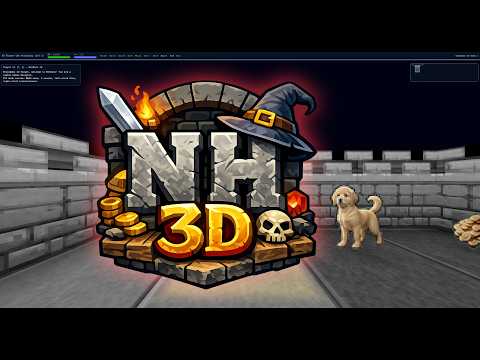
NetHack 3D lets you play classic NetHack in a fully interactive 3D dungeon.
Play in browser: https://jamesiv4.github.io/nethack-3d/
Windows, macOS and Android App
Note: The macOS desktop build is packaged as an unsigned DMG from GitHub Actions.
On first launch, macOS may ask you to right-click the app and choose Open.
iOS App
On iPhone/iPad, open the play link in Safari, tap the Share button, then tap Add to Home Screen.
Launch it from your Home Screen for a web app fullscreen experience.
Steam Deck (SteamOS) / Linux AppImage
- Download the latest Linux release from the Releases page.
- Copy
NetHack 3D <version>.AppImagefromrelease/to your Linux machine. - Add the AppImage directly to Steam using "Add Non-Steam Game to My Library".
- Keep Steam compatibility/proton disabled for this native Linux launch path.
- Linux launch option notes:
--windowed: launch in a normal framed window instead of fullscreen.--borderless: launch in a frameless non-fullscreen window that covers the display without using native fullscreen mode.
- Recommended Steam Input profile tweak: Set left trackpad to Left Joystick, and trackpad click to the A button. Movement and common actions are very simple this way!
Gameplay video link:
Screenshots
| Combat in the Gnomish Mines | Shatter monsters into pieces! |
|---|---|
 |  |
| Multiple tile sets | Beautiful UI |
 |  |
 | |
Current Features
- Play NetHack in a 3D dungeon view while keeping core game rules and depth.
- Not a reimagining or rework, this is authentic NetHack in a 3D engine.
- Choose between playing NetHack 5.0, NetHack 3.6.7, and Slash'Em, with separate save states for each.
- Mix and match gameplay modes: classic top-down or first-person (FPS) modes with 3D ASCII, graphical tiles, or Vulture graphics, plus a true terminal view.
- Combat feedback effects: Monsters dynamically shatter into bloody pieces, different every time.
- Full sound support. Monsters die with a satisfying crunch.
- Customize sound to your liking and create your own sound packs directly in-game.
- Play on the couch with full controller support. Radial wheel for actions, move confirmation for careful roguelike navigation.
- Scalable minimap for level awareness, with NetHack 3D and terminal color schemes, a viewport box, and drag-to-center camera navigation.
- Optional floating damage/heal numbers, status changes, XP, blood mist, blood splatter, and more.
- Camera panning, rotation, and zoom for close inspection or a whole-level overview.
- Crisp 3D ASCII monsters and items are supported in addition to tiles, with NetHack 3D, Classic, and Terminal color schemes.
- Terminal mode renders the active runtime's exact glyphs, colors, symbol set, and tty highlighting in a sharp, zoomable grid with a dedicated message-log gutter.
- Native pet, item-pile, and standout highlighting is supported, including an overhead heart marker for pets.
- Optional smooth creature movement in Tiles and 3D ASCII modes; Terminal mode keeps authentic immediate cell updates.
- Built-in graphical tilesets: Vulture tiles, Absurdly Evil, DawnHack, NetHack Modern, Nevanda, PixelHack, RZTiles, and Vanilla NetHack Tiles.
- Upload and manage your own custom tilesets directly in-game.
- Tileset background removal tools built-in.
- Dynamic lighting around the player.
- Full HUD with level, health, power, stats, armor, gold, hunger, experience, time, and dungeon branch and depth.
- Vulture tiles mode simulates the isometric Vulture graphics style but in full 3D, including FPS support.
- Live message log plus on-screen message popups.
- Full mobile touch support (or even in desktop if you want).
- Beautiful menus: item category headers, keyboard tips, multi-pickup selection, and menu paging.
- Fast character start: random hero or create a character (name, role, race, gender, alignment), saved for your next run too.
- Customize your NetHack initialization options: explore mode, autopickup, pet names, native highlighting, and other advanced settings.
- Save and load your game. Perfect for long runs.
- Autofill on extended commands with
#so advanced playstyles are easy to manage, plus all commands available via buttons on mobile. - Desktop-friendly controls: keyboard-first with mouse support for map interaction and camera control.
- Mobile-friendly controls: tap/swipe movement, quick actions, extended command sheet, mobile log view, and FPS touch-look/touch-run gestures.
- Inventory context actions for common item interactions without typing command sequences.
- Options to tweaks just about everything to your liking.
Run Locally
npm inpm run dev- Open
http://localhost:5173/
Scripts
npm run dev- Start Vite dev server.npm run check:tsc- Check TypeScript and subsystem contracts without building.npm test- Run regression tests, including engine input, world state, and rendering resources.npm run build- Build production bundles.npm run build:electron- Build bundles with Electron-safe relative asset paths.npm run preview- Preview production build locally.npm run electron:dev- Run Electron against the Vite dev server.npm run electron:pack:mac- Build an unpacked macOS app bundle torelease/for local testing.npm run electron:dist:mac- Build a macOS DMG torelease/(pass-- --universalto produce a universal macOS build).npm run electron:dist:win- Build and package a Windows NSIS.exeinstaller (x64) torelease/.npm run electron:dist:win:portable- Build and package portable Windows.exefiles for x64 and legacy x86 torelease/; the 32-bit artifact ends in-legacy-x86.exe.npm run electron:dist:linux:appimage- Build and package a Linux AppImage (x64) torelease/(uses WSL automatically on Windows, stages Linux runtime deps, and includes Linux icon assets).npm run electron:dist:all- Build Electron assets once, then package the Windows setup, x64 and legacy x86 portable executables, and Linux AppImage back to back.npm run electron:dist:all:parallel- Same as above, but packages Windows and Linux at the same time after the shared Electron build.npm run android:add- Create the native Android project with Capacitor (run once).npm run android:sync- Build web assets and sync them into the Android project.npm run android:open- Open the Android project in Android Studio.npm run android:run- Build web assets and run on a connected Android device/emulator.npm run updates:package- Createbuild/client-updates/manifest.json+ build payload fromdist/for in-app client updates.npm run update- Build + package the latest client-update payload in one command.npm run glyphs:generate- Regenerate glyph catalog from runtime artifacts.npm run glyphs:check- Verify checked-in glyph catalog is up to date.
Client Update Pipeline
- Startup update checks are enabled for packaged Electron and Capacitor Android clients.
- The app reads
build/client-updates/manifest.json(orVITE_NH3D_UPDATE_MANIFEST_URLwhen set), prompts users when updates are available, and can download/apply the latest packaged web build. - Update payloads are generated by
scripts/updates/prepare-client-update.mjs, which copiesdist/intobuild/client-updates/latest/(rolling state) and writes SHA-verified file metadata. - Update channel switches live in
scripts/updates/channel-config.json:- Set
requireClientUpgradetotrueto force a full native client upgrade warning while still allowing web build download. - Use
clientUpgradeMessagefor custom upgrade guidance text shown in the startup update dialog.
- Set
- Update packaging is intentional/manual:
- Run
npm run updatewhen you want to prepare and publish a new online update from current source.
- Run
Architecture
src/main.tsx mounts App.tsx. The React UI feature modules own startup, dialogs, client options and interaction state; the app composition wires them to the engine and UI adapter. Nethack3DEngine.ts coordinates startup, runtime events, frame updates, options, and disposal, and preserves the public controller API used by the UI.
Rendering, input, camera, world presentation, menus, audio, and diagnostics live in focused classes under src/game/engine/. Each subsystem owns its state and declares the specific members it uses from neighboring systems. NetHack's authoritative game state and rules continue to run in WASM inside the worker.
LocalNetHackRuntime.ts coordinates the worker-facing API, callback dispatch, startup and shutdown. Its runtime subsystems own input waits, menus, map and status caches, callback decoding, and persistence, with explicit dependencies assembled before WASM starts.
flowchart LR
  UI[React UI] -->|controller calls| Engine[Engine coordinator]
  Engine --> Systems[Engine subsystems]
  Systems -->|commands| Bridge[WorkerRuntimeBridge]
  Bridge --> Runtime[LocalNetHackRuntime coordinator]
  Runtime --> RuntimeSystems[Runtime subsystems]
  RuntimeSystems <--> WASM[NetHack WASM]
  Runtime -->|runtime events| Bridge
  Bridge -->|runtime events| Engine
  Engine -->|UI adapter and store| UI
  Systems -->|UI adapter and store| UI
| Area | Entry point |
|---|---|
| Engine composition and dependencies | create-engine-systems.ts |
| Rendering and visual effects | rendering/, effects/ |
| Commands, devices, and camera | input/, camera/ |
| Terrain caches, tile updates, and entity movement | world/ |
| Menus, minimap, and status presentation | ui/ |
| Sound, haptics, and developer panels | audio/, diagnostics/ |
| React state bridge | engineUiAdapter.ts, gameStore.ts |
| Worker transport and host | WorkerRuntimeBridge.ts, runtime-worker.ts |
| Runtime API and subsystem assembly | LocalNetHackRuntime.ts, create-runtime-systems.ts |
| NetHack callbacks, input waits, state and persistence | Runtime ownership guide, RuntimeInputBroker.ts |
| Glyph classification and fallback catalogs | glyphs/ |
| Browser debug helpers | app.ts |
For task-to-file maps and ownership rules, start with the engine guide, runtime guide, and React UI guide. The world/runtime flow guide covers map updates, under-player items, level transitions, and movement. Contributor and agent references include the project structure, code hotspots, movement and input flow, and WASM pointer troubleshooting.
Credits
- NetHack 3.6.7 to 5.0 tile-order translation logic is adapted from
horlogeislux/tileto370(MIT License).
GitHub Pages Deploy
- Push this repo to GitHub.
- In repository settings, go to
Settings > Pages. - Set
SourcetoGitHub Actions. - Ensure your deploy branch matches
.github/workflows/deploy-gh-pages.yml(mainby default). - Push to
main(or run the workflow manually).
The workflow builds with Vite and deploys the dist/ folder.
GitHub Actions Desktop Builds
.github/workflows/build-macos-electron.ymlbuilds the macOS Electron app onmacos-latest.- Manual runs upload the generated DMG as a workflow artifact and will also publish it when a matching release tag already exists.
- Tag pushes like
1.2.2also upload the macOS DMG to the matching GitHub Release.
Contributors


Similar repos


Languages
TypeScript
92.1%
C
3.0%
SCSS
2.5%
JavaScript
1.9%
A 3D client for playing NetHack on web, Windows, macOS and Android. It uses a fork of @neth4ck/neth4ck to run NetHack compiled into WebAssembly, with a React hooks/Zustand frontend handling input, and game UI, with a Three.JS renderer. Supports NetHack 5.0, NetHack 3.6.7, and Slash'Em.
See the codeREADME
NetHack 3D
NetHack 3D lets you play classic NetHack in a fully interactive 3D dungeon.
Play in browser: https://jamesiv4.github.io/nethack-3d/
Windows, macOS and Android App
Note: The macOS desktop build is packaged as an unsigned DMG from GitHub Actions.
On first launch, macOS may ask you to right-click the app and choose Open.
iOS App
On iPhone/iPad, open the play link in Safari, tap the Share button, then tap Add to Home Screen.
Launch it from your Home Screen for a web app fullscreen experience.
Steam Deck (SteamOS) / Linux AppImage
- Download the latest Linux release from the Releases page.
- Copy
NetHack 3D <version>.AppImagefromrelease/to your Linux machine. - Add the AppImage directly to Steam using "Add Non-Steam Game to My Library".
- Keep Steam compatibility/proton disabled for this native Linux launch path.
- Linux launch option notes:
--windowed: launch in a normal framed window instead of fullscreen.--borderless: launch in a frameless non-fullscreen window that covers the display without using native fullscreen mode.
- Recommended Steam Input profile tweak: Set left trackpad to Left Joystick, and trackpad click to the A button. Movement and common actions are very simple this way!
Gameplay video link:
Screenshots
| Combat in the Gnomish Mines | Shatter monsters into pieces! |
|---|---|
| |
| Multiple tile sets | Beautiful UI |
| |
| |
Current Features
- Play NetHack in a 3D dungeon view while keeping core game rules and depth.
- Not a reimagining or rework, this is authentic NetHack in a 3D engine.
- Choose between playing NetHack 5.0, NetHack 3.6.7, and Slash'Em, with separate save states for each.
- Mix and match gameplay modes: classic top-down or first-person (FPS) modes with 3D ASCII, graphical tiles, or Vulture graphics, plus a true terminal view.
- Combat feedback effects: Monsters dynamically shatter into bloody pieces, different every time.
- Full sound support. Monsters die with a satisfying crunch.
- Customize sound to your liking and create your own sound packs directly in-game.
- Play on the couch with full controller support. Radial wheel for actions, move confirmation for careful roguelike navigation.
- Scalable minimap for level awareness, with NetHack 3D and terminal color schemes, a viewport box, and drag-to-center camera navigation.
- Optional floating damage/heal numbers, status changes, XP, blood mist, blood splatter, and more.
- Camera panning, rotation, and zoom for close inspection or a whole-level overview.
- Crisp 3D ASCII monsters and items are supported in addition to tiles, with NetHack 3D, Classic, and Terminal color schemes.
- Terminal mode renders the active runtime's exact glyphs, colors, symbol set, and tty highlighting in a sharp, zoomable grid with a dedicated message-log gutter.
- Native pet, item-pile, and standout highlighting is supported, including an overhead heart marker for pets.
- Optional smooth creature movement in Tiles and 3D ASCII modes; Terminal mode keeps authentic immediate cell updates.
- Built-in graphical tilesets: Vulture tiles, Absurdly Evil, DawnHack, NetHack Modern, Nevanda, PixelHack, RZTiles, and Vanilla NetHack Tiles.
- Upload and manage your own custom tilesets directly in-game.
- Tileset background removal tools built-in.
- Dynamic lighting around the player.
- Full HUD with level, health, power, stats, armor, gold, hunger, experience, time, and dungeon branch and depth.
- Vulture tiles mode simulates the isometric Vulture graphics style but in full 3D, including FPS support.
- Live message log plus on-screen message popups.
- Full mobile touch support (or even in desktop if you want).
- Beautiful menus: item category headers, keyboard tips, multi-pickup selection, and menu paging.
- Fast character start: random hero or create a character (name, role, race, gender, alignment), saved for your next run too.
- Customize your NetHack initialization options: explore mode, autopickup, pet names, native highlighting, and other advanced settings.
- Save and load your game. Perfect for long runs.
- Autofill on extended commands with
#so advanced playstyles are easy to manage, plus all commands available via buttons on mobile. - Desktop-friendly controls: keyboard-first with mouse support for map interaction and camera control.
- Mobile-friendly controls: tap/swipe movement, quick actions, extended command sheet, mobile log view, and FPS touch-look/touch-run gestures.
- Inventory context actions for common item interactions without typing command sequences.
- Options to tweaks just about everything to your liking.
Run Locally
npm inpm run dev- Open
http://localhost:5173/
Scripts
npm run dev- Start Vite dev server.npm run check:tsc- Check TypeScript and subsystem contracts without building.npm test- Run regression tests, including engine input, world state, and rendering resources.npm run build- Build production bundles.npm run build:electron- Build bundles with Electron-safe relative asset paths.npm run preview- Preview production build locally.npm run electron:dev- Run Electron against the Vite dev server.npm run electron:pack:mac- Build an unpacked macOS app bundle torelease/for local testing.npm run electron:dist:mac- Build a macOS DMG torelease/(pass-- --universalto produce a universal macOS build).npm run electron:dist:win- Build and package a Windows NSIS.exeinstaller (x64) torelease/.npm run electron:dist:win:portable- Build and package portable Windows.exefiles for x64 and legacy x86 torelease/; the 32-bit artifact ends in-legacy-x86.exe.npm run electron:dist:linux:appimage- Build and package a Linux AppImage (x64) torelease/(uses WSL automatically on Windows, stages Linux runtime deps, and includes Linux icon assets).npm run electron:dist:all- Build Electron assets once, then package the Windows setup, x64 and legacy x86 portable executables, and Linux AppImage back to back.npm run electron:dist:all:parallel- Same as above, but packages Windows and Linux at the same time after the shared Electron build.npm run android:add- Create the native Android project with Capacitor (run once).npm run android:sync- Build web assets and sync them into the Android project.npm run android:open- Open the Android project in Android Studio.npm run android:run- Build web assets and run on a connected Android device/emulator.npm run updates:package- Createbuild/client-updates/manifest.json+ build payload fromdist/for in-app client updates.npm run update- Build + package the latest client-update payload in one command.npm run glyphs:generate- Regenerate glyph catalog from runtime artifacts.npm run glyphs:check- Verify checked-in glyph catalog is up to date.
Client Update Pipeline
- Startup update checks are enabled for packaged Electron and Capacitor Android clients.
- The app reads
build/client-updates/manifest.json(orVITE_NH3D_UPDATE_MANIFEST_URLwhen set), prompts users when updates are available, and can download/apply the latest packaged web build. - Update payloads are generated by
scripts/updates/prepare-client-update.mjs, which copiesdist/intobuild/client-updates/latest/(rolling state) and writes SHA-verified file metadata. - Update channel switches live in
scripts/updates/channel-config.json:- Set
requireClientUpgradetotrueto force a full native client upgrade warning while still allowing web build download. - Use
clientUpgradeMessagefor custom upgrade guidance text shown in the startup update dialog.
- Set
- Update packaging is intentional/manual:
- Run
npm run updatewhen you want to prepare and publish a new online update from current source.
- Run
Architecture
src/main.tsx mounts App.tsx. The React UI feature modules own startup, dialogs, client options and interaction state; the app composition wires them to the engine and UI adapter. Nethack3DEngine.ts coordinates startup, runtime events, frame updates, options, and disposal, and preserves the public controller API used by the UI.
Rendering, input, camera, world presentation, menus, audio, and diagnostics live in focused classes under src/game/engine/. Each subsystem owns its state and declares the specific members it uses from neighboring systems. NetHack's authoritative game state and rules continue to run in WASM inside the worker.
LocalNetHackRuntime.ts coordinates the worker-facing API, callback dispatch, startup and shutdown. Its runtime subsystems own input waits, menus, map and status caches, callback decoding, and persistence, with explicit dependencies assembled before WASM starts.
flowchart LR
  UI[React UI] -->|controller calls| Engine[Engine coordinator]
  Engine --> Systems[Engine subsystems]
  Systems -->|commands| Bridge[WorkerRuntimeBridge]
  Bridge --> Runtime[LocalNetHackRuntime coordinator]
  Runtime --> RuntimeSystems[Runtime subsystems]
  RuntimeSystems <--> WASM[NetHack WASM]
  Runtime -->|runtime events| Bridge
  Bridge -->|runtime events| Engine
  Engine -->|UI adapter and store| UI
  Systems -->|UI adapter and store| UI
| Area | Entry point |
|---|---|
| Engine composition and dependencies | create-engine-systems.ts |
| Rendering and visual effects | rendering/, effects/ |
| Commands, devices, and camera | input/, camera/ |
| Terrain caches, tile updates, and entity movement | world/ |
| Menus, minimap, and status presentation | ui/ |
| Sound, haptics, and developer panels | audio/, diagnostics/ |
| React state bridge | engineUiAdapter.ts, gameStore.ts |
| Worker transport and host | WorkerRuntimeBridge.ts, runtime-worker.ts |
| Runtime API and subsystem assembly | LocalNetHackRuntime.ts, create-runtime-systems.ts |
| NetHack callbacks, input waits, state and persistence | Runtime ownership guide, RuntimeInputBroker.ts |
| Glyph classification and fallback catalogs | glyphs/ |
| Browser debug helpers | app.ts |
For task-to-file maps and ownership rules, start with the engine guide, runtime guide, and React UI guide. The world/runtime flow guide covers map updates, under-player items, level transitions, and movement. Contributor and agent references include the project structure, code hotspots, movement and input flow, and WASM pointer troubleshooting.
Credits
- NetHack 3.6.7 to 5.0 tile-order translation logic is adapted from
horlogeislux/tileto370(MIT License).
GitHub Pages Deploy
- Push this repo to GitHub.
- In repository settings, go to
Settings > Pages. - Set
SourcetoGitHub Actions. - Ensure your deploy branch matches
.github/workflows/deploy-gh-pages.yml(mainby default). - Push to
main(or run the workflow manually).
The workflow builds with Vite and deploys the dist/ folder.
GitHub Actions Desktop Builds
.github/workflows/build-macos-electron.ymlbuilds the macOS Electron app onmacos-latest.- Manual runs upload the generated DMG as a workflow artifact and will also publish it when a matching release tag already exists.
- Tag pushes like
1.2.2also upload the macOS DMG to the matching GitHub Release.
Similar repos
Contributors
Languages
TypeScript
92.1%
C
3.0%
SCSS
2.5%
JavaScript
1.9%