ChessQueries: chess board recognition from real-life images
See the code♟️ Update: now used on the 2nd-biggest chess website, the fully open-source and non-profit lichess.org (see announcement here)
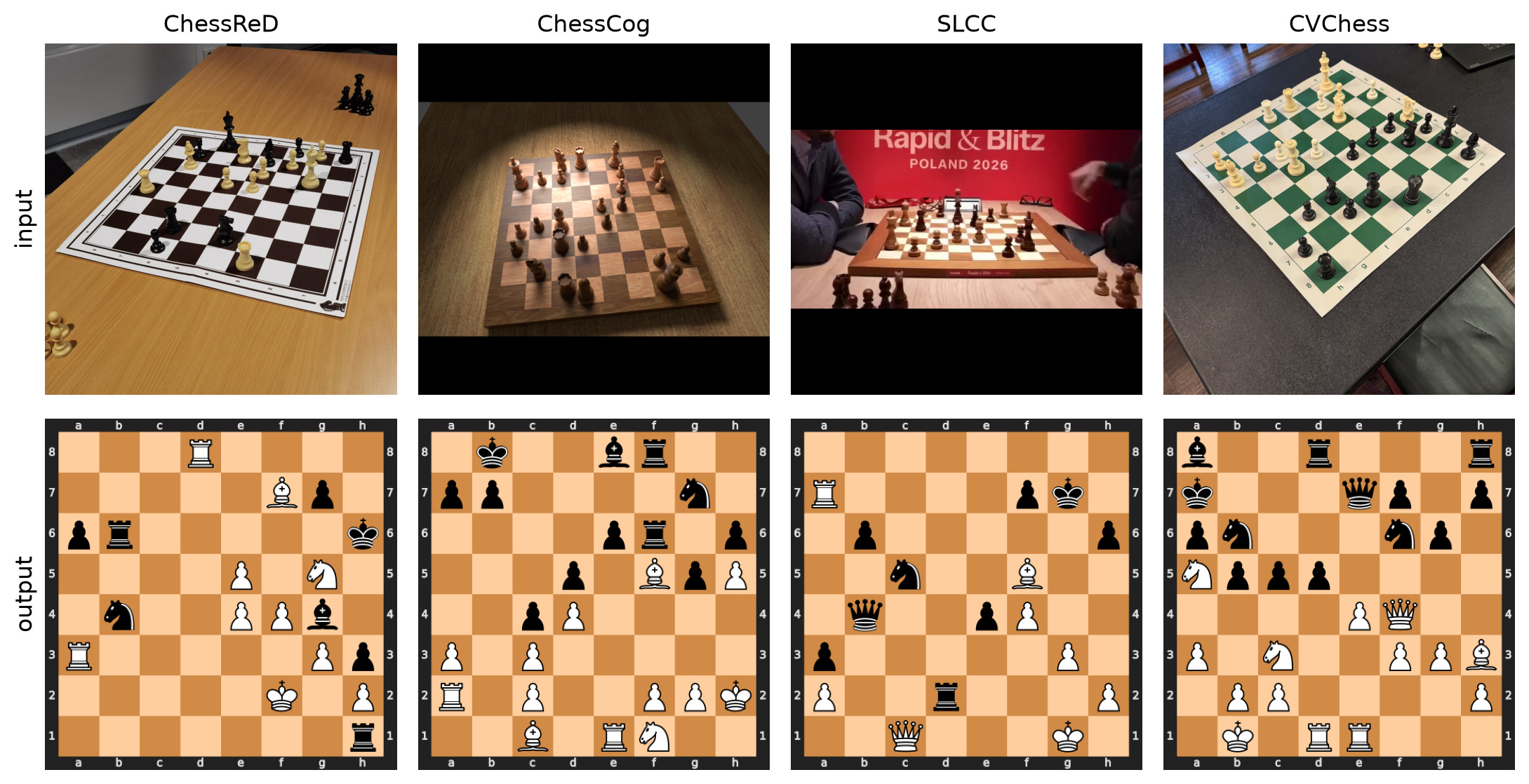
Chess board recognition: provide a photo of a real-life chessboard and receive its chess position.
🌐 Demo · 📄 Paper · 📊 Dataset · 🤖 Model weights
Try it online. The website uses a ChessQueries model further trained on proprietary data.
ChessQueries consists of a 304M-parameter ViT-L/14 encoder that maps a 644 × 644 input image to patch tokens. Sixty-four learned queries—one for each board square—cross-attend to those tokens through a DETR-style decoder. A single shared linear head maps each decoded query to its per-square class.
Best exact-board accuracy reported in the paper for a model trained on the ChessReD, ChessCog, and SLCC training splits:
| ChessReD | ChessCog | SLCC | CVChess (zero-shot) |
|---|---|---|---|
| 99.5% | 98.5% | 87.1% | 87.6% |
ChessQueries requires Python 3.12 and Poetry. Install the visualizer and launch the local Gradio demo:
poetry install --with viz
poetry run chessqueries-demo
You can also predict directly from one or more images:
poetry run chessqueries-predict photo.jpg --viz prediction.png
On first use, both commands download and verify the FP16 paper ViT-L
safetensors checkpoint, then
cache it under checkpoints/release/. CUDA runs in FP16; CPU uses the same
download with FP32 arithmetic. Preprocessing stays FP32; the default batch size is one.
For other checkpoints and their download instructions, see the Hugging Face pages for paper models and ChessQ Lite.
@misc{seytre2026chessqueries,
  title         = {ChessQueries: Toward Better Chess Board Recognition},
  author        = {Seytre, Jo{\"e}l},
  year          = {2026},
  eprint        = {2608.30762},
  archivePrefix = {arXiv},
  primaryClass  = {cs.CV},
  doi           = {10.48550/arXiv.2608.30762},
  url           = {https://arxiv.org/abs/2608.30762}
}
Commercial use is not licensed.
See DEVELOPMENT.md for repository layout, data preparation, training and evaluation commands, experiment utilities, and checks.
See the minimal reproduction guide for a self-contained implementation of the model, training, evaluation, and leakage checks used in the paper.
Questions and enquiries: contact "at" chessq.org
133 followers · starred Sep 2026
ChessQueries: chess board recognition from real-life images
See the code♟️ Update: now used on the 2nd-biggest chess website, the fully open-source and non-profit lichess.org (see announcement here)
Chess board recognition: provide a photo of a real-life chessboard and receive its chess position.
🌐 Demo · 📄 Paper · 📊 Dataset · 🤖 Model weights
Try it online. The website uses a ChessQueries model further trained on proprietary data.
ChessQueries consists of a 304M-parameter ViT-L/14 encoder that maps a 644 × 644 input image to patch tokens. Sixty-four learned queries—one for each board square—cross-attend to those tokens through a DETR-style decoder. A single shared linear head maps each decoded query to its per-square class.
Best exact-board accuracy reported in the paper for a model trained on the ChessReD, ChessCog, and SLCC training splits:
| ChessReD | ChessCog | SLCC | CVChess (zero-shot) |
|---|---|---|---|
| 99.5% | 98.5% | 87.1% | 87.6% |
ChessQueries requires Python 3.12 and Poetry. Install the visualizer and launch the local Gradio demo:
poetry install --with viz
poetry run chessqueries-demo
You can also predict directly from one or more images:
poetry run chessqueries-predict photo.jpg --viz prediction.png
On first use, both commands download and verify the FP16 paper ViT-L
safetensors checkpoint, then
cache it under checkpoints/release/. CUDA runs in FP16; CPU uses the same
download with FP32 arithmetic. Preprocessing stays FP32; the default batch size is one.
For other checkpoints and their download instructions, see the Hugging Face pages for paper models and ChessQ Lite.
@misc{seytre2026chessqueries,
  title         = {ChessQueries: Toward Better Chess Board Recognition},
  author        = {Seytre, Jo{\"e}l},
  year          = {2026},
  eprint        = {2608.30762},
  archivePrefix = {arXiv},
  primaryClass  = {cs.CV},
  doi           = {10.48550/arXiv.2608.30762},
  url           = {https://arxiv.org/abs/2608.30762}
}
Commercial use is not licensed.
See DEVELOPMENT.md for repository layout, data preparation, training and evaluation commands, experiment utilities, and checks.
See the minimal reproduction guide for a self-contained implementation of the model, training, evaluation, and leakage checks used in the paper.
Questions and enquiries: contact "at" chessq.org
133 followers · starred Sep 2026



