Open visual probability research: encode an image once, answer multiple structured questions. Public data, trained weights, reproducible baselines and failure cases.
Python
41
13 commits
updated Sep 28, 2026
Encode an image once. Answer several questions from a shared probability distribution.
OpenJev-Vision is an open research toolkit for visual probabilistic decisions. It includes original synthetic scenes, public-image experiments, downloadable trained readouts, and reproducible evaluations. The original OpenJev text-decision experiments remain available in this repository.
Vision guide · Vision weights · Dataset · Vision results · 中文
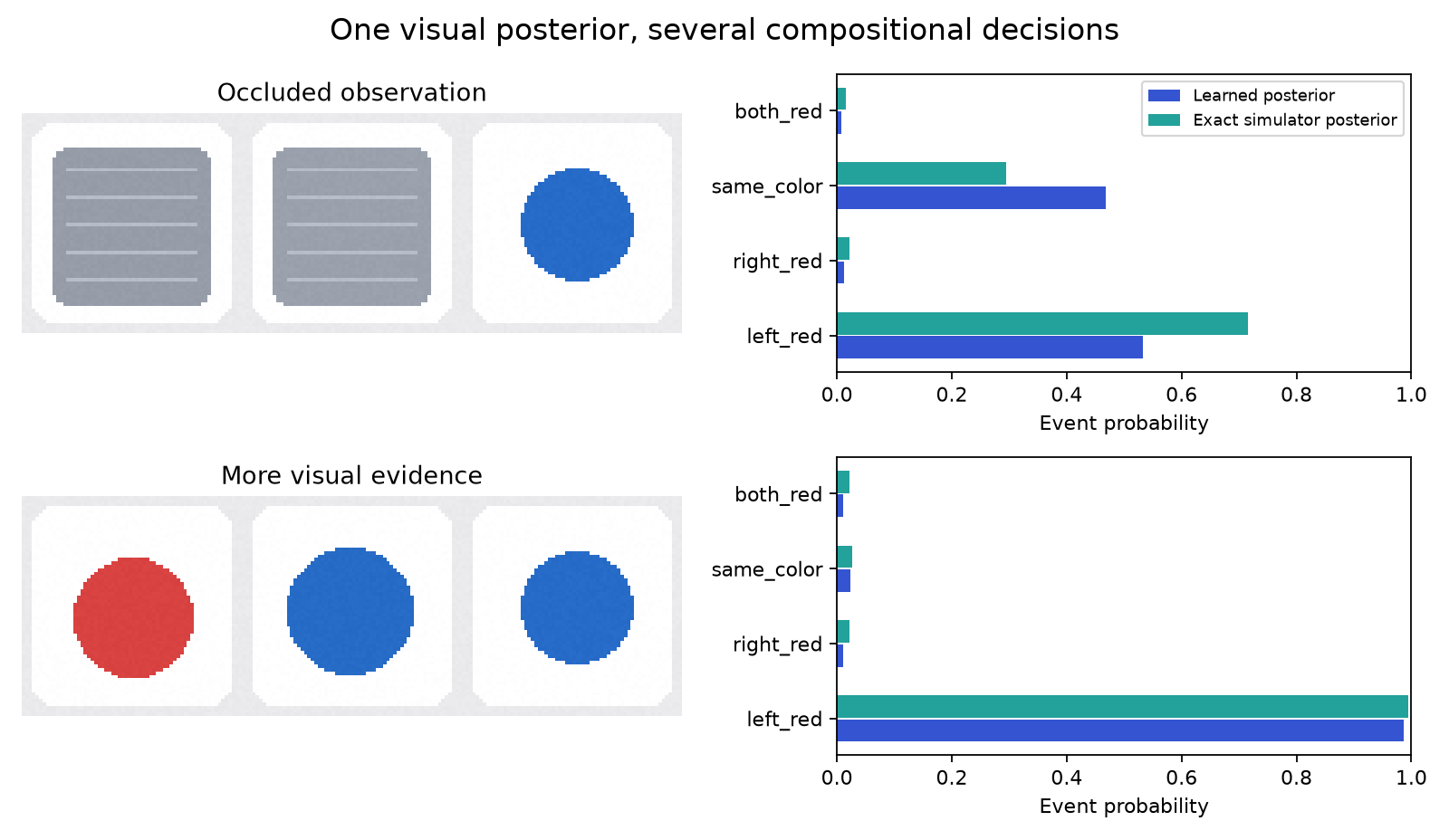
The release contains 8,192 original synthetic images, a 2,960-image Oxford-IIIT Pet subset, and 1,680 CLEVR-4 images. Synthetic scenes use a small CNN plus a supplied prior; public images use frozen DINOv2 features and trained readouts. These are separate experiments with fixed event vocabularies, not a general visual assistant. Queries use declared event semantics and a limited English parser.
git clone https://github.com/IamBusy/OpenJev-Vision.git
cd OpenJev-Vision
uv sync --frozen --extra vision --extra dev
uv run --no-sync openjev-vision download
uv run --no-sync openjev-vision predict \
  --checkpoint artifacts/openjev-vision-v0.1/synthetic-joint \
  --image examples/vision/scene-0.png \
  --prior examples/vision/scene-0-prior.json \
  --questions examples/vision/questions.json
Three-seed results include independent calibration and negative findings: the direct joint predictor degrades on new dependency structures, and independent attributes beat the tested joint and binding heads on unseen CLEVR-4 combinations. See the vision guide for public-image inference and reproduction.

Hugging Face model · 中文 · Results · Reproduce · Model card
Small, local models for typed probabilistic decisions. The published model is
OpenJev-0.6B; model revisions and software releases are tracked separately. Give OpenJev a state,
questions and candidate descriptions. It returns probabilities for choice,
noul (probability of truth), and ordinal score, without decoding answer tokens.
OpenJev is an independent research project inspired by TypeSafe's Jev. It is not affiliated with TypeSafe and does not reproduce Jev's undisclosed weights, architecture or RLCD algorithm. Training here uses supervised cross entropy and held-out temperature calibration. This is an experimental release.
| Track | Model | Purpose |
|---|---|---|
| v0.3 | Qwen3-0.6B + LoRA + scalar head | Shared state prefix, independent candidate scoring; current experiment |
| v0.2 | Qwen3-0.6B + LoRA | Letter-logit baseline, up to 26 candidates |
| v0.1 | Frozen MiniLM + residual head | Compact historical baseline |
v0.3 computes a state prefix once per request, then evaluates isolated question/candidate branches. A shared 1,024-parameter head scores candidates; 1,146,880 LoRA parameters are also trained. Question IDs and candidate keys are output handles, not model features. There is no persistent cross-request cache.
flowchart LR
  S[State] --> P[One prefix encoding]
  P --> A[Question 1 / candidate A]
  P --> B[Question 1 / candidate B]
  P --> C[Question 2 / candidates]
  A --> H[Shared scalar head]
  B --> H
  C --> H
  H --> N[Normalize within each question]
Use Python 3.12 and uv. The measured runtime is Apple M3 Pro / macOS with BF16 inference. CPU uses FP32; CUDA acceleration is not implemented in this release. Allow several GB of disk space and RAM; the separately downloaded base weights are about 1.2 GB.
git clone https://github.com/IamBusy/OpenJev-Vision.git
cd OpenJev-Vision
uv sync --frozen --extra qwen --extra dev
uv run --no-sync openjev-model download
uv run --no-sync openjev-model predict --input examples/refund.json
download fetches a pinned Qwen base from Hugging Face and the small OpenJev
adapter/head bundle from this repository's release. It checks the release archive
and model file hashes. No model-service key is needed for inference or data
reconstruction. Run commands from the checkout, or supply --root /path/to/OpenJev-Vision
before the subcommand. Existing model files are verified rather than replaced.
from pathlib import Path
from openjev import OpenJevModel

root = Path.cwd()
model = OpenJevModel(root, checkpoint=root / "artifacts/openjev-0.6b")
result = model.predict(
    state="The recorded color is red.",
    questions={
        "color": {
            "type": "choice",
            "instructions": "Which candidate agrees with the recorded color?",
            "criteria": {"red": "The color is red.", "blue": "The color is blue."},
        }
    },
)
print(result["answers"]["color"])
The Python example uses uncalibrated probabilities. The CLI loads the delivered calibration file automatically. Calibration is specific to the measured mixture, not a guarantee for a new domain.
After installing the Qwen extra, no checkout-specific model directories are needed:
from openjev import OpenJevModel
model = OpenJevModel.from_pretrained("IamBusy/OpenJev-0.6B")
This loads the trained LoRA, custom scoring head, calibration and pinned base. See Hub usage and adapter versus merged weights.
| Primitive | Input | Output |
|---|---|---|
choice | 2–255 named, distinct candidate descriptions | Distribution, selected key, maximum probability |
noul | Proposition; optional explicit false/true descriptions | Probability of truth; not an abstention flag |
score | 2–10 ordered rubric descriptions | Level distribution and expected zero-based level |
A v0.3 request supports at most 512 total candidate branches, a 768-token state prefix and 192 tokens per candidate branch, including prompt overhead. Oversized inputs fail explicitly. Questions do not attend to each other. Independently scored candidates do not see the other candidates; set-relative instructions such as “none of the above” need separate validation.
The frozen experiment used 725 training judgments, 176 development judgments, 167 calibration judgments, 405 fresh test judgments and 448 older regression judgments. Whole state groups stay within splits. Public pretraining overlap cannot be ruled out.
| Same-input comparison | v0.2 | v0.3 |
|---|---|---|
| Accuracy on the fixed 60-question reference subset | 39/60 | 45/60 |
| Candidate reversal consistency, fixed 16 questions | 68.75% | 100% |
| Long synthetic state, 8 questions × 4 candidates, warm median | 1.38 s | 0.70 s |
| Short state, 1 question × 4 candidates, warm median | 55 ms | 104 ms |
DeepSeek answered 59/60 on the same small reference subset. v0.3 changes both architecture and data, so accuracy differences are not an architecture-only ablation. Some banking, access-policy and shipping tasks regress. A 255-candidate execution check establishes output shape, not general 255-way accuracy. Timings are in-process measurements on one M3 Pro, not production latency or a comparison with Jev. See all task results and regressions.
uv run --no-sync openjev-model serve --port 8081
curl http://127.0.0.1:8081/v1/decide \
  -H 'Content-Type: application/json' --data-binary @examples/refund.json
The service binds to localhost and serializes model calls. It has no authentication
or production deployment controls. Its /v1/decide endpoint is an OpenJev contract,
not a drop-in replacement for TypeSafe's API.
The vision quick start supports the data and CPU unit tests without PEFT. For development across all backends, install the full contributor environment:
uv sync --frozen --extra vision --extra dev --extra qwen
uv run --no-sync pytest -q
uv run --no-sync ruff check src tests scripts marketing
uv run --no-sync ruff format --check src tests scripts marketing
uv build
CI tests both vision + dev (without PEFT) and the full environment above.
The tiny randomly initialized Qwen cache test, including forward and gradient
equivalence, runs in both. Full model/data integration tests run
when local artifacts are present and otherwise skip explicitly. Rebuilding the
frozen data needs public source downloads but no provider credentials; see the
complete reproduction guide.
Code and the original scenario generator are Apache-2.0. Public dataset texts retain their source-specific licenses. Full corpora are fetched from pinned upstream sources; the repository includes a few attributed schema examples. Model weights and research limitations are documented in the model card. Credentials, raw provider traces, model caches and training runs are excluded from the source distribution.
Open visual probability research: encode an image once, answer multiple structured questions. Public data, trained weights, reproducible baselines and failure cases.
Python
41
13 commits
updated Sep 28, 2026
Encode an image once. Answer several questions from a shared probability distribution.
OpenJev-Vision is an open research toolkit for visual probabilistic decisions. It includes original synthetic scenes, public-image experiments, downloadable trained readouts, and reproducible evaluations. The original OpenJev text-decision experiments remain available in this repository.
Vision guide · Vision weights · Dataset · Vision results · 中文
The release contains 8,192 original synthetic images, a 2,960-image Oxford-IIIT Pet subset, and 1,680 CLEVR-4 images. Synthetic scenes use a small CNN plus a supplied prior; public images use frozen DINOv2 features and trained readouts. These are separate experiments with fixed event vocabularies, not a general visual assistant. Queries use declared event semantics and a limited English parser.
git clone https://github.com/IamBusy/OpenJev-Vision.git
cd OpenJev-Vision
uv sync --frozen --extra vision --extra dev
uv run --no-sync openjev-vision download
uv run --no-sync openjev-vision predict \
  --checkpoint artifacts/openjev-vision-v0.1/synthetic-joint \
  --image examples/vision/scene-0.png \
  --prior examples/vision/scene-0-prior.json \
  --questions examples/vision/questions.json
Three-seed results include independent calibration and negative findings: the direct joint predictor degrades on new dependency structures, and independent attributes beat the tested joint and binding heads on unseen CLEVR-4 combinations. See the vision guide for public-image inference and reproduction.
Hugging Face model · 中文 · Results · Reproduce · Model card
Small, local models for typed probabilistic decisions. The published model is
OpenJev-0.6B; model revisions and software releases are tracked separately. Give OpenJev a state,
questions and candidate descriptions. It returns probabilities for choice,
noul (probability of truth), and ordinal score, without decoding answer tokens.
OpenJev is an independent research project inspired by TypeSafe's Jev. It is not affiliated with TypeSafe and does not reproduce Jev's undisclosed weights, architecture or RLCD algorithm. Training here uses supervised cross entropy and held-out temperature calibration. This is an experimental release.
| Track | Model | Purpose |
|---|---|---|
| v0.3 | Qwen3-0.6B + LoRA + scalar head | Shared state prefix, independent candidate scoring; current experiment |
| v0.2 | Qwen3-0.6B + LoRA | Letter-logit baseline, up to 26 candidates |
| v0.1 | Frozen MiniLM + residual head | Compact historical baseline |
v0.3 computes a state prefix once per request, then evaluates isolated question/candidate branches. A shared 1,024-parameter head scores candidates; 1,146,880 LoRA parameters are also trained. Question IDs and candidate keys are output handles, not model features. There is no persistent cross-request cache.
flowchart LR
  S[State] --> P[One prefix encoding]
  P --> A[Question 1 / candidate A]
  P --> B[Question 1 / candidate B]
  P --> C[Question 2 / candidates]
  A --> H[Shared scalar head]
  B --> H
  C --> H
  H --> N[Normalize within each question]
Use Python 3.12 and uv. The measured runtime is Apple M3 Pro / macOS with BF16 inference. CPU uses FP32; CUDA acceleration is not implemented in this release. Allow several GB of disk space and RAM; the separately downloaded base weights are about 1.2 GB.
git clone https://github.com/IamBusy/OpenJev-Vision.git
cd OpenJev-Vision
uv sync --frozen --extra qwen --extra dev
uv run --no-sync openjev-model download
uv run --no-sync openjev-model predict --input examples/refund.json
download fetches a pinned Qwen base from Hugging Face and the small OpenJev
adapter/head bundle from this repository's release. It checks the release archive
and model file hashes. No model-service key is needed for inference or data
reconstruction. Run commands from the checkout, or supply --root /path/to/OpenJev-Vision
before the subcommand. Existing model files are verified rather than replaced.
from pathlib import Path
from openjev import OpenJevModel

root = Path.cwd()
model = OpenJevModel(root, checkpoint=root / "artifacts/openjev-0.6b")
result = model.predict(
    state="The recorded color is red.",
    questions={
        "color": {
            "type": "choice",
            "instructions": "Which candidate agrees with the recorded color?",
            "criteria": {"red": "The color is red.", "blue": "The color is blue."},
        }
    },
)
print(result["answers"]["color"])
The Python example uses uncalibrated probabilities. The CLI loads the delivered calibration file automatically. Calibration is specific to the measured mixture, not a guarantee for a new domain.
After installing the Qwen extra, no checkout-specific model directories are needed:
from openjev import OpenJevModel
model = OpenJevModel.from_pretrained("IamBusy/OpenJev-0.6B")
This loads the trained LoRA, custom scoring head, calibration and pinned base. See Hub usage and adapter versus merged weights.
| Primitive | Input | Output |
|---|---|---|
choice | 2–255 named, distinct candidate descriptions | Distribution, selected key, maximum probability |
noul | Proposition; optional explicit false/true descriptions | Probability of truth; not an abstention flag |
score | 2–10 ordered rubric descriptions | Level distribution and expected zero-based level |
A v0.3 request supports at most 512 total candidate branches, a 768-token state prefix and 192 tokens per candidate branch, including prompt overhead. Oversized inputs fail explicitly. Questions do not attend to each other. Independently scored candidates do not see the other candidates; set-relative instructions such as “none of the above” need separate validation.
The frozen experiment used 725 training judgments, 176 development judgments, 167 calibration judgments, 405 fresh test judgments and 448 older regression judgments. Whole state groups stay within splits. Public pretraining overlap cannot be ruled out.
| Same-input comparison | v0.2 | v0.3 |
|---|---|---|
| Accuracy on the fixed 60-question reference subset | 39/60 | 45/60 |
| Candidate reversal consistency, fixed 16 questions | 68.75% | 100% |
| Long synthetic state, 8 questions × 4 candidates, warm median | 1.38 s | 0.70 s |
| Short state, 1 question × 4 candidates, warm median | 55 ms | 104 ms |
DeepSeek answered 59/60 on the same small reference subset. v0.3 changes both architecture and data, so accuracy differences are not an architecture-only ablation. Some banking, access-policy and shipping tasks regress. A 255-candidate execution check establishes output shape, not general 255-way accuracy. Timings are in-process measurements on one M3 Pro, not production latency or a comparison with Jev. See all task results and regressions.
uv run --no-sync openjev-model serve --port 8081
curl http://127.0.0.1:8081/v1/decide \
  -H 'Content-Type: application/json' --data-binary @examples/refund.json
The service binds to localhost and serializes model calls. It has no authentication
or production deployment controls. Its /v1/decide endpoint is an OpenJev contract,
not a drop-in replacement for TypeSafe's API.
The vision quick start supports the data and CPU unit tests without PEFT. For development across all backends, install the full contributor environment:
uv sync --frozen --extra vision --extra dev --extra qwen
uv run --no-sync pytest -q
uv run --no-sync ruff check src tests scripts marketing
uv run --no-sync ruff format --check src tests scripts marketing
uv build
CI tests both vision + dev (without PEFT) and the full environment above.
The tiny randomly initialized Qwen cache test, including forward and gradient
equivalence, runs in both. Full model/data integration tests run
when local artifacts are present and otherwise skip explicitly. Rebuilding the
frozen data needs public source downloads but no provider credentials; see the
complete reproduction guide.
Code and the original scenario generator are Apache-2.0. Public dataset texts retain their source-specific licenses. Full corpora are fetched from pinned upstream sources; the repository includes a few attributed schema examples. Model weights and research limitations are documented in the model card. Credentials, raw provider traces, model caches and training runs are excluded from the source distribution.