
Jev-like decision models that can also see images — open weights on Qwen3.5, run on your own GPU
Python
11
33 commits
updated Oct 3, 2026
See what people are saying
README
Vev



Jev-like decision models that can also see images.

vev-4b playing Doom in real time. A small harness cuts each frame into 8 vertical slices and asks Vev one yes/no question per slice in a single request ("does this slice show a monster?"); a fixed rule turns the answers into turning and firing. The game never waits for the model.
Ask yes/no, multiple-choice or graded questions about a piece of text, a JSON record or a screenshot, and get a probability for every allowed answer back in about 40 ms. Nothing is generated, so the answer is always one of the options you defined, and you can put a threshold on it. The weights are open and run on your own GPU.
- Speaks the Jev API. Jev is TypeSafe's hosted
decision model. Vev serves the same
/v1/systemonerequest format, so code written with TypeSafe's SDK works after changing the base URL. - Sees images. Screenshots and photos go into the request next to text. We measured it on reading UI state, checking images against a written policy and checking generated images against their prompt (what it can do).
- Two sizes, English and Chinese.
vev-4bneeds about 10 GB of GPU memory andvev-9babout 19 GB. Both are fine-tuned from Qwen3.5.
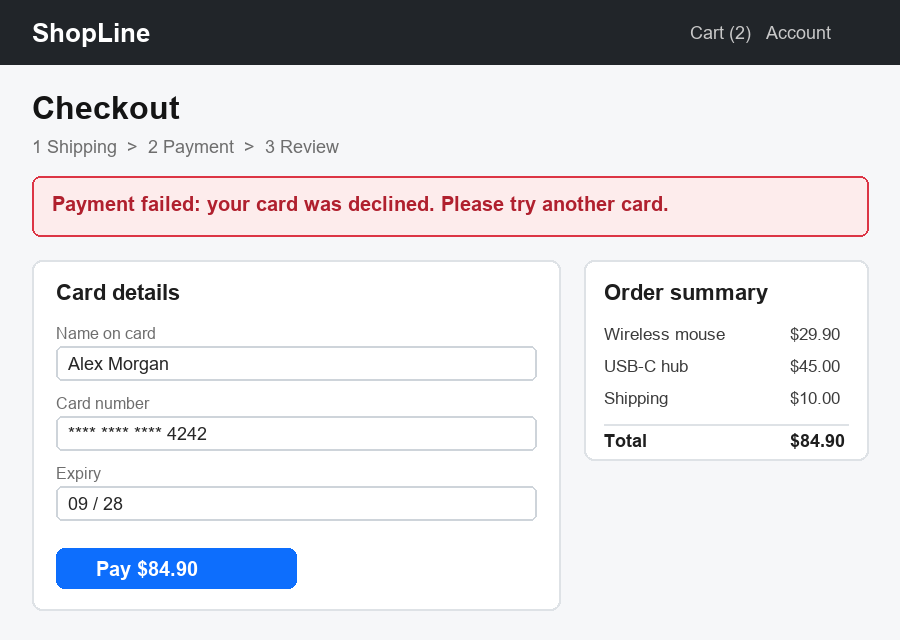
resp = client.system_one(
    state={"screen": {"image": {"url": checkout_png}}},
    questions={
        "error": Noul(instructions="Does the screen show an error message?"),
        "step": Choice(instructions="Which checkout step is the user on?",
                       criteria={"shipping": None, "payment": None, "review": None}),
        "next": Choice(instructions="What should the user do next?",
                       criteria={"retry": "Try another card", "wait": "Wait for the order to ship",
                                 "nothing": "Nothing, the order went through"}),
    },
)
# vev-4b:  error 0.991
#          step  {"shipping": 0.005, "payment": 0.765, "review": 0.229}
#          next  {"retry": 0.983, "wait": 0.004, "nothing": 0.014}
The step question gets a less certain answer than the other two, which is what the probabilities are for: the progress bar shows both "Payment" and "Review".
This is v0.1, a research preview. The weights are for non-commercial use only, and on most text sets Vev is less accurate than Jev; see limitations.
Get started
pip install git+https://github.com/Xiaooolong/vev
vev serve --model CountingSheep/vev-4b          # downloads the weights on first start, listens on 127.0.0.1:8009
You need Python 3.11 or newer, an NVIDIA GPU and a CUDA build of PyTorch; CPU and Apple Silicon are untested. On
Windows, pip installs a CPU-only PyTorch by default, so install torch and torchvision together from
pytorch.org first. Tested with torch 2.8.0, transformers 5.17.0 and
peft 0.21.0.
Then ask questions with TypeSafe's Python SDK (pip install typesafe-sdk):
from typesafe_sdk import Choice, Noul, TypeSafeClient

client = TypeSafeClient(api_key="local", base_url="http://127.0.0.1:8009")
resp = client.system_one(
    state="Order #4411 still shows 'label created' after 9 days. I need it before Friday.",
    questions={
        "urgent": Noul(instructions="Is the customer asking for something time-sensitive?"),
        "team": Choice(instructions="Which team should handle this?",
                       criteria={"shipping": "Delivery and tracking", "billing": "Charges and refunds"}),
    },
)
print(resp.answers["urgent"].noul)          # probability of "yes": 0.98 with vev-4b
print(resp.answers["team"].probabilities)   # {"shipping": 0.97, "billing": 0.03}
Noul is the API's name for a yes/no question. The state can be a string or any JSON object; an image is an
object {"image": {"url": "data:image/png;base64,..."}} anywhere inside it:
import base64

checkout_png = "data:image/png;base64," + base64.b64encode(open("docs/checkout.png", "rb").read()).decode()
Other ways to run it
-
--model CountingSheep/vev-4b-loradownloads only the adapter (130 MB) and applies it toQwen/Qwen3.5-4B, which is reused if it is already in your Hugging Face cache.--revision v0.1.0pins the weights. -
Docker:
docker build -t vev .in a clone of this repository, thendocker run --gpus all -p 8009:8009 -v ~/.cache/huggingface:/root/.cache/huggingface vev --model CountingSheep/vev-4b. -
Without the HTTP server, for example to score a large file offline:
from vev.model import CheckpointEngine engine = CheckpointEngine("CountingSheep/vev-4b") result = engine.run({"ticket": "My kettle never arrived."}, {"refund": {"type": "noul", "instructions": "Is the customer asking for a refund?"}}) print(result.answers["refund"]["noul"]) -
In another inference engine: spec/systemone-api.md, section 10, gives the prompt template and which token probabilities to read.
Speed
All questions of a request run as one batch. On one H800, vev-4b answers:
| Request | 1 question | 10 questions | 100 questions |
|---|---|---|---|
| short text | 38 ms | 58 ms | 232 ms |
| 7k-token text | 280 ms | 334 ms | 1.07 s |
| one 1 MP image | 78 ms | 120 ms (25 questions: 143 ms) | — |
vev-9b is up to 30% slower; the full curves are in conformance/results/vev-*/curves.json. A vev serve
process handles one request at a time and queues the rest; for more throughput, run one process per GPU behind a
load balancer.
What it can do
Accuracy on human-labelled data, by the kind of question. The text sets are public benchmarks; the image tasks are judgment sets we converted from labelled public data (details).
| Kind of question | Example | vev-4b | vev-9b |
|---|---|---|---|
| Jev-style decisions on text | JevBench public subset | 0.766 | 0.823 |
| The same, on sources the model has not seen | kev transfer-v4 | 0.776 | 0.781 |
| Chinese | judgekit | 0.962 | 0.938 |
| Pairs where a small change flips the answer | nimble | 0.707 | 0.747 |
| UI state in an app screenshot | "Is there a switch or checkbox that is turned on?" / "Is there a text input field?" | 0.928 / 0.951 | 0.923 / 0.955 |
| An image against a written safety policy | the LlavaGuard policy categories (hate, violence, sexual content, ...) | 0.742 | 0.724 |
| A generated image against its prompt | "Does the image show the element 'grass' as the prompt describes?" | 0.715 | 0.703 |
| General questions about a photo | MMBench-EN / POPE / MMStar | 0.881 / 0.889 / 0.627 | 0.902 / 0.897 / 0.674 |
| Bugs in game screenshots | glitch / object clipping (VideoGameQA-Bench) | 0.613 / 0.671 | 0.626 / 0.729 |
UI-state questions are the most accurate; policy checks, generated-image checks and the harder visual benchmarks
are mid-range; game bugs are too weak to rely on. These numbers describe these data sets, not yours. To check Vev
on your own questions, write a few hundred labelled examples in the record format and run
python -m evals.run against your server; it reports accuracy, calibration, and accuracy among the most confident
answers at each coverage level.
Detailed results
All numbers are accuracy on the full sets, measured with the harness in evals/. Where two systems are compared,
the difference is tested with a paired bootstrap over the same questions (95% interval); "n.s." marks differences
whose interval includes zero; for the image sets, questions that share an image are resampled together. The results
were computed with version 0.1.0, which ran one forward pass per question; 0.1.1 gives the same probabilities for
requests with one question, and with 5 or 50 extra questions per request no significance verdict below changes.
Per-set metrics, including Brier score and calibration error, are in results/; sets there that are not
below were used for diagnostics during development.
Text
| Set | n | kev-4B | vev-4b | vev-9b | Jev |
|---|---|---|---|---|---|
| judgekit (Chinese) | 130 | 0.846 | 0.962 | 0.938 | 0.962 |
| JevBench (public subset) | 231 | 0.719 | 0.766 | 0.823 | 0.861 |
| nimble | 324 | 0.735 | 0.707 | 0.747 | 0.923 |
| kev transfer-v4 (held-out sources) | 1528 | 0.802 | 0.776 | 0.781 | 0.854 |
kev-4B was run locally with the same harness. Jev was queried through TypeSafe's API (jev-latest, 23–24 September
2026); no Jev outputs were used for training. Differences in accuracy points:
- vev-4b against kev-4B: +11.5 on judgekit, −2.6 on kev transfer-v4; JevBench and nimble are n.s.
- vev-9b against kev-4B: +9.2 on judgekit, +10.4 on JevBench, −2.1 on kev transfer-v4; nimble is n.s.
- vev-4b against Jev: −9.5 on JevBench, −21.6 on nimble, −7.8 on kev transfer-v4; judgekit is a tie.
- vev-9b against Jev: −17.6 on nimble, −7.3 on kev transfer-v4; judgekit (−2.3) and JevBench (−3.9) are n.s.
Before and after fine-tuning
The base model, read the same way without fine-tuning (zero-shot), against Vev:
| Set | n | Qwen3.5-4B | vev-4b | Qwen3.5-9B | vev-9b |
|---|---|---|---|---|---|
| judgekit | 130 | 0.962 | 0.962 | 0.938 | 0.938 |
| JevBench | 231 | 0.758 | 0.766 | 0.805 | 0.823 |
| nimble | 324 | 0.710 | 0.707 | 0.710 | 0.747 |
| kev transfer-v4 | 1528 | 0.758 | 0.776 | 0.764 | 0.781 |
| MMBench-EN | 1164 | 0.872 | 0.881 | 0.887 | 0.902 |
| POPE | 9000 | 0.894 | 0.889 | 0.894 | 0.897 |
| MMStar | 1498 | 0.544 | 0.627 | 0.608 | 0.674 |
Bold marks a significant improvement, italics a significant drop.
Images
Public vision benchmarks mostly ask questions about an image. Vev is meant for judging an image against a stated
rule, so we built judgment sets from human-labelled public data. The converters are in evals/datasets/; the
converted data is not redistributed. Jev's API takes text only, so there is no Jev column here.
| Set | What is judged | n | Qwen3.5-4B | vev-4b | Qwen3.5-9B | vev-9b |
|---|---|---|---|---|---|---|
| policy_mod | Does the image violate this safety policy? (LlavaGuard) | 659 | 0.686 | 0.742 | 0.666 | 0.724 |
| game_glitch | Does the game screenshot contain a glitch? (VideoGameQA-Bench) | 1000 | 0.646 | 0.613 | 0.577 | 0.626 |
| game_clip | Is the object clipping into the character? (VideoGameQA-Bench) | 686 | 0.561 | 0.671 | 0.736 | 0.729 |
| ui_toggle | Is there a switch turned on / off? (MobileViews) | 800 | 0.901 | 0.928 | 0.921 | 0.923 |
| ui_input | Is there a text input field? (MobileViews) | 800 | 0.949 | 0.951 | 0.948 | 0.955 |
| t2i_elem | Does the generated image show this prompt element? (EvalMuse) | 1027 | 0.690 | 0.715 | 0.733 | 0.703 |
Limitations
- The probabilities rank answers well but are not exact frequencies: expected calibration error ranges from 0.01 to 0.14 depending on the task (Jev: 0.04–0.07 on the text sets). On "is something wrong here?" questions Vev says "no" more often than the labels do. If you act on a threshold, choose it on your own labelled data (how).
- Reversing the order of the options changes the top answer on 13% (
vev-9b) and 17% (vev-4b) of JevBench and kev transfer-v4 questions, against 10–12% for kev-4B and under 4% for Jev. Keep the option order fixed in your application. - Judgments that need several steps of reasoning are weaker than the base model's own answer when it may think first: on one internal scenario set (not released), by 4–8 points. On most public sets we tried, the single pass was as accurate or better.
- A question asked together with others gets probabilities up to a few hundredths away from asking it alone (bf16 rounding; p99 0.025), and a different top answer on at most 0.8% of questions. The same request always returns the same answer (spec §6).
- Long texts gain little from batching: with a 7k-token text, 100 questions take 3.8 times as long as one. A text
near the 32k-token limit does not fit on a 24 GB GPU with
vev-9b. The first request with a new length or batch shape can take a few seconds while GPU kernels are tuned. - The image sets are our own conversions of public data, not established benchmarks.
- Compatible means the request and response formats match
/v1/systemone; it does not mean Vev behaves like Jev. Vev is not affiliated with or endorsed by TypeSafe.
How it works
Each question becomes a prompt with the state, the question and the lettered options, and Vev reads the model's next-token probabilities for the answer tokens (Yes/No, option letters, level digits), renormalised over the allowed answers. Fine-tuning (LoRA on Qwen3.5) adjusts those probabilities; there is no separate classifier head.
| Document | Contents |
|---|---|
| spec/systemone-api.md | request format, limits, errors, guarantees, the prompt template |
| TRAINING.md | training recipe, data sources and their licenses, what cannot be rebuilt |
| evals/ | converting the evaluation sets and running them against any /v1/systemone server |
| conformance/ | checking an implementation against the spec, including the official API |
| Model | Base | Hugging Face |
|---|---|---|
vev-4b | Qwen3.5-4B | CountingSheep/vev-4b (merged), CountingSheep/vev-4b-lora (adapter) |
vev-9b | Qwen3.5-9B | CountingSheep/vev-9b (merged), CountingSheep/vev-9b-lora (adapter) |
License
Code: Apache 2.0. Model weights: CC BY-NC 4.0, non-commercial use only, because some training data is licensed for research use; the sources and their terms are listed in TRAINING.md.
Citation
@software{vev2026,
  title  = {Vev: Jev-like decision models that can also see images},
  author = {Wang, Xiaolong},
  year   = {2026},
  url    = {https://github.com/Xiaooolong/vev},
  version = {0.1.1}
}
Similar repos



Languages
Python
99.9%
Jev-like decision models that can also see images — open weights on Qwen3.5, run on your own GPU
Python
11
33 commits
updated Oct 3, 2026
See what people are saying
README
Vev
Jev-like decision models that can also see images.
vev-4b playing Doom in real time. A small harness cuts each frame into 8 vertical slices and asks Vev one yes/no question per slice in a single request ("does this slice show a monster?"); a fixed rule turns the answers into turning and firing. The game never waits for the model.
Ask yes/no, multiple-choice or graded questions about a piece of text, a JSON record or a screenshot, and get a probability for every allowed answer back in about 40 ms. Nothing is generated, so the answer is always one of the options you defined, and you can put a threshold on it. The weights are open and run on your own GPU.
- Speaks the Jev API. Jev is TypeSafe's hosted
decision model. Vev serves the same
/v1/systemonerequest format, so code written with TypeSafe's SDK works after changing the base URL. - Sees images. Screenshots and photos go into the request next to text. We measured it on reading UI state, checking images against a written policy and checking generated images against their prompt (what it can do).
- Two sizes, English and Chinese.
vev-4bneeds about 10 GB of GPU memory andvev-9babout 19 GB. Both are fine-tuned from Qwen3.5.
resp = client.system_one(
    state={"screen": {"image": {"url": checkout_png}}},
    questions={
        "error": Noul(instructions="Does the screen show an error message?"),
        "step": Choice(instructions="Which checkout step is the user on?",
                       criteria={"shipping": None, "payment": None, "review": None}),
        "next": Choice(instructions="What should the user do next?",
                       criteria={"retry": "Try another card", "wait": "Wait for the order to ship",
                                 "nothing": "Nothing, the order went through"}),
    },
)
# vev-4b:  error 0.991
#          step  {"shipping": 0.005, "payment": 0.765, "review": 0.229}
#          next  {"retry": 0.983, "wait": 0.004, "nothing": 0.014}
The step question gets a less certain answer than the other two, which is what the probabilities are for: the progress bar shows both "Payment" and "Review".
This is v0.1, a research preview. The weights are for non-commercial use only, and on most text sets Vev is less accurate than Jev; see limitations.
Get started
pip install git+https://github.com/Xiaooolong/vev
vev serve --model CountingSheep/vev-4b          # downloads the weights on first start, listens on 127.0.0.1:8009
You need Python 3.11 or newer, an NVIDIA GPU and a CUDA build of PyTorch; CPU and Apple Silicon are untested. On
Windows, pip installs a CPU-only PyTorch by default, so install torch and torchvision together from
pytorch.org first. Tested with torch 2.8.0, transformers 5.17.0 and
peft 0.21.0.
Then ask questions with TypeSafe's Python SDK (pip install typesafe-sdk):
from typesafe_sdk import Choice, Noul, TypeSafeClient

client = TypeSafeClient(api_key="local", base_url="http://127.0.0.1:8009")
resp = client.system_one(
    state="Order #4411 still shows 'label created' after 9 days. I need it before Friday.",
    questions={
        "urgent": Noul(instructions="Is the customer asking for something time-sensitive?"),
        "team": Choice(instructions="Which team should handle this?",
                       criteria={"shipping": "Delivery and tracking", "billing": "Charges and refunds"}),
    },
)
print(resp.answers["urgent"].noul)          # probability of "yes": 0.98 with vev-4b
print(resp.answers["team"].probabilities)   # {"shipping": 0.97, "billing": 0.03}
Noul is the API's name for a yes/no question. The state can be a string or any JSON object; an image is an
object {"image": {"url": "data:image/png;base64,..."}} anywhere inside it:
import base64

checkout_png = "data:image/png;base64," + base64.b64encode(open("docs/checkout.png", "rb").read()).decode()
Other ways to run it
-
--model CountingSheep/vev-4b-loradownloads only the adapter (130 MB) and applies it toQwen/Qwen3.5-4B, which is reused if it is already in your Hugging Face cache.--revision v0.1.0pins the weights. -
Docker:
docker build -t vev .in a clone of this repository, thendocker run --gpus all -p 8009:8009 -v ~/.cache/huggingface:/root/.cache/huggingface vev --model CountingSheep/vev-4b. -
Without the HTTP server, for example to score a large file offline:
from vev.model import CheckpointEngine engine = CheckpointEngine("CountingSheep/vev-4b") result = engine.run({"ticket": "My kettle never arrived."}, {"refund": {"type": "noul", "instructions": "Is the customer asking for a refund?"}}) print(result.answers["refund"]["noul"]) -
In another inference engine: spec/systemone-api.md, section 10, gives the prompt template and which token probabilities to read.
Speed
All questions of a request run as one batch. On one H800, vev-4b answers:
| Request | 1 question | 10 questions | 100 questions |
|---|---|---|---|
| short text | 38 ms | 58 ms | 232 ms |
| 7k-token text | 280 ms | 334 ms | 1.07 s |
| one 1 MP image | 78 ms | 120 ms (25 questions: 143 ms) | — |
vev-9b is up to 30% slower; the full curves are in conformance/results/vev-*/curves.json. A vev serve
process handles one request at a time and queues the rest; for more throughput, run one process per GPU behind a
load balancer.
What it can do
Accuracy on human-labelled data, by the kind of question. The text sets are public benchmarks; the image tasks are judgment sets we converted from labelled public data (details).
| Kind of question | Example | vev-4b | vev-9b |
|---|---|---|---|
| Jev-style decisions on text | JevBench public subset | 0.766 | 0.823 |
| The same, on sources the model has not seen | kev transfer-v4 | 0.776 | 0.781 |
| Chinese | judgekit | 0.962 | 0.938 |
| Pairs where a small change flips the answer | nimble | 0.707 | 0.747 |
| UI state in an app screenshot | "Is there a switch or checkbox that is turned on?" / "Is there a text input field?" | 0.928 / 0.951 | 0.923 / 0.955 |
| An image against a written safety policy | the LlavaGuard policy categories (hate, violence, sexual content, ...) | 0.742 | 0.724 |
| A generated image against its prompt | "Does the image show the element 'grass' as the prompt describes?" | 0.715 | 0.703 |
| General questions about a photo | MMBench-EN / POPE / MMStar | 0.881 / 0.889 / 0.627 | 0.902 / 0.897 / 0.674 |
| Bugs in game screenshots | glitch / object clipping (VideoGameQA-Bench) | 0.613 / 0.671 | 0.626 / 0.729 |
UI-state questions are the most accurate; policy checks, generated-image checks and the harder visual benchmarks
are mid-range; game bugs are too weak to rely on. These numbers describe these data sets, not yours. To check Vev
on your own questions, write a few hundred labelled examples in the record format and run
python -m evals.run against your server; it reports accuracy, calibration, and accuracy among the most confident
answers at each coverage level.
Detailed results
All numbers are accuracy on the full sets, measured with the harness in evals/. Where two systems are compared,
the difference is tested with a paired bootstrap over the same questions (95% interval); "n.s." marks differences
whose interval includes zero; for the image sets, questions that share an image are resampled together. The results
were computed with version 0.1.0, which ran one forward pass per question; 0.1.1 gives the same probabilities for
requests with one question, and with 5 or 50 extra questions per request no significance verdict below changes.
Per-set metrics, including Brier score and calibration error, are in results/; sets there that are not
below were used for diagnostics during development.
Text
| Set | n | kev-4B | vev-4b | vev-9b | Jev |
|---|---|---|---|---|---|
| judgekit (Chinese) | 130 | 0.846 | 0.962 | 0.938 | 0.962 |
| JevBench (public subset) | 231 | 0.719 | 0.766 | 0.823 | 0.861 |
| nimble | 324 | 0.735 | 0.707 | 0.747 | 0.923 |
| kev transfer-v4 (held-out sources) | 1528 | 0.802 | 0.776 | 0.781 | 0.854 |
kev-4B was run locally with the same harness. Jev was queried through TypeSafe's API (jev-latest, 23–24 September
2026); no Jev outputs were used for training. Differences in accuracy points:
- vev-4b against kev-4B: +11.5 on judgekit, −2.6 on kev transfer-v4; JevBench and nimble are n.s.
- vev-9b against kev-4B: +9.2 on judgekit, +10.4 on JevBench, −2.1 on kev transfer-v4; nimble is n.s.
- vev-4b against Jev: −9.5 on JevBench, −21.6 on nimble, −7.8 on kev transfer-v4; judgekit is a tie.
- vev-9b against Jev: −17.6 on nimble, −7.3 on kev transfer-v4; judgekit (−2.3) and JevBench (−3.9) are n.s.
Before and after fine-tuning
The base model, read the same way without fine-tuning (zero-shot), against Vev:
| Set | n | Qwen3.5-4B | vev-4b | Qwen3.5-9B | vev-9b |
|---|---|---|---|---|---|
| judgekit | 130 | 0.962 | 0.962 | 0.938 | 0.938 |
| JevBench | 231 | 0.758 | 0.766 | 0.805 | 0.823 |
| nimble | 324 | 0.710 | 0.707 | 0.710 | 0.747 |
| kev transfer-v4 | 1528 | 0.758 | 0.776 | 0.764 | 0.781 |
| MMBench-EN | 1164 | 0.872 | 0.881 | 0.887 | 0.902 |
| POPE | 9000 | 0.894 | 0.889 | 0.894 | 0.897 |
| MMStar | 1498 | 0.544 | 0.627 | 0.608 | 0.674 |
Bold marks a significant improvement, italics a significant drop.
Images
Public vision benchmarks mostly ask questions about an image. Vev is meant for judging an image against a stated
rule, so we built judgment sets from human-labelled public data. The converters are in evals/datasets/; the
converted data is not redistributed. Jev's API takes text only, so there is no Jev column here.
| Set | What is judged | n | Qwen3.5-4B | vev-4b | Qwen3.5-9B | vev-9b |
|---|---|---|---|---|---|---|
| policy_mod | Does the image violate this safety policy? (LlavaGuard) | 659 | 0.686 | 0.742 | 0.666 | 0.724 |
| game_glitch | Does the game screenshot contain a glitch? (VideoGameQA-Bench) | 1000 | 0.646 | 0.613 | 0.577 | 0.626 |
| game_clip | Is the object clipping into the character? (VideoGameQA-Bench) | 686 | 0.561 | 0.671 | 0.736 | 0.729 |
| ui_toggle | Is there a switch turned on / off? (MobileViews) | 800 | 0.901 | 0.928 | 0.921 | 0.923 |
| ui_input | Is there a text input field? (MobileViews) | 800 | 0.949 | 0.951 | 0.948 | 0.955 |
| t2i_elem | Does the generated image show this prompt element? (EvalMuse) | 1027 | 0.690 | 0.715 | 0.733 | 0.703 |
Limitations
- The probabilities rank answers well but are not exact frequencies: expected calibration error ranges from 0.01 to 0.14 depending on the task (Jev: 0.04–0.07 on the text sets). On "is something wrong here?" questions Vev says "no" more often than the labels do. If you act on a threshold, choose it on your own labelled data (how).
- Reversing the order of the options changes the top answer on 13% (
vev-9b) and 17% (vev-4b) of JevBench and kev transfer-v4 questions, against 10–12% for kev-4B and under 4% for Jev. Keep the option order fixed in your application. - Judgments that need several steps of reasoning are weaker than the base model's own answer when it may think first: on one internal scenario set (not released), by 4–8 points. On most public sets we tried, the single pass was as accurate or better.
- A question asked together with others gets probabilities up to a few hundredths away from asking it alone (bf16 rounding; p99 0.025), and a different top answer on at most 0.8% of questions. The same request always returns the same answer (spec §6).
- Long texts gain little from batching: with a 7k-token text, 100 questions take 3.8 times as long as one. A text
near the 32k-token limit does not fit on a 24 GB GPU with
vev-9b. The first request with a new length or batch shape can take a few seconds while GPU kernels are tuned. - The image sets are our own conversions of public data, not established benchmarks.
- Compatible means the request and response formats match
/v1/systemone; it does not mean Vev behaves like Jev. Vev is not affiliated with or endorsed by TypeSafe.
How it works
Each question becomes a prompt with the state, the question and the lettered options, and Vev reads the model's next-token probabilities for the answer tokens (Yes/No, option letters, level digits), renormalised over the allowed answers. Fine-tuning (LoRA on Qwen3.5) adjusts those probabilities; there is no separate classifier head.
| Document | Contents |
|---|---|
| spec/systemone-api.md | request format, limits, errors, guarantees, the prompt template |
| TRAINING.md | training recipe, data sources and their licenses, what cannot be rebuilt |
| evals/ | converting the evaluation sets and running them against any /v1/systemone server |
| conformance/ | checking an implementation against the spec, including the official API |
| Model | Base | Hugging Face |
|---|---|---|
vev-4b | Qwen3.5-4B | CountingSheep/vev-4b (merged), CountingSheep/vev-4b-lora (adapter) |
vev-9b | Qwen3.5-9B | CountingSheep/vev-9b (merged), CountingSheep/vev-9b-lora (adapter) |
License
Code: Apache 2.0. Model weights: CC BY-NC 4.0, non-commercial use only, because some training data is licensed for research use; the sources and their terms are listed in TRAINING.md.
Citation
@software{vev2026,
  title  = {Vev: Jev-like decision models that can also see images},
  author = {Wang, Xiaolong},
  year   = {2026},
  url    = {https://github.com/Xiaooolong/vev},
  version = {0.1.1}
}
Similar repos
Languages
Python
99.9%