A Web Interface for chatting with your local LLMs via the ollama API
See the code
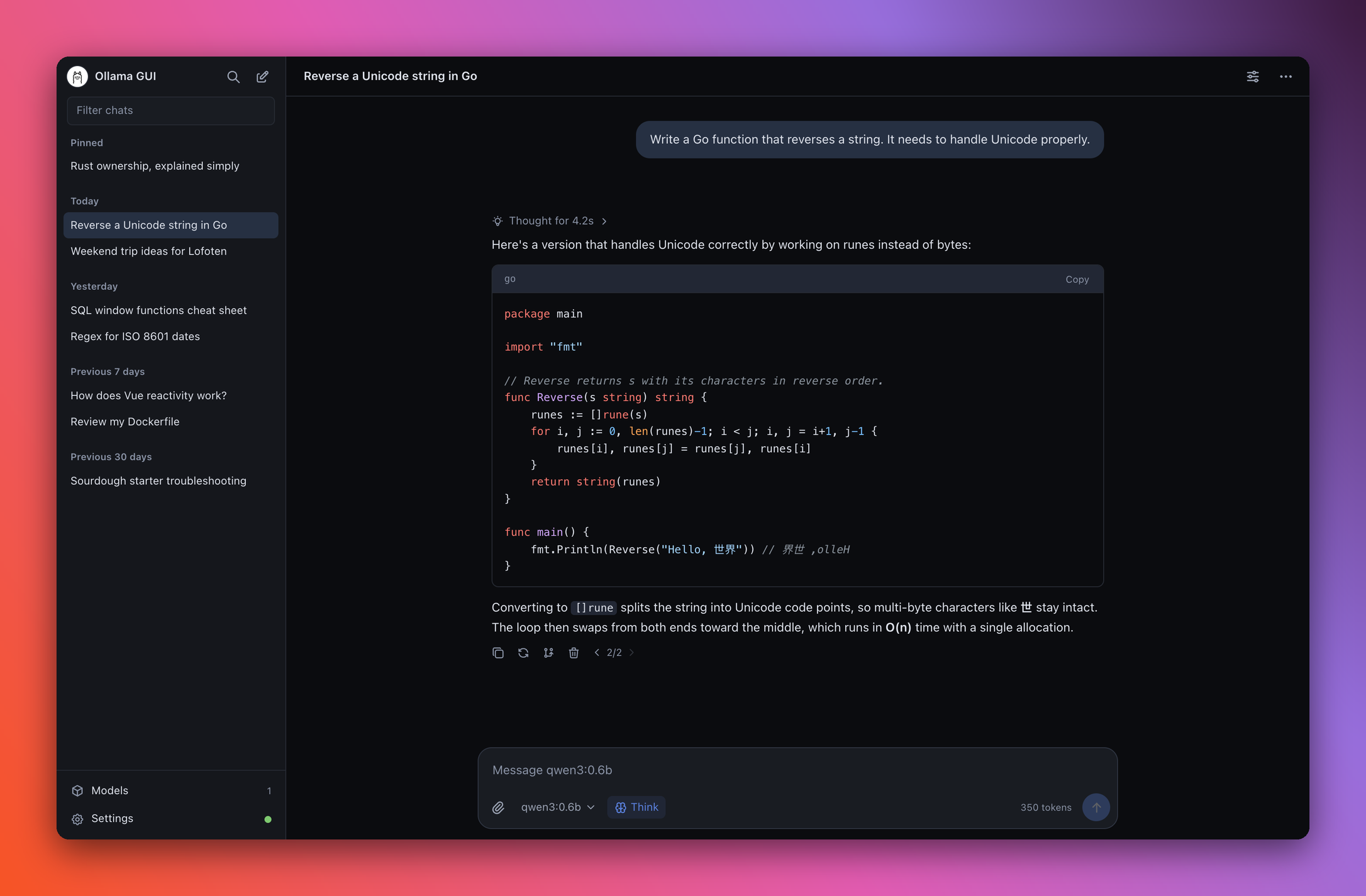
A web interface for chatting with local models through Ollama.



Ollama GUI is a single-page app that talks directly to the Ollama API from your browser. There is no backend of its own: chats are stored in the browser's IndexedDB and never leave your machine except to reach the Ollama server you point it at.
num_ctx, top_p, seed and others), set globally, per model or per chat.| Shortcut | Action |
|---|---|
⌘/Ctrl K | Search chats and messages, run commands |
⌘/Ctrl ⇧ O | New chat |
⌘/Ctrl ⇧ ⌫ | Delete the current chat |
Enter / ⇧ Enter | Send / new line |
Esc | Stop generating |
↑ (in an empty message box) | Edit your last message |
You need Ollama running, plus Bun and Node.js 20 or newer for development.
ollama pull llama3.2      # any model works; you can also pull from the app
ollama serve

git clone https://github.com/HelgeSverre/ollama-gui.git
cd ollama-gui
bun install
bun run dev               # http://localhost:5173
The dev server forwards /api to http://localhost:11434, so Ollama needs no CORS configuration. With bun run dev --host, other devices on your network can use the app as well. To use an Ollama instance elsewhere, set its URL under Settings → Connection, or start the dev server with VITE_NO_PROXY=true.
Plain HTTP LAN access supports chatting, history, imports, exports and copying text. Gravatar avatars, service-worker offline caching and requests for persistent storage require a secure context (HTTPS or localhost). Copying uses a legacy browser fallback on HTTP; if the browser blocks it, select and copy the text manually. HTTP does not encrypt your messages, so use HTTPS on untrusted networks.
IndexedDB is scoped to the exact origin the app is served from. localhost:5173, 127.0.0.1:5173, another port, another browser and a private window each have their own, separate history. For this reason the dev server always uses port 5173 and fails to start if the port is taken, rather than silently moving to another one. Use Settings → Data to export and import chats, or to ask the browser to keep the data persistently.
The hosted version runs in your browser and connects to your local Ollama. Allow its origin when starting Ollama:
OLLAMA_ORIGINS=https://ollama-gui.vercel.app ollama serve
If you use the Ollama desktop app on macOS instead, set the variable for apps and restart Ollama:
launchctl setenv OLLAMA_ORIGINS "https://ollama-gui.vercel.app"
Chrome and Edge also ask whether the site may access devices on your local network. Choose Allow. If you dismissed it, re-enable "Local network access" in the site settings next to the address bar.
The image serves the app with nginx and proxies /api to Ollama, so the browser only talks to one origin and OLLAMA_ORIGINS isn't needed.
# Ollama and the GUI together, at http://localhost:8080
docker compose up -d

# Only the GUI, using Ollama on the host machine
docker run -d -p 8080:80 --add-host=host.docker.internal:host-gateway ghcr.io/helgesverre/ollama-gui

# Only the GUI, using Ollama on another machine
docker run -d -p 8080:80 -e OLLAMA_URL=http://gpu-box:11434 ghcr.io/helgesverre/ollama-gui
OLLAMA_URL sets where nginx forwards API requests (default http://host.docker.internal:11434). Images are published for amd64 and arm64; tags follow releases (latest, 2.0.0, 2.0). To build your own, run docker build -t ollama-gui .. In compose.yml, uncomment the deploy block to give Ollama GPU access. Models are stored in ./ollama_data.
bun run build writes a static site to dist/. The browser must be able to reach Ollama, which you can arrange in one of two ways:
dist/ behind a reverse proxy that forwards /api/ to Ollama, and build with VITE_OLLAMA_URL=/. nginx/default.conf.template is a working example.VITE_OLLAMA_URL=https://ollama.example.com (users can also change it in Settings), and start Ollama with OLLAMA_ORIGINS=https://your-domain.com.bun run lint # ESLint
bun run test # Vitest unit and integration tests
bun run test:coverage # the same, with a coverage report
bun run test:e2e # Playwright, against a mocked Ollama API
bun run build # type-check and production build
e2e/real-ollama.spec.ts runs the attachment and vision flows against a real Ollama instead of the mock. It's skipped by default:
ollama pull qwen3-vl:2b && ollama pull qwen3:0.6b
OLLAMA_REAL=1 bun run test:e2e real-ollama
The model search uses a snapshot of the Ollama library in src/data/model-catalog.json, built with ollama-library-scraper. Refresh it with bun run catalog:update. The app itself never contacts ollama.com.
See CLAUDE.md for an overview of the code structure.
Built with Vue, Vite, Tailwind CSS, VueUse, Dexie, markdown-it, highlight.js, KaTeX and Tabler Icons.
2,020 followers · starred Mar 2025
1,427 followers · starred Jan 2024
84 followers · starred Apr 2026
302 followers · starred Oct 2023
A Web Interface for chatting with your local LLMs via the ollama API
See the code
A web interface for chatting with local models through Ollama.
Ollama GUI is a single-page app that talks directly to the Ollama API from your browser. There is no backend of its own: chats are stored in the browser's IndexedDB and never leave your machine except to reach the Ollama server you point it at.
num_ctx, top_p, seed and others), set globally, per model or per chat.| Shortcut | Action |
|---|---|
⌘/Ctrl K | Search chats and messages, run commands |
⌘/Ctrl ⇧ O | New chat |
⌘/Ctrl ⇧ ⌫ | Delete the current chat |
Enter / ⇧ Enter | Send / new line |
Esc | Stop generating |
↑ (in an empty message box) | Edit your last message |
You need Ollama running, plus Bun and Node.js 20 or newer for development.
ollama pull llama3.2      # any model works; you can also pull from the app
ollama serve

git clone https://github.com/HelgeSverre/ollama-gui.git
cd ollama-gui
bun install
bun run dev               # http://localhost:5173
The dev server forwards /api to http://localhost:11434, so Ollama needs no CORS configuration. With bun run dev --host, other devices on your network can use the app as well. To use an Ollama instance elsewhere, set its URL under Settings → Connection, or start the dev server with VITE_NO_PROXY=true.
Plain HTTP LAN access supports chatting, history, imports, exports and copying text. Gravatar avatars, service-worker offline caching and requests for persistent storage require a secure context (HTTPS or localhost). Copying uses a legacy browser fallback on HTTP; if the browser blocks it, select and copy the text manually. HTTP does not encrypt your messages, so use HTTPS on untrusted networks.
IndexedDB is scoped to the exact origin the app is served from. localhost:5173, 127.0.0.1:5173, another port, another browser and a private window each have their own, separate history. For this reason the dev server always uses port 5173 and fails to start if the port is taken, rather than silently moving to another one. Use Settings → Data to export and import chats, or to ask the browser to keep the data persistently.
The hosted version runs in your browser and connects to your local Ollama. Allow its origin when starting Ollama:
OLLAMA_ORIGINS=https://ollama-gui.vercel.app ollama serve
If you use the Ollama desktop app on macOS instead, set the variable for apps and restart Ollama:
launchctl setenv OLLAMA_ORIGINS "https://ollama-gui.vercel.app"
Chrome and Edge also ask whether the site may access devices on your local network. Choose Allow. If you dismissed it, re-enable "Local network access" in the site settings next to the address bar.
The image serves the app with nginx and proxies /api to Ollama, so the browser only talks to one origin and OLLAMA_ORIGINS isn't needed.
# Ollama and the GUI together, at http://localhost:8080
docker compose up -d

# Only the GUI, using Ollama on the host machine
docker run -d -p 8080:80 --add-host=host.docker.internal:host-gateway ghcr.io/helgesverre/ollama-gui

# Only the GUI, using Ollama on another machine
docker run -d -p 8080:80 -e OLLAMA_URL=http://gpu-box:11434 ghcr.io/helgesverre/ollama-gui
OLLAMA_URL sets where nginx forwards API requests (default http://host.docker.internal:11434). Images are published for amd64 and arm64; tags follow releases (latest, 2.0.0, 2.0). To build your own, run docker build -t ollama-gui .. In compose.yml, uncomment the deploy block to give Ollama GPU access. Models are stored in ./ollama_data.
bun run build writes a static site to dist/. The browser must be able to reach Ollama, which you can arrange in one of two ways:
dist/ behind a reverse proxy that forwards /api/ to Ollama, and build with VITE_OLLAMA_URL=/. nginx/default.conf.template is a working example.VITE_OLLAMA_URL=https://ollama.example.com (users can also change it in Settings), and start Ollama with OLLAMA_ORIGINS=https://your-domain.com.bun run lint # ESLint
bun run test # Vitest unit and integration tests
bun run test:coverage # the same, with a coverage report
bun run test:e2e # Playwright, against a mocked Ollama API
bun run build # type-check and production build
e2e/real-ollama.spec.ts runs the attachment and vision flows against a real Ollama instead of the mock. It's skipped by default:
ollama pull qwen3-vl:2b && ollama pull qwen3:0.6b
OLLAMA_REAL=1 bun run test:e2e real-ollama
The model search uses a snapshot of the Ollama library in src/data/model-catalog.json, built with ollama-library-scraper. Refresh it with bun run catalog:update. The app itself never contacts ollama.com.
See CLAUDE.md for an overview of the code structure.
Built with Vue, Vite, Tailwind CSS, VueUse, Dexie, markdown-it, highlight.js, KaTeX and Tabler Icons.
2,020 followers · starred Mar 2025
1,427 followers · starred Jan 2024
84 followers · starred Apr 2026
302 followers · starred Oct 2023



