An official implementation of "Towards Federated RLHF with Aggregated Client Preference for LLMs," which is accepted by ICLR'25.
Python
9
796 commits
updated Mar 3, 2025




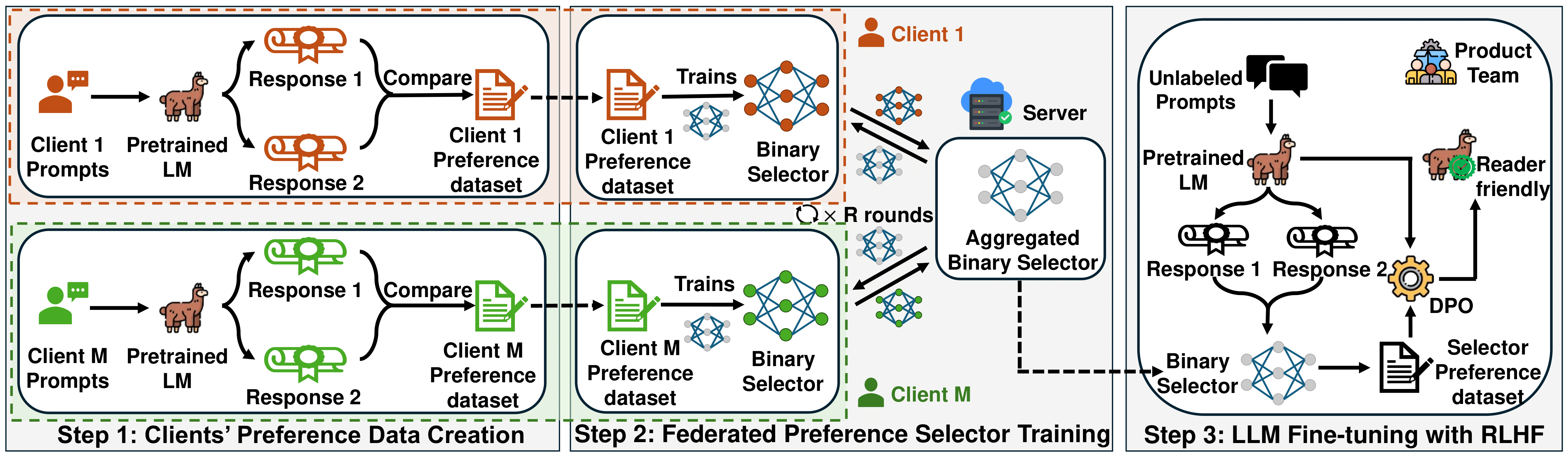
FedBis/FedBiscuit is a federated learning framework that enables reinforcement learning with human feedback (RLHF) for large language models (LLMs) without compromising user privacy. This codebase—forked from FederatedScope and FedBiOT—supports bfloat16 precision and MultiGPU training.
Key Features:
Why FedBis/FedBiscuit?
Before you run the code, set up your environment and install FS-LLM (which is integrated into this repository). Follow these steps:
Create a Conda Environment:
conda create -n fs-llm python=3.9
conda activate fs-llm
Install PyTorch (>=1.13.0):
conda install pytorch==2.0.0 torchvision==0.15.0 torchaudio==2.0.0 pytorch-cuda=11.7 -c pytorch -c nvidia
Install FS-LLM in Editable Mode:
pip install -e .[llm]
You are now ready to use FS-LLM.
The training process is divided into two phases:
Prepare the Configuration File:
Create a YAML file (e.g., fedbiscuit_script/tldr/tldr_choice_gemma_fedbiscuit_u3.yaml) with the settings for your task. An example configuration is shown below:
# Whether to use GPU
use_gpu: True

# Deciding which GPU to use
device: 0

# Early stop steps, set `0` to disable
early_stop:
  patience: 0

# Federate learning setting for TLDR task
federate:
  mode: standalone
  client_num: 53
  # Number of clients sampled per round
  sample_client_num: 5
  # Number of communication round
  total_round_num: 500
  # Saving path for checkpoinnt
  save_to: "checkpoints/tldr_choice_gemma_fedbiscuit_u3.ckpt"
  ignore_weight: True
  save_freq: 50
  share_local_model: True
  online_aggr: False

# Dataset for TLDR task (selector training phase)
data:
  root: data/
  type: 'reddit-tldr-comparison-choice@llm'
  splits: [0.9,0.09,0.01]
  splitter: 'meta'

# LLM related options
llm:
  tok_len: 1024
  # Gradient accumulation steps
  grad_accum_step: 2
  chat:
    max_len: 1024
  adapter:
    use: True
    args: [ { 'adapter_package': 'peft', 'adapter_method': 'lora', 'r': 8, 'lora_alpha': 16, 'lora_dropout': 0.05 } ]

    # skip the following setting for FedBis
    count: 3
    warmup:
      use: True
      round: 50
    grouping:
      use: True
      round: 50

# DataLoader related options
dataloader:
  # Batch size for iter loader (for a single update, the actual batch size is batch_size*grad_accum_step)
  batch_size: 8

# Model related options
model:
  # Model type (format: {MODEL_REPO}@huggingface_llm)
  type: 'google/gemma-2b@huggingface_llm'

# Training related options for a binary selector
train:
  # Number of local update steps
  local_update_steps: 30
  batch_or_epoch: batch
  optimizer:
    type: AdamW
    betas: (0.9, 0.95)
    lr: 0.00001
  is_enable_half: True
criterion:
  type: CrossEntropyLoss
trainer:
  type: llmrewardchoicetrainer
  choices: ['A', 'B']
eval:
  freq: 50
  metrics: ['loss', 'acc']
  best_res_update_round_wise_key: test_loss
  count_flops: False

# Specify the path to store the experimental results
expname: tldr/choice_gemma/fedbiscuit_u3
Run the Training Script:
Execute the training with your configuration:
CUDA_LAUNCH_BLOCKING=1 CUDA_VISIBLE_DEVICES=0 \
PYTORCH_CUDA_ALLOC_CONF=expandable_segments:True python federatedscope/main.py --cfg fedbiscuit_script/tldr/tldr_choice_gemma_fedbiscuit_u3.yaml
To enable multi-GPU training with Accelerate, run:
CUDA_LAUNCH_BLOCKING=1 CUDA_VISIBLE_DEVICES=0,1 PYTORCH_CUDA_ALLOC_CONF=expandable_segments:True \
accelerate launch --config_file fedbiscuit_script/accelerator_config_bf16.yaml federatedscope/main.py \
--cfg fedbiscuit_script/tldr/tldr_choice_gemma_fedbiscuit_u3.yaml llm.accelerator.use True
Prepare the Fine-tuning YAML File:
Create a YAML file (e.g., fedbiscuit_script/tldr/tldr_rlhf_fedbiscuit_gemma.yaml) for RLHF fine-tuning. An example configuration is:
# Whether to use GPU
use_gpu: True

# Deciding which GPU to use
device: 0

# Early stop steps, set `0` to disable
early_stop:
  patience: 0

# Federate learning related options
federate:
  mode: standalone
  client_num: 1
  total_round_num: 150
  # Replace <choice_ckpt> with a stored federated preference selector
  save_to: "checkpoints/tldr_rlhf_gemma_<choice_ckpt>.ckpt"
  save_freq: 50
  share_local_model: True
  online_aggr: False

# Dataset for TLDR task (RLHF phase)
data:
  root: data/
  type: 'reddit-tldr-rlhf@llm'
  splits: [0.9,0.09,0.01]
  splitter: 'iid'

# RLHF Fine-tuning related options
llm:
  rlhf: True
  tok_len: 1024
  max_new_token: 80
  chat:
    max_len: 1024
  adapter:
    use: True
    args: [ { 'adapter_package': 'peft', 'adapter_method': 'lora', 'r': 8, 'lora_alpha': 16, 'lora_dropout': 0.05 } ]
  # DPO beta value
  reward_coeff: 0.1
  # Gradient accumulation steps
  grad_accum_step: 8

# DataLoader related options
dataloader:
  # Batch size for iter loader (for a single update, the actual batch size is batch_size*grad_accum_step)
  batch_size: 4

# Model related options
model:
  # Model type (format: {MODEL_REPO}@huggingface_llm)
  type: 'mlabonne/Gemmalpaca-2B@huggingface_llm'

# Training related options for a binary selector
train:
  local_update_steps: 30
  batch_or_epoch: batch
  optimizer:
    type: RMSprop
    lr: 0.000001
  is_enable_half: True
criterion:
  type: CrossEntropyLoss
trainer:
  type: llmrewardtrainer
eval:
  freq: 50
  metrics: ['loss', 'acc']
  best_res_update_round_wise_key: val_loss
  count_flops: False

# Specify the path to store the experimental results, replace <choice_ckpt> with a stored federated preference selector
expname: tldr/rlhf_gemma/<choice_ckpt>
Run the RLHF Fine-tuning Script:
Use the selector configuration file from Phase 1 (e.g., fedbiscuit_script/tldr/tldr_choice_gemma_fedbiscuit_u3.yaml) as an argument:
CUDA_LAUNCH_BLOCKING=1 CUDA_VISIBLE_DEVICES=0 \
PYTORCH_CUDA_ALLOC_CONF=expandable_segments:True python federatedscope/llm/rlhf/main.py \
--selector-cfg-file fedbiscuit_script/tldr/tldr_choice_gemma_fedbiscuit_u3.yaml \
--cfg fedbiscuit_script/tldr/tldr_rlhf_fedbiscuit_gemma.yaml llm.accelerator.use True \
federate.save_to checkpoints/tldr_rlhf_gemma__tldr_choice_gemma_fedbiscuit_u3.ckpt \
expname tldr/rlhf_gemma/tldr_choice_gemma_fedbiscuit_u3
For multi-GPU training, use:
CUDA_LAUNCH_BLOCKING=1 CUDA_VISIBLE_DEVICES=0,1 PYTORCH_CUDA_ALLOC_CONF=expandable_segments:True \
accelerate launch --config_file fedbiscuit_script/accelerator_config_bf16.yaml federatedscope/llm/rlhf/main.py \
--selector-cfg-file fedbiscuit_script/tldr/tldr_choice_gemma_fedbiscuit_u3.yaml \
--cfg fedbiscuit_script/tldr/tldr_rlhf_fedbiscuit_gemma.yaml llm.accelerator.use True \
federate.save_to checkpoints/tldr_rlhf_gemma__tldr_choice_gemma_fedbiscuit_u3.ckpt \
expname tldr/rlhf_gemma/tldr_choice_gemma_fedbiscuit_u3
Evaluation procedures vary with the task. Here are the two main setups:
Run Summarization Evaluation on Different Checkpoints:
Replace the checkpoint file name in the command accordingly.
# Evaluation at 50 rounds:
CUDA_LAUNCH_BLOCKING=1 CUDA_VISIBLE_DEVICES=0 \
PYTORCH_CUDA_ALLOC_CONF=expandable_segments:True python federatedscope/llm/eval/eval_for_tldr/eval_summarization.py \
--selector-cfg-file fedbiscuit_script/tldr/tldr_choice_gemma_fedbiscuit_u3.yaml \
--cfg fedbiscuit_script/tldr/tldr_rlhf_fedbiscuit_gemma.yaml llm.accelerator.use False \
federate.save_to checkpoints/50_tldr_rlhf_gemma__tldr_choice_gemma_fedbiscuit_u3.ckpt \
expname eval_tldr/rlhf_gemma/tldr_choice_gemma_fedbiscuit_u3 train.is_enable_half True
Run Auto-J Evaluation:
To compare generated summaries with human annotations:
CUDA_LAUNCH_BLOCKING=1 CUDA_VISIBLE_DEVICES=0 \
PYTORCH_CUDA_ALLOC_CONF=expandable_segments:True python federatedscope/llm/eval/eval_for_tldr/auto_j_vllm.py \
--model-outputs-directory exp/tldr/rlhf_gemma/tldr_choice_gemma_fedbiscuit_u3/_summarization.txt --pairwise
CUDA_LAUNCH_BLOCKING=1 CUDA_VISIBLE_DEVICES=0 \
PYTORCH_CUDA_ALLOC_CONF=expandable_segments:True python federatedscope/llm/eval/eval_for_AlpacaEval/eval_winrate.py \
--cfg fedbiscuit_script/shp/shp_rlhf_fedbiscuit_gemma.yaml federate.saveto {checkpoint_name} \
llm.accelerator.use False expname eval_shp/rlhf_gemma/{checkpoint_name}
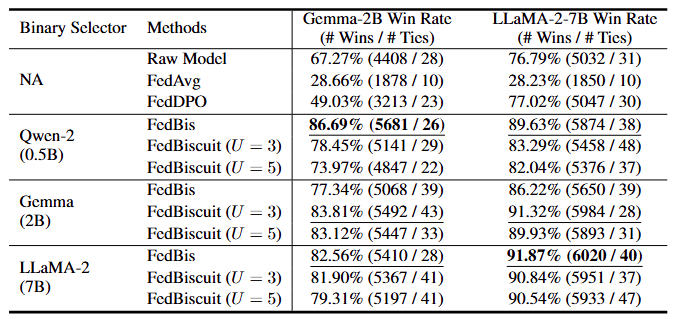
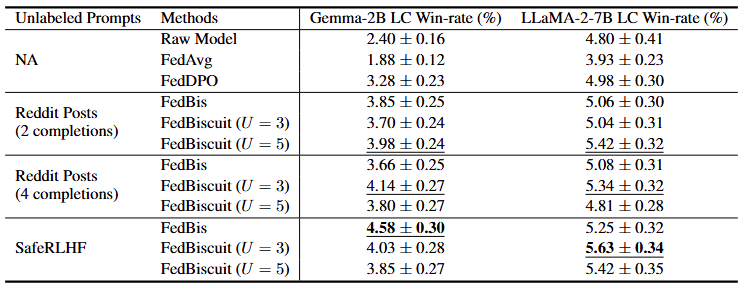
alpaca_eval.json file will be generated. You can then use GPT-4-turbo to compare the outputs.The figures below are the results as reported in our paper:
TLDR Summarization:
SHP QA:
If you use FedBis/FedBiscuit in your research, please cite our work as follows:
@inproceedings{wu2025towards,
  title={Towards Federated RLHF with Aggregated Client Preference for LLMs},
  author={Wu, Feijie and Liu, Xiaoze and Wang, Haoyu and Wang, Xingchen and Su, Lu and Gao, Jing},
  booktitle={The Thirteenth International Conference on Learning Representations},
  year={2025}
}

@inproceedings{wu2024fedbiot,
  author = {Wu, Feijie and Li, Zitao and Li, Yaliang and Ding, Bolin and Gao, Jing},
  title = {FedBiOT: LLM Local Fine-tuning in Federated Learning without Full Model},
  year = {2024},
  booktitle = {Proceedings of the 30th ACM SIGKDD Conference on Knowledge Discovery and Data Mining},
  pages = {3345–3355}
}

@inproceedings{kuang2024federatedscope,
  author = {Kuang, Weirui and Qian, Bingchen and Li, Zitao and Chen, Daoyuan and Gao, Dawei and Pan, Xuchen and Xie, Yuexiang and Li, Yaliang and Ding, Bolin and Zhou, Jingren},
  title = {FederatedScope-LLM: A Comprehensive Package for Fine-tuning Large Language Models in Federated Learning},
  year = {2024},
  booktitle = {Proceedings of the 30th ACM SIGKDD Conference on Knowledge Discovery and Data Mining},
  pages = {5260–5271}
}

@article{federatedscope,
  title = {FederatedScope: A Flexible Federated Learning Platform for Heterogeneity},
  author = {Xie, Yuexiang and Wang, Zhen and Gao, Dawei and Chen, Daoyuan and Yao, Liuyi and Kuang, Weirui and Li, Yaliang and Ding, Bolin and Zhou, Jingren},
  journal={Proceedings of the VLDB Endowment},
  volume={16},
  number={5},
  pages={1059--1072},
  year={2023}
}
An official implementation of "Towards Federated RLHF with Aggregated Client Preference for LLMs," which is accepted by ICLR'25.
Python
9
796 commits
updated Mar 3, 2025
FedBis/FedBiscuit is a federated learning framework that enables reinforcement learning with human feedback (RLHF) for large language models (LLMs) without compromising user privacy. This codebase—forked from FederatedScope and FedBiOT—supports bfloat16 precision and MultiGPU training.
Key Features:
Why FedBis/FedBiscuit?
Before you run the code, set up your environment and install FS-LLM (which is integrated into this repository). Follow these steps:
Create a Conda Environment:
conda create -n fs-llm python=3.9
conda activate fs-llm
Install PyTorch (>=1.13.0):
conda install pytorch==2.0.0 torchvision==0.15.0 torchaudio==2.0.0 pytorch-cuda=11.7 -c pytorch -c nvidia
Install FS-LLM in Editable Mode:
pip install -e .[llm]
You are now ready to use FS-LLM.
The training process is divided into two phases:
Prepare the Configuration File:
Create a YAML file (e.g., fedbiscuit_script/tldr/tldr_choice_gemma_fedbiscuit_u3.yaml) with the settings for your task. An example configuration is shown below:
# Whether to use GPU
use_gpu: True

# Deciding which GPU to use
device: 0

# Early stop steps, set `0` to disable
early_stop:
  patience: 0

# Federate learning setting for TLDR task
federate:
  mode: standalone
  client_num: 53
  # Number of clients sampled per round
  sample_client_num: 5
  # Number of communication round
  total_round_num: 500
  # Saving path for checkpoinnt
  save_to: "checkpoints/tldr_choice_gemma_fedbiscuit_u3.ckpt"
  ignore_weight: True
  save_freq: 50
  share_local_model: True
  online_aggr: False

# Dataset for TLDR task (selector training phase)
data:
  root: data/
  type: 'reddit-tldr-comparison-choice@llm'
  splits: [0.9,0.09,0.01]
  splitter: 'meta'

# LLM related options
llm:
  tok_len: 1024
  # Gradient accumulation steps
  grad_accum_step: 2
  chat:
    max_len: 1024
  adapter:
    use: True
    args: [ { 'adapter_package': 'peft', 'adapter_method': 'lora', 'r': 8, 'lora_alpha': 16, 'lora_dropout': 0.05 } ]

    # skip the following setting for FedBis
    count: 3
    warmup:
      use: True
      round: 50
    grouping:
      use: True
      round: 50

# DataLoader related options
dataloader:
  # Batch size for iter loader (for a single update, the actual batch size is batch_size*grad_accum_step)
  batch_size: 8

# Model related options
model:
  # Model type (format: {MODEL_REPO}@huggingface_llm)
  type: 'google/gemma-2b@huggingface_llm'

# Training related options for a binary selector
train:
  # Number of local update steps
  local_update_steps: 30
  batch_or_epoch: batch
  optimizer:
    type: AdamW
    betas: (0.9, 0.95)
    lr: 0.00001
  is_enable_half: True
criterion:
  type: CrossEntropyLoss
trainer:
  type: llmrewardchoicetrainer
  choices: ['A', 'B']
eval:
  freq: 50
  metrics: ['loss', 'acc']
  best_res_update_round_wise_key: test_loss
  count_flops: False

# Specify the path to store the experimental results
expname: tldr/choice_gemma/fedbiscuit_u3
Run the Training Script:
Execute the training with your configuration:
CUDA_LAUNCH_BLOCKING=1 CUDA_VISIBLE_DEVICES=0 \
PYTORCH_CUDA_ALLOC_CONF=expandable_segments:True python federatedscope/main.py --cfg fedbiscuit_script/tldr/tldr_choice_gemma_fedbiscuit_u3.yaml
To enable multi-GPU training with Accelerate, run:
CUDA_LAUNCH_BLOCKING=1 CUDA_VISIBLE_DEVICES=0,1 PYTORCH_CUDA_ALLOC_CONF=expandable_segments:True \
accelerate launch --config_file fedbiscuit_script/accelerator_config_bf16.yaml federatedscope/main.py \
--cfg fedbiscuit_script/tldr/tldr_choice_gemma_fedbiscuit_u3.yaml llm.accelerator.use True
Prepare the Fine-tuning YAML File:
Create a YAML file (e.g., fedbiscuit_script/tldr/tldr_rlhf_fedbiscuit_gemma.yaml) for RLHF fine-tuning. An example configuration is:
# Whether to use GPU
use_gpu: True

# Deciding which GPU to use
device: 0

# Early stop steps, set `0` to disable
early_stop:
  patience: 0

# Federate learning related options
federate:
  mode: standalone
  client_num: 1
  total_round_num: 150
  # Replace <choice_ckpt> with a stored federated preference selector
  save_to: "checkpoints/tldr_rlhf_gemma_<choice_ckpt>.ckpt"
  save_freq: 50
  share_local_model: True
  online_aggr: False

# Dataset for TLDR task (RLHF phase)
data:
  root: data/
  type: 'reddit-tldr-rlhf@llm'
  splits: [0.9,0.09,0.01]
  splitter: 'iid'

# RLHF Fine-tuning related options
llm:
  rlhf: True
  tok_len: 1024
  max_new_token: 80
  chat:
    max_len: 1024
  adapter:
    use: True
    args: [ { 'adapter_package': 'peft', 'adapter_method': 'lora', 'r': 8, 'lora_alpha': 16, 'lora_dropout': 0.05 } ]
  # DPO beta value
  reward_coeff: 0.1
  # Gradient accumulation steps
  grad_accum_step: 8

# DataLoader related options
dataloader:
  # Batch size for iter loader (for a single update, the actual batch size is batch_size*grad_accum_step)
  batch_size: 4

# Model related options
model:
  # Model type (format: {MODEL_REPO}@huggingface_llm)
  type: 'mlabonne/Gemmalpaca-2B@huggingface_llm'

# Training related options for a binary selector
train:
  local_update_steps: 30
  batch_or_epoch: batch
  optimizer:
    type: RMSprop
    lr: 0.000001
  is_enable_half: True
criterion:
  type: CrossEntropyLoss
trainer:
  type: llmrewardtrainer
eval:
  freq: 50
  metrics: ['loss', 'acc']
  best_res_update_round_wise_key: val_loss
  count_flops: False

# Specify the path to store the experimental results, replace <choice_ckpt> with a stored federated preference selector
expname: tldr/rlhf_gemma/<choice_ckpt>
Run the RLHF Fine-tuning Script:
Use the selector configuration file from Phase 1 (e.g., fedbiscuit_script/tldr/tldr_choice_gemma_fedbiscuit_u3.yaml) as an argument:
CUDA_LAUNCH_BLOCKING=1 CUDA_VISIBLE_DEVICES=0 \
PYTORCH_CUDA_ALLOC_CONF=expandable_segments:True python federatedscope/llm/rlhf/main.py \
--selector-cfg-file fedbiscuit_script/tldr/tldr_choice_gemma_fedbiscuit_u3.yaml \
--cfg fedbiscuit_script/tldr/tldr_rlhf_fedbiscuit_gemma.yaml llm.accelerator.use True \
federate.save_to checkpoints/tldr_rlhf_gemma__tldr_choice_gemma_fedbiscuit_u3.ckpt \
expname tldr/rlhf_gemma/tldr_choice_gemma_fedbiscuit_u3
For multi-GPU training, use:
CUDA_LAUNCH_BLOCKING=1 CUDA_VISIBLE_DEVICES=0,1 PYTORCH_CUDA_ALLOC_CONF=expandable_segments:True \
accelerate launch --config_file fedbiscuit_script/accelerator_config_bf16.yaml federatedscope/llm/rlhf/main.py \
--selector-cfg-file fedbiscuit_script/tldr/tldr_choice_gemma_fedbiscuit_u3.yaml \
--cfg fedbiscuit_script/tldr/tldr_rlhf_fedbiscuit_gemma.yaml llm.accelerator.use True \
federate.save_to checkpoints/tldr_rlhf_gemma__tldr_choice_gemma_fedbiscuit_u3.ckpt \
expname tldr/rlhf_gemma/tldr_choice_gemma_fedbiscuit_u3
Evaluation procedures vary with the task. Here are the two main setups:
Run Summarization Evaluation on Different Checkpoints:
Replace the checkpoint file name in the command accordingly.
# Evaluation at 50 rounds:
CUDA_LAUNCH_BLOCKING=1 CUDA_VISIBLE_DEVICES=0 \
PYTORCH_CUDA_ALLOC_CONF=expandable_segments:True python federatedscope/llm/eval/eval_for_tldr/eval_summarization.py \
--selector-cfg-file fedbiscuit_script/tldr/tldr_choice_gemma_fedbiscuit_u3.yaml \
--cfg fedbiscuit_script/tldr/tldr_rlhf_fedbiscuit_gemma.yaml llm.accelerator.use False \
federate.save_to checkpoints/50_tldr_rlhf_gemma__tldr_choice_gemma_fedbiscuit_u3.ckpt \
expname eval_tldr/rlhf_gemma/tldr_choice_gemma_fedbiscuit_u3 train.is_enable_half True
Run Auto-J Evaluation:
To compare generated summaries with human annotations:
CUDA_LAUNCH_BLOCKING=1 CUDA_VISIBLE_DEVICES=0 \
PYTORCH_CUDA_ALLOC_CONF=expandable_segments:True python federatedscope/llm/eval/eval_for_tldr/auto_j_vllm.py \
--model-outputs-directory exp/tldr/rlhf_gemma/tldr_choice_gemma_fedbiscuit_u3/_summarization.txt --pairwise
CUDA_LAUNCH_BLOCKING=1 CUDA_VISIBLE_DEVICES=0 \
PYTORCH_CUDA_ALLOC_CONF=expandable_segments:True python federatedscope/llm/eval/eval_for_AlpacaEval/eval_winrate.py \
--cfg fedbiscuit_script/shp/shp_rlhf_fedbiscuit_gemma.yaml federate.saveto {checkpoint_name} \
llm.accelerator.use False expname eval_shp/rlhf_gemma/{checkpoint_name}
alpaca_eval.json file will be generated. You can then use GPT-4-turbo to compare the outputs.The figures below are the results as reported in our paper:
TLDR Summarization:
SHP QA:
If you use FedBis/FedBiscuit in your research, please cite our work as follows:
@inproceedings{wu2025towards,
  title={Towards Federated RLHF with Aggregated Client Preference for LLMs},
  author={Wu, Feijie and Liu, Xiaoze and Wang, Haoyu and Wang, Xingchen and Su, Lu and Gao, Jing},
  booktitle={The Thirteenth International Conference on Learning Representations},
  year={2025}
}

@inproceedings{wu2024fedbiot,
  author = {Wu, Feijie and Li, Zitao and Li, Yaliang and Ding, Bolin and Gao, Jing},
  title = {FedBiOT: LLM Local Fine-tuning in Federated Learning without Full Model},
  year = {2024},
  booktitle = {Proceedings of the 30th ACM SIGKDD Conference on Knowledge Discovery and Data Mining},
  pages = {3345–3355}
}

@inproceedings{kuang2024federatedscope,
  author = {Kuang, Weirui and Qian, Bingchen and Li, Zitao and Chen, Daoyuan and Gao, Dawei and Pan, Xuchen and Xie, Yuexiang and Li, Yaliang and Ding, Bolin and Zhou, Jingren},
  title = {FederatedScope-LLM: A Comprehensive Package for Fine-tuning Large Language Models in Federated Learning},
  year = {2024},
  booktitle = {Proceedings of the 30th ACM SIGKDD Conference on Knowledge Discovery and Data Mining},
  pages = {5260–5271}
}

@article{federatedscope,
  title = {FederatedScope: A Flexible Federated Learning Platform for Heterogeneity},
  author = {Xie, Yuexiang and Wang, Zhen and Gao, Dawei and Chen, Daoyuan and Yao, Liuyi and Kuang, Weirui and Li, Yaliang and Ding, Bolin and Zhou, Jingren},
  journal={Proceedings of the VLDB Endowment},
  volume={16},
  number={5},
  pages={1059--1072},
  year={2023}
}



