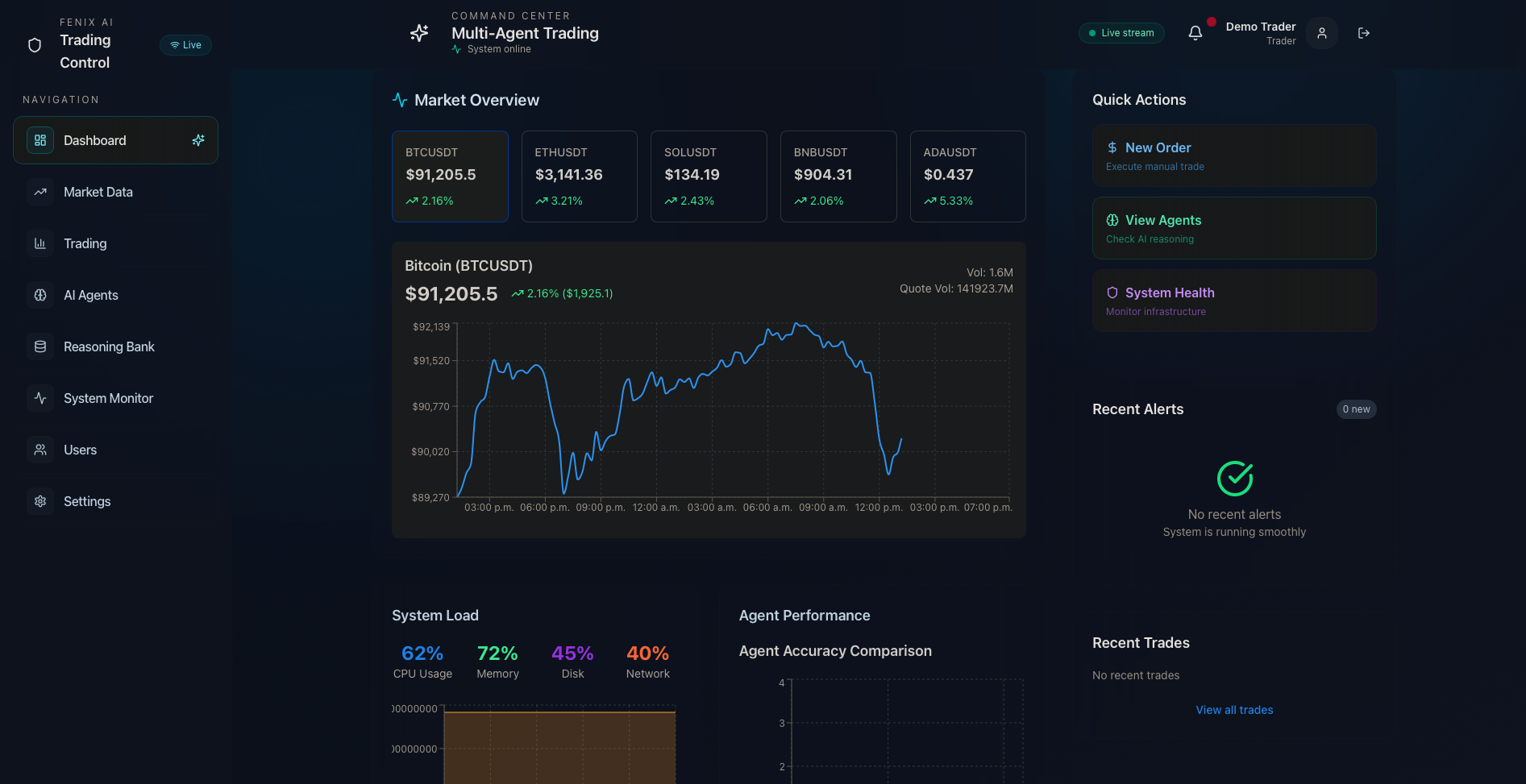
Fenix Ai Trading Bot with LangGraph and ollama and multipe providers
See the code




An advanced trading system powered by multiple specialized AI agents that collaborate to analyze markets, manage risk, and execute trades on Binance Futures. Features ReasoningBank memory system for self-evolving agent capabilities.
[!WARNING]
🛡️ FenixAI is 100% free and open source — beware of scams
FenixAI is free software released under the Apache 2.0 license. Nobody sells it, licenses it, or charges for access. If anyone asks you to pay, "activate" a copy, join a paid group, or deposit funds into any wallet or exchange account to "unlock" Fenix, it is a scam impersonating this project — do not send them anything.
The only official channels are:
- 📦 This repository: github.com/Ganador1/FenixAI_tradingBot
- ☕ The project's official Ko-fi: ko-fi.com/ganador
- ✉️ Private contact: [email protected]
There are no official Telegram groups, Discord servers, paid signal channels, or "resellers". Anything else claiming to be FenixAI is not us.
⚠️ WARNING: Fenix is under active development, is not yet proven profitable, and may not work as expected. Use at your own risk. Paper trading is strongly recommended before any live deployment.
It has been a few months since v2.0. I've been testing the project 24/7 and brainstorming ways to make Fenix more reliable and capable of making better trades. After extensive testing, I am including in this v2.5 release the changes that have made a real, quantifiable impact on performance.
Among these improvements are the removal of the Sentiment agent, as well as refining the entry and exit logic with new rules, better indicators, and improved timing for decisions. Another upgrade that has provided a massive boost is Nanofenix, which introduces a classical ML model with live training. It acts as a strict filter for trades—preventing us from entering too early or too late—and improves the overall win rate by analyzing more input layers. Fenix now executes fewer trades, but the system is much safer and more confident when deciding on an entry or exit.
The Sentiment agent has been reactivated with broader macro context, bounded source handling, and deterministic risk controls. Private evaluation prompts, event-level outputs, and operator-specific thresholds are not published.
The new Sentiment stack fixes the root cause:
src/tools/macro_news.py): world-news RSS feeds (BBC, Al Jazeera, CNBC) filtered by high-impact keywords with word-boundary matching and a severe/high severity classifier. Fresh high-impact headlines are injected into the sentiment prompt ahead of crypto news."20 (yesterday 27, change -7)" instead of a bare number — a sharp drop flags an active macro shock with causal context.I will keep testing and improving Fenix. I know I don't push commits very often, but I strongly prefer to test everything exhaustively in a local environment before sharing my findings with you all, just to ensure everything is perfect.
This version will be available as a new Release. If you prefer to revert to v2.0 (which is highly stable), you will still be able to do so.
Thank you all so much for your massive support!
Ganador
Data-integrity release — v2.6 is built around one flagship discovery and fix: live indicators were being computed on partial-candle snapshots instead of closed candles. Everything else hardens the stack around it: smarter NanoFenix self-monitoring, a rebuilt vision pipeline, prompt-injection defenses, and a dashboard that finally shows why the engine did (or didn't) trade.
| Fix | Details |
|---|---|
| Closed-candle indicator buffer | Indicators use closed candles while partial updates refresh market price only. |
| REST candle backfill on startup | The indicator buffer is seeded with the last ~60 closed candles before the WebSocket starts (FENIX_KLINE_BACKFILL_LIMIT), so the very first analysis cycle works with a real series instead of warming up on ticks. |
| Entry-filter observability | Every blocked entry now logs its exact reason (MTF veto, directional score, min confidence, cooldown…) instead of only emitting a silent frontend event. |
| Order reconciliation | Ambiguous order outcomes fail closed and are reconciled before another action is attempted. |
| Feature | Details |
|---|---|
| Drift-triggered retraining | Page-Hinkley test on normalized forecast error forces an early retrain when the market shifts, instead of waiting for the fixed retrain cadence. A post-retrain cooldown prevents echo firing. |
| Per-regime meta-labeling | Signal success is tracked per market regime (TRENDING / CHOP / VOLATILE / DEAD) with exponential decay; the meta-probability gate tightens only in regimes where the signal historically fails. |
| Safeguards composing | Drift detection and retrain-quality gates are evaluated together before replacing an active model. |
| Honest telemetry | drift_retrain_count, regime_meta_prob and regime sample counts are reported even on HOLD signals, and surfaced in the dashboard. |
| Fix | Details |
|---|---|
| Prompt formatting bug | The visual prompt contained a literal JSON example with unescaped braces — str.format() crashed before the image ever reached the model. |
| Chart generator accuracy | The chart labeled an SMA 50 as "EMA 50", had no pivot overlay, and drew a false vertical line from SuperTrend warmup zeros. Now: true EMA 50, R3..S3 pivot levels, NaN warmup. |
| Chart metadata in the prompt | The vision model receives the real candle count plus numeric EMA/Bollinger/VWAP/SuperTrend/pivot values alongside the image. |
| Compact JSON contract | Single-line, ~300-char response schema with a raised token budget — eliminates truncated-JSON retry loops. |
src/security/prompt_sanitizer.py) and the sentiment prompt is instructed to never follow instructions embedded in it.approved_size is explicitly USD notional in the risk prompt, with an automatic base-asset→notional conversion guard in the engine.REDIS_URL), external companions are detected (no duplicate spawns), and previously-dropped events (filters, positions, trades, NanoFenix policy) are now forwarded.Reliability-focused release — v2.5 brings short-timeframe latency work, a complete performance optimisation pass, NanoFenix v3.5 as a first-class companion signal, DeepSeek v4 cloud experiments, and a full suite of live/paper reliability fixes.
| Improvement | Details |
|---|---|
| Hot-path nonblocking (1m/3m/5m) | Critical path cycle dropped from ~140 ms → ~10–13 ms. Technical and QABBA agents resolve cache/fallback before building prompts; LLM refreshes run in background. |
| Paper mode no-REST | Paper trades no longer initialise BinanceService for balance; uses FENIX_BALANCE_FALLBACK_USDT to avoid ~1 s spikes per simulated trade. |
| Parallel agent graph | Technical, QABBA, Sentiment, and Visual run in true parallel via LangGraph; background caches for charts, news, and balance. |
| Deterministic risk mode | FENIX_RISK_DETERMINISTIC=1 skips the Risk LLM entirely and computes ATR-based SL/TP/size — 15m full pipeline now runs in ~15 s (was ~57 s). |
| Fix | Details |
|---|---|
| Live position hydration | On restart, if Binance already has an open position, the engine hydrates local state before assuming the account is flat — prevents duplicate entries. |
| Invalid-price guard | Paper trade:simulated events and hybrid runner reject signals with price = 0.0 before logging position transitions. |
| Algo protective order verification | Order monitor now also checks openAlgoOrders (Binance 3xxxxxxx IDs), fixing false PROTECTION_NOT_VERIFIED alerts. |
| Failed execution risk isolation | Failed live execution attempts no longer count as realized losing trades in the RuntimeRiskManager loss-streak counter. |
| Direction-aware SL/TP validation | Risk agent validates SL is on the correct side of entry; example-copied BTC-like levels for SOL are replaced with deterministic ATR levels before execution. |
| Same-side entry prevention | Engine skips same-side entries after hydration; FENIX_ALLOW_ADD_TO_POSITION=1 enables intentional pyramiding. |
| Feature | Details |
|---|---|
| Adaptive fusion | ENABLE_ADAPTIVE_FUSION=1 — multi-horizon blending adapts weights based on per-horizon calibration instead of fixed 0.4/0.6 split. |
| Fee-aware trailing | MIN_TRAILING_NET_PCT gates trailing exits: position is only closed when estimated net PnL after round-trip fees exceeds the threshold — no more "wins" that lose money to fees. |
| Configurable hard-veto | FENIX_NANOFENIX_HARD_VETO_REASONS — only critical reasons (direction mismatch, companion not ready, stale signal) unconditionally block execution; soft reasons (low_pred_bps) reduce size without blocking. |
| Companion readiness | COMPANION_MIN_DIR_SAMPLES lowered from 80 → 10, allowing companion activation in the first few hundred bars. |
| Improvement | Details |
|---|---|
| Tiered trailing stop | Four profit tiers: 0–1% → 2.0%, 1–2% → 1.0%, 2–3% → 0.5%, >3% → 0.3% trailing. Trailing history tracked per trade. |
| Risk Manager soft-cap | Instead of vetoing, the Risk Manager now caps position size to available exposure and approves the trade. |
| Agent weight rebalance | Technical/QABBA at 0.35 each; Sentiment at 0.15 as a confidence modulator (reactivated July 2026 with macro awareness), with live agent track records injected so the Decision Agent discounts underperforming agents. |
| Decision Agent JSON fix | Prompt payload trimmed to essential fields; timeout reduced 15 s → 12 s; fallback consensus improved. |
| Sentiment Agent cache | 15-minute news cache (_NEWS_CACHE_TTL_SEC=900); payload and retries reduced for faster fallback. |
| Feature | Details |
|---|---|
| Per-TF indicator profiles | Database of 20+ indicators scored by timeframe, market regime, lag, and reliability. |
| CHOP / Donchian / Keltner | Choppiness Index drives execution gating; Donchian breakout detection; Keltner Channels for TTM Squeeze. |
| Advanced indicators | HMA, Fisher Transform, VWAP bands, Funding Rate extremes, Open Interest trend confirmation, CVD divergences. |
| Timeframe-aware SL/TP | Long TF (15m/1h/4h): 4% default SL, 2.0 RR, 2× ATR. Short TF (1m/5m): 2% SL, 1.5 RR, 1.5× ATR. |
FenixAI supports configurable local and cloud inference providers. No model is presented as profitable or universally suitable. Evaluate provider and prompt changes with isolated paper runs using your own data, costs, and risk limits.
See NanoFenix HTF v2.5 changes and the release checklist.
Complete architectural overhaul - Migrated from CrewAI to LangGraph for more robust and flexible agent orchestration.
| Feature | v1.0 (June 2025) | v2.0 (December 2025) |
|---|---|---|
| Orchestration | CrewAI | LangGraph (State Machine) |
| Memory System | Basic TradeMemory | ReasoningBank + LLM-as-Judge |
| Visual Analysis | Static screenshots | Chart Generator + Playwright TradingView Capture |
| LLM Providers | Ollama only | Ollama, MLX, Groq, HuggingFace |
| Frontend | Flask Dashboard | React + Vite + TypeScript |
| Agent Weighting | Static | Dynamic (performance-based) |
| Security | Basic | SecureSecretsManager + Path Validation |
| Real-time | Polling | WebSocket + Socket.IO |
127.0.0.1 by default to avoid accidental public exposure. To bind to all interfaces intentionally, set ALLOW_EXPOSE_API=true.CREATE_DEMO_USERS=true for local development.DEFAULT_DEMO_PASSWORD and DEFAULT_ADMIN_PASSWORD may be used for local testing; avoid using them in production.DEVELOPMENT.md and RELEASE_CHECKLIST.md to help developers follow the release process and avoid secrets leaks.docs/archives/reports/ to reduce root clutter.FenixAI employs a multi-agent architecture where specialized AI agents collaborate to make trading decisions. The system is built on three core pillars:
FenixAI implements the ReasoningBank architecture based on the research paper "ReasoningBank: Scaling Agent Self-Evolving with Reasoning Memory". This novel memory framework:
# Example: Agent retrieves relevant context from ReasoningBank
context = reasoning_bank.get_relevant_context(
    agent_name="technical_analyst",
    current_prompt=market_analysis_prompt,
    limit=3
)
# Agent uses historical insights to make better decisions
The Visual Agent supports two modes for chart analysis:
| Mode | Description | Use Case |
|---|---|---|
| Chart Generator | Generates charts with indicators using mplfinance | Fast, offline, customizable |
| Playwright Capture | Captures TradingView screenshots via browser automation | Real TradingView charts, advanced indicators |
Both modes produce base64-encoded images that are analyzed by vision-capable LLMs (LLaVA, GPT-4V, etc.).
| Agent | Responsibility | Inputs | Output |
|---|---|---|---|
| Technical Analyst | RSI, MACD, ADX, SuperTrend, EMA crossovers | OHLCV data, indicators | Signal + confidence |
| Visual Analyst | Chart pattern recognition, support/resistance | Generated charts / TradingView screenshots | Pattern analysis |
| Sentiment Analyst | News, Twitter, Reddit, Fear & Greed Index | Social feeds, news APIs | Market sentiment |
| QABBA Agent | Bollinger Bands, volatility, squeeze detection, OBI, CVD | Microstructure data | Volatility signal |
| Decision Agent | Weighted consensus from all agents | All agent reports | Final trade decision |
| Risk Manager | Circuit breakers, position sizing, drawdown limits | Portfolio state, decision | Approved/vetoed trade |
┌─────────────────────────────────────────────────────────────────────────────┐
│                              FENIX AI v2.5 RC                               │
├─────────────────────────────────────────────────────────────────────────────┤
│                                                                             │
│  ┌─────────────┐    ┌──────────────────────────────────────────────────┐    │
│  │   Frontend  │◄──►│              FastAPI + Socket.IO                 │    │
│  │  React/Vite │    │                  (Real-time)                     │    │
│  └─────────────┘    └────────────────────┬─────────────────────────────┘    │
│                                          │                                  │
│  ┌───────────────────────────────────────▼──────────────────────────────┐   │
│  │                      TRADING ENGINE                                  │   │
│  │  ┌─────────────────────────────────────────────────────────────────┐ │   │
│  │  │                 LangGraph Orchestrator                          │ │   │
│  │  │                   (State Machine)                               │ │   │
│  │  └─────────────────────────────────────────────────────────────────┘ │   │
│  │           │              │              │              │             │   │
│  │     ┌─────▼─────┐  ┌─────▼─────┐  ┌─────▼─────┐  ┌─────▼─────┐       │   │
│  │     │ Technical │  │  Visual   │  │ Sentiment │  │   QABBA   │       │   │
│  │     │  Agent    │  │  Agent    │  │  Agent    │  │  Agent    │       │   │
│  │     └─────┬─────┘  └─────┬─────┘  └─────┬─────┘  └─────┬─────┘       │   │
│  │           │              │              │              │             │   │
│  │     ┌─────▼──────────────▼──────────────▼──────────────▼─────┐       │   │
│  │     │              Decision Agent + Risk Manager             │       │   │
│  │     │           (Dynamic Weighting + LLM-as-Judge)           │       │   │
│  │     └────────────────────────┬───────────────────────────────┘       │   │
│  └──────────────────────────────┼───────────────────────────────────────┘   │
│                                 │                                           │
│  ┌──────────────────────────────▼───────────────────────────────────────┐   │
│  │                         MEMORY LAYER                                 │   │
│  │  ┌─────────────────┐  ┌─────────────────┐  ┌─────────────────────┐   │   │
│  │  │  ReasoningBank  │  │  Trade Memory   │  │   LLM-as-Judge      │   │   │
│  │  │ (Semantic Search)│ │   (History)     │  │  (Self-Evaluation)  │   │   │
│  │  └─────────────────┘  └─────────────────┘  └─────────────────────┘   │   │
│  └──────────────────────────────────────────────────────────────────────┘   │
│                                                                             │
│  ┌──────────────────────────────────────────────────────────────────────┐   │
│  │                        EXECUTION LAYER                               │   │
│  │  ┌─────────────────┐  ┌─────────────────┐  ┌─────────────────────┐   │   │
│  │  │  Binance Client │  │  Order Executor │  │   Market Data       │   │   │
│  │  │ (REST + WS)     │  │  (Paper/Live)   │  │   (Real-time)       │   │   │
│  │  └─────────────────┘  └─────────────────┘  └─────────────────────┘   │   │
│  └──────────────────────────────────────────────────────────────────────┘   │
│                                                                             │
└─────────────────────────────────────────────────────────────────────────────┘
| Requirement | Version | Notes |
|---|---|---|
| Python | 3.10+ | 3.11 recommended |
| Node.js | 18+ | For frontend |
| Ollama | Latest | Local LLM inference |
| RAM | 16GB+ | 32GB for larger models |
| GPU | Optional | CUDA for faster inference |
| Apple Silicon | M1/M2/M3 | MLX support for optimized inference |
# Clone the repository
git clone https://github.com/Ganador1/FenixAI_tradingBot.git
cd FenixAI_tradingBot

# Create and activate virtual environment
python -m venv .venv
source .venv/bin/activate  # Linux/Mac

# Install dependencies
pip install -e ".[dev,llm,vision,monitoring]"
python -m playwright install chromium
plotly_get_chrome -y

# Configure environment
cp .env.example .env
# Edit .env with your API keys

# Pull required Ollama models
ollama pull qwen3:8b
# Terminal 1: Start the backend with API
python run_fenix.py --api

# Terminal 2: Start the frontend
cd frontend && npm install && npm run client:dev
Access the dashboard at: http://localhost:5173
Note: For safety, the API will bind to 127.0.0.1 by default. To allow external binding, set ALLOW_EXPOSE_API=true.
If you want to enable demo accounts for local development, set CREATE_DEMO_USERS=true and (optionally) DEFAULT_DEMO_PASSWORD to control the demo password. Avoid enabling demo users in production.
cp .env.example .env
chmod 600 .env
# Set independent 32+ character JWT, metrics, Redis, and Grafana secrets.

# API + Redis
docker compose up -d --build

# API + Redis + Prometheus + Grafana
docker compose --profile monitoring up -d --build
Docker defaults to Python 3.12, publishes the API only on 127.0.0.1:8001, and keeps Redis internal to the Compose network.
For local (non-Docker) runs, the API defaults to 127.0.0.1:8000; override it
with FENIX_API_PORT or --port. For Docker Compose, change the published host
port with FENIX_API_HOST_PORT while the container remains on port 8000.
127.0.0.1 by default, demo users are gated, and secrets scanning is part of the developer workflow.RELEASE_CHECKLIST.md before publishing. Dev-focused run instructions are in DEVELOPMENT.md.docs/archives/reports/.python run_fenix.py --help
python run_fenix.py # Paper trading (default)
python run_fenix.py --symbol ETHUSDT # Different symbol
python run_fenix.py --timeframe 5m # Different timeframe
python run_fenix.py --mode paper --mainnet-data # Mainnet public data, simulated orders
python run_fenix.py --no-visual # Disable visual agent
python run_fenix.py --mode live --allow-live # Live trading (⚠️ real money)
For isolated multi-timeframe paper research, use
scripts/paper_experiment_harness.sh. It can run against Testnet or Mainnet
public data, separates each candidate's database and memory, strips Binance
credentials, and includes an aggregate-only inspector. See
docs/PAPER_EXPERIMENT_HARNESS.md.
FenixAI/
├── run_fenix.py              # Main entry point (paper / live / testnet)
├── run_nanofenix*.py         # NanoFenix entry points (v1/v2/v3/live)
├── run_hybrid_live_paper.py  # Hybrid live+paper runner
├── run_minifenix*.py         # MiniFenix entry points
├── pyproject.toml            # Python project configuration
│
├── src/
│   ├── analysis/             # Technical analysis modules
│   ├── api/                  # FastAPI server & WebSocket
│   ├── cache/                # Caching utilities (AgentReportCache)
│   ├── core/                 # LangGraph orchestrator
│   │   ├── langgraph_orchestrator.py
│   │   └── orchestrator/
│   │       ├── agents/       # Individual agent logic
│   │       ├── agent_cache.py
│   │       ├── state.py      # FenixAgentState TypedDict
│   │       ├── validation.py
│   │       └── retry_system.py
│   ├── indicators/           # Timeframe-aware indicator system
│   │   ├── timeframe_aware_indicators.py
│   │   └── advanced_indicators.py
│   ├── inference/            # Multi-provider LLM clients
│   │   ├── providers/        # Ollama, MLX, Groq, HuggingFace
│   │   └── unified_inference_client.py
│   ├── memory/               # ReasoningBank + trade memory
│   │   ├── reasoning_bank.py
│   │   └── trade_memory.py
│   ├── models/               # Pydantic models & DB schemas
│   ├── prompts/              # Agent prompt templates
│   ├── risk/                 # Runtime risk manager + circuit breakers
│   ├── security/             # SecureSecretsManager, path validation
│   ├── services/             # Binance REST/WS service layer
│   ├── tools/                # Chart generators, scrapers
│   └── trading/              # Trading engine, executor, order monitor
│       ├── engine.py         # Main trading engine
│       ├── executor.py       # Order execution (timeframe-aware SL/TP)
│       ├── trade_manager.py  # Tiered trailing stop, position tracking
│       └── market_data.py    # Microstructure metrics + normalisation
│
├── nanofenixv3/              # NanoFenix v3.5 — ML companion signal
│   ├── predictor.py          # Online LightGBM, adaptive fusion
│   ├── executor.py           # Fee-aware trailing stop
│   ├── feature_engine.py     # LOB microstructure features
│   └── adaptive_fusion.py    # Multi-horizon blending
│
├── config/
│   ├── fenix.yaml            # Main trading configuration
│   ├── llm_providers.yaml    # LLM provider profiles
│   └── settings.py           # Environment settings
│
├── frontend/                 # React + Vite + TypeScript dashboard
├── docs/                     # Documentation
│   ├── analysis/             # Run analysis reports
│   ├── benchmarks/           # Model benchmark results
│   ├── research/             # Research papers and notes
│   └── releases/             # Release notes per version
├── tests/                    # Test suite (pytest, 300+ tests)
├── scripts/                  # Utility scripts
│   ├── analysis/             # Run analysis scripts
│   └── fixes/                # One-off patch scripts
├── plans/                    # Experiment and improvement plans
└── logs/                     # Application logs
| Layer | Technology | Details |
|---|---|---|
| Orchestration | LangGraph, LangChain | State machine-based agent workflow |
| LLM Inference | Ollama, MLX, Groq, HuggingFace | Multi-provider with automatic fallback |
| Backend | Python 3.10+, FastAPI, Socket.IO | Async REST API + WebSocket |
| Frontend | React 18, Vite, TypeScript, TailwindCSS | Modern SPA with real-time updates |
| Exchange | Binance Futures (ccxt, python-binance) | Testnet & production support |
| Memory | ReasoningBank | Semantic search + embeddings + LLM-as-Judge |
| Visual Tools | mplfinance, Playwright | Chart generation + TradingView capture |
| Database | SQLite | Trade history & reasoning persistence |
| Monitoring | Custom dashboard | System metrics, agent performance |
config/fenix.yaml)trading:
symbol: BTCUSDT
timeframe: 15m
max_risk_per_trade: 0.02
agents:
enable_technical: true
enable_qabba: true
enable_visual: true # Requires vision model
enable_sentiment: true # Requires news APIs
technical_weight: 0.30
qabba_weight: 0.30
consensus_threshold: 0.65
You can choose a provider profile in config/llm_providers.yaml or by setting the environment variable LLM_PROFILE. For example, to use the Groq Free profile:
export GROQ_API_KEY=gsk_...
export LLM_PROFILE=groq_free
export LLM_ALLOW_NOOP_STUB=1  # optional -- fallback to noop in dev
If Groq packages (langchain_groq) or local providers (e.g., langchain_ollama) are not installed, Fenix will try the configured fallback provider. If none are available and LLM_ALLOW_NOOP_STUB is 1, the system will initialize a Noop stub so the graph can still run for local testing.
config/llm_providers.yaml)active_profile: "all_local" # Options: all_local, mixed_providers, mlx_optimized, all_cloud
all_local:
technical:
provider_type: "ollama_local"
model_name: "qwen3:8b"
temperature: 0.1
| Variable | Description | Default |
|---|---|---|
BINANCE_API_KEY | Binance API key | - |
BINANCE_SECRET_KEY | Binance secret key | - |
LLM_PROFILE | LLM provider profile to use | all_local |
GROQ_API_KEY | Groq API key (for cloud inference) | - |
HF_TOKEN | HuggingFace token | - |
ALLOW_EXPOSE_API | Allow API to bind to all interfaces | false |
CREATE_DEMO_USERS | Enable demo user creation | false |
LLM_ALLOW_NOOP_STUB | Fallback to noop LLM for testing | 0 |
ENABLE_VISUAL_AGENT | Enable chart analysis agent | true |
ENABLE_SENTIMENT_AGENT | Enable news/social analysis | true |
# Run all tests
pytest

# Run specific test file
pytest tests/test_agents.py -v

# Run with coverage
pytest --cov=src --cov-report=html

# Run integration tests
pytest tests/test_integration.py -v

# Run LangGraph orchestrator tests
pytest tests/test_langgraph_orchestrator.py -v
| Document | Description |
|---|---|
| QUICKSTART.md | Getting started guide |
| ARCHITECTURE.md | System architecture |
| AGENTS.md | Agent system documentation |
| API.md | REST API reference |
| CHANGELOG.md | Version history |
| DEVELOPMENT.md | Developer guide |
| CONTRIBUTING.md | Contribution guidelines |
Report vulnerabilities privately by following SECURITY.md. Do not include vulnerability details, credentials, production configuration, or exploit steps in public issues or pull requests.
| Feature | Description |
|---|---|
| Paper Trading Default | Always starts in paper mode - no real money at risk |
| Live Trading Safeguard | Requires explicit --allow-live flag |
| Circuit Breakers | Automatic trading halt on excessive losses |
| Position Limits | Configurable maximum position sizes |
| Daily Loss Limits | Stop trading when daily loss threshold reached |
| Feature | Description |
|---|---|
| API Key Encryption | SecureSecretsManager for encrypted storage |
| Local API Binding | API binds to 127.0.0.1 by default |
| Path Validation | Prevents path traversal attacks |
| Rate Limiting | Respects Binance API limits |
| Demo User Gating | Demo accounts disabled by default |
| Secrets Scanning | Pre-commit hooks for secret detection |
Contributions are welcome! Please read our contributing guidelines before submitting PRs.
git checkout -b feature/AmazingFeature)git commit -m 'Add some AmazingFeature')git push origin feature/AmazingFeature)# Install dev dependencies
pip install -e ".[dev]"
# Install pre-commit hooks
pre-commit install
# Run linting
ruff check src/
# Run type checking
mypy src/
This software is for educational and research purposes only.
This project is licensed under the Apache License 2.0 - see the LICENSE file for details.
Copyright 2025 Ganador1

Licensed under the Apache License, Version 2.0 (the "License");
you may not use this file except in compliance with the License.
You may obtain a copy of the License at

    http://www.apache.org/licenses/LICENSE-2.0
FenixAI v2.5 draws on two distinct bodies of research: the multi-agent LLM system (Fenix core) and the NanoFenix ML companion (high-frequency microstructure predictor). Each component has its own set of inspirations.
ReasoningBank: Scaling Agent Self-Evolving with Reasoning Memory Ouyang et al., arXiv:2509.25140, 2025
The core memory architecture of FenixAI. ReasoningBank enables agents to distil reasoning strategies from successful and failed decisions, retrieve semantically similar historical context at inference time, and use LLM-as-Judge feedback to continuously improve decision quality. Fenix implements: semantic retrieval via sentence-transformers, experience distillation, LLM-as-Judge evaluation, and memory-aware test-time scaling.
Large Language Model-based Multi-Agent Systems for Trading Firms (Multi-agent role specialisation in financial LLM systems, 2024)
Inspires the specialised agent roles in Fenix: Technical, Sentiment, QABBA, Visual, Decision, and Risk Manager mirror a professional trading desk structure. Private benchmark outcomes are not published as performance claims.
NanoFenix is a zero-LLM, ultra-low-latency prediction engine (~0.2 ms per prediction) that runs alongside Fenix as a microstructure companion signal. It uses online LightGBM with a 28-feature LOB-derived feature set and a dual-horizon consensus architecture.
Learning Fast and Slow for Online Time Series Forecasting
Pham et al., 2022 — directly cited in nanofenixv3/adaptive_fusion.py
The adaptive dual-horizon fusion in NanoFenix v3.5 is directly based on this paper. NanoFenix maintains a "fast" short-horizon model (30 bars ≈ 30s) and a "slow" long-horizon model (120 bars ≈ 2 min). Weights adapt dynamically by market regime (Trending / Chop / Volatile / Dead) instead of using a fixed 0.4/0.6 blend.
Deep Learning for Limit Order Books Wallbridge, 2020 — DeepLOB architecture
Informs the "V0 Deep LOB features" in the NanoFenix feature engine: WAP (Weighted Average Price) distance, depth OBI (Order Book Imbalance across levels), and price pressure from the top-of-book. NanoFenix uses a simplified subset of these features (no deep neural net) while keeping the same LOB-derived signal logic.
Order Flow Imbalance and Market Impact Cont, Kukanov & Stoikov, 2014
Theoretical foundation for the OBI and multi-level OFI features used across both the QABBA agent and the NanoFenix feature engine. NanoFenix computes OBI at each 1s bar from bookTicker streams and accumulates it as a multi-scale signal (5s, 15s, 30s, 60s, 120s, 300s).
The Microstructure of Financial Markets De Jong & Rindi, 2009
Conceptual foundation for the regime detection logic in NanoFenix v1–v3: the system classifies each bar into LONG / SHORT / NEUTRAL based on fast/slow OBI EMA crossover and price trend in bps — a direct application of market microstructure theory (order flow driving short-term price formation).
Temporal Kolmogorov-Arnold Networks (T-KAN) Liu et al., 2024 — targeted for NanoFenix v4 (planned)
T-KAN replaces standard LSTM/RNN architectures with learnable B-Spline activation functions, reducing alpha decay in LOB forecasting. NanoFenix v4 plans a hybrid LightGBM + T-KAN module accelerated on Apple Neural Engine (MLX) consuming
@depth10/@depth20data.
Multi-Level Order Flow Imbalance with Siamese Networks (Deep OFI, 2021) — targeted for NanoFenix v4 (planned)
Motivates the "Vía 3" NanoFenix v4 architecture: processing bid and ask sides in parallel via Siamese networks over full depth-10/20 tensor data to expose institutional walls invisible in the top-of-book OBI.
MiniFenix is the research prototype that proved LLM reasoning should not sit on the hot path. It
runs a slow loop (Ollama LLM, ~15 s cadence) that publishes a TradingRegime object and a fast
loop (Binance WebSocket + LightGBM) that reads the regime without blocking. The lessons from
MiniFenix directly shaped NanoFenix v3.5 and the live slot runners in v2.5.
DeepLOB: Deep Convolutional Neural Networks for Limit Order Books
Zhang, Zohren & Roberts, 2018 — cited in minifenix/feature_engine.py
Multi-level LOB feature design that informs the MiniFenix feature engine: depth-aware order book features, normalised LOB tensors, and the multi-scale momentum / imbalance signals that MiniFenix produces for its fast trigger.
LOBCAST: A Benchmark Framework for Stock Price Forecasting from Limit Order Book Data
Sangiorgio et al., 2023 — cited in minifenix/feature_engine.py
Comparative benchmark of 15 state-of-the-art LOB forecasting models. MiniFenix borrows the standardised feature definitions and the train/test methodology, while keeping the actual predictor lightweight (online LightGBM) so it can run on a single laptop alongside Fenix Core.
Ollama Cloud — Multi-model cloud inference
FenixAI supports configurable model-role assignments. Public examples are illustrative and are not recommendations or copies of private operator configurations.
DeepSeek V4 — Frontier reasoning model
Supported as an optional provider choice. Users should validate model changes in isolated paper runs.
The Choppiness Index E.W. Dreiss, 1993
The CHOP indicator (38.2–61.8 transition band) drives execution gating in the trading engine. In transition, position size is reduced by
FENIX_FILTER_CHOP_SIZE_MULT; in CHOP (≥61.8), low-confidence signals are blocked entirely.
TTM Squeeze — John Carter
TTM Squeeze detection (
bb_inside_kc) is used by the QABBA agent as a momentum context cue. A squeeze fires when Bollinger Bands collapse inside Keltner Channels; the release is treated as a high-momentum breakout signal.
The Kelly Criterion in Blackjack, Sports Betting, and the Stock Market Thorp, 2007
Informs ATR-based position sizing and the Risk Manager soft-cap: size is bounded so a string of losses cannot breach the configured daily drawdown limit, consistent with fractional Kelly sizing principles.
Made with ❤️ by Ganador1
If you find this project useful, please consider giving it a ⭐!
15 followers · starred Jun 2025
Fenix Ai Trading Bot with LangGraph and ollama and multipe providers
See the code
An advanced trading system powered by multiple specialized AI agents that collaborate to analyze markets, manage risk, and execute trades on Binance Futures. Features ReasoningBank memory system for self-evolving agent capabilities.
[!WARNING]
🛡️ FenixAI is 100% free and open source — beware of scams
FenixAI is free software released under the Apache 2.0 license. Nobody sells it, licenses it, or charges for access. If anyone asks you to pay, "activate" a copy, join a paid group, or deposit funds into any wallet or exchange account to "unlock" Fenix, it is a scam impersonating this project — do not send them anything.
The only official channels are:
- 📦 This repository: github.com/Ganador1/FenixAI_tradingBot
- ☕ The project's official Ko-fi: ko-fi.com/ganador
- ✉️ Private contact: [email protected]
There are no official Telegram groups, Discord servers, paid signal channels, or "resellers". Anything else claiming to be FenixAI is not us.
⚠️ WARNING: Fenix is under active development, is not yet proven profitable, and may not work as expected. Use at your own risk. Paper trading is strongly recommended before any live deployment.
It has been a few months since v2.0. I've been testing the project 24/7 and brainstorming ways to make Fenix more reliable and capable of making better trades. After extensive testing, I am including in this v2.5 release the changes that have made a real, quantifiable impact on performance.
Among these improvements are the removal of the Sentiment agent, as well as refining the entry and exit logic with new rules, better indicators, and improved timing for decisions. Another upgrade that has provided a massive boost is Nanofenix, which introduces a classical ML model with live training. It acts as a strict filter for trades—preventing us from entering too early or too late—and improves the overall win rate by analyzing more input layers. Fenix now executes fewer trades, but the system is much safer and more confident when deciding on an entry or exit.
The Sentiment agent has been reactivated with broader macro context, bounded source handling, and deterministic risk controls. Private evaluation prompts, event-level outputs, and operator-specific thresholds are not published.
The new Sentiment stack fixes the root cause:
src/tools/macro_news.py): world-news RSS feeds (BBC, Al Jazeera, CNBC) filtered by high-impact keywords with word-boundary matching and a severe/high severity classifier. Fresh high-impact headlines are injected into the sentiment prompt ahead of crypto news."20 (yesterday 27, change -7)" instead of a bare number — a sharp drop flags an active macro shock with causal context.I will keep testing and improving Fenix. I know I don't push commits very often, but I strongly prefer to test everything exhaustively in a local environment before sharing my findings with you all, just to ensure everything is perfect.
This version will be available as a new Release. If you prefer to revert to v2.0 (which is highly stable), you will still be able to do so.
Thank you all so much for your massive support!
Ganador
Data-integrity release — v2.6 is built around one flagship discovery and fix: live indicators were being computed on partial-candle snapshots instead of closed candles. Everything else hardens the stack around it: smarter NanoFenix self-monitoring, a rebuilt vision pipeline, prompt-injection defenses, and a dashboard that finally shows why the engine did (or didn't) trade.
| Fix | Details |
|---|---|
| Closed-candle indicator buffer | Indicators use closed candles while partial updates refresh market price only. |
| REST candle backfill on startup | The indicator buffer is seeded with the last ~60 closed candles before the WebSocket starts (FENIX_KLINE_BACKFILL_LIMIT), so the very first analysis cycle works with a real series instead of warming up on ticks. |
| Entry-filter observability | Every blocked entry now logs its exact reason (MTF veto, directional score, min confidence, cooldown…) instead of only emitting a silent frontend event. |
| Order reconciliation | Ambiguous order outcomes fail closed and are reconciled before another action is attempted. |
| Feature | Details |
|---|---|
| Drift-triggered retraining | Page-Hinkley test on normalized forecast error forces an early retrain when the market shifts, instead of waiting for the fixed retrain cadence. A post-retrain cooldown prevents echo firing. |
| Per-regime meta-labeling | Signal success is tracked per market regime (TRENDING / CHOP / VOLATILE / DEAD) with exponential decay; the meta-probability gate tightens only in regimes where the signal historically fails. |
| Safeguards composing | Drift detection and retrain-quality gates are evaluated together before replacing an active model. |
| Honest telemetry | drift_retrain_count, regime_meta_prob and regime sample counts are reported even on HOLD signals, and surfaced in the dashboard. |
| Fix | Details |
|---|---|
| Prompt formatting bug | The visual prompt contained a literal JSON example with unescaped braces — str.format() crashed before the image ever reached the model. |
| Chart generator accuracy | The chart labeled an SMA 50 as "EMA 50", had no pivot overlay, and drew a false vertical line from SuperTrend warmup zeros. Now: true EMA 50, R3..S3 pivot levels, NaN warmup. |
| Chart metadata in the prompt | The vision model receives the real candle count plus numeric EMA/Bollinger/VWAP/SuperTrend/pivot values alongside the image. |
| Compact JSON contract | Single-line, ~300-char response schema with a raised token budget — eliminates truncated-JSON retry loops. |
src/security/prompt_sanitizer.py) and the sentiment prompt is instructed to never follow instructions embedded in it.approved_size is explicitly USD notional in the risk prompt, with an automatic base-asset→notional conversion guard in the engine.REDIS_URL), external companions are detected (no duplicate spawns), and previously-dropped events (filters, positions, trades, NanoFenix policy) are now forwarded.Reliability-focused release — v2.5 brings short-timeframe latency work, a complete performance optimisation pass, NanoFenix v3.5 as a first-class companion signal, DeepSeek v4 cloud experiments, and a full suite of live/paper reliability fixes.
| Improvement | Details |
|---|---|
| Hot-path nonblocking (1m/3m/5m) | Critical path cycle dropped from ~140 ms → ~10–13 ms. Technical and QABBA agents resolve cache/fallback before building prompts; LLM refreshes run in background. |
| Paper mode no-REST | Paper trades no longer initialise BinanceService for balance; uses FENIX_BALANCE_FALLBACK_USDT to avoid ~1 s spikes per simulated trade. |
| Parallel agent graph | Technical, QABBA, Sentiment, and Visual run in true parallel via LangGraph; background caches for charts, news, and balance. |
| Deterministic risk mode | FENIX_RISK_DETERMINISTIC=1 skips the Risk LLM entirely and computes ATR-based SL/TP/size — 15m full pipeline now runs in ~15 s (was ~57 s). |
| Fix | Details |
|---|---|
| Live position hydration | On restart, if Binance already has an open position, the engine hydrates local state before assuming the account is flat — prevents duplicate entries. |
| Invalid-price guard | Paper trade:simulated events and hybrid runner reject signals with price = 0.0 before logging position transitions. |
| Algo protective order verification | Order monitor now also checks openAlgoOrders (Binance 3xxxxxxx IDs), fixing false PROTECTION_NOT_VERIFIED alerts. |
| Failed execution risk isolation | Failed live execution attempts no longer count as realized losing trades in the RuntimeRiskManager loss-streak counter. |
| Direction-aware SL/TP validation | Risk agent validates SL is on the correct side of entry; example-copied BTC-like levels for SOL are replaced with deterministic ATR levels before execution. |
| Same-side entry prevention | Engine skips same-side entries after hydration; FENIX_ALLOW_ADD_TO_POSITION=1 enables intentional pyramiding. |
| Feature | Details |
|---|---|
| Adaptive fusion | ENABLE_ADAPTIVE_FUSION=1 — multi-horizon blending adapts weights based on per-horizon calibration instead of fixed 0.4/0.6 split. |
| Fee-aware trailing | MIN_TRAILING_NET_PCT gates trailing exits: position is only closed when estimated net PnL after round-trip fees exceeds the threshold — no more "wins" that lose money to fees. |
| Configurable hard-veto | FENIX_NANOFENIX_HARD_VETO_REASONS — only critical reasons (direction mismatch, companion not ready, stale signal) unconditionally block execution; soft reasons (low_pred_bps) reduce size without blocking. |
| Companion readiness | COMPANION_MIN_DIR_SAMPLES lowered from 80 → 10, allowing companion activation in the first few hundred bars. |
| Improvement | Details |
|---|---|
| Tiered trailing stop | Four profit tiers: 0–1% → 2.0%, 1–2% → 1.0%, 2–3% → 0.5%, >3% → 0.3% trailing. Trailing history tracked per trade. |
| Risk Manager soft-cap | Instead of vetoing, the Risk Manager now caps position size to available exposure and approves the trade. |
| Agent weight rebalance | Technical/QABBA at 0.35 each; Sentiment at 0.15 as a confidence modulator (reactivated July 2026 with macro awareness), with live agent track records injected so the Decision Agent discounts underperforming agents. |
| Decision Agent JSON fix | Prompt payload trimmed to essential fields; timeout reduced 15 s → 12 s; fallback consensus improved. |
| Sentiment Agent cache | 15-minute news cache (_NEWS_CACHE_TTL_SEC=900); payload and retries reduced for faster fallback. |
| Feature | Details |
|---|---|
| Per-TF indicator profiles | Database of 20+ indicators scored by timeframe, market regime, lag, and reliability. |
| CHOP / Donchian / Keltner | Choppiness Index drives execution gating; Donchian breakout detection; Keltner Channels for TTM Squeeze. |
| Advanced indicators | HMA, Fisher Transform, VWAP bands, Funding Rate extremes, Open Interest trend confirmation, CVD divergences. |
| Timeframe-aware SL/TP | Long TF (15m/1h/4h): 4% default SL, 2.0 RR, 2× ATR. Short TF (1m/5m): 2% SL, 1.5 RR, 1.5× ATR. |
FenixAI supports configurable local and cloud inference providers. No model is presented as profitable or universally suitable. Evaluate provider and prompt changes with isolated paper runs using your own data, costs, and risk limits.
See NanoFenix HTF v2.5 changes and the release checklist.
Complete architectural overhaul - Migrated from CrewAI to LangGraph for more robust and flexible agent orchestration.
| Feature | v1.0 (June 2025) | v2.0 (December 2025) |
|---|---|---|
| Orchestration | CrewAI | LangGraph (State Machine) |
| Memory System | Basic TradeMemory | ReasoningBank + LLM-as-Judge |
| Visual Analysis | Static screenshots | Chart Generator + Playwright TradingView Capture |
| LLM Providers | Ollama only | Ollama, MLX, Groq, HuggingFace |
| Frontend | Flask Dashboard | React + Vite + TypeScript |
| Agent Weighting | Static | Dynamic (performance-based) |
| Security | Basic | SecureSecretsManager + Path Validation |
| Real-time | Polling | WebSocket + Socket.IO |
127.0.0.1 by default to avoid accidental public exposure. To bind to all interfaces intentionally, set ALLOW_EXPOSE_API=true.CREATE_DEMO_USERS=true for local development.DEFAULT_DEMO_PASSWORD and DEFAULT_ADMIN_PASSWORD may be used for local testing; avoid using them in production.DEVELOPMENT.md and RELEASE_CHECKLIST.md to help developers follow the release process and avoid secrets leaks.docs/archives/reports/ to reduce root clutter.FenixAI employs a multi-agent architecture where specialized AI agents collaborate to make trading decisions. The system is built on three core pillars:
FenixAI implements the ReasoningBank architecture based on the research paper "ReasoningBank: Scaling Agent Self-Evolving with Reasoning Memory". This novel memory framework:
# Example: Agent retrieves relevant context from ReasoningBank
context = reasoning_bank.get_relevant_context(
    agent_name="technical_analyst",
    current_prompt=market_analysis_prompt,
    limit=3
)
# Agent uses historical insights to make better decisions
The Visual Agent supports two modes for chart analysis:
| Mode | Description | Use Case |
|---|---|---|
| Chart Generator | Generates charts with indicators using mplfinance | Fast, offline, customizable |
| Playwright Capture | Captures TradingView screenshots via browser automation | Real TradingView charts, advanced indicators |
Both modes produce base64-encoded images that are analyzed by vision-capable LLMs (LLaVA, GPT-4V, etc.).
| Agent | Responsibility | Inputs | Output |
|---|---|---|---|
| Technical Analyst | RSI, MACD, ADX, SuperTrend, EMA crossovers | OHLCV data, indicators | Signal + confidence |
| Visual Analyst | Chart pattern recognition, support/resistance | Generated charts / TradingView screenshots | Pattern analysis |
| Sentiment Analyst | News, Twitter, Reddit, Fear & Greed Index | Social feeds, news APIs | Market sentiment |
| QABBA Agent | Bollinger Bands, volatility, squeeze detection, OBI, CVD | Microstructure data | Volatility signal |
| Decision Agent | Weighted consensus from all agents | All agent reports | Final trade decision |
| Risk Manager | Circuit breakers, position sizing, drawdown limits | Portfolio state, decision | Approved/vetoed trade |
┌─────────────────────────────────────────────────────────────────────────────┐
│                              FENIX AI v2.5 RC                               │
├─────────────────────────────────────────────────────────────────────────────┤
│                                                                             │
│  ┌─────────────┐    ┌──────────────────────────────────────────────────┐    │
│  │   Frontend  │◄──►│              FastAPI + Socket.IO                 │    │
│  │  React/Vite │    │                  (Real-time)                     │    │
│  └─────────────┘    └────────────────────┬─────────────────────────────┘    │
│                                          │                                  │
│  ┌───────────────────────────────────────▼──────────────────────────────┐   │
│  │                      TRADING ENGINE                                  │   │
│  │  ┌─────────────────────────────────────────────────────────────────┐ │   │
│  │  │                 LangGraph Orchestrator                          │ │   │
│  │  │                   (State Machine)                               │ │   │
│  │  └─────────────────────────────────────────────────────────────────┘ │   │
│  │           │              │              │              │             │   │
│  │     ┌─────▼─────┐  ┌─────▼─────┐  ┌─────▼─────┐  ┌─────▼─────┐       │   │
│  │     │ Technical │  │  Visual   │  │ Sentiment │  │   QABBA   │       │   │
│  │     │  Agent    │  │  Agent    │  │  Agent    │  │  Agent    │       │   │
│  │     └─────┬─────┘  └─────┬─────┘  └─────┬─────┘  └─────┬─────┘       │   │
│  │           │              │              │              │             │   │
│  │     ┌─────▼──────────────▼──────────────▼──────────────▼─────┐       │   │
│  │     │              Decision Agent + Risk Manager             │       │   │
│  │     │           (Dynamic Weighting + LLM-as-Judge)           │       │   │
│  │     └────────────────────────┬───────────────────────────────┘       │   │
│  └──────────────────────────────┼───────────────────────────────────────┘   │
│                                 │                                           │
│  ┌──────────────────────────────▼───────────────────────────────────────┐   │
│  │                         MEMORY LAYER                                 │   │
│  │  ┌─────────────────┐  ┌─────────────────┐  ┌─────────────────────┐   │   │
│  │  │  ReasoningBank  │  │  Trade Memory   │  │   LLM-as-Judge      │   │   │
│  │  │ (Semantic Search)│ │   (History)     │  │  (Self-Evaluation)  │   │   │
│  │  └─────────────────┘  └─────────────────┘  └─────────────────────┘   │   │
│  └──────────────────────────────────────────────────────────────────────┘   │
│                                                                             │
│  ┌──────────────────────────────────────────────────────────────────────┐   │
│  │                        EXECUTION LAYER                               │   │
│  │  ┌─────────────────┐  ┌─────────────────┐  ┌─────────────────────┐   │   │
│  │  │  Binance Client │  │  Order Executor │  │   Market Data       │   │   │
│  │  │ (REST + WS)     │  │  (Paper/Live)   │  │   (Real-time)       │   │   │
│  │  └─────────────────┘  └─────────────────┘  └─────────────────────┘   │   │
│  └──────────────────────────────────────────────────────────────────────┘   │
│                                                                             │
└─────────────────────────────────────────────────────────────────────────────┘
| Requirement | Version | Notes |
|---|---|---|
| Python | 3.10+ | 3.11 recommended |
| Node.js | 18+ | For frontend |
| Ollama | Latest | Local LLM inference |
| RAM | 16GB+ | 32GB for larger models |
| GPU | Optional | CUDA for faster inference |
| Apple Silicon | M1/M2/M3 | MLX support for optimized inference |
# Clone the repository
git clone https://github.com/Ganador1/FenixAI_tradingBot.git
cd FenixAI_tradingBot

# Create and activate virtual environment
python -m venv .venv
source .venv/bin/activate  # Linux/Mac

# Install dependencies
pip install -e ".[dev,llm,vision,monitoring]"
python -m playwright install chromium
plotly_get_chrome -y

# Configure environment
cp .env.example .env
# Edit .env with your API keys

# Pull required Ollama models
ollama pull qwen3:8b
# Terminal 1: Start the backend with API
python run_fenix.py --api

# Terminal 2: Start the frontend
cd frontend && npm install && npm run client:dev
Access the dashboard at: http://localhost:5173
Note: For safety, the API will bind to 127.0.0.1 by default. To allow external binding, set ALLOW_EXPOSE_API=true.
If you want to enable demo accounts for local development, set CREATE_DEMO_USERS=true and (optionally) DEFAULT_DEMO_PASSWORD to control the demo password. Avoid enabling demo users in production.
cp .env.example .env
chmod 600 .env
# Set independent 32+ character JWT, metrics, Redis, and Grafana secrets.

# API + Redis
docker compose up -d --build

# API + Redis + Prometheus + Grafana
docker compose --profile monitoring up -d --build
Docker defaults to Python 3.12, publishes the API only on 127.0.0.1:8001, and keeps Redis internal to the Compose network.
For local (non-Docker) runs, the API defaults to 127.0.0.1:8000; override it
with FENIX_API_PORT or --port. For Docker Compose, change the published host
port with FENIX_API_HOST_PORT while the container remains on port 8000.
127.0.0.1 by default, demo users are gated, and secrets scanning is part of the developer workflow.RELEASE_CHECKLIST.md before publishing. Dev-focused run instructions are in DEVELOPMENT.md.docs/archives/reports/.python run_fenix.py --help
python run_fenix.py # Paper trading (default)
python run_fenix.py --symbol ETHUSDT # Different symbol
python run_fenix.py --timeframe 5m # Different timeframe
python run_fenix.py --mode paper --mainnet-data # Mainnet public data, simulated orders
python run_fenix.py --no-visual # Disable visual agent
python run_fenix.py --mode live --allow-live # Live trading (⚠️ real money)
For isolated multi-timeframe paper research, use
scripts/paper_experiment_harness.sh. It can run against Testnet or Mainnet
public data, separates each candidate's database and memory, strips Binance
credentials, and includes an aggregate-only inspector. See
docs/PAPER_EXPERIMENT_HARNESS.md.
FenixAI/
├── run_fenix.py              # Main entry point (paper / live / testnet)
├── run_nanofenix*.py         # NanoFenix entry points (v1/v2/v3/live)
├── run_hybrid_live_paper.py  # Hybrid live+paper runner
├── run_minifenix*.py         # MiniFenix entry points
├── pyproject.toml            # Python project configuration
│
├── src/
│   ├── analysis/             # Technical analysis modules
│   ├── api/                  # FastAPI server & WebSocket
│   ├── cache/                # Caching utilities (AgentReportCache)
│   ├── core/                 # LangGraph orchestrator
│   │   ├── langgraph_orchestrator.py
│   │   └── orchestrator/
│   │       ├── agents/       # Individual agent logic
│   │       ├── agent_cache.py
│   │       ├── state.py      # FenixAgentState TypedDict
│   │       ├── validation.py
│   │       └── retry_system.py
│   ├── indicators/           # Timeframe-aware indicator system
│   │   ├── timeframe_aware_indicators.py
│   │   └── advanced_indicators.py
│   ├── inference/            # Multi-provider LLM clients
│   │   ├── providers/        # Ollama, MLX, Groq, HuggingFace
│   │   └── unified_inference_client.py
│   ├── memory/               # ReasoningBank + trade memory
│   │   ├── reasoning_bank.py
│   │   └── trade_memory.py
│   ├── models/               # Pydantic models & DB schemas
│   ├── prompts/              # Agent prompt templates
│   ├── risk/                 # Runtime risk manager + circuit breakers
│   ├── security/             # SecureSecretsManager, path validation
│   ├── services/             # Binance REST/WS service layer
│   ├── tools/                # Chart generators, scrapers
│   └── trading/              # Trading engine, executor, order monitor
│       ├── engine.py         # Main trading engine
│       ├── executor.py       # Order execution (timeframe-aware SL/TP)
│       ├── trade_manager.py  # Tiered trailing stop, position tracking
│       └── market_data.py    # Microstructure metrics + normalisation
│
├── nanofenixv3/              # NanoFenix v3.5 — ML companion signal
│   ├── predictor.py          # Online LightGBM, adaptive fusion
│   ├── executor.py           # Fee-aware trailing stop
│   ├── feature_engine.py     # LOB microstructure features
│   └── adaptive_fusion.py    # Multi-horizon blending
│
├── config/
│   ├── fenix.yaml            # Main trading configuration
│   ├── llm_providers.yaml    # LLM provider profiles
│   └── settings.py           # Environment settings
│
├── frontend/                 # React + Vite + TypeScript dashboard
├── docs/                     # Documentation
│   ├── analysis/             # Run analysis reports
│   ├── benchmarks/           # Model benchmark results
│   ├── research/             # Research papers and notes
│   └── releases/             # Release notes per version
├── tests/                    # Test suite (pytest, 300+ tests)
├── scripts/                  # Utility scripts
│   ├── analysis/             # Run analysis scripts
│   └── fixes/                # One-off patch scripts
├── plans/                    # Experiment and improvement plans
└── logs/                     # Application logs
| Layer | Technology | Details |
|---|---|---|
| Orchestration | LangGraph, LangChain | State machine-based agent workflow |
| LLM Inference | Ollama, MLX, Groq, HuggingFace | Multi-provider with automatic fallback |
| Backend | Python 3.10+, FastAPI, Socket.IO | Async REST API + WebSocket |
| Frontend | React 18, Vite, TypeScript, TailwindCSS | Modern SPA with real-time updates |
| Exchange | Binance Futures (ccxt, python-binance) | Testnet & production support |
| Memory | ReasoningBank | Semantic search + embeddings + LLM-as-Judge |
| Visual Tools | mplfinance, Playwright | Chart generation + TradingView capture |
| Database | SQLite | Trade history & reasoning persistence |
| Monitoring | Custom dashboard | System metrics, agent performance |
config/fenix.yaml)trading:
symbol: BTCUSDT
timeframe: 15m
max_risk_per_trade: 0.02
agents:
enable_technical: true
enable_qabba: true
enable_visual: true # Requires vision model
enable_sentiment: true # Requires news APIs
technical_weight: 0.30
qabba_weight: 0.30
consensus_threshold: 0.65
You can choose a provider profile in config/llm_providers.yaml or by setting the environment variable LLM_PROFILE. For example, to use the Groq Free profile:
export GROQ_API_KEY=gsk_...
export LLM_PROFILE=groq_free
export LLM_ALLOW_NOOP_STUB=1  # optional -- fallback to noop in dev
If Groq packages (langchain_groq) or local providers (e.g., langchain_ollama) are not installed, Fenix will try the configured fallback provider. If none are available and LLM_ALLOW_NOOP_STUB is 1, the system will initialize a Noop stub so the graph can still run for local testing.
config/llm_providers.yaml)active_profile: "all_local" # Options: all_local, mixed_providers, mlx_optimized, all_cloud
all_local:
technical:
provider_type: "ollama_local"
model_name: "qwen3:8b"
temperature: 0.1
| Variable | Description | Default |
|---|---|---|
BINANCE_API_KEY | Binance API key | - |
BINANCE_SECRET_KEY | Binance secret key | - |
LLM_PROFILE | LLM provider profile to use | all_local |
GROQ_API_KEY | Groq API key (for cloud inference) | - |
HF_TOKEN | HuggingFace token | - |
ALLOW_EXPOSE_API | Allow API to bind to all interfaces | false |
CREATE_DEMO_USERS | Enable demo user creation | false |
LLM_ALLOW_NOOP_STUB | Fallback to noop LLM for testing | 0 |
ENABLE_VISUAL_AGENT | Enable chart analysis agent | true |
ENABLE_SENTIMENT_AGENT | Enable news/social analysis | true |
# Run all tests
pytest

# Run specific test file
pytest tests/test_agents.py -v

# Run with coverage
pytest --cov=src --cov-report=html

# Run integration tests
pytest tests/test_integration.py -v

# Run LangGraph orchestrator tests
pytest tests/test_langgraph_orchestrator.py -v
| Document | Description |
|---|---|
| QUICKSTART.md | Getting started guide |
| ARCHITECTURE.md | System architecture |
| AGENTS.md | Agent system documentation |
| API.md | REST API reference |
| CHANGELOG.md | Version history |
| DEVELOPMENT.md | Developer guide |
| CONTRIBUTING.md | Contribution guidelines |
Report vulnerabilities privately by following SECURITY.md. Do not include vulnerability details, credentials, production configuration, or exploit steps in public issues or pull requests.
| Feature | Description |
|---|---|
| Paper Trading Default | Always starts in paper mode - no real money at risk |
| Live Trading Safeguard | Requires explicit --allow-live flag |
| Circuit Breakers | Automatic trading halt on excessive losses |
| Position Limits | Configurable maximum position sizes |
| Daily Loss Limits | Stop trading when daily loss threshold reached |
| Feature | Description |
|---|---|
| API Key Encryption | SecureSecretsManager for encrypted storage |
| Local API Binding | API binds to 127.0.0.1 by default |
| Path Validation | Prevents path traversal attacks |
| Rate Limiting | Respects Binance API limits |
| Demo User Gating | Demo accounts disabled by default |
| Secrets Scanning | Pre-commit hooks for secret detection |
Contributions are welcome! Please read our contributing guidelines before submitting PRs.
git checkout -b feature/AmazingFeature)git commit -m 'Add some AmazingFeature')git push origin feature/AmazingFeature)# Install dev dependencies
pip install -e ".[dev]"
# Install pre-commit hooks
pre-commit install
# Run linting
ruff check src/
# Run type checking
mypy src/
This software is for educational and research purposes only.
This project is licensed under the Apache License 2.0 - see the LICENSE file for details.
Copyright 2025 Ganador1

Licensed under the Apache License, Version 2.0 (the "License");
you may not use this file except in compliance with the License.
You may obtain a copy of the License at

    http://www.apache.org/licenses/LICENSE-2.0
FenixAI v2.5 draws on two distinct bodies of research: the multi-agent LLM system (Fenix core) and the NanoFenix ML companion (high-frequency microstructure predictor). Each component has its own set of inspirations.
ReasoningBank: Scaling Agent Self-Evolving with Reasoning Memory Ouyang et al., arXiv:2509.25140, 2025
The core memory architecture of FenixAI. ReasoningBank enables agents to distil reasoning strategies from successful and failed decisions, retrieve semantically similar historical context at inference time, and use LLM-as-Judge feedback to continuously improve decision quality. Fenix implements: semantic retrieval via sentence-transformers, experience distillation, LLM-as-Judge evaluation, and memory-aware test-time scaling.
Large Language Model-based Multi-Agent Systems for Trading Firms (Multi-agent role specialisation in financial LLM systems, 2024)
Inspires the specialised agent roles in Fenix: Technical, Sentiment, QABBA, Visual, Decision, and Risk Manager mirror a professional trading desk structure. Private benchmark outcomes are not published as performance claims.
NanoFenix is a zero-LLM, ultra-low-latency prediction engine (~0.2 ms per prediction) that runs alongside Fenix as a microstructure companion signal. It uses online LightGBM with a 28-feature LOB-derived feature set and a dual-horizon consensus architecture.
Learning Fast and Slow for Online Time Series Forecasting
Pham et al., 2022 — directly cited in nanofenixv3/adaptive_fusion.py
The adaptive dual-horizon fusion in NanoFenix v3.5 is directly based on this paper. NanoFenix maintains a "fast" short-horizon model (30 bars ≈ 30s) and a "slow" long-horizon model (120 bars ≈ 2 min). Weights adapt dynamically by market regime (Trending / Chop / Volatile / Dead) instead of using a fixed 0.4/0.6 blend.
Deep Learning for Limit Order Books Wallbridge, 2020 — DeepLOB architecture
Informs the "V0 Deep LOB features" in the NanoFenix feature engine: WAP (Weighted Average Price) distance, depth OBI (Order Book Imbalance across levels), and price pressure from the top-of-book. NanoFenix uses a simplified subset of these features (no deep neural net) while keeping the same LOB-derived signal logic.
Order Flow Imbalance and Market Impact Cont, Kukanov & Stoikov, 2014
Theoretical foundation for the OBI and multi-level OFI features used across both the QABBA agent and the NanoFenix feature engine. NanoFenix computes OBI at each 1s bar from bookTicker streams and accumulates it as a multi-scale signal (5s, 15s, 30s, 60s, 120s, 300s).
The Microstructure of Financial Markets De Jong & Rindi, 2009
Conceptual foundation for the regime detection logic in NanoFenix v1–v3: the system classifies each bar into LONG / SHORT / NEUTRAL based on fast/slow OBI EMA crossover and price trend in bps — a direct application of market microstructure theory (order flow driving short-term price formation).
Temporal Kolmogorov-Arnold Networks (T-KAN) Liu et al., 2024 — targeted for NanoFenix v4 (planned)
T-KAN replaces standard LSTM/RNN architectures with learnable B-Spline activation functions, reducing alpha decay in LOB forecasting. NanoFenix v4 plans a hybrid LightGBM + T-KAN module accelerated on Apple Neural Engine (MLX) consuming
@depth10/@depth20data.
Multi-Level Order Flow Imbalance with Siamese Networks (Deep OFI, 2021) — targeted for NanoFenix v4 (planned)
Motivates the "Vía 3" NanoFenix v4 architecture: processing bid and ask sides in parallel via Siamese networks over full depth-10/20 tensor data to expose institutional walls invisible in the top-of-book OBI.
MiniFenix is the research prototype that proved LLM reasoning should not sit on the hot path. It
runs a slow loop (Ollama LLM, ~15 s cadence) that publishes a TradingRegime object and a fast
loop (Binance WebSocket + LightGBM) that reads the regime without blocking. The lessons from
MiniFenix directly shaped NanoFenix v3.5 and the live slot runners in v2.5.
DeepLOB: Deep Convolutional Neural Networks for Limit Order Books
Zhang, Zohren & Roberts, 2018 — cited in minifenix/feature_engine.py
Multi-level LOB feature design that informs the MiniFenix feature engine: depth-aware order book features, normalised LOB tensors, and the multi-scale momentum / imbalance signals that MiniFenix produces for its fast trigger.
LOBCAST: A Benchmark Framework for Stock Price Forecasting from Limit Order Book Data
Sangiorgio et al., 2023 — cited in minifenix/feature_engine.py
Comparative benchmark of 15 state-of-the-art LOB forecasting models. MiniFenix borrows the standardised feature definitions and the train/test methodology, while keeping the actual predictor lightweight (online LightGBM) so it can run on a single laptop alongside Fenix Core.
Ollama Cloud — Multi-model cloud inference
FenixAI supports configurable model-role assignments. Public examples are illustrative and are not recommendations or copies of private operator configurations.
DeepSeek V4 — Frontier reasoning model
Supported as an optional provider choice. Users should validate model changes in isolated paper runs.
The Choppiness Index E.W. Dreiss, 1993
The CHOP indicator (38.2–61.8 transition band) drives execution gating in the trading engine. In transition, position size is reduced by
FENIX_FILTER_CHOP_SIZE_MULT; in CHOP (≥61.8), low-confidence signals are blocked entirely.
TTM Squeeze — John Carter
TTM Squeeze detection (
bb_inside_kc) is used by the QABBA agent as a momentum context cue. A squeeze fires when Bollinger Bands collapse inside Keltner Channels; the release is treated as a high-momentum breakout signal.
The Kelly Criterion in Blackjack, Sports Betting, and the Stock Market Thorp, 2007
Informs ATR-based position sizing and the Risk Manager soft-cap: size is bounded so a string of losses cannot breach the configured daily drawdown limit, consistent with fractional Kelly sizing principles.
Made with ❤️ by Ganador1
If you find this project useful, please consider giving it a ⭐!
15 followers · starred Jun 2025