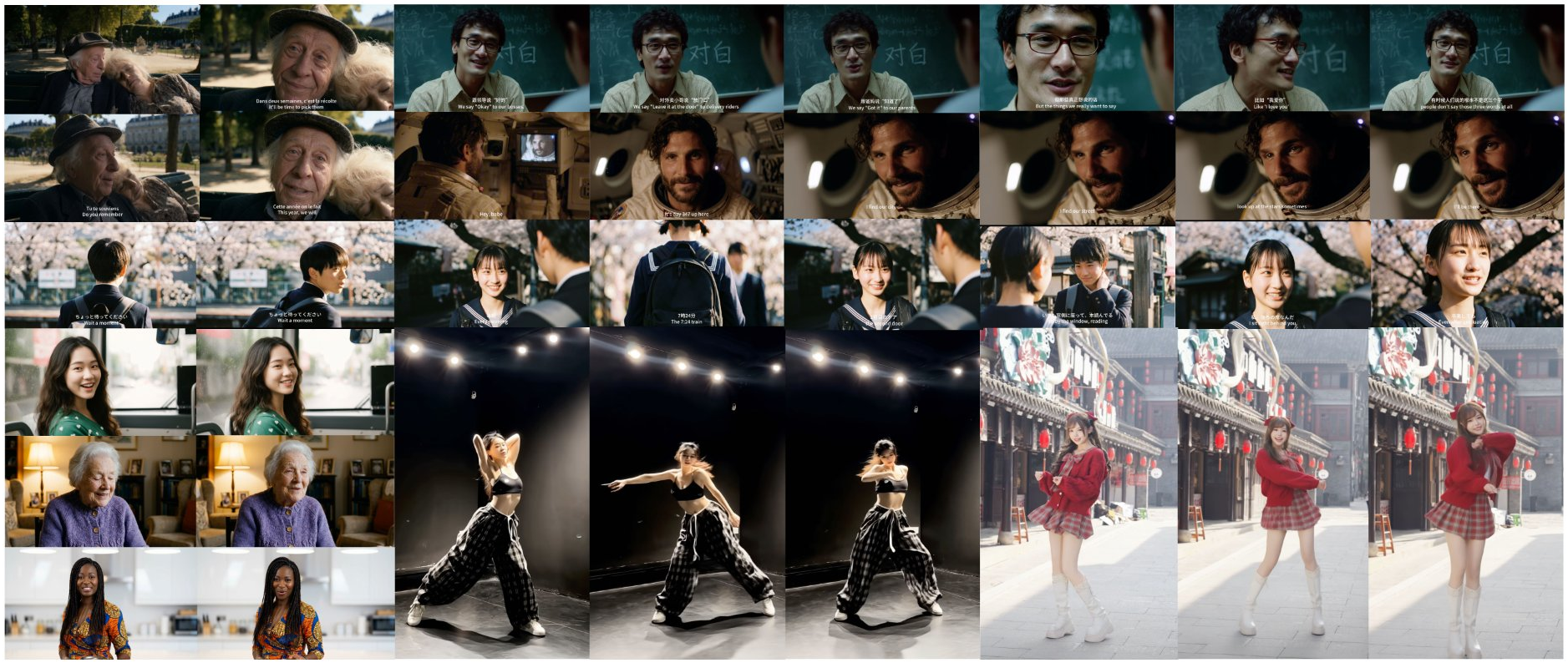






https://github.com/user-attachments/assets/7050a191-38ef-4e36-8b48-0084ccc694f1
https://github.com/user-attachments/assets/c6cc056f-56ca-4285-80f3-bb6052228d23
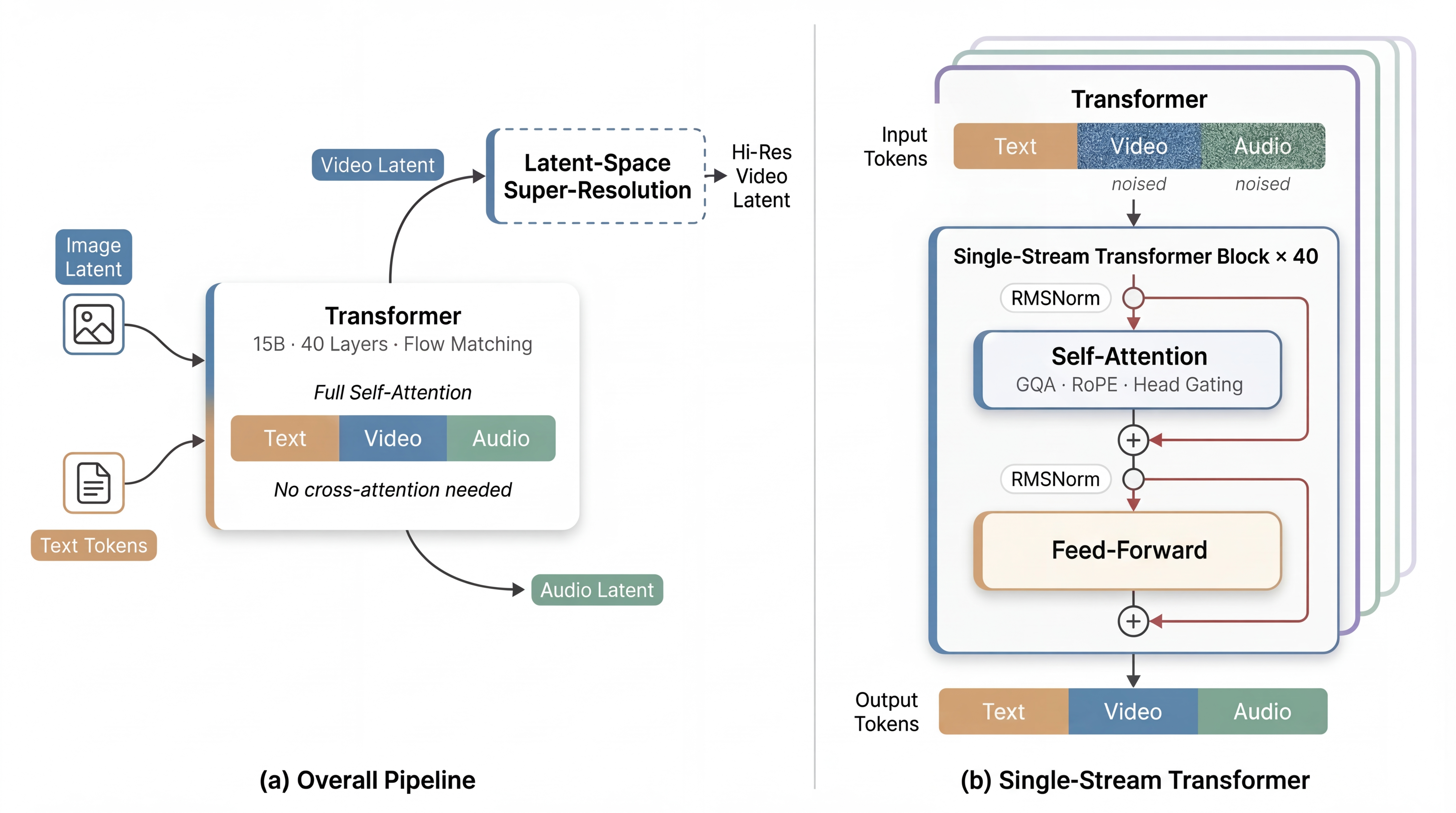
daVinci-MagiHuman uses a single-stream Transformer that takes text tokens, an optional reference image latent, and noisy video and audio tokens as input, and jointly denoises the video and audio within a unified token sequence.
Key design choices:
| Component | Description |
|---|---|
| 🥪 Sandwich Architecture | First and last 4 layers use modality-specific projections; middle 32 layers share parameters across modalities |
| 🕐 Timestep-Free Denoising | No explicit timestep embeddings — the model infers the denoising state directly from input latents |
| 🔀 Per-Head Gating | Learned scalar gates with sigmoid activation on each attention head for training stability |
| 🔗 Unified Conditioning | Denoising and reference signals handled through a minimal unified interface — no dedicated conditioning branches |
| Model | Visual Quality ↑ | Text Alignment ↑ | Physical Consistency ↑ | WER ↓ |
|---|---|---|---|---|
| OVI 1.1 | 4.73 | 4.10 | 4.41 | 40.45% |
| LTX 2.3 | 4.76 | 4.12 | 4.56 | 19.23% |
| daVinci-MagiHuman | 4.80 | 4.18 | 4.52 | 14.60% |
| Matchup | daVinci-MagiHuman Win | Tie | Opponent Win |
|---|---|---|---|
| vs Ovi 1.1 | 80.0% | 8.2% | 11.8% |
| vs LTX 2.3 | 60.9% | 17.2% | 21.9% |
| Resolution | Base (s) | Super-Res (s) | Decode (s) | Total (s) |
|---|---|---|---|---|
| 256p | 1.6 | — | 0.4 | 2.0 |
| 540p | 1.6 | 5.1 | 1.3 | 8.0 |
| 1080p | 1.6 | 31.0 | 5.8 | 38.4 |
# Recommended: use the prebuilt MagiHuman image (supports full pipeline including SR 1080p)
docker pull sandai/magi-human:latest

docker run -it --gpus all --network host --ipc host \
  -v /path/to/repos:/workspace \
  -v /path/to/checkpoints:/models \
  --name my-magi-human \
  sandai/magi-human:latest \
  bash

# Install MagiCompiler
git clone https://github.com/SandAI-org/MagiCompiler.git
cd MagiCompiler
pip install -r requirements.txt
pip install .
cd ..

# Clone daVinci-MagiHuman
git clone https://github.com/GAIR-NLP/daVinci-MagiHuman
cd daVinci-MagiHuman
If you prefer manual setup, follow Option 2 (Conda) below.
# Create environment
conda create -n davinci-magihuman python=3.12
conda activate davinci-magihuman
conda install ffmpeg

# Install PyTorch
pip install torch==2.10.0 torchvision==0.25.0 torchaudio==2.10.0

# Install Flash Attention (Hopper)
git clone https://github.com/Dao-AILab/flash-attention
cd flash-attention/hopper && python setup.py install && cd ../..

# Install MagiCompiler
git clone https://github.com/SandAI-org/MagiCompiler.git
cd MagiCompiler
pip install -r requirements.txt
pip install .
cd ..

# Clone and install daVinci-MagiHuman
git clone https://github.com/GAIR-NLP/daVinci-MagiHuman
cd daVinci-MagiHuman
pip install -r requirements.txt
pip install --no-deps -r requirements-nodeps.txt

# Optional (only for sr-1080p): Install MagiAttention
git clone --recursive https://github.com/SandAI-org/MagiAttention.git
cd MagiAttention
git checkout v1.0.5
git submodule update --init --recursive
pip install -r requirements.txt
pip install --no-build-isolation .
Download the complete model stack from HuggingFace and update the paths in the config files under example/.
You will also need the following external models:
| Model | Source |
|---|---|
| Text Encoder | t5gemma-9b-9b-ul2 |
| Audio Model | stable-audio-open-1.0 |
| VAE | Wan2.2-TI2V-5B |
Before running, update the checkpoint paths in the config files (example/*/config.json) to point to your local model directory.
Note: The first run will be slower due to model compilation and cache warmup. Subsequent runs will match the reported inference speeds.
--prompt only and omit --image_path.--prompt and --image_path.Base Model (256p)
bash example/base/run_T2V.sh   # T2V
bash example/base/run_TI2V.sh  # TI2V
Distilled Model (256p, 8 steps, no CFG)
bash example/distill/run_T2V.sh
bash example/distill/run_TI2V.sh
Super-Resolution to 540p
bash example/sr_540p/run_T2V.sh
bash example/sr_540p/run_TI2V.sh
Super-Resolution to 1080p
bash example/sr_1080p/run_T2V.sh
bash example/sr_1080p/run_TI2V.sh
--image_path is omitted, inference/pipeline/entry.py runs T2V.--image_path is provided, inference/pipeline/entry.py runs TI2V.--image_path is passed.daVinci-MagiHuman uses an Enhanced Prompt system that rewrites user inputs into detailed performance directions optimized for avatar-style video generation. For the full system prompt specification, see prompts/enhanced_prompt_design.md.
Below is a quick reference for writing effective prompts.
Every enhanced prompt has three parts:
Main Body (150–200 words) — A clinical, chronological description of the character's appearance, facial dynamics, vocal delivery, and static cinematography. Written in English regardless of dialogue language.
Dialogue — Repeats all spoken lines in a structured format:
Dialogue:
<character description, language>: "Line content"
Background Sound — Specifies the most prominent ambient sound:
Background Sound:
<Description of the background sound>
Use <No prominent background sound> if none.
User input: A man in a yellow shirt says "有的人在一起生活一辈子,还带着假面具呢"
Enhanced prompt (abbreviated):
A young man with short dark hair, wearing a bright yellow polo shirt, sits stationary. His disposition is earnest and slightly agitated... He speaks with a rapid, emphatic tone, his mouth opening wide as he says, "有 的 人 在 一 起 生 活 一 辈 子,还 带 着 假 面 具 呢..." His brow furrows, lip muscles showing distinct dynamics...
Dialogue: <Young man in yellow polo, Mandarin>: "有 的 人 在 一 起 生 活 一 辈 子,还 带 着 假 面 具 呢..."
Background Sound: <No prominent background sound>
We thank the open-source community, and in particular Wan2.2 and Turbo-VAED, for their valuable contributions.
This project is released under the Apache License 2.0.
@article{davinci-magihuman-2026,
  title={Speed by Simplicity: A Single-Stream Architecture for Fast Audio-Video Generative Foundation Model},
  author={SII-GAIR and Sand. ai and Chern, Ethan and Teng, Hansi and Sun, Hanwen and Wang, Hao and Pan, Hong and Jia, Hongyu and Su, Jiadi and Li, Jin and Yu, Junjie and Liu, Lijie and Li, Lingzhi and Ye, Lyumanshan and Hu, Min and Wang, Qiangang and Qi, Quanwei and Chern, Steffi and Bu, Tao and Wang, Taoran and Xu, Teren and Zhang, Tianning and Mi, Tiantian and Xu, Weixian and Zhang, Wenqiang and Zhang, Wentai and Yi, Xianping and Cai, Xiaojie and Kang, Xiaoyang and Ma, Yan and Liu, Yixiu and Zhang, Yunbo and Huang, Yunpeng and Lin, Yutong and Tao, Zewei and Liu, Zhaoliang and Zhang, Zheng and Cen, Zhiyao and Yu, Zhixuan and Wang, Zhongshu and Hu, Zhulin and Zhou, Zijin and Guo, Zinan and Cao, Yue and Liu, Pengfei},
  journal={arXiv preprint arXiv:2603.21986},
  year={2026}
}
(top 24 of 29)
427 followers · starred Mar 2026
296 followers · starred Mar 2026
316 followers · starred Mar 2026
171 followers · starred Mar 2026
https://github.com/user-attachments/assets/7050a191-38ef-4e36-8b48-0084ccc694f1
https://github.com/user-attachments/assets/c6cc056f-56ca-4285-80f3-bb6052228d23
daVinci-MagiHuman uses a single-stream Transformer that takes text tokens, an optional reference image latent, and noisy video and audio tokens as input, and jointly denoises the video and audio within a unified token sequence.
Key design choices:
| Component | Description |
|---|---|
| 🥪 Sandwich Architecture | First and last 4 layers use modality-specific projections; middle 32 layers share parameters across modalities |
| 🕐 Timestep-Free Denoising | No explicit timestep embeddings — the model infers the denoising state directly from input latents |
| 🔀 Per-Head Gating | Learned scalar gates with sigmoid activation on each attention head for training stability |
| 🔗 Unified Conditioning | Denoising and reference signals handled through a minimal unified interface — no dedicated conditioning branches |
| Model | Visual Quality ↑ | Text Alignment ↑ | Physical Consistency ↑ | WER ↓ |
|---|---|---|---|---|
| OVI 1.1 | 4.73 | 4.10 | 4.41 | 40.45% |
| LTX 2.3 | 4.76 | 4.12 | 4.56 | 19.23% |
| daVinci-MagiHuman | 4.80 | 4.18 | 4.52 | 14.60% |
| Matchup | daVinci-MagiHuman Win | Tie | Opponent Win |
|---|---|---|---|
| vs Ovi 1.1 | 80.0% | 8.2% | 11.8% |
| vs LTX 2.3 | 60.9% | 17.2% | 21.9% |
| Resolution | Base (s) | Super-Res (s) | Decode (s) | Total (s) |
|---|---|---|---|---|
| 256p | 1.6 | — | 0.4 | 2.0 |
| 540p | 1.6 | 5.1 | 1.3 | 8.0 |
| 1080p | 1.6 | 31.0 | 5.8 | 38.4 |
# Recommended: use the prebuilt MagiHuman image (supports full pipeline including SR 1080p)
docker pull sandai/magi-human:latest

docker run -it --gpus all --network host --ipc host \
  -v /path/to/repos:/workspace \
  -v /path/to/checkpoints:/models \
  --name my-magi-human \
  sandai/magi-human:latest \
  bash

# Install MagiCompiler
git clone https://github.com/SandAI-org/MagiCompiler.git
cd MagiCompiler
pip install -r requirements.txt
pip install .
cd ..

# Clone daVinci-MagiHuman
git clone https://github.com/GAIR-NLP/daVinci-MagiHuman
cd daVinci-MagiHuman
If you prefer manual setup, follow Option 2 (Conda) below.
# Create environment
conda create -n davinci-magihuman python=3.12
conda activate davinci-magihuman
conda install ffmpeg

# Install PyTorch
pip install torch==2.10.0 torchvision==0.25.0 torchaudio==2.10.0

# Install Flash Attention (Hopper)
git clone https://github.com/Dao-AILab/flash-attention
cd flash-attention/hopper && python setup.py install && cd ../..

# Install MagiCompiler
git clone https://github.com/SandAI-org/MagiCompiler.git
cd MagiCompiler
pip install -r requirements.txt
pip install .
cd ..

# Clone and install daVinci-MagiHuman
git clone https://github.com/GAIR-NLP/daVinci-MagiHuman
cd daVinci-MagiHuman
pip install -r requirements.txt
pip install --no-deps -r requirements-nodeps.txt

# Optional (only for sr-1080p): Install MagiAttention
git clone --recursive https://github.com/SandAI-org/MagiAttention.git
cd MagiAttention
git checkout v1.0.5
git submodule update --init --recursive
pip install -r requirements.txt
pip install --no-build-isolation .
Download the complete model stack from HuggingFace and update the paths in the config files under example/.
You will also need the following external models:
| Model | Source |
|---|---|
| Text Encoder | t5gemma-9b-9b-ul2 |
| Audio Model | stable-audio-open-1.0 |
| VAE | Wan2.2-TI2V-5B |
Before running, update the checkpoint paths in the config files (example/*/config.json) to point to your local model directory.
Note: The first run will be slower due to model compilation and cache warmup. Subsequent runs will match the reported inference speeds.
--prompt only and omit --image_path.--prompt and --image_path.Base Model (256p)
bash example/base/run_T2V.sh   # T2V
bash example/base/run_TI2V.sh  # TI2V
Distilled Model (256p, 8 steps, no CFG)
bash example/distill/run_T2V.sh
bash example/distill/run_TI2V.sh
Super-Resolution to 540p
bash example/sr_540p/run_T2V.sh
bash example/sr_540p/run_TI2V.sh
Super-Resolution to 1080p
bash example/sr_1080p/run_T2V.sh
bash example/sr_1080p/run_TI2V.sh
--image_path is omitted, inference/pipeline/entry.py runs T2V.--image_path is provided, inference/pipeline/entry.py runs TI2V.--image_path is passed.daVinci-MagiHuman uses an Enhanced Prompt system that rewrites user inputs into detailed performance directions optimized for avatar-style video generation. For the full system prompt specification, see prompts/enhanced_prompt_design.md.
Below is a quick reference for writing effective prompts.
Every enhanced prompt has three parts:
Main Body (150–200 words) — A clinical, chronological description of the character's appearance, facial dynamics, vocal delivery, and static cinematography. Written in English regardless of dialogue language.
Dialogue — Repeats all spoken lines in a structured format:
Dialogue:
<character description, language>: "Line content"
Background Sound — Specifies the most prominent ambient sound:
Background Sound:
<Description of the background sound>
Use <No prominent background sound> if none.
User input: A man in a yellow shirt says "有的人在一起生活一辈子,还带着假面具呢"
Enhanced prompt (abbreviated):
A young man with short dark hair, wearing a bright yellow polo shirt, sits stationary. His disposition is earnest and slightly agitated... He speaks with a rapid, emphatic tone, his mouth opening wide as he says, "有 的 人 在 一 起 生 活 一 辈 子,还 带 着 假 面 具 呢..." His brow furrows, lip muscles showing distinct dynamics...
Dialogue: <Young man in yellow polo, Mandarin>: "有 的 人 在 一 起 生 活 一 辈 子,还 带 着 假 面 具 呢..."
Background Sound: <No prominent background sound>
We thank the open-source community, and in particular Wan2.2 and Turbo-VAED, for their valuable contributions.
This project is released under the Apache License 2.0.
@article{davinci-magihuman-2026,
  title={Speed by Simplicity: A Single-Stream Architecture for Fast Audio-Video Generative Foundation Model},
  author={SII-GAIR and Sand. ai and Chern, Ethan and Teng, Hansi and Sun, Hanwen and Wang, Hao and Pan, Hong and Jia, Hongyu and Su, Jiadi and Li, Jin and Yu, Junjie and Liu, Lijie and Li, Lingzhi and Ye, Lyumanshan and Hu, Min and Wang, Qiangang and Qi, Quanwei and Chern, Steffi and Bu, Tao and Wang, Taoran and Xu, Teren and Zhang, Tianning and Mi, Tiantian and Xu, Weixian and Zhang, Wenqiang and Zhang, Wentai and Yi, Xianping and Cai, Xiaojie and Kang, Xiaoyang and Ma, Yan and Liu, Yixiu and Zhang, Yunbo and Huang, Yunpeng and Lin, Yutong and Tao, Zewei and Liu, Zhaoliang and Zhang, Zheng and Cen, Zhiyao and Yu, Zhixuan and Wang, Zhongshu and Hu, Zhulin and Zhou, Zijin and Guo, Zinan and Cao, Yue and Liu, Pengfei},
  journal={arXiv preprint arXiv:2603.21986},
  year={2026}
}
(top 24 of 29)
427 followers · starred Mar 2026
296 followers · starred Mar 2026
316 followers · starred Mar 2026
171 followers · starred Mar 2026