
README
RelayLLM: Efficient Reasoning via Collaborative Decoding
Empower Small Language Models (SLMs) to act as active controllers, invoking Large Language Models (LLMs) only for critical tokens. Achieve expert-level reasoning with minimal cost.
Check out our paper and models for the details.
🔥 Updates
- [2026-08-20] RelayLLM is accepted by EMNLP as finding paper.
- [2026-01-08] We released our paper and code. RelayLLM achieves 98.2% cost reduction compared to random routers while bridging the performance gap between SLMs and LLMs!
🧩 Overview
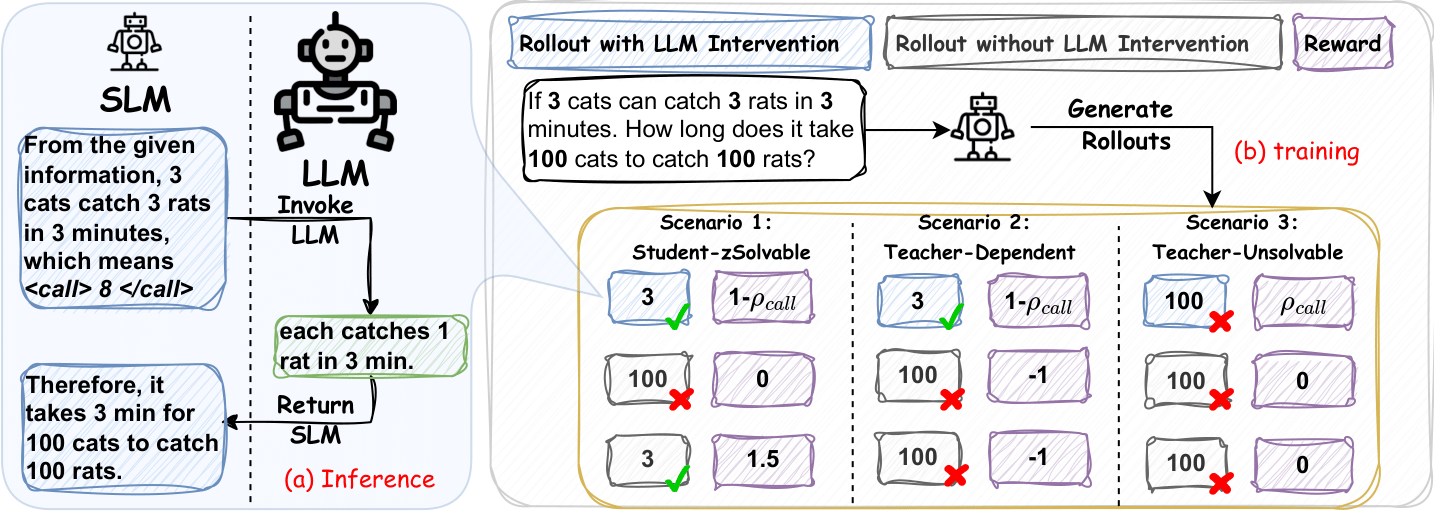
Deploying Large Language Models (LLMs) for complex reasoning is often hindered by high computational costs and latency. Existing "routing" approaches operate at a coarse granularity (offloading entire queries), leading to significant waste when the small model could have handled most of the steps.
RelayLLM is a novel framework for token-level collaborative decoding. Unlike passive routers, RelayLLM empowers the SLM to act as an active controller. It dynamically invokes the LLM only for critical tokens via a special <call> command, effectively "relaying" the generation process to the expert when necessary.
Our approach utilizes a two-stage training framework combining Supervised Warm-up and Group Relative Policy Optimization (GRPO) to teach the model to balance independence with strategic help-seeking.
Key Features
- Token-Level Granularity: Collaboration happens within the generation stream via interleaved decoding, not just at the query level.
- Active Control: The SLM autonomously decides when and how long to call the LLM using a learned
<call>token. - Extreme Efficiency: Reduces token costs by 98.2% compared to performance-matched routers, invoking the LLM for only ~1% of total generated tokens.
- Difficulty-Aware Reward: A specialized RL reward system designed to encourage independence on easy tasks (Student-Solvable) and help-seeking only on hard ones (Teacher-Dependent).
- Bridged Performance: Recovers ~60% of the performance gap between the SLM and LLM on challenging math benchmarks.
⚡️ Quickstart Guide
Getting started with RelayLLM is straightforward.
1. Configure Environment and Prepare Dirs
git clone https://github.com/Chengsong-Huang/RelayLLM.git

# Navigate into the new directory
cd RelayLLM
# Install the required packages
pip install -r requirements.txt

# We use vLLM for efficient teacher model serving
pip install vllm

# Create storage directories
export STORAGE_PATH="/path/to/your/storage"
If you meet any problems, please refer to installation for verl
2. Configure Environment and Prepare Dirs
# run the example codes
sh example.bash
📊 Impressive Results
The table below compares RelayLLM against the Base SLM, GRPO baseline, and other routing methods (CITER). Results are averaged across six benchmarks (Minerva, MATH-500, GSM8K, Olympiad-Bench, AIME-2024, AIME-2025).
| Model Family | Method | Avg. Accuracy (%) | Avg. Call Ratio (%) |
|---|---|---|---|
| Qwen3-0.6B | Base Model | 27.17 | - |
| GRPO Baseline | 29.91 | - | |
| CITER (Token-Level) | 30.77 | 0.98% | |
| RelayLLM (Ours) | 33.04 | 0.77% | |
| Qwen3-1.7B | Base Model | 42.50 | - |
| GRPO Baseline | 44.06 | - | |
| CITER (Token-Level) | 46.81 | 1.34% | |
| RelayLLM (Ours) | 49.52 | 1.07% | |
| Qwen3-8B | Teacher LLM | 54.12 | 100% |
Note: RelayLLM (Difficulty-Aware) achieves the best trade-off, recovering significant performance with negligible token overhead (~1%).
🙏 Acknowledgements
Our framework is directly based on the great work of EasyR1, implementing all of its core functionalities. Additionally, our evaluation process referenced the work from General-Reasoner. We are very grateful for their excellent work.
💬 Citation
If our work is useful for you, please consider citing our paper:
@misc{huang2026relayllmefficientreasoningcollaborative,
      title={RelayLLM: Efficient Reasoning via Collaborative Decoding},
      author={Chengsong Huang and Tong Zheng and Langlin Huang and Jinyuan Li and Haolin Liu and Jiaxin Huang},
      year={2026},
      eprint={2601.05167},
      archivePrefix={arXiv},
      primaryClass={cs.CL},
      url={https://arxiv.org/abs/2601.05167},
}




README
RelayLLM: Efficient Reasoning via Collaborative Decoding
Empower Small Language Models (SLMs) to act as active controllers, invoking Large Language Models (LLMs) only for critical tokens. Achieve expert-level reasoning with minimal cost.
Check out our paper and models for the details.
🔥 Updates
- [2026-08-20] RelayLLM is accepted by EMNLP as finding paper.
- [2026-01-08] We released our paper and code. RelayLLM achieves 98.2% cost reduction compared to random routers while bridging the performance gap between SLMs and LLMs!
🧩 Overview
Deploying Large Language Models (LLMs) for complex reasoning is often hindered by high computational costs and latency. Existing "routing" approaches operate at a coarse granularity (offloading entire queries), leading to significant waste when the small model could have handled most of the steps.
RelayLLM is a novel framework for token-level collaborative decoding. Unlike passive routers, RelayLLM empowers the SLM to act as an active controller. It dynamically invokes the LLM only for critical tokens via a special <call> command, effectively "relaying" the generation process to the expert when necessary.
Our approach utilizes a two-stage training framework combining Supervised Warm-up and Group Relative Policy Optimization (GRPO) to teach the model to balance independence with strategic help-seeking.
Key Features
- Token-Level Granularity: Collaboration happens within the generation stream via interleaved decoding, not just at the query level.
- Active Control: The SLM autonomously decides when and how long to call the LLM using a learned
<call>token. - Extreme Efficiency: Reduces token costs by 98.2% compared to performance-matched routers, invoking the LLM for only ~1% of total generated tokens.
- Difficulty-Aware Reward: A specialized RL reward system designed to encourage independence on easy tasks (Student-Solvable) and help-seeking only on hard ones (Teacher-Dependent).
- Bridged Performance: Recovers ~60% of the performance gap between the SLM and LLM on challenging math benchmarks.
⚡️ Quickstart Guide
Getting started with RelayLLM is straightforward.
1. Configure Environment and Prepare Dirs
git clone https://github.com/Chengsong-Huang/RelayLLM.git

# Navigate into the new directory
cd RelayLLM
# Install the required packages
pip install -r requirements.txt

# We use vLLM for efficient teacher model serving
pip install vllm

# Create storage directories
export STORAGE_PATH="/path/to/your/storage"
If you meet any problems, please refer to installation for verl
2. Configure Environment and Prepare Dirs
# run the example codes
sh example.bash
📊 Impressive Results
The table below compares RelayLLM against the Base SLM, GRPO baseline, and other routing methods (CITER). Results are averaged across six benchmarks (Minerva, MATH-500, GSM8K, Olympiad-Bench, AIME-2024, AIME-2025).
| Model Family | Method | Avg. Accuracy (%) | Avg. Call Ratio (%) |
|---|---|---|---|
| Qwen3-0.6B | Base Model | 27.17 | - |
| GRPO Baseline | 29.91 | - | |
| CITER (Token-Level) | 30.77 | 0.98% | |
| RelayLLM (Ours) | 33.04 | 0.77% | |
| Qwen3-1.7B | Base Model | 42.50 | - |
| GRPO Baseline | 44.06 | - | |
| CITER (Token-Level) | 46.81 | 1.34% | |
| RelayLLM (Ours) | 49.52 | 1.07% | |
| Qwen3-8B | Teacher LLM | 54.12 | 100% |
Note: RelayLLM (Difficulty-Aware) achieves the best trade-off, recovering significant performance with negligible token overhead (~1%).
🙏 Acknowledgements
Our framework is directly based on the great work of EasyR1, implementing all of its core functionalities. Additionally, our evaluation process referenced the work from General-Reasoner. We are very grateful for their excellent work.
💬 Citation
If our work is useful for you, please consider citing our paper:
@misc{huang2026relayllmefficientreasoningcollaborative,
      title={RelayLLM: Efficient Reasoning via Collaborative Decoding},
      author={Chengsong Huang and Tong Zheng and Langlin Huang and Jinyuan Li and Haolin Liu and Jiaxin Huang},
      year={2026},
      eprint={2601.05167},
      archivePrefix={arXiv},
      primaryClass={cs.CL},
      url={https://arxiv.org/abs/2601.05167},
}