
README



English | 简体中文
A sparse-first inference engine for long-context LLM serving.
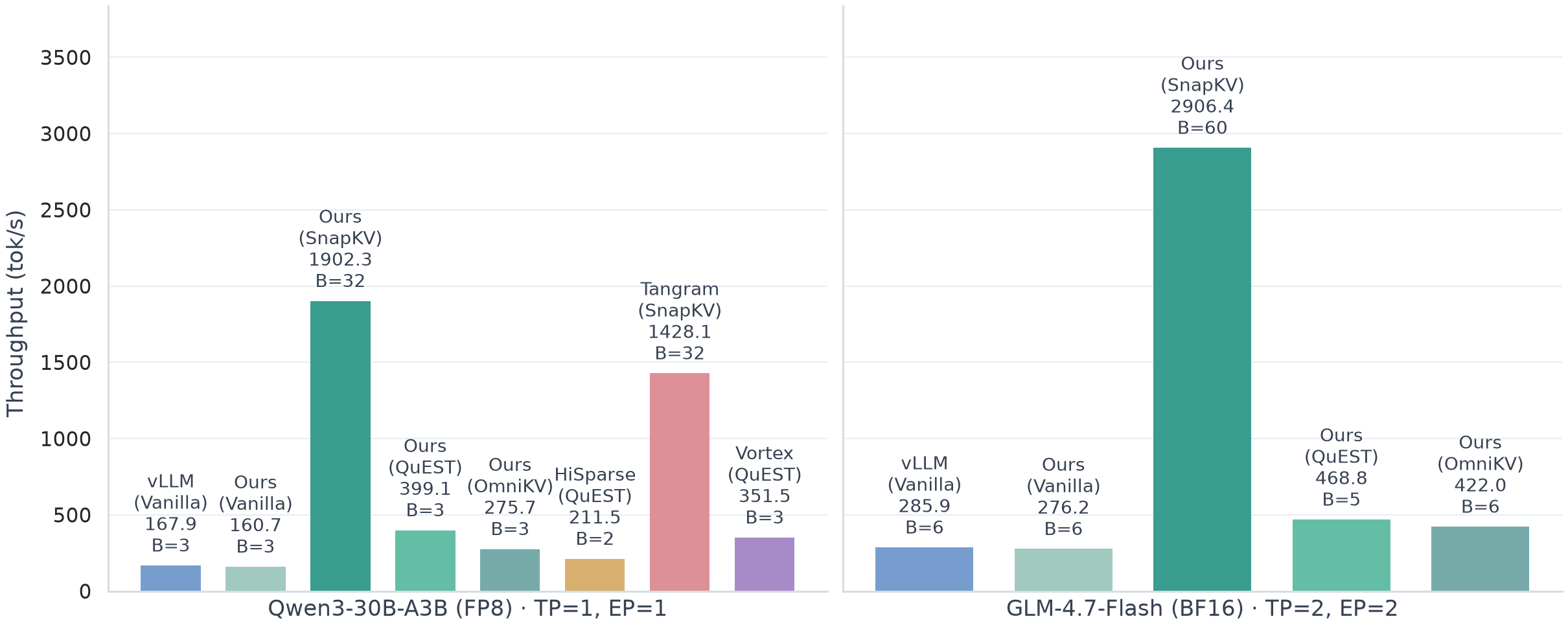
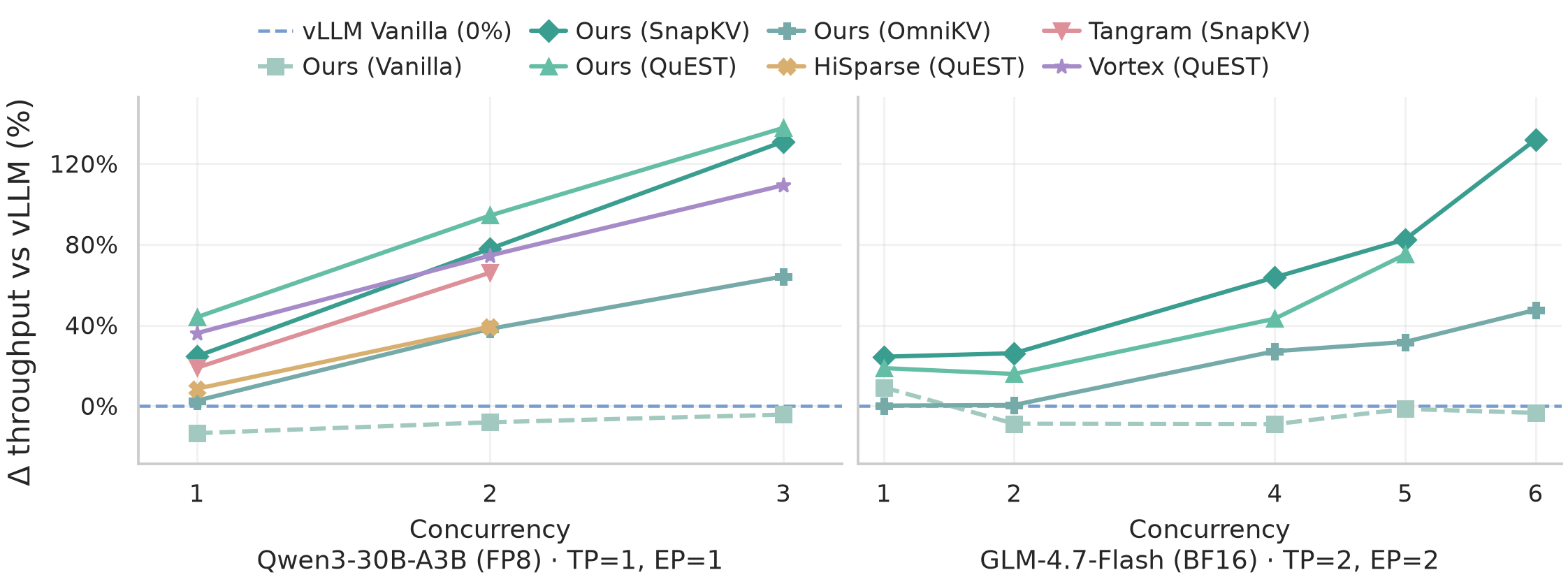
128K input / 2K output on H100 80GB. Top: decode throughput at each method's largest measured batch. Bottom: throughput improvement relative to vLLM Vanilla at the same concurrency, with vLLM at 0%. Ours denotes SparseEngine. See the measurement and figure notes.
Project Overview
SparseEngine is an inference framework built with sparsity as the first design principle. Instead of layering sparse methods on top of a conventional KV cache, it rethinks cache layout, controller flow, and kernels so that multiple sparse mechanisms can plug in cleanly.
Note: DeltaKV compressor training code is maintained separately in CURRENTF/DeltaKV. This repository only keeps the native DeltaKV inference implementation under
src/sparseengine/; it does not include DeltaKV training code or an HF reference implementation.
Key Runtime Principles
- Runtime parameter names are identical across
LLM(...),Config, JSON configs, benchmark manifests, and internal consumers. Usesparse_methodeverywhere; legacy field aliases are not accepted. - Sparse method runtime state belongs in
src/sparseengine/engine/cache_manager/;attention.pyshould stay generic. - Prefill scheduling is method-specific and registry-owned. The source of
truth is
src/sparseengine/method_registry.py, not benchmark scripts. - SparseEngine currently uses two prefill policies:
all_chunkedand the speciallong_bs1full_short_batchpolicy. long_bs1full_short_batchis only for methods that are registered to need a complete long-prefill pass before their sparse/cache transformation. Long requests run as full prefill with batch size 1; short requests still use chunked batching.- Benchmark reports should record the sparse method, prefill policy, prefill chunk size, prompt length, batch size, and any DeltaKV checkpoint.
Core Sparse Methods
SparseEngine supports physical eviction, logical masking, query-aware selection,
and hybrid KV compression. The main method families are streamingllm,
snapkv, h2o, pyramidkv, omnikv, quest, and deltakv.
| Method | Type | Short Description |
|---|---|---|
vanilla | Dense baseline | Runs full attention and keeps the standard KV cache behavior for correctness and performance baselines. |
streamingllm / attention-sink | Physical eviction | Keeps fixed sink tokens plus a recent window, then physically evicts older tokens outside that policy. |
snapkv, pyramidkv | Physical eviction | Selects important historical tokens during prefill/finalization and stores only the retained KV tokens. |
h2o | Physical eviction | Maintains independent cumulative attention importance for every layer, then physically compacts each layer's KV rows using its own heavy-hitter selection plus a recent suffix. |
omnikv | Logical masking | Keeps tokens in storage but masks the attention read view so sparse layers attend only selected context. |
quest | Query-aware selection | Uses decode-time query-aware page selection while keeping prefill dense. |
deltakv / deltakv-* | Hybrid compression | Keeps a small full-precision pool and stores older context through DeltaKV compression or related ablations. |
Prefill acceleration is an independent axis: h2o_prefill compacts KV between
prompt chunks, while flashprefill_v2 sparsifies prefill attention
computation. Both are selected with prefill_sparse_method and combined with a
compatible sparse_method for cache/decode behavior.
Read the method overview and integration rules in Core Sparse Methods.
Supported Models
| Model | Supported |
|---|---|
| Qwen2.5 | ✅ |
| Qwen3 | ✅ |
| Qwen3MoE | ✅ |
| Qwen3.5 / 3.6 / 3.8 | ✅ |
| Qwen3.5 / Qwen3.6 MoE | ✅ |
| GLM-4.7-Flash | ✅ |
| Gemma 4 Dense / MoE | ✅ |
| Llama 3 / 3.1 | ✅ |
| MiniMax M2.7 | ✅ |
See Supported Models for the precision, parallelism, and sparse-method compatibility matrices.
Native image, video, and audio inputs are enabled per checkpoint with
enable_multimodal=True; see the supported-model matrix for media coverage.
Documentation
| Topic | Link |
|---|---|
| Quick setup and minimal usage | Getting Started |
| Model, precision, and parallelism support | Supported Models |
| Sparse method taxonomy and extension rules | Core Sparse Methods |
| Runtime architecture | Architecture |
| Runtime parameter semantics | Runtime Parameter Semantics |
| Benchmark commands | Benchmarks |
| DeltaKV inference | DeltaKV |
| Reproducibility checklist | Reproducibility |
The full documentation index is maintained in docs/en/README.md.
Quick Start
SparseEngine requires Python 3.10 or newer. The canonical CUDA 13 development
environment uses Python 3.12. Default dependencies are declared in
pyproject.toml.
Conda
conda create -n sparseengine-cu130-py312 python=3.12 -y
conda activate sparseengine-cu130-py312

python -m pip config --site set global.extra-index-url \
  "https://download.pytorch.org/whl/cu130 https://flashinfer.ai/whl"
python -m pip install "transformers==5.13.1" -e ".[cu130]"
python -m pip check
uv
uv venv --python 3.12
source .venv/bin/activate

uv pip install -e ".[cu130]"
Use cu129 instead of cu130 for CUDA 12.9.
Optional dependencies
After installing the base environment, add these packages as needed.
FlashInfer JIT Cache provides precompiled kernel caches to reduce compilation overhead on first use.
pip install flashinfer-jit-cache --index-url https://flashinfer.ai/whl/cu130
DeepEP V1 provides the NVLink MoE communication backend selected by moe_backend="deepepv1" and builds against the installed PyTorch/CUDA environment.
pip install --no-build-isolation -e ".[deepepv1]"
For the full dependency list and a minimal LLM(...) example, see
Getting Started.
Benchmarks
Use scripts/benchmarks/bench_sparse_engine.py for throughput measurements and
the benchmark/ entrypoints for LongBench, MathBench, SCBench, NIAH, and
multimodal evaluations.
See Benchmarks for command examples and backend notes.
Contributing Sparse Methods
New sparse methods should keep persistent physical cache state in
src/sparseengine/engine/cache_manager/, keep logical orchestration behind a
SparseMethodRuntime, and keep src/sparseengine/layers/attention.py generic.
See the sparse method runtime architecture.
Acknowledgements
This project is inspired by and/or references ideas and implementation techniques from:
LightLLM(ModelTC/LightLLM)SGLang(sgl-project/sglang)ShadowKV(ByteDance-Seed/ShadowKV)nano-vllm(GeeeekExplorer/nano-vllm)
License
Citation
@article{hao2026deltakv,
  title={DeltaKV: Residual-Based KV Cache Compression via Long-Range Similarity},
  author={Hao, Jitai and Huang, Qiang and Wang, Yaowei and Zhang, Min and Yu, Jun},
  journal={arXiv preprint arXiv:2602.08005},
  year={2026}
}

@inproceedings{hao2025omnikv,
  title={Omnikv: Dynamic context selection for efficient long-context llms},
  author={Hao, Jitai and Zhu, Yuke and Wang, Tian and Yu, Jun and Xin, Xin and Zheng, Bo and Ren, Zhaochun and Guo, Sheng},
  booktitle={The Thirteenth International Conference on Learning Representations},
  year={2025}
}
Contributors


Similar repos


Languages
Python
96.7%
Cuda
2.1%
README
English | 简体中文
A sparse-first inference engine for long-context LLM serving.
128K input / 2K output on H100 80GB. Top: decode throughput at each method's largest measured batch. Bottom: throughput improvement relative to vLLM Vanilla at the same concurrency, with vLLM at 0%. Ours denotes SparseEngine. See the measurement and figure notes.
Project Overview
SparseEngine is an inference framework built with sparsity as the first design principle. Instead of layering sparse methods on top of a conventional KV cache, it rethinks cache layout, controller flow, and kernels so that multiple sparse mechanisms can plug in cleanly.
Note: DeltaKV compressor training code is maintained separately in CURRENTF/DeltaKV. This repository only keeps the native DeltaKV inference implementation under
src/sparseengine/; it does not include DeltaKV training code or an HF reference implementation.
Key Runtime Principles
- Runtime parameter names are identical across
LLM(...),Config, JSON configs, benchmark manifests, and internal consumers. Usesparse_methodeverywhere; legacy field aliases are not accepted. - Sparse method runtime state belongs in
src/sparseengine/engine/cache_manager/;attention.pyshould stay generic. - Prefill scheduling is method-specific and registry-owned. The source of
truth is
src/sparseengine/method_registry.py, not benchmark scripts. - SparseEngine currently uses two prefill policies:
all_chunkedand the speciallong_bs1full_short_batchpolicy. long_bs1full_short_batchis only for methods that are registered to need a complete long-prefill pass before their sparse/cache transformation. Long requests run as full prefill with batch size 1; short requests still use chunked batching.- Benchmark reports should record the sparse method, prefill policy, prefill chunk size, prompt length, batch size, and any DeltaKV checkpoint.
Core Sparse Methods
SparseEngine supports physical eviction, logical masking, query-aware selection,
and hybrid KV compression. The main method families are streamingllm,
snapkv, h2o, pyramidkv, omnikv, quest, and deltakv.
| Method | Type | Short Description |
|---|---|---|
vanilla | Dense baseline | Runs full attention and keeps the standard KV cache behavior for correctness and performance baselines. |
streamingllm / attention-sink | Physical eviction | Keeps fixed sink tokens plus a recent window, then physically evicts older tokens outside that policy. |
snapkv, pyramidkv | Physical eviction | Selects important historical tokens during prefill/finalization and stores only the retained KV tokens. |
h2o | Physical eviction | Maintains independent cumulative attention importance for every layer, then physically compacts each layer's KV rows using its own heavy-hitter selection plus a recent suffix. |
omnikv | Logical masking | Keeps tokens in storage but masks the attention read view so sparse layers attend only selected context. |
quest | Query-aware selection | Uses decode-time query-aware page selection while keeping prefill dense. |
deltakv / deltakv-* | Hybrid compression | Keeps a small full-precision pool and stores older context through DeltaKV compression or related ablations. |
Prefill acceleration is an independent axis: h2o_prefill compacts KV between
prompt chunks, while flashprefill_v2 sparsifies prefill attention
computation. Both are selected with prefill_sparse_method and combined with a
compatible sparse_method for cache/decode behavior.
Read the method overview and integration rules in Core Sparse Methods.
Supported Models
| Model | Supported |
|---|---|
| Qwen2.5 | ✅ |
| Qwen3 | ✅ |
| Qwen3MoE | ✅ |
| Qwen3.5 / 3.6 / 3.8 | ✅ |
| Qwen3.5 / Qwen3.6 MoE | ✅ |
| GLM-4.7-Flash | ✅ |
| Gemma 4 Dense / MoE | ✅ |
| Llama 3 / 3.1 | ✅ |
| MiniMax M2.7 | ✅ |
See Supported Models for the precision, parallelism, and sparse-method compatibility matrices.
Native image, video, and audio inputs are enabled per checkpoint with
enable_multimodal=True; see the supported-model matrix for media coverage.
Documentation
| Topic | Link |
|---|---|
| Quick setup and minimal usage | Getting Started |
| Model, precision, and parallelism support | Supported Models |
| Sparse method taxonomy and extension rules | Core Sparse Methods |
| Runtime architecture | Architecture |
| Runtime parameter semantics | Runtime Parameter Semantics |
| Benchmark commands | Benchmarks |
| DeltaKV inference | DeltaKV |
| Reproducibility checklist | Reproducibility |
The full documentation index is maintained in docs/en/README.md.
Quick Start
SparseEngine requires Python 3.10 or newer. The canonical CUDA 13 development
environment uses Python 3.12. Default dependencies are declared in
pyproject.toml.
Conda
conda create -n sparseengine-cu130-py312 python=3.12 -y
conda activate sparseengine-cu130-py312

python -m pip config --site set global.extra-index-url \
  "https://download.pytorch.org/whl/cu130 https://flashinfer.ai/whl"
python -m pip install "transformers==5.13.1" -e ".[cu130]"
python -m pip check
uv
uv venv --python 3.12
source .venv/bin/activate

uv pip install -e ".[cu130]"
Use cu129 instead of cu130 for CUDA 12.9.
Optional dependencies
After installing the base environment, add these packages as needed.
FlashInfer JIT Cache provides precompiled kernel caches to reduce compilation overhead on first use.
pip install flashinfer-jit-cache --index-url https://flashinfer.ai/whl/cu130
DeepEP V1 provides the NVLink MoE communication backend selected by moe_backend="deepepv1" and builds against the installed PyTorch/CUDA environment.
pip install --no-build-isolation -e ".[deepepv1]"
For the full dependency list and a minimal LLM(...) example, see
Getting Started.
Benchmarks
Use scripts/benchmarks/bench_sparse_engine.py for throughput measurements and
the benchmark/ entrypoints for LongBench, MathBench, SCBench, NIAH, and
multimodal evaluations.
See Benchmarks for command examples and backend notes.
Contributing Sparse Methods
New sparse methods should keep persistent physical cache state in
src/sparseengine/engine/cache_manager/, keep logical orchestration behind a
SparseMethodRuntime, and keep src/sparseengine/layers/attention.py generic.
See the sparse method runtime architecture.
Acknowledgements
This project is inspired by and/or references ideas and implementation techniques from:
LightLLM(ModelTC/LightLLM)SGLang(sgl-project/sglang)ShadowKV(ByteDance-Seed/ShadowKV)nano-vllm(GeeeekExplorer/nano-vllm)
License
Citation
@article{hao2026deltakv,
  title={DeltaKV: Residual-Based KV Cache Compression via Long-Range Similarity},
  author={Hao, Jitai and Huang, Qiang and Wang, Yaowei and Zhang, Min and Yu, Jun},
  journal={arXiv preprint arXiv:2602.08005},
  year={2026}
}

@inproceedings{hao2025omnikv,
  title={Omnikv: Dynamic context selection for efficient long-context llms},
  author={Hao, Jitai and Zhu, Yuke and Wang, Tian and Yu, Jun and Xin, Xin and Zheng, Bo and Ren, Zhaochun and Guo, Sheng},
  booktitle={The Thirteenth International Conference on Learning Representations},
  year={2025}
}
Similar repos
Contributors
Languages
Python
96.7%
Cuda
2.1%