
README
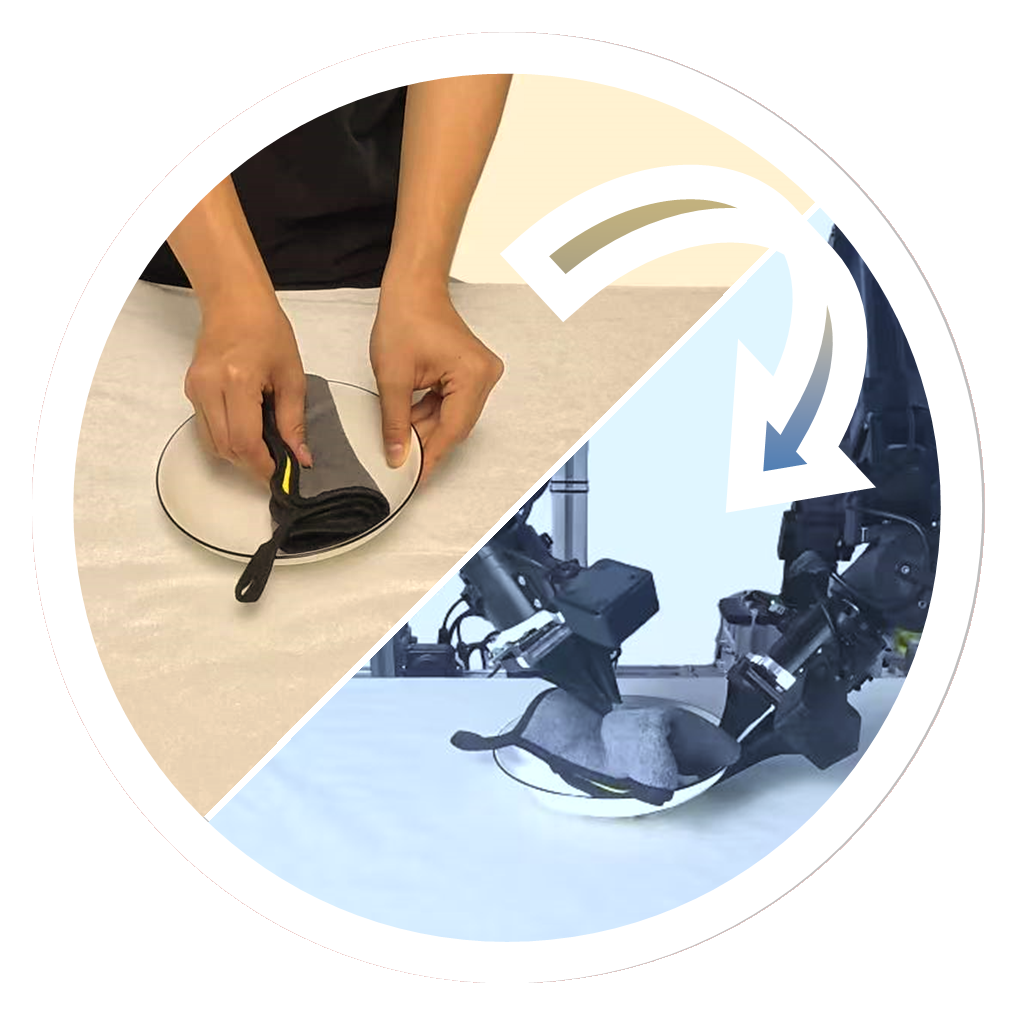
HOST: Robots Acquire Manipulation Skills in Seconds from a Single Human Video
HOST: Human-to-robot One-Shot Skill AcquisiTion
arXiv · Hugging Face Paper · Model Weights · Project Website · Getting Started · Data Format · Citation






This repository is the official implementation of our paper, “Robots Acquire Manipulation Skills in Seconds from a Single Human Video.” The paper introduces HOST (Human-to-robot One-Shot Skill AcquisiTion), a framework that enables a robot to acquire a previously unseen manipulation skill at inference time from one human demonstration video, without task-specific parameter updates.
Instead of mapping the entire video directly to actions, HOST:
- couples each prediction target to the demonstration on a shared task-progress manifold; and
- resolves execution through a self-grounded cascade that localizes progress, predicts the robot's own future observations, and then derives actions.
The resulting policy actively follows the demonstrated procedure while adapting it to the robot's embodiment, viewpoint, and deployment scene. Because skill acquisition does not modify the policy weights, previously mastered skills are retained.
Highlights
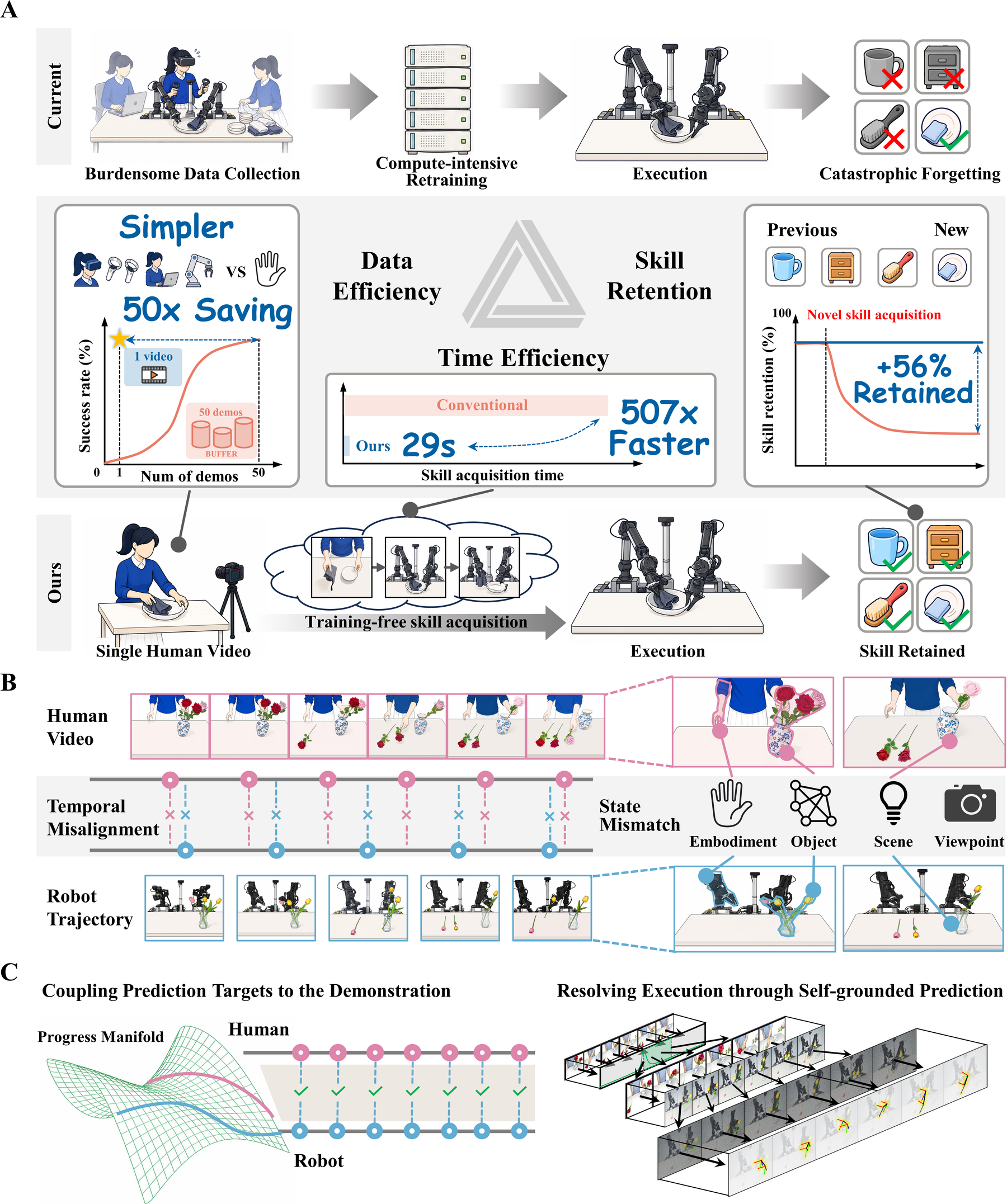
- Inference-time skill acquisition: one human video, no fine-tuning, and no parameter update.
- Fast acquisition: 29 seconds per novel skill on average, including recording the demonstration.
- Broad real-robot evaluation: acquires executable skills across 50 novel manipulation tasks, each evaluated over 20 trials.
- Strong novel-task performance: achieves 62% average success on the task subset used for baseline comparisons.
- Data and time efficiency: 50 times fewer demonstrations and 507 times faster acquisition than the strongest task-specific fine-tuning baseline evaluated in the paper.
- Skill retention: new skills are supplied through external video context rather than written into the shared policy weights.
- Robust execution: evaluated under lighting changes, unseen objects, scene replacement, and human disturbances during execution.
The numbers above are results reported in the paper.
Method
HOST addresses two structural mismatches between human demonstration and robot execution.
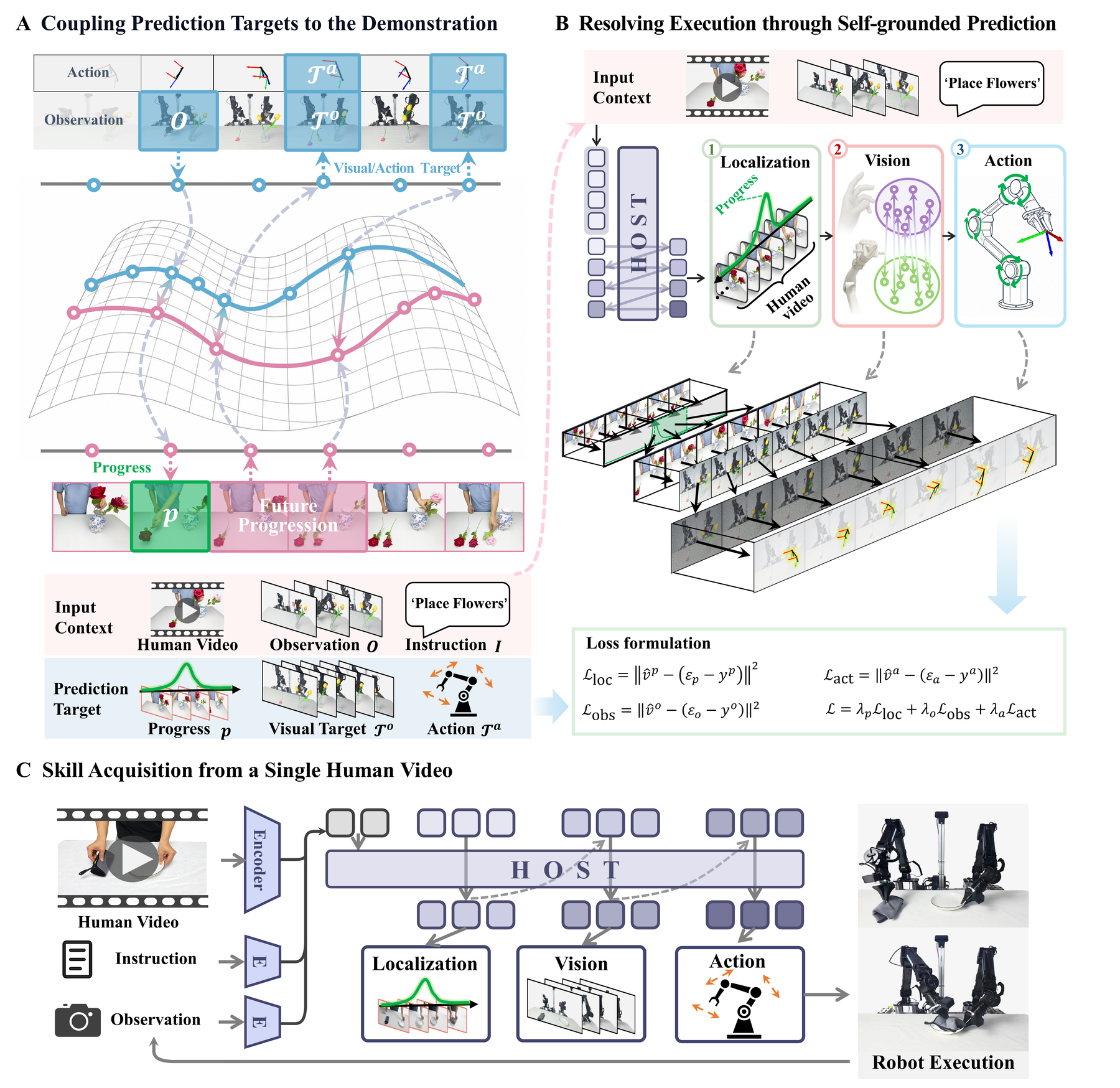
1. Target coupling. Human and robot trajectories progress at different speeds. A Qwen3-VL-Embedding-8B alignment model, trained with temporal cycle consistency and Smooth DTW, maps same-task trajectories to a shared task-progress manifold. The recovered correspondence couples each robot prediction target to the upcoming progression of the demonstration rather than to a fixed clock-time offset.
2. Self-grounded prediction. A dual-expert autoregressive diffusion model first localizes the robot's current progress in the demonstration, then predicts the corresponding future in the robot's own visual domain, and finally predicts an action chunk from that future. The video expert is initialized from Wan2.2-TI2V-5B; the action expert and video expert communicate through shared attention in a Mixture-of-Transformers architecture.
Codebase overview
The repository contains the released model-training and offline data-processing components of HOST:
| Component | Purpose | Location |
|---|---|---|
| Dataset preprocessing | Episode schema and same-task grouping | data_preprocessing/ |
| Target coupling | Progress-alignment training and evaluation | alignment/ |
| Progress conversion | Convert DTW records into progress targets | coupling/ |
| Self-grounded prediction | Policy training and recorded-data evaluation | policy_training/ |
Repository layout
The four top-level modules follow the training-data flow:
HOST/
├── data_preprocessing/   # Define the dataset contract and group same-task episodes
├── alignment/            # Learn temporal correspondence with TCC + Smooth DTW
├── coupling/             # Convert alignment records into per-frame progress targets
└── policy_training/      # Train and evaluate the self-grounded diffusion policy
raw episodes
    │
    ├─ data_preprocessing ──> task_paths.json
    │                              │
    └──────────────────────────────v
                              alignment
                                  │
                                  v
                    high_loss_samples_*.jsonl
                                  │
                                  v
                              coupling ──> info_dtw.json
                                                  │
                                                  v
                                         policy_training
Start with the module that matches your goal:
| Goal | Documentation |
|---|---|
| Convert a dataset to the expected episode format | data_preprocessing/README.md |
| Train or evaluate the progress-alignment model | alignment/README.md |
| Materialize aligned progress labels | coupling/README.md |
| Train or evaluate the policy | policy_training/README.md |
| Interpret real-robot action fields and normalization (中文) | 格式说明/README.md |
| Read the policy documentation in Chinese | policy_training/README_zh.md |
Getting started
1. Clone the repository
git clone https://github.com/CGuangyan-BIT/HOST.git
cd HOST
2. Set up the environments
HOST uses two separate Conda environments because alignment and policy training use different large-model stacks and PyTorch versions.
| Module | Conda environment | Dependency definition | Main framework |
|---|---|---|---|
alignment/ | HOST_Alignment | alignment/environment.yml | PyTorch 2.4.0 + CUDA 12.4 |
policy_training/ | HOST_Policy | policy_training/environment.yml | PyTorch 2.6.0 + CUDA 12.4 |
There is no single root-level requirements.txt. The complete alignment environment is recorded
in alignment/environment.yml, exported from the local alignment environment. The complete policy
environment is recorded in policy_training/environment.yml, exported from the local lingbot
environment. Policy package dependencies are also declared in
policy_training/pyproject.toml. Keeping the two Conda
definitions separate preserves their respective PyTorch stacks.
Create the alignment environment from its complete Conda specification:
conda env create -f alignment/environment.yml
conda activate HOST_Alignment
Create the policy-training environment from the local lingbot export, then install the repository
package in editable mode without resolving a second dependency set:
conda env create -f policy_training/environment.yml
conda activate HOST_Policy
pip install -e ./policy_training --no-deps
3. Prepare episode data
Arrange robot episodes using the shared dataset schema, then group episodes that execute the same task:
cd data_preprocessing

python build_task_dictionary.py \
  --input_dir /path/to/episodes \
  --output_path ./output/my_dataset.hdf5 \
  --dataset_name my_dataset \
  --clear

python write_task_paths.py \
  --hdf5_path ./output/my_dataset.hdf5
This writes a task_paths.json file into each episode directory. It is used to sample paired
same-task trajectories during alignment and policy training.
4. Train the alignment model
cd ../alignment
conda activate HOST_Alignment
Pass your JSON episode list through VIDEO_PATHS, then launch the DeepSpeed ZeRO-3 entrypoint:
VIDEO_PATHS=/path/to/video_paths.json bash train_scripts/run_ds.sh
For evaluation or a custom launcher, inspect all supported arguments with:
python train.py --help
python evaluate_v2.py --help
5. Build coupled progress targets
Alignment runs write high_loss_samples_*.jsonl records. Convert them into the info_dtw.json
files consumed by policy training:
cd ../coupling/progress_alignment

python build_progress_info.py \
  --log_file /path/to/alignment_run/logs
The converter filters unreliable or non-causal alignments before writing per-frame normalized progress values.
6. Train the self-grounded policy
cd ../../policy_training
conda activate HOST_Policy
Prepare the Wan2.2-derived ActionDiT initialization:
mkdir -p checkpoints
export DIFFSYNTH_MODEL_BASE_PATH="$(pwd)/checkpoints"

python scripts/preprocess_action_dit_backbone.py \
  --model-config configs/model/self_grounded_predictor_joint_cross_attn_ve.yaml \
  --output checkpoints/ActionDiT_linear_interp_Wan22_alphascale_1024hdim.pt \
  --device cuda \
  --dtype bfloat16
Update configs/data/custom_cross_all.yaml with your dataset, camera mapping, action
normalization, image size, and frame rate. Precompute text embeddings and start training:
python scripts/precompute_text_embeds.py \
  task=real_joint_2cam_224_1e-4_pac_headwise_ncp_ve

bash scripts/run_train.sh
The launch script accepts Hydra overrides, for example:
bash scripts/run_train.sh batch_size=4
7. Run recorded-data evaluation
After setting the checkpoint, normalization-statistics, and dataset paths in the evaluation launcher:
bash scripts/eval_openloop.sh
This evaluates action prediction on recorded episodes. It does not command a live robot.
Data format
Both large-model modules share one episode format. A typical policy-training episode contains:
episode_001/
├── episode_001.json     # Synchronized robot state and action trajectory
├── instruction.txt      # Task instruction
├── instruction.pt       # Cached UMT5-XXL embedding
├── task_paths.json      # Other episodes of the same task
├── info_dtw.json        # Optional per-frame aligned progress produced by coupling/
├── images/              # Third-person RGB frames, or an equivalent video file
└── gripper_images/      # Additional camera view(s), when used
A dataset-level episode-list JSON, camera mapping, and action-normalization mapping are also
required. Field definitions, path conventions, examples, and the differences between alignment
and policy training are documented in
data_preprocessing/README.md.
For real open-loop inference, see joint/action mapping and action format (中文) for field order, normalization, relative-pose decoding, and a single mapping example. Normalization ranges are dataset-specific; inference must use the mapping associated with training.
Compute requirements
The paper-scale experiments used 64 GPUs for both alignment and policy training:
- alignment: 10,000 steps, bfloat16, DeepSpeed ZeRO-3;
- policy Stage 1: 500,000 steps on 193,462 robot trajectories from 229 tasks; and
- policy Stage 2: 100,000 steps on 5,847 human-video/robot-trajectory pairs.
The shipped launchers are configurable templates and do not automatically reproduce this full training scale.
Acknowledgements
The self-grounded policy implementation is built on Fast-WAM. HOST also builds on Qwen3-VL-Embedding-8B, Wan2.2, DINOv2, and SigLIP. We thank the authors of these projects for releasing their work.
Citation
If you find HOST useful in your research, please cite:
@article{chen2026host,
  title   = {Robots acquire manipulation skills in seconds from a single human video},
  author  = {Chen, Guangyan and Wang, Meiling and Cui, Te and Zhou, Zichen and others},
  year    = {2026}
}
License
The self-grounded policy module includes the
policy_training/LICENSE inherited from its Fast-WAM foundation.
This snapshot does not yet include a repository-wide license file. Please also follow the license
terms of the external models and codebases listed above.
Similar repos


Languages
Python
97.8%
Shell
2.2%
README
HOST: Robots Acquire Manipulation Skills in Seconds from a Single Human Video
HOST: Human-to-robot One-Shot Skill AcquisiTion
arXiv · Hugging Face Paper · Model Weights · Project Website · Getting Started · Data Format · Citation
This repository is the official implementation of our paper, “Robots Acquire Manipulation Skills in Seconds from a Single Human Video.” The paper introduces HOST (Human-to-robot One-Shot Skill AcquisiTion), a framework that enables a robot to acquire a previously unseen manipulation skill at inference time from one human demonstration video, without task-specific parameter updates.
Instead of mapping the entire video directly to actions, HOST:
- couples each prediction target to the demonstration on a shared task-progress manifold; and
- resolves execution through a self-grounded cascade that localizes progress, predicts the robot's own future observations, and then derives actions.
The resulting policy actively follows the demonstrated procedure while adapting it to the robot's embodiment, viewpoint, and deployment scene. Because skill acquisition does not modify the policy weights, previously mastered skills are retained.
Highlights
- Inference-time skill acquisition: one human video, no fine-tuning, and no parameter update.
- Fast acquisition: 29 seconds per novel skill on average, including recording the demonstration.
- Broad real-robot evaluation: acquires executable skills across 50 novel manipulation tasks, each evaluated over 20 trials.
- Strong novel-task performance: achieves 62% average success on the task subset used for baseline comparisons.
- Data and time efficiency: 50 times fewer demonstrations and 507 times faster acquisition than the strongest task-specific fine-tuning baseline evaluated in the paper.
- Skill retention: new skills are supplied through external video context rather than written into the shared policy weights.
- Robust execution: evaluated under lighting changes, unseen objects, scene replacement, and human disturbances during execution.
The numbers above are results reported in the paper.
Method
HOST addresses two structural mismatches between human demonstration and robot execution.
1. Target coupling. Human and robot trajectories progress at different speeds. A Qwen3-VL-Embedding-8B alignment model, trained with temporal cycle consistency and Smooth DTW, maps same-task trajectories to a shared task-progress manifold. The recovered correspondence couples each robot prediction target to the upcoming progression of the demonstration rather than to a fixed clock-time offset.
2. Self-grounded prediction. A dual-expert autoregressive diffusion model first localizes the robot's current progress in the demonstration, then predicts the corresponding future in the robot's own visual domain, and finally predicts an action chunk from that future. The video expert is initialized from Wan2.2-TI2V-5B; the action expert and video expert communicate through shared attention in a Mixture-of-Transformers architecture.
Codebase overview
The repository contains the released model-training and offline data-processing components of HOST:
| Component | Purpose | Location |
|---|---|---|
| Dataset preprocessing | Episode schema and same-task grouping | data_preprocessing/ |
| Target coupling | Progress-alignment training and evaluation | alignment/ |
| Progress conversion | Convert DTW records into progress targets | coupling/ |
| Self-grounded prediction | Policy training and recorded-data evaluation | policy_training/ |
Repository layout
The four top-level modules follow the training-data flow:
HOST/
├── data_preprocessing/   # Define the dataset contract and group same-task episodes
├── alignment/            # Learn temporal correspondence with TCC + Smooth DTW
├── coupling/             # Convert alignment records into per-frame progress targets
└── policy_training/      # Train and evaluate the self-grounded diffusion policy
raw episodes
    │
    ├─ data_preprocessing ──> task_paths.json
    │                              │
    └──────────────────────────────v
                              alignment
                                  │
                                  v
                    high_loss_samples_*.jsonl
                                  │
                                  v
                              coupling ──> info_dtw.json
                                                  │
                                                  v
                                         policy_training
Start with the module that matches your goal:
| Goal | Documentation |
|---|---|
| Convert a dataset to the expected episode format | data_preprocessing/README.md |
| Train or evaluate the progress-alignment model | alignment/README.md |
| Materialize aligned progress labels | coupling/README.md |
| Train or evaluate the policy | policy_training/README.md |
| Interpret real-robot action fields and normalization (中文) | 格式说明/README.md |
| Read the policy documentation in Chinese | policy_training/README_zh.md |
Getting started
1. Clone the repository
git clone https://github.com/CGuangyan-BIT/HOST.git
cd HOST
2. Set up the environments
HOST uses two separate Conda environments because alignment and policy training use different large-model stacks and PyTorch versions.
| Module | Conda environment | Dependency definition | Main framework |
|---|---|---|---|
alignment/ | HOST_Alignment | alignment/environment.yml | PyTorch 2.4.0 + CUDA 12.4 |
policy_training/ | HOST_Policy | policy_training/environment.yml | PyTorch 2.6.0 + CUDA 12.4 |
There is no single root-level requirements.txt. The complete alignment environment is recorded
in alignment/environment.yml, exported from the local alignment environment. The complete policy
environment is recorded in policy_training/environment.yml, exported from the local lingbot
environment. Policy package dependencies are also declared in
policy_training/pyproject.toml. Keeping the two Conda
definitions separate preserves their respective PyTorch stacks.
Create the alignment environment from its complete Conda specification:
conda env create -f alignment/environment.yml
conda activate HOST_Alignment
Create the policy-training environment from the local lingbot export, then install the repository
package in editable mode without resolving a second dependency set:
conda env create -f policy_training/environment.yml
conda activate HOST_Policy
pip install -e ./policy_training --no-deps
3. Prepare episode data
Arrange robot episodes using the shared dataset schema, then group episodes that execute the same task:
cd data_preprocessing

python build_task_dictionary.py \
  --input_dir /path/to/episodes \
  --output_path ./output/my_dataset.hdf5 \
  --dataset_name my_dataset \
  --clear

python write_task_paths.py \
  --hdf5_path ./output/my_dataset.hdf5
This writes a task_paths.json file into each episode directory. It is used to sample paired
same-task trajectories during alignment and policy training.
4. Train the alignment model
cd ../alignment
conda activate HOST_Alignment
Pass your JSON episode list through VIDEO_PATHS, then launch the DeepSpeed ZeRO-3 entrypoint:
VIDEO_PATHS=/path/to/video_paths.json bash train_scripts/run_ds.sh
For evaluation or a custom launcher, inspect all supported arguments with:
python train.py --help
python evaluate_v2.py --help
5. Build coupled progress targets
Alignment runs write high_loss_samples_*.jsonl records. Convert them into the info_dtw.json
files consumed by policy training:
cd ../coupling/progress_alignment

python build_progress_info.py \
  --log_file /path/to/alignment_run/logs
The converter filters unreliable or non-causal alignments before writing per-frame normalized progress values.
6. Train the self-grounded policy
cd ../../policy_training
conda activate HOST_Policy
Prepare the Wan2.2-derived ActionDiT initialization:
mkdir -p checkpoints
export DIFFSYNTH_MODEL_BASE_PATH="$(pwd)/checkpoints"

python scripts/preprocess_action_dit_backbone.py \
  --model-config configs/model/self_grounded_predictor_joint_cross_attn_ve.yaml \
  --output checkpoints/ActionDiT_linear_interp_Wan22_alphascale_1024hdim.pt \
  --device cuda \
  --dtype bfloat16
Update configs/data/custom_cross_all.yaml with your dataset, camera mapping, action
normalization, image size, and frame rate. Precompute text embeddings and start training:
python scripts/precompute_text_embeds.py \
  task=real_joint_2cam_224_1e-4_pac_headwise_ncp_ve

bash scripts/run_train.sh
The launch script accepts Hydra overrides, for example:
bash scripts/run_train.sh batch_size=4
7. Run recorded-data evaluation
After setting the checkpoint, normalization-statistics, and dataset paths in the evaluation launcher:
bash scripts/eval_openloop.sh
This evaluates action prediction on recorded episodes. It does not command a live robot.
Data format
Both large-model modules share one episode format. A typical policy-training episode contains:
episode_001/
├── episode_001.json     # Synchronized robot state and action trajectory
├── instruction.txt      # Task instruction
├── instruction.pt       # Cached UMT5-XXL embedding
├── task_paths.json      # Other episodes of the same task
├── info_dtw.json        # Optional per-frame aligned progress produced by coupling/
├── images/              # Third-person RGB frames, or an equivalent video file
└── gripper_images/      # Additional camera view(s), when used
A dataset-level episode-list JSON, camera mapping, and action-normalization mapping are also
required. Field definitions, path conventions, examples, and the differences between alignment
and policy training are documented in
data_preprocessing/README.md.
For real open-loop inference, see joint/action mapping and action format (中文) for field order, normalization, relative-pose decoding, and a single mapping example. Normalization ranges are dataset-specific; inference must use the mapping associated with training.
Compute requirements
The paper-scale experiments used 64 GPUs for both alignment and policy training:
- alignment: 10,000 steps, bfloat16, DeepSpeed ZeRO-3;
- policy Stage 1: 500,000 steps on 193,462 robot trajectories from 229 tasks; and
- policy Stage 2: 100,000 steps on 5,847 human-video/robot-trajectory pairs.
The shipped launchers are configurable templates and do not automatically reproduce this full training scale.
Acknowledgements
The self-grounded policy implementation is built on Fast-WAM. HOST also builds on Qwen3-VL-Embedding-8B, Wan2.2, DINOv2, and SigLIP. We thank the authors of these projects for releasing their work.
Citation
If you find HOST useful in your research, please cite:
@article{chen2026host,
  title   = {Robots acquire manipulation skills in seconds from a single human video},
  author  = {Chen, Guangyan and Wang, Meiling and Cui, Te and Zhou, Zichen and others},
  year    = {2026}
}
License
The self-grounded policy module includes the
policy_training/LICENSE inherited from its Fast-WAM foundation.
This snapshot does not yet include a repository-wide license file. Please also follow the license
terms of the external models and codebases listed above.
Similar repos
Languages
Python
97.8%
Shell
2.2%