
README
PRIMO R1: From Passive Observer to Active Critic
Reinforcement Learning Elicits Process Reasoning for Robotic Manipulation (ECCV 2026)
[📖 Paper] [🌐 Project Page] [🤗 Model/Dataset]
Yibin Liu, Yaxing Lyu, Daqi Gao, Zhixuan Liang, Weiliang Tang, Shilong Mu, Xiaokang Yang, Yao Mu
About
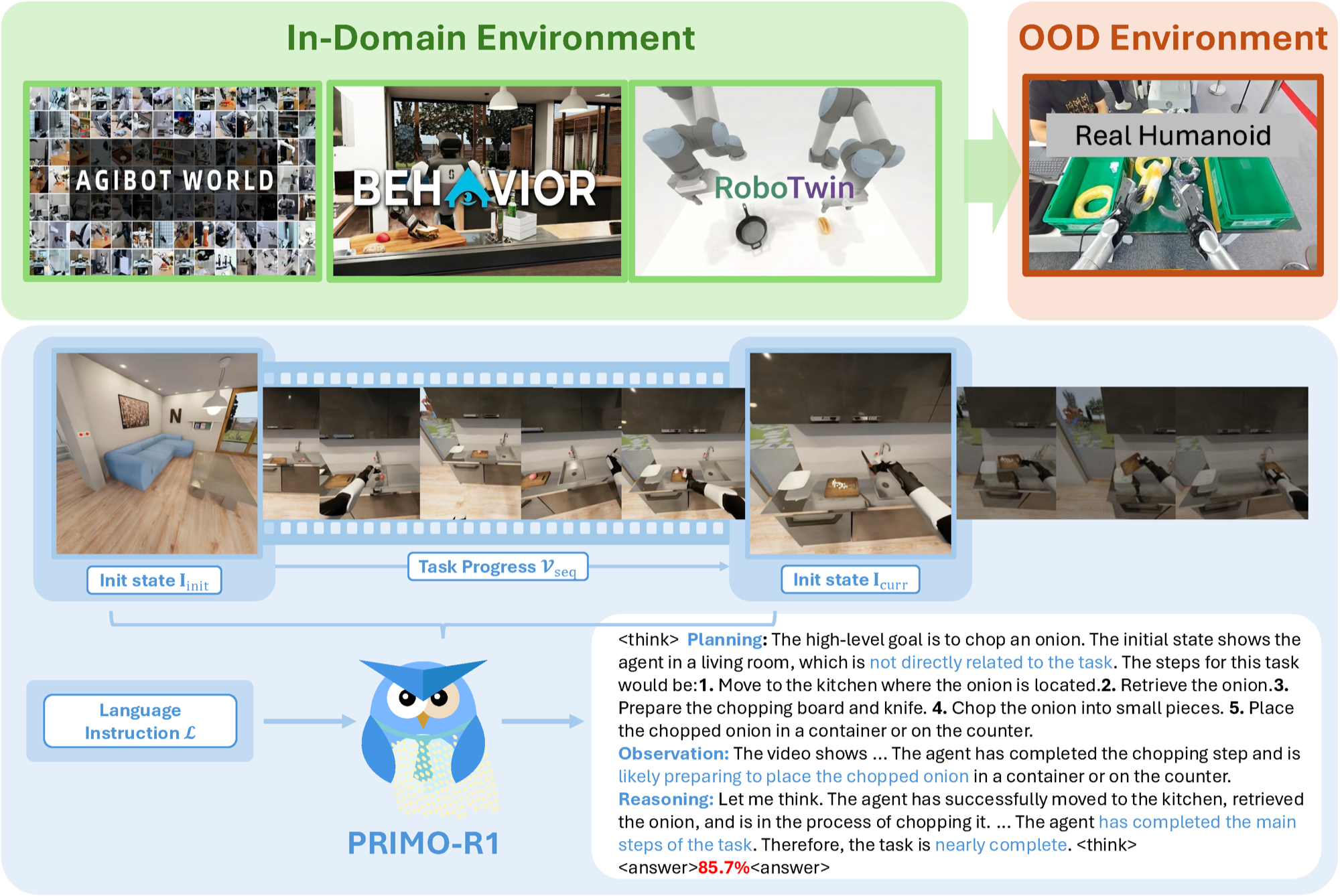
Accurate process supervision is a bottleneck for long-horizon robotic manipulation. Video MLLMs trained under a pure SFT paradigm behave as passive Observers: they recognise what is happening rather than judging the current state against the final goal.
PRIMO R1 (Process Reasoning Induced MOnitoring) is a 7B framework that turns a video MLLM into an active Critic. Two ideas carry the work:
- Outcome-based RL for explicit reasoning. GRPO on a verifiable progress reward incentivises chain-of-thought generation for progress estimation, instead of imitating CoT token-by-token.
- Structured temporal input. The video sequence is anchored between an initial-state and a current-state image — the interleaved format
I_init + V_seq + I_curr— rather than fed as a bare clip.
Training is two staged: an SFT cold start, then GRPO RL on top of that checkpoint.
Quantitative results are in the paper and on the project page.
Models and data
Everything is released on Hugging Face, collected under 🤗 PRIMO R1. Each repo's card is self-contained; the sizes below are what you actually download.
| Repo | What it is | Size |
|---|---|---|
| PRIMO-R1-7B | final SFT+RL checkpoint — use this one | 16.6 GB |
| PRIMO-COT-SFT-7B | stage-1 cold start; the SFT-only ablation, and the RL starting point | 16.6 GB |
| primo-bench-json | benchmark annotations, 7 splits / 23,704 samples | 71 MB |
| primo-sft-json | stage-1 CoT annotations, 10 subsets / 116,755 records | 856 MB |
| primo-rl-json | stage-2 RL annotations, 6 subsets / 328,454 records | 1.7 GB |
| primo-video-media | videos + pre-extracted anchor frames, multipart zip | 6.58 TB |
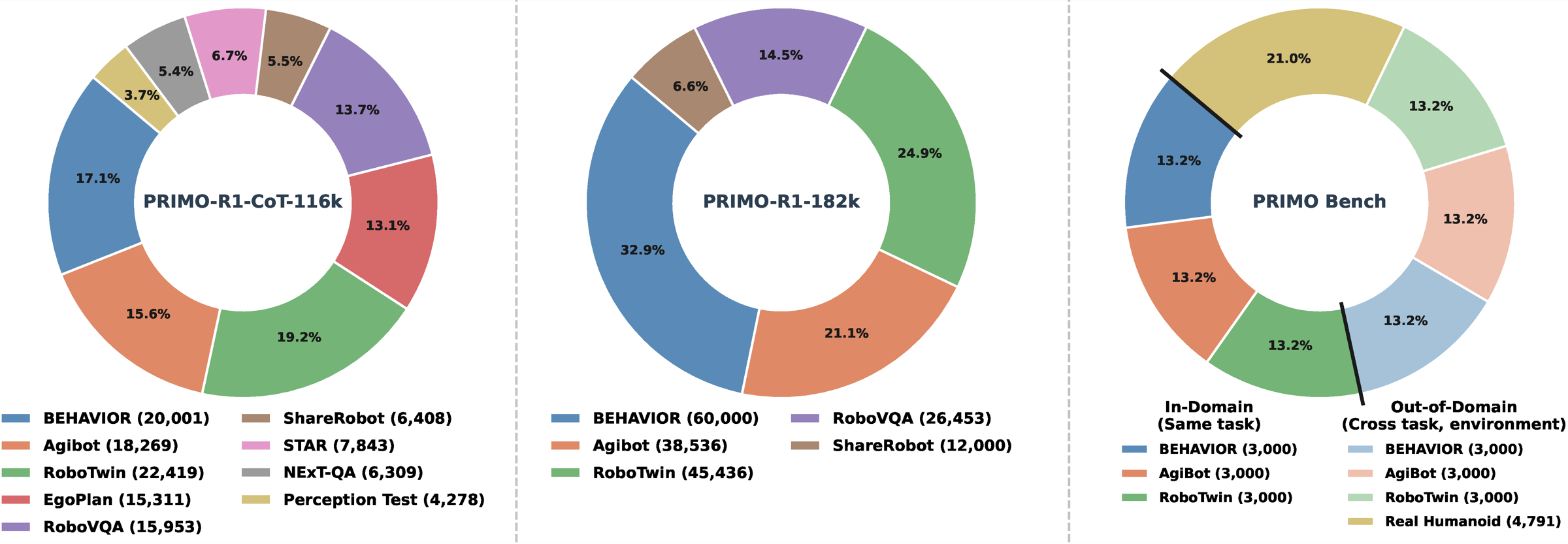
Dataset distribution for SFT (left), RL (middle), and PRIMO Bench (right).
The RL panel shows the 182k mixture the paper trained on; primo-rl-json ships 328,454 records because it releases all available behavior-1k annotations (206,029) rather than the 60,000 sampled for training. Every other RL subset matches the figure exactly.
The annotations are small; the videos are not, and they are extremely skewed. behavior-1k alone is 5,981 GB — 91% of the media release. Skip it unless you specifically need the long-horizon progress-estimation results. robotwin is 12.5 GB and covers both benchmark robotwin splits plus both robotwin training subsets, so it is the cheapest way to get a working run.
A minimal end-to-end setup — the model plus one benchmark environment, roughly 29 GB of download:
export VIDEO_DATA_ROOT=/path/to/PRIMO-Data
export MODEL_ROOT=/path/to/models

# Model
hf download LeonOverload/PRIMO-R1-7B --local-dir "$MODEL_ROOT/PRIMO-R1-7B"

# Benchmark annotations -> $VIDEO_DATA_ROOT/primo-bench/
hf download LeonOverload/primo-bench-json --repo-type dataset \
    --include "raw_json/*" --local-dir /tmp/primo-bench
cp -r /tmp/primo-bench/raw_json/primo-bench "$VIDEO_DATA_ROOT/"

# Videos for the robotwin splits -> $VIDEO_DATA_ROOT/primo-video/
hf download LeonOverload/primo-video-media --repo-type dataset \
    --include "robotwin.z*" --local-dir /tmp/primo-video-zips
7z x /tmp/primo-video-zips/robotwin.zip -o"$VIDEO_DATA_ROOT/primo-video/"

bash src/eval/src/eval_interleave_local.sh
Training data follows the same shape — see the SFT and RL cards for the per-subset download commands and the SFT_DATASET / RL_DATASET mixtures that drop behavior-1k.
PRIMO-R1-7B's DeepSpeed resume state from RL step 2500 lives on a separate training-state branch, so a default download is 16.6 GB rather than ~116 GB:
from huggingface_hub import snapshot_download

snapshot_download("LeonOverload/PRIMO-R1-7B", local_dir="models/PRIMO-R1-7B")   # inference
snapshot_download("LeonOverload/PRIMO-R1-7B", revision="training-state")        # resume RL
Note that hf download's --include / --exclude are silently ignored if you also pass filenames positionally.
Install
Requires Linux with CUDA GPUs. Local macOS work is limited to reading and editing code.
conda create -n primo-r1 python=3.11 && conda activate primo-r1
cd PRIMO-R1
bash setup.sh
setup.sh installs, in this order:
src/r1-veditable, which pulls intorch,vllm==0.7.2,trl==0.16.0, DeepSpeed and the eval dependencies.tensorboardxandflash-attn(the latter with--no-build-isolation, since it needs an existing torch).- The vendored
src/qwen-vl-utilseditable with thedecordextra — after step 1, so this local copy shadows anyqwen_vl_utilsa transitive dependency pulled from PyPI. - The vendored
transformers-main/tree — last, so nothing replaces it.
The pins are not cosmetic. Qwen2.5-VL support shifts between transformers releases, and installing a PyPI transformers over the vendored tree is the usual cause of shape and processor errors. vllm==0.7.2 and trl==0.16.0 are likewise pinned by upstream R1-V. transformers is deliberately absent from setup.py's dependency lists so pip cannot silently replace the vendored install.
Verify:
python -c "import transformers, trl, vllm, qwen_vl_utils; print(transformers.__version__, trl.__version__, vllm.__version__)"
Data layout
The published repos are packaged to drop straight into this tree — annotations go to $VIDEO_DATA_ROOT/, archives extract to $VIDEO_DATA_ROOT/primo-video/:
$VIDEO_DATA_ROOT/
├── primo-bench/<source>/{id,ood}.json       <- primo-bench-json  raw_json/
├── primo-sft/<source>/train_cot.json        <- primo-sft-json    raw_json/
├── primo-rl/<source>/train.json             <- primo-rl-json     raw_json/
└── primo-video/<group>/{videos,frames}/     <- primo-video-media archives
raw_json/ is what the entry points read. The jsonl/ shards in the same repos exist only to drive the Dataset Viewer, so load_dataset(...) is for browsing, not for training.
Two environment variables locate everything:
| Variable | Meaning | Default |
|---|---|---|
VIDEO_DATA_ROOT | root of the PRIMO data tree | PRIMO-R1/data |
MODEL_ROOT | checkpoint directory | PRIMO-R1/models |
src/r1-v/src/open_r1/DatasetLoader.py is the single dataset registry. It maps a logical name to a JSON manifest plus a video root under VIDEO_DATA_ROOT and returns (json_list, video_paths). Add new datasets to its cfg dict rather than threading raw paths through scripts.
23 registered datasets, named primo-{sft,rl,bench}-<source>:
- SFT (10):
agibot,behavior-1k,robovqa,robotwin-clean,robotwin-randomized,nextqa,perceptiontest,seed-bench-r1,star,sharerobot - RL (6):
agibot,behavior-1k,robovqa,robotwin-clean,robotwin-randomized,sharerobot - Bench (7):
primo-bench-{id,ood}-agibot,primo-bench-{id,ood}-behavior-1k,primo-bench-{id,ood}-robotwin,primo-bench-ood-real-humanoid
A -cot suffix selects the CoT variant; SFT datasets force CoT filtering (select == true plus the four required fields process, planning, observation, reasoning).
The interleaved input format needs a first and last frame per video. The published archives already ship them, and the published JSON already carries init_frame_path / current_frame_path, so there is no preprocessing step for the released data. For datasets you add yourself:
python src/preprocess_video_frames.py                       # all 23 datasets
python src/preprocess_video_frames.py --only-behavior       # one subset
This writes <VIDEO_DATA_ROOT>/primo-video/<source>/frames/ and adds init_frame_path / current_frame_path to each JSON record in place, backing up the original to .json.backup. Records whose extraction fails are left untouched rather than dropped.
Training reads those two fields from the JSON; evaluation ignores them and re-derives both frames with OpenCV at run time.
Training
Two stages, six launchers. Paths come from the environment; GPU count is auto-detected.
# Stage 1: SFT cold start
bash src/scripts/run_sft_7b.sh

# Stage 2: GRPO RL on top of the stage-1 checkpoint
export SFT_CKPT=/path/to/primo-sft-7b/checkpoint-XXXX
bash src/scripts/run_rl_7b.sh
3B variants (run_sft_3b.sh, run_rl_3b.sh) and the video-only baselines
(run_sft_baseline_7b.sh, run_rl_baseline_7b.sh) are alongside them. To skip
stage 1, point SFT_CKPT at the published cold start
LeonOverload/PRIMO-COT-SFT-7B.
Hyper-parameters, the full override list, and the R1-V invariants are in
src/scripts/README.md.
Evaluation
Four launchers, run from the project root.
bash src/eval/src/eval_baseline_local.sh     # local baselines, vLLM  -> eval_outputs/baseline/
bash src/eval/src/eval_interleave_local.sh   # PRIMO R1 models        -> eval_outputs/interleave/
bash src/eval/src/eval_ablation.sh           # input-modality sweep   -> eval_outputs/ablation/
bash src/eval/src/eval_api.sh                # remote API models      -> eval_outputs/api/
Results land in src/r1-v/eval_outputs/<kind>/<model_name>/<dataset>.json. Models
and datasets are selected by a comment-toggled heredoc inside each launcher, not
by CLI flags.
Metric definitions — including the three non-comparable regression formulas —
and per-harness setup are in src/eval/README.md.
Shared modules
src/primo_prompts.py and src/primo_video_utils.py are the single source of
truth for every prompt and for the anchor-frame helpers. Import from them rather
than pasting a copy. The answer extractors are coupled to the prompt format, so
editing a prompt without updating them silently collapses scores rather than
erroring — see src/README.md.
Single example
python ./src/inference_example.py
Citation
@misc{liu2026passiveobserveractivecritic,
      title={From Passive Observer to Active Critic: Reinforcement Learning Elicits Process Reasoning for Robotic Manipulation},
      author={Yibin Liu and Yaxing Lyu and Daqi Gao and Zhixuan Liang and Weiliang Tang and Shilong Mu and Xiaokang Yang and Yao Mu},
      year={2026},
      eprint={2603.15600},
      archivePrefix={arXiv},
      primaryClass={cs.RO},
      url={https://arxiv.org/abs/2603.15600},
}
Acknowledgement
Built on Video-R1, which is itself built on R1-V and open-r1. Thanks to those authors for releasing their code.
Contributors

10 commits

1 commits
Similar repos


Languages
Python
99.0%
README
PRIMO R1: From Passive Observer to Active Critic
Reinforcement Learning Elicits Process Reasoning for Robotic Manipulation (ECCV 2026)
[📖 Paper] [🌐 Project Page] [🤗 Model/Dataset]
Yibin Liu, Yaxing Lyu, Daqi Gao, Zhixuan Liang, Weiliang Tang, Shilong Mu, Xiaokang Yang, Yao Mu
About
Accurate process supervision is a bottleneck for long-horizon robotic manipulation. Video MLLMs trained under a pure SFT paradigm behave as passive Observers: they recognise what is happening rather than judging the current state against the final goal.
PRIMO R1 (Process Reasoning Induced MOnitoring) is a 7B framework that turns a video MLLM into an active Critic. Two ideas carry the work:
- Outcome-based RL for explicit reasoning. GRPO on a verifiable progress reward incentivises chain-of-thought generation for progress estimation, instead of imitating CoT token-by-token.
- Structured temporal input. The video sequence is anchored between an initial-state and a current-state image — the interleaved format
I_init + V_seq + I_curr— rather than fed as a bare clip.
Training is two staged: an SFT cold start, then GRPO RL on top of that checkpoint.
Quantitative results are in the paper and on the project page.
Models and data
Everything is released on Hugging Face, collected under 🤗 PRIMO R1. Each repo's card is self-contained; the sizes below are what you actually download.
| Repo | What it is | Size |
|---|---|---|
| PRIMO-R1-7B | final SFT+RL checkpoint — use this one | 16.6 GB |
| PRIMO-COT-SFT-7B | stage-1 cold start; the SFT-only ablation, and the RL starting point | 16.6 GB |
| primo-bench-json | benchmark annotations, 7 splits / 23,704 samples | 71 MB |
| primo-sft-json | stage-1 CoT annotations, 10 subsets / 116,755 records | 856 MB |
| primo-rl-json | stage-2 RL annotations, 6 subsets / 328,454 records | 1.7 GB |
| primo-video-media | videos + pre-extracted anchor frames, multipart zip | 6.58 TB |
Dataset distribution for SFT (left), RL (middle), and PRIMO Bench (right).
The RL panel shows the 182k mixture the paper trained on; primo-rl-json ships 328,454 records because it releases all available behavior-1k annotations (206,029) rather than the 60,000 sampled for training. Every other RL subset matches the figure exactly.
The annotations are small; the videos are not, and they are extremely skewed. behavior-1k alone is 5,981 GB — 91% of the media release. Skip it unless you specifically need the long-horizon progress-estimation results. robotwin is 12.5 GB and covers both benchmark robotwin splits plus both robotwin training subsets, so it is the cheapest way to get a working run.
A minimal end-to-end setup — the model plus one benchmark environment, roughly 29 GB of download:
export VIDEO_DATA_ROOT=/path/to/PRIMO-Data
export MODEL_ROOT=/path/to/models

# Model
hf download LeonOverload/PRIMO-R1-7B --local-dir "$MODEL_ROOT/PRIMO-R1-7B"

# Benchmark annotations -> $VIDEO_DATA_ROOT/primo-bench/
hf download LeonOverload/primo-bench-json --repo-type dataset \
    --include "raw_json/*" --local-dir /tmp/primo-bench
cp -r /tmp/primo-bench/raw_json/primo-bench "$VIDEO_DATA_ROOT/"

# Videos for the robotwin splits -> $VIDEO_DATA_ROOT/primo-video/
hf download LeonOverload/primo-video-media --repo-type dataset \
    --include "robotwin.z*" --local-dir /tmp/primo-video-zips
7z x /tmp/primo-video-zips/robotwin.zip -o"$VIDEO_DATA_ROOT/primo-video/"

bash src/eval/src/eval_interleave_local.sh
Training data follows the same shape — see the SFT and RL cards for the per-subset download commands and the SFT_DATASET / RL_DATASET mixtures that drop behavior-1k.
PRIMO-R1-7B's DeepSpeed resume state from RL step 2500 lives on a separate training-state branch, so a default download is 16.6 GB rather than ~116 GB:
from huggingface_hub import snapshot_download

snapshot_download("LeonOverload/PRIMO-R1-7B", local_dir="models/PRIMO-R1-7B")   # inference
snapshot_download("LeonOverload/PRIMO-R1-7B", revision="training-state")        # resume RL
Note that hf download's --include / --exclude are silently ignored if you also pass filenames positionally.
Install
Requires Linux with CUDA GPUs. Local macOS work is limited to reading and editing code.
conda create -n primo-r1 python=3.11 && conda activate primo-r1
cd PRIMO-R1
bash setup.sh
setup.sh installs, in this order:
src/r1-veditable, which pulls intorch,vllm==0.7.2,trl==0.16.0, DeepSpeed and the eval dependencies.tensorboardxandflash-attn(the latter with--no-build-isolation, since it needs an existing torch).- The vendored
src/qwen-vl-utilseditable with thedecordextra — after step 1, so this local copy shadows anyqwen_vl_utilsa transitive dependency pulled from PyPI. - The vendored
transformers-main/tree — last, so nothing replaces it.
The pins are not cosmetic. Qwen2.5-VL support shifts between transformers releases, and installing a PyPI transformers over the vendored tree is the usual cause of shape and processor errors. vllm==0.7.2 and trl==0.16.0 are likewise pinned by upstream R1-V. transformers is deliberately absent from setup.py's dependency lists so pip cannot silently replace the vendored install.
Verify:
python -c "import transformers, trl, vllm, qwen_vl_utils; print(transformers.__version__, trl.__version__, vllm.__version__)"
Data layout
The published repos are packaged to drop straight into this tree — annotations go to $VIDEO_DATA_ROOT/, archives extract to $VIDEO_DATA_ROOT/primo-video/:
$VIDEO_DATA_ROOT/
├── primo-bench/<source>/{id,ood}.json       <- primo-bench-json  raw_json/
├── primo-sft/<source>/train_cot.json        <- primo-sft-json    raw_json/
├── primo-rl/<source>/train.json             <- primo-rl-json     raw_json/
└── primo-video/<group>/{videos,frames}/     <- primo-video-media archives
raw_json/ is what the entry points read. The jsonl/ shards in the same repos exist only to drive the Dataset Viewer, so load_dataset(...) is for browsing, not for training.
Two environment variables locate everything:
| Variable | Meaning | Default |
|---|---|---|
VIDEO_DATA_ROOT | root of the PRIMO data tree | PRIMO-R1/data |
MODEL_ROOT | checkpoint directory | PRIMO-R1/models |
src/r1-v/src/open_r1/DatasetLoader.py is the single dataset registry. It maps a logical name to a JSON manifest plus a video root under VIDEO_DATA_ROOT and returns (json_list, video_paths). Add new datasets to its cfg dict rather than threading raw paths through scripts.
23 registered datasets, named primo-{sft,rl,bench}-<source>:
- SFT (10):
agibot,behavior-1k,robovqa,robotwin-clean,robotwin-randomized,nextqa,perceptiontest,seed-bench-r1,star,sharerobot - RL (6):
agibot,behavior-1k,robovqa,robotwin-clean,robotwin-randomized,sharerobot - Bench (7):
primo-bench-{id,ood}-agibot,primo-bench-{id,ood}-behavior-1k,primo-bench-{id,ood}-robotwin,primo-bench-ood-real-humanoid
A -cot suffix selects the CoT variant; SFT datasets force CoT filtering (select == true plus the four required fields process, planning, observation, reasoning).
The interleaved input format needs a first and last frame per video. The published archives already ship them, and the published JSON already carries init_frame_path / current_frame_path, so there is no preprocessing step for the released data. For datasets you add yourself:
python src/preprocess_video_frames.py                       # all 23 datasets
python src/preprocess_video_frames.py --only-behavior       # one subset
This writes <VIDEO_DATA_ROOT>/primo-video/<source>/frames/ and adds init_frame_path / current_frame_path to each JSON record in place, backing up the original to .json.backup. Records whose extraction fails are left untouched rather than dropped.
Training reads those two fields from the JSON; evaluation ignores them and re-derives both frames with OpenCV at run time.
Training
Two stages, six launchers. Paths come from the environment; GPU count is auto-detected.
# Stage 1: SFT cold start
bash src/scripts/run_sft_7b.sh

# Stage 2: GRPO RL on top of the stage-1 checkpoint
export SFT_CKPT=/path/to/primo-sft-7b/checkpoint-XXXX
bash src/scripts/run_rl_7b.sh
3B variants (run_sft_3b.sh, run_rl_3b.sh) and the video-only baselines
(run_sft_baseline_7b.sh, run_rl_baseline_7b.sh) are alongside them. To skip
stage 1, point SFT_CKPT at the published cold start
LeonOverload/PRIMO-COT-SFT-7B.
Hyper-parameters, the full override list, and the R1-V invariants are in
src/scripts/README.md.
Evaluation
Four launchers, run from the project root.
bash src/eval/src/eval_baseline_local.sh     # local baselines, vLLM  -> eval_outputs/baseline/
bash src/eval/src/eval_interleave_local.sh   # PRIMO R1 models        -> eval_outputs/interleave/
bash src/eval/src/eval_ablation.sh           # input-modality sweep   -> eval_outputs/ablation/
bash src/eval/src/eval_api.sh                # remote API models      -> eval_outputs/api/
Results land in src/r1-v/eval_outputs/<kind>/<model_name>/<dataset>.json. Models
and datasets are selected by a comment-toggled heredoc inside each launcher, not
by CLI flags.
Metric definitions — including the three non-comparable regression formulas —
and per-harness setup are in src/eval/README.md.
Shared modules
src/primo_prompts.py and src/primo_video_utils.py are the single source of
truth for every prompt and for the anchor-frame helpers. Import from them rather
than pasting a copy. The answer extractors are coupled to the prompt format, so
editing a prompt without updating them silently collapses scores rather than
erroring — see src/README.md.
Single example
python ./src/inference_example.py
Citation
@misc{liu2026passiveobserveractivecritic,
      title={From Passive Observer to Active Critic: Reinforcement Learning Elicits Process Reasoning for Robotic Manipulation},
      author={Yibin Liu and Yaxing Lyu and Daqi Gao and Zhixuan Liang and Weiliang Tang and Shilong Mu and Xiaokang Yang and Yao Mu},
      year={2026},
      eprint={2603.15600},
      archivePrefix={arXiv},
      primaryClass={cs.RO},
      url={https://arxiv.org/abs/2603.15600},
}
Acknowledgement
Built on Video-R1, which is itself built on R1-V and open-r1. Thanks to those authors for releasing their code.
Similar repos
Contributors
10 commits
1 commits
Languages
Python
99.0%