
README
🔬 Awesome WSI: Everything about Computational Pathology






A Comprehensive Collection of Whole Slide Image Analysis and Pathology Foundation Models
🌐 Website • 📖 Our Survey • 📚 Curated Papers • 🔧 Toolboxes • 📊 Datasets • 🏆 Benchmarks
🌐 Website
Open the Awesome WSI Website
Interactive survey companion for pathology foundation models, evaluation tasks, curated papers, toolboxes, datasets, and benchmarks.
📋 Table of Contents
- 🆕 Latest Updates
- 🌐 Website
- 🎯 Overview
- 📑 Our Survey
- 📚 Curated Papers
- 🔧 Useful Toolboxes
- 📊 Datasets
- 🏆 Benchmarks
- 📄 Citation
🆕 Latest Updates
📈 Latest Updates & Milestones
| 📅 Timeline | 🎉 What's New |
|---|---|
| 🔔 May 2026 | Interactive Website Added! 🌐 A static website is now included for browsing the survey companion, foundation model explorer, evaluation matrix, curated papers, toolboxes, datasets, and benchmarks. Open it here: 🌐 Awesome WSI Website. |
| 🔔 May 2026 | Structured Data, Resources, and Official Links Updated! 📄 The survey citation now links to the official IJCAI proceedings page, PDF, and DOI. The Toolboxes, Datasets, and Benchmarks sections have been expanded with verified resources and migrated to structured JSON, together with the core tables and curated papers, so the README can be rendered consistently from data sources. Conference placeholders for upcoming curated paper sections have also been prepared. |
| 🔔 Oct 2025 | Toolboxes, Datasets, Benchmarks Online! 📑 The rest of the planned contents are online, available in 🔧 Useful Toolboxes, 📊 Datasets, and 🏆 Benchmarks! Check them out as we will update them regularly! |
| 🔔 July 2025 | Curated Papers Online! 📑 The curated paper section is online, and available in 📚 Curated Papers. More papers are coming and check it out! |
| 🌟 June 2025 | Survey Materials Organized! 📑 All materials related to our comprehensive survey have been carefully organized and are now available in 📑 Our Survey. More exciting updates coming your way soon! |
| 🚀 June 2025 | Repository Structure Finalized! 🎯 We've established the perfect organizational structure for this repository. Everything is now in its right place for optimal collaboration and accessibility! |
| 🏆 March 2025 | IJCAI 2025 Acceptance! 🎊 🎉 Our survey has been officially accepted by the prestigious IJCAI 2025 Survey Track! This is a major milestone for our research. |
Stay tuned for more exciting developments! 🔔
🎯 Overview
🔬 Computational Pathology Research Hub
Your comprehensive gateway to cutting-edge research in AI-powered computational pathology
Welcome to our systematic compilation of research works in computational pathology! This repository brings together groundbreaking publications from premier conferences and top-tier journals, creating an invaluable centralized resource for the global research community.
🌟 Why This Repository?
Perfect for: Researchers 👨🔬 | Practitioners 👩⚕️ | Students 🎓 | Anyone exploring the fascinating intersection of Artificial Intelligence and Computational Pathology
📚 What You'll Discover
🏆 Featured Content
- 🎊 Our IJCAI 2025 Survey Paper - Published in the IJCAI 2025 Survey Track
- ⚡ Latest High-Impact Research - Curated from top-tier conferences and journals
- 📊 Essential Datasets - Commonly utilized in computational pathology research
- 🏆 Comprehensive Benchmarks - Industry-standard evaluation frameworks
🚀 Ready to dive into the future of computational pathology? Explore our carefully curated collection and accelerate your research journey!
📑 Our Survey
A Survey of Pathology Foundation Model: Progress and Future Directions
IJCAI 2025 Survey Track
Abstract: Computational pathology, which involves analyzing whole slide images for automated cancer diagnosis, relies on multiple instance learning, where performance depends heavily on the feature extractor and aggregator. Recent Pathology Foundation Models (PFMs), pretrained on large-scale histopathology data, have significantly enhanced both the extractor and aggregator, but they lack a systematic analysis framework. In this survey, we present a hierarchical taxonomy organizing PFMs through a top-down philosophy applicable to foundation model analysis in any domain: model scope, model pretraining, and model design. Additionally, we systematically categorize PFM evaluation tasks into slide-level, patch-level, multimodal, and biological tasks, providing comprehensive benchmarking criteria. Our analysis identifies critical challenges in both PFM development (pathology-specific methodology, end-to-end pretraining, data-model scalability) and utilization (effective adaptation, model maintenance), paving the way for future directions in this promising field.
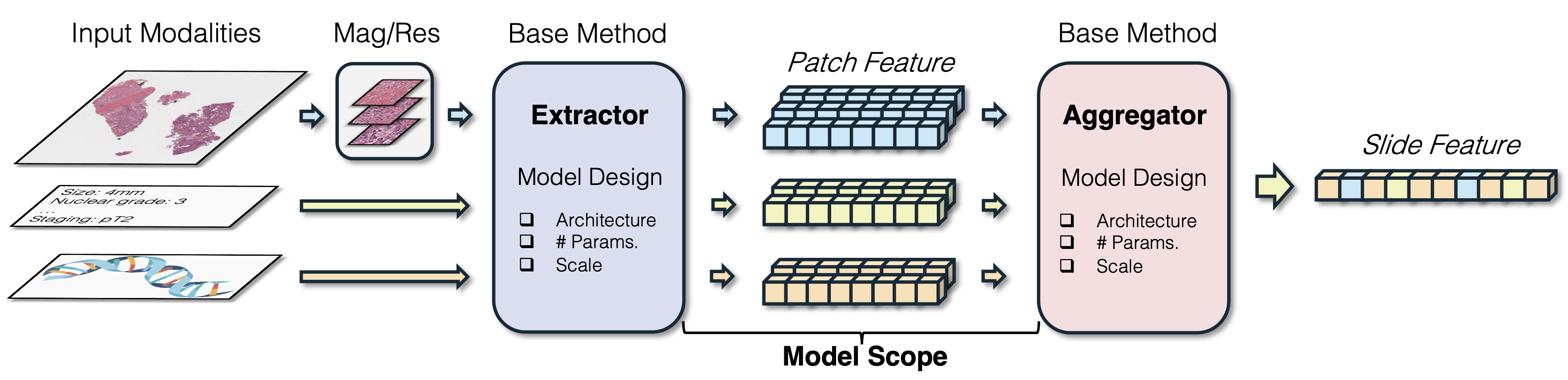
Figure 1: Schematic representation of our hierarchical taxonomy integrated within the MIL framework for PFMs.
📄 Survey Paper Citation
If you find our paper useful, please consider citing our paper in your work:
@inproceedings{ijcai2025p1193,
  title={A Survey of Pathology Foundation Model: Progress and Future Directions},
  author={Xiong, Conghao and Chen, Hao and Sung, Joseph J. Y.},
  booktitle={Proceedings of the Thirty-Fourth International Joint Conference on Artificial Intelligence, IJCAI-25},
  pages={10751--10760},
  year={2025},
  month={8},
  note={Survey Track},
  doi={10.24963/ijcai.2025/1193},
  url={https://doi.org/10.24963/ijcai.2025/1193}
}
Update policy: This website is a living companion to the IJCAI 2025 survey. The IJCAI paper is the fixed camera-ready record; the website and JSON tables are maintained as live resources with updated venues, links, metadata, and curated table refinements.
Hierarchical Taxonomy for PFMs
The following table presents comprehensive technical specifications for Our Surveyed PFMs according to our hierarchical taxonomy dimensions: Model Scope, Model Pretraining, and Model Design. This hierarchical taxonomy encompasses:
- 🔧 Model Scope → Extractor-centric, Aggregator-centric, Hybrid-centric approaches
- ⚙️ Model Pretraining → Input modalities, base methods, magnification/resolution specifications
- 🏗️ Model Design → Model architectures, parameter counts, scale categories (XS to G)
- 📏 Scale Hierarchy → From 2.78M (XS) to 1.9B (G) parameters following model-scale categorization
Input Modalities: H&E (H), Patch (P), Text (T), WSIs with unspecified stains (W), IHC (I), Genomics (G), DNA (D), RNA (R).
Scale Categories: XS, S, B, L, H, g, G (Extra-Small to Giant) based on parameter count
🔍 Essential for developers to understand PFM architectures, computational requirements, and implementation specifications for deployment in clinical and research environments.
| Model Scope | Model Pretraining | Model Design | ||||||
|---|---|---|---|---|---|---|---|---|
| Model | Extractor | Aggregator | Input | Base Method | Mag/Res | Architecture | # Params. | Scale |
| CTransPath | ✅ | ❌ | H | MoCov3 | 10/224 | Swin-T/14 | 28.3M | S |
| REMEDIS | ✅ | ❌ | H | SimCLR | Multi/224 | ResNet-50 | 25.6M | S |
| HIPT | ✅ | ✅ | H | DINO | 20/256,4096 | ViT-S/16-XS/256 | 21.7/2.78M | S/XS |
| PLIP | ✅ | ❌ | P, T | CLIP | 20/224 | ViT-B/32 | 87M | B |
| CONCH | ✅ | ❌ | W, T | iBOT/CoCa | 20/256 | ViT-B/16 | 86.3M | B |
| Phikon | ✅ | ❌ | H | iBOT | 20/224 | ViT-S/B/L/16 | 21.7/85.8/307M | S/B/L |
| UNI | ✅ | ❌ | H | DINOv2 | 20/256,512 | ViT-L/16 | 307M | L |
| Virchow | ✅ | ❌ | H | DINOv2 | 20/224 | ViT-H/14 | 632M | H |
| SINAI | ✅ | ❌ | H | DINO/MAE | Unknown | ViT-S/L | 21.7M/303.3M | S/L |
| CHIEF | ❌ | ✅ | H, T | Sup.+CLIP | 10/224 | CHIEF | 1.2M | XS |
| Prov-GigaPath | ✅ | ✅ | H, I | DINOv2/MAE | 20/256 | ViT-g/14/LongNet | 1.13B/85.1M | g/B |
| Pathoduet | ✅ | ❌ | H, I | MoCov3 | 40/256,20/1024 | ViT-B/16 | 85.8M | B |
| RudolfV | ✅ | ❌ | W | DINOv2 | 20,40,80/256 | ViT-L/14 | 304M | L |
| PLUTO | ✅ | ❌ | W | DINOv2+MAE+Fourier | 20,40/224 | FlexiViT-S/16 | 22M | S |
| PRISM | ❌ | ✅ | H, T | CoCa | 20/224 | Perceiver | 45.0M | S |
| TANGLE | ✅ | ✅ | H, G | iBOT/SimCLR | 20/224 | ViT-B/16/ABMIL | 86.3/2.3M | B/XS |
| MUSK | ✅ | ❌ | H, T | MIM | 10,20,40/384 | BEiT-3 | 675M | H |
| BEPH | ✅ | ❌ | H | MIM | 40/224 | BEiTv2 | 192.55M | B |
| Hibou | ✅ | ❌ | W | DINOv2 | Unknown | ViT-B/14, ViT-L/14 | 86.3/307M | B/L |
| mSTAR+ | ✅ | ✅ | H, G, T | CLIP/ST | 20/256 | TransMIL+/ViT-L | 2.67/307M | XS/L |
| GPFM | ✅ | ❌ | H | UKD | 40/512 | ViT-L/14 | 307M | L |
| Virchow2G | ✅ | ❌ | W | DINOv2 | 5,10,20,40/224 | ViT-G/14 | 1.9B | G |
| MADELEINE | ❌ | ✅ | W | CLIP | 10,20/256 | MH-ABMIL | 5.0M | XS |
| Phikon-v2 | ✅ | ❌ | W | DINOv2 | 20/224 | ViT-L/16 | 307M | L |
| TITAN | ❌ | ✅ | W, T | iBOT/CoCa | 20/8192 | TITAN/TITAN-V | 48.5/42.1M | S |
| KEEP | ✅ | ❌ | W, T | KEVL/CLIP-style VLP | 20/224 | UNI | 307M | L |
| THREADS | ❌ | ✅ | H, D, R | CLIP | 20/512 | MH-ABMIL | 11.3M | XS |
Foundation Models Overview
The following comprehensive table presents the surveyed PFMs with detailed technical specifications aligned with our hierarchical taxonomy. This systematic compilation encompasses models from premier venues spanning the latest advances in computational pathology:
- 🏆 Publication Venues → Nature, Nature Medicine, CVPR, ECCV, and leading conferences
- 🔬 Training Methods → Self-supervised learning, contrastive learning, masked image modeling
- 🏗️ Model Architectures → Vision Transformers, ResNet, BEiT, Swin Transformers
- 📊 Training Scale → Up to 3.1M WSIs and 2B+ patches for pretraining
- 🔗 Complete Resources → GitHub repositories, HuggingFace models, research papers, docker images
Technical Details: Publication venue, pretraining methodology, model architecture, data sources, dataset statistics, and direct access links to implementations and pre-trained models.
🚀 Essential reference for researchers to explore PFM specifications, access implementations, and compare training scales across the computational pathology landscape.
| Venue | Model | Method | Architecture | Data Source | Data Statistics | Links |
|---|---|---|---|---|---|---|
| MedIA | CTransPath | SRCL | Swin-T/14 | TCGA + PAIP | 32,220 WSIs 15,580,262 Patches | GitHub PDF |
| Nat. Biomed. Eng. | REMEDIS | SimCLR | ResNet-50 | TCGA | 29,018 WSIs 50 Million Patches | |
| CVPR | HIPT | DINO | ViT-S/16 ViT-XS/256 | TCGA | 10,678 H&E WSIs ~ 104 Million Patches | GitHub PDF |
| Nat. Med. | PLIP | CLIP | ViT-B/32 | OpenPath | 208,414 Image-Text Pairs | HuggingFace GitHub PDF |
| Nat. Med. | CONCH | P: iBOT A: CoCa | P: ViT-B/16 A: GPT-style | In-house | 21,442 WSIs 16 Million Patches > 1.17M Image-Text Pairs | HuggingFace GitHub PDF |
| medRxiv | Phikon | iBOT | ViT-S/B/L/16 | TCGA | 6,093 WSIs 43,374,634 Patches | HuggingFace GitHub PDF |
| Nat. Med. | UNI | DINOv2 | ViT-L/16 | Mass-100K | 100,426 H&E WSIs 100,130,900 Patches | HuggingFace GitHub PDF |
| Nat. Med. | Virchow | DINOv2 | ViT-H/14 | MSKCC | 1,488,550 H&E WSIs 2 Billion Patches | HuggingFace GitHub PDF |
| AAAI S. | SINAI | DINO MAE | ViT-S ViT-L | Mount Sinai Health System | 423,563 H&E WSIs 3.2 Billion Patches | GitHub PDF |
| Nature | CHIEF | P: Pretrained S: Sup.+CLIP | P: CTransPath S: CHIEF | Public + In-house | 60,530 H&E WSIs ~ 15 Million Patches | Docker GitHub PDF |
| Nature | Prov-GigaPath | P: DINOv2 S: MAE A: CLIP | P: ViT-g/14 S: LongNet | Providence Health System | 171,189 WSIs 1,384,860,229 Patches | HuggingFace GitHub PDF |
| MedIA | Pathoduet | Enhanced MoCov3 | ViT-B/16 | TCGA | 11,000 WSIs 13,166,437 Patches | GitHub PDF |
| arXiv | RudolfV | DINOv2 | ViT-L/14 | TCGA + In-house | 133,998 WSIs 1.25 Billion Patches | |
| ICML W. | PLUTO | DINOv2+ MAE+Fourier | FlexiViT-S/16 | TCGA + Proprietary | 158,852 WSIs 195 Million Patches | |
| arXiv | PRISM | P: Pretrained S: CoCa | P: Virchow S: Perceiver | MSKCC | 587,196 WSIs 195K Pathology Reports | HuggingFace PDF |
| CVPR | TANGLE | P: iBOT S: Alignment | P: ViT-B/16 S: ABMIL | TG-GATEs TCGA-BRCA TCGA-NSCLC | Visual pretraining: 47,227 WSIs 15M Patches S+E RNA pairs: 6,597 liver 1,020 breast 1,012 lung | GitHub PDF |
| Nature | MUSK | UMP | BEiT-3 | Quilt-1M + PathAsst | ~33,000 H&E WSIs 50M Patches 1M Image-Text Pairs | HuggingFace GitHub PDF |
| Nat. Commun. | BEPH | MIM | BEiTv2 | TCGA | 11,760 WSIs 11,774,353 Patches | GitHub PDF |
| arXiv | Hibou | DINOv2 | ViT-L/14 ViT-B/14 | Proprietary | 936,441 H&E WSIs 202,464 non-H&E WSIs ViT-L: 1.2B Patches ViT-B: 512M Patches | HuggingFace GitHub PDF |
| Nat. Commun. | mSTAR+ | S: CLIP P: mSTAR | S: TransMIL+ (pretrained aggregator) P: ViT-L | TCGA | 11,727 WSIs 22,127 Pretraining Modality Pairs 26,169 Curated Modality Pairs | HuggingFace GitHub PDF |
| Nat. Biomed. Eng. | GPFM | UKD | ViT-L/14 | 33 Public Dataset | 72,280 WSIs 190,212,668 Patches | HuggingFace GitHub PDF |
| arXiv | Virchow2 Virchow2G | Enhanced DINOv2 | ViT-H/14 ViT-G/14 | MSKCC + Worldwide | 3,134,922 WSIs with Diverse Stains | HuggingFace PDF |
| ECCV | MADELEINE | P: Pretrained S: CLIP + GOT | P: CONCH S:MH-ABMIL | Acrobat + BWH | 16,281 WSIs with Diverse Stains | HuggingFace GitHub PDF |
| arXiv | Phikon-v2 | DINOv2 | ViT-L/16 | Public + In-house | 58,359 WSIs 456,060,584 Patches | HuggingFace PDF |
| Nat. Med. | TITAN | P: Pretrained Stage1: iBOT Stage2: CoCa | P: CONCHv1.5 S: ViT-T/14 | Mass-340K | 335,645 WSIs 423,122 Image-Text Pairs 182,862 WSI-Text Pairs | HuggingFace GitHub PDF |
| Cancer Cell | KEEP | KEVL | UNI | Quilt-1M + OpenPath | 143K KG-structured Image-Text Semantic Groups Hierarchical Medical KG | HuggingFace GitHub DOI |
| arXiv | THREADS | P: Pretrained S: CLIP | P: CONCHv1.5 S: MH-ABMIL | MBTG-47K: MGH+BWH +TCGA +GTEx | 47,171 H&E WSIs 125,148,770 Patches 26,615 Bulk RNA 20,556 DNA Variants | Benchmark/Data Benchmark Code Paper |
Evaluation Benchmark
The following comparison table systematically evaluates the PFMs across 13 distinct evaluation tasks within our comprehensive evaluation benchmark. The analysis spans four critical capability domains aligned with the Multiple Instance Learning (MIL) paradigm:
- 🩻 Slide-Level Tasks → WSI classification, survival prediction, retrieval, segmentation
- 🧩 Patch-Level Tasks → Patch classification, patch-to-patch analysis, segmentation
- 🤖 Multimodal Tasks → Image-to-text, text-to-image, report generation, VQA
- 🧬 Biological Tasks → Genetic alteration, molecular prediction
Evaluation Paradigms: Zero-shot (Z), Few-shot (F), Complete Training (C), Not Available (❌)
💡 Critical for practitioners seeking to identify optimal PFMs for specific tasks, from basic WSI classification to advanced multimodal AI tasks.
| Model | Slide Level | Patch Level | Multimodal | Biological | |||||||||
|---|---|---|---|---|---|---|---|---|---|---|---|---|---|
| Cls. | Surv. | Retri. | Seg. | Cls. | P2P | Seg. | I2T | T2I | RG | VQA | GA | MP | |
| CTransPath | C | C | ❌ | ❌ | F/C | Z | C | ❌ | ❌ | ❌ | ❌ | ❌ | ❌ |
| REMEDIS | C | C | ❌ | ❌ | ❌ | ❌ | ❌ | ❌ | ❌ | ❌ | ❌ | ❌ | ❌ |
| HIPT | C | C | ❌ | ❌ | ❌ | ❌ | ❌ | ❌ | ❌ | ❌ | ❌ | ❌ | ❌ |
| PLIP | ❌ | ❌ | ❌ | ❌ | Z | Z | ❌ | ❌ | Z | ❌ | ❌ | ❌ | ❌ |
| CONCH | Z/F/C | ❌ | ❌ | Z | Z/F | ❌ | ❌ | Z | Z | C | ❌ | ❌ | ❌ |
| Phikon | C | C | ❌ | ❌ | C | ❌ | ❌ | ❌ | ❌ | ❌ | ❌ | C | C |
| UNI | F/C | ❌ | F | ❌ | F/C | Z | C | ❌ | ❌ | ❌ | ❌ | ❌ | ❌ |
| Virchow | C | ❌ | ❌ | ❌ | C | ❌ | ❌ | ❌ | ❌ | ❌ | ❌ | C | ❌ |
| SINAI | C | ❌ | ❌ | ❌ | ❌ | ❌ | ❌ | ❌ | ❌ | ❌ | ❌ | C | C |
| CHIEF | C | C | ❌ | ❌ | ❌ | ❌ | ❌ | ❌ | ❌ | ❌ | ❌ | C | C |
| Prov-GigaPath | Z/C | ❌ | C | ❌ | ❌ | ❌ | ❌ | ❌ | ❌ | ❌ | ❌ | Z/C | ❌ |
| Pathoduet | C | ❌ | ❌ | ❌ | F/C | ❌ | ❌ | ❌ | ❌ | ❌ | ❌ | ❌ | F/C |
| RudolfV | ❌ | ❌ | Z | ❌ | C | ❌ | C | ❌ | ❌ | ❌ | ❌ | C | C |
| PLUTO | C | ❌ | ❌ | ❌ | C | ❌ | C | ❌ | ❌ | ❌ | ❌ | ❌ | C |
| PRISM | Z/C | ❌ | ❌ | ❌ | ❌ | ❌ | ❌ | ❌ | ❌ | C | ❌ | F/C | ❌ |
| TANGLE | F | ❌ | C | ❌ | ❌ | ❌ | ❌ | ❌ | ❌ | ❌ | ❌ | ❌ | ❌ |
| MUSK | C | C | ❌ | ❌ | Z/F/C | Z | ❌ | Z | Z | ❌ | C | C | C |
| BEPH | Z/F/C | C | ❌ | ❌ | C | ❌ | ❌ | ❌ | ❌ | ❌ | ❌ | ❌ | ❌ |
| Hibou | C | ❌ | ❌ | ❌ | C | ❌ | C | ❌ | ❌ | ❌ | ❌ | C | ❌ |
| mSTAR+ | Z/F/C | C | ❌ | ❌ | ❌ | ❌ | ❌ | ❌ | ❌ | C | ❌ | C | C |
| GPFM | C | C | ❌ | ❌ | C | Z | ❌ | ❌ | ❌ | C | C | C | ❌ |
| Virchow2 | ❌ | ❌ | ❌ | ❌ | C | ❌ | ❌ | ❌ | ❌ | ❌ | ❌ | ❌ | ❌ |
| MADELEINE | F | C | ❌ | ❌ | ❌ | ❌ | ❌ | ❌ | ❌ | ❌ | ❌ | ❌ | F/C |
| Phikon-v2 | F/C | ❌ | ❌ | ❌ | ❌ | ❌ | ❌ | ❌ | ❌ | ❌ | ❌ | F/C | F/C |
| TITAN | Z/F/C | C | Z | ❌ | C | ❌ | ❌ | Z | Z | C | ❌ | C | C |
| KEEP | Z | ❌ | ❌ | Z | Z | ❌ | ❌ | Z | Z | ❌ | ❌ | ❌ | ❌ |
| THREADS | F/C | C | Z | ❌ | ❌ | ❌ | ❌ | ❌ | ❌ | ❌ | ❌ | C | F/C |
📚 Curated Papers
Paper tags: task describes the final problem/output; topic describes the main technical route.
Task tags: classification WSI/patch/tile classification; survival prognosis/risk prediction; segmentation segmentation or localization; generation synthesis or augmentation; molecular gene/RNA/DNA/spatial transcriptomics/pathway prediction or generation; language VQA/caption/report/dialogue outputs; compression WSI compression; benchmark dataset or benchmark contribution.
Topic tags: mil MIL or slide-level aggregation; foundation_model pathology foundation model pretraining/adaptation/evaluation; vision_language image-text/report/language-prompt/VLM/LLM reasoning; generative_model diffusion, flow, VAE, or related generative modeling; multi_omics histology with gene/RNA/DNA/genomic/spatial transcriptomic/pathway data, not report text alone; efficient_wsi sampling, compression, scalable training/inference, or other WSI efficiency methods.
Show curated paper list
ICML 2026
CVPR 2026
ICLR 2026
- ASMIL: Attention-Stabilized Multiple Instance Learning for Whole-Slide Imaging: This paper proposes ASMIL, an attention-stabilized MIL framework that uses an anchor model, normalized sigmoid attention, and token random dropping, addressing unstable attention dynamics, over-concentrated attention, and overfitting in WSI diagnosis.
Tags: task:classification; topic:mil - Exploiting Low-Dimensional Manifold of Features for Few-Shot Whole Slide Image Classification: This paper proposes the Manifold Residual block, a plug-and-play module that preserves pathology foundation model feature geometry with a fixed random anchor and low-rank residual pathway, addressing overfitting and manifold distortion in few-shot WSI classification.
Tags: task:classification; topic:foundation_model,mil - Multihead Mixture of Experts for Classification of Gigapixel Pathology Images: This paper proposes MAMMOTH, a parameter-efficient multi-head mixture-of-experts transformation module for MIL pipelines, addressing the overlooked bottleneck between general-purpose patch features and task-specific slide-level aggregation.
Tags: task:classification; topic:mil - Histopathology-Genomics Multi-modal Structural Representation Learning for Data-Efficient Precision Oncology: This paper proposes MSRL, a graph-structure-learning framework for histopathology-genomics representation learning that models inter-case relevance and uses authentic genomics from related training cases, addressing missing genomics and data-efficient precision oncology prediction.
Tags: task:survival,classification,molecular; topic:multi_omics - Fusing Pixels and Genes: Spatially-Aware Learning in Computational Pathology: This paper proposes STAMP, a spatial-transcriptomics-augmented pathology representation learning framework that aligns pathology images with spatial gene expression using hierarchical multi-scale contrastive alignment, addressing weak molecular supervision in pathology image representations.
Tags: task:molecular; topic:multi_omics - HistoPrism: Unlocking Functional Pathway Analysis from Pan-Cancer Histology via Gene Expression Prediction: This paper proposes HistoPrism, an efficient transformer-based pan-cancer model for predicting spatial gene expression from H&E histology and a pathway-level benchmark, addressing cross-cancer generalization and functional coherence in histology-to-transcriptomics modeling.
Tags: task:molecular; topic:multi_omics - Structural Prognostic Event Modeling for Multimodal Cancer Survival Analysis: This paper proposes SlotSPE, a slot-based multimodal survival framework that compresses histology images and gene profiles into modality-specific prognostic event slots, addressing sparse patient-specific survival signals and interpretable multimodal interaction modeling.
Tags: task:survival; topic:multi_omics - Bridging Radiology and Pathology Foundation Models via Concept-Based Multimodal Co-Adaptation: This paper proposes Concept Tuning and Fusing, a parameter-efficient framework that uses clinically grounded concepts and shared prompt tokens to co-adapt radiology and pathology foundation models, addressing cross-domain multimodal fusion and interpretability.
Tags: task:classification,survival; topic:foundation_model,vision_language - PathChat-SegR1: Reasoning Segmentation in Pathology via SO-GRPO: This paper proposes PathChat-SegR1, a pathology reasoning-segmentation model with stain-invariant self-distillation and segmentation-optimized GRPO, addressing zero-shot pathology segmentation and the lack of pathology-specific reasoning segmentation benchmarks.
Tags: task:segmentation,language,benchmark; topic:vision_language
AAAI 2026
- PathFLIP: Fine-grained Language-Image Pretraining for Versatile Computational Pathology: This paper proposes PathFLIP, a fine-grained pathology language-image pretraining framework that decomposes slide captions into region-level sub-captions and grounds them to WSI regions, addressing weak visual-text alignment for slide classification, retrieval, lesion localization, and instruction-following pathology analysis.
Tags: task:classification,segmentation,language; topic:foundation_model,vision_language - Graph-Semantic Guided Learning for Virtual Immunohistochemistry Staining on Consecutive Histology Sections: This paper proposes GSGStain, a graph-semantic guided virtual IHC staining framework that builds cell graphs from H&E images and rectifies noisy biomarker semantics from adjacent IHC sections, addressing semantic underuse and section-misalignment artifacts in H&E-to-IHC generation.
Tags: task:generation; topic:generative_model - Auxiliary Gene Learning: Spatial Gene Expression Estimation by Auxiliary Gene Selection: This paper proposes Auxiliary Gene Learning, which reformulates ignored low-expression genes as auxiliary prediction tasks and selects useful auxiliary genes with differentiable top-k bi-level optimization, addressing noisy and restricted target-gene supervision in spatial gene expression estimation from pathological images.
Tags: task:molecular; topic:multi_omics - Towards Effective and Efficient Context-aware Nucleus Detection in Histopathology Whole Slide Images: This paper proposes an efficient context-aware nucleus detection method that reuses historical sliding-window features and nearby unlabeled patches instead of repeatedly cropping large field-of-view regions, addressing missing tissue context and high WSI inference latency.
Tags: task:segmentation; topic:efficient_wsi - FedSDA: Federated Stain Distribution Alignment for Non-IID Histopathological Image Classification: This paper proposes FedSDA, a federated stain distribution alignment method that uses stain separation and privacy-conscious diffusion-based distribution modeling to align client stain distributions, addressing non-IID histopathology classification under decentralized data constraints.
Tags: task:classification; topic:generative_model - HiFusion: Hierarchical Intra-Spot Alignment and Regional Context Fusion for Spatial Gene Expression Prediction from Histopathology: This paper proposes HiFusion, a spatial gene expression prediction framework that combines multi-resolution intra-spot morphology modeling with context-aware cross-scale fusion, addressing within-spot heterogeneity and noisy surrounding-tissue context in ST inference from H&E WSIs.
Tags: task:molecular; topic:multi_omics - CiNuSeg: Class Incremental Nuclei Segmentation via Anchor-driven Consistency Learning with Dual Region Regularization: This paper proposes CiNuSeg, an anchor-driven consistency learning framework with dual region regularization for class-incremental nuclei segmentation, addressing new-cell-class adaptation while preserving prior nuclei segmentation knowledge.
Tags: task:segmentation - MUSE: Multi-Scale Dense Self-Distillation for Nucleus Detection and Classification: This paper proposes MUSE, a multi-scale dense self-distillation method for nucleus detection and classification that uses coordinate-guided local self-distillation and large-field semi-supervised fine-tuning, addressing annotation scarcity and cross-scale representation learning in histopathological nuclei analysis.
Tags: task:segmentation,classification - Dual-Path Knowledge-Augmented Contrastive Alignment Network for Spatially Resolved Transcriptomics: This paper proposes DKAN, a dual-path knowledge-augmented contrastive alignment network that uses gene semantic representations from external databases and one-stage contrastive learning, addressing weak biological context use and heterogeneous image-gene alignment in spatial transcriptomics prediction.
Tags: task:molecular; topic:multi_omics - Content-aware Information Compression and Selection for Whole Slide Image Analysis: This paper proposes CICS, a plug-and-play WSI MIL module with context-aware compression and global-proximity selective attention, addressing redundant instance computation and uninformative feature interference in WSI classification and survival prediction.
Tags: task:classification,survival; topic:mil,efficient_wsi - Libra-MIL: Multimodal Prototypes Stereoscopic Infused with Task-specific Language Priors for Few-shot Whole Slide Image Classification: This paper proposes Libra-MIL, a multimodal prototype-based MIL framework that uses frozen LLM-generated task-specific pathology entity descriptions, vision prototypes, and stereoscopic optimal transport fusion, addressing few-shot WSI classification and interpretability under bag-level supervision.
Tags: task:classification; topic:mil,vision_language - Cancer Survival Prediction by Cyclic Generation and Multi-grained Alignment: This paper proposes CIMA, an end-to-end multimodal survival framework that cyclically imputes missing histopathology and genomics modalities and aligns slide patches with biological pathways, addressing incomplete genomics data and hard-to-interpret cross-modal interactions.
Tags: task:survival; topic:multi_omics,generative_model - Palimpsest: Reconciling the CISS Trilemma for Incremental Nuclei Segmentation: This paper proposes Palimpsest, an exemplar-free incremental nuclei segmentation framework with parameter-conserving synthesis, similarity-aware centroid recalibration, and adaptive residual shading, addressing the stability-plasticity-scalability trade-off in evolving computational pathology segmentation.
Tags: task:segmentation - Patho-R1: A Multimodal Reinforcement Learning-Based Pathology Expert Reasoner: This paper proposes Patho-R1, a pathology VLM reasoner trained through continued image-text pretraining, supervised chain-of-thought fine-tuning, and reinforcement learning, addressing diagnostic accuracy and reasoning plausibility in pathology classification, retrieval, VQA, and multiple-choice reasoning.
Tags: task:classification,language; topic:foundation_model,vision_language - Patho-AgenticRAG: Towards Multimodal Agentic Retrieval-Augmented Generation for Pathology VLMs via Reinforcement Learning: This paper proposes Patho-AgenticRAG, a multimodal agentic RAG framework that retrieves page-level text-image evidence from pathology textbooks and supports planning and multi-turn search, addressing hallucination and weak visual evidence grounding in pathology VLM reasoning.
Tags: task:language; topic:vision_language
NeurIPS 2025
- PathVQ: Reforming Computational Pathology Foundation Model for Whole Slide Image Analysis via Vector Quantization: This paper proposes PathVQ, a WSI foundation model framework that vector-quantizes spatial patch tokens into compact discrete codes and uses multi-scale VQ supervision for slide-level self-supervised learning, addressing the efficiency-representation trade-off in scalable pathology foundation models.
Tags: task:classification; topic:foundation_model,efficient_wsi - CPathAgent: An Agent-based Foundation Model for Interpretable High-Resolution Pathology Image Analysis Mimicking Pathologists' Diagnostic Logic: This paper proposes CPathAgent, an agent-based pathology foundation model that navigates WSIs through zoom and move operations and unifies patch-, region-, and slide-level capabilities, addressing black-box WSI diagnosis by producing interpretable diagnostic summaries.
Tags: task:language,benchmark; topic:foundation_model,vision_language,efficient_wsi - Single GPU Task Adaptation of Pathology Foundation Models for Whole Slide Image Analysis: This paper proposes TAPFM, a single-GPU adaptation method that uses ViT attention for MIL aggregation while separately optimizing PFM representations and attention weights, making weakly supervised pathology foundation model adaptation practical for WSI mutation prediction.
Tags: task:classification,molecular; topic:foundation_model,mil,efficient_wsi - Revisiting End-to-End Learning with Slide-level Supervision in Computational Pathology: This paper proposes ABMILX with global correlation-based attention refinement and efficient multi-scale random patch sampling, revisiting end-to-end slide-level training to address the disjoint optimization and high compute cost of two-stage WSI MIL pipelines.
Tags: task:classification,survival; topic:mil,efficient_wsi - Navigating the MIL Trade-Off: Flexible Pooling for Whole Slide Image Classification: This paper proposes Maxsoft, a flexible MIL pooling function derived from temperature-controlled log-sum-exp pooling, together with PerPatch augmentation, to balance mean-like robustness and max-like sensitivity for low-data WSI classification.
Tags: task:classification; topic:mil - Sequential Attention-based Sampling for Histopathological Analysis: This paper proposes SASHA, a deep reinforcement learning framework that combines hierarchical attention-based MIL feature learning with sequential patch sampling, addressing WSI inference cost by selectively zooming into only 10-20% of high-resolution patches.
Tags: task:classification; topic:mil,efficient_wsi - MAPLE: Multi-scale Attribute-enhanced Prompt Learning for Few-shot Whole Slide Image Classification: This paper proposes MAPLE, a few-shot WSI classification framework that uses LLM-generated entity- and slide-level prompts, entity-guided cross-attention, and cross-scale entity graph learning to capture subtype-specific histological attributes under limited labels.
Tags: task:classification; topic:foundation_model,vision_language,mil - Cancer Survival Analysis via Zero-shot Tumor Microenvironment Segmentation on Low-resolution Whole Slide Pathology Images: This paper proposes ZTSurv, an end-to-end survival framework that performs zero-shot tumor and stroma segmentation from TIL maps on 50x downsampled WSIs and builds heterogeneous graphs over TME components, reducing annotation and computational costs for prognosis prediction.
Tags: task:survival,segmentation; topic:efficient_wsi - Learning Relative Gene Expression Trends from Pathology Images in Spatial Transcriptomics: This paper proposes STRank, a relative-expression learning objective that predicts gene-expression trends rather than absolute values from pathology images, addressing stochastic noise and batch effects in spatial transcriptomics prediction.
Tags: task:molecular; topic:multi_omics - GeneFlow: Translation of Single-cell Gene Expression to Histopathological Images via Rectified Flow: This paper proposes GeneFlow, a rectified-flow framework with an attention-based RNA encoder and conditional UNet to translate single- and multi-cell gene expression into paired histopathology images, addressing the many-to-one mapping between transcriptomics and morphology.
Tags: task:generation,molecular; topic:multi_omics,generative_model - D-VST: Diffusion Transformer for Pathology-Correct Tone-Controllable Cross-Dye Virtual Staining of Whole Slide Images: This paper proposes D-VST, a diffusion virtual staining transformer with separate pathology and tone encoders plus frequency-aware adaptive patch sampling, addressing pathology leakage and efficient billion-pixel WSI cross-dye virtual staining.
Tags: task:generation; topic:generative_model,efficient_wsi - SGCD: Stain-Guided CycleDiffusion for Unsupervised Domain Adaptation of Histopathology Image Classification: This paper proposes SGCD, a stain-guided dual diffusion framework with bidirectional generative constraints and consistency loss, addressing unpaired domain translation while preserving discriminative features for histopathology classification.
Tags: task:classification,generation; topic:generative_model - Semantic and Visual Crop-Guided Diffusion Models for Heterogeneous Tissue Synthesis in Histopathology: This paper proposes a latent diffusion model conditioned on semantic segmentation maps and tissue-specific visual crops, with a self-supervised extension for unannotated TCGA WSIs, addressing heterogeneous histopathology synthesis and annotated data scarcity.
Tags: task:generation,segmentation; topic:generative_model - MATCH: Multi-faceted Adaptive Topo-Consistency for Semi-Supervised Histopathology Segmentation: This paper proposes MATCH, a semi-supervised histopathology segmentation framework that enforces topological consistency across dropout- and snapshot-perturbed predictions and matches structures using spatial overlap and global alignment, addressing limited labels and noisy dense tissue objects.
Tags: task:segmentation - THUNDER: Tile-level Histopathology image UNDERstanding benchmark: This paper introduces THUNDER, a tile-level benchmark for digital pathology foundation models that compares 23 models across 16 datasets while analyzing downstream performance, feature spaces, robustness, and uncertainty, addressing fragmented evaluation of pathology feature extractors.
Tags: task:benchmark; topic:foundation_model - STARC-9: A Large-scale Dataset for Multi-Class Tissue Classification for CRC Histopathology: This paper introduces STARC-9, a 630K-tile CRC histopathology dataset across nine tissue classes, curated with DeepCluster++ and pathologist verification, addressing diversity, class balance, and quality limitations in public CRC tissue classification datasets.
Tags: task:classification,segmentation,benchmark; topic:foundation_model
ICCV 2025
- Graph Domain Adaptation with Dual-branch Encoder and Two-level Alignment for Whole Slide Image-based Survival Prediction: This paper proposes a dual-branch graph encoder with message-passing and shortest-path branches, together with two-level alignment at the category and feature levels to capture semantic information from WSIs and mitigate domain shifts between datasets.
Tags: task:survival; topic:mil - Continual Multiple Instance Learning with Enhanced Localization for Histopathological Whole Slide Image Analysis: This paper proposes CoMEL, a continual MIL framework that combines Grouped Double Attention Transformer instance encoding, bag-prototype pseudo-labeling, and orthogonal weighted LoRA to address forgetting and instance localization in weakly supervised WSI analysis.
Tags: task:classification,segmentation; topic:mil - Cracking Instance Jigsaw Puzzles: An Alternative to Multiple Instance Learning for Whole Slide Image Analysis: This paper proposes an instance jigsaw-puzzle alternative to permutation-invariant MIL, using a Siamese network grounded in optimal transport to restore shuffled instance order and capture spatial and semantic correlations for WSI classification and survival prediction.
Tags: task:classification,survival; topic:mil - Flow-MIL: Constructing Highly-expressive Latent Feature Space For Whole Slide Image Classification Using Normalizing Flow: This paper proposes Flow-MIL, which maps instance features into a simple, highly expressive latent space that preserves critical semantics via a normalizing-flow latent semantic embedding space and GMM-based latent prototypes, enabling better instance-level insight and stronger slide-level predictions.
Tags: task:classification; topic:mil,generative_model - GMMamba: Group Masking Mamba for Whole Slide Image Classification: This paper proposes GMMamba, which couples intra-group masking Mamba and cross-group super-feature sampling to form compact local representations and discriminative global features, thereby reducing redundant or uninformative instances and better modeling long-range dependencies in WSIs.
Tags: task:classification; topic:mil,efficient_wsi - Bridging Local Inductive Bias and Long-Range Dependencies with Pixel-Mamba for End-to-end Whole Slide Image Analysis: This paper introduces Pixel-Mamba, which incorporates local inductive biases through progressively expanding tokens to hierarchically combine both local and global information and address computational and representational challenges.
Tags: task:classification,survival; topic:efficient_wsi - WSI-LLaVA: A Multimodal Large Language Model for Whole Slide Image: This paper proposes WSI-LLaVA, a WSI-level MLLM trained through WSI-text alignment, feature-space alignment, and task-specific instruction tuning, and introduces WSI-Bench to address patch-level MLLMs limited whole-slide morphological reasoning.
Tags: task:language,benchmark; topic:foundation_model,vision_language - PS3: A Multimodal Transformer Integrating Pathology Reports with Histology Images and Biological Pathways for Cancer Survival Prediction: This paper proposes PS3, a prototype-based multimodal transformer that integrates pathology reports, histology whole slide images, and pathway-level transcriptomics, enabling effective intra-modal and cross-modal attention for survival prediction and addressing modality imbalance in early fusion.
Tags: task:survival; topic:vision_language,multi_omics - Controllable Latent Space Augmentation for Digital Pathology: This paper introduces HistAug, a controllable feature space augmentation for patch features, to overcome the challenge of heavy computational cost in patch image augmentation as well as the challenge of preserving the semantic information during feature space augmentation.
Tags: task:generation; topic:mil,generative_model,efficient_wsi - ModalTune: Fine-Tuning Slide-Level Foundation Models with Multi-Modal Information for Multi-task Learning in Digital Pathology: This paper proposes ModalTune, a fine-tuning framework that adds modal adapters to frozen slide-level foundation models and uses LLM-encoded label text to share semantics across tasks, modalities, and cancer types, addressing underused cross-task and cross-modal information in survival and subtype prediction.
Tags: task:classification,survival; topic:foundation_model
ICML 2025
- Scalable Generation of Spatial Transcriptomics from Histology Images via Whole-Slide Flow Matching: This paper proposes STFlow, a flow-matching generative model that predicts whole-slide spatial transcriptomics by modeling the joint gene-expression distribution and using local spatial attention, addressing independent spot prediction and memory constraints in ST-from-histology generation.
Tags: task:generation,molecular; topic:multi_omics,generative_model,efficient_wsi - Distributed Parallel Gradient Stacking (DPGS): Solving Whole Slide Image Stacking Challenge in Multi-Instance Learning: This paper introduces Distributed Parallel Gradient Stacking with Deep Model-Gradient Compression to solve the non-stackable data problem in MIL where varying patch counts across WSIs prevent efficient batch processing.
Tags: task:classification; topic:mil,efficient_wsi - L-Diffusion: Laplace Diffusion for Efficient Pathology Image Segmentation: This paper introduces a diffusion model using multiple Laplace distributions (instead of Gaussian) combined with contrastive learning for pixel-wise feature refinement to solve the challenge of segmenting rare cell and tissue types in pathology images with limited annotations.
Tags: task:segmentation; topic:generative_model - Do Multiple Instance Learning Models Transfer?: This paper systematically studies MIL transfer learning by evaluating pretrained MIL models across tissue subtyping, cancer grading, and molecular subtype tasks, showing when supervised MIL pretraining improves data-scarce computational pathology instead of training from scratch.
Tags: task:classification; topic:mil - How Effective Can Dropout Be in Multiple Instance Learning?: This paper introduces MIL-Dropout that systematically drops top-k most important instances to address noisy feature embeddings and weak supervision in WSI classification, demonstrating improved generalization across five MIL benchmarks with negligible computational cost.
Tags: task:classification; topic:mil
CVPR 2025
- FOCUS: Knowledge-enhanced Adaptive Visual Compression for Few-shot Whole Slide Image Classification: This paper introduces knowledge-enhanced adaptive visual compression with language prompts to solve the challenge of few-shot WSI classification with limited training data and vast irrelevant patches, achieving superior performance on cancer diagnosis by prioritizing diagnostically relevant regions through pathology foundation models.
Tags: task:classification; topic:foundation_model,vision_language,efficient_wsi - Distilled Prompt Learning for Incomplete Multimodal Survival Prediction: This paper introduces a two-stage prompting framework (unimodal and multimodal) to solve the challenge of incomplete multimodal data collection in survival prediction, enabling inference of missing modality information from available ones.
Tags: task:survival; topic:vision_language,multi_omics - Fast and Accurate Gigapixel Pathological Image Classification with Hierarchical Distillation Multi-Instance Learning: This paper proposes HDMIL, which trains high-resolution DMIN attention masks to supervise a lightweight low-resolution pre-screening network and adds a Chebyshev-polynomial KAN classifier, reducing WSI inference cost by filtering irrelevant regions while preserving classification accuracy.
Tags: task:classification; topic:mil,efficient_wsi - SlideChat: A Large Vision-Language Assistant for Whole-Slide Pathology Image Understanding: This paper introduces SlideChat, the first vision-language assistant capable of understanding gigapixel WSIs, supported by the SlideInstruction dataset (4.2K captions, 176K VQA pairs) and SlideBench benchmark, to solve the challenge of existing MLLMs being limited to patch-level analysis without WSI-level contextual understanding.
Tags: task:language,benchmark; topic:foundation_model,vision_language - 2DMamba: Efficient State Space Model for Image Representation with Applications on Giga-Pixel Whole Slide Image Classification: This paper introduces 2DMamba, a 2D selective state-space framework with a hardware-aware operator that preserves image spatial structure while keeping efficient long-context modeling, addressing transformer cost and 1D Mamba spatial mismatch for WSI classification and survival analysis.
Tags: task:classification,survival; topic:efficient_wsi - CPath-Omni: A Unified Multimodal Foundation Model for Patch and Whole Slide Image Analysis in Computational Pathology: This paper introduces CPath-Omni, a 15B pathology LMM that unifies patch- and WSI-level classification, VQA, captioning, and visual referring, with a specialized CPath-CLIP visual processor to reduce fragmentation between separate patch and slide models.
Tags: task:classification,language; topic:foundation_model,vision_language - MERGE: Multi-faceted Hierarchical Graph-based GNN for Gene Expression Prediction from Whole Slide Histopathology Images: This paper proposes MERGE, a hierarchical graph neural network that clusters patches by spatial and morphological features and connects intra- and inter-cluster tissue regions to improve WSI-based gene-expression prediction while using gene-aware smoothing to reduce ST artifacts.
Tags: task:molecular; topic:multi_omics - HistoFS: Non-IID Histopathologic Whole Slide Image Classification via Federated Style Transfer with RoI-Preserving: This paper introduces HistoFS, which incorporates a pseudo-bag style and an authenticity module so the model can learn from multiple centers while maintaining essential RoIs, addressing the non-IID challenge across centers.
Tags: task:classification; topic:mil - M3amba: Memory Mamba is All You Need for Whole Slide Image Classification: This paper proposes a memory-driven Mamba framework that fully explores the global latent relations among instances, mitigating both the contextual forgetting issue and the failure to capture global context in WSI that vanilla Mamba has.
Tags: task:classification; topic:mil,efficient_wsi - Advancing Multiple Instance Learning with Continual Learning for Whole Slide Imaging: This paper proposes Attention Knowledge Distillation and the Pseudo-Bag Memory Pool to supplement the current continual learning framework and mitigate catastrophic forgetting, mainly in the attention layer of the MIL model.
Tags: task:classification; topic:mil - WISE: A Framework for Gigapixel Whole-Slide-Image Lossless Compression: This paper proposes WISE as a lossless compression method that employs a hierarchical encoding strategy to extract effective bits, reducing the entropy of the image and then adopting a dictionary-based method to handle the irregular frequency patterns to mitigate the storage challenge of the gigapixel WSIs.
Tags: task:compression; topic:efficient_wsi - MExD: An Expert-Infused Diffusion Model for Whole-Slide Image Classification: This paper proposes MExD, an expert-infused diffusion model that uses an MoE aggregator to rebalance and denoise patch features, then generates WSI class distributions with a diffusion process to address noisy, imbalanced feature aggregation in WSI classification.
Tags: task:classification; topic:generative_model - Learning Heterogeneous Tissues with Mixture of Experts for Gigapixel Whole Slide Images: This paper proposes a plug-and-play Pathology-Aware Mixture-of-Experts module to learn pathology-specific information based on an MoE structure and discard patches that none of the experts prioritize, addressing complex pathological tissue environments and the absence of target-driven domain knowledge.
Tags: task:survival; topic:mil - Unsupervised Foundation Model-Agnostic Slide-Level Representation Learning: This paper proposes a self-supervised method for single-modality slide-level aggregator pretraining, using features from different foundation models and patch configurations for contrastive learning without requiring multimodal data or multiview augmentation.
Tags: task:classification; topic:foundation_model - Robust Multimodal Survival Prediction with Conditional Latent Differentiation Variational AutoEncoder: This paper proposes a Conditional Latent Differentiation Variational AutoEncoder for robust multimodal survival prediction that compresses gigapixel WSIs and generates genomic embeddings with diverse biological functions, enabling effective prediction even when genomic data is missing.
Tags: task:survival; topic:multi_omics,generative_model - BioX-CPath: Biologically-driven Explainable Diagnostics for Multistain IHC Computational Pathology: This paper introduces BioX-CPath, an explainable graph neural network for multistain IHC WSI classification that uses Stain-Aware Attention Pooling to create patient embeddings and expose stain attention and interactions, addressing biological interpretability in computational pathology.
Tags: task:classification; topic:mil - Multi-Resolution Pathology-Language Pre-training Model with Text-Guided Visual Representation: This paper proposes a multi-resolution pathology-language pre-training model that aligns visual and textual features across multiple magnification levels to address the challenge of single-resolution VLMs failing to capture both contextual overview and cellular details.
Tags: task:classification,survival; topic:foundation_model,vision_language
🔧 Useful Toolboxes
WSI I/O, Visualization, and Annotation
- OpenSlide: The foundational C library and Python interface for reading many WSI formats.
- QuPath: Open-source software for WSI visualization, annotation, and bioimage analysis.
- ASAP: A fast WSI viewer with annotation tools and support for visualizing algorithm outputs.
- SlideIO: A Python module for reading whole slides and slide regions across multiple microscopy formats.
- large_image: A tile-source library for serving and processing large images, including WSI-style tiled access.
- paquo: A Python interface for interacting with QuPath projects and annotations.
- ASlide: An integrated pathology image reading library with broad format support.
Preprocessing, QC, and Image Analysis
- histolab: A digital pathology image-processing library for WSI tiling and tissue-aware preprocessing.
- HistoQC: An open-source quality-control tool for detecting artifacts and quantifying slide quality.
- HistomicsTK: A Python toolkit for pathology image analysis algorithms in the Digital Slide Archive ecosystem.
- SliDL: A toolbox for WSI preprocessing workflows in deep learning, including tiling and artifact/background filtering.
- PathML: A Python toolbox for computational pathology workflows over high-resolution pathology images.
Modeling and End-to-End Pipelines
- CLAM: A WSI pipeline for patching, feature extraction, MIL training, and heatmap visualization.
- Trident: A foundation-model-oriented WSI processing toolkit from Mahmood Lab.
- TIAToolbox: An end-to-end PyTorch toolkit for WSI reading, preprocessing, modeling, and visualization.
- Slideflow: A Python package for building and evaluating deep learning models for digital pathology.
📊 Datasets
Public WSI Cohorts
- GDC Data Portal: Access to cancer study data, including TCGA and CPTAC tissue slide images where available.
- TCGA: A landmark cancer genomics program with diagnostic slide images accessible through the GDC ecosystem.
- GTEx Histology Viewer: Histology images from the Genotype-Tissue Expression project across normal human tissues.
- HEST-1k: Paired histology and spatial transcriptomics data with an accompanying HEST library and benchmark.
Challenge and Task-Specific WSI Datasets
- Camelyon16: H&E lymph-node WSIs for breast cancer metastasis detection.
- Camelyon17: Multi-center H&E lymph-node WSIs for breast cancer metastasis detection and classification.
- PANDA: Prostate biopsy WSIs for Gleason grading and prostate cancer grade assessment.
- BRACS: Breast carcinoma subtyping data with labeled WSIs and labeled ROIs.
- BCNB: Early breast cancer core-needle biopsy WSIs with clinical variables and pathologist annotations.
- PAIP2021: Multi-organ WSIs for perineural invasion detection in colon, prostate, and pancreatobiliary cancers.
- TUPAC16: Breast cancer WSIs for tumor proliferation assessment.
- TIGER: Breast cancer WSIs for tumor-infiltrating lymphocyte assessment.
- ACROBAT: Multi-stain breast cancer WSIs for WSI registration.
- HEROHE: H&E breast cancer WSIs for HER2-status prediction.
- BreastPathQ: Breast cancer H&E WSI-derived data for tumor cellularity assessment.
Multimodal and Image-Text Pathology Datasets
- Quilt-1M: A histopathology image-text dataset with paired image-text samples curated from educational and web sources.
- OpenPath: Pathology image-text pairs curated from public medical social-media content for PLIP pretraining.
- PathGen-1.6M: A pathology image-caption dataset generated through a multi-agent collaboration pipeline.
🏆 Benchmarks
Pathology Foundation Model and MIL Benchmarks
- Patho-Bench: A standardized benchmark library for computational pathology foundation models.
- HEST-Benchmark: A benchmark for evaluating pathology foundation models on gene-expression prediction from histology.
- PathBench-MIL: A benchmarking and AutoML framework for multiple-instance learning pipelines in histopathology.
- THUNDER: A tile-level histopathology benchmark for comparing pathology foundation models across downstream performance, feature space, robustness, and uncertainty.
- eva: An open-source evaluation framework and public leaderboard for oncology and pathology foundation models.
- PLISM benchmark: A robustness benchmark for pathology foundation models on the PLISM dataset.
- PathBench (Clinical PFM): A multi-task, multi-organ clinical benchmark and leaderboard for real-world pathology foundation model evaluation.
WSI Vision-Language and Multimodal Benchmarks
- WSI-Bench: A morphology-aware benchmark for gigapixel WSI understanding and VQA.
- SlideBench: A WSI multimodal benchmark released with SlideChat for captioning, report, and closed-form VQA tasks.
- PathMMU: An expert-validated pathology multimodal understanding and reasoning benchmark.
- PathBench (LMM): A patch- and WSI-level pathology large multimodal model benchmark with PatchVQA, WSICap, and WSIVQA subsets.
- HistoVL: A holistic histopathology vision-language benchmark spanning many organs, cancer types, cohorts, and acquisition tools.
- DALPHIN: A multicentric pathology AI copilot and VQA benchmark built from histopathology images derived from whole-slide cases.
- REG2 / REG2026: A WSI pathology report-generation and diagnostic-reasoning challenge using paired slide and reasoning data.
Dense Prediction and Cell Benchmarks
- PFM-DenseBench: A large-scale dense-prediction benchmark evaluating pathology foundation models across segmentation datasets and adaptation strategies.
- PathoCellBench: A cell-phenotyping benchmark for pathology foundation models on H&E histopathology images.
- BCSS: A breast cancer semantic segmentation benchmark with tissue-region annotations from H&E whole-slide images.
- MIDOG: A mitosis detection and atypical mitosis classification benchmark focused on domain generalization in histopathology.
- OCELOT: A cell detection benchmark using paired cell-level and tissue-level histopathology annotations to study cell-tissue interaction.
Challenge Benchmarks and Leaderboards
- Camelyon16: Breast cancer lymph-node metastasis detection challenge.
- Camelyon17: Multi-center breast cancer lymph-node metastasis challenge.
- PANDA: Prostate cancer grade-assessment competition.
- PAIP2019: Liver cancer WSI segmentation and viable tumor burden estimation challenge.
- PAIP2021: Perineural invasion detection challenge across multiple organ cancers.
- TIGER: Tumor-infiltrating lymphocyte assessment challenge in breast cancer.
- ACROBAT: WSI registration challenge for differently stained breast cancer tissue sections.
- HEROHE: HER2-status prediction challenge from H&E breast cancer WSIs.
- TUPAC16: Breast tumor proliferation assessment challenge from whole-slide images.
- BreastPathQ: Breast cancer cellularity estimation challenge using H&E whole-slide image-derived data.
- ACDC@LungHP: Automatic cancer detection and classification benchmark for whole-slide lung histopathology.
- DigestPath2019: Digestive-system pathology detection and segmentation challenge.
- ANHIR: Automatic non-rigid histological image registration benchmark for differently stained tissue sections.
📄 Citation
If you find this repository useful, please cite our work:
@inproceedings{ijcai2025p1193,
  title={A Survey of Pathology Foundation Model: Progress and Future Directions},
  author={Xiong, Conghao and Chen, Hao and Sung, Joseph J. Y.},
  booktitle={Proceedings of the Thirty-Fourth International Joint Conference on Artificial Intelligence, IJCAI-25},
  pages={10751--10760},
  year={2025},
  month={8},
  note={Survey Track},
  doi={10.24963/ijcai.2025/1193},
  url={https://doi.org/10.24963/ijcai.2025/1193}
}
Similar repos


README
🔬 Awesome WSI: Everything about Computational Pathology
A Comprehensive Collection of Whole Slide Image Analysis and Pathology Foundation Models
🌐 Website • 📖 Our Survey • 📚 Curated Papers • 🔧 Toolboxes • 📊 Datasets • 🏆 Benchmarks
🌐 Website
Open the Awesome WSI Website
Interactive survey companion for pathology foundation models, evaluation tasks, curated papers, toolboxes, datasets, and benchmarks.
📋 Table of Contents
- 🆕 Latest Updates
- 🌐 Website
- 🎯 Overview
- 📑 Our Survey
- 📚 Curated Papers
- 🔧 Useful Toolboxes
- 📊 Datasets
- 🏆 Benchmarks
- 📄 Citation
🆕 Latest Updates
📈 Latest Updates & Milestones
| 📅 Timeline | 🎉 What's New |
|---|---|
| 🔔 May 2026 | Interactive Website Added! 🌐 A static website is now included for browsing the survey companion, foundation model explorer, evaluation matrix, curated papers, toolboxes, datasets, and benchmarks. Open it here: 🌐 Awesome WSI Website. |
| 🔔 May 2026 | Structured Data, Resources, and Official Links Updated! 📄 The survey citation now links to the official IJCAI proceedings page, PDF, and DOI. The Toolboxes, Datasets, and Benchmarks sections have been expanded with verified resources and migrated to structured JSON, together with the core tables and curated papers, so the README can be rendered consistently from data sources. Conference placeholders for upcoming curated paper sections have also been prepared. |
| 🔔 Oct 2025 | Toolboxes, Datasets, Benchmarks Online! 📑 The rest of the planned contents are online, available in 🔧 Useful Toolboxes, 📊 Datasets, and 🏆 Benchmarks! Check them out as we will update them regularly! |
| 🔔 July 2025 | Curated Papers Online! 📑 The curated paper section is online, and available in 📚 Curated Papers. More papers are coming and check it out! |
| 🌟 June 2025 | Survey Materials Organized! 📑 All materials related to our comprehensive survey have been carefully organized and are now available in 📑 Our Survey. More exciting updates coming your way soon! |
| 🚀 June 2025 | Repository Structure Finalized! 🎯 We've established the perfect organizational structure for this repository. Everything is now in its right place for optimal collaboration and accessibility! |
| 🏆 March 2025 | IJCAI 2025 Acceptance! 🎊 🎉 Our survey has been officially accepted by the prestigious IJCAI 2025 Survey Track! This is a major milestone for our research. |
Stay tuned for more exciting developments! 🔔
🎯 Overview
🔬 Computational Pathology Research Hub
Your comprehensive gateway to cutting-edge research in AI-powered computational pathology
Welcome to our systematic compilation of research works in computational pathology! This repository brings together groundbreaking publications from premier conferences and top-tier journals, creating an invaluable centralized resource for the global research community.
🌟 Why This Repository?
Perfect for: Researchers 👨🔬 | Practitioners 👩⚕️ | Students 🎓 | Anyone exploring the fascinating intersection of Artificial Intelligence and Computational Pathology
📚 What You'll Discover
🏆 Featured Content
- 🎊 Our IJCAI 2025 Survey Paper - Published in the IJCAI 2025 Survey Track
- ⚡ Latest High-Impact Research - Curated from top-tier conferences and journals
- 📊 Essential Datasets - Commonly utilized in computational pathology research
- 🏆 Comprehensive Benchmarks - Industry-standard evaluation frameworks
🚀 Ready to dive into the future of computational pathology? Explore our carefully curated collection and accelerate your research journey!
📑 Our Survey
A Survey of Pathology Foundation Model: Progress and Future Directions
IJCAI 2025 Survey Track
Abstract: Computational pathology, which involves analyzing whole slide images for automated cancer diagnosis, relies on multiple instance learning, where performance depends heavily on the feature extractor and aggregator. Recent Pathology Foundation Models (PFMs), pretrained on large-scale histopathology data, have significantly enhanced both the extractor and aggregator, but they lack a systematic analysis framework. In this survey, we present a hierarchical taxonomy organizing PFMs through a top-down philosophy applicable to foundation model analysis in any domain: model scope, model pretraining, and model design. Additionally, we systematically categorize PFM evaluation tasks into slide-level, patch-level, multimodal, and biological tasks, providing comprehensive benchmarking criteria. Our analysis identifies critical challenges in both PFM development (pathology-specific methodology, end-to-end pretraining, data-model scalability) and utilization (effective adaptation, model maintenance), paving the way for future directions in this promising field.
Figure 1: Schematic representation of our hierarchical taxonomy integrated within the MIL framework for PFMs.
📄 Survey Paper Citation
If you find our paper useful, please consider citing our paper in your work:
@inproceedings{ijcai2025p1193,
  title={A Survey of Pathology Foundation Model: Progress and Future Directions},
  author={Xiong, Conghao and Chen, Hao and Sung, Joseph J. Y.},
  booktitle={Proceedings of the Thirty-Fourth International Joint Conference on Artificial Intelligence, IJCAI-25},
  pages={10751--10760},
  year={2025},
  month={8},
  note={Survey Track},
  doi={10.24963/ijcai.2025/1193},
  url={https://doi.org/10.24963/ijcai.2025/1193}
}
Update policy: This website is a living companion to the IJCAI 2025 survey. The IJCAI paper is the fixed camera-ready record; the website and JSON tables are maintained as live resources with updated venues, links, metadata, and curated table refinements.
Hierarchical Taxonomy for PFMs
The following table presents comprehensive technical specifications for Our Surveyed PFMs according to our hierarchical taxonomy dimensions: Model Scope, Model Pretraining, and Model Design. This hierarchical taxonomy encompasses:
- 🔧 Model Scope → Extractor-centric, Aggregator-centric, Hybrid-centric approaches
- ⚙️ Model Pretraining → Input modalities, base methods, magnification/resolution specifications
- 🏗️ Model Design → Model architectures, parameter counts, scale categories (XS to G)
- 📏 Scale Hierarchy → From 2.78M (XS) to 1.9B (G) parameters following model-scale categorization
Input Modalities: H&E (H), Patch (P), Text (T), WSIs with unspecified stains (W), IHC (I), Genomics (G), DNA (D), RNA (R).
Scale Categories: XS, S, B, L, H, g, G (Extra-Small to Giant) based on parameter count
🔍 Essential for developers to understand PFM architectures, computational requirements, and implementation specifications for deployment in clinical and research environments.
| Model Scope | Model Pretraining | Model Design | ||||||
|---|---|---|---|---|---|---|---|---|
| Model | Extractor | Aggregator | Input | Base Method | Mag/Res | Architecture | # Params. | Scale |
| CTransPath | ✅ | ❌ | H | MoCov3 | 10/224 | Swin-T/14 | 28.3M | S |
| REMEDIS | ✅ | ❌ | H | SimCLR | Multi/224 | ResNet-50 | 25.6M | S |
| HIPT | ✅ | ✅ | H | DINO | 20/256,4096 | ViT-S/16-XS/256 | 21.7/2.78M | S/XS |
| PLIP | ✅ | ❌ | P, T | CLIP | 20/224 | ViT-B/32 | 87M | B |
| CONCH | ✅ | ❌ | W, T | iBOT/CoCa | 20/256 | ViT-B/16 | 86.3M | B |
| Phikon | ✅ | ❌ | H | iBOT | 20/224 | ViT-S/B/L/16 | 21.7/85.8/307M | S/B/L |
| UNI | ✅ | ❌ | H | DINOv2 | 20/256,512 | ViT-L/16 | 307M | L |
| Virchow | ✅ | ❌ | H | DINOv2 | 20/224 | ViT-H/14 | 632M | H |
| SINAI | ✅ | ❌ | H | DINO/MAE | Unknown | ViT-S/L | 21.7M/303.3M | S/L |
| CHIEF | ❌ | ✅ | H, T | Sup.+CLIP | 10/224 | CHIEF | 1.2M | XS |
| Prov-GigaPath | ✅ | ✅ | H, I | DINOv2/MAE | 20/256 | ViT-g/14/LongNet | 1.13B/85.1M | g/B |
| Pathoduet | ✅ | ❌ | H, I | MoCov3 | 40/256,20/1024 | ViT-B/16 | 85.8M | B |
| RudolfV | ✅ | ❌ | W | DINOv2 | 20,40,80/256 | ViT-L/14 | 304M | L |
| PLUTO | ✅ | ❌ | W | DINOv2+MAE+Fourier | 20,40/224 | FlexiViT-S/16 | 22M | S |
| PRISM | ❌ | ✅ | H, T | CoCa | 20/224 | Perceiver | 45.0M | S |
| TANGLE | ✅ | ✅ | H, G | iBOT/SimCLR | 20/224 | ViT-B/16/ABMIL | 86.3/2.3M | B/XS |
| MUSK | ✅ | ❌ | H, T | MIM | 10,20,40/384 | BEiT-3 | 675M | H |
| BEPH | ✅ | ❌ | H | MIM | 40/224 | BEiTv2 | 192.55M | B |
| Hibou | ✅ | ❌ | W | DINOv2 | Unknown | ViT-B/14, ViT-L/14 | 86.3/307M | B/L |
| mSTAR+ | ✅ | ✅ | H, G, T | CLIP/ST | 20/256 | TransMIL+/ViT-L | 2.67/307M | XS/L |
| GPFM | ✅ | ❌ | H | UKD | 40/512 | ViT-L/14 | 307M | L |
| Virchow2G | ✅ | ❌ | W | DINOv2 | 5,10,20,40/224 | ViT-G/14 | 1.9B | G |
| MADELEINE | ❌ | ✅ | W | CLIP | 10,20/256 | MH-ABMIL | 5.0M | XS |
| Phikon-v2 | ✅ | ❌ | W | DINOv2 | 20/224 | ViT-L/16 | 307M | L |
| TITAN | ❌ | ✅ | W, T | iBOT/CoCa | 20/8192 | TITAN/TITAN-V | 48.5/42.1M | S |
| KEEP | ✅ | ❌ | W, T | KEVL/CLIP-style VLP | 20/224 | UNI | 307M | L |
| THREADS | ❌ | ✅ | H, D, R | CLIP | 20/512 | MH-ABMIL | 11.3M | XS |
Foundation Models Overview
The following comprehensive table presents the surveyed PFMs with detailed technical specifications aligned with our hierarchical taxonomy. This systematic compilation encompasses models from premier venues spanning the latest advances in computational pathology:
- 🏆 Publication Venues → Nature, Nature Medicine, CVPR, ECCV, and leading conferences
- 🔬 Training Methods → Self-supervised learning, contrastive learning, masked image modeling
- 🏗️ Model Architectures → Vision Transformers, ResNet, BEiT, Swin Transformers
- 📊 Training Scale → Up to 3.1M WSIs and 2B+ patches for pretraining
- 🔗 Complete Resources → GitHub repositories, HuggingFace models, research papers, docker images
Technical Details: Publication venue, pretraining methodology, model architecture, data sources, dataset statistics, and direct access links to implementations and pre-trained models.
🚀 Essential reference for researchers to explore PFM specifications, access implementations, and compare training scales across the computational pathology landscape.
| Venue | Model | Method | Architecture | Data Source | Data Statistics | Links |
|---|---|---|---|---|---|---|
| MedIA | CTransPath | SRCL | Swin-T/14 | TCGA + PAIP | 32,220 WSIs 15,580,262 Patches | GitHub PDF |
| Nat. Biomed. Eng. | REMEDIS | SimCLR | ResNet-50 | TCGA | 29,018 WSIs 50 Million Patches | |
| CVPR | HIPT | DINO | ViT-S/16 ViT-XS/256 | TCGA | 10,678 H&E WSIs ~ 104 Million Patches | GitHub PDF |
| Nat. Med. | PLIP | CLIP | ViT-B/32 | OpenPath | 208,414 Image-Text Pairs | HuggingFace GitHub PDF |
| Nat. Med. | CONCH | P: iBOT A: CoCa | P: ViT-B/16 A: GPT-style | In-house | 21,442 WSIs 16 Million Patches > 1.17M Image-Text Pairs | HuggingFace GitHub PDF |
| medRxiv | Phikon | iBOT | ViT-S/B/L/16 | TCGA | 6,093 WSIs 43,374,634 Patches | HuggingFace GitHub PDF |
| Nat. Med. | UNI | DINOv2 | ViT-L/16 | Mass-100K | 100,426 H&E WSIs 100,130,900 Patches | HuggingFace GitHub PDF |
| Nat. Med. | Virchow | DINOv2 | ViT-H/14 | MSKCC | 1,488,550 H&E WSIs 2 Billion Patches | HuggingFace GitHub PDF |
| AAAI S. | SINAI | DINO MAE | ViT-S ViT-L | Mount Sinai Health System | 423,563 H&E WSIs 3.2 Billion Patches | GitHub PDF |
| Nature | CHIEF | P: Pretrained S: Sup.+CLIP | P: CTransPath S: CHIEF | Public + In-house | 60,530 H&E WSIs ~ 15 Million Patches | Docker GitHub PDF |
| Nature | Prov-GigaPath | P: DINOv2 S: MAE A: CLIP | P: ViT-g/14 S: LongNet | Providence Health System | 171,189 WSIs 1,384,860,229 Patches | HuggingFace GitHub PDF |
| MedIA | Pathoduet | Enhanced MoCov3 | ViT-B/16 | TCGA | 11,000 WSIs 13,166,437 Patches | GitHub PDF |
| arXiv | RudolfV | DINOv2 | ViT-L/14 | TCGA + In-house | 133,998 WSIs 1.25 Billion Patches | |
| ICML W. | PLUTO | DINOv2+ MAE+Fourier | FlexiViT-S/16 | TCGA + Proprietary | 158,852 WSIs 195 Million Patches | |
| arXiv | PRISM | P: Pretrained S: CoCa | P: Virchow S: Perceiver | MSKCC | 587,196 WSIs 195K Pathology Reports | HuggingFace PDF |
| CVPR | TANGLE | P: iBOT S: Alignment | P: ViT-B/16 S: ABMIL | TG-GATEs TCGA-BRCA TCGA-NSCLC | Visual pretraining: 47,227 WSIs 15M Patches S+E RNA pairs: 6,597 liver 1,020 breast 1,012 lung | GitHub PDF |
| Nature | MUSK | UMP | BEiT-3 | Quilt-1M + PathAsst | ~33,000 H&E WSIs 50M Patches 1M Image-Text Pairs | HuggingFace GitHub PDF |
| Nat. Commun. | BEPH | MIM | BEiTv2 | TCGA | 11,760 WSIs 11,774,353 Patches | GitHub PDF |
| arXiv | Hibou | DINOv2 | ViT-L/14 ViT-B/14 | Proprietary | 936,441 H&E WSIs 202,464 non-H&E WSIs ViT-L: 1.2B Patches ViT-B: 512M Patches | HuggingFace GitHub PDF |
| Nat. Commun. | mSTAR+ | S: CLIP P: mSTAR | S: TransMIL+ (pretrained aggregator) P: ViT-L | TCGA | 11,727 WSIs 22,127 Pretraining Modality Pairs 26,169 Curated Modality Pairs | HuggingFace GitHub PDF |
| Nat. Biomed. Eng. | GPFM | UKD | ViT-L/14 | 33 Public Dataset | 72,280 WSIs 190,212,668 Patches | HuggingFace GitHub PDF |
| arXiv | Virchow2 Virchow2G | Enhanced DINOv2 | ViT-H/14 ViT-G/14 | MSKCC + Worldwide | 3,134,922 WSIs with Diverse Stains | HuggingFace PDF |
| ECCV | MADELEINE | P: Pretrained S: CLIP + GOT | P: CONCH S:MH-ABMIL | Acrobat + BWH | 16,281 WSIs with Diverse Stains | HuggingFace GitHub PDF |
| arXiv | Phikon-v2 | DINOv2 | ViT-L/16 | Public + In-house | 58,359 WSIs 456,060,584 Patches | HuggingFace PDF |
| Nat. Med. | TITAN | P: Pretrained Stage1: iBOT Stage2: CoCa | P: CONCHv1.5 S: ViT-T/14 | Mass-340K | 335,645 WSIs 423,122 Image-Text Pairs 182,862 WSI-Text Pairs | HuggingFace GitHub PDF |
| Cancer Cell | KEEP | KEVL | UNI | Quilt-1M + OpenPath | 143K KG-structured Image-Text Semantic Groups Hierarchical Medical KG | HuggingFace GitHub DOI |
| arXiv | THREADS | P: Pretrained S: CLIP | P: CONCHv1.5 S: MH-ABMIL | MBTG-47K: MGH+BWH +TCGA +GTEx | 47,171 H&E WSIs 125,148,770 Patches 26,615 Bulk RNA 20,556 DNA Variants | Benchmark/Data Benchmark Code Paper |
Evaluation Benchmark
The following comparison table systematically evaluates the PFMs across 13 distinct evaluation tasks within our comprehensive evaluation benchmark. The analysis spans four critical capability domains aligned with the Multiple Instance Learning (MIL) paradigm:
- 🩻 Slide-Level Tasks → WSI classification, survival prediction, retrieval, segmentation
- 🧩 Patch-Level Tasks → Patch classification, patch-to-patch analysis, segmentation
- 🤖 Multimodal Tasks → Image-to-text, text-to-image, report generation, VQA
- 🧬 Biological Tasks → Genetic alteration, molecular prediction
Evaluation Paradigms: Zero-shot (Z), Few-shot (F), Complete Training (C), Not Available (❌)
💡 Critical for practitioners seeking to identify optimal PFMs for specific tasks, from basic WSI classification to advanced multimodal AI tasks.
| Model | Slide Level | Patch Level | Multimodal | Biological | |||||||||
|---|---|---|---|---|---|---|---|---|---|---|---|---|---|
| Cls. | Surv. | Retri. | Seg. | Cls. | P2P | Seg. | I2T | T2I | RG | VQA | GA | MP | |
| CTransPath | C | C | ❌ | ❌ | F/C | Z | C | ❌ | ❌ | ❌ | ❌ | ❌ | ❌ |
| REMEDIS | C | C | ❌ | ❌ | ❌ | ❌ | ❌ | ❌ | ❌ | ❌ | ❌ | ❌ | ❌ |
| HIPT | C | C | ❌ | ❌ | ❌ | ❌ | ❌ | ❌ | ❌ | ❌ | ❌ | ❌ | ❌ |
| PLIP | ❌ | ❌ | ❌ | ❌ | Z | Z | ❌ | ❌ | Z | ❌ | ❌ | ❌ | ❌ |
| CONCH | Z/F/C | ❌ | ❌ | Z | Z/F | ❌ | ❌ | Z | Z | C | ❌ | ❌ | ❌ |
| Phikon | C | C | ❌ | ❌ | C | ❌ | ❌ | ❌ | ❌ | ❌ | ❌ | C | C |
| UNI | F/C | ❌ | F | ❌ | F/C | Z | C | ❌ | ❌ | ❌ | ❌ | ❌ | ❌ |
| Virchow | C | ❌ | ❌ | ❌ | C | ❌ | ❌ | ❌ | ❌ | ❌ | ❌ | C | ❌ |
| SINAI | C | ❌ | ❌ | ❌ | ❌ | ❌ | ❌ | ❌ | ❌ | ❌ | ❌ | C | C |
| CHIEF | C | C | ❌ | ❌ | ❌ | ❌ | ❌ | ❌ | ❌ | ❌ | ❌ | C | C |
| Prov-GigaPath | Z/C | ❌ | C | ❌ | ❌ | ❌ | ❌ | ❌ | ❌ | ❌ | ❌ | Z/C | ❌ |
| Pathoduet | C | ❌ | ❌ | ❌ | F/C | ❌ | ❌ | ❌ | ❌ | ❌ | ❌ | ❌ | F/C |
| RudolfV | ❌ | ❌ | Z | ❌ | C | ❌ | C | ❌ | ❌ | ❌ | ❌ | C | C |
| PLUTO | C | ❌ | ❌ | ❌ | C | ❌ | C | ❌ | ❌ | ❌ | ❌ | ❌ | C |
| PRISM | Z/C | ❌ | ❌ | ❌ | ❌ | ❌ | ❌ | ❌ | ❌ | C | ❌ | F/C | ❌ |
| TANGLE | F | ❌ | C | ❌ | ❌ | ❌ | ❌ | ❌ | ❌ | ❌ | ❌ | ❌ | ❌ |
| MUSK | C | C | ❌ | ❌ | Z/F/C | Z | ❌ | Z | Z | ❌ | C | C | C |
| BEPH | Z/F/C | C | ❌ | ❌ | C | ❌ | ❌ | ❌ | ❌ | ❌ | ❌ | ❌ | ❌ |
| Hibou | C | ❌ | ❌ | ❌ | C | ❌ | C | ❌ | ❌ | ❌ | ❌ | C | ❌ |
| mSTAR+ | Z/F/C | C | ❌ | ❌ | ❌ | ❌ | ❌ | ❌ | ❌ | C | ❌ | C | C |
| GPFM | C | C | ❌ | ❌ | C | Z | ❌ | ❌ | ❌ | C | C | C | ❌ |
| Virchow2 | ❌ | ❌ | ❌ | ❌ | C | ❌ | ❌ | ❌ | ❌ | ❌ | ❌ | ❌ | ❌ |
| MADELEINE | F | C | ❌ | ❌ | ❌ | ❌ | ❌ | ❌ | ❌ | ❌ | ❌ | ❌ | F/C |
| Phikon-v2 | F/C | ❌ | ❌ | ❌ | ❌ | ❌ | ❌ | ❌ | ❌ | ❌ | ❌ | F/C | F/C |
| TITAN | Z/F/C | C | Z | ❌ | C | ❌ | ❌ | Z | Z | C | ❌ | C | C |
| KEEP | Z | ❌ | ❌ | Z | Z | ❌ | ❌ | Z | Z | ❌ | ❌ | ❌ | ❌ |
| THREADS | F/C | C | Z | ❌ | ❌ | ❌ | ❌ | ❌ | ❌ | ❌ | ❌ | C | F/C |
📚 Curated Papers
Paper tags: task describes the final problem/output; topic describes the main technical route.
Task tags: classification WSI/patch/tile classification; survival prognosis/risk prediction; segmentation segmentation or localization; generation synthesis or augmentation; molecular gene/RNA/DNA/spatial transcriptomics/pathway prediction or generation; language VQA/caption/report/dialogue outputs; compression WSI compression; benchmark dataset or benchmark contribution.
Topic tags: mil MIL or slide-level aggregation; foundation_model pathology foundation model pretraining/adaptation/evaluation; vision_language image-text/report/language-prompt/VLM/LLM reasoning; generative_model diffusion, flow, VAE, or related generative modeling; multi_omics histology with gene/RNA/DNA/genomic/spatial transcriptomic/pathway data, not report text alone; efficient_wsi sampling, compression, scalable training/inference, or other WSI efficiency methods.
Show curated paper list
ICML 2026
CVPR 2026
ICLR 2026
- ASMIL: Attention-Stabilized Multiple Instance Learning for Whole-Slide Imaging: This paper proposes ASMIL, an attention-stabilized MIL framework that uses an anchor model, normalized sigmoid attention, and token random dropping, addressing unstable attention dynamics, over-concentrated attention, and overfitting in WSI diagnosis.
Tags: task:classification; topic:mil - Exploiting Low-Dimensional Manifold of Features for Few-Shot Whole Slide Image Classification: This paper proposes the Manifold Residual block, a plug-and-play module that preserves pathology foundation model feature geometry with a fixed random anchor and low-rank residual pathway, addressing overfitting and manifold distortion in few-shot WSI classification.
Tags: task:classification; topic:foundation_model,mil - Multihead Mixture of Experts for Classification of Gigapixel Pathology Images: This paper proposes MAMMOTH, a parameter-efficient multi-head mixture-of-experts transformation module for MIL pipelines, addressing the overlooked bottleneck between general-purpose patch features and task-specific slide-level aggregation.
Tags: task:classification; topic:mil - Histopathology-Genomics Multi-modal Structural Representation Learning for Data-Efficient Precision Oncology: This paper proposes MSRL, a graph-structure-learning framework for histopathology-genomics representation learning that models inter-case relevance and uses authentic genomics from related training cases, addressing missing genomics and data-efficient precision oncology prediction.
Tags: task:survival,classification,molecular; topic:multi_omics - Fusing Pixels and Genes: Spatially-Aware Learning in Computational Pathology: This paper proposes STAMP, a spatial-transcriptomics-augmented pathology representation learning framework that aligns pathology images with spatial gene expression using hierarchical multi-scale contrastive alignment, addressing weak molecular supervision in pathology image representations.
Tags: task:molecular; topic:multi_omics - HistoPrism: Unlocking Functional Pathway Analysis from Pan-Cancer Histology via Gene Expression Prediction: This paper proposes HistoPrism, an efficient transformer-based pan-cancer model for predicting spatial gene expression from H&E histology and a pathway-level benchmark, addressing cross-cancer generalization and functional coherence in histology-to-transcriptomics modeling.
Tags: task:molecular; topic:multi_omics - Structural Prognostic Event Modeling for Multimodal Cancer Survival Analysis: This paper proposes SlotSPE, a slot-based multimodal survival framework that compresses histology images and gene profiles into modality-specific prognostic event slots, addressing sparse patient-specific survival signals and interpretable multimodal interaction modeling.
Tags: task:survival; topic:multi_omics - Bridging Radiology and Pathology Foundation Models via Concept-Based Multimodal Co-Adaptation: This paper proposes Concept Tuning and Fusing, a parameter-efficient framework that uses clinically grounded concepts and shared prompt tokens to co-adapt radiology and pathology foundation models, addressing cross-domain multimodal fusion and interpretability.
Tags: task:classification,survival; topic:foundation_model,vision_language - PathChat-SegR1: Reasoning Segmentation in Pathology via SO-GRPO: This paper proposes PathChat-SegR1, a pathology reasoning-segmentation model with stain-invariant self-distillation and segmentation-optimized GRPO, addressing zero-shot pathology segmentation and the lack of pathology-specific reasoning segmentation benchmarks.
Tags: task:segmentation,language,benchmark; topic:vision_language
AAAI 2026
- PathFLIP: Fine-grained Language-Image Pretraining for Versatile Computational Pathology: This paper proposes PathFLIP, a fine-grained pathology language-image pretraining framework that decomposes slide captions into region-level sub-captions and grounds them to WSI regions, addressing weak visual-text alignment for slide classification, retrieval, lesion localization, and instruction-following pathology analysis.
Tags: task:classification,segmentation,language; topic:foundation_model,vision_language - Graph-Semantic Guided Learning for Virtual Immunohistochemistry Staining on Consecutive Histology Sections: This paper proposes GSGStain, a graph-semantic guided virtual IHC staining framework that builds cell graphs from H&E images and rectifies noisy biomarker semantics from adjacent IHC sections, addressing semantic underuse and section-misalignment artifacts in H&E-to-IHC generation.
Tags: task:generation; topic:generative_model - Auxiliary Gene Learning: Spatial Gene Expression Estimation by Auxiliary Gene Selection: This paper proposes Auxiliary Gene Learning, which reformulates ignored low-expression genes as auxiliary prediction tasks and selects useful auxiliary genes with differentiable top-k bi-level optimization, addressing noisy and restricted target-gene supervision in spatial gene expression estimation from pathological images.
Tags: task:molecular; topic:multi_omics - Towards Effective and Efficient Context-aware Nucleus Detection in Histopathology Whole Slide Images: This paper proposes an efficient context-aware nucleus detection method that reuses historical sliding-window features and nearby unlabeled patches instead of repeatedly cropping large field-of-view regions, addressing missing tissue context and high WSI inference latency.
Tags: task:segmentation; topic:efficient_wsi - FedSDA: Federated Stain Distribution Alignment for Non-IID Histopathological Image Classification: This paper proposes FedSDA, a federated stain distribution alignment method that uses stain separation and privacy-conscious diffusion-based distribution modeling to align client stain distributions, addressing non-IID histopathology classification under decentralized data constraints.
Tags: task:classification; topic:generative_model - HiFusion: Hierarchical Intra-Spot Alignment and Regional Context Fusion for Spatial Gene Expression Prediction from Histopathology: This paper proposes HiFusion, a spatial gene expression prediction framework that combines multi-resolution intra-spot morphology modeling with context-aware cross-scale fusion, addressing within-spot heterogeneity and noisy surrounding-tissue context in ST inference from H&E WSIs.
Tags: task:molecular; topic:multi_omics - CiNuSeg: Class Incremental Nuclei Segmentation via Anchor-driven Consistency Learning with Dual Region Regularization: This paper proposes CiNuSeg, an anchor-driven consistency learning framework with dual region regularization for class-incremental nuclei segmentation, addressing new-cell-class adaptation while preserving prior nuclei segmentation knowledge.
Tags: task:segmentation - MUSE: Multi-Scale Dense Self-Distillation for Nucleus Detection and Classification: This paper proposes MUSE, a multi-scale dense self-distillation method for nucleus detection and classification that uses coordinate-guided local self-distillation and large-field semi-supervised fine-tuning, addressing annotation scarcity and cross-scale representation learning in histopathological nuclei analysis.
Tags: task:segmentation,classification - Dual-Path Knowledge-Augmented Contrastive Alignment Network for Spatially Resolved Transcriptomics: This paper proposes DKAN, a dual-path knowledge-augmented contrastive alignment network that uses gene semantic representations from external databases and one-stage contrastive learning, addressing weak biological context use and heterogeneous image-gene alignment in spatial transcriptomics prediction.
Tags: task:molecular; topic:multi_omics - Content-aware Information Compression and Selection for Whole Slide Image Analysis: This paper proposes CICS, a plug-and-play WSI MIL module with context-aware compression and global-proximity selective attention, addressing redundant instance computation and uninformative feature interference in WSI classification and survival prediction.
Tags: task:classification,survival; topic:mil,efficient_wsi - Libra-MIL: Multimodal Prototypes Stereoscopic Infused with Task-specific Language Priors for Few-shot Whole Slide Image Classification: This paper proposes Libra-MIL, a multimodal prototype-based MIL framework that uses frozen LLM-generated task-specific pathology entity descriptions, vision prototypes, and stereoscopic optimal transport fusion, addressing few-shot WSI classification and interpretability under bag-level supervision.
Tags: task:classification; topic:mil,vision_language - Cancer Survival Prediction by Cyclic Generation and Multi-grained Alignment: This paper proposes CIMA, an end-to-end multimodal survival framework that cyclically imputes missing histopathology and genomics modalities and aligns slide patches with biological pathways, addressing incomplete genomics data and hard-to-interpret cross-modal interactions.
Tags: task:survival; topic:multi_omics,generative_model - Palimpsest: Reconciling the CISS Trilemma for Incremental Nuclei Segmentation: This paper proposes Palimpsest, an exemplar-free incremental nuclei segmentation framework with parameter-conserving synthesis, similarity-aware centroid recalibration, and adaptive residual shading, addressing the stability-plasticity-scalability trade-off in evolving computational pathology segmentation.
Tags: task:segmentation - Patho-R1: A Multimodal Reinforcement Learning-Based Pathology Expert Reasoner: This paper proposes Patho-R1, a pathology VLM reasoner trained through continued image-text pretraining, supervised chain-of-thought fine-tuning, and reinforcement learning, addressing diagnostic accuracy and reasoning plausibility in pathology classification, retrieval, VQA, and multiple-choice reasoning.
Tags: task:classification,language; topic:foundation_model,vision_language - Patho-AgenticRAG: Towards Multimodal Agentic Retrieval-Augmented Generation for Pathology VLMs via Reinforcement Learning: This paper proposes Patho-AgenticRAG, a multimodal agentic RAG framework that retrieves page-level text-image evidence from pathology textbooks and supports planning and multi-turn search, addressing hallucination and weak visual evidence grounding in pathology VLM reasoning.
Tags: task:language; topic:vision_language
NeurIPS 2025
- PathVQ: Reforming Computational Pathology Foundation Model for Whole Slide Image Analysis via Vector Quantization: This paper proposes PathVQ, a WSI foundation model framework that vector-quantizes spatial patch tokens into compact discrete codes and uses multi-scale VQ supervision for slide-level self-supervised learning, addressing the efficiency-representation trade-off in scalable pathology foundation models.
Tags: task:classification; topic:foundation_model,efficient_wsi - CPathAgent: An Agent-based Foundation Model for Interpretable High-Resolution Pathology Image Analysis Mimicking Pathologists' Diagnostic Logic: This paper proposes CPathAgent, an agent-based pathology foundation model that navigates WSIs through zoom and move operations and unifies patch-, region-, and slide-level capabilities, addressing black-box WSI diagnosis by producing interpretable diagnostic summaries.
Tags: task:language,benchmark; topic:foundation_model,vision_language,efficient_wsi - Single GPU Task Adaptation of Pathology Foundation Models for Whole Slide Image Analysis: This paper proposes TAPFM, a single-GPU adaptation method that uses ViT attention for MIL aggregation while separately optimizing PFM representations and attention weights, making weakly supervised pathology foundation model adaptation practical for WSI mutation prediction.
Tags: task:classification,molecular; topic:foundation_model,mil,efficient_wsi - Revisiting End-to-End Learning with Slide-level Supervision in Computational Pathology: This paper proposes ABMILX with global correlation-based attention refinement and efficient multi-scale random patch sampling, revisiting end-to-end slide-level training to address the disjoint optimization and high compute cost of two-stage WSI MIL pipelines.
Tags: task:classification,survival; topic:mil,efficient_wsi - Navigating the MIL Trade-Off: Flexible Pooling for Whole Slide Image Classification: This paper proposes Maxsoft, a flexible MIL pooling function derived from temperature-controlled log-sum-exp pooling, together with PerPatch augmentation, to balance mean-like robustness and max-like sensitivity for low-data WSI classification.
Tags: task:classification; topic:mil - Sequential Attention-based Sampling for Histopathological Analysis: This paper proposes SASHA, a deep reinforcement learning framework that combines hierarchical attention-based MIL feature learning with sequential patch sampling, addressing WSI inference cost by selectively zooming into only 10-20% of high-resolution patches.
Tags: task:classification; topic:mil,efficient_wsi - MAPLE: Multi-scale Attribute-enhanced Prompt Learning for Few-shot Whole Slide Image Classification: This paper proposes MAPLE, a few-shot WSI classification framework that uses LLM-generated entity- and slide-level prompts, entity-guided cross-attention, and cross-scale entity graph learning to capture subtype-specific histological attributes under limited labels.
Tags: task:classification; topic:foundation_model,vision_language,mil - Cancer Survival Analysis via Zero-shot Tumor Microenvironment Segmentation on Low-resolution Whole Slide Pathology Images: This paper proposes ZTSurv, an end-to-end survival framework that performs zero-shot tumor and stroma segmentation from TIL maps on 50x downsampled WSIs and builds heterogeneous graphs over TME components, reducing annotation and computational costs for prognosis prediction.
Tags: task:survival,segmentation; topic:efficient_wsi - Learning Relative Gene Expression Trends from Pathology Images in Spatial Transcriptomics: This paper proposes STRank, a relative-expression learning objective that predicts gene-expression trends rather than absolute values from pathology images, addressing stochastic noise and batch effects in spatial transcriptomics prediction.
Tags: task:molecular; topic:multi_omics - GeneFlow: Translation of Single-cell Gene Expression to Histopathological Images via Rectified Flow: This paper proposes GeneFlow, a rectified-flow framework with an attention-based RNA encoder and conditional UNet to translate single- and multi-cell gene expression into paired histopathology images, addressing the many-to-one mapping between transcriptomics and morphology.
Tags: task:generation,molecular; topic:multi_omics,generative_model - D-VST: Diffusion Transformer for Pathology-Correct Tone-Controllable Cross-Dye Virtual Staining of Whole Slide Images: This paper proposes D-VST, a diffusion virtual staining transformer with separate pathology and tone encoders plus frequency-aware adaptive patch sampling, addressing pathology leakage and efficient billion-pixel WSI cross-dye virtual staining.
Tags: task:generation; topic:generative_model,efficient_wsi - SGCD: Stain-Guided CycleDiffusion for Unsupervised Domain Adaptation of Histopathology Image Classification: This paper proposes SGCD, a stain-guided dual diffusion framework with bidirectional generative constraints and consistency loss, addressing unpaired domain translation while preserving discriminative features for histopathology classification.
Tags: task:classification,generation; topic:generative_model - Semantic and Visual Crop-Guided Diffusion Models for Heterogeneous Tissue Synthesis in Histopathology: This paper proposes a latent diffusion model conditioned on semantic segmentation maps and tissue-specific visual crops, with a self-supervised extension for unannotated TCGA WSIs, addressing heterogeneous histopathology synthesis and annotated data scarcity.
Tags: task:generation,segmentation; topic:generative_model - MATCH: Multi-faceted Adaptive Topo-Consistency for Semi-Supervised Histopathology Segmentation: This paper proposes MATCH, a semi-supervised histopathology segmentation framework that enforces topological consistency across dropout- and snapshot-perturbed predictions and matches structures using spatial overlap and global alignment, addressing limited labels and noisy dense tissue objects.
Tags: task:segmentation - THUNDER: Tile-level Histopathology image UNDERstanding benchmark: This paper introduces THUNDER, a tile-level benchmark for digital pathology foundation models that compares 23 models across 16 datasets while analyzing downstream performance, feature spaces, robustness, and uncertainty, addressing fragmented evaluation of pathology feature extractors.
Tags: task:benchmark; topic:foundation_model - STARC-9: A Large-scale Dataset for Multi-Class Tissue Classification for CRC Histopathology: This paper introduces STARC-9, a 630K-tile CRC histopathology dataset across nine tissue classes, curated with DeepCluster++ and pathologist verification, addressing diversity, class balance, and quality limitations in public CRC tissue classification datasets.
Tags: task:classification,segmentation,benchmark; topic:foundation_model
ICCV 2025
- Graph Domain Adaptation with Dual-branch Encoder and Two-level Alignment for Whole Slide Image-based Survival Prediction: This paper proposes a dual-branch graph encoder with message-passing and shortest-path branches, together with two-level alignment at the category and feature levels to capture semantic information from WSIs and mitigate domain shifts between datasets.
Tags: task:survival; topic:mil - Continual Multiple Instance Learning with Enhanced Localization for Histopathological Whole Slide Image Analysis: This paper proposes CoMEL, a continual MIL framework that combines Grouped Double Attention Transformer instance encoding, bag-prototype pseudo-labeling, and orthogonal weighted LoRA to address forgetting and instance localization in weakly supervised WSI analysis.
Tags: task:classification,segmentation; topic:mil - Cracking Instance Jigsaw Puzzles: An Alternative to Multiple Instance Learning for Whole Slide Image Analysis: This paper proposes an instance jigsaw-puzzle alternative to permutation-invariant MIL, using a Siamese network grounded in optimal transport to restore shuffled instance order and capture spatial and semantic correlations for WSI classification and survival prediction.
Tags: task:classification,survival; topic:mil - Flow-MIL: Constructing Highly-expressive Latent Feature Space For Whole Slide Image Classification Using Normalizing Flow: This paper proposes Flow-MIL, which maps instance features into a simple, highly expressive latent space that preserves critical semantics via a normalizing-flow latent semantic embedding space and GMM-based latent prototypes, enabling better instance-level insight and stronger slide-level predictions.
Tags: task:classification; topic:mil,generative_model - GMMamba: Group Masking Mamba for Whole Slide Image Classification: This paper proposes GMMamba, which couples intra-group masking Mamba and cross-group super-feature sampling to form compact local representations and discriminative global features, thereby reducing redundant or uninformative instances and better modeling long-range dependencies in WSIs.
Tags: task:classification; topic:mil,efficient_wsi - Bridging Local Inductive Bias and Long-Range Dependencies with Pixel-Mamba for End-to-end Whole Slide Image Analysis: This paper introduces Pixel-Mamba, which incorporates local inductive biases through progressively expanding tokens to hierarchically combine both local and global information and address computational and representational challenges.
Tags: task:classification,survival; topic:efficient_wsi - WSI-LLaVA: A Multimodal Large Language Model for Whole Slide Image: This paper proposes WSI-LLaVA, a WSI-level MLLM trained through WSI-text alignment, feature-space alignment, and task-specific instruction tuning, and introduces WSI-Bench to address patch-level MLLMs limited whole-slide morphological reasoning.
Tags: task:language,benchmark; topic:foundation_model,vision_language - PS3: A Multimodal Transformer Integrating Pathology Reports with Histology Images and Biological Pathways for Cancer Survival Prediction: This paper proposes PS3, a prototype-based multimodal transformer that integrates pathology reports, histology whole slide images, and pathway-level transcriptomics, enabling effective intra-modal and cross-modal attention for survival prediction and addressing modality imbalance in early fusion.
Tags: task:survival; topic:vision_language,multi_omics - Controllable Latent Space Augmentation for Digital Pathology: This paper introduces HistAug, a controllable feature space augmentation for patch features, to overcome the challenge of heavy computational cost in patch image augmentation as well as the challenge of preserving the semantic information during feature space augmentation.
Tags: task:generation; topic:mil,generative_model,efficient_wsi - ModalTune: Fine-Tuning Slide-Level Foundation Models with Multi-Modal Information for Multi-task Learning in Digital Pathology: This paper proposes ModalTune, a fine-tuning framework that adds modal adapters to frozen slide-level foundation models and uses LLM-encoded label text to share semantics across tasks, modalities, and cancer types, addressing underused cross-task and cross-modal information in survival and subtype prediction.
Tags: task:classification,survival; topic:foundation_model
ICML 2025
- Scalable Generation of Spatial Transcriptomics from Histology Images via Whole-Slide Flow Matching: This paper proposes STFlow, a flow-matching generative model that predicts whole-slide spatial transcriptomics by modeling the joint gene-expression distribution and using local spatial attention, addressing independent spot prediction and memory constraints in ST-from-histology generation.
Tags: task:generation,molecular; topic:multi_omics,generative_model,efficient_wsi - Distributed Parallel Gradient Stacking (DPGS): Solving Whole Slide Image Stacking Challenge in Multi-Instance Learning: This paper introduces Distributed Parallel Gradient Stacking with Deep Model-Gradient Compression to solve the non-stackable data problem in MIL where varying patch counts across WSIs prevent efficient batch processing.
Tags: task:classification; topic:mil,efficient_wsi - L-Diffusion: Laplace Diffusion for Efficient Pathology Image Segmentation: This paper introduces a diffusion model using multiple Laplace distributions (instead of Gaussian) combined with contrastive learning for pixel-wise feature refinement to solve the challenge of segmenting rare cell and tissue types in pathology images with limited annotations.
Tags: task:segmentation; topic:generative_model - Do Multiple Instance Learning Models Transfer?: This paper systematically studies MIL transfer learning by evaluating pretrained MIL models across tissue subtyping, cancer grading, and molecular subtype tasks, showing when supervised MIL pretraining improves data-scarce computational pathology instead of training from scratch.
Tags: task:classification; topic:mil - How Effective Can Dropout Be in Multiple Instance Learning?: This paper introduces MIL-Dropout that systematically drops top-k most important instances to address noisy feature embeddings and weak supervision in WSI classification, demonstrating improved generalization across five MIL benchmarks with negligible computational cost.
Tags: task:classification; topic:mil
CVPR 2025
- FOCUS: Knowledge-enhanced Adaptive Visual Compression for Few-shot Whole Slide Image Classification: This paper introduces knowledge-enhanced adaptive visual compression with language prompts to solve the challenge of few-shot WSI classification with limited training data and vast irrelevant patches, achieving superior performance on cancer diagnosis by prioritizing diagnostically relevant regions through pathology foundation models.
Tags: task:classification; topic:foundation_model,vision_language,efficient_wsi - Distilled Prompt Learning for Incomplete Multimodal Survival Prediction: This paper introduces a two-stage prompting framework (unimodal and multimodal) to solve the challenge of incomplete multimodal data collection in survival prediction, enabling inference of missing modality information from available ones.
Tags: task:survival; topic:vision_language,multi_omics - Fast and Accurate Gigapixel Pathological Image Classification with Hierarchical Distillation Multi-Instance Learning: This paper proposes HDMIL, which trains high-resolution DMIN attention masks to supervise a lightweight low-resolution pre-screening network and adds a Chebyshev-polynomial KAN classifier, reducing WSI inference cost by filtering irrelevant regions while preserving classification accuracy.
Tags: task:classification; topic:mil,efficient_wsi - SlideChat: A Large Vision-Language Assistant for Whole-Slide Pathology Image Understanding: This paper introduces SlideChat, the first vision-language assistant capable of understanding gigapixel WSIs, supported by the SlideInstruction dataset (4.2K captions, 176K VQA pairs) and SlideBench benchmark, to solve the challenge of existing MLLMs being limited to patch-level analysis without WSI-level contextual understanding.
Tags: task:language,benchmark; topic:foundation_model,vision_language - 2DMamba: Efficient State Space Model for Image Representation with Applications on Giga-Pixel Whole Slide Image Classification: This paper introduces 2DMamba, a 2D selective state-space framework with a hardware-aware operator that preserves image spatial structure while keeping efficient long-context modeling, addressing transformer cost and 1D Mamba spatial mismatch for WSI classification and survival analysis.
Tags: task:classification,survival; topic:efficient_wsi - CPath-Omni: A Unified Multimodal Foundation Model for Patch and Whole Slide Image Analysis in Computational Pathology: This paper introduces CPath-Omni, a 15B pathology LMM that unifies patch- and WSI-level classification, VQA, captioning, and visual referring, with a specialized CPath-CLIP visual processor to reduce fragmentation between separate patch and slide models.
Tags: task:classification,language; topic:foundation_model,vision_language - MERGE: Multi-faceted Hierarchical Graph-based GNN for Gene Expression Prediction from Whole Slide Histopathology Images: This paper proposes MERGE, a hierarchical graph neural network that clusters patches by spatial and morphological features and connects intra- and inter-cluster tissue regions to improve WSI-based gene-expression prediction while using gene-aware smoothing to reduce ST artifacts.
Tags: task:molecular; topic:multi_omics - HistoFS: Non-IID Histopathologic Whole Slide Image Classification via Federated Style Transfer with RoI-Preserving: This paper introduces HistoFS, which incorporates a pseudo-bag style and an authenticity module so the model can learn from multiple centers while maintaining essential RoIs, addressing the non-IID challenge across centers.
Tags: task:classification; topic:mil - M3amba: Memory Mamba is All You Need for Whole Slide Image Classification: This paper proposes a memory-driven Mamba framework that fully explores the global latent relations among instances, mitigating both the contextual forgetting issue and the failure to capture global context in WSI that vanilla Mamba has.
Tags: task:classification; topic:mil,efficient_wsi - Advancing Multiple Instance Learning with Continual Learning for Whole Slide Imaging: This paper proposes Attention Knowledge Distillation and the Pseudo-Bag Memory Pool to supplement the current continual learning framework and mitigate catastrophic forgetting, mainly in the attention layer of the MIL model.
Tags: task:classification; topic:mil - WISE: A Framework for Gigapixel Whole-Slide-Image Lossless Compression: This paper proposes WISE as a lossless compression method that employs a hierarchical encoding strategy to extract effective bits, reducing the entropy of the image and then adopting a dictionary-based method to handle the irregular frequency patterns to mitigate the storage challenge of the gigapixel WSIs.
Tags: task:compression; topic:efficient_wsi - MExD: An Expert-Infused Diffusion Model for Whole-Slide Image Classification: This paper proposes MExD, an expert-infused diffusion model that uses an MoE aggregator to rebalance and denoise patch features, then generates WSI class distributions with a diffusion process to address noisy, imbalanced feature aggregation in WSI classification.
Tags: task:classification; topic:generative_model - Learning Heterogeneous Tissues with Mixture of Experts for Gigapixel Whole Slide Images: This paper proposes a plug-and-play Pathology-Aware Mixture-of-Experts module to learn pathology-specific information based on an MoE structure and discard patches that none of the experts prioritize, addressing complex pathological tissue environments and the absence of target-driven domain knowledge.
Tags: task:survival; topic:mil - Unsupervised Foundation Model-Agnostic Slide-Level Representation Learning: This paper proposes a self-supervised method for single-modality slide-level aggregator pretraining, using features from different foundation models and patch configurations for contrastive learning without requiring multimodal data or multiview augmentation.
Tags: task:classification; topic:foundation_model - Robust Multimodal Survival Prediction with Conditional Latent Differentiation Variational AutoEncoder: This paper proposes a Conditional Latent Differentiation Variational AutoEncoder for robust multimodal survival prediction that compresses gigapixel WSIs and generates genomic embeddings with diverse biological functions, enabling effective prediction even when genomic data is missing.
Tags: task:survival; topic:multi_omics,generative_model - BioX-CPath: Biologically-driven Explainable Diagnostics for Multistain IHC Computational Pathology: This paper introduces BioX-CPath, an explainable graph neural network for multistain IHC WSI classification that uses Stain-Aware Attention Pooling to create patient embeddings and expose stain attention and interactions, addressing biological interpretability in computational pathology.
Tags: task:classification; topic:mil - Multi-Resolution Pathology-Language Pre-training Model with Text-Guided Visual Representation: This paper proposes a multi-resolution pathology-language pre-training model that aligns visual and textual features across multiple magnification levels to address the challenge of single-resolution VLMs failing to capture both contextual overview and cellular details.
Tags: task:classification,survival; topic:foundation_model,vision_language
🔧 Useful Toolboxes
WSI I/O, Visualization, and Annotation
- OpenSlide: The foundational C library and Python interface for reading many WSI formats.
- QuPath: Open-source software for WSI visualization, annotation, and bioimage analysis.
- ASAP: A fast WSI viewer with annotation tools and support for visualizing algorithm outputs.
- SlideIO: A Python module for reading whole slides and slide regions across multiple microscopy formats.
- large_image: A tile-source library for serving and processing large images, including WSI-style tiled access.
- paquo: A Python interface for interacting with QuPath projects and annotations.
- ASlide: An integrated pathology image reading library with broad format support.
Preprocessing, QC, and Image Analysis
- histolab: A digital pathology image-processing library for WSI tiling and tissue-aware preprocessing.
- HistoQC: An open-source quality-control tool for detecting artifacts and quantifying slide quality.
- HistomicsTK: A Python toolkit for pathology image analysis algorithms in the Digital Slide Archive ecosystem.
- SliDL: A toolbox for WSI preprocessing workflows in deep learning, including tiling and artifact/background filtering.
- PathML: A Python toolbox for computational pathology workflows over high-resolution pathology images.
Modeling and End-to-End Pipelines
- CLAM: A WSI pipeline for patching, feature extraction, MIL training, and heatmap visualization.
- Trident: A foundation-model-oriented WSI processing toolkit from Mahmood Lab.
- TIAToolbox: An end-to-end PyTorch toolkit for WSI reading, preprocessing, modeling, and visualization.
- Slideflow: A Python package for building and evaluating deep learning models for digital pathology.
📊 Datasets
Public WSI Cohorts
- GDC Data Portal: Access to cancer study data, including TCGA and CPTAC tissue slide images where available.
- TCGA: A landmark cancer genomics program with diagnostic slide images accessible through the GDC ecosystem.
- GTEx Histology Viewer: Histology images from the Genotype-Tissue Expression project across normal human tissues.
- HEST-1k: Paired histology and spatial transcriptomics data with an accompanying HEST library and benchmark.
Challenge and Task-Specific WSI Datasets
- Camelyon16: H&E lymph-node WSIs for breast cancer metastasis detection.
- Camelyon17: Multi-center H&E lymph-node WSIs for breast cancer metastasis detection and classification.
- PANDA: Prostate biopsy WSIs for Gleason grading and prostate cancer grade assessment.
- BRACS: Breast carcinoma subtyping data with labeled WSIs and labeled ROIs.
- BCNB: Early breast cancer core-needle biopsy WSIs with clinical variables and pathologist annotations.
- PAIP2021: Multi-organ WSIs for perineural invasion detection in colon, prostate, and pancreatobiliary cancers.
- TUPAC16: Breast cancer WSIs for tumor proliferation assessment.
- TIGER: Breast cancer WSIs for tumor-infiltrating lymphocyte assessment.
- ACROBAT: Multi-stain breast cancer WSIs for WSI registration.
- HEROHE: H&E breast cancer WSIs for HER2-status prediction.
- BreastPathQ: Breast cancer H&E WSI-derived data for tumor cellularity assessment.
Multimodal and Image-Text Pathology Datasets
- Quilt-1M: A histopathology image-text dataset with paired image-text samples curated from educational and web sources.
- OpenPath: Pathology image-text pairs curated from public medical social-media content for PLIP pretraining.
- PathGen-1.6M: A pathology image-caption dataset generated through a multi-agent collaboration pipeline.
🏆 Benchmarks
Pathology Foundation Model and MIL Benchmarks
- Patho-Bench: A standardized benchmark library for computational pathology foundation models.
- HEST-Benchmark: A benchmark for evaluating pathology foundation models on gene-expression prediction from histology.
- PathBench-MIL: A benchmarking and AutoML framework for multiple-instance learning pipelines in histopathology.
- THUNDER: A tile-level histopathology benchmark for comparing pathology foundation models across downstream performance, feature space, robustness, and uncertainty.
- eva: An open-source evaluation framework and public leaderboard for oncology and pathology foundation models.
- PLISM benchmark: A robustness benchmark for pathology foundation models on the PLISM dataset.
- PathBench (Clinical PFM): A multi-task, multi-organ clinical benchmark and leaderboard for real-world pathology foundation model evaluation.
WSI Vision-Language and Multimodal Benchmarks
- WSI-Bench: A morphology-aware benchmark for gigapixel WSI understanding and VQA.
- SlideBench: A WSI multimodal benchmark released with SlideChat for captioning, report, and closed-form VQA tasks.
- PathMMU: An expert-validated pathology multimodal understanding and reasoning benchmark.
- PathBench (LMM): A patch- and WSI-level pathology large multimodal model benchmark with PatchVQA, WSICap, and WSIVQA subsets.
- HistoVL: A holistic histopathology vision-language benchmark spanning many organs, cancer types, cohorts, and acquisition tools.
- DALPHIN: A multicentric pathology AI copilot and VQA benchmark built from histopathology images derived from whole-slide cases.
- REG2 / REG2026: A WSI pathology report-generation and diagnostic-reasoning challenge using paired slide and reasoning data.
Dense Prediction and Cell Benchmarks
- PFM-DenseBench: A large-scale dense-prediction benchmark evaluating pathology foundation models across segmentation datasets and adaptation strategies.
- PathoCellBench: A cell-phenotyping benchmark for pathology foundation models on H&E histopathology images.
- BCSS: A breast cancer semantic segmentation benchmark with tissue-region annotations from H&E whole-slide images.
- MIDOG: A mitosis detection and atypical mitosis classification benchmark focused on domain generalization in histopathology.
- OCELOT: A cell detection benchmark using paired cell-level and tissue-level histopathology annotations to study cell-tissue interaction.
Challenge Benchmarks and Leaderboards
- Camelyon16: Breast cancer lymph-node metastasis detection challenge.
- Camelyon17: Multi-center breast cancer lymph-node metastasis challenge.
- PANDA: Prostate cancer grade-assessment competition.
- PAIP2019: Liver cancer WSI segmentation and viable tumor burden estimation challenge.
- PAIP2021: Perineural invasion detection challenge across multiple organ cancers.
- TIGER: Tumor-infiltrating lymphocyte assessment challenge in breast cancer.
- ACROBAT: WSI registration challenge for differently stained breast cancer tissue sections.
- HEROHE: HER2-status prediction challenge from H&E breast cancer WSIs.
- TUPAC16: Breast tumor proliferation assessment challenge from whole-slide images.
- BreastPathQ: Breast cancer cellularity estimation challenge using H&E whole-slide image-derived data.
- ACDC@LungHP: Automatic cancer detection and classification benchmark for whole-slide lung histopathology.
- DigestPath2019: Digestive-system pathology detection and segmentation challenge.
- ANHIR: Automatic non-rigid histological image registration benchmark for differently stained tissue sections.
📄 Citation
If you find this repository useful, please cite our work:
@inproceedings{ijcai2025p1193,
  title={A Survey of Pathology Foundation Model: Progress and Future Directions},
  author={Xiong, Conghao and Chen, Hao and Sung, Joseph J. Y.},
  booktitle={Proceedings of the Thirty-Fourth International Joint Conference on Artificial Intelligence, IJCAI-25},
  pages={10751--10760},
  year={2025},
  month={8},
  note={Survey Track},
  doi={10.24963/ijcai.2025/1193},
  url={https://doi.org/10.24963/ijcai.2025/1193}
}