WebAI-to-API is a browser-native AI runtime that exposes browser-based AI services through OpenAI-compatible APIs.
/v1/chat/completions APIProvides access to Google Gemini models through either the WebAPI backend or a browser-native Playwright runtime.
Prerequisites: Git, Python >=3.11,<3.13 and Poetry. On Windows, use Python 3.11.10+ or 3.12.4+ for secure Gemini WebAPI temporary-cookie-cache handling. See the Installation Guide for full installation and troubleshooting details.
Clone the repository, enter the project directory, then run the setup wrapper for your platform.
Linux / macOS
git clone https://github.com/Amm1rr/WebAI-to-API.git
cd WebAI-to-API
./install.sh
Windows PowerShell
git clone https://github.com/Amm1rr/WebAI-to-API.git
cd WebAI-to-API
.\install.ps1
The wrappers create missing configuration and runtime state, install project dependencies and Playwright Chromium, then run diagnostics. See the Installation Guide for manual setup, troubleshooting, and Make shortcuts.
Review the generated config.conf. Core Gemini settings include:
[Gemini]
backend = webapi
default_model = gemini-3-flash
extended_thinking = false
See the Configuration Guide for provider, proxy, logging, and authentication settings.
For browser-based Gemini authentication:
poetry run python verify_login.py
Gemini WebAPI can also use configured cookies. See the Configuration Guide for authentication methods. For Docker authentication, see the Docker Deployment Guide.
poetry run python src/run.py
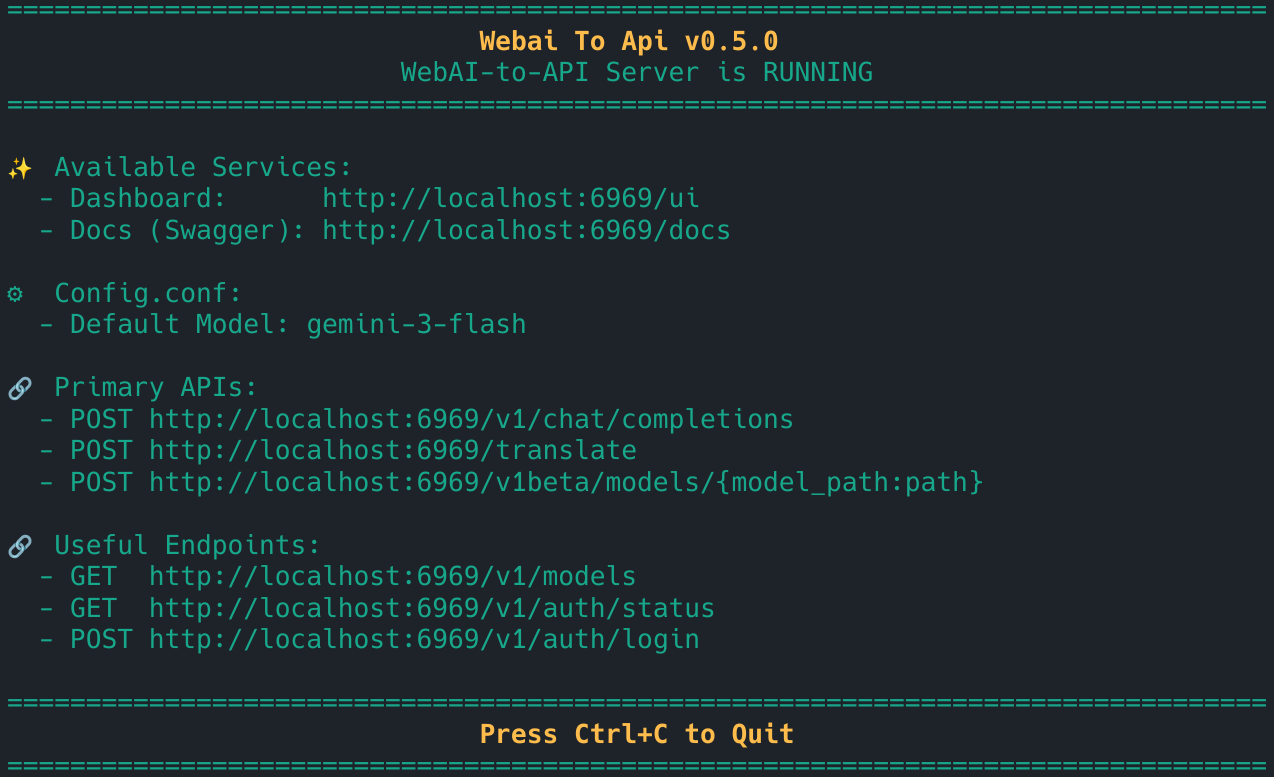
http://localhost:6969http://localhost:6969/uihttp://localhost:6969/docsLinux / macOS
./update-linux-macos.sh
Windows
update-windows.cmd
Updates are version-driven from origin/master. See the Updater Guide for locking, preflight checks, rollback, dependency sync, and platform details.
git pull
APP_UID=$(id -u) APP_GID=$(id -g) docker compose up -d --build
See the Docker Deployment Guide for Docker setup and deployment details.
curl -X POST http://localhost:6969/v1/chat/completions \
  -H "Content-Type: application/json" \
  -d '{
    "model": "gemini-3-flash",
    "messages": [
      {
        "role": "user",
        "content": "Hello!"
      }
    ]
  }'
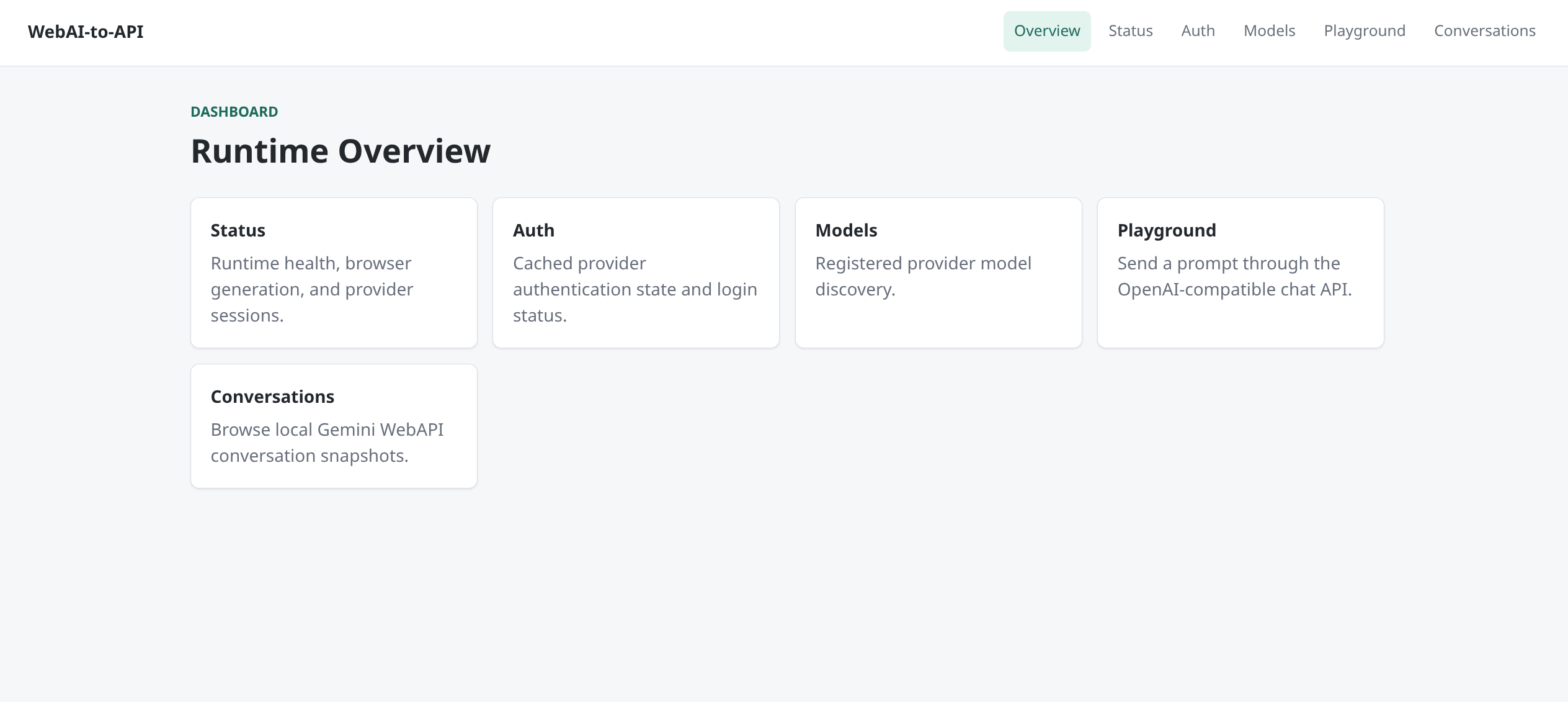
Open the dashboard at http://localhost:6969/ui. It provides runtime status, authentication view, model and API discovery, a playground, and conversation management where supported. See the Dashboard Guide.
| Endpoint | Purpose |
|---|---|
/v1/chat/completions | Main OpenAI-compatible chat endpoint |
/v1/stateless/chat/completions | Canonical client-owned-history Gemini WebAPI chat endpoint |
/v1/stateless/models | Direct Gemini WebAPI models valid for stateless chat (including valid slash-containing IDs) |
/v1/temporary/chat/completions | Deprecated temporary compatibility endpoint (delegates to stateless) |
/v1/models | Current runtime model catalog |
/v1/conversations | Manage persisted Gemini WebAPI conversations |
/v1/auth/status | Authentication status |
/v1/auth/login | Interactive browser login trigger |
/v1/runtime/status | Runtime diagnostics |
/health | Liveness |
/ready | Runtime readiness |
/translate | Translate It! compatibility endpoint |
/ui | Dashboard |
See API Documentation for the complete API surface, including compatibility and legacy endpoints.
Hermes Agent and other client-owned-history clients can use the canonical stateless endpoint:
http://127.0.0.1:6969/v1/stateless
Append /models for discovery or /chat/completions for requests:
GET  /models
POST /chat/completions
This surface uses direct Gemini WebAPI execution only (temporary=True, no conversation_id, no SQLite snapshots, client owns and resends all history). Slash-containing model IDs are valid when advertised by the Gemini WebAPI runtime catalog. Streaming and tool calling are supported. The legacy /v1/temporary/chat/completions endpoint remains as a deprecated compatibility wrapper that delegates to the same implementation. See the API Documentation and Stateless Chat Contract.
Available models depend on configured providers and runtime availability. Use /v1/models as the authoritative current catalog.
gemini-3-flash
playwright/gemini-3-flash
Unprefixed Gemini models use the configured Gemini backend. playwright/... forces browser-native Gemini routing, while atlas/... routes to Atlas. See API Documentation for full routing behavior.
Configure Gemini backend selection (webapi or playwright), default model, provider enablement, proxy, logging, and Atlas API access in config.conf and .env. Set a default for Extended Thinking with [Gemini].extended_thinking, or override it per request with provider_options.gemini.extended_thinking. See the Configuration Guide.
OpenAI-style file content parts are supported by Gemini WebAPI. Gemini Playwright and Atlas do not currently support file parts, and Gemini WebAPI does not preserve exact text/file interleaving. See API Documentation for supported formats and limits.
WebAI-to-API does not provide caller API authentication. Keep the default localhost binding unless external authentication and access control protect the service. See the Docker Deployment Guide and Dashboard Guide.
Interactive API documentation is available through Swagger UI when the server is running.
WebAI-to-API is licensed under the MIT License. See LICENSE for the full text.
154 followers · starred Jan 2026
31 followers · starred Sep 2025
234 followers · starred Jan 2026
59 followers · starred Jun 2025
WebAI-to-API is a browser-native AI runtime that exposes browser-based AI services through OpenAI-compatible APIs.
/v1/chat/completions APIProvides access to Google Gemini models through either the WebAPI backend or a browser-native Playwright runtime.
Prerequisites: Git, Python >=3.11,<3.13 and Poetry. On Windows, use Python 3.11.10+ or 3.12.4+ for secure Gemini WebAPI temporary-cookie-cache handling. See the Installation Guide for full installation and troubleshooting details.
Clone the repository, enter the project directory, then run the setup wrapper for your platform.
Linux / macOS
git clone https://github.com/Amm1rr/WebAI-to-API.git
cd WebAI-to-API
./install.sh
Windows PowerShell
git clone https://github.com/Amm1rr/WebAI-to-API.git
cd WebAI-to-API
.\install.ps1
The wrappers create missing configuration and runtime state, install project dependencies and Playwright Chromium, then run diagnostics. See the Installation Guide for manual setup, troubleshooting, and Make shortcuts.
Review the generated config.conf. Core Gemini settings include:
[Gemini]
backend = webapi
default_model = gemini-3-flash
extended_thinking = false
See the Configuration Guide for provider, proxy, logging, and authentication settings.
For browser-based Gemini authentication:
poetry run python verify_login.py
Gemini WebAPI can also use configured cookies. See the Configuration Guide for authentication methods. For Docker authentication, see the Docker Deployment Guide.
poetry run python src/run.py
http://localhost:6969http://localhost:6969/uihttp://localhost:6969/docsLinux / macOS
./update-linux-macos.sh
Windows
update-windows.cmd
Updates are version-driven from origin/master. See the Updater Guide for locking, preflight checks, rollback, dependency sync, and platform details.
git pull
APP_UID=$(id -u) APP_GID=$(id -g) docker compose up -d --build
See the Docker Deployment Guide for Docker setup and deployment details.
curl -X POST http://localhost:6969/v1/chat/completions \
  -H "Content-Type: application/json" \
  -d '{
    "model": "gemini-3-flash",
    "messages": [
      {
        "role": "user",
        "content": "Hello!"
      }
    ]
  }'
Open the dashboard at http://localhost:6969/ui. It provides runtime status, authentication view, model and API discovery, a playground, and conversation management where supported. See the Dashboard Guide.
| Endpoint | Purpose |
|---|---|
/v1/chat/completions | Main OpenAI-compatible chat endpoint |
/v1/stateless/chat/completions | Canonical client-owned-history Gemini WebAPI chat endpoint |
/v1/stateless/models | Direct Gemini WebAPI models valid for stateless chat (including valid slash-containing IDs) |
/v1/temporary/chat/completions | Deprecated temporary compatibility endpoint (delegates to stateless) |
/v1/models | Current runtime model catalog |
/v1/conversations | Manage persisted Gemini WebAPI conversations |
/v1/auth/status | Authentication status |
/v1/auth/login | Interactive browser login trigger |
/v1/runtime/status | Runtime diagnostics |
/health | Liveness |
/ready | Runtime readiness |
/translate | Translate It! compatibility endpoint |
/ui | Dashboard |
See API Documentation for the complete API surface, including compatibility and legacy endpoints.
Hermes Agent and other client-owned-history clients can use the canonical stateless endpoint:
http://127.0.0.1:6969/v1/stateless
Append /models for discovery or /chat/completions for requests:
GET  /models
POST /chat/completions
This surface uses direct Gemini WebAPI execution only (temporary=True, no conversation_id, no SQLite snapshots, client owns and resends all history). Slash-containing model IDs are valid when advertised by the Gemini WebAPI runtime catalog. Streaming and tool calling are supported. The legacy /v1/temporary/chat/completions endpoint remains as a deprecated compatibility wrapper that delegates to the same implementation. See the API Documentation and Stateless Chat Contract.
Available models depend on configured providers and runtime availability. Use /v1/models as the authoritative current catalog.
gemini-3-flash
playwright/gemini-3-flash
Unprefixed Gemini models use the configured Gemini backend. playwright/... forces browser-native Gemini routing, while atlas/... routes to Atlas. See API Documentation for full routing behavior.
Configure Gemini backend selection (webapi or playwright), default model, provider enablement, proxy, logging, and Atlas API access in config.conf and .env. Set a default for Extended Thinking with [Gemini].extended_thinking, or override it per request with provider_options.gemini.extended_thinking. See the Configuration Guide.
OpenAI-style file content parts are supported by Gemini WebAPI. Gemini Playwright and Atlas do not currently support file parts, and Gemini WebAPI does not preserve exact text/file interleaving. See API Documentation for supported formats and limits.
WebAI-to-API does not provide caller API authentication. Keep the default localhost binding unless external authentication and access control protect the service. See the Docker Deployment Guide and Dashboard Guide.
Interactive API documentation is available through Swagger UI when the server is running.
WebAI-to-API is licensed under the MIT License. See LICENSE for the full text.
154 followers · starred Jan 2026
31 followers · starred Sep 2025
234 followers · starred Jan 2026
59 followers · starred Jun 2025



