This repository contains experimental research on Continuous Sign Language Recognition (CSLR). The objective of the project was to explore architectural complexity limits by integrating advanced temporal and spatial modeling techniques. The resulting architecture achieved a Word Error Rate (WER) of 15.7%, which significantly outperformed the 60% Transformer baseline.
The approach:
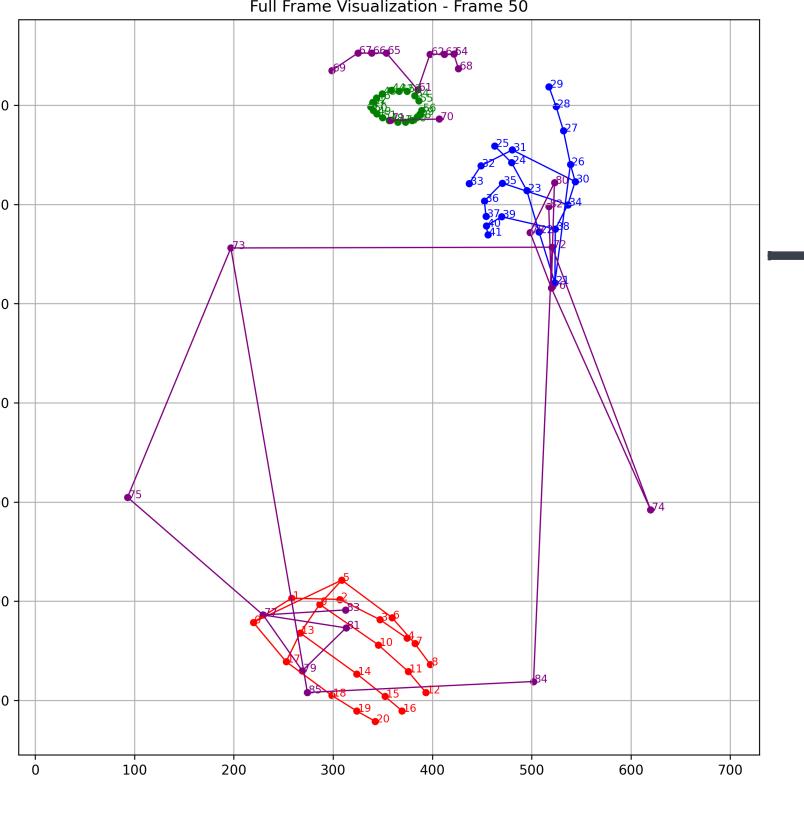
This project was purely for experimenting and learning. The main GNN architecture achieved a Word Error Rate (WER) of 15.7%, which significantly outperformed our custom-built Transformer experiment (ID-CNN + AraGPT2) which yielded a 60% WER.
However, the GNN model underfitted the data due to severe compute limits. This was an important lesson in architectural design: ensembling multiple Graph Neural Networks drastically increases the parameter count and the compute required to train them effectively. The bottleneck was a direct result of underestimating the true computational cost that ensembling entails.

This implementation builds upon concepts and code from two main sources:
Note: The TCN addition was an experimental "sprinkle" introduced to observe how Temporal Convolutional Networks could further refine the temporal modeling.
train_gnn.py: Setup script that clones the base MSLR repository and automatically injects the custom GNN/TCN ensemble modifications for training.train_transformer.py: Standalone script containing the custom ID-CNN + AraGPT2 transformer experiment, built specifically to serve as a comparative baseline.src/: Core Python modules (the modifications).
slr_network.py: The main recognition network combining visual extraction with temporal sequences.stgcn_block.py: High-speed Spatial-Temporal Graph Convolutional Network blocks including TurboGAT and GNN Ensemble.seq_scripts.py: Custom training and evaluation sequences.notebooks/: Jupyter notebooks used for implementation and training via Colab.assets/: Relevant figures and training logs.This repository contains experimental research on Continuous Sign Language Recognition (CSLR). The objective of the project was to explore architectural complexity limits by integrating advanced temporal and spatial modeling techniques. The resulting architecture achieved a Word Error Rate (WER) of 15.7%, which significantly outperformed the 60% Transformer baseline.
The approach:
This project was purely for experimenting and learning. The main GNN architecture achieved a Word Error Rate (WER) of 15.7%, which significantly outperformed our custom-built Transformer experiment (ID-CNN + AraGPT2) which yielded a 60% WER.
However, the GNN model underfitted the data due to severe compute limits. This was an important lesson in architectural design: ensembling multiple Graph Neural Networks drastically increases the parameter count and the compute required to train them effectively. The bottleneck was a direct result of underestimating the true computational cost that ensembling entails.
This implementation builds upon concepts and code from two main sources:
Note: The TCN addition was an experimental "sprinkle" introduced to observe how Temporal Convolutional Networks could further refine the temporal modeling.
train_gnn.py: Setup script that clones the base MSLR repository and automatically injects the custom GNN/TCN ensemble modifications for training.train_transformer.py: Standalone script containing the custom ID-CNN + AraGPT2 transformer experiment, built specifically to serve as a comparative baseline.src/: Core Python modules (the modifications).
slr_network.py: The main recognition network combining visual extraction with temporal sequences.stgcn_block.py: High-speed Spatial-Temporal Graph Convolutional Network blocks including TurboGAT and GNN Ensemble.seq_scripts.py: Custom training and evaluation sequences.notebooks/: Jupyter notebooks used for implementation and training via Colab.assets/: Relevant figures and training logs.


