Implementation of CV-SLT (Conditional Variational Autoencoder for Sign Language Translation with Cross-Modal Alignment).
Python
22
7 commits
updated Sep 20, 2026
This repo holds codes of the paper: Conditional Variational Autoencoder for Sign Language Translation with Cross-Modal Alignment.
The extended journal version, Variational Sign Language Translation, has been accepted by the International Journal of Computer Vision (IJCV).
The CV-SLT builds upon the strong baseline MMTLB, many thanks to their great work!
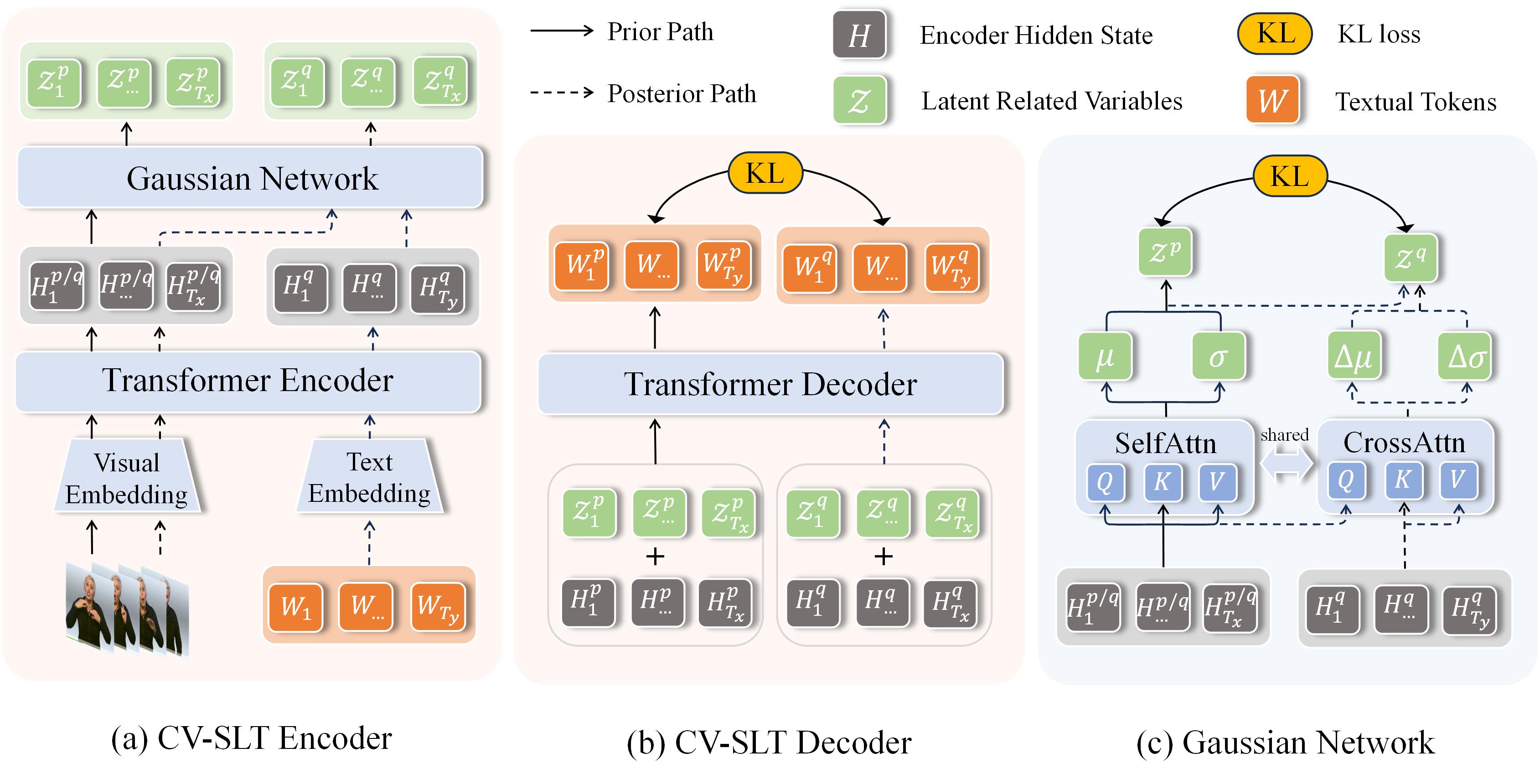
We propose CV-SLT to facilitate direct and sufficient cross-modal alignment between sign language videos and spoken language text. Specifically, our CV-SLT consists of two paths with two KL divergences to regularize the outputs of the encoder and decoder, respectively. In the prior path, the model solely relies on visual information to predict the target text; whereas in the posterior path, it simultaneously encodes visual information and textual knowledge to reconstruct the target text. Experiments conducted on public datasets (PHOENIX14T and CSL-daily) demonstrate the effectiveness of our framework, achieving new state-of-the-art results while significantly alleviating the cross-modal representation discrepancy.
| Dataset | ROUGE | B@1 | B@2 | B@3 | B@4 |
|---|---|---|---|---|---|
| PHOENIX14T | 54.91 | 55.89 | 43.70 | 35.74 | 30.20 |
| CSL-daily | 58.19 | 58.33 | 45.43 | 36.08 | 29.23 |
| Method | RGB | Pose | WER ↓ | ROUGE | B@1 | B@2 | B@3 | B@4 |
|---|---|---|---|---|---|---|---|---|
| TS-SLT | ✔ | ✔ | 47.11 | 61.10 | 61.41 | 50.04 | 41.52 | 34.56 |
| HyperSign | ✔ | ✔ | - | 60.50 | 61.67 | 50.33 | 41.89 | 34.60 |
| SLRT | ✔ | ✘ | 63.21 | 44.01 | 42.39 | 31.25 | 23.57 | 18.38 |
| ConSLT | ✔ | ✘ | - | 46.30 | 42.96 | 32.66 | 25.46 | 20.50 |
| MCL-SLT | ✔ | ✘ | - | 47.06 | 45.05 | 34.11 | 26.51 | 21.29 |
| MMTLB | ✔ | ✘ | 50.66 | 57.74 | 57.29 | 45.91 | 37.58 | 31.33 |
| TS-SLT-V | ✔ | ✘ | 52.11 | 57.63 | 58.01 | 46.89 | 38.64 | 32.48 |
| VSLT | ✔ | ✘ | 50.66 | 61.39 | 58.99 | 48.27 | 39.98 | 33.69 |
In the gloss-free setting, we remove the S2G (sign-to-gloss) pre-training stage.
| Dataset | ROUGE | B@1 | B@2 | B@3 | B@4 |
|---|---|---|---|---|---|
| PHOENIX14T | 49.94 | 51.33 | 39.18 | 31.79 | 26.83 |
| CSL-Daily | 48.07 | 48.98 | 36.34 | 27.87 | 21.97 |
| OpenASL | 48.07 | 48.98 | 36.34 | 27.87 | 21.97 |
| How2Sign | 48.07 | 48.98 | 36.34 | 27.87 | 21.97 |
The implementation for the prior path and the posterior path is given in ./modeling/translation.py
The Gaussian Network equipped with shared ARGD is given in ./modeling/gaussian_net.py
conda env create -f environment.yml
conda activate slt
The raw data are from:
Please refer to the implementation of MMTLB for preparing the data and models, as CV-SLT simply focuses on the SLT training. Specifically, the required processed data and pre-trained models include:
./experiment./pretrained_modelsNote that the path is configured in the *.yaml file and you can change it anywhere you want.
We backup the ckpts used in this repo here.
Train
dataset=phoenix-2014t #phoenix14t / csl-daily
python -m torch.distributed.launch \
--nproc_per_node 1 \
--use_env training.py \
--config experiments/configs/SingleStream/${dataset}_vs2t.yaml
Evaluate
Upon finishing training, your can evaluate the model with:
dataset=phoenix-2014t #phoenix14t / csl-daily
python -m torch.distributed.launch \
--nproc_per_node 1 \
--use_env prediction.py  \
--config experiments/configs/SingleStream/${dataset}_vs2t.yaml
You can also reproduce our reported performance with our trained ckpts.
We also provide a trained g2t ckpt of CSL-daily to help re-train our CV-SLT since it is lost in the repo of MMTLB.
35.24/34.70 on Dev/Test sets.@InProceedings{
Zhao_2024_AAAI,
author = {Rui Zhao, Liang Zhang, Biao Fu, Cong Hu, Jinsong Su, Yidong Chen},
title = {Conditional Variational Autoencoder for Sign Language Translation with Cross-Modal Alignment},
booktitle = {Proceedings of the AAAI Conference on Artificial Intelligence},
year = {2024},
}
@Article{
Zhao_2026_IJCV,
author = {Zhao, Rui and Zhang, Liang and Fu, Biao and Zhang, Ruiquan and Chen, Yidong and Shi, Xiaodong},
title = {Variational Sign Language Translation},
journal = {International Journal of Computer Vision},
volume = {134},
pages = {408},
year = {2026},
doi = {10.1007/s11263-026-02978-x},
url = {https://doi.org/10.1007/s11263-026-02978-x},
}
Implementation of CV-SLT (Conditional Variational Autoencoder for Sign Language Translation with Cross-Modal Alignment).
Python
22
7 commits
updated Sep 20, 2026
This repo holds codes of the paper: Conditional Variational Autoencoder for Sign Language Translation with Cross-Modal Alignment.
The extended journal version, Variational Sign Language Translation, has been accepted by the International Journal of Computer Vision (IJCV).
The CV-SLT builds upon the strong baseline MMTLB, many thanks to their great work!
We propose CV-SLT to facilitate direct and sufficient cross-modal alignment between sign language videos and spoken language text. Specifically, our CV-SLT consists of two paths with two KL divergences to regularize the outputs of the encoder and decoder, respectively. In the prior path, the model solely relies on visual information to predict the target text; whereas in the posterior path, it simultaneously encodes visual information and textual knowledge to reconstruct the target text. Experiments conducted on public datasets (PHOENIX14T and CSL-daily) demonstrate the effectiveness of our framework, achieving new state-of-the-art results while significantly alleviating the cross-modal representation discrepancy.
| Dataset | ROUGE | B@1 | B@2 | B@3 | B@4 |
|---|---|---|---|---|---|
| PHOENIX14T | 54.91 | 55.89 | 43.70 | 35.74 | 30.20 |
| CSL-daily | 58.19 | 58.33 | 45.43 | 36.08 | 29.23 |
| Method | RGB | Pose | WER ↓ | ROUGE | B@1 | B@2 | B@3 | B@4 |
|---|---|---|---|---|---|---|---|---|
| TS-SLT | ✔ | ✔ | 47.11 | 61.10 | 61.41 | 50.04 | 41.52 | 34.56 |
| HyperSign | ✔ | ✔ | - | 60.50 | 61.67 | 50.33 | 41.89 | 34.60 |
| SLRT | ✔ | ✘ | 63.21 | 44.01 | 42.39 | 31.25 | 23.57 | 18.38 |
| ConSLT | ✔ | ✘ | - | 46.30 | 42.96 | 32.66 | 25.46 | 20.50 |
| MCL-SLT | ✔ | ✘ | - | 47.06 | 45.05 | 34.11 | 26.51 | 21.29 |
| MMTLB | ✔ | ✘ | 50.66 | 57.74 | 57.29 | 45.91 | 37.58 | 31.33 |
| TS-SLT-V | ✔ | ✘ | 52.11 | 57.63 | 58.01 | 46.89 | 38.64 | 32.48 |
| VSLT | ✔ | ✘ | 50.66 | 61.39 | 58.99 | 48.27 | 39.98 | 33.69 |
In the gloss-free setting, we remove the S2G (sign-to-gloss) pre-training stage.
| Dataset | ROUGE | B@1 | B@2 | B@3 | B@4 |
|---|---|---|---|---|---|
| PHOENIX14T | 49.94 | 51.33 | 39.18 | 31.79 | 26.83 |
| CSL-Daily | 48.07 | 48.98 | 36.34 | 27.87 | 21.97 |
| OpenASL | 48.07 | 48.98 | 36.34 | 27.87 | 21.97 |
| How2Sign | 48.07 | 48.98 | 36.34 | 27.87 | 21.97 |
The implementation for the prior path and the posterior path is given in ./modeling/translation.py
The Gaussian Network equipped with shared ARGD is given in ./modeling/gaussian_net.py
conda env create -f environment.yml
conda activate slt
The raw data are from:
Please refer to the implementation of MMTLB for preparing the data and models, as CV-SLT simply focuses on the SLT training. Specifically, the required processed data and pre-trained models include:
./experiment./pretrained_modelsNote that the path is configured in the *.yaml file and you can change it anywhere you want.
We backup the ckpts used in this repo here.
Train
dataset=phoenix-2014t #phoenix14t / csl-daily
python -m torch.distributed.launch \
--nproc_per_node 1 \
--use_env training.py \
--config experiments/configs/SingleStream/${dataset}_vs2t.yaml
Evaluate
Upon finishing training, your can evaluate the model with:
dataset=phoenix-2014t #phoenix14t / csl-daily
python -m torch.distributed.launch \
--nproc_per_node 1 \
--use_env prediction.py  \
--config experiments/configs/SingleStream/${dataset}_vs2t.yaml
You can also reproduce our reported performance with our trained ckpts.
We also provide a trained g2t ckpt of CSL-daily to help re-train our CV-SLT since it is lost in the repo of MMTLB.
35.24/34.70 on Dev/Test sets.@InProceedings{
Zhao_2024_AAAI,
author = {Rui Zhao, Liang Zhang, Biao Fu, Cong Hu, Jinsong Su, Yidong Chen},
title = {Conditional Variational Autoencoder for Sign Language Translation with Cross-Modal Alignment},
booktitle = {Proceedings of the AAAI Conference on Artificial Intelligence},
year = {2024},
}
@Article{
Zhao_2026_IJCV,
author = {Zhao, Rui and Zhang, Liang and Fu, Biao and Zhang, Ruiquan and Chen, Yidong and Shi, Xiaodong},
title = {Variational Sign Language Translation},
journal = {International Journal of Computer Vision},
volume = {134},
pages = {408},
year = {2026},
doi = {10.1007/s11263-026-02978-x},
url = {https://doi.org/10.1007/s11263-026-02978-x},
}



