
Model-neutral agent desktop/runtime for private, enterprise, and OpenAI-compatible / Anthropic-compatible model API. Tested on DeepSeek, Qwen, Kimi, GLM models. Supports MCP, Skills,and local code search.
See the codeREADME

Devo is an open-source coding agent with a Desktop app, terminal TUI/CLI, and model-neutral Rust runtime for private, enterprise, and OpenAI-compatible model environments. Connect DeepSeek, Qwen, Kimi, Anthropic-compatible APIs, local gateways, or your own model endpoint.






English | 简体中文 | 繁體中文 | 日本語 | Русский
Why Devo · Screenshots · Features · Tested Models · Tested Platforms · Install · Quick Start · Docs
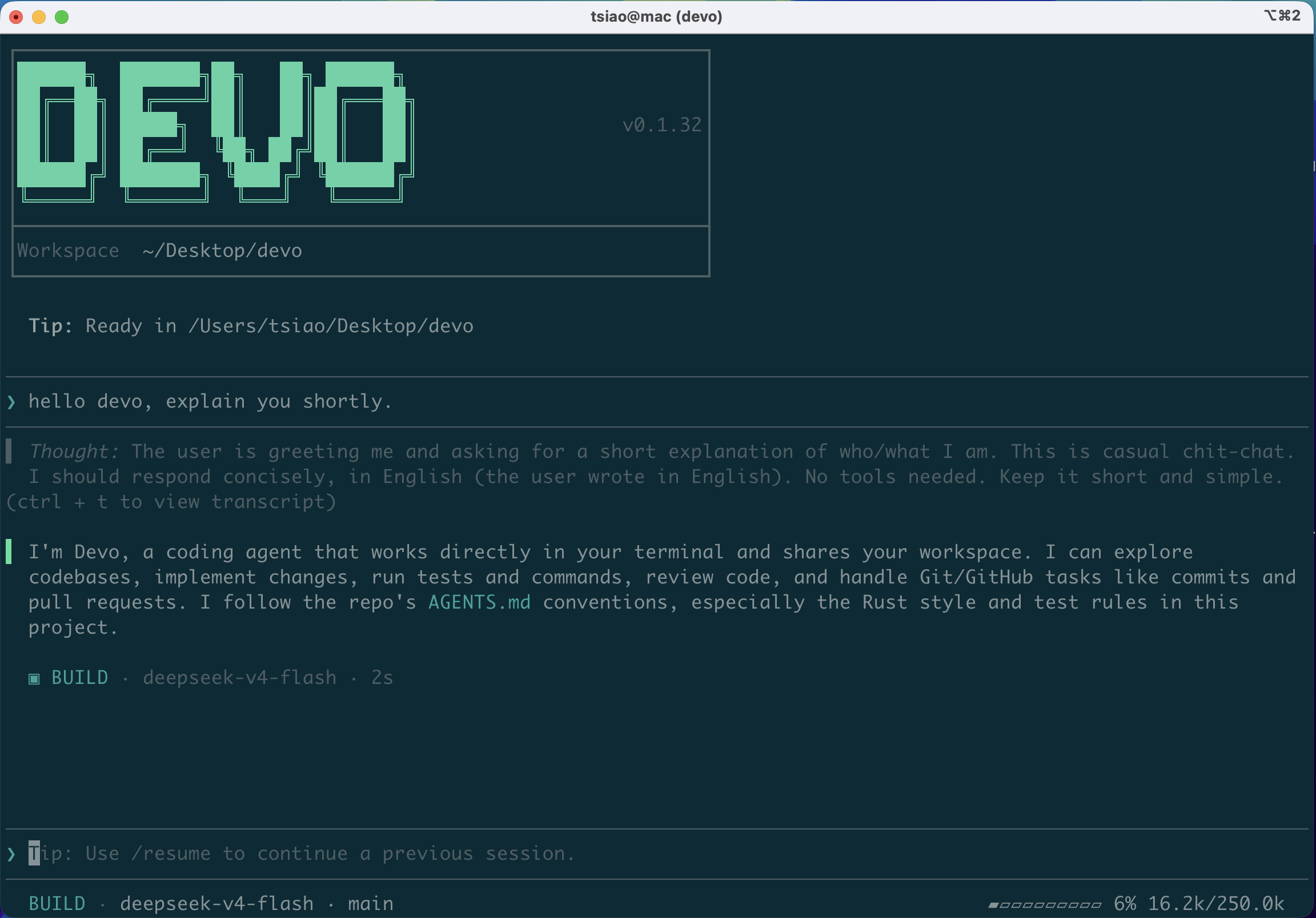
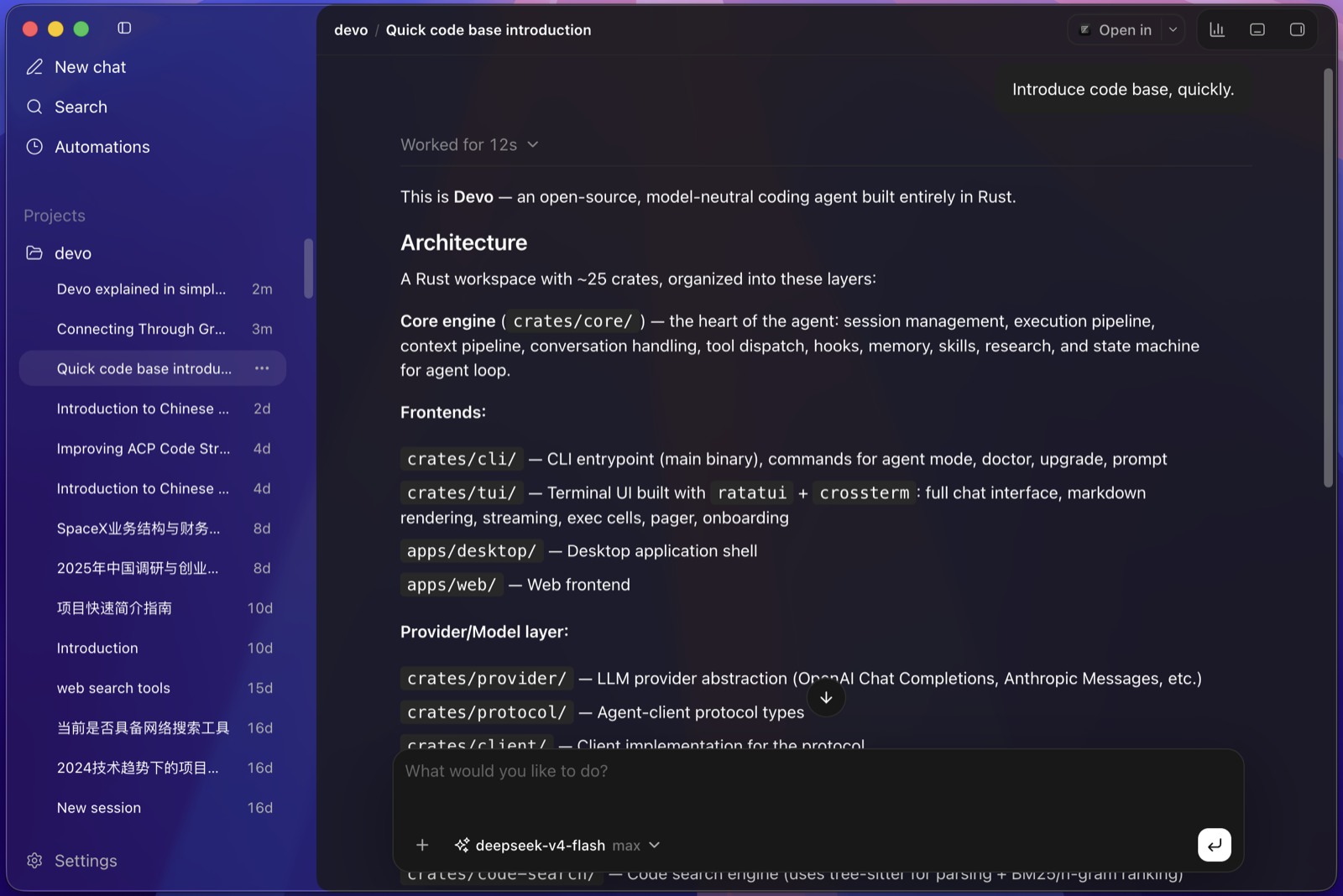
Screenshots
Why Devo
Devo is for teams that need a coding agent outside a single hosted model ecosystem. It keeps the desktop experience, terminal workflow, model choice, runtime behavior, and workspace execution under your control.
- Bring your own model - Connect OpenAI-compatible Chat Completions, OpenAI-compatible Responses, Anthropic Messages, DeepSeek, Qwen, Kimi, or private model gateways through provider/model Connections.
- Works in private and intranet environments - Run a single local Rust binary, support offline installation paths, and point Devo at internal endpoints without depending on a hosted agent service.
- One agent across Desktop and terminal - Use the Desktop app for visual onboarding and daily coding, or the CLI/TUI for terminal-native automation, remote shells, and scriptable workflows.
- Built for agent runtime extensibility - MCP servers, reusable skills, auditable sessions, permissions, and multi-agent flows are runtime features rather than one-off prompts.
Features
- Model-neutral provider runtime - Use provider/model Connections for OpenAI-compatible, Anthropic-compatible, DeepSeek, Qwen, Kimi, GLM, MiniMax, Xiaomi MiMo, OpenRouter, or local endpoints.
- MCP support - Connect external tools and context through
Model Context Protocol servers. Add and
manage servers from the CLI with
devo mcp add|list|enable|disable|remove(see Configuration). - Skill support - Package repeatable workflows, instructions, scripts, and references as reusable Agent Skills.
- Long-running task support - Let Devo manage context automatically across multi-turn work instead of losing the thread as tasks grow.
- Multi-agent support - Split work across specialized agents while keeping coordination visible in the session.
- Plan Mode - Break larger tasks into clear multi-step plans before implementation starts.
- Parallel tool calls - Run multiple independent tools in parallel so models spend less time waiting and more time making progress.
- Permissioned tool execution - Review sensitive tool calls before they touch your workspace.
- Auditable sessions - Keep model output, tool calls, approvals, token usage, and session history inspectable and resumable.
- Cost and context visibility - Show input/output tokens, cached tokens, and context-window usage where providers expose them.
- Lightweight Rust runtime - Built in Rust with low memory overhead and a compact local runtime.
- Built-in semantic code search (MCP) - Optional bundled MCP server
(
code_search/devo-code-search-mcp), not installed or enabled by default. Runs a local CPU code-embedding model and combines dense retrieval with BM25 keyword matching to reduce code-search context versus grep/find-only agents. Install it explicitly with--with-code-search, then enable it withdevo mcp enable code_searchor TUI/mcps.
Tested Models





Devo's built-in model catalog includes tested model definitions for Qwen, Kimi, MiniMax, GLM, and DeepSeek. Provider endpoints remain configurable through provider/model Connections.
Tested Platforms



Devo has been tested on macOS, Linux, Windows, and Kylin OS.
For Chinese Enterprise Users


Kylin OS coverage is called out because domestic operating systems are often part of real deployment requirements in Chinese enterprise environments. HarmonyOS support is on the roadmap; contributors with HarmonyOS devices are welcome to build, test, and publish releases for that platform.
Installation
Devo can be installed in two forms. Pick the Desktop app for a graphical coding agent workspace, the terminal-native TUI/CLI for shell-first development, or install both on the same machine.
Option 1: Desktop App
Start here if you want the graphical Devo experience. Download the latest Devo Desktop package from GitHub Releases, then choose the asset that matches your operating system and architecture:
- macOS - download the
devo-desktop-...-mac-....dmgor.zipasset. - Windows - download the
devo-desktop-...-windows-....exeasset. - Linux - download the
devo-desktop-...-linux-....AppImage,.deb, or.rpmasset.
If macOS reports that Devo.app is damaged and cannot be opened, this is
expected. Current macOS Desktop builds are unsigned, so after installing,
run the following command so macOS can launch the app:
sudo xattr -dr com.apple.quarantine /Applications/Devo.app
Option 2: TUI / CLI
Install the terminal-native devo command if you prefer the TUI, want shell
automation, or want to use Devo alongside the Desktop app.
Linux / macOS:
curl -fsSL https://raw.githubusercontent.com/7df-lab/devo/main/install.sh | sh
Windows:
irm 'https://raw.githubusercontent.com/7df-lab/devo/main/install.ps1' | iex
The online installer places devo under the Devo home directory and installs
the rg sidecar used for fast repository search. It does not install the
code_search MCP or its local model by default.
Optional: install the code_search MCP and local model
Use this only if you want the code-search MCP and its Hugging Face model installed during setup.
Linux / macOS:
curl -fsSL https://raw.githubusercontent.com/7df-lab/devo/main/install.sh | sh -s -- --with-code-search
Windows:
$env:DEVO_INSTALL_CODE_SEARCH = "1"; irm 'https://raw.githubusercontent.com/7df-lab/devo/main/install.ps1' | iex
Upgrade an existing installation to the latest release:
devo upgrade
The upgrade command runs the same platform installer, and the installer prints
the version transition, for example Version: v0.1.12 -> v0.1.15.
For air-gapped or intranet installs, see Offline Installation.
Quick Start
Configure a provider, open a repository, and start the TUI:
cd /path/to/your/repo
devo onboard
Useful commands:
devo                         # start the interactive TUI in the current repo
devo resume <session-id>
Configuration
devo onboard is the recommended setup path. It writes provider Connections
and model directories to providers.json and stores your API key in
user-scoped auth.json.
To bring your own key with a custom model manually:
- Define a
provider.<id>.models.<model-id>entry inproviders.jsonand set the active model asprovider/model. - Put the secret in
DEVO_HOME/auth.jsonand reference that credential id fromprovider.<id>.credential— never put the API key itself inproviders.json. - Set
wire_apito match the endpoint protocol:openai_chat_completions,openai_responses, oranthropic_messages.
Full worked example (custom model parameters + API key) and protocol details: Configuration.
Slow Providers
Provider responses are not subject to an application-level response timeout, so local models may take as long as necessary to load or generate output. Provider connections still have an internal connection-establishment deadline, and every request can be cancelled by the user.
Docs
FAQ
What is the project status?
Devo is pre-1.0 and actively developed. It is ready for local evaluation, experiments, and contributor use; public APIs and configuration may still change.
What models are supported?
Built-in model metadata currently covers Qwen, Kimi, MiniMax, GLM, and DeepSeek families. Any model endpoint that supports OpenAI-compatible Chat Completions, OpenAI-compatible Responses, or the Anthropic Messages API can be connected through provider/model Connections.
How do I bring my own API key?
Use devo onboard, or manually define a custom provider/model in
providers.json, store the key in user-scoped auth.json, and set
wire_api to openai_chat_completions, openai_responses, or
anthropic_messages. See
Configuration.
Should I use the Desktop app or the TUI/CLI?
Use the Desktop app when you want visual onboarding, session browsing, and a graphical coding workspace. Use the TUI/CLI when you want terminal-native automation, remote shell workflows, or a coding agent that stays inside your existing command-line setup. Both surfaces target the same local Devo runtime.
Contributing
Contributions are welcome while the project is still early:
- Architecture feedback on the client/server runtime, provider layer, safety model, and TUI.
- Documentation and translations.
- Provider, model, and wire API coverage.
- Focused fixes with validation commands and regression tests.
Open an issue or pull request to discuss changes.
License
This project is licensed under the MIT License.
If you find Devo useful, please consider giving it a star.
Contributors


Similar repos


Languages
Rust
76.6%
TypeScript
20.1%
MDX
1.9%
Model-neutral agent desktop/runtime for private, enterprise, and OpenAI-compatible / Anthropic-compatible model API. Tested on DeepSeek, Qwen, Kimi, GLM models. Supports MCP, Skills,and local code search.
See the codeREADME
Devo is an open-source coding agent with a Desktop app, terminal TUI/CLI, and model-neutral Rust runtime for private, enterprise, and OpenAI-compatible model environments. Connect DeepSeek, Qwen, Kimi, Anthropic-compatible APIs, local gateways, or your own model endpoint.
English | 简体中文 | 繁體中文 | 日本語 | Русский
Why Devo · Screenshots · Features · Tested Models · Tested Platforms · Install · Quick Start · Docs
Screenshots
Why Devo
Devo is for teams that need a coding agent outside a single hosted model ecosystem. It keeps the desktop experience, terminal workflow, model choice, runtime behavior, and workspace execution under your control.
- Bring your own model - Connect OpenAI-compatible Chat Completions, OpenAI-compatible Responses, Anthropic Messages, DeepSeek, Qwen, Kimi, or private model gateways through provider/model Connections.
- Works in private and intranet environments - Run a single local Rust binary, support offline installation paths, and point Devo at internal endpoints without depending on a hosted agent service.
- One agent across Desktop and terminal - Use the Desktop app for visual onboarding and daily coding, or the CLI/TUI for terminal-native automation, remote shells, and scriptable workflows.
- Built for agent runtime extensibility - MCP servers, reusable skills, auditable sessions, permissions, and multi-agent flows are runtime features rather than one-off prompts.
Features
- Model-neutral provider runtime - Use provider/model Connections for OpenAI-compatible, Anthropic-compatible, DeepSeek, Qwen, Kimi, GLM, MiniMax, Xiaomi MiMo, OpenRouter, or local endpoints.
- MCP support - Connect external tools and context through
Model Context Protocol servers. Add and
manage servers from the CLI with
devo mcp add|list|enable|disable|remove(see Configuration). - Skill support - Package repeatable workflows, instructions, scripts, and references as reusable Agent Skills.
- Long-running task support - Let Devo manage context automatically across multi-turn work instead of losing the thread as tasks grow.
- Multi-agent support - Split work across specialized agents while keeping coordination visible in the session.
- Plan Mode - Break larger tasks into clear multi-step plans before implementation starts.
- Parallel tool calls - Run multiple independent tools in parallel so models spend less time waiting and more time making progress.
- Permissioned tool execution - Review sensitive tool calls before they touch your workspace.
- Auditable sessions - Keep model output, tool calls, approvals, token usage, and session history inspectable and resumable.
- Cost and context visibility - Show input/output tokens, cached tokens, and context-window usage where providers expose them.
- Lightweight Rust runtime - Built in Rust with low memory overhead and a compact local runtime.
- Built-in semantic code search (MCP) - Optional bundled MCP server
(
code_search/devo-code-search-mcp), not installed or enabled by default. Runs a local CPU code-embedding model and combines dense retrieval with BM25 keyword matching to reduce code-search context versus grep/find-only agents. Install it explicitly with--with-code-search, then enable it withdevo mcp enable code_searchor TUI/mcps.
Tested Models
Devo's built-in model catalog includes tested model definitions for Qwen, Kimi, MiniMax, GLM, and DeepSeek. Provider endpoints remain configurable through provider/model Connections.
Tested Platforms
Devo has been tested on macOS, Linux, Windows, and Kylin OS.
For Chinese Enterprise Users
Kylin OS coverage is called out because domestic operating systems are often part of real deployment requirements in Chinese enterprise environments. HarmonyOS support is on the roadmap; contributors with HarmonyOS devices are welcome to build, test, and publish releases for that platform.
Installation
Devo can be installed in two forms. Pick the Desktop app for a graphical coding agent workspace, the terminal-native TUI/CLI for shell-first development, or install both on the same machine.
Option 1: Desktop App
Start here if you want the graphical Devo experience. Download the latest Devo Desktop package from GitHub Releases, then choose the asset that matches your operating system and architecture:
- macOS - download the
devo-desktop-...-mac-....dmgor.zipasset. - Windows - download the
devo-desktop-...-windows-....exeasset. - Linux - download the
devo-desktop-...-linux-....AppImage,.deb, or.rpmasset.
If macOS reports that Devo.app is damaged and cannot be opened, this is
expected. Current macOS Desktop builds are unsigned, so after installing,
run the following command so macOS can launch the app:
sudo xattr -dr com.apple.quarantine /Applications/Devo.app
Option 2: TUI / CLI
Install the terminal-native devo command if you prefer the TUI, want shell
automation, or want to use Devo alongside the Desktop app.
Linux / macOS:
curl -fsSL https://raw.githubusercontent.com/7df-lab/devo/main/install.sh | sh
Windows:
irm 'https://raw.githubusercontent.com/7df-lab/devo/main/install.ps1' | iex
The online installer places devo under the Devo home directory and installs
the rg sidecar used for fast repository search. It does not install the
code_search MCP or its local model by default.
Optional: install the code_search MCP and local model
Use this only if you want the code-search MCP and its Hugging Face model installed during setup.
Linux / macOS:
curl -fsSL https://raw.githubusercontent.com/7df-lab/devo/main/install.sh | sh -s -- --with-code-search
Windows:
$env:DEVO_INSTALL_CODE_SEARCH = "1"; irm 'https://raw.githubusercontent.com/7df-lab/devo/main/install.ps1' | iex
Upgrade an existing installation to the latest release:
devo upgrade
The upgrade command runs the same platform installer, and the installer prints
the version transition, for example Version: v0.1.12 -> v0.1.15.
For air-gapped or intranet installs, see Offline Installation.
Quick Start
Configure a provider, open a repository, and start the TUI:
cd /path/to/your/repo
devo onboard
Useful commands:
devo                         # start the interactive TUI in the current repo
devo resume <session-id>
Configuration
devo onboard is the recommended setup path. It writes provider Connections
and model directories to providers.json and stores your API key in
user-scoped auth.json.
To bring your own key with a custom model manually:
- Define a
provider.<id>.models.<model-id>entry inproviders.jsonand set the active model asprovider/model. - Put the secret in
DEVO_HOME/auth.jsonand reference that credential id fromprovider.<id>.credential— never put the API key itself inproviders.json. - Set
wire_apito match the endpoint protocol:openai_chat_completions,openai_responses, oranthropic_messages.
Full worked example (custom model parameters + API key) and protocol details: Configuration.
Slow Providers
Provider responses are not subject to an application-level response timeout, so local models may take as long as necessary to load or generate output. Provider connections still have an internal connection-establishment deadline, and every request can be cancelled by the user.
Docs
FAQ
What is the project status?
Devo is pre-1.0 and actively developed. It is ready for local evaluation, experiments, and contributor use; public APIs and configuration may still change.
What models are supported?
Built-in model metadata currently covers Qwen, Kimi, MiniMax, GLM, and DeepSeek families. Any model endpoint that supports OpenAI-compatible Chat Completions, OpenAI-compatible Responses, or the Anthropic Messages API can be connected through provider/model Connections.
How do I bring my own API key?
Use devo onboard, or manually define a custom provider/model in
providers.json, store the key in user-scoped auth.json, and set
wire_api to openai_chat_completions, openai_responses, or
anthropic_messages. See
Configuration.
Should I use the Desktop app or the TUI/CLI?
Use the Desktop app when you want visual onboarding, session browsing, and a graphical coding workspace. Use the TUI/CLI when you want terminal-native automation, remote shell workflows, or a coding agent that stays inside your existing command-line setup. Both surfaces target the same local Devo runtime.
Contributing
Contributions are welcome while the project is still early:
- Architecture feedback on the client/server runtime, provider layer, safety model, and TUI.
- Documentation and translations.
- Provider, model, and wire API coverage.
- Focused fixes with validation commands and regression tests.
Open an issue or pull request to discuss changes.
License
This project is licensed under the MIT License.
If you find Devo useful, please consider giving it a star.
Similar repos
Contributors
Languages
Rust
76.6%
TypeScript
20.1%
MDX
1.9%