
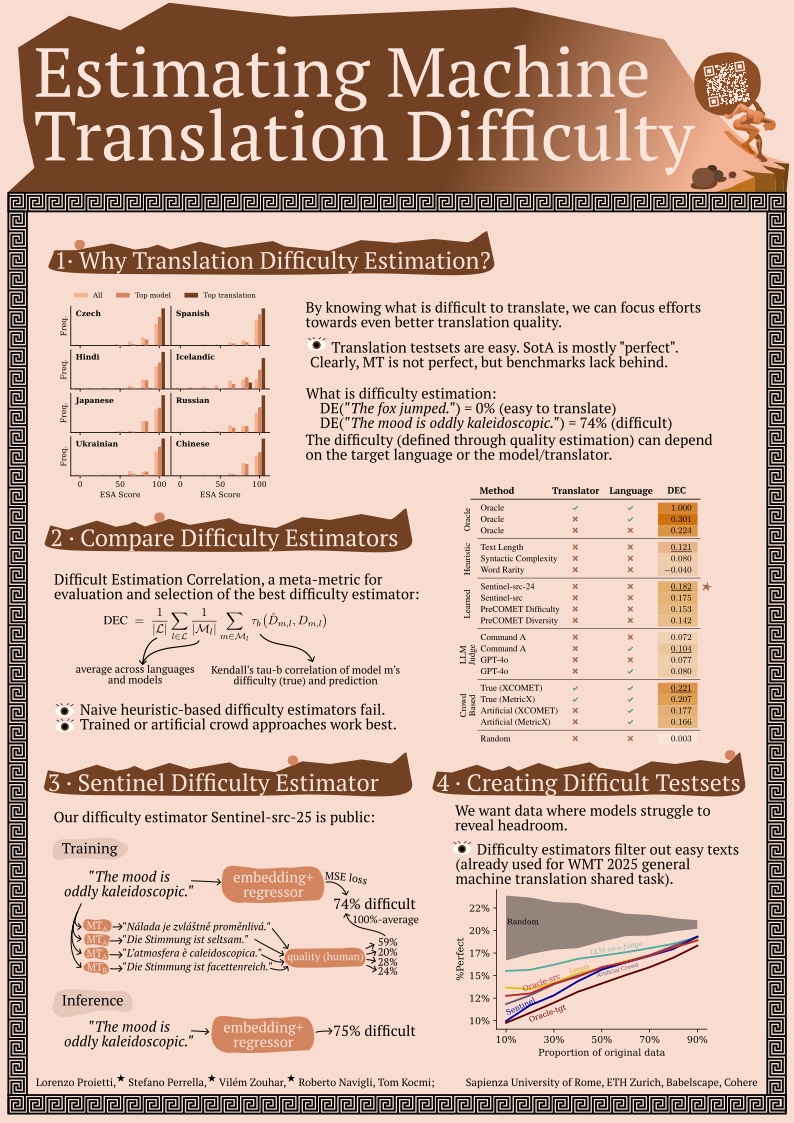
This repository contains the code for the paper Estimating Machine Translation Difficulty by Lorenzo Proietti*, Stefano Perrella*, Vilém Zouhar*, Roberto Navigli, Tom Kocmi.
Abstract: Machine translation quality has began achieving near-perfect translations in some setups. These high-quality outputs make it difficult to distinguish between state-of-the-art models and to identify areas for future improvement. Automatically identifying texts where machine translation systems struggle holds promise for developing more discriminative evaluations and guiding future research. We formalize the task of translation difficulty estimation, defining a text's difficulty based on the expected quality of its translations. We introduce a new metric to evaluate difficulty estimators and use it to assess both baselines and novel approaches. Finally, we demonstrate the practical utility of difficulty estimators by using them to construct more challenging machine translation benchmarks. Our results show that dedicated models (dubbed Sentinel-src) outperform both heuristic-based methods (e.g. word rarity or syntactic complexity) and LLM-as-a-judge approaches. We release two improved models for difficulty estimation, Sentinel-src-24 and Sentinel-src-25, which can be used to scan large collections of texts and select those most likely to challenge contemporary machine translation systems.
For trained Sentinel difficulty estimation models, see the associated HuggingFace collection.
To access data loaders and evaluators, you need to install the local package, which will also make sure all the dependencies are installed:
pip3 install -e .
Then, in Python, you can use the loader, which is unified across all datasets and automatically fetches data. The first time you try to load the data, it will take long (30s-5min). Then, everything should be cached and instant:
import difficulty_estimation
data = difficulty_estimation.utils.load_data_wmt_all()
data.keys()
> dict_keys([('wmt23', 'cs-uk'), ('wmt23', 'de-en'), ('wmt23', 'en-cs'), ('wmt23', 'en-de'), ('wmt23', 'en-ja'), ('wmt23', 'en-zh'), ('wmt23', 'he-en'), ('wmt23', 'ja-en'), ('wmt23', 'zh-en'), ('wmt24', 'cs-uk'), ('wmt24', 'en-cs'), ('wmt24', 'en-es'), ('wmt24', 'en-hi'), ('wmt24', 'en-is'), ('wmt24', 'en-ja'), ('wmt24', 'en-ru'), ('wmt24', 'en-uk'), ('wmt24', 'en-zh'), ('wmt24', 'ja-zh'), ('wmt22', 'cs-uk'), ('wmt22', 'en-cs'), ('wmt22', 'en-de'), ('wmt22', 'en-hr'), ('wmt22', 'en-ja'), ('wmt22', 'en-ru'), ('wmt22', 'en-uk'), ('wmt22', 'en-zh'), ('wmt22', 'ru-en'), ('wmt22', 'sah-ru'), ('wmt22', 'zh-en'), ('wmt21.tedtalks', 'en-de'), ('wmt21.tedtalks', 'en-ru'), ('wmt21.tedtalks', 'zh-en'), ('wmt21.news', 'en-cs'), ('wmt21.news', 'en-de'), ('wmt21.news', 'en-is'), ('wmt21.news', 'en-ja'), ('wmt21.news', 'en-ru'), ('wmt21.news', 'zh-en'), ('wmt20', 'zh-en'), ('wmt20', 'en-de'), ('wmt19', 'kk-en'), ('wmt19', 'de-en'), ('wmt19', 'gu-en'), ('wmt19', 'lt-en')])
Each dataset has some number of source items and each item contains a few keys. Each row thus contains a unique source and multiple scored translations.
len(data[("wmt24", "en-cs")])
> 572

data[("wmt24", "en-cs")][0].keys()
> dict_keys(['i', 'src', 'ref', 'tgt', 'cost', 'domain', 'doc', 'scores'])
Run scripts in experiments/ for main results, for example python3 experiments/01-eval_all.py.
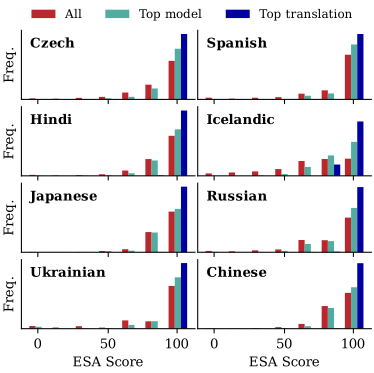
To generate the following figure, run python3 experiments/07-perlang_distribution_wmt24.py.
Further documentation WIP.
If you use this work, please cite:
@misc{proietti2025estimatingmachinetranslationdifficulty,
      title={Estimating Machine Translation Difficulty},
      author={Lorenzo Proietti and Stefano Perrella and Vilém Zouhar and Roberto Navigli and Tom Kocmi},
      year={2025},
      eprint={2508.10175},
      archivePrefix={arXiv},
      primaryClass={cs.CL},
      url={https://arxiv.org/abs/2508.10175},
}
This repository contains the code for the paper Estimating Machine Translation Difficulty by Lorenzo Proietti*, Stefano Perrella*, Vilém Zouhar*, Roberto Navigli, Tom Kocmi.
Abstract: Machine translation quality has began achieving near-perfect translations in some setups. These high-quality outputs make it difficult to distinguish between state-of-the-art models and to identify areas for future improvement. Automatically identifying texts where machine translation systems struggle holds promise for developing more discriminative evaluations and guiding future research. We formalize the task of translation difficulty estimation, defining a text's difficulty based on the expected quality of its translations. We introduce a new metric to evaluate difficulty estimators and use it to assess both baselines and novel approaches. Finally, we demonstrate the practical utility of difficulty estimators by using them to construct more challenging machine translation benchmarks. Our results show that dedicated models (dubbed Sentinel-src) outperform both heuristic-based methods (e.g. word rarity or syntactic complexity) and LLM-as-a-judge approaches. We release two improved models for difficulty estimation, Sentinel-src-24 and Sentinel-src-25, which can be used to scan large collections of texts and select those most likely to challenge contemporary machine translation systems.
For trained Sentinel difficulty estimation models, see the associated HuggingFace collection.
To access data loaders and evaluators, you need to install the local package, which will also make sure all the dependencies are installed:
pip3 install -e .
Then, in Python, you can use the loader, which is unified across all datasets and automatically fetches data. The first time you try to load the data, it will take long (30s-5min). Then, everything should be cached and instant:
import difficulty_estimation
data = difficulty_estimation.utils.load_data_wmt_all()
data.keys()
> dict_keys([('wmt23', 'cs-uk'), ('wmt23', 'de-en'), ('wmt23', 'en-cs'), ('wmt23', 'en-de'), ('wmt23', 'en-ja'), ('wmt23', 'en-zh'), ('wmt23', 'he-en'), ('wmt23', 'ja-en'), ('wmt23', 'zh-en'), ('wmt24', 'cs-uk'), ('wmt24', 'en-cs'), ('wmt24', 'en-es'), ('wmt24', 'en-hi'), ('wmt24', 'en-is'), ('wmt24', 'en-ja'), ('wmt24', 'en-ru'), ('wmt24', 'en-uk'), ('wmt24', 'en-zh'), ('wmt24', 'ja-zh'), ('wmt22', 'cs-uk'), ('wmt22', 'en-cs'), ('wmt22', 'en-de'), ('wmt22', 'en-hr'), ('wmt22', 'en-ja'), ('wmt22', 'en-ru'), ('wmt22', 'en-uk'), ('wmt22', 'en-zh'), ('wmt22', 'ru-en'), ('wmt22', 'sah-ru'), ('wmt22', 'zh-en'), ('wmt21.tedtalks', 'en-de'), ('wmt21.tedtalks', 'en-ru'), ('wmt21.tedtalks', 'zh-en'), ('wmt21.news', 'en-cs'), ('wmt21.news', 'en-de'), ('wmt21.news', 'en-is'), ('wmt21.news', 'en-ja'), ('wmt21.news', 'en-ru'), ('wmt21.news', 'zh-en'), ('wmt20', 'zh-en'), ('wmt20', 'en-de'), ('wmt19', 'kk-en'), ('wmt19', 'de-en'), ('wmt19', 'gu-en'), ('wmt19', 'lt-en')])
Each dataset has some number of source items and each item contains a few keys. Each row thus contains a unique source and multiple scored translations.
len(data[("wmt24", "en-cs")])
> 572

data[("wmt24", "en-cs")][0].keys()
> dict_keys(['i', 'src', 'ref', 'tgt', 'cost', 'domain', 'doc', 'scores'])
Run scripts in experiments/ for main results, for example python3 experiments/01-eval_all.py.
To generate the following figure, run python3 experiments/07-perlang_distribution_wmt24.py.
Further documentation WIP.
If you use this work, please cite:
@misc{proietti2025estimatingmachinetranslationdifficulty,
      title={Estimating Machine Translation Difficulty},
      author={Lorenzo Proietti and Stefano Perrella and Vilém Zouhar and Roberto Navigli and Tom Kocmi},
      year={2025},
      eprint={2508.10175},
      archivePrefix={arXiv},
      primaryClass={cs.CL},
      url={https://arxiv.org/abs/2508.10175},
}





