
Reinforcement Learning of Vision Language Models with Self Visual Perception Reward
Python
185
214 commits
updated Mar 14, 2026
README
Vision-SR1: Self-Rewarding Vision-Language Model via Reasoning Decomposition
[📖 Paper]
Models:
🤗 Vision-SR1-7B |
🤗 Vision-SR1-7B-Cold-Start
Datasets:
📊 Vision-SR1-Cold-Start-9K |
📊 Vision-SR1-47K
Training Curves:
📈 Vision-SR1
👀 About Vision-SR1
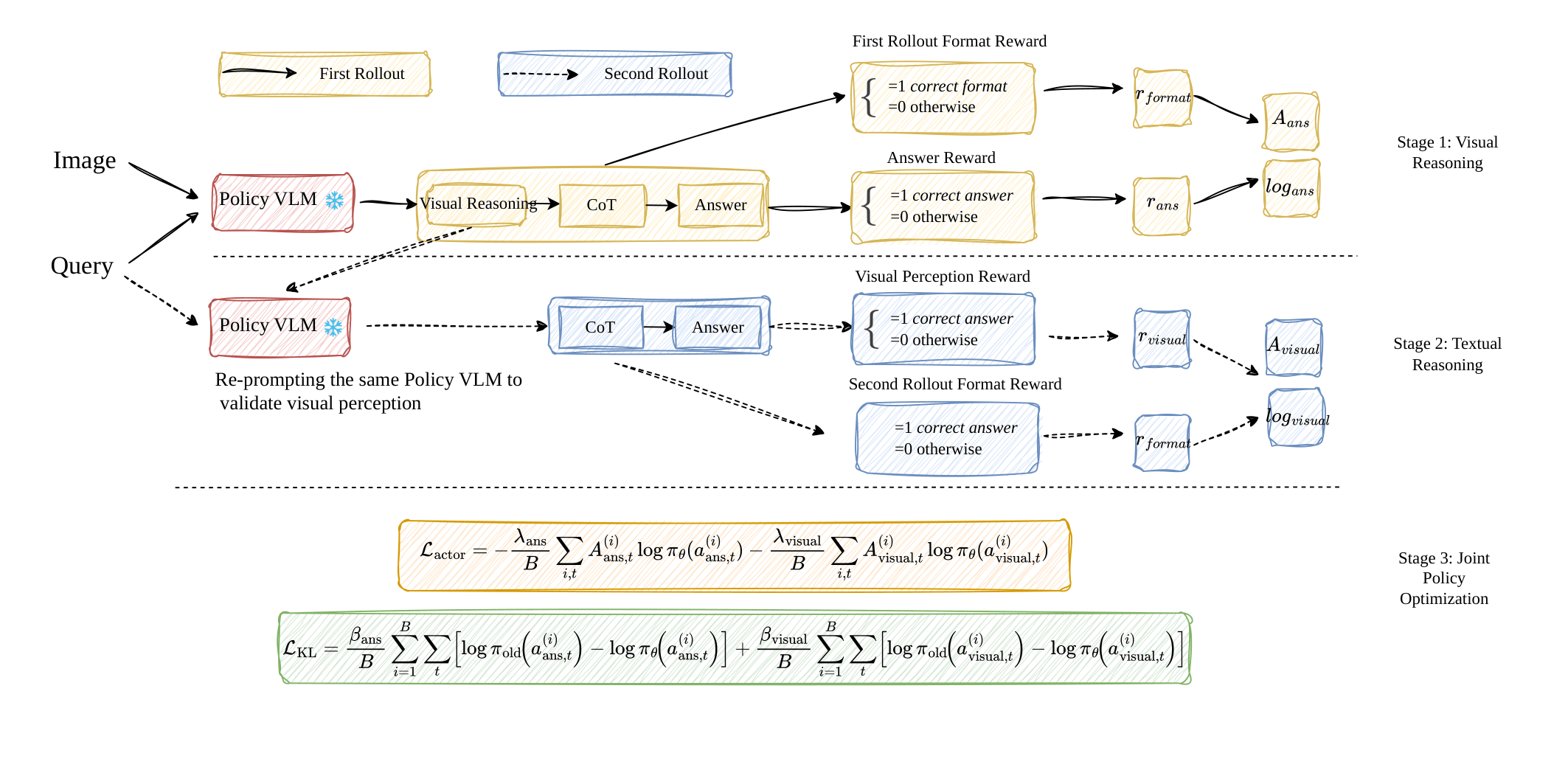
Vision-SR1 is a self-rewarded RL training framework to decompose VLMs' language reasoning into visual perception reasoning and language reasoning. Inspired by the awesome works of e.g. Vision-R1, Visionary-R1, R1-VL, we leverage VLM's self evolving and reasoning ability to Reward Itself.
Because VLMs fuse the vision encoder with the LLM backbone only late in pretraining, they often rely primarily on language reasoning rather than visual perception. Standard RL training tends to recall prior language knowledge for accuracy gains while neglecting vision. External LLM-based perception rewards can help but introduce bias and heavy latency. We instead propose a self-reward framework, enabling the model to provide its own visual and reasoning feedback with no latency.
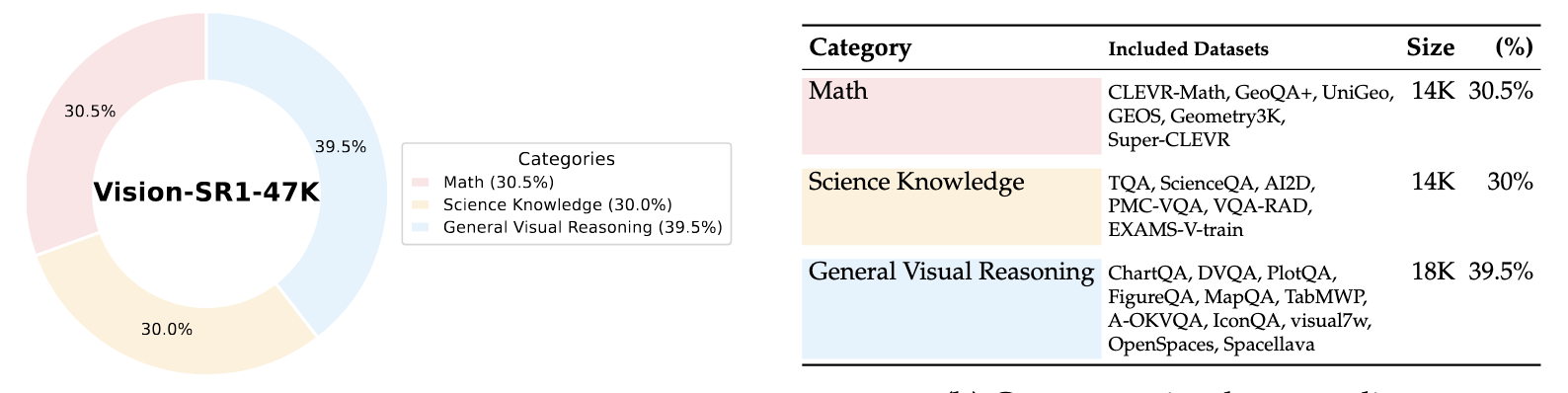
Besides vision decomposition, We constructed two datasets: Vision-SR1-Cold-9K for SFT and Vision-SR1-47K for RL.
🔍 Dataset
Our training dataset is sourced from 23 sources and evenly split across three main areas -- general visual understanding, science knowledge, multimodal mathematical reasoning.
New Features:
-- Supports Lora Training. Results are not verified. -- Support Qwen3-VL series. However, Qwen3 series format reward is always 0. (Pending debug.) -- Separate advantage computation for final answer accuracy and visual description accuracy.
Requirements
The code base adopted from verl and EasyR1.
Software Requirements
- Python 3.9+
- transformers=4.49.0
Setup
git clone https://github.com/zli12321/Vision-SR1.git
cd Vision-SR1
conda create -n Vision-SR1 python=3.12
bash setup.sh
Training
We support both full fine-tuning and LoRA fine-tuning for two training modes:
- Vision-R1: Standard GRPO with accuracy reward (
<think>...\boxed{}format). - Vision-SR1: Self-reward GRPO with accuracy + self-generated perception reward (
<description>...<think>...\boxed{}format).
Full Fine-Tuning
# Vision-SR1 (Self-Reward) full fine-tuning
bash ./vision_sr1/train.sh

# Vision-R1 (standard accuracy) full fine-tuning
bash ./vision_r1/train.sh
-
Checkpoints are saved to
./saves/7b_grpo_self_reward/and./saves/7b_grpo_accuracy/respectively. -
To use Qwen3-VL, simply change the model name in train.sh file.
LoRA Fine-Tuning
# Vision-SR1 LoRA fine-tuning
bash ./vision_sr1_lora/train.sh

# Vision-R1 LoRA fine-tuning
bash ./vision_r1_lora/train.sh
LoRA training uses rank=64, lr=1e-5, and only trains the language model layers (vision tower is excluded via exclude_modules: .*visual.*). Checkpoints are saved to ./saves/7b_grpo_self_reward_lora/ and ./saves/7b_grpo_accuracy_lora/ respectively.
Merge Checkpoints
python3 scripts/model_merger.py --local_dir CHECKPOINT_SAVE_DIR/global_step_*/actor
Hardware Requirements
* estimated
| Method | Bits | 3B | 7B |
|---|---|---|---|
| GRPO Full Fine-Tuning | AMP | 4/8 or 8x80GB | 4/8 or 8x80GB |
| GRPO LoRA Fine-Tuning | AMP | 2/4/8 or 8x32GB | 2/4/8 or 8x40GB |
[!NOTE] Use
worker.actor.fsdp.torch_dtype=bf16andworker.actor.optim.strategy=adamw_bf16to enable bf16 training with fewer memory.
Evaluation
The evaluation/ folder contains scripts for evaluating checkpoints across multiple benchmarks with automated answer extraction and LLM-based judging.
Folder Structure
evaluation/
├── eval_config.yaml              # Base evaluation config (val_only, greedy decoding)
├── format_prompt/
│   ├── cot_format.jinja           # CoT prompt template (for Vision-R1)
│   └── see_think_format.jinja     # See-Think prompt template (for Vision-SR1)
├── reward_function/
│   └── eval_accuracy.py           # Rule-based accuracy scoring
├── full_rl/
│   ├── eval_vision_r1.sh          # Evaluate full fine-tuned Vision-R1 checkpoints
│   └── eval_vision_sr1.sh         # Evaluate full fine-tuned Vision-SR1 checkpoints
├── lora_rl/
│   ├── eval_vision_r1_lora.sh     # Evaluate LoRA Vision-R1 checkpoints
│   └── eval_vision_sr1_lora.sh    # Evaluate LoRA Vision-SR1 checkpoints
├── llm_judge.py                   # Extract \boxed{} answers, then judge with LLM
└── print_accuracy.py              # Print accuracy table from judgment files
Running Evaluations
Full Fine-Tuning Checkpoints
# Evaluate base model (no checkpoint):
bash evaluation/full_rl/eval_vision_r1.sh

# Evaluate a specific checkpoint:
bash evaluation/full_rl/eval_vision_r1.sh ./saves/7b_grpo_accuracy/global_step_15

# Vision-SR1 variant:
bash evaluation/full_rl/eval_vision_sr1.sh ./saves/7b_grpo_self_reward/global_step_15
LoRA Checkpoints
# LoRA checkpoint (required):
bash evaluation/lora_rl/eval_vision_r1_lora.sh ./saves/7b_grpo_accuracy_lora/global_step_15

# Vision-SR1 LoRA:
bash evaluation/lora_rl/eval_vision_sr1_lora.sh ./saves/7b_grpo_self_reward_lora/global_step_15
Evaluation Pipeline
Each evaluation script runs the following three-stage pipeline automatically:
-
Generate responses: Run the model on each benchmark dataset with greedy decoding (
temperature=0), saving all responses toevaluation/responses/. -
Extract & judge:
llm_judge.pyextracts the final answer from\boxed{}in each response, then sends the extracted answer and the ground truth to an LLM judge (Qwen2.5-14B-Instruct via vLLM) for comparison. Judgments are saved toevaluation/judgments/. -
Print accuracy:
print_accuracy.pyaggregates the judgments and prints a per-dataset accuracy table comparing LLM-judge accuracy with the rule-based score.
Supported Benchmarks
The evaluation scripts include the following datasets (uncomment as needed in the shell scripts):
mmstar, mm-vet, MLLM_test, visnumbench, mmmu_pro_10options, mmmu-pro-vision, hallusionbench, MMMU, MMSI, mathverse, mathvision, mathvista, realWorldQA
Supervised Finetuning (Cold Start)
The supervised finetuning code is adopted from LLaMA-Factory for easy setup.
Download the filtered SFT format data
while ! python download-sft-data.py; do echo "Retrying..."; sleep 5; done
Setup
conda create -n SFT python=3.11
cd LLaMA-Factory-Cold-Start
pip install -e ".[torch,metrics]" --no-build-isolation

pip install --upgrade huggingface_hub
huggingface-cli login
Training
FORCE_TORCHRUN=1 llamafactory-cli train examples/train_full/Vision-SR1-Cold-Start.yaml
Troubleshoot
If you still encounter errors after you follow the setup, simply clone the original LLaMA-Factory repo and follow their setup. Download the dataset and place into the LLaMA-Factory data folder. Place the Vision-SR1-Cold-Start.yaml file into the LLaMA-Factory SFT training folder.
Custom Dataset
Please refer to the example datasets to prepare your own dataset.
- Text dataset: https://huggingface.co/datasets/hiyouga/math12k
- Image-text dataset: https://huggingface.co/datasets/hiyouga/geometry3k
- Multi-image-text dataset: https://huggingface.co/datasets/hiyouga/journeybench-multi-image-vqa
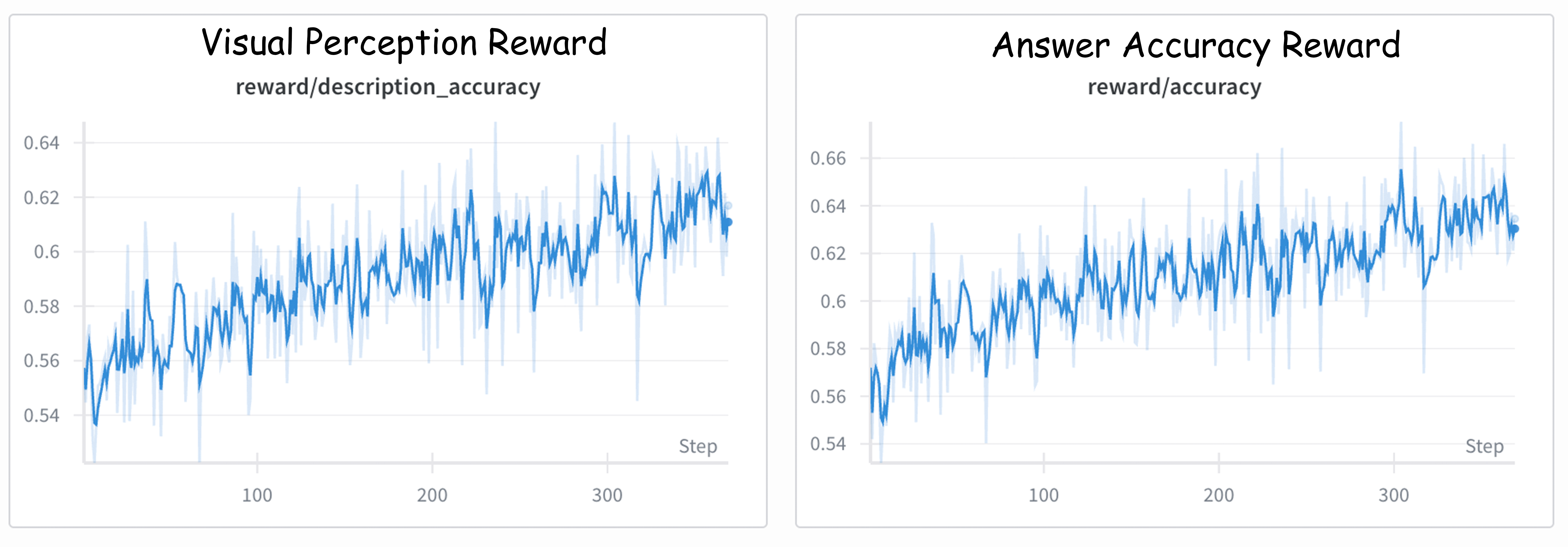
Reward Progression in Training
Citation
If you find our works helpful, please cite
@misc{li2025selfrewardingvisionlanguagemodelreasoning,
      title={Self-Rewarding Vision-Language Model via Reasoning Decomposition},
      author={Zongxia Li and Wenhao Yu and Chengsong Huang and Rui Liu and Zhenwen Liang and Fuxiao Liu and Jingxi Che and Dian Yu and Jordan Boyd-Graber and Haitao Mi and Dong Yu},
      year={2025},
      eprint={2508.19652},
      archivePrefix={arXiv},
      primaryClass={cs.CV},
      url={https://arxiv.org/abs/2508.19652},
}

@article{huang2508self,
  title={Self-evolving reasoning llm from zero data, 2025},
  author={Huang, Chengsong and Yu, Wenhao and Wang, Xiaoyang and Zhang, Hongming and Li, Zongxia and Li, Ruosen and Huang, Jiaxin and Mi, Haitao},
  journal={URL https://arxiv. org/abs/2508.05004}
}

@article{he2025visplay,
  title={Visplay: Self-evolving vision-language models from images},
  author={He, Yicheng and Huang, Chengsong and Li, Zongxia and Huang, Jiaxin and Yang, Yonghui},
  journal={arXiv preprint arXiv:2511.15661},
  year={2025}
}
We recommend to also cite the sourcecode work.
@misc{zheng2025easyr1,
  title        = {EasyR1: An Efficient, Scalable, Multi-Modality RL Training Framework},
  author       = {Yaowei Zheng, Junting Lu, Shenzhi Wang, Zhangchi Feng, Dongdong Kuang, Yuwen Xiong},
  howpublished = {\url{https://github.com/hiyouga/EasyR1}},
  year         = {2025}
}
Significant stargazers

19 followers · starred Aug 2025
Similar repos


Languages
Python
97.8%
Shell
1.2%
Reinforcement Learning of Vision Language Models with Self Visual Perception Reward
Python
185
214 commits
updated Mar 14, 2026
README
Vision-SR1: Self-Rewarding Vision-Language Model via Reasoning Decomposition
[📖 Paper]
Models:
🤗 Vision-SR1-7B |
🤗 Vision-SR1-7B-Cold-Start
Datasets:
📊 Vision-SR1-Cold-Start-9K |
📊 Vision-SR1-47K
Training Curves:
📈 Vision-SR1
👀 About Vision-SR1
Vision-SR1 is a self-rewarded RL training framework to decompose VLMs' language reasoning into visual perception reasoning and language reasoning. Inspired by the awesome works of e.g. Vision-R1, Visionary-R1, R1-VL, we leverage VLM's self evolving and reasoning ability to Reward Itself.
Because VLMs fuse the vision encoder with the LLM backbone only late in pretraining, they often rely primarily on language reasoning rather than visual perception. Standard RL training tends to recall prior language knowledge for accuracy gains while neglecting vision. External LLM-based perception rewards can help but introduce bias and heavy latency. We instead propose a self-reward framework, enabling the model to provide its own visual and reasoning feedback with no latency.
Besides vision decomposition, We constructed two datasets: Vision-SR1-Cold-9K for SFT and Vision-SR1-47K for RL.
🔍 Dataset
Our training dataset is sourced from 23 sources and evenly split across three main areas -- general visual understanding, science knowledge, multimodal mathematical reasoning.
New Features:
-- Supports Lora Training. Results are not verified. -- Support Qwen3-VL series. However, Qwen3 series format reward is always 0. (Pending debug.) -- Separate advantage computation for final answer accuracy and visual description accuracy.
Requirements
The code base adopted from verl and EasyR1.
Software Requirements
- Python 3.9+
- transformers=4.49.0
Setup
git clone https://github.com/zli12321/Vision-SR1.git
cd Vision-SR1
conda create -n Vision-SR1 python=3.12
bash setup.sh
Training
We support both full fine-tuning and LoRA fine-tuning for two training modes:
- Vision-R1: Standard GRPO with accuracy reward (
<think>...\boxed{}format). - Vision-SR1: Self-reward GRPO with accuracy + self-generated perception reward (
<description>...<think>...\boxed{}format).
Full Fine-Tuning
# Vision-SR1 (Self-Reward) full fine-tuning
bash ./vision_sr1/train.sh

# Vision-R1 (standard accuracy) full fine-tuning
bash ./vision_r1/train.sh
-
Checkpoints are saved to
./saves/7b_grpo_self_reward/and./saves/7b_grpo_accuracy/respectively. -
To use Qwen3-VL, simply change the model name in train.sh file.
LoRA Fine-Tuning
# Vision-SR1 LoRA fine-tuning
bash ./vision_sr1_lora/train.sh

# Vision-R1 LoRA fine-tuning
bash ./vision_r1_lora/train.sh
LoRA training uses rank=64, lr=1e-5, and only trains the language model layers (vision tower is excluded via exclude_modules: .*visual.*). Checkpoints are saved to ./saves/7b_grpo_self_reward_lora/ and ./saves/7b_grpo_accuracy_lora/ respectively.
Merge Checkpoints
python3 scripts/model_merger.py --local_dir CHECKPOINT_SAVE_DIR/global_step_*/actor
Hardware Requirements
* estimated
| Method | Bits | 3B | 7B |
|---|---|---|---|
| GRPO Full Fine-Tuning | AMP | 4/8 or 8x80GB | 4/8 or 8x80GB |
| GRPO LoRA Fine-Tuning | AMP | 2/4/8 or 8x32GB | 2/4/8 or 8x40GB |
[!NOTE] Use
worker.actor.fsdp.torch_dtype=bf16andworker.actor.optim.strategy=adamw_bf16to enable bf16 training with fewer memory.
Evaluation
The evaluation/ folder contains scripts for evaluating checkpoints across multiple benchmarks with automated answer extraction and LLM-based judging.
Folder Structure
evaluation/
├── eval_config.yaml              # Base evaluation config (val_only, greedy decoding)
├── format_prompt/
│   ├── cot_format.jinja           # CoT prompt template (for Vision-R1)
│   └── see_think_format.jinja     # See-Think prompt template (for Vision-SR1)
├── reward_function/
│   └── eval_accuracy.py           # Rule-based accuracy scoring
├── full_rl/
│   ├── eval_vision_r1.sh          # Evaluate full fine-tuned Vision-R1 checkpoints
│   └── eval_vision_sr1.sh         # Evaluate full fine-tuned Vision-SR1 checkpoints
├── lora_rl/
│   ├── eval_vision_r1_lora.sh     # Evaluate LoRA Vision-R1 checkpoints
│   └── eval_vision_sr1_lora.sh    # Evaluate LoRA Vision-SR1 checkpoints
├── llm_judge.py                   # Extract \boxed{} answers, then judge with LLM
└── print_accuracy.py              # Print accuracy table from judgment files
Running Evaluations
Full Fine-Tuning Checkpoints
# Evaluate base model (no checkpoint):
bash evaluation/full_rl/eval_vision_r1.sh

# Evaluate a specific checkpoint:
bash evaluation/full_rl/eval_vision_r1.sh ./saves/7b_grpo_accuracy/global_step_15

# Vision-SR1 variant:
bash evaluation/full_rl/eval_vision_sr1.sh ./saves/7b_grpo_self_reward/global_step_15
LoRA Checkpoints
# LoRA checkpoint (required):
bash evaluation/lora_rl/eval_vision_r1_lora.sh ./saves/7b_grpo_accuracy_lora/global_step_15

# Vision-SR1 LoRA:
bash evaluation/lora_rl/eval_vision_sr1_lora.sh ./saves/7b_grpo_self_reward_lora/global_step_15
Evaluation Pipeline
Each evaluation script runs the following three-stage pipeline automatically:
-
Generate responses: Run the model on each benchmark dataset with greedy decoding (
temperature=0), saving all responses toevaluation/responses/. -
Extract & judge:
llm_judge.pyextracts the final answer from\boxed{}in each response, then sends the extracted answer and the ground truth to an LLM judge (Qwen2.5-14B-Instruct via vLLM) for comparison. Judgments are saved toevaluation/judgments/. -
Print accuracy:
print_accuracy.pyaggregates the judgments and prints a per-dataset accuracy table comparing LLM-judge accuracy with the rule-based score.
Supported Benchmarks
The evaluation scripts include the following datasets (uncomment as needed in the shell scripts):
mmstar, mm-vet, MLLM_test, visnumbench, mmmu_pro_10options, mmmu-pro-vision, hallusionbench, MMMU, MMSI, mathverse, mathvision, mathvista, realWorldQA
Supervised Finetuning (Cold Start)
The supervised finetuning code is adopted from LLaMA-Factory for easy setup.
Download the filtered SFT format data
while ! python download-sft-data.py; do echo "Retrying..."; sleep 5; done
Setup
conda create -n SFT python=3.11
cd LLaMA-Factory-Cold-Start
pip install -e ".[torch,metrics]" --no-build-isolation

pip install --upgrade huggingface_hub
huggingface-cli login
Training
FORCE_TORCHRUN=1 llamafactory-cli train examples/train_full/Vision-SR1-Cold-Start.yaml
Troubleshoot
If you still encounter errors after you follow the setup, simply clone the original LLaMA-Factory repo and follow their setup. Download the dataset and place into the LLaMA-Factory data folder. Place the Vision-SR1-Cold-Start.yaml file into the LLaMA-Factory SFT training folder.
Custom Dataset
Please refer to the example datasets to prepare your own dataset.
- Text dataset: https://huggingface.co/datasets/hiyouga/math12k
- Image-text dataset: https://huggingface.co/datasets/hiyouga/geometry3k
- Multi-image-text dataset: https://huggingface.co/datasets/hiyouga/journeybench-multi-image-vqa
Reward Progression in Training
Citation
If you find our works helpful, please cite
@misc{li2025selfrewardingvisionlanguagemodelreasoning,
      title={Self-Rewarding Vision-Language Model via Reasoning Decomposition},
      author={Zongxia Li and Wenhao Yu and Chengsong Huang and Rui Liu and Zhenwen Liang and Fuxiao Liu and Jingxi Che and Dian Yu and Jordan Boyd-Graber and Haitao Mi and Dong Yu},
      year={2025},
      eprint={2508.19652},
      archivePrefix={arXiv},
      primaryClass={cs.CV},
      url={https://arxiv.org/abs/2508.19652},
}

@article{huang2508self,
  title={Self-evolving reasoning llm from zero data, 2025},
  author={Huang, Chengsong and Yu, Wenhao and Wang, Xiaoyang and Zhang, Hongming and Li, Zongxia and Li, Ruosen and Huang, Jiaxin and Mi, Haitao},
  journal={URL https://arxiv. org/abs/2508.05004}
}

@article{he2025visplay,
  title={Visplay: Self-evolving vision-language models from images},
  author={He, Yicheng and Huang, Chengsong and Li, Zongxia and Huang, Jiaxin and Yang, Yonghui},
  journal={arXiv preprint arXiv:2511.15661},
  year={2025}
}
We recommend to also cite the sourcecode work.
@misc{zheng2025easyr1,
  title        = {EasyR1: An Efficient, Scalable, Multi-Modality RL Training Framework},
  author       = {Yaowei Zheng, Junting Lu, Shenzhi Wang, Zhangchi Feng, Dongdong Kuang, Yuwen Xiong},
  howpublished = {\url{https://github.com/hiyouga/EasyR1}},
  year         = {2025}
}
Similar repos
Significant stargazers
19 followers · starred Aug 2025
Languages
Python
97.8%
Shell
1.2%