
CEO-Bench: Can Agents Play the Long Game?
See the codeREADME

CEO-Bench: Can Agents Play the Long Game?
Haozhe Chen, Karthik Narasimhan, Zhuang Liu
Princeton University
🌐 Website | 📄 Paper | 📊 Trajectory Viewer
📊 Overview
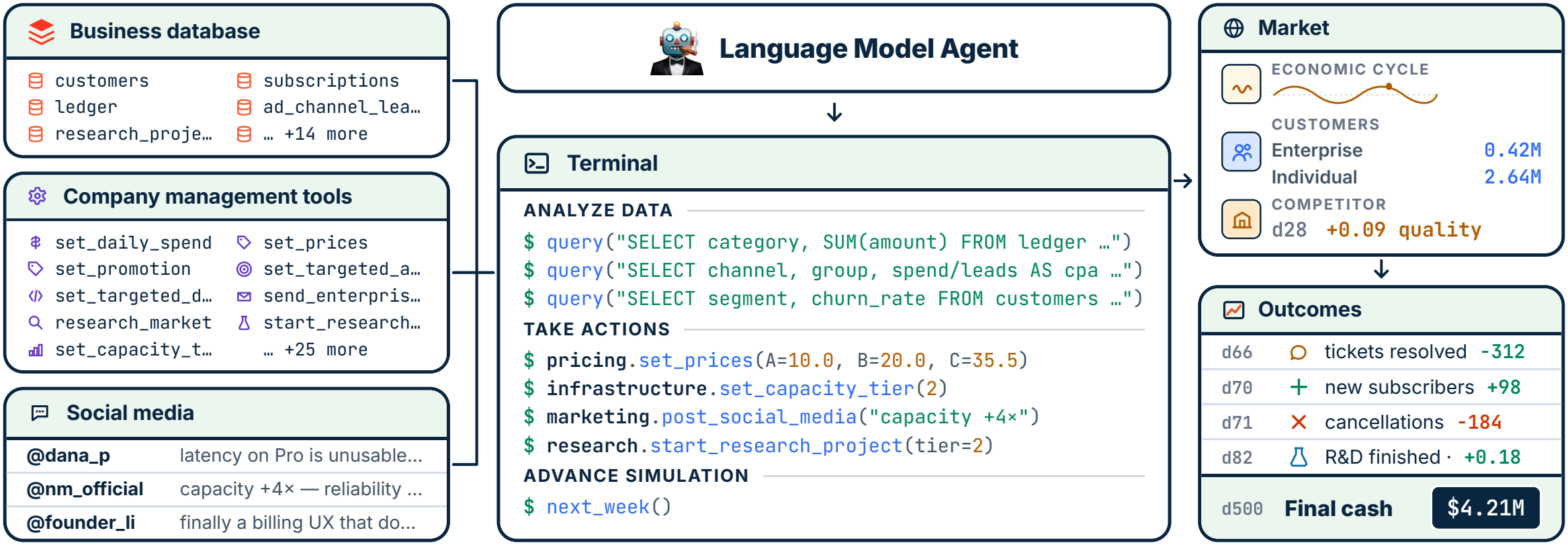
CEO-Bench evaluates general long-horizon agent capabilities by simulating a startup over 500 days in a realistic and challenging environment. The agent operates through a programmable interface with access to business databases, company management tools, and social media. Outcomes are driven by a partially observable, noisy, and evolving market with delayed and coupled consequences.
🚀 Running CEO-Bench
🔑 Setup: Environment variables
CEO-Bench has three LLM roles:
- the benchmarked agent model
- the social/macro post simulator model, Haiku 4.5 by default
- the enterprise customer simulator model, Sonnet 4.5 by default
Pick one provider family and use provider-specific model identifiers in
src/saas_bench/config.py.
Option A: Amazon Bedrock for all models
export AWS_ACCESS_KEY_ID="..."
export AWS_SECRET_ACCESS_KEY="..."
export AWS_REGION="us-east-2"
agent_llm_provider: str = "bedrock"
agent_llm_model: str = "anthropic.claude-fable-5"  # Claude Fable 5
# or another Bedrock model id, e.g. "us.anthropic.claude-sonnet-4-6"

social_post_llm_provider: str = "bedrock"
social_post_llm_model: str = "us.anthropic.claude-haiku-4-5-20251001-v1:0"

enterprise_llm_provider: str = "bedrock"
enterprise_llm_model: str = "us.anthropic.claude-sonnet-4-5-20250929-v1:0"
Option B: Anthropic direct API for all models
export ANTHROPIC_API_KEY="sk-ant-..."
agent_llm_provider: str = "anthropic"
agent_llm_model: str = "claude-fable-5"  # Claude Fable 5

social_post_llm_provider: str = "anthropic"
social_post_llm_model: str = "claude-haiku-4-5"

enterprise_llm_provider: str = "anthropic"
enterprise_llm_model: str = "claude-sonnet-4-5"
The LLM config fields are:
agent_llm_provider,agent_llm_model,agent_llm_reasoning_effortsocial_post_llm_provider,social_post_llm_modelenterprise_llm_provider,enterprise_llm_model
The bash-agent CLI --provider, --model, and --reasoning-effort flags only
override the benchmarked agent for ad hoc runs. Simulator social/macro and
enterprise LLMs use the simulator config and do not reuse the agent-only
--api-key. If you change a simulator provider, also set the corresponding
model to the identifier expected by that provider; model names are not
translated automatically.
For Claude Fable 5 agent runs, use --provider anthropic --model claude-fable-5
for the direct Anthropic API, or --provider bedrock --model anthropic.claude-fable-5
for Amazon Bedrock.
🎯 Option A: Evaluate any coding agent easily
We built CEO-Bench into a single executable and docs that any coding agent can just download the game and start playing.
The executable is hosted at zlab-princeton/run-ceobench
If you want to evaluate a coding agent with terminal and internet access, prompt it
Download this, read instructions, and finish 500 day gameplay. https://github.com/zlab-princeton/run-ceobench
⚙️ Option B: Customize the configuration
All tunable simulator constants live in src/saas_bench/config.py: pricing,
customer groups, ad-channel productivity, R&D speed, competitor difficulty, etc.
After editing, rebuild the public bundle.
uv sync                                  # one-time install
uv run python scripts/build_public.py    # rebuild public/ artifact
Then generated public/ directory would play the same role as the same way as zlab-princeton/run-ceobench in Option A
Tuning difficulty You can modify configuration in config.py to adjust difficulty.
An important difficulty is competitor strength. Competitor keeps track of a unreleased_dev_bank. Each agent's research and development quality improvement is added to this variable. At each competitor event, competitor draws u ~ U(competitor_feedback_u_min, competitor_feedback_u_max), raises customer expectations by u × unreleased_dev_bank, and subtract this amount from unreleased_dev_bank. Larger competitor_feedback_u_min and competitor_feedback_u_max leads to stronger competitor and higher quality pressure. The default config value is (0.2,0.5).
🤖 Option C: Replicate the bash-agent baseline
The paper's baseline gives an LLM a sandboxed bash shell plus the public CLI and runs the full 500-day loop with checkpointing and logging. The full process:
1. Install dependencies (one-time):
uv sync
2. Set provider credentials in a .env file at the repo root. Which keys you
need depends on the agent model; for a Bedrock run:
AWS_ACCESS_KEY_ID="..."
AWS_SECRET_ACCESS_KEY="..."
AWS_REGION="us-east-2"
Other providers read OPENAI_API_KEY, ANTHROPIC_API_KEY, GOOGLE_API_KEY,
XAI_API_KEY, TOGETHER_API_KEY, or MODAL_TOKEN_*. No NMDB_KEY is needed:
the SQLCipher key is embedded in the engine.
If you configure simulator LLMs to use direct anthropic or openai, export
ANTHROPIC_API_KEY or OPENAI_API_KEY in the shell before running. The
simulator does not receive the agent-only --api-key.
3. Run. public/ ships prebuilt, so there is no build step:
uv run python -m saas_bench.agents.bash_agent.run_test \
    --model us.anthropic.claude-sonnet-4-6 \
    --provider bedrock \
    --reasoning-effort max \
    --seed 42 \
    --days 500 \
    --workspace bash_agent_runs
4. Output. Each run lands at bash_agent_runs/run_<id>/: world.nmdb
(encrypted ledger), config.json, checkpoint.json, agent_workspace/ (the
agent's sandbox, a fresh git repo with weekly commits), and logs/ containing
per-turn raw_responses_<id>.jsonl (model thinking + tool calls),
tool_results_<id>.jsonl (tool calls + their outputs), and
timing_<id>.jsonl. To score and analyze the run, see
docs/analyze_trajectory.md.
If you edit src/saas_bench/config.py, rebuild the bundle the agent sees with
uv run python scripts/build_public.py before launching.
📈 Analyzing agent trajectory
Every finished run leaves a single artifact: an encrypted world.nmdb ledger
(SQLCipher, page-level AES-256). It is the complete record of the run: cash,
subscriptions, customers, competitor events, and every action the agent took.
The decryption key is fixed and bundled into the published novamind-operation
zipapp at build time; see KEYS.md in this repo for the value, or import it
from the compiled saas_bench._embedded_key module. To decrypt and query:
KEY=$(grep _NMDB_KEY KEYS.md | head -1 | cut -d'"' -f2)
sqlcipher path/to/world.nmdb \
  "PRAGMA key = '$KEY';" \
  "SELECT day, category, amount FROM ledger ORDER BY day, id LIMIT 10;"
For the database schema, analysis recipes, and notes on keeping the agent from cheating, see docs/analyze_trajectory.md.
📁 Repo layout
ceobench-src/
├── README.md                          ← this file
├── docs/
│   └── analyze_trajectory.md          ← decrypt, schema + analysis guide
├── public_sources/                    ← human-written inputs to the public build
│   ├── README.md, requirements.txt
│   └── examples/{autoplay_loop,basic_strategy}.py
├── scripts/
│   ├── build_public.py                ← canonical public-repo builder
│   ├── start_fresh_sonnet_bash.sh     ← bash-agent launcher (Bedrock Sonnet)
│   ├── start_fresh_gpt_bash.sh        ← bash-agent launcher (OpenAI GPT)
│   └── resume_run.sh                  ← resume bash agent from checkpoint
└── src/saas_bench/                    ← simulator + bash agent
    ├── simulation.py, environment.py, shocks.py, event_logger.py
    ├── config.py                      ← all tunable constants
    ├── customer_llm.py, personas.py, enterprise.py
    ├── database.py, db_protection.py
    ├── api_server.py, server_entry.py, tools.py
    ├── novamind_api/, novamind_cli.py, _public_cli.py
    └── agents/bash_agent/             ← canonical baseline harness
📜 Citation
@misc{chen2026ceobenchagentsplaylong,
  title={CEO-Bench: Can Agents Play the Long Game?},
  author={Haozhe Chen and Karthik Narasimhan and Zhuang Liu},
  year={2026},
  eprint={2606.18543},
  archivePrefix={arXiv},
  primaryClass={cs.AI},
  url={https://arxiv.org/abs/2606.18543},
}
Contributors

119 commits

22 commits
Languages
Python
99.2%
CEO-Bench: Can Agents Play the Long Game?
See the codeREADME
CEO-Bench: Can Agents Play the Long Game?
Haozhe Chen, Karthik Narasimhan, Zhuang Liu
Princeton University
🌐 Website | 📄 Paper | 📊 Trajectory Viewer
📊 Overview
CEO-Bench evaluates general long-horizon agent capabilities by simulating a startup over 500 days in a realistic and challenging environment. The agent operates through a programmable interface with access to business databases, company management tools, and social media. Outcomes are driven by a partially observable, noisy, and evolving market with delayed and coupled consequences.
🚀 Running CEO-Bench
🔑 Setup: Environment variables
CEO-Bench has three LLM roles:
- the benchmarked agent model
- the social/macro post simulator model, Haiku 4.5 by default
- the enterprise customer simulator model, Sonnet 4.5 by default
Pick one provider family and use provider-specific model identifiers in
src/saas_bench/config.py.
Option A: Amazon Bedrock for all models
export AWS_ACCESS_KEY_ID="..."
export AWS_SECRET_ACCESS_KEY="..."
export AWS_REGION="us-east-2"
agent_llm_provider: str = "bedrock"
agent_llm_model: str = "anthropic.claude-fable-5"  # Claude Fable 5
# or another Bedrock model id, e.g. "us.anthropic.claude-sonnet-4-6"

social_post_llm_provider: str = "bedrock"
social_post_llm_model: str = "us.anthropic.claude-haiku-4-5-20251001-v1:0"

enterprise_llm_provider: str = "bedrock"
enterprise_llm_model: str = "us.anthropic.claude-sonnet-4-5-20250929-v1:0"
Option B: Anthropic direct API for all models
export ANTHROPIC_API_KEY="sk-ant-..."
agent_llm_provider: str = "anthropic"
agent_llm_model: str = "claude-fable-5"  # Claude Fable 5

social_post_llm_provider: str = "anthropic"
social_post_llm_model: str = "claude-haiku-4-5"

enterprise_llm_provider: str = "anthropic"
enterprise_llm_model: str = "claude-sonnet-4-5"
The LLM config fields are:
agent_llm_provider,agent_llm_model,agent_llm_reasoning_effortsocial_post_llm_provider,social_post_llm_modelenterprise_llm_provider,enterprise_llm_model
The bash-agent CLI --provider, --model, and --reasoning-effort flags only
override the benchmarked agent for ad hoc runs. Simulator social/macro and
enterprise LLMs use the simulator config and do not reuse the agent-only
--api-key. If you change a simulator provider, also set the corresponding
model to the identifier expected by that provider; model names are not
translated automatically.
For Claude Fable 5 agent runs, use --provider anthropic --model claude-fable-5
for the direct Anthropic API, or --provider bedrock --model anthropic.claude-fable-5
for Amazon Bedrock.
🎯 Option A: Evaluate any coding agent easily
We built CEO-Bench into a single executable and docs that any coding agent can just download the game and start playing.
The executable is hosted at zlab-princeton/run-ceobench
If you want to evaluate a coding agent with terminal and internet access, prompt it
Download this, read instructions, and finish 500 day gameplay. https://github.com/zlab-princeton/run-ceobench
⚙️ Option B: Customize the configuration
All tunable simulator constants live in src/saas_bench/config.py: pricing,
customer groups, ad-channel productivity, R&D speed, competitor difficulty, etc.
After editing, rebuild the public bundle.
uv sync                                  # one-time install
uv run python scripts/build_public.py    # rebuild public/ artifact
Then generated public/ directory would play the same role as the same way as zlab-princeton/run-ceobench in Option A
Tuning difficulty You can modify configuration in config.py to adjust difficulty.
An important difficulty is competitor strength. Competitor keeps track of a unreleased_dev_bank. Each agent's research and development quality improvement is added to this variable. At each competitor event, competitor draws u ~ U(competitor_feedback_u_min, competitor_feedback_u_max), raises customer expectations by u × unreleased_dev_bank, and subtract this amount from unreleased_dev_bank. Larger competitor_feedback_u_min and competitor_feedback_u_max leads to stronger competitor and higher quality pressure. The default config value is (0.2,0.5).
🤖 Option C: Replicate the bash-agent baseline
The paper's baseline gives an LLM a sandboxed bash shell plus the public CLI and runs the full 500-day loop with checkpointing and logging. The full process:
1. Install dependencies (one-time):
uv sync
2. Set provider credentials in a .env file at the repo root. Which keys you
need depends on the agent model; for a Bedrock run:
AWS_ACCESS_KEY_ID="..."
AWS_SECRET_ACCESS_KEY="..."
AWS_REGION="us-east-2"
Other providers read OPENAI_API_KEY, ANTHROPIC_API_KEY, GOOGLE_API_KEY,
XAI_API_KEY, TOGETHER_API_KEY, or MODAL_TOKEN_*. No NMDB_KEY is needed:
the SQLCipher key is embedded in the engine.
If you configure simulator LLMs to use direct anthropic or openai, export
ANTHROPIC_API_KEY or OPENAI_API_KEY in the shell before running. The
simulator does not receive the agent-only --api-key.
3. Run. public/ ships prebuilt, so there is no build step:
uv run python -m saas_bench.agents.bash_agent.run_test \
    --model us.anthropic.claude-sonnet-4-6 \
    --provider bedrock \
    --reasoning-effort max \
    --seed 42 \
    --days 500 \
    --workspace bash_agent_runs
4. Output. Each run lands at bash_agent_runs/run_<id>/: world.nmdb
(encrypted ledger), config.json, checkpoint.json, agent_workspace/ (the
agent's sandbox, a fresh git repo with weekly commits), and logs/ containing
per-turn raw_responses_<id>.jsonl (model thinking + tool calls),
tool_results_<id>.jsonl (tool calls + their outputs), and
timing_<id>.jsonl. To score and analyze the run, see
docs/analyze_trajectory.md.
If you edit src/saas_bench/config.py, rebuild the bundle the agent sees with
uv run python scripts/build_public.py before launching.
📈 Analyzing agent trajectory
Every finished run leaves a single artifact: an encrypted world.nmdb ledger
(SQLCipher, page-level AES-256). It is the complete record of the run: cash,
subscriptions, customers, competitor events, and every action the agent took.
The decryption key is fixed and bundled into the published novamind-operation
zipapp at build time; see KEYS.md in this repo for the value, or import it
from the compiled saas_bench._embedded_key module. To decrypt and query:
KEY=$(grep _NMDB_KEY KEYS.md | head -1 | cut -d'"' -f2)
sqlcipher path/to/world.nmdb \
  "PRAGMA key = '$KEY';" \
  "SELECT day, category, amount FROM ledger ORDER BY day, id LIMIT 10;"
For the database schema, analysis recipes, and notes on keeping the agent from cheating, see docs/analyze_trajectory.md.
📁 Repo layout
ceobench-src/
├── README.md                          ← this file
├── docs/
│   └── analyze_trajectory.md          ← decrypt, schema + analysis guide
├── public_sources/                    ← human-written inputs to the public build
│   ├── README.md, requirements.txt
│   └── examples/{autoplay_loop,basic_strategy}.py
├── scripts/
│   ├── build_public.py                ← canonical public-repo builder
│   ├── start_fresh_sonnet_bash.sh     ← bash-agent launcher (Bedrock Sonnet)
│   ├── start_fresh_gpt_bash.sh        ← bash-agent launcher (OpenAI GPT)
│   └── resume_run.sh                  ← resume bash agent from checkpoint
└── src/saas_bench/                    ← simulator + bash agent
    ├── simulation.py, environment.py, shocks.py, event_logger.py
    ├── config.py                      ← all tunable constants
    ├── customer_llm.py, personas.py, enterprise.py
    ├── database.py, db_protection.py
    ├── api_server.py, server_entry.py, tools.py
    ├── novamind_api/, novamind_cli.py, _public_cli.py
    └── agents/bash_agent/             ← canonical baseline harness
📜 Citation
@misc{chen2026ceobenchagentsplaylong,
  title={CEO-Bench: Can Agents Play the Long Game?},
  author={Haozhe Chen and Karthik Narasimhan and Zhuang Liu},
  year={2026},
  eprint={2606.18543},
  archivePrefix={arXiv},
  primaryClass={cs.AI},
  url={https://arxiv.org/abs/2606.18543},
}
Contributors
119 commits
22 commits
Languages
Python
99.2%