VideoRAE: Taming Video Foundation Models for Generative Modeling via Representation Autoencoders
Python
106
4 commits
updated Aug 29, 2026




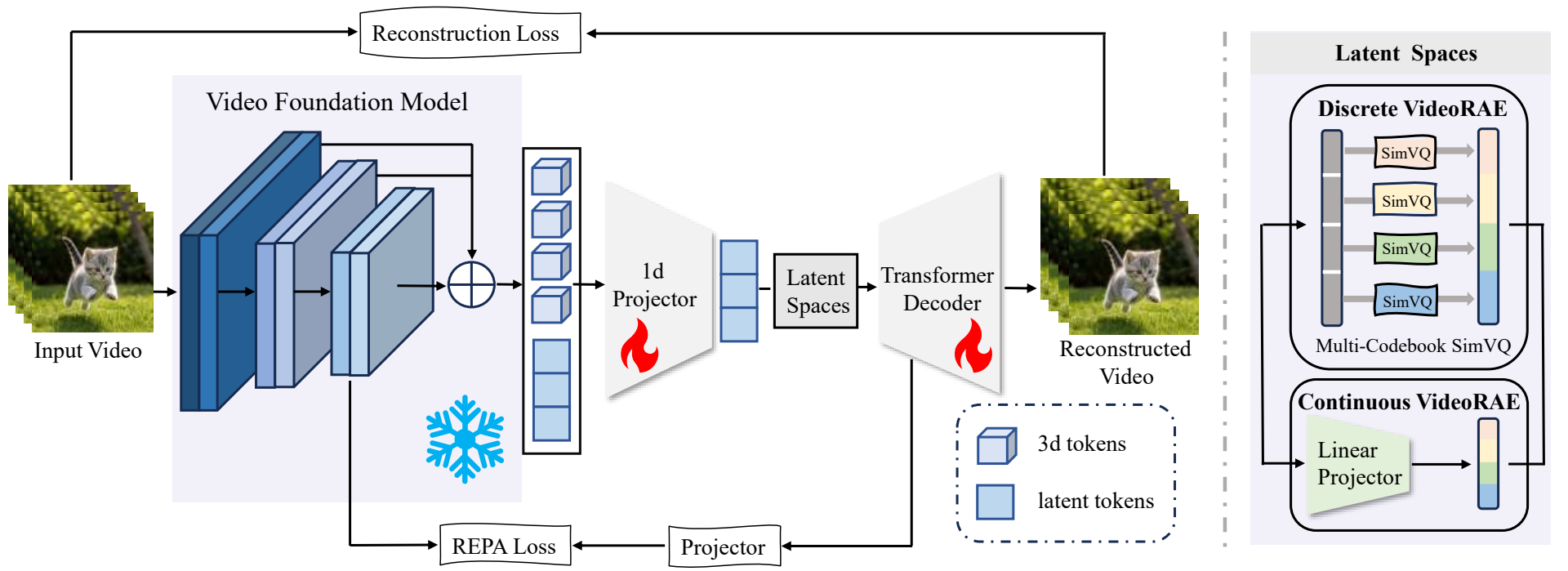
Overall architecture of VideoRAE.
VideoRAE turns frozen Video Foundation Models (VFMs) such as V-JEPA 2 and VideoMAEv2 into compact, reconstruction-capable, and generation-friendly video latents. Unlike conventional 3D-VAEs trained mainly for pixel reconstruction, VideoRAE:
On UCF-101, VideoRAE achieves state-of-the-art class-to-video gFVD of 40 (AR) and 93 (DiT), while converging roughly 5× faster than competing autoencoder baselines. See the project page for video demos and full results.
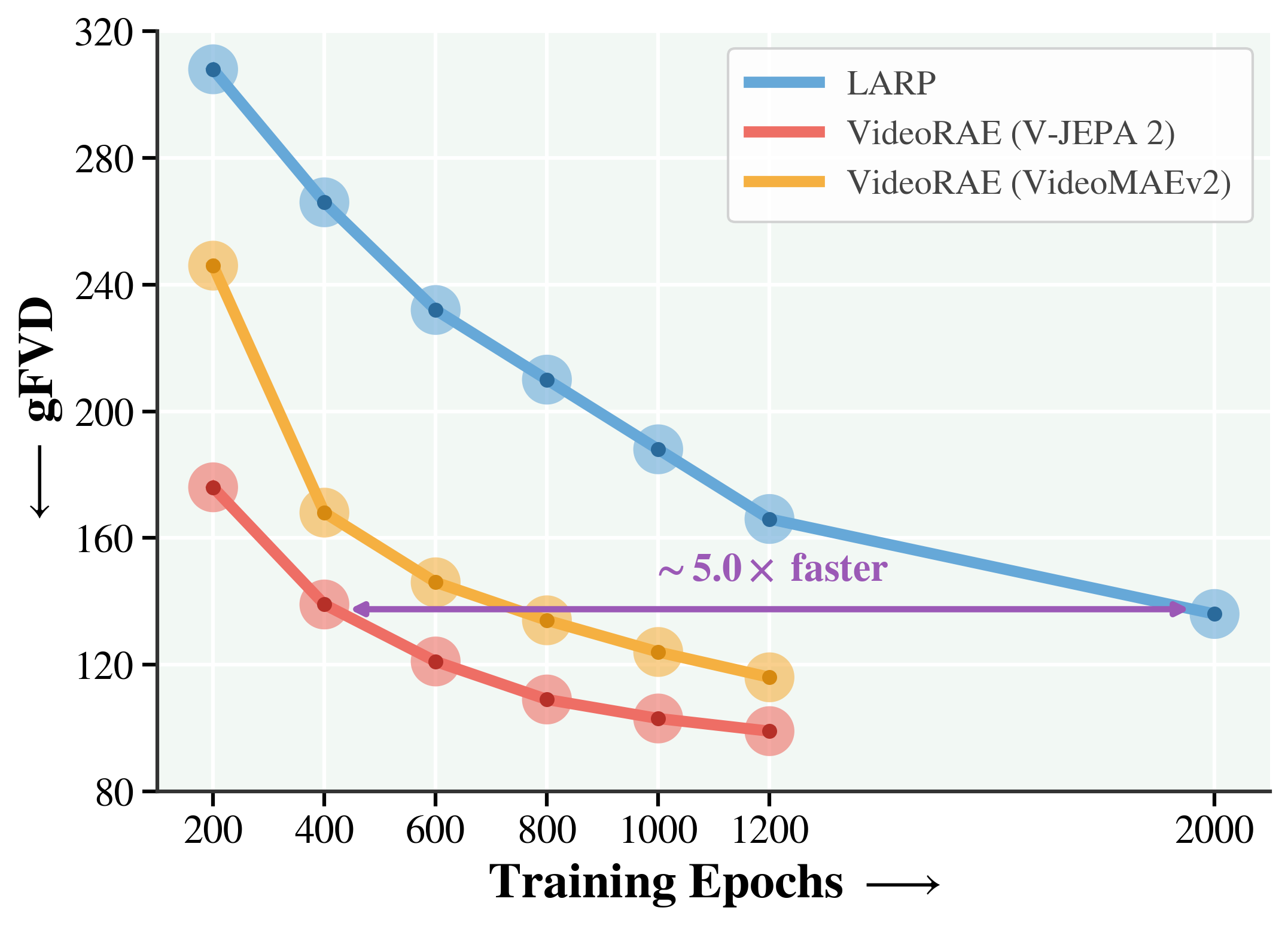 | 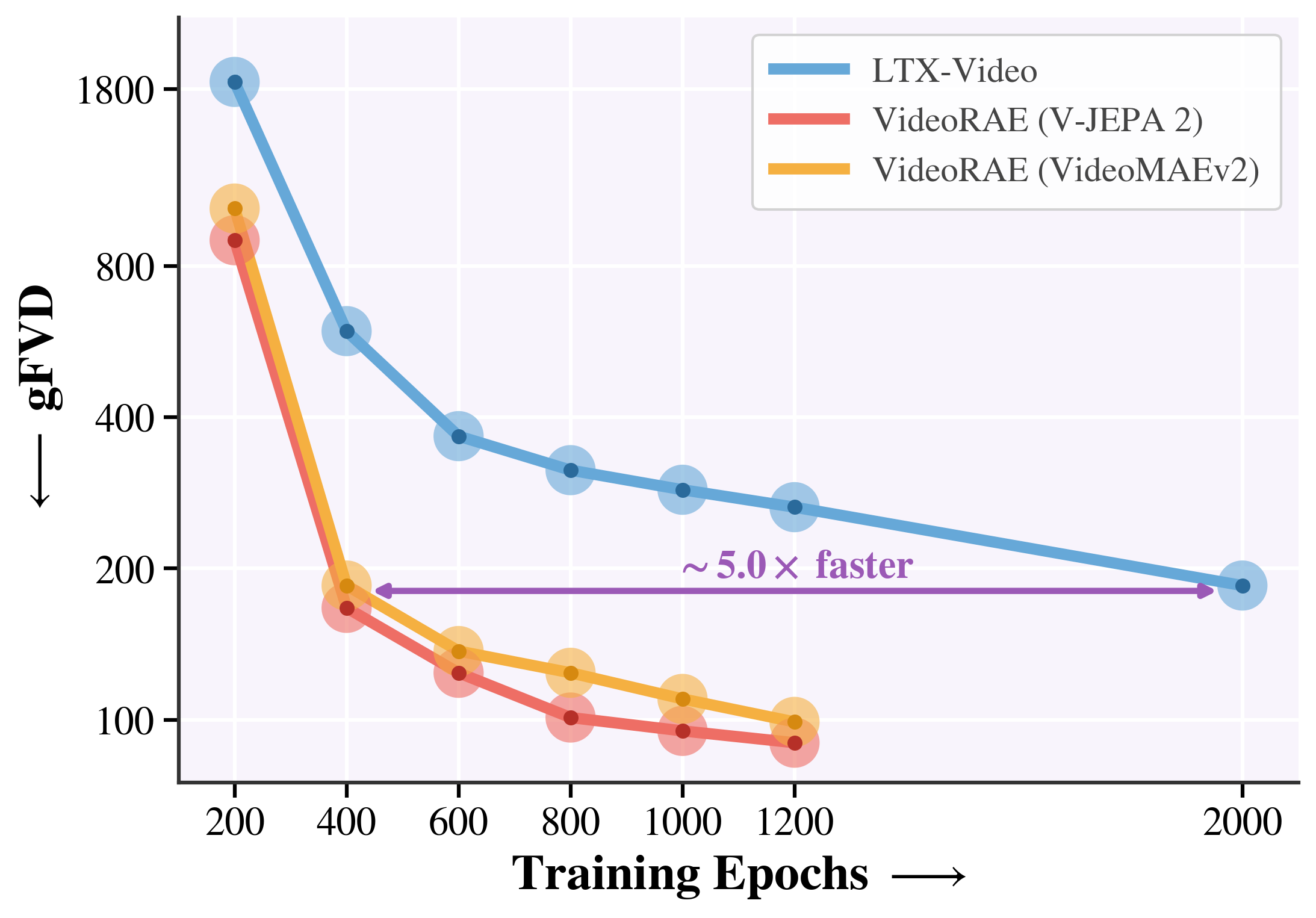 |
Class-to-video generation: AR (left) and DiT (right).
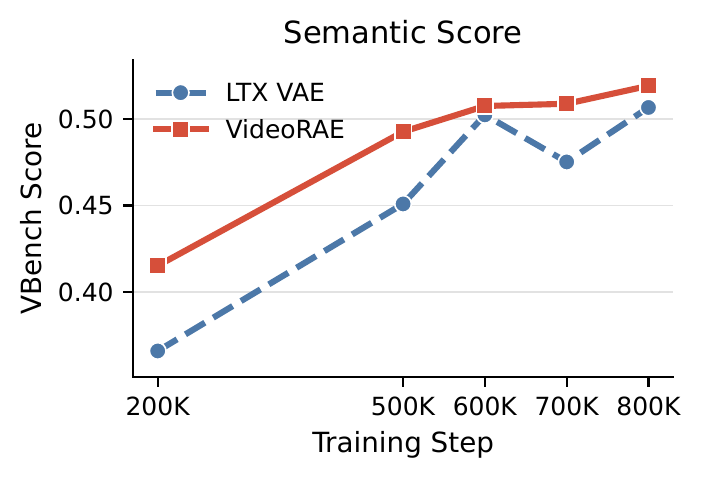 | 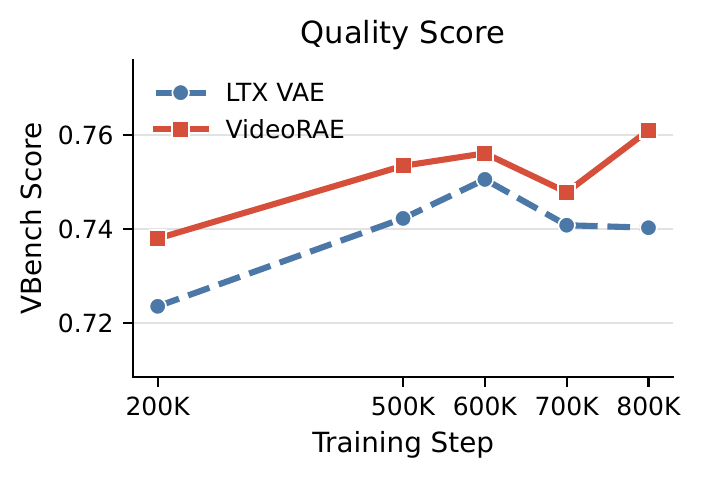 | 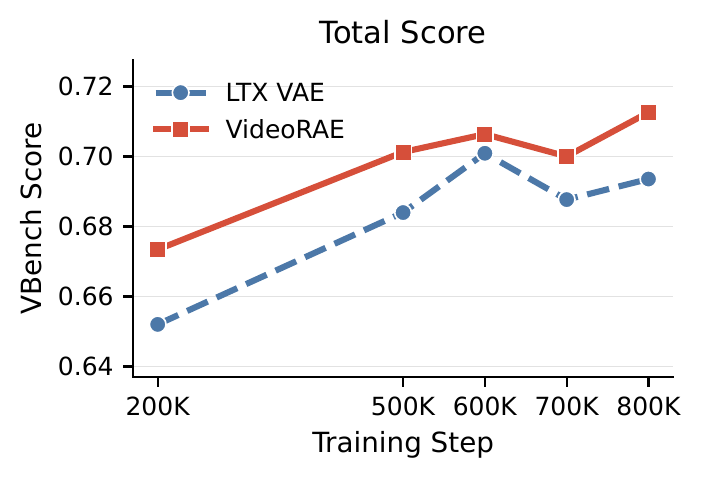 |
Text-to-video VBench scores (2B-scale setting): semantic, quality, and total.
# Recommended: PyTorch 2.4 + CUDA 12.4
pip install torch==2.4.0 torchvision==0.19.0 torchaudio==2.4.0 \
  --index-url https://download.pytorch.org/whl/cu124

pip install -r requirements.txt
Training expects CSV metadata under data/metadata/, with relative video paths resolvable from the repo root (or your chosen data root).
Example CSV format:
id,path,action,label
0,data/ucf101/ApplyEyeMakeup/v_ApplyEyeMakeup_g08_c01.avi,ApplyEyeMakeup,0
Typical layout:
data/
├── metadata/
│   ├── ucf101_train.csv
│   ├── ucf101_val.csv
│   └── kinetics_dataset.csv   #  used by provided scripts
├── ucf101/
└── kinetics/                  # or your Kinetics-600 root
Clips used in the paper are 16 × 256 × 256.
Please download UCF-101 / Kinetics-600 yourself and build the CSV files accordingly. Do not commit absolute machine-local paths.
Both configs assume an 8-GPU machine by default (-b 64). Adjust batch size / workers for your hardware.
Before training, download the V-JEPA 2 (vitl.pt) checkpoint.
bash scripts/train_rae_vjepa.sh
bash scripts/train_vqrae_vjepa.sh
python evalvfm/eval_larp_tokenizer.py \
  --tokenizer /path/to/videorae_checkpoint.pth \
  --dataset_csv ucf101_train.csv \
  --use_amp --det
This reports MSE / PSNR / rFVD / LPIPS / SSIM.
We also open-source a 3D latent VideoRAE built on V-JEPA 2.1. The model architecture is defined in models/model_sem/auto_vjepa21_3d.py, which compresses V-JEPA 2.1 teacher features into a structured 3D latent volume for reconstruction and downstream modeling.
We are currently training a video generation model on top of this 3D latent representation, and plan to release it in a future update. We hope this line of work can be useful for downstream video generation and embodied AI applications such as world action models.
Train a 1D DiT on frozen VideoRAE latents:
bash scripts/train_dit_vjepa.sh
Train an AR transformer on discrete VideoRAE tokens with the provided AR trainers. Class-conditional generation visualizations:
bash scripts/train_ar_vjepa.sh
Pretrained VideoRAE weights are available on Hugging Face and ModelScope.
This codebase builds upon ideas and infrastructure from:
We thank Yi Jiang for his personal guidance and support.
If you find this code useful in your research, please consider citing:
@article{xie2026videorae,
  title={VideoRAE: Taming Video Foundation Models for Generative Modeling via Representation Autoencoders},
  author={Xie, Zhihao and Wu, Junfeng and Hu, Xinting and Huang, Junchao and Jiang, Li},
  journal={arXiv preprint arXiv:2607.14088},
  year={2026}
}
VideoRAE: Taming Video Foundation Models for Generative Modeling via Representation Autoencoders
Python
106
4 commits
updated Aug 29, 2026
Overall architecture of VideoRAE.
VideoRAE turns frozen Video Foundation Models (VFMs) such as V-JEPA 2 and VideoMAEv2 into compact, reconstruction-capable, and generation-friendly video latents. Unlike conventional 3D-VAEs trained mainly for pixel reconstruction, VideoRAE:
On UCF-101, VideoRAE achieves state-of-the-art class-to-video gFVD of 40 (AR) and 93 (DiT), while converging roughly 5× faster than competing autoencoder baselines. See the project page for video demos and full results.
| |
Class-to-video generation: AR (left) and DiT (right).
| | |
Text-to-video VBench scores (2B-scale setting): semantic, quality, and total.
# Recommended: PyTorch 2.4 + CUDA 12.4
pip install torch==2.4.0 torchvision==0.19.0 torchaudio==2.4.0 \
  --index-url https://download.pytorch.org/whl/cu124

pip install -r requirements.txt
Training expects CSV metadata under data/metadata/, with relative video paths resolvable from the repo root (or your chosen data root).
Example CSV format:
id,path,action,label
0,data/ucf101/ApplyEyeMakeup/v_ApplyEyeMakeup_g08_c01.avi,ApplyEyeMakeup,0
Typical layout:
data/
├── metadata/
│   ├── ucf101_train.csv
│   ├── ucf101_val.csv
│   └── kinetics_dataset.csv   #  used by provided scripts
├── ucf101/
└── kinetics/                  # or your Kinetics-600 root
Clips used in the paper are 16 × 256 × 256.
Please download UCF-101 / Kinetics-600 yourself and build the CSV files accordingly. Do not commit absolute machine-local paths.
Both configs assume an 8-GPU machine by default (-b 64). Adjust batch size / workers for your hardware.
Before training, download the V-JEPA 2 (vitl.pt) checkpoint.
bash scripts/train_rae_vjepa.sh
bash scripts/train_vqrae_vjepa.sh
python evalvfm/eval_larp_tokenizer.py \
  --tokenizer /path/to/videorae_checkpoint.pth \
  --dataset_csv ucf101_train.csv \
  --use_amp --det
This reports MSE / PSNR / rFVD / LPIPS / SSIM.
We also open-source a 3D latent VideoRAE built on V-JEPA 2.1. The model architecture is defined in models/model_sem/auto_vjepa21_3d.py, which compresses V-JEPA 2.1 teacher features into a structured 3D latent volume for reconstruction and downstream modeling.
We are currently training a video generation model on top of this 3D latent representation, and plan to release it in a future update. We hope this line of work can be useful for downstream video generation and embodied AI applications such as world action models.
Train a 1D DiT on frozen VideoRAE latents:
bash scripts/train_dit_vjepa.sh
Train an AR transformer on discrete VideoRAE tokens with the provided AR trainers. Class-conditional generation visualizations:
bash scripts/train_ar_vjepa.sh
Pretrained VideoRAE weights are available on Hugging Face and ModelScope.
This codebase builds upon ideas and infrastructure from:
We thank Yi Jiang for his personal guidance and support.
If you find this code useful in your research, please consider citing:
@article{xie2026videorae,
  title={VideoRAE: Taming Video Foundation Models for Generative Modeling via Representation Autoencoders},
  author={Xie, Zhihao and Wu, Junfeng and Hu, Xinting and Huang, Junchao and Jiang, Li},
  journal={arXiv preprint arXiv:2607.14088},
  year={2026}
}








