This repository contains the PyTorch implementation of IECata framework, as described in paper "IECata: Interpretable bilinear attention network and evidential deep learning improve the catalytic efficiency prediction of enzymes".
Python
4
16 commits
updated May 4, 2025
This repository contains the PyTorch implementation of IECata framework, as described in paper
"IECata: Interpretable bilinear attention network and evidential deep learning improve the catalytic efficiency prediction of enzymes".
We also provide online prediction tools where users can access http://mathtc.nscc-tj.cn/cataai/ for direct prediction.
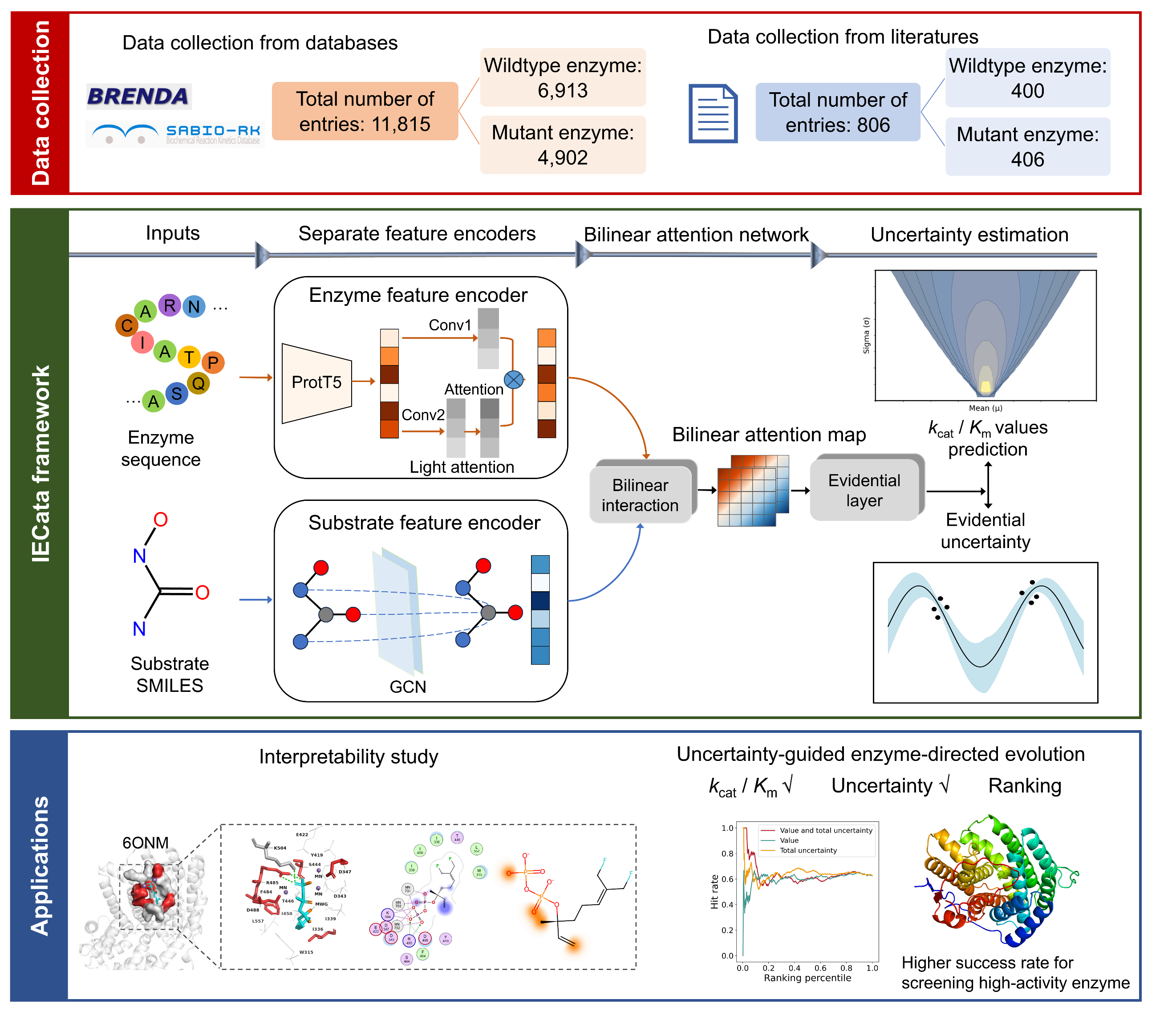
The source code developed in Python 3.8 using PyTorch 1.12.0. we recommend using a virtual conda environment as enviroment management for the installation of IECata and its dependencies. The virtual environment can be created as follows:
conda create -n iecata python==3.8
conda activate iecata
Download the source code of IECata from GitHub:
git clone https://github.com/zhaoyanpeng208/IECata.git
Install IECata dependencies as following, this will take about one to two hours.:
conda env create -f environment.yaml
The required python dependencies are given below.
torch=1.12.0
dgl=1.1.1.cu113
dgllife==0.2.8
torch-cluster=1.6.0+pt112cu113
torch-geometric==2.2.0
torch-scatter=2.1.0+pt112cu113
torch-sparse=0.6.14
torch-spline-conv=1.2.1+pt112cu113
torchmetrics==1.2.1
numpy=1.24.3
scikit-learn=1.2.2
pandas=2.0.3
prettytable=3.10.0
rdkit=2020.09.1
yacs=0.1.8
transformers=4.32.1
The datasets folder contains all experimental data used in IECata.
The datasets are stored in the datasets/kcatkm/train folder,
and the datasets, validation sets and test sets have been
divided in 8:1:1 ratio (random seed=100 ).
The independent test set is stored in datasets/independent_test
and contains 806 samples from the literature collection.
Scripts for data collection and screening from BRENDA and SABIO-RK databases
are stored in the Dataset collection folder
To train IECata, where we provide the basic configurations for all hyperparameters in config.py.
python main.py --cfg configs/IECata.yaml --data kcatkm
The training results are saved in the folder./result/train.
If you want to change the folder, you can change IECata.yaml
Model parameters can be found under the result folder. It takes about 5 minutes to run a test on the Kcatkm testset (1183 samples) and output the results.
python independent_test_attention.py --cfg configs/independent_test.yaml --data independent_test
After predicting with your well trained model,
the predicting output will be saved in "result" dictory.
If you want to specify the output folder, you can change
the independent_test.yaml.
This project is covered under the Apache 2.0 License.
This repository contains the PyTorch implementation of IECata framework, as described in paper "IECata: Interpretable bilinear attention network and evidential deep learning improve the catalytic efficiency prediction of enzymes".
Python
4
16 commits
updated May 4, 2025
This repository contains the PyTorch implementation of IECata framework, as described in paper
"IECata: Interpretable bilinear attention network and evidential deep learning improve the catalytic efficiency prediction of enzymes".
We also provide online prediction tools where users can access http://mathtc.nscc-tj.cn/cataai/ for direct prediction.
The source code developed in Python 3.8 using PyTorch 1.12.0. we recommend using a virtual conda environment as enviroment management for the installation of IECata and its dependencies. The virtual environment can be created as follows:
conda create -n iecata python==3.8
conda activate iecata
Download the source code of IECata from GitHub:
git clone https://github.com/zhaoyanpeng208/IECata.git
Install IECata dependencies as following, this will take about one to two hours.:
conda env create -f environment.yaml
The required python dependencies are given below.
torch=1.12.0
dgl=1.1.1.cu113
dgllife==0.2.8
torch-cluster=1.6.0+pt112cu113
torch-geometric==2.2.0
torch-scatter=2.1.0+pt112cu113
torch-sparse=0.6.14
torch-spline-conv=1.2.1+pt112cu113
torchmetrics==1.2.1
numpy=1.24.3
scikit-learn=1.2.2
pandas=2.0.3
prettytable=3.10.0
rdkit=2020.09.1
yacs=0.1.8
transformers=4.32.1
The datasets folder contains all experimental data used in IECata.
The datasets are stored in the datasets/kcatkm/train folder,
and the datasets, validation sets and test sets have been
divided in 8:1:1 ratio (random seed=100 ).
The independent test set is stored in datasets/independent_test
and contains 806 samples from the literature collection.
Scripts for data collection and screening from BRENDA and SABIO-RK databases
are stored in the Dataset collection folder
To train IECata, where we provide the basic configurations for all hyperparameters in config.py.
python main.py --cfg configs/IECata.yaml --data kcatkm
The training results are saved in the folder./result/train.
If you want to change the folder, you can change IECata.yaml
Model parameters can be found under the result folder. It takes about 5 minutes to run a test on the Kcatkm testset (1183 samples) and output the results.
python independent_test_attention.py --cfg configs/independent_test.yaml --data independent_test
After predicting with your well trained model,
the predicting output will be saved in "result" dictory.
If you want to specify the output folder, you can change
the independent_test.yaml.
This project is covered under the Apache 2.0 License.



