
README
 From Seeing to Acting: Smart Glasses as First-Person Intelligence Platforms






Jiangning Zhang 1,*,✉ , Haojun Chen 1,* , Yong Liu 1
1Zhejiang University, APRIL Lab
This repository accompanies our survey From Seeing to Acting: Smart Glasses as First-Person Intelligence Platforms and maintains a structured collection of smart-glasses products/platforms, foundational capabilities, and application scenarios, which will be continuously updated.For more details, kindly refer to our paper 🚀
💬 Researchers and industry practitioners are welcome to join our WeChat group; we look forward to exchanging ideas and collaborating with you.
📰 News
- 2026-08-26: We release our initial-version survey: From Seeing to Acting: Smart Glasses as First-Person Intelligence Platforms.
Table of Contents
- 🎯 Contributions
- 👓 Representative Smart-Glasses Products/Platforms
- 📏 Foundational Capabilities for Smart Glasses
- 🌍 Application Scenes for Smart Glasses
- 📄 Citation
- 🤝 Contributing
- 🔗 Related Resources & Links
- 🤗 Acknowledgments
🎯 Contributions
1️⃣ A formal and hardware-grounded problem definition.
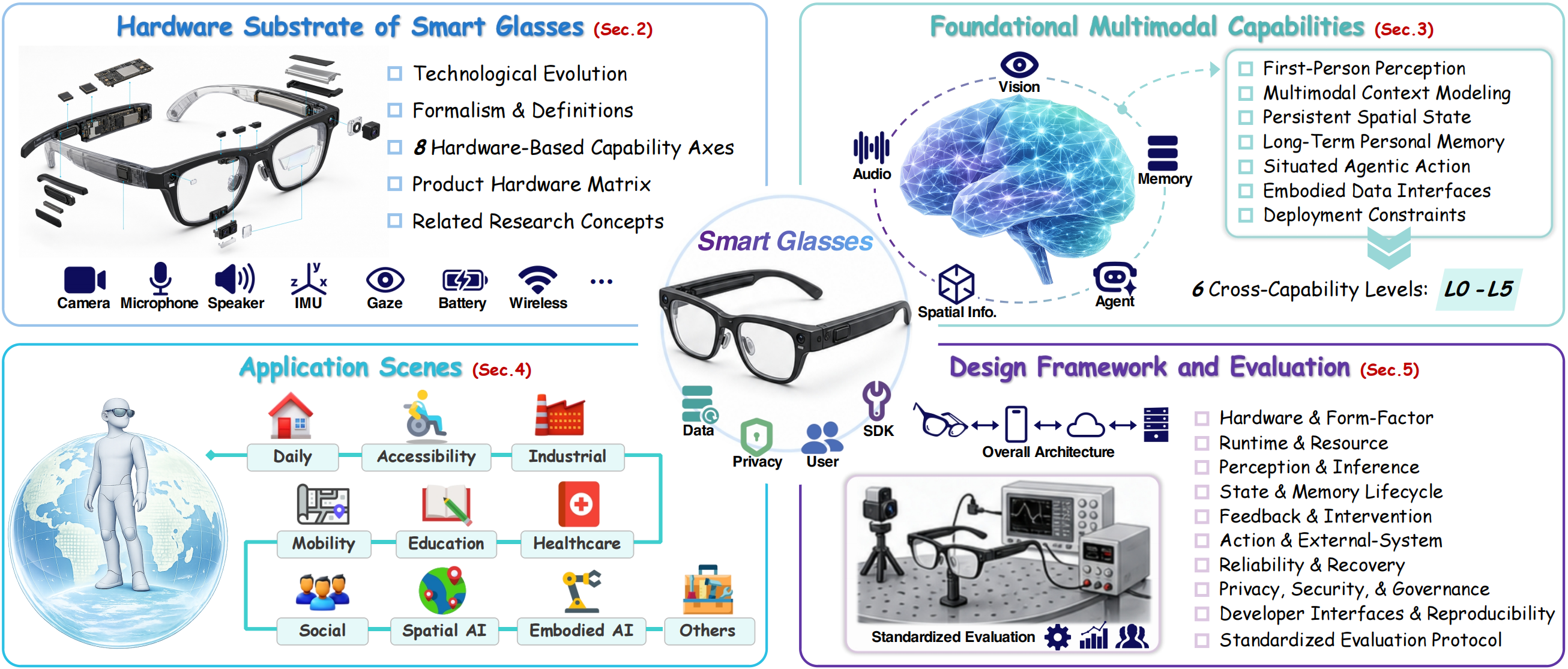
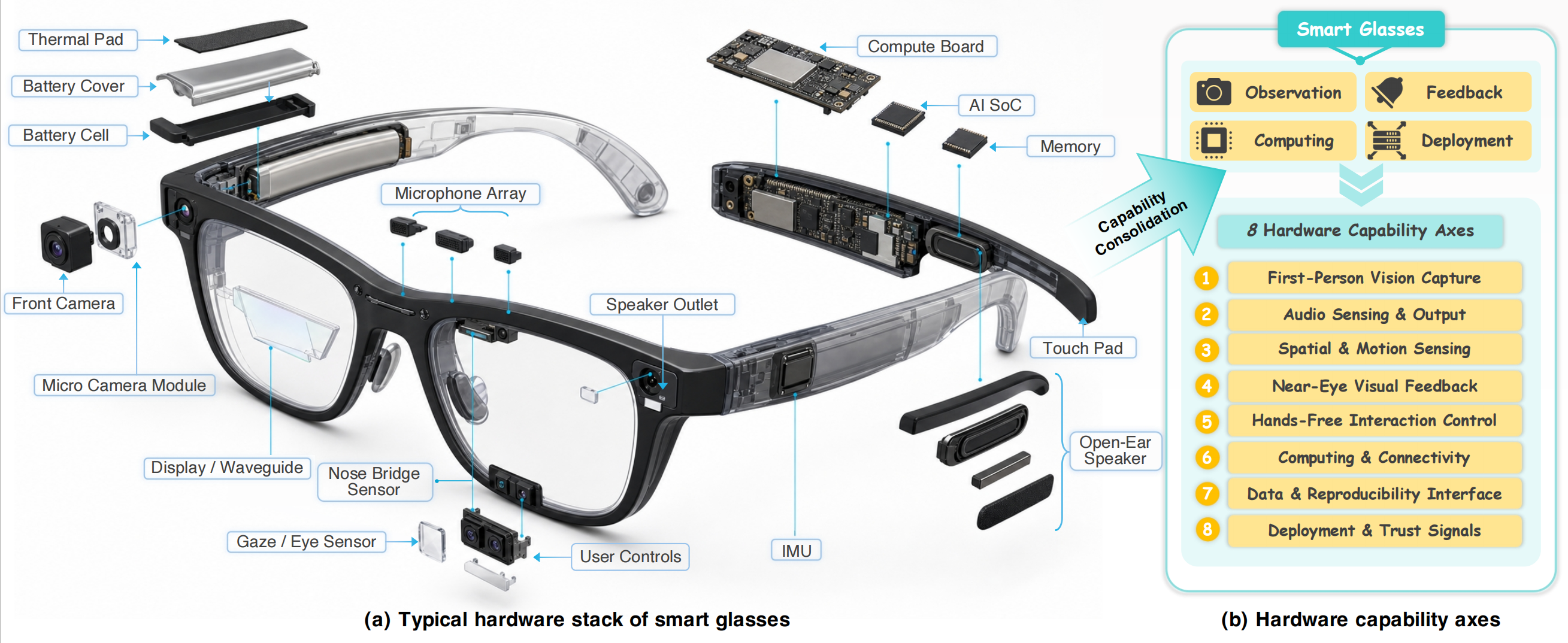
We define smart glasses through a first-person observation stream, a closed-loop mapping from observation and intent to feedback, persistent state, and optional action, and a constrained utility objective that makes latency, energy, thermals, privacy, and social cost explicit. We further consolidate heterogeneous devices into eight verifiable hardware capability axes and route-aware product profiles, converting marketing categories into evidence-bearing experimental substrates.
2️⃣ A compositional capability framework with explicit evidential boundaries.
We synthesize seven interdependent capabilities: first-person perception, multimodal context, persistent spatial state, auditable personal memory, situated agentic action, embodied data interfaces, and cross-cutting deployment constraints. Building upon these building blocks, we present an L0-L5 framework that covers capture, reactive perception, contextual assistance, persistent state, governed action, and embodied coupling. The framework treats levels as task- and evidence-conditioned claims, distinguishes prerequisites from demonstrated capability, and makes clear that L5 crosses the embodiment boundary rather than simply extending the wearer-facing L0-L4 axis.
3️⃣ An application-centered evidence map.
We reorganize the literature into nine application scenes and connect each scene to its required capability loop, representative datasets and benchmarks, research systems, product entry points, affected stakeholders, failure consequences, and missing validation evidence. This structure separates transferable component evidence from direct smart-glasses evidence and clarifies why identical model functions require different thresholds in daily assistance, accessibility, industry, healthcare, education, mobility, social collaboration, spatial intelligence, and embodied intelligence.
4️⃣ A deployment and evaluation blueprint.
We formulate nine coupled design dimensions covering hardware, runtime, perception and inference, memory, feedback, external action, reliability, governance, and reproducibility. On this basis, we provide a claim-conditioned evaluation protocol, a deployment checklist, and an iterative evidence ladder that connects documentation, laboratory measurement, benchmark testing, device-stream replay, fault injection, end-to-end studies, longitudinal deployment, and privacy or security audit. We finally derive eight open challenges and six roadmap directions for building trustworthy first-person embodied-intelligence systems.
Representative Smart-Glasses Products/Platforms
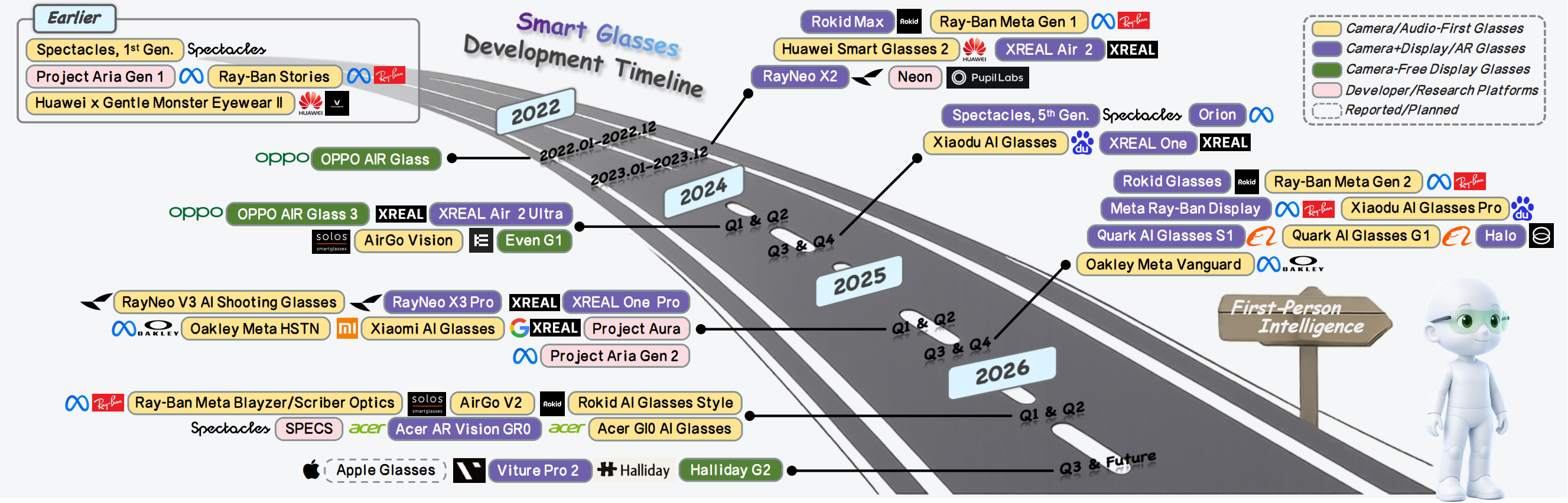
👓 The table below summarizes some representative smart-glasses products/platforms and their corresponding links (⏰ last update: 2026.09.06).
| Date | Smart-Glasses Product/Platform | Link |
|---|---|---|
| 2020-09 | Project Aria Gen 1 | Project Aria Gen 1 |
| 2023-09 | Ray-Ban Meta Gen 1 | Ray-Ban Meta Gen 1 |
| 2024-06 | Even Realities G1 | Even Realities G1 |
| 2025-02 | Project Aria Gen 2 | Project Aria Gen 2 |
| 2025-05 | RayNeo X3 Pro | RayNeo X3 Pro |
| 2025-05 | XREAL AURA | XREAL AURA |
| 2025-06 | Xiaomi AI Glasses | Xiaomi AI Glasses |
| 2025-09 | Ray-Ban Meta Gen 2 | Ray-Ban Meta Gen 2 |
| 2025-09 | Meta Ray-Ban Display | Meta Ray-Ban Display |
| 2025-10 | Oakley Meta Vanguard | Oakley Meta Vanguard |
| 2025-11 | Xiaodu AI Glasses Pro | Xiaodu AI Glasses Pro |
| 2025-11 | Quark AI Glasses S1 | Quark AI Glasses S1 |
| 2025-11 | Quark AI Glasses G1 | Quark AI Glasses G1 |
| 2026-01 | Rokid AI Glasses Style | Rokid AI Glasses Style |
| 2026-01 | Solos AirGo V2 | Solos AirGo V2 |
| 2026-04 | RayNeo V4 | RayNeo V4 |
| 2026-06 | Snap SPECS | Snap SPECS |
| 2026-07 | Halliday G2 | Halliday G2 |
| 2026-08 | RayNeo iO | RayNeo iO |
Figure: Hardware stack and hardware-based capability-axis consolidation.
Foundational Capabilities for Smart Glasses
Figure: Foundational capabilities and L0-L5 cross-capability level framework.
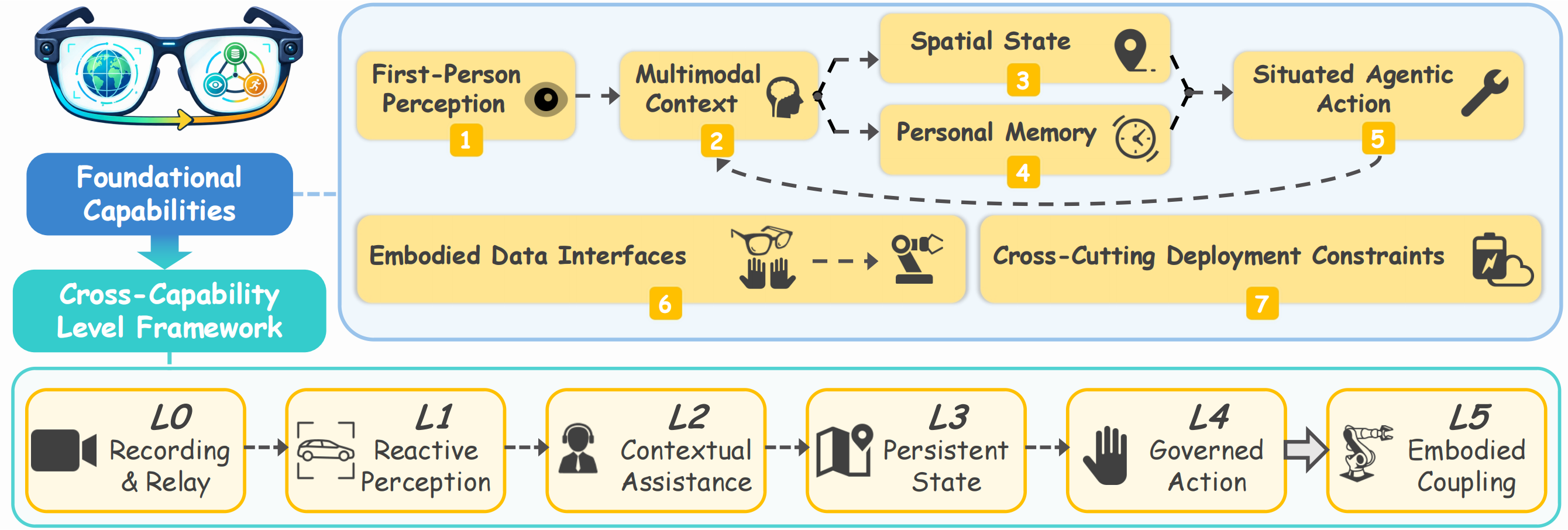
⏰ We organize the works in chronological order, from the latest to the earliest. 🎨 Colored labels indicate seven foundational capabilities to which the work contributes:
,
,
,
,
,
, and
.
| Capabilities | Paper Title | Link |
|---|---|---|
| VoiceMem: Streaming Dual-Brain Memory for Real-Time Interaction |  |
| EgoMonth: A Month-Level Egocentric Video Benchmark for Long-Term Spatiotemporal Memory |  |
| EgoExoMoCap: Distributed Ego-Exo Human Motion Capture |  |
| Open-AoE: An Open Egocentric Manipulation Dataset and Toolchain for Embodied Learning |  |
| LightMem-Ego: Your AI Memory for Everyday Life |  |
| OpenGlass: A Sensing-Computing Split Architecture for Local MLLM-Driven Real-Time Visual Assistance |  |
| EgoSAT: A Comprehensive Benchmark of Egocentric Streaming Interaction Understanding |  |
| EPIC: A System Framework for Efficient Egocentric Perception on Embodied AR Glasses |  |
| EgoEngine: From Egocentric Human Videos to High-Fidelity Dexterous Robot Demonstrations |  |
| SpatialWorld: Benchmarking Interactive Spatial Reasoning of Multimodal Agents in Real-World Tasks |  |
| Streaming Interventions: Can Video Large Language Models Correct Mistakes as They Occur? |  |
| H2HMem: A Multimodal Memory Benchmark for Agents in Human-Human Interactions |  |
| EgoTactile: Learning Grasp Pressure for Everyday Objects from Egocentric Video |  |
| OpenGlass: Ultra-Low-Power On-Device AI Eyewear with Event-Based Vision |  |
| ActiveMimic: Egocentric Video Pretraining with Active Perception |  |
| Plan, Watch, Recover: A Benchmark and Architectures for Proactive Procedural Assistance |  |
| EGOSTREAM: A Diagnostic Benchmark for Streaming Episodic Memory in Egocentric Vision |  |
| IPIBench: Evaluating Interactive Proactive Intelligence of MLLMs under Continuous Streams |  |
| HumanEgo: Zero-Shot Robot Learning from Minutes of Human Egocentric Videos |  |
| EgoProx: Evaluating MLLMs on Egocentric 3D Proximity Reasoning Across a Cognitive Hierarchy |  |
| EgoExoMem: Cross-View Memory Reasoning over Synchronized Egocentric and Exocentric Videos |  |
| EgoKit: Towards Unified Low-Cost Egocentric Data Collection with Heterogeneous Devices |  |
| Urban Risk-Aware Navigation via VQA-Based Event Maps for People with Low Vision |  |
| Personal Visual Context Learning in Large Multimodal Models |  |
| Position: Life-Logging Video Streams Make the Privacy-Utility Trade-off Inevitable |  |
| EgoMemReason: A Memory-Driven Reasoning Benchmark for Long-Horizon Egocentric Video Understanding |  |
| EgoPro-Bench: Benchmarking Personalized Proactive Interaction in Egocentric Video Streams |  |
| HumanNet: Scaling Human-Centric Video Learning to One Million Hours |  |
| Pro $^2$ Assist: Continuous Step-Aware Proactive Assistance with Multimodal Egocentric Perception for Long-Horizon Procedural Tasks |  |
| Intention-Aware Semantic Agent Communications for AI Glasses |  |
| PhySE: A Psychological Framework for Real-Time AR-LLM Social Engineering Attacks |  |
| UNSEEN: A Cross-Stack LLM Unlearning Defense against AR-LLM Social Engineering Attacks |  |
| Do MLLMs Understand Pointing? Benchmarking and Enhancing Referential Reasoning in Egocentric Vision |  |
| ActiveGlasses: Learning Manipulation with Active Vision from Ego-Centric Human Demonstration |  |
| Reshaping Inclusive Interpersonal Dynamics through Smart Glasses in Mixed-Vision Social Activities |  |
| Active Noise Cancellation on Open-Ear Smart Glasses |  |
| VisionClaw: Always-On AI Agents through Smart Glasses |  |
| Ego-Grounding for Personalized Question-Answering in Egocentric Videos |  |
| Pandora: Articulated 3D Scene Graphs from Egocentric Vision |  |
| Ego2Web: A Web Agent Benchmark Grounded in Egocentric Videos |  |
| UniDex: A Robot Foundation Suite for Universal Dexterous Hand Control from Egocentric Human Videos |  |
| EgoForge: Goal-Directed Egocentric World Simulator |  |
| Ego-1K--A Large-Scale Multiview Video Dataset for Egocentric Vision |  |
| Mind the Gap: Mapping Wearer--Bystander Privacy Tensions and Context-Adaptive Pathways for Camera Glasses |  |
| Egocentric Co-Pilot: Web-Native Smart-Glasses Agents for Assistive Egocentric AI |  |
| AoE: Always-On Egocentric Human Video Collection for Embodied AI |  |
| SUPERGLASSES: Benchmarking Vision Language Models as Intelligent Agents for AI Smart Glasses |  |
| Exploring Multimodal LMMs for Online Episodic Memory Question Answering on the Edge |  |
| Conversational Successes and Breakdowns in Everyday Smart Glasses Use |  |
| SAW-Bench: Learning Situated Awareness in the Real World |  |
| GLIMPSE: Real-Time Text Recognition and Contextual Understanding for VQA in Wearables |  |
| LEVIO: Lightweight Embedded Visual Inertial Odometry for Resource-Constrained Devices |  |
| Evaluating OCR Performance for Assistive Technology: Effects of Walking Speed, Camera Placement, and Camera Type |  |
| VisGuardian: A Lightweight Group-based Privacy Control Technique For Front Camera Data From AR Glasses in Home Environments |  |
| Agentic Very Long Video Understanding |  |
| ROMA: Real-time Omni-Multimodal Assistant with Interactive Streaming Understanding |  |
| WearVQA: A Visual Question Answering Benchmark for Wearables in Egocentric Authentic Real-World Scenarios |  |
| EgoMI: Learning Active Vision and Whole-Body Manipulation from Egocentric Human Demonstrations |  |
| AI for Service: Proactive Assistance with AI Glasses |  |
| EgoTrigger: Toward Audio-Driven Image Capture for Human Memory Enhancement in All-Day Energy-Efficient Smart Glasses |  |
| DailyLLM: Context-Aware Activity Log Generation Using Multi-Modal Sensors and LLMs |  |
| EgoVLA: Learning Vision-Language-Action Models from Egocentric Human Videos |  |
| AdaVideoRAG: Omni-Contextual Adaptive Retrieval-Augmented Efficient Long Video Understanding |  |
| EgoZero: Robot Learning from Smart Glasses |  |
| ContextAgent: Context-Aware Proactive LLM Agents with Open-World Sensory Perceptions |  |
| EgoDex: Learning Dexterous Manipulation from Large-Scale Egocentric Video |  |
| EgoLife: Towards Egocentric Life Assistant |  |
| EgoSim: An Egocentric Multi-view Simulator and Real Dataset for Body-worn Cameras during Motion and Activity |  |
| Vinci: A Real-Time Smart Assistant Based on Egocentric Vision-Language Model for Portable Devices |  |
| EgoMimic: Scaling Imitation Learning via Egocentric Video |  |
| OpenEQA: Embodied Question Answering in the Era of Foundation Models |  |
| Memoro: Using Large Language Models to Realize a Concise Interface for Real-Time Memory Augmentation |  |
| Ego-Exo4D: Understanding Skilled Human Activity from First- and Third-Person Perspectives |  |
| Head-Mounted Display Augmented Reality in Manufacturing: A Systematic Review |  |
| HoloAssist: An Egocentric Human Interaction Dataset for Interactive AI Assistants in the Real World |  |
| EgoObjects: A Large-Scale Egocentric Dataset for Fine-Grained Object Understanding |  |
| Project Aria: A New Tool for Egocentric Multi-Modal AI Research |  |
| EgoPoser: Robust Real-Time Egocentric Pose Estimation from Sparse and Intermittent Observations Everywhere |  |
| EgoVLPv2: Egocentric Video-Language Pre-Training with Fusion in the Backbone |  |
| Aria Digital Twin: A New Benchmark Dataset for Egocentric 3D Machine Perception |  |
| EPIC-Sounds: A Large-Scale Dataset of Actions That Sound |  |
| EgoTracks: A Long-Term Egocentric Visual Object Tracking Dataset |  |
| LidSonic for Visually Impaired: Green Machine Learning-Based Assistive Smart Glasses with Smart App and Arduino |  |
| AvatarPoser: Articulated Full-Body Pose Tracking from Sparse Motion Sensing |  |
| Assembly101: A Large-Scale Multi-View Video Dataset for Understanding Procedural Activities |  |
| Ego4D: Around the World in 3,000 Hours of Egocentric Video |  |
| DROID-SLAM: Deep Visual SLAM for Monocular, Stereo, and RGB-D Cameras |  |
| QMSum: A New Benchmark for Query-Based Multi-Domain Meeting Summarization |  |
| The IKEA ASM Dataset: Understanding People Assembling Furniture through Actions, Objects and Pose |  |
| Rescaling Egocentric Vision: Collection, Pipeline and Challenges for EPIC-KITCHENS-100 |  |
| In the Eye of the Beholder: Joint Learning of Gaze and Actions in First Person Video |  |
| Evaluating a Wearable Camera's Social Acceptability In-the-Wild | |
| COIN: A Large-Scale Dataset for Comprehensive Instructional Video Analysis |  |
| AVA Active Speaker: An Audio-Visual Dataset for Active Speaker Detection |  |
| Your Smart Glasses' Camera Bothers Me! Exploring Opt-In and Opt-Out Gestures for Privacy Mediation | |
| VizWiz Grand Challenge: Answering Visual Questions from Blind People |  |
| Matterport3D: Learning from RGB-D Data in Indoor Environments |  |
| VINS-Mono: A Robust and Versatile Monocular Visual-Inertial State Estimator |  |
| ScanNet: Richly-Annotated 3D Reconstructions of Indoor Scenes |  |
| NavCog: A Navigational Cognitive Assistant for the Blind | |
| In Situ with Bystanders of Augmented Reality Glasses: Perspectives on Recording and Privacy-Mediating Technologies | |
| The AMI Meeting Corpus: A Pre-Announcement |  |
Application Scenes for Smart Glasses
⏰ For each application scene, we organize the works in chronological order, from the earliest to the latest.
4.1 Daily Situated Assistance
| Paper Title | Link |
|---|---|
| Vinci: A Real-Time Smart Assistant Based on Egocentric Vision-Language Model for Portable Devices | |
| AiGet: Transforming Everyday Moments into Hidden Knowledge Discovery with AI Assistance on Smart Glasses |  |
| EgoLife: Towards Egocentric Life Assistant | |
| ContextAgent: Context-Aware Proactive LLM Agents with Open-World Sensory Perceptions | |
| DailyLLM: Context-Aware Activity Log Generation Using Multi-Modal Sensors and LLMs | |
| AI for Service: Proactive Assistance with AI Glasses | |
| TeleEgo: Benchmarking Egocentric AI Assistants in the Wild |  |
| WearVQA: A Visual Question Answering Benchmark for Wearables in Egocentric Authentic Real-world Scenarios | |
| ROMA: Real-time Omni-Multimodal Assistant with Interactive Streaming Understanding | |
| GLIMPSE: Real-Time Text Recognition and Contextual Understanding for VQA in Wearables | |
| SAW-Bench: Learning Situated Awareness in the Real World | |
| Exploring Multimodal LMMs for Online Episodic Memory Question Answering on the Edge | |
| SUPERGLASSES: Benchmarking Vision Language Models as Intelligent Agents for AI Smart Glasses | |
| Egocentric Co-Pilot: Web-Native Smart-Glasses Agents for Assistive Egocentric AI | |
| Ego2Web: A Web Agent Benchmark Grounded in Egocentric Videos | |
| VisionClaw: Always-On AI Agents through Smart Glasses | |
| Intention-Aware Semantic Agent Communications for AI Glasses | |
| EgoMemReason: A Memory-Driven Reasoning Benchmark for Long-Horizon Egocentric Video Understanding | |
| Personal Visual Context Learning in Large Multimodal Models | |
| EgoPro-Bench: Benchmarking Personalized Proactive Interaction in Egocentric Video Streams | |
| IPIBench: Evaluating Interactive Proactive Intelligence of MLLMs under Continuous Streams | |
| EGOSTREAM: A Diagnostic Benchmark for Streaming Episodic Memory in Egocentric Vision | |
| EgoSAT: A Comprehensive Benchmark of Egocentric Streaming Interaction Understanding | |
| OpenGlass: A Sensing-Computing Split Architecture for Local MLLM-Driven Real-Time Visual Assistance | |
| LightMem-Ego: Your AI Memory for Everyday Life | |
| EgoMonth: A Month-Level Egocentric Video Benchmark for Long-Term Spatiotemporal Memory | |
4.2 Accessibility Assistance
| Paper Title | Link |
|---|---|
| NavCog: A Navigational Cognitive Assistant for the Blind | |
| VizWiz Grand Challenge: Answering Visual Questions from Blind People | |
| The Effectiveness of Visual and Audio Wayfinding Guidance on Smartglasses for People with Low Vision | |
| LidSonic for Visually Impaired: Green Machine Learning-Based Assistive Smart Glasses with Smart App and Arduino | |
| EgoBlind: Towards Egocentric Visual Assistance for the Blind |  |
| Exploring LLM-Based Assistants with Smart Glasses for the Visually Impaired | |
| Evaluating OCR Performance for Assistive Technology: Effects of Walking Speed, Camera Placement, and Camera Type | |
| Active Noise Cancellation on Open-Ear Smart Glasses | |
| Urban Risk-Aware Navigation via VQA-Based Event Maps for People with Low Vision | |
4.3 Industrial Workflow Support
| Paper Title | Link |
|---|---|
| COIN: A Large-Scale Dataset for Comprehensive Instructional Video Analysis | |
| Smart Glasses-Based Personnel Proximity Warning System for Improving Pedestrian Safety in Construction and Mining Sites |  |
| Augmented Reality’s Impact in Industry—A Scoping Review | |
| The IKEA ASM Dataset: Understanding People Assembling Furniture through Actions, Objects and Pose | |
| Augmented Reality Smart Glasses in Industrial Assembly: Current Status and Future Challenges |  |
| Assembly101: A Large-Scale Multi-View Video Dataset for Understanding Procedural Activities | |
| HoloAssist: An Egocentric Human Interaction Dataset for Interactive AI Assistants in the Real World | |
| Head-Mounted Display Augmented Reality in Manufacturing: A Systematic Review | |
| LabOS: The AI-XR Co-scientist that sees and works with humans |  |
| Pro $^2$ Assist: Continuous Step-Aware Proactive Assistance with Multimodal Egocentric Perception for Long-Horizon Procedural Tasks | |
| Plan, Watch, Recover: A Benchmark and Architectures for Proactive Procedural Assistance | |
| Streaming Interventions: Can Video Large Language Models Correct Mistakes as They Occur? | |
| Toward a Full-Stack Framework for Industrial Augmented Reality: Benefits, Risks, and Design Considerations for Dependable Deployment in Manufacturing |  |
4.4 Healthcare and Caregiving
| Paper Title | Link |
|---|---|
| JHU-ISI Gesture and Skill Assessment Working Set (JIGSAWS): A Surgical Activity Dataset for Human Motion Modeling |  |
| Technical Support by Smart Glasses During a Mass Casualty Incident |  |
| A Systematic Literature Review on Integrating AI-Powered Smart Glasses into Digital Health Management for Proactive Healthcare Solutions |  |
| Development of an AI-Powered AR Glasses System for Real-Time First Aid Guidance in Emergency Situations | |
| Smart Glasses for Older Adults With Cognitive Impairment: A Scoping Review |  |
| A Smart-Glasses for Emergency Medical Services via Multimodal Multitask Learning |  |
| Wearable AR for Restorative Breaks: How Interactive Narrative Experiences Support Relaxation for Young People |  |
4.5 Education and Skills Training
| Paper Title | Link |
|---|---|
| Cross-Task Weakly Supervised Learning from Instructional Videos |  |
| Evaluating the Effectiveness of Learning Design with Mixed Reality in Higher Education | |
| Augmented Reality in Medical Education: A Systematic Review | |
| Rescaling Egocentric Vision: Collection, Pipeline and Challenges for EPIC-KITCHENS-100 | |
| A Critical Evaluation, Challenges, and Future Perspectives of Using AI and Emerging Technologies in Smart Classrooms | |
| The Use of Smart Glasses in Nursing Education: A Scoping Review | |
| Evaluating the Feasibility of Augmented Reality to Support Communication Access for Deaf Students in Experiential Higher Education Contexts |  |
4.6 Mobility and Transportation Safety
| Paper Title | Link |
|---|---|
| NavCog: A Navigational Cognitive Assistant for the Blind | |
| Are They Going to Cross? A Benchmark Dataset and Baseline for Pedestrian Crosswalk Behavior | |
| PIE: A Large-Scale Dataset and Models for Pedestrian Intention Estimation and Trajectory Prediction |  |
| The Effectiveness of Visual and Audio Wayfinding Guidance on Smartglasses for People with Low Vision | |
| Urban Risk-Aware Navigation via VQA-Based Event Maps for People with Low Vision | |
| Decoding Pedestrian Crossing Intention from Egocentric Vision via Vision Language Models |  |
4.7 Social Interaction and Collaboration
| Paper Title | Link |
|---|---|
| The AMI Meeting Corpus: A Pre-Announcement | |
| In Situ with Bystanders of Augmented Reality Glasses: Perspectives on Recording and Privacy-Mediating Technologies | |
| Your Smart Glasses' Camera Bothers Me! Exploring Opt-In and Opt-Out Gestures for Privacy Mediation | |
| AVA Active Speaker: An Audio-Visual Dataset for Active Speaker Detection | |
| Evaluating a Wearable Camera's Social Acceptability In-the-Wild | |
| QMSum: A New Benchmark for Query-Based Multi-Domain Meeting Summarization | |
| Social Acceptance of Smart Glasses in Health Care: Model Evaluation Study of Anticipated Adoption and Social Interaction | |
| VisGuardian: A Lightweight Group-based Privacy Control Technique For Front Camera Data From AR Glasses in Home Environments | |
| Conversational Successes and Breakdowns in Everyday Smart Glasses Use | |
| Mind the Gap: Mapping Wearer--Bystander Privacy Tensions and Context-Adaptive Pathways for Camera Glasses | |
| Reshaping Inclusive Interpersonal Dynamics through Smart Glasses in Mixed-Vision Social Activities | |
| Position: Life-Logging Video Streams Make the Privacy-Utility Trade-off Inevitable | |
| H2HMem: A Multimodal Memory Benchmark for Agents in Human-Human Interactions | |
4.8 Spatial Intelligence
| Paper Title | Link |
|---|---|
| VINS-Mono: A Robust and Versatile Monocular Visual-Inertial State Estimator | |
| Matterport3D: Learning from RGB-D Data in Indoor Environments | |
| In the Eye of the Beholder: Joint Learning of Gaze and Actions in First Person Video | |
| ORB-SLAM3: An Accurate Open-Source Library for Visual, Visual-Inertial, and Multimap SLAM |  |
| DROID-SLAM: Deep Visual SLAM for Monocular, Stereo, and RGB-D Cameras | |
| Aria Digital Twin: A New Benchmark Dataset for Egocentric 3D Machine Perception | |
| Project Aria: A New Tool for Egocentric Multi-Modal AI Research | |
| LEVIO: Lightweight Embedded Visual Inertial Odometry for Resource-Constrained Devices | |
| EgoForge: Goal-Directed Egocentric World Simulator | |
| Pandora: Articulated 3D Scene Graphs from Egocentric Vision | |
| Do MLLMs Understand Pointing? Benchmarking and Enhancing Referential Reasoning in Egocentric Vision | |
| EgoProx: Evaluating MLLMs on Egocentric 3D Proximity Reasoning Across a Cognitive Hierarchy | |
| SpatialWorld: Benchmarking Interactive Spatial Reasoning of Multimodal Agents in Real-World Tasks | |
4.9 Embodied Intelligence
| Paper Title | Link |
|---|---|
| Ego4D: Around the World in 3,000 Hours of Egocentric Video | |
| AvatarPoser: Articulated Full-Body Pose Tracking from Sparse Motion Sensing | |
| EgoPoser: Robust Real-Time Egocentric Pose Estimation from Sparse and Intermittent Observations Everywhere | |
| Ego-Exo4D: Understanding Skilled Human Activity from First- and Third-Person Perspectives | |
| EgoMimic: Scaling Imitation Learning via Egocentric Video | |
| EgoSim: An Egocentric Multi-view Simulator and Real Dataset for Body-worn Cameras during Motion and Activity | |
| EgoDex: Learning Dexterous Manipulation from Large-Scale Egocentric Video | |
| EgoZero: Robot Learning from Smart Glasses | |
| EgoVLA: Learning Vision-Language-Action Models from Egocentric Human Videos | |
| EgoBridge: Domain Adaptation for Generalizable Imitation from Egocentric Human Data |  |
| Scalable Vision-Language-Action Model Pretraining for Robotic Manipulation with Real-Life Human Activity Videos |  |
| EgoMI: Learning Active Vision and Whole-Body Manipulation from Egocentric Human Demonstrations | |
| EgoScale: Scaling Dexterous Manipulation with Diverse Egocentric Human Data |  |
| AoE: Always-On Egocentric Human Video Collection for Embodied AI | |
| UniDex: A Robot Foundation Suite for Universal Dexterous Hand Control from Egocentric Human Videos | |
| ActiveGlasses: Learning Manipulation with Active Vision from Ego-Centric Human Demonstration | |
| HumanNet: Scaling Human-Centric Video Learning to One Million Hours | |
| EgoKit: Towards Unified Low-Cost Egocentric Data Collection with Heterogeneous Devices | |
| HumanEgo: Zero-Shot Robot Learning from Minutes of Human Egocentric Videos | |
| ActiveMimic: Egocentric Video Pretraining with Active Perception | |
| EgoTactile: Learning Grasp Pressure for Everyday Objects from Egocentric Video | |
| EgoEngine: From Egocentric Human Videos to High-Fidelity Dexterous Robot Demonstrations | |
| EPIC: A System Framework for Efficient Egocentric Perception on Embodied AR Glasses | |
| Human Universal Grasping |  |
| ForceBand: Learning Forceful Manipulation with sEMG |  |
| EgoWAM: World Action Models Beyond Pixels with In-the-Wild Egocentric Human Data |  |
| Open-AoE: An Open Egocentric Manipulation Dataset and Toolchain for Embodied Learning | |
| EgoExoMoCap: Distributed Ego-Exo Human Motion Capture | |
📄 Citation
If you find our work helpful, please consider citing our paper:
@misc{zhang2026seeingactingsmartglasses,
      title={From Seeing to Acting: Smart Glasses as First-Person Intelligence Platforms},
      author={Jiangning Zhang and Haojun Chen and Yong Liu},
      year={2026},
      eprint={2608.24877},
      archivePrefix={arXiv},
      primaryClass={cs.CV},
      url={https://arxiv.org/abs/2608.24877},
}
🤝 Contributing
Contributions are welcome. Please open an issue or submit a pull request to add or correct related smart-glasses products/platforms and works (datasets, benchmarks, methods, systems, and application resources). New entries should include a verifiable paper, official product/project page, or repository link.
🔗 Related Resources & Links
- Awesome Egocentric Vision
- Awsome Ego Equipments
- An open smart-glasses product and market dataset
- MentraOS
🤗 Acknowledgments
We thank the authors, dataset and benchmark creators, product and platform developers, and open-source contributors whose work supports this survey.


Similar repos


README
From Seeing to Acting: Smart Glasses as First-Person Intelligence Platforms
Jiangning Zhang 1,*,✉ , Haojun Chen 1,* , Yong Liu 1
1Zhejiang University, APRIL Lab
This repository accompanies our survey From Seeing to Acting: Smart Glasses as First-Person Intelligence Platforms and maintains a structured collection of smart-glasses products/platforms, foundational capabilities, and application scenarios, which will be continuously updated.For more details, kindly refer to our paper 🚀
💬 Researchers and industry practitioners are welcome to join our WeChat group; we look forward to exchanging ideas and collaborating with you.
📰 News
- 2026-08-26: We release our initial-version survey: From Seeing to Acting: Smart Glasses as First-Person Intelligence Platforms.
Table of Contents
- 🎯 Contributions
- 👓 Representative Smart-Glasses Products/Platforms
- 📏 Foundational Capabilities for Smart Glasses
- 🌍 Application Scenes for Smart Glasses
- 📄 Citation
- 🤝 Contributing
- 🔗 Related Resources & Links
- 🤗 Acknowledgments
🎯 Contributions
1️⃣ A formal and hardware-grounded problem definition.
We define smart glasses through a first-person observation stream, a closed-loop mapping from observation and intent to feedback, persistent state, and optional action, and a constrained utility objective that makes latency, energy, thermals, privacy, and social cost explicit. We further consolidate heterogeneous devices into eight verifiable hardware capability axes and route-aware product profiles, converting marketing categories into evidence-bearing experimental substrates.
2️⃣ A compositional capability framework with explicit evidential boundaries.
We synthesize seven interdependent capabilities: first-person perception, multimodal context, persistent spatial state, auditable personal memory, situated agentic action, embodied data interfaces, and cross-cutting deployment constraints. Building upon these building blocks, we present an L0-L5 framework that covers capture, reactive perception, contextual assistance, persistent state, governed action, and embodied coupling. The framework treats levels as task- and evidence-conditioned claims, distinguishes prerequisites from demonstrated capability, and makes clear that L5 crosses the embodiment boundary rather than simply extending the wearer-facing L0-L4 axis.
3️⃣ An application-centered evidence map.
We reorganize the literature into nine application scenes and connect each scene to its required capability loop, representative datasets and benchmarks, research systems, product entry points, affected stakeholders, failure consequences, and missing validation evidence. This structure separates transferable component evidence from direct smart-glasses evidence and clarifies why identical model functions require different thresholds in daily assistance, accessibility, industry, healthcare, education, mobility, social collaboration, spatial intelligence, and embodied intelligence.
4️⃣ A deployment and evaluation blueprint.
We formulate nine coupled design dimensions covering hardware, runtime, perception and inference, memory, feedback, external action, reliability, governance, and reproducibility. On this basis, we provide a claim-conditioned evaluation protocol, a deployment checklist, and an iterative evidence ladder that connects documentation, laboratory measurement, benchmark testing, device-stream replay, fault injection, end-to-end studies, longitudinal deployment, and privacy or security audit. We finally derive eight open challenges and six roadmap directions for building trustworthy first-person embodied-intelligence systems.
Representative Smart-Glasses Products/Platforms
👓 The table below summarizes some representative smart-glasses products/platforms and their corresponding links (⏰ last update: 2026.09.06).
| Date | Smart-Glasses Product/Platform | Link |
|---|---|---|
| 2020-09 | Project Aria Gen 1 | Project Aria Gen 1 |
| 2023-09 | Ray-Ban Meta Gen 1 | Ray-Ban Meta Gen 1 |
| 2024-06 | Even Realities G1 | Even Realities G1 |
| 2025-02 | Project Aria Gen 2 | Project Aria Gen 2 |
| 2025-05 | RayNeo X3 Pro | RayNeo X3 Pro |
| 2025-05 | XREAL AURA | XREAL AURA |
| 2025-06 | Xiaomi AI Glasses | Xiaomi AI Glasses |
| 2025-09 | Ray-Ban Meta Gen 2 | Ray-Ban Meta Gen 2 |
| 2025-09 | Meta Ray-Ban Display | Meta Ray-Ban Display |
| 2025-10 | Oakley Meta Vanguard | Oakley Meta Vanguard |
| 2025-11 | Xiaodu AI Glasses Pro | Xiaodu AI Glasses Pro |
| 2025-11 | Quark AI Glasses S1 | Quark AI Glasses S1 |
| 2025-11 | Quark AI Glasses G1 | Quark AI Glasses G1 |
| 2026-01 | Rokid AI Glasses Style | Rokid AI Glasses Style |
| 2026-01 | Solos AirGo V2 | Solos AirGo V2 |
| 2026-04 | RayNeo V4 | RayNeo V4 |
| 2026-06 | Snap SPECS | Snap SPECS |
| 2026-07 | Halliday G2 | Halliday G2 |
| 2026-08 | RayNeo iO | RayNeo iO |
Figure: Hardware stack and hardware-based capability-axis consolidation.
Foundational Capabilities for Smart Glasses
Figure: Foundational capabilities and L0-L5 cross-capability level framework.
⏰ We organize the works in chronological order, from the latest to the earliest. 🎨 Colored labels indicate seven foundational capabilities to which the work contributes:
| Capabilities | Paper Title | Link |
|---|---|---|
| VoiceMem: Streaming Dual-Brain Memory for Real-Time Interaction | |
| EgoMonth: A Month-Level Egocentric Video Benchmark for Long-Term Spatiotemporal Memory | |
| EgoExoMoCap: Distributed Ego-Exo Human Motion Capture | |
| Open-AoE: An Open Egocentric Manipulation Dataset and Toolchain for Embodied Learning | |
| LightMem-Ego: Your AI Memory for Everyday Life | |
| OpenGlass: A Sensing-Computing Split Architecture for Local MLLM-Driven Real-Time Visual Assistance | |
| EgoSAT: A Comprehensive Benchmark of Egocentric Streaming Interaction Understanding | |
| EPIC: A System Framework for Efficient Egocentric Perception on Embodied AR Glasses | |
| EgoEngine: From Egocentric Human Videos to High-Fidelity Dexterous Robot Demonstrations | |
| SpatialWorld: Benchmarking Interactive Spatial Reasoning of Multimodal Agents in Real-World Tasks | |
| Streaming Interventions: Can Video Large Language Models Correct Mistakes as They Occur? | |
| H2HMem: A Multimodal Memory Benchmark for Agents in Human-Human Interactions | |
| EgoTactile: Learning Grasp Pressure for Everyday Objects from Egocentric Video | |
| OpenGlass: Ultra-Low-Power On-Device AI Eyewear with Event-Based Vision | |
| ActiveMimic: Egocentric Video Pretraining with Active Perception | |
| Plan, Watch, Recover: A Benchmark and Architectures for Proactive Procedural Assistance | |
| EGOSTREAM: A Diagnostic Benchmark for Streaming Episodic Memory in Egocentric Vision | |
| IPIBench: Evaluating Interactive Proactive Intelligence of MLLMs under Continuous Streams | |
| HumanEgo: Zero-Shot Robot Learning from Minutes of Human Egocentric Videos | |
| EgoProx: Evaluating MLLMs on Egocentric 3D Proximity Reasoning Across a Cognitive Hierarchy | |
| EgoExoMem: Cross-View Memory Reasoning over Synchronized Egocentric and Exocentric Videos | |
| EgoKit: Towards Unified Low-Cost Egocentric Data Collection with Heterogeneous Devices | |
| Urban Risk-Aware Navigation via VQA-Based Event Maps for People with Low Vision | |
| Personal Visual Context Learning in Large Multimodal Models | |
| Position: Life-Logging Video Streams Make the Privacy-Utility Trade-off Inevitable | |
| EgoMemReason: A Memory-Driven Reasoning Benchmark for Long-Horizon Egocentric Video Understanding | |
| EgoPro-Bench: Benchmarking Personalized Proactive Interaction in Egocentric Video Streams | |
| HumanNet: Scaling Human-Centric Video Learning to One Million Hours | |
| Pro $^2$ Assist: Continuous Step-Aware Proactive Assistance with Multimodal Egocentric Perception for Long-Horizon Procedural Tasks | |
| Intention-Aware Semantic Agent Communications for AI Glasses | |
| PhySE: A Psychological Framework for Real-Time AR-LLM Social Engineering Attacks | |
| UNSEEN: A Cross-Stack LLM Unlearning Defense against AR-LLM Social Engineering Attacks | |
| Do MLLMs Understand Pointing? Benchmarking and Enhancing Referential Reasoning in Egocentric Vision | |
| ActiveGlasses: Learning Manipulation with Active Vision from Ego-Centric Human Demonstration | |
| Reshaping Inclusive Interpersonal Dynamics through Smart Glasses in Mixed-Vision Social Activities | |
| Active Noise Cancellation on Open-Ear Smart Glasses | |
| VisionClaw: Always-On AI Agents through Smart Glasses | |
| Ego-Grounding for Personalized Question-Answering in Egocentric Videos | |
| Pandora: Articulated 3D Scene Graphs from Egocentric Vision | |
| Ego2Web: A Web Agent Benchmark Grounded in Egocentric Videos | |
| UniDex: A Robot Foundation Suite for Universal Dexterous Hand Control from Egocentric Human Videos | |
| EgoForge: Goal-Directed Egocentric World Simulator | |
| Ego-1K--A Large-Scale Multiview Video Dataset for Egocentric Vision | |
| Mind the Gap: Mapping Wearer--Bystander Privacy Tensions and Context-Adaptive Pathways for Camera Glasses | |
| Egocentric Co-Pilot: Web-Native Smart-Glasses Agents for Assistive Egocentric AI | |
| AoE: Always-On Egocentric Human Video Collection for Embodied AI | |
| SUPERGLASSES: Benchmarking Vision Language Models as Intelligent Agents for AI Smart Glasses | |
| Exploring Multimodal LMMs for Online Episodic Memory Question Answering on the Edge | |
| Conversational Successes and Breakdowns in Everyday Smart Glasses Use | |
| SAW-Bench: Learning Situated Awareness in the Real World | |
| GLIMPSE: Real-Time Text Recognition and Contextual Understanding for VQA in Wearables | |
| LEVIO: Lightweight Embedded Visual Inertial Odometry for Resource-Constrained Devices | |
| Evaluating OCR Performance for Assistive Technology: Effects of Walking Speed, Camera Placement, and Camera Type | |
| VisGuardian: A Lightweight Group-based Privacy Control Technique For Front Camera Data From AR Glasses in Home Environments | |
| Agentic Very Long Video Understanding | |
| ROMA: Real-time Omni-Multimodal Assistant with Interactive Streaming Understanding | |
| WearVQA: A Visual Question Answering Benchmark for Wearables in Egocentric Authentic Real-World Scenarios | |
| EgoMI: Learning Active Vision and Whole-Body Manipulation from Egocentric Human Demonstrations | |
| AI for Service: Proactive Assistance with AI Glasses | |
| EgoTrigger: Toward Audio-Driven Image Capture for Human Memory Enhancement in All-Day Energy-Efficient Smart Glasses | |
| DailyLLM: Context-Aware Activity Log Generation Using Multi-Modal Sensors and LLMs | |
| EgoVLA: Learning Vision-Language-Action Models from Egocentric Human Videos | |
| AdaVideoRAG: Omni-Contextual Adaptive Retrieval-Augmented Efficient Long Video Understanding | |
| EgoZero: Robot Learning from Smart Glasses | |
| ContextAgent: Context-Aware Proactive LLM Agents with Open-World Sensory Perceptions | |
| EgoDex: Learning Dexterous Manipulation from Large-Scale Egocentric Video | |
| EgoLife: Towards Egocentric Life Assistant | |
| EgoSim: An Egocentric Multi-view Simulator and Real Dataset for Body-worn Cameras during Motion and Activity | |
| Vinci: A Real-Time Smart Assistant Based on Egocentric Vision-Language Model for Portable Devices | |
| EgoMimic: Scaling Imitation Learning via Egocentric Video | |
| OpenEQA: Embodied Question Answering in the Era of Foundation Models | |
| Memoro: Using Large Language Models to Realize a Concise Interface for Real-Time Memory Augmentation | |
| Ego-Exo4D: Understanding Skilled Human Activity from First- and Third-Person Perspectives | |
| Head-Mounted Display Augmented Reality in Manufacturing: A Systematic Review | |
| HoloAssist: An Egocentric Human Interaction Dataset for Interactive AI Assistants in the Real World | |
| EgoObjects: A Large-Scale Egocentric Dataset for Fine-Grained Object Understanding | |
| Project Aria: A New Tool for Egocentric Multi-Modal AI Research | |
| EgoPoser: Robust Real-Time Egocentric Pose Estimation from Sparse and Intermittent Observations Everywhere | |
| EgoVLPv2: Egocentric Video-Language Pre-Training with Fusion in the Backbone | |
| Aria Digital Twin: A New Benchmark Dataset for Egocentric 3D Machine Perception | |
| EPIC-Sounds: A Large-Scale Dataset of Actions That Sound | |
| EgoTracks: A Long-Term Egocentric Visual Object Tracking Dataset | |
| LidSonic for Visually Impaired: Green Machine Learning-Based Assistive Smart Glasses with Smart App and Arduino | |
| AvatarPoser: Articulated Full-Body Pose Tracking from Sparse Motion Sensing | |
| Assembly101: A Large-Scale Multi-View Video Dataset for Understanding Procedural Activities | |
| Ego4D: Around the World in 3,000 Hours of Egocentric Video | |
| DROID-SLAM: Deep Visual SLAM for Monocular, Stereo, and RGB-D Cameras | |
| QMSum: A New Benchmark for Query-Based Multi-Domain Meeting Summarization | |
| The IKEA ASM Dataset: Understanding People Assembling Furniture through Actions, Objects and Pose | |
| Rescaling Egocentric Vision: Collection, Pipeline and Challenges for EPIC-KITCHENS-100 | |
| In the Eye of the Beholder: Joint Learning of Gaze and Actions in First Person Video | |
| Evaluating a Wearable Camera's Social Acceptability In-the-Wild | |
| COIN: A Large-Scale Dataset for Comprehensive Instructional Video Analysis | |
| AVA Active Speaker: An Audio-Visual Dataset for Active Speaker Detection | |
| Your Smart Glasses' Camera Bothers Me! Exploring Opt-In and Opt-Out Gestures for Privacy Mediation | |
| VizWiz Grand Challenge: Answering Visual Questions from Blind People | |
| Matterport3D: Learning from RGB-D Data in Indoor Environments | |
| VINS-Mono: A Robust and Versatile Monocular Visual-Inertial State Estimator | |
| ScanNet: Richly-Annotated 3D Reconstructions of Indoor Scenes | |
| NavCog: A Navigational Cognitive Assistant for the Blind | |
| In Situ with Bystanders of Augmented Reality Glasses: Perspectives on Recording and Privacy-Mediating Technologies | |
| The AMI Meeting Corpus: A Pre-Announcement | |
Application Scenes for Smart Glasses
⏰ For each application scene, we organize the works in chronological order, from the earliest to the latest.
4.1 Daily Situated Assistance
| Paper Title | Link |
|---|---|
| Vinci: A Real-Time Smart Assistant Based on Egocentric Vision-Language Model for Portable Devices | |
| AiGet: Transforming Everyday Moments into Hidden Knowledge Discovery with AI Assistance on Smart Glasses | |
| EgoLife: Towards Egocentric Life Assistant | |
| ContextAgent: Context-Aware Proactive LLM Agents with Open-World Sensory Perceptions | |
| DailyLLM: Context-Aware Activity Log Generation Using Multi-Modal Sensors and LLMs | |
| AI for Service: Proactive Assistance with AI Glasses | |
| TeleEgo: Benchmarking Egocentric AI Assistants in the Wild | |
| WearVQA: A Visual Question Answering Benchmark for Wearables in Egocentric Authentic Real-world Scenarios | |
| ROMA: Real-time Omni-Multimodal Assistant with Interactive Streaming Understanding | |
| GLIMPSE: Real-Time Text Recognition and Contextual Understanding for VQA in Wearables | |
| SAW-Bench: Learning Situated Awareness in the Real World | |
| Exploring Multimodal LMMs for Online Episodic Memory Question Answering on the Edge | |
| SUPERGLASSES: Benchmarking Vision Language Models as Intelligent Agents for AI Smart Glasses | |
| Egocentric Co-Pilot: Web-Native Smart-Glasses Agents for Assistive Egocentric AI | |
| Ego2Web: A Web Agent Benchmark Grounded in Egocentric Videos | |
| VisionClaw: Always-On AI Agents through Smart Glasses | |
| Intention-Aware Semantic Agent Communications for AI Glasses | |
| EgoMemReason: A Memory-Driven Reasoning Benchmark for Long-Horizon Egocentric Video Understanding | |
| Personal Visual Context Learning in Large Multimodal Models | |
| EgoPro-Bench: Benchmarking Personalized Proactive Interaction in Egocentric Video Streams | |
| IPIBench: Evaluating Interactive Proactive Intelligence of MLLMs under Continuous Streams | |
| EGOSTREAM: A Diagnostic Benchmark for Streaming Episodic Memory in Egocentric Vision | |
| EgoSAT: A Comprehensive Benchmark of Egocentric Streaming Interaction Understanding | |
| OpenGlass: A Sensing-Computing Split Architecture for Local MLLM-Driven Real-Time Visual Assistance | |
| LightMem-Ego: Your AI Memory for Everyday Life | |
| EgoMonth: A Month-Level Egocentric Video Benchmark for Long-Term Spatiotemporal Memory | |
4.2 Accessibility Assistance
| Paper Title | Link |
|---|---|
| NavCog: A Navigational Cognitive Assistant for the Blind | |
| VizWiz Grand Challenge: Answering Visual Questions from Blind People | |
| The Effectiveness of Visual and Audio Wayfinding Guidance on Smartglasses for People with Low Vision | |
| LidSonic for Visually Impaired: Green Machine Learning-Based Assistive Smart Glasses with Smart App and Arduino | |
| EgoBlind: Towards Egocentric Visual Assistance for the Blind | |
| Exploring LLM-Based Assistants with Smart Glasses for the Visually Impaired | |
| Evaluating OCR Performance for Assistive Technology: Effects of Walking Speed, Camera Placement, and Camera Type | |
| Active Noise Cancellation on Open-Ear Smart Glasses | |
| Urban Risk-Aware Navigation via VQA-Based Event Maps for People with Low Vision | |
4.3 Industrial Workflow Support
| Paper Title | Link |
|---|---|
| COIN: A Large-Scale Dataset for Comprehensive Instructional Video Analysis | |
| Smart Glasses-Based Personnel Proximity Warning System for Improving Pedestrian Safety in Construction and Mining Sites | |
| Augmented Reality’s Impact in Industry—A Scoping Review | |
| The IKEA ASM Dataset: Understanding People Assembling Furniture through Actions, Objects and Pose | |
| Augmented Reality Smart Glasses in Industrial Assembly: Current Status and Future Challenges | |
| Assembly101: A Large-Scale Multi-View Video Dataset for Understanding Procedural Activities | |
| HoloAssist: An Egocentric Human Interaction Dataset for Interactive AI Assistants in the Real World | |
| Head-Mounted Display Augmented Reality in Manufacturing: A Systematic Review | |
| LabOS: The AI-XR Co-scientist that sees and works with humans | |
| Pro $^2$ Assist: Continuous Step-Aware Proactive Assistance with Multimodal Egocentric Perception for Long-Horizon Procedural Tasks | |
| Plan, Watch, Recover: A Benchmark and Architectures for Proactive Procedural Assistance | |
| Streaming Interventions: Can Video Large Language Models Correct Mistakes as They Occur? | |
| Toward a Full-Stack Framework for Industrial Augmented Reality: Benefits, Risks, and Design Considerations for Dependable Deployment in Manufacturing | |
4.4 Healthcare and Caregiving
| Paper Title | Link |
|---|---|
| JHU-ISI Gesture and Skill Assessment Working Set (JIGSAWS): A Surgical Activity Dataset for Human Motion Modeling | |
| Technical Support by Smart Glasses During a Mass Casualty Incident | |
| A Systematic Literature Review on Integrating AI-Powered Smart Glasses into Digital Health Management for Proactive Healthcare Solutions | |
| Development of an AI-Powered AR Glasses System for Real-Time First Aid Guidance in Emergency Situations | |
| Smart Glasses for Older Adults With Cognitive Impairment: A Scoping Review | |
| A Smart-Glasses for Emergency Medical Services via Multimodal Multitask Learning | |
| Wearable AR for Restorative Breaks: How Interactive Narrative Experiences Support Relaxation for Young People | |
4.5 Education and Skills Training
| Paper Title | Link |
|---|---|
| Cross-Task Weakly Supervised Learning from Instructional Videos | |
| Evaluating the Effectiveness of Learning Design with Mixed Reality in Higher Education | |
| Augmented Reality in Medical Education: A Systematic Review | |
| Rescaling Egocentric Vision: Collection, Pipeline and Challenges for EPIC-KITCHENS-100 | |
| A Critical Evaluation, Challenges, and Future Perspectives of Using AI and Emerging Technologies in Smart Classrooms | |
| The Use of Smart Glasses in Nursing Education: A Scoping Review | |
| Evaluating the Feasibility of Augmented Reality to Support Communication Access for Deaf Students in Experiential Higher Education Contexts | |
4.6 Mobility and Transportation Safety
| Paper Title | Link |
|---|---|
| NavCog: A Navigational Cognitive Assistant for the Blind | |
| Are They Going to Cross? A Benchmark Dataset and Baseline for Pedestrian Crosswalk Behavior | |
| PIE: A Large-Scale Dataset and Models for Pedestrian Intention Estimation and Trajectory Prediction | |
| The Effectiveness of Visual and Audio Wayfinding Guidance on Smartglasses for People with Low Vision | |
| Urban Risk-Aware Navigation via VQA-Based Event Maps for People with Low Vision | |
| Decoding Pedestrian Crossing Intention from Egocentric Vision via Vision Language Models | |
4.7 Social Interaction and Collaboration
| Paper Title | Link |
|---|---|
| The AMI Meeting Corpus: A Pre-Announcement | |
| In Situ with Bystanders of Augmented Reality Glasses: Perspectives on Recording and Privacy-Mediating Technologies | |
| Your Smart Glasses' Camera Bothers Me! Exploring Opt-In and Opt-Out Gestures for Privacy Mediation | |
| AVA Active Speaker: An Audio-Visual Dataset for Active Speaker Detection | |
| Evaluating a Wearable Camera's Social Acceptability In-the-Wild | |
| QMSum: A New Benchmark for Query-Based Multi-Domain Meeting Summarization | |
| Social Acceptance of Smart Glasses in Health Care: Model Evaluation Study of Anticipated Adoption and Social Interaction | |
| VisGuardian: A Lightweight Group-based Privacy Control Technique For Front Camera Data From AR Glasses in Home Environments | |
| Conversational Successes and Breakdowns in Everyday Smart Glasses Use | |
| Mind the Gap: Mapping Wearer--Bystander Privacy Tensions and Context-Adaptive Pathways for Camera Glasses | |
| Reshaping Inclusive Interpersonal Dynamics through Smart Glasses in Mixed-Vision Social Activities | |
| Position: Life-Logging Video Streams Make the Privacy-Utility Trade-off Inevitable | |
| H2HMem: A Multimodal Memory Benchmark for Agents in Human-Human Interactions | |
4.8 Spatial Intelligence
| Paper Title | Link |
|---|---|
| VINS-Mono: A Robust and Versatile Monocular Visual-Inertial State Estimator | |
| Matterport3D: Learning from RGB-D Data in Indoor Environments | |
| In the Eye of the Beholder: Joint Learning of Gaze and Actions in First Person Video | |
| ORB-SLAM3: An Accurate Open-Source Library for Visual, Visual-Inertial, and Multimap SLAM | |
| DROID-SLAM: Deep Visual SLAM for Monocular, Stereo, and RGB-D Cameras | |
| Aria Digital Twin: A New Benchmark Dataset for Egocentric 3D Machine Perception | |
| Project Aria: A New Tool for Egocentric Multi-Modal AI Research | |
| LEVIO: Lightweight Embedded Visual Inertial Odometry for Resource-Constrained Devices | |
| EgoForge: Goal-Directed Egocentric World Simulator | |
| Pandora: Articulated 3D Scene Graphs from Egocentric Vision | |
| Do MLLMs Understand Pointing? Benchmarking and Enhancing Referential Reasoning in Egocentric Vision | |
| EgoProx: Evaluating MLLMs on Egocentric 3D Proximity Reasoning Across a Cognitive Hierarchy | |
| SpatialWorld: Benchmarking Interactive Spatial Reasoning of Multimodal Agents in Real-World Tasks | |
4.9 Embodied Intelligence
| Paper Title | Link |
|---|---|
| Ego4D: Around the World in 3,000 Hours of Egocentric Video | |
| AvatarPoser: Articulated Full-Body Pose Tracking from Sparse Motion Sensing | |
| EgoPoser: Robust Real-Time Egocentric Pose Estimation from Sparse and Intermittent Observations Everywhere | |
| Ego-Exo4D: Understanding Skilled Human Activity from First- and Third-Person Perspectives | |
| EgoMimic: Scaling Imitation Learning via Egocentric Video | |
| EgoSim: An Egocentric Multi-view Simulator and Real Dataset for Body-worn Cameras during Motion and Activity | |
| EgoDex: Learning Dexterous Manipulation from Large-Scale Egocentric Video | |
| EgoZero: Robot Learning from Smart Glasses | |
| EgoVLA: Learning Vision-Language-Action Models from Egocentric Human Videos | |
| EgoBridge: Domain Adaptation for Generalizable Imitation from Egocentric Human Data | |
| Scalable Vision-Language-Action Model Pretraining for Robotic Manipulation with Real-Life Human Activity Videos | |
| EgoMI: Learning Active Vision and Whole-Body Manipulation from Egocentric Human Demonstrations | |
| EgoScale: Scaling Dexterous Manipulation with Diverse Egocentric Human Data | |
| AoE: Always-On Egocentric Human Video Collection for Embodied AI | |
| UniDex: A Robot Foundation Suite for Universal Dexterous Hand Control from Egocentric Human Videos | |
| ActiveGlasses: Learning Manipulation with Active Vision from Ego-Centric Human Demonstration | |
| HumanNet: Scaling Human-Centric Video Learning to One Million Hours | |
| EgoKit: Towards Unified Low-Cost Egocentric Data Collection with Heterogeneous Devices | |
| HumanEgo: Zero-Shot Robot Learning from Minutes of Human Egocentric Videos | |
| ActiveMimic: Egocentric Video Pretraining with Active Perception | |
| EgoTactile: Learning Grasp Pressure for Everyday Objects from Egocentric Video | |
| EgoEngine: From Egocentric Human Videos to High-Fidelity Dexterous Robot Demonstrations | |
| EPIC: A System Framework for Efficient Egocentric Perception on Embodied AR Glasses | |
| Human Universal Grasping | |
| ForceBand: Learning Forceful Manipulation with sEMG | |
| EgoWAM: World Action Models Beyond Pixels with In-the-Wild Egocentric Human Data | |
| Open-AoE: An Open Egocentric Manipulation Dataset and Toolchain for Embodied Learning | |
| EgoExoMoCap: Distributed Ego-Exo Human Motion Capture | |
📄 Citation
If you find our work helpful, please consider citing our paper:
@misc{zhang2026seeingactingsmartglasses,
      title={From Seeing to Acting: Smart Glasses as First-Person Intelligence Platforms},
      author={Jiangning Zhang and Haojun Chen and Yong Liu},
      year={2026},
      eprint={2608.24877},
      archivePrefix={arXiv},
      primaryClass={cs.CV},
      url={https://arxiv.org/abs/2608.24877},
}
🤝 Contributing
Contributions are welcome. Please open an issue or submit a pull request to add or correct related smart-glasses products/platforms and works (datasets, benchmarks, methods, systems, and application resources). New entries should include a verifiable paper, official product/project page, or repository link.
🔗 Related Resources & Links
- Awesome Egocentric Vision
- Awsome Ego Equipments
- An open smart-glasses product and market dataset
- MentraOS
🤗 Acknowledgments
We thank the authors, dataset and benchmark creators, product and platform developers, and open-source contributors whose work supports this survey.