[ACL 2026] Bidirectional LMs are Better Knowledge Memorizers? A Benchmark for Real-world Knowledge Injection
Shell
2
31 commits
updated Jun 2, 2026
Bidirectional LMs are Better Knowledge Memorizers? A Benchmark for Real-world Knowledge Injection




WikiDYK is the official implementation for Bidirectional LMs are Better Knowledge Memorizers? A Benchmark for Real-world Knowledge Injection, accepted to ACL 2026 (Main Conference).
WikiDYK is a real-world, continuously extensible knowledge injection benchmark built from recently-added, human-written facts in Wikipedia's "Did You Know..." (DYK) entries. The benchmark contains 12,290 facts and 77,180 questions spanning formats from cloze prompts to complex multi-hop questions. Our experiments show that causal language models (CLMs) can be significantly weaker knowledge memorizers than bidirectional language models (BiLMs) after continued pre-training, and that ensembles of BiLMs can serve as external knowledge repositories for LLMs.
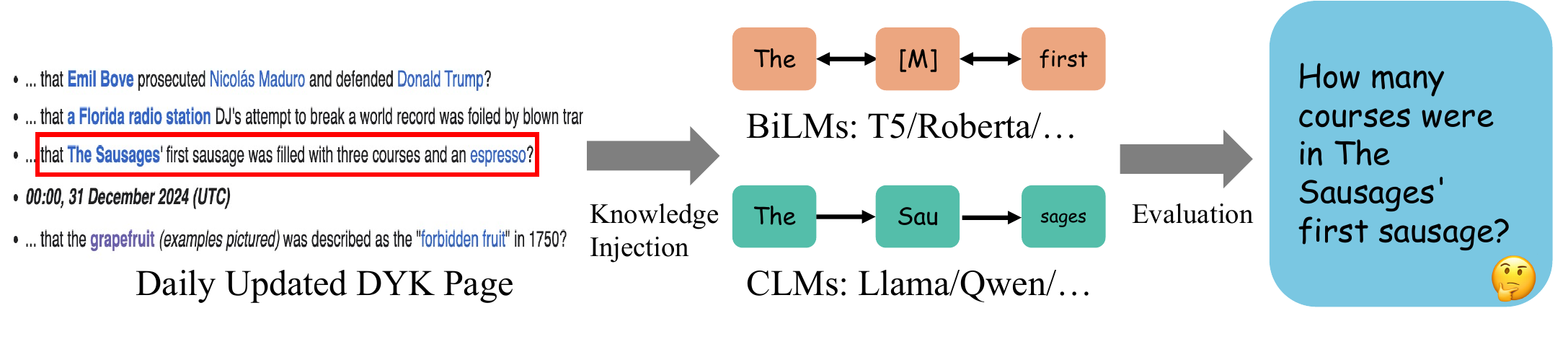
Proposed knowledge injection evaluation workflow. Knowledge from daily-updated DYK pages is injected via continued pre-training with various architectures and objectives. The injected model is then evaluated with questions spanning easy cloze prompts to complex multi-hop questions.
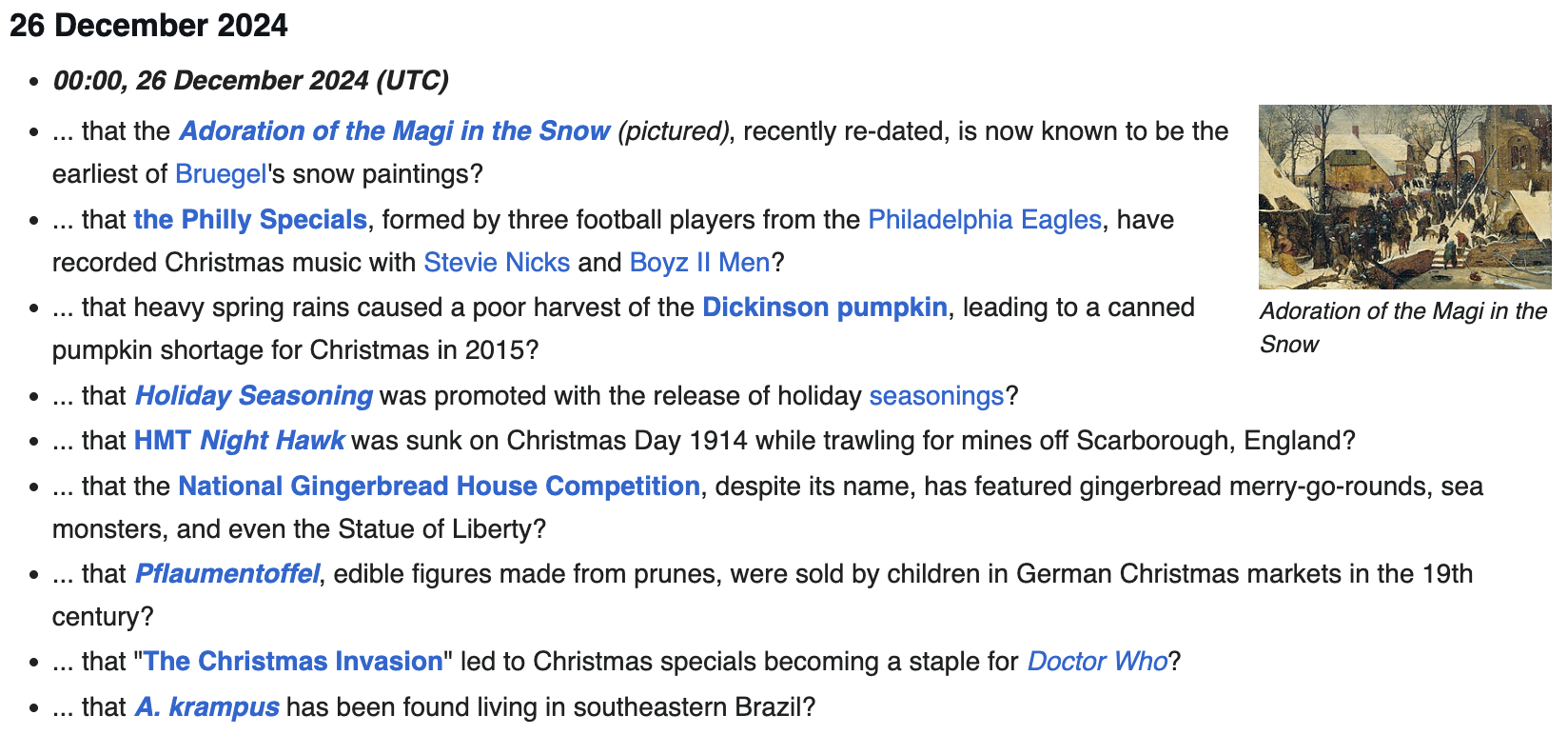
Example of the Wikipedia "Did You Know..." page that serves as the data source for WikiDYK.
WikiDYK leverages Wikipedia's "Did You Know..." pages, which highlight daily updates of facts reviewed by expert Wikipedia editors. Each day, about 10 facts are selected from recently created or expanded articles, ensuring both novelty and quality. We collect facts from January 2022 to April 2025, yielding 12,290 entries that are unlikely to exist in LLM pre-training data.
The code in this repository supports:
| Resource | Link | Description |
|---|---|---|
| WikiDYK | YWZBrandon/wikidyk | Public benchmark dataset |
| WikiDYK Experiments | YWZBrandon/wikidyk_exp | Ready-to-run experiment data |
| Paper | arXiv:2505.12306 | Full paper |
Key characteristics:
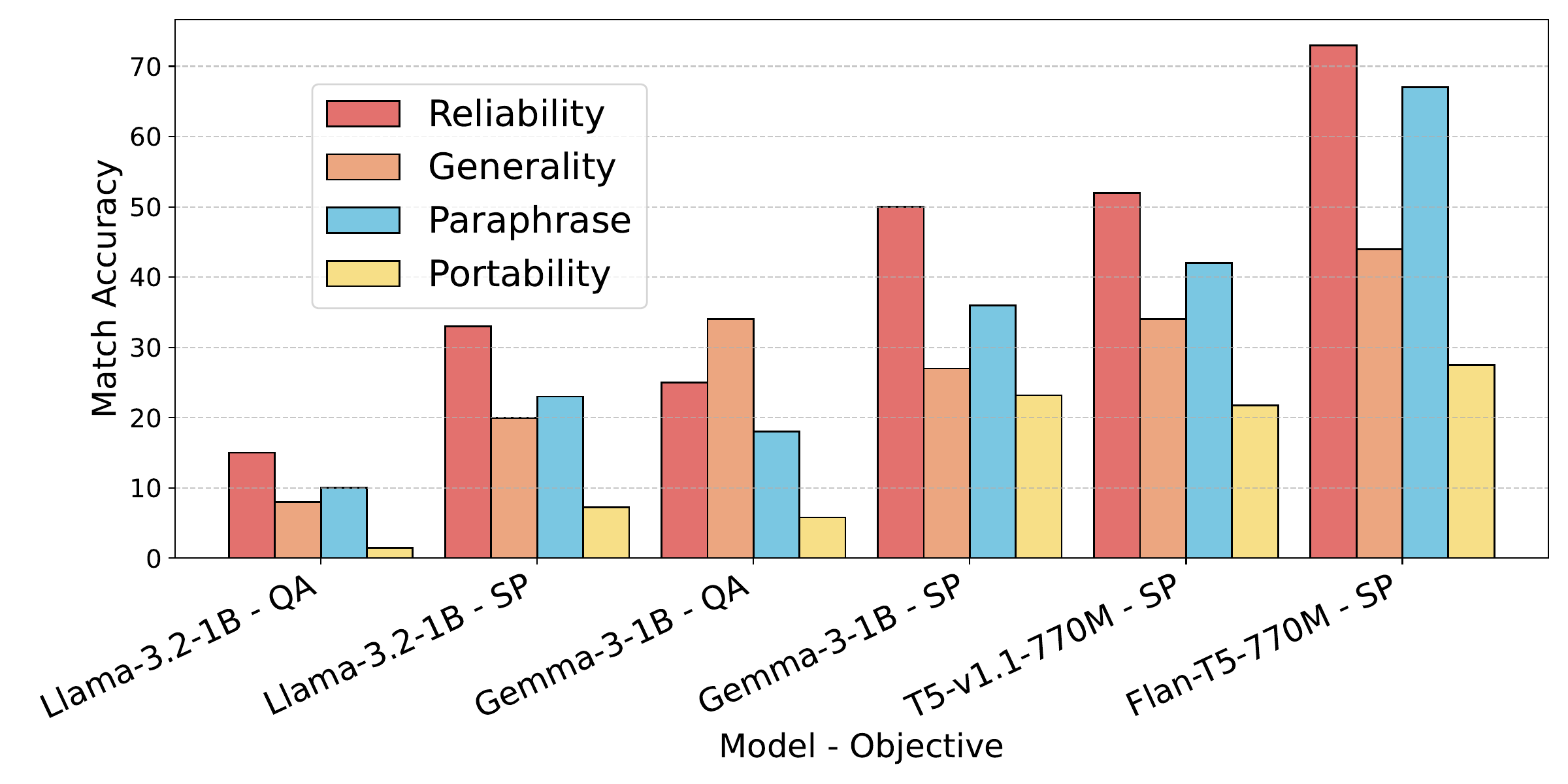
Evaluation results of injecting 1,000 facts from WikiDYK. BiLMs (Flan-T5) significantly outperform CLMs (Llama, Gemma) of comparable or larger size under aligned training objectives.
Key findings:
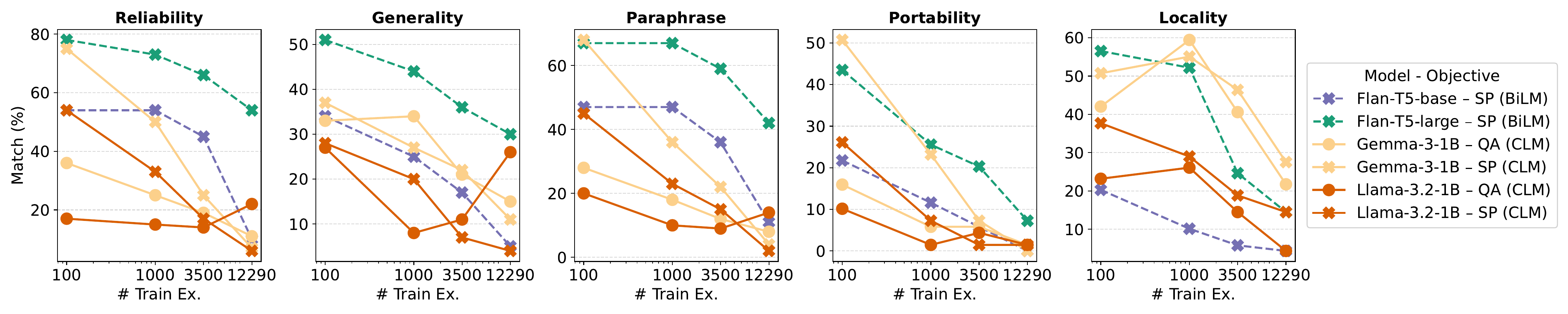
Effect of number of knowledge injected (upsampling s=1,000). BiLMs maintain stable performance as data scales up, while CLMs degrade sharply.
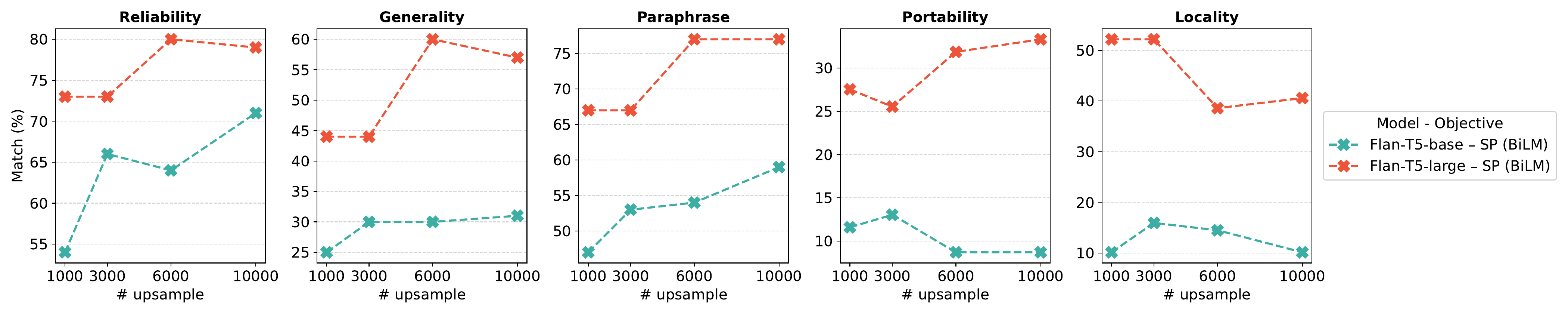
Effect of number of upsampling with 1,000 injected facts. Performance generally improves with more upsampling but saturates around s=6,000.
git clone git@github.com:zhang-yu-wei/WikiDYK.git
cd WikiDYK
conda create --name wikidyk python=3.10 -y
conda activate wikidyk
python -m pip install -r requirements.txt
python -m pip install flash-attn --no-build-isolation
Download the ready-to-run experiment data from Hugging Face:
huggingface-cli download YWZBrandon/wikidyk_exp --repo-type dataset --local-dir data
bash scripts/train_ar_full_all_8gpu.sh
bash scripts/train_synthetic_qa_all_8gpu.sh
bash scripts/train_pred_mask_full_all_8gpu.sh
bash scripts/train_full_flan_t5.sh
bash scripts/eval_qa_static.sh
bash scripts/eval_qa_rag.sh
bash scripts/eval_qa_trained.sh
bash scripts/eval_qa_accelerate.sh
Train the scope classifier:
bash scripts/train_scope_clf_deberta_large.sh
Train models on clustered data:
bash scripts/train_cluster_s10_flan_t5_base_us1000.sh
bash scripts/train_cluster_s10_flan_t5_large_us1000.sh
Then evaluate the trained BiLMs with scripts/eval_qa_accelerate.sh. To run the full ensemble pipeline, modify the ensemble configs in src/ens_configs/config_t5_base_s10.json and src/ens_configs/config_t5_large_s10.json, then run:
python src/ensemble_pipeline.py --ens_config src/ens_configs/config_t5_large_s10.json --no_factual
If you find WikiDYK useful in your research or applications, we would appreciate it if you could cite our work:
@misc{zhang2025bidirectionallmsbetterknowledge,
      title={Bidirectional LMs are Better Knowledge Memorizers? A Benchmark for Real-world Knowledge Injection},
      author={Yuwei Zhang and Wenhao Yu and Shangbin Feng and Yifan Zhu and Letian Peng and Jayanth Srinivasa and Gaowen Liu and Jingbo Shang},
      year={2025},
      eprint={2505.12306},
      archivePrefix={arXiv},
      primaryClass={cs.CL},
      url={https://arxiv.org/abs/2505.12306},
}
[ACL 2026] Bidirectional LMs are Better Knowledge Memorizers? A Benchmark for Real-world Knowledge Injection
Shell
2
31 commits
updated Jun 2, 2026
Bidirectional LMs are Better Knowledge Memorizers? A Benchmark for Real-world Knowledge Injection
WikiDYK is the official implementation for Bidirectional LMs are Better Knowledge Memorizers? A Benchmark for Real-world Knowledge Injection, accepted to ACL 2026 (Main Conference).
WikiDYK is a real-world, continuously extensible knowledge injection benchmark built from recently-added, human-written facts in Wikipedia's "Did You Know..." (DYK) entries. The benchmark contains 12,290 facts and 77,180 questions spanning formats from cloze prompts to complex multi-hop questions. Our experiments show that causal language models (CLMs) can be significantly weaker knowledge memorizers than bidirectional language models (BiLMs) after continued pre-training, and that ensembles of BiLMs can serve as external knowledge repositories for LLMs.
Proposed knowledge injection evaluation workflow. Knowledge from daily-updated DYK pages is injected via continued pre-training with various architectures and objectives. The injected model is then evaluated with questions spanning easy cloze prompts to complex multi-hop questions.
Example of the Wikipedia "Did You Know..." page that serves as the data source for WikiDYK.
WikiDYK leverages Wikipedia's "Did You Know..." pages, which highlight daily updates of facts reviewed by expert Wikipedia editors. Each day, about 10 facts are selected from recently created or expanded articles, ensuring both novelty and quality. We collect facts from January 2022 to April 2025, yielding 12,290 entries that are unlikely to exist in LLM pre-training data.
The code in this repository supports:
| Resource | Link | Description |
|---|---|---|
| WikiDYK | YWZBrandon/wikidyk | Public benchmark dataset |
| WikiDYK Experiments | YWZBrandon/wikidyk_exp | Ready-to-run experiment data |
| Paper | arXiv:2505.12306 | Full paper |
Key characteristics:
Evaluation results of injecting 1,000 facts from WikiDYK. BiLMs (Flan-T5) significantly outperform CLMs (Llama, Gemma) of comparable or larger size under aligned training objectives.
Key findings:
Effect of number of knowledge injected (upsampling s=1,000). BiLMs maintain stable performance as data scales up, while CLMs degrade sharply.
Effect of number of upsampling with 1,000 injected facts. Performance generally improves with more upsampling but saturates around s=6,000.
git clone git@github.com:zhang-yu-wei/WikiDYK.git
cd WikiDYK
conda create --name wikidyk python=3.10 -y
conda activate wikidyk
python -m pip install -r requirements.txt
python -m pip install flash-attn --no-build-isolation
Download the ready-to-run experiment data from Hugging Face:
huggingface-cli download YWZBrandon/wikidyk_exp --repo-type dataset --local-dir data
bash scripts/train_ar_full_all_8gpu.sh
bash scripts/train_synthetic_qa_all_8gpu.sh
bash scripts/train_pred_mask_full_all_8gpu.sh
bash scripts/train_full_flan_t5.sh
bash scripts/eval_qa_static.sh
bash scripts/eval_qa_rag.sh
bash scripts/eval_qa_trained.sh
bash scripts/eval_qa_accelerate.sh
Train the scope classifier:
bash scripts/train_scope_clf_deberta_large.sh
Train models on clustered data:
bash scripts/train_cluster_s10_flan_t5_base_us1000.sh
bash scripts/train_cluster_s10_flan_t5_large_us1000.sh
Then evaluate the trained BiLMs with scripts/eval_qa_accelerate.sh. To run the full ensemble pipeline, modify the ensemble configs in src/ens_configs/config_t5_base_s10.json and src/ens_configs/config_t5_large_s10.json, then run:
python src/ensemble_pipeline.py --ens_config src/ens_configs/config_t5_large_s10.json --no_factual
If you find WikiDYK useful in your research or applications, we would appreciate it if you could cite our work:
@misc{zhang2025bidirectionallmsbetterknowledge,
      title={Bidirectional LMs are Better Knowledge Memorizers? A Benchmark for Real-world Knowledge Injection},
      author={Yuwei Zhang and Wenhao Yu and Shangbin Feng and Yifan Zhu and Letian Peng and Jayanth Srinivasa and Gaowen Liu and Jingbo Shang},
      year={2025},
      eprint={2505.12306},
      archivePrefix={arXiv},
      primaryClass={cs.CL},
      url={https://arxiv.org/abs/2505.12306},
}



