
A lightweight audio codec based on a single quantizer
Python
36
3 commits
updated Sep 4, 2025
README
L3AC
This repository contains the implementation of L3AC, a lightweight audio codec based on a single quantizer, introduced in the paper titled "L3AC: Towards a Lightweight and Lossless Audio Codec".
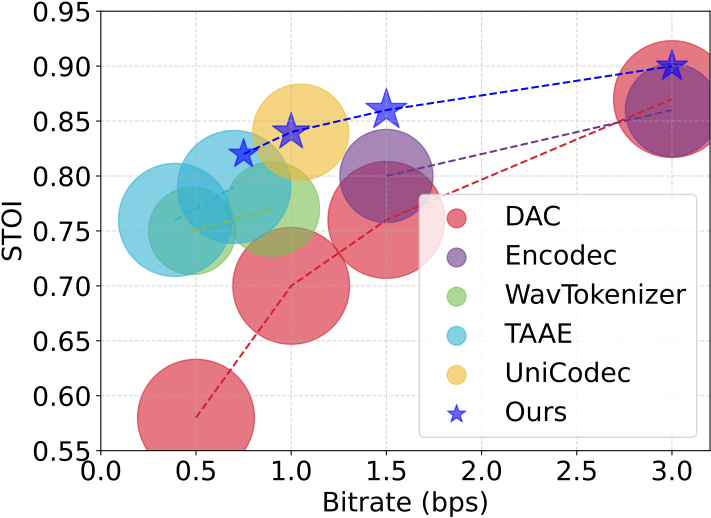 Comparison of various audio codec
install
pip install l3ac
demo
Firstly, make sure you have installed the librosa package to load the example audio file. You can install it using pip:
pip install librosa
Then, you can use the following code to load a sample audio file, encode it using the L3AC model, and decode it back to audio. The code also calculates the mean squared error (MSE) between the original and generated audio.
import librosa
import torch
import l3ac

all_models = l3ac.list_models()
print(f"Available models: {all_models}")

MODEL_USED = '1kbps'
codec = l3ac.get_model(MODEL_USED)
print(f"loaded codec({MODEL_USED}) and codec sample rate: {codec.config.sample_rate}")

sample_audio, sample_rate = librosa.load(librosa.example("libri1"))
sample_audio = sample_audio[None, :]
print(f"loaded sample audio and audio sample_rate :{sample_rate}")

sample_audio = librosa.resample(sample_audio, orig_sr=sample_rate, target_sr=codec.config.sample_rate)

codec.network.cuda()
codec.network.eval()
with torch.inference_mode():
    audio_in = torch.tensor(sample_audio, dtype=torch.float32, device='cuda')
    _, audio_length = audio_in.shape
    print(f"{audio_in.shape=}")
    q_feature, indices = codec.encode_audio(audio_in)
    audio_out = codec.decode_audio(q_feature)  # or
    # audio_out = codec.decode_audio(indices=indices['indices'])
    generated_audio = audio_out[:, :audio_length].detach().cpu().numpy()

mse = ((sample_audio - generated_audio) ** 2).mean().item()
print(f"codec({MODEL_USED}) mse: {mse}")
available models
| config_name | Sample rate(Hz) | tokens/s | Codebook size | Bitrate(bps) |
|---|---|---|---|---|
| 0k75bps | 16,000 | 44.44 | 117,649 | 748.6 |
| 1kbps | 16,000 | 59.26 | 117,649 | 998.2 |
| 1k5bps | 16,000 | 88.89 | 117,649 | 1497.3 |
| 3kbps | 16,000 | 166.67 | 250,047 | 2988.6 |
Contributors

3 commits
Similar repos





Languages
Python
100.0%
A lightweight audio codec based on a single quantizer
Python
36
3 commits
updated Sep 4, 2025
README
L3AC
This repository contains the implementation of L3AC, a lightweight audio codec based on a single quantizer, introduced in the paper titled "L3AC: Towards a Lightweight and Lossless Audio Codec".
Comparison of various audio codec
install
pip install l3ac
demo
Firstly, make sure you have installed the librosa package to load the example audio file. You can install it using pip:
pip install librosa
Then, you can use the following code to load a sample audio file, encode it using the L3AC model, and decode it back to audio. The code also calculates the mean squared error (MSE) between the original and generated audio.
import librosa
import torch
import l3ac

all_models = l3ac.list_models()
print(f"Available models: {all_models}")

MODEL_USED = '1kbps'
codec = l3ac.get_model(MODEL_USED)
print(f"loaded codec({MODEL_USED}) and codec sample rate: {codec.config.sample_rate}")

sample_audio, sample_rate = librosa.load(librosa.example("libri1"))
sample_audio = sample_audio[None, :]
print(f"loaded sample audio and audio sample_rate :{sample_rate}")

sample_audio = librosa.resample(sample_audio, orig_sr=sample_rate, target_sr=codec.config.sample_rate)

codec.network.cuda()
codec.network.eval()
with torch.inference_mode():
    audio_in = torch.tensor(sample_audio, dtype=torch.float32, device='cuda')
    _, audio_length = audio_in.shape
    print(f"{audio_in.shape=}")
    q_feature, indices = codec.encode_audio(audio_in)
    audio_out = codec.decode_audio(q_feature)  # or
    # audio_out = codec.decode_audio(indices=indices['indices'])
    generated_audio = audio_out[:, :audio_length].detach().cpu().numpy()

mse = ((sample_audio - generated_audio) ** 2).mean().item()
print(f"codec({MODEL_USED}) mse: {mse}")
available models
| config_name | Sample rate(Hz) | tokens/s | Codebook size | Bitrate(bps) |
|---|---|---|---|---|
| 0k75bps | 16,000 | 44.44 | 117,649 | 748.6 |
| 1kbps | 16,000 | 59.26 | 117,649 | 998.2 |
| 1k5bps | 16,000 | 88.89 | 117,649 | 1497.3 |
| 3kbps | 16,000 | 166.67 | 250,047 | 2988.6 |
Similar repos
Contributors
3 commits
Languages
Python
100.0%