
LeanCTX — Context Intelligence for AI systems.
3,790
stars
5,803
commits
Rust
primary language
Sep 15, 2026
updated
README
██╗     ███████╗ █████╗ ███╗   ██╗     ██████╗████████╗██╗  ██╗
██║     ██╔════╝██╔══██╗████╗  ██║    ██╔════╝╚══██╔══╝╚██╗██╔╝
██║     █████╗  ███████║██╔██╗ ██║    ██║        ██║    ╚███╔╝
██║     ██╔══╝  ██╔══██║██║╚██╗██║    ██║        ██║    ██╔██╗
███████╗███████╗██║  ██║██║ ╚████║    ╚██████╗   ██║   ██╔╝ ██╗
╚══════╝╚══════╝╚═╝  ╚═╝╚═╝  ╚═══╝     ╚═════╝   ╚═╝   ╚═╝  ╚═╝
Control what your AI can see.
LeanCTX — AI Value Gate for AI Coding Agents
LeanCTX — short for Lean Context — is an AI Value Gate and context engineering layer for AI coding agents. It runs locally alongside your coding agent, helping it read repositories, run development commands, and send focused context to the model: it understands the task, routes the right context, compresses what it sends, and tracks the cost and outcome of that work. Savings depend on the workload and enabled modes; the local savings ledger and Shadow Mode show the measured result against a comparable baseline. Zero config required. Local-first.
| Problem | With LeanCTX |
|---|---|
| Repeated file reads resend unchanged content | Cached re-reads return a compact deterministic reference |
| Raw development commands include repetitive noise | Command-specific compression preserves salient output |
| Every turn re-sends the whole history | Proxy compresses each request, prompt-cache-safe |
| Context resets every chat | Session memory persists across chats |
| No visibility into context usage | Real-time dashboard + budget control |






Website · Docs · Install · Scenarios · Demo · Benchmarks · Cookbook · Security · Changelog
Control what your AI can see — and what it costs. LeanCTX is an AI Value Gate for coding agents: it understands tasks, routes and compresses context, remembers what it learns, and measures cost against accepted outcomes.
Token savings are the receipt. Intelligence is the product. Works with Cursor, Claude Code, Copilot, Windsurf, Codex, Gemini and 30+ other agents — no config needed.
See it in action:
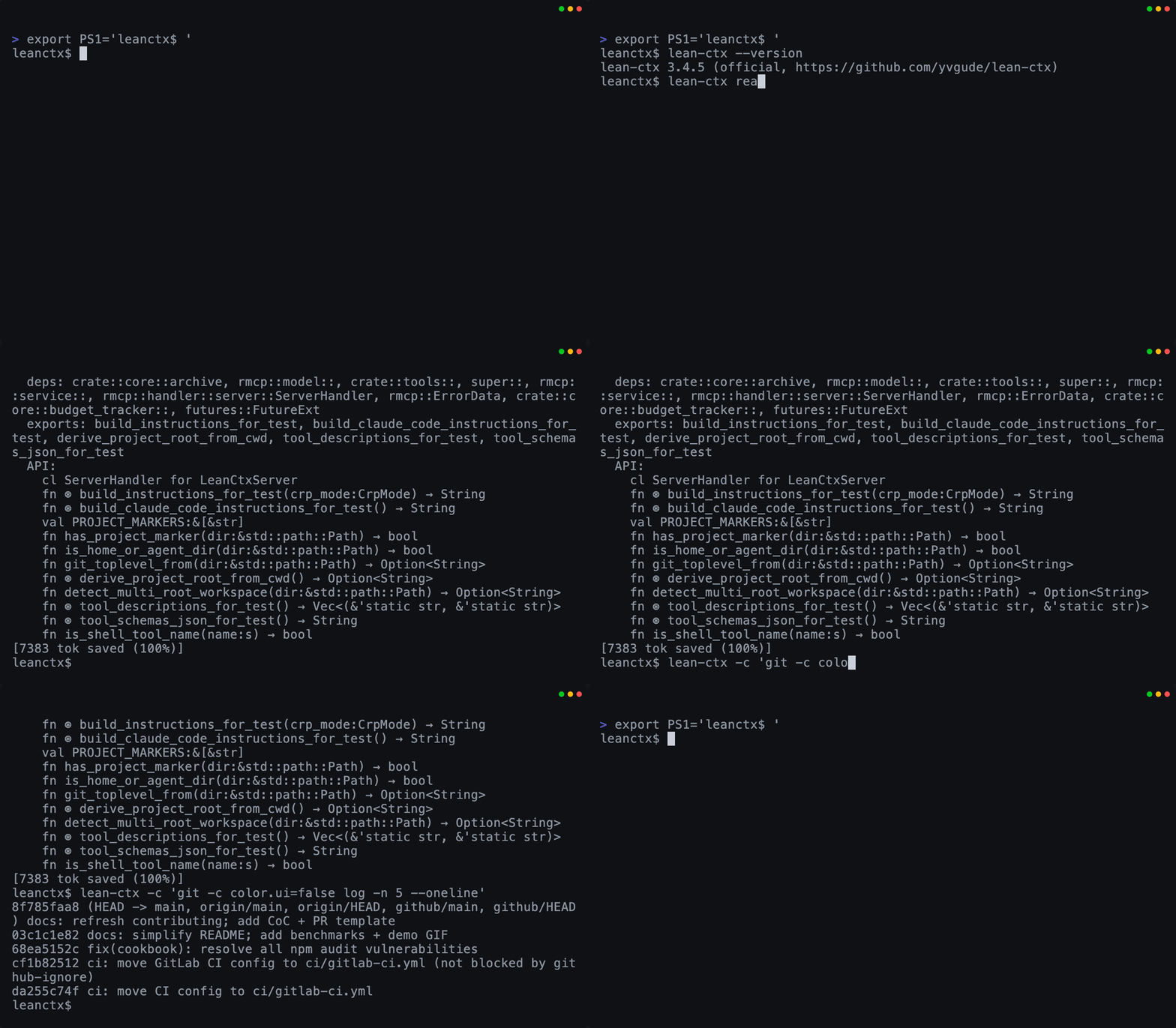
Read + Shell Map-mode reads + compressed CLI output |
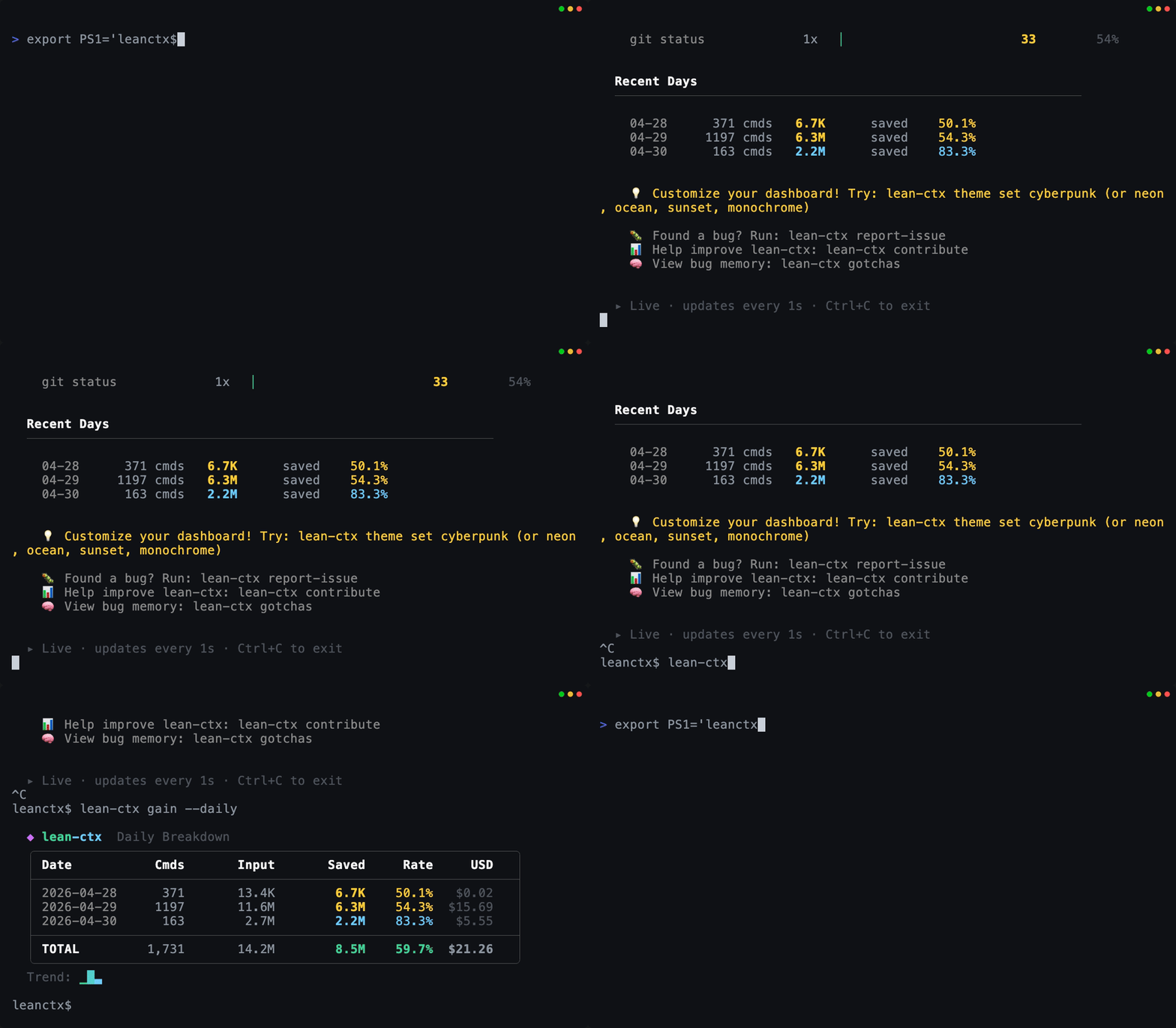
Gain (live) Tokens + USD savings in real time |
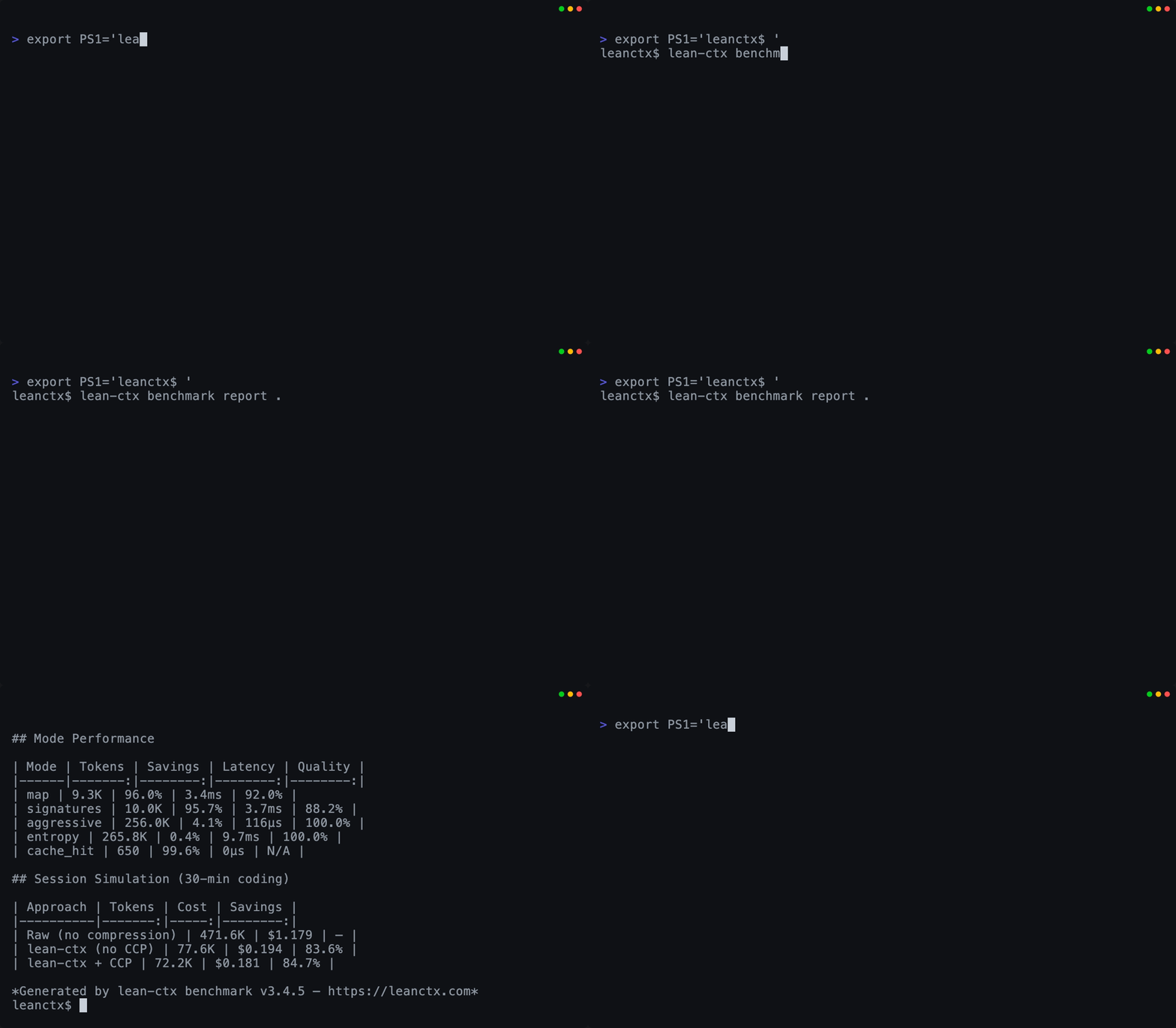
Benchmark proof Measure compression by language + mode |
All GIFs are generated from reproducible VHS tapes in demo/.
Why developers use LeanCTX
- Longer useful coding sessions — less context waste = more room for actual code reasoning
- Lower API costs — reduce repeated context on reads and shell output; inspect the local savings ledger and Shadow Mode baseline for your workload
- No more "I already showed you this file" — session memory persists across chats
- Works with your existing setup — one
lean-ctx setupcommand, no config changes needed - Full visibility — see exactly where your context window budget goes
- Model-agnostic & yours — swap OpenAI/Anthropic/Gemini freely; your context and memory stay local and portable, never locked in a vendor's black box
Saves you tokens? Give it a star — it helps others discover LeanCTX.
Why now — own your context
Models are converging on commodity. The durable edge isn't which model you call — it's your context: what your agents read, what they remember, and what you can prove. And the layer that optimizes and owns that context can't come from the vendor that bills per token or keeps your memory in a black box — it has to sit on your side.
That's the shift behind "agent entities" that live in your chat and remember your company (Claude in Slack, ClickUp Brain): a context login, not a model login — you end up renting your own company knowledge back. LeanCTX is the opposite layer. It keeps the moat yours: local-first, portable (.ctxpkg), and model-agnostic — swap OpenAI, Anthropic or Gemini without losing context or cache. Own your context; don't rent it back.
What it does — five capabilities of an AI Value Gate
LeanCTX treats context and AI spend as managed resources, not afterthoughts. One binary covers the capabilities that decide how well an AI agent performs:
1. Context Compression — input efficiency
Your AI agent reads files and runs commands. LeanCTX compresses both automatically.
-
Workload-specific token reduction on eligible context, with recovery paths and a local Shadow Mode baseline for measurement
-
File reads: 10 read modes (
full,map,signatures,diff,lines:N-M,density:X, …) — cached re-reads cost ~13 tokens -
Target density (
density:0.4): SDE-style budget compression — keeps the highest-entropy lines until ~40% of the original tokens remain, deterministic -
JIT disclosure:
signaturescarries line spans and points atlines:N-Mfor targeted expansion — outline first, bodies on demand -
Shell output: 95+ shell-output patterns compress git, npm, cargo, docker, kubectl, terraform and more (270 passthrough rules)
-
Tree-sitter AST: structural understanding for 27 languages — not just text compression
-
Reversible by design (CCR): compression never discards content — pruned or truncated payloads move to a content-addressed store with a deterministic handle, so the model can pull the original bytes back on demand via
ctx_expand,ctx_retrieve, an in-band marker, orGET /v1/references/{id}. Five recovery paths →
2. Intelligent Triage — task understanding
Not every task or file needs the same depth. LeanCTX classifies the task, then sends the signal rather than the noise.
- 10 read modes: from full content down to AST signatures and entropy-filtered views
- Adaptive
ModePredictor: learns the optimal read mode per file type from past sessions IntentEngine: classifies query complexity so simple lookups stay cheap
3. Knowledge Routing — cross-source context
Relevant code, sessions, and connected sources become focused context instead of a larger prompt.
- Session memory (CCP): persist task/facts/decisions across chats — structured recovery queries survive compaction
- Knowledge graph: temporal facts with validity windows, episodic + procedural memory
- Property Graph: multi-edge code graph (imports, calls, exports, type_ref) powers impact analysis and search ranking
- Yours, not the vendor's: memory stays local and portable — export it as a
.ctxpkgpackage and move it across machines or models, instead of locking it in a vendor's black box
4. AI Value Gate — cost and outcome tracking
Performance is the cost of a useful result, not just speed. LeanCTX records costs and outcomes locally; CPAO (Cost per Accepted Outcome) is the north-star metric for comparing useful AI work.
- Context Manager: browser dashboard with real-time token tracking, compression stats, utilization gauge
- Budgets & SLOs: profiles, roles, per-agent budgets, and throttling policies
- Context Proof (
ctx_proof,ctx_verify): 4-layer verification engine with CI drift gates
5. Shadow Recommendations — savings proof
Shadow Mode compares LeanCTX treatment with a configured baseline without changing the active workflow. Its reports show cost, tokens, CPAO, and whether quality held, then recommend savings only when the comparison supports them.
Cost Intelligence
LeanCTX automatically tracks local cost and outcome signals; it does not add those reports to agent context. CPAO — cost per accepted outcome — is the north-star metric, while Shadow Mode provides a baseline comparison for savings.
lean-ctx savings --period week                 # costs, token savings, and CPAO
lean-ctx value-report --format markdown --last 20  # recent outcome quality
lean-ctx shadow --latest                       # latest baseline comparison
Quick start: value tracking
# Enable shadow mode for savings comparison
echo '[shadow]\nenabled = true' >> ~/.config/lean-ctx/config.toml

# After using LeanCTX for a while:
lean-ctx savings
lean-ctx shadow --latest
Full feature list (complete MCP tool set)
- Web & Research (
ctx_url_read): pull a public web page, PDF, or YouTube transcript into context as compressed, citation-backed text —facts/quotesreturn claims with a confidence score + source URL, relevance-ranked research-compression distils to a token budget, SSRF-guarded (http/https only) - Graph-Powered Intelligence: hybrid search (BM25 + embeddings + graph proximity via RRF), incremental git-diff updates
- LSP Refactoring (
ctx_refactor): language-server-powered rename, references, go-to-definition via rust-analyzer, typescript-language-server, pylsp, gopls - Multi-Agent (
ctx_agent,ctx_handoff): agent handoff with context transfer bundles, diary system, synchronized shared state - Archive Full-Text Search (
ctx_expand search_all): FTS5-powered cross-archive search over all previously archived tool outputs - PR Context Packs:
lean-ctx pack --prbuilds a PR-ready context pack (changed files, related tests, impact, artifacts) - Context Packages:
lean-ctx pack createbundles Knowledge + Graph + Session into portable.ctxpkgfiles with SHA-256 integrity - Context Time Machine:
lean-ctx snapshot create|list|show|verify|restore|publish|import— git-anchored, ed25519-signed snapshots of the layer state (lineage, ledger Φ, ROI, session) on an append-only timeline; replay them in the dashboard,restoreto resume a session (and--gitto check out the commit), orpublish/importa signed snapshot to share it (concept →) - Observability:
lean-ctx gain --livefor real-time savings,lean-ctx wrappedfor weekly/monthly summaries (gain --svg/--sharefor a shareable card or self-hostable page),lean-ctx watchfor TUI monitoring - Verified savings:
lean-ctx savingsis an auditable, per-event ledger (tokenizer transparency, bounce-netting, tamper-evident SHA-256 chain) — local-only, on by default - HTTP mode:
lean-ctx servefor Streamable HTTP MCP +/v1/tools/call(used by the Cookbook and external clients)
Addons — extend the engine, or run the ecosystem through one gateway
You don't have to choose between LeanCTX and the other context tools you already
like. An addon is a signed package carrying either a sandboxed WASM module
that runs inside the context pipeline, or an [mcp] declaration that wires an
external MCP server into the gateway — after which LeanCTX treats what it returns
like your own reads instead of just proxying it.
lean-ctx addon release ./my-addon   # build a signed .ctxpkg — no artifact host, no CI
lean-ctx addon add ./my-addon-1.0.0.ctxpkg   # verify, disclose, ask, install
lean-ctx addon list                 # what's installed, what loads, what's wired
- Publish it yourself — the module travels inside the signed package, so the signature covers the executable bytes. Nothing external to host, hash or serve, and no pipeline of your own.
- Verified locally, then asked —
addre-checks the signature on your machine rather than trusting its source, checks every module against its pinned SHA-256, prints the publisher key and the exact command any declared server would run, and only then prompts. - LeanCTX never installs the server for you — no
uv tool install, nonpx. Fetching a declared tool stays your step, where your own package manager's trust model applies. The manifest says how to run it. - Folded in, not just proxied — opt-in post-processing runs addon output through the same pipeline as your code: compress to a budget, spill oversized blobs to a
ctx_expandhandle, index into BM25 / graph / knowledge. A typedintegrationroutes specific tools straight intoctx_expand,ctx_callgraphandctx_knowledge. - Untrusted by default — every addon's output is scrubbed for secrets and tagged untrusted before it reaches the model. Always on, not a flag.
There is deliberately no marketplace and no addon search: LeanCTX does not
host, curate or rank addons. A package is a file you install, or one you fetch
from a registry you name. See the
addon guide for the full walkthrough.
Where it's going
LeanCTX is growing from a single context layer into a full cognitive context layer for whole teams: version-controlled context strategy, one unified graph, and a governance layer across many agents.
- Context Time Machine → hosted history — the snapshot engine, dashboard replay, restore, and signed file-based share/import have shipped (see above); next is a
ctxpkg.comregistry for hosted, versioned context history and a side-by-side model-view | git-diff replay. The temporal axis through everything LeanCTX does — it decides, remembers, guards, proves, and replays. (concept →) - Context as Code — declarative pipelines, profiles, and policies in TOML, versioned like infrastructure
- Unified Context Graph — code, tests, commits, CI runs, and knowledge entries in a single semantic graph
- Agent Harness — roles, budgets, and tool permissions for multi-agent governance
- Context Observability — SLOs on context consumption, anomaly detection, OpenTelemetry / Prometheus export
The full roadmap lives in VISION.md.
How it works (30 seconds)
LeanCTX works on two planes — what your agents read and what they send to the model:
read path:   AI tool  →  (MCP tools + shell)  →  lean-ctx  →  your repo + CLI
wire path:   AI tool  →  lean-ctx proxy        →  model provider   (every request, compressed)
- MCP server (read path): exposes
ctx_*tools (read modes, caching, deltas, search, memory, multi-agent) - Shell hook (read path): transparently compresses common commands so the LLM sees less noise
- Request proxy (wire path, opt-in):
lean-ctx proxy enableputs a local proxy between your agent and the model that compresses every request — system prompt, full history and tool results — prompt-cache-safe, with measured USD spend. It can also pin one reasoning-effort level across OpenAI, Anthropic & Gemini (proxy.effort) without breaking that cache, cut output tokens with a cache-safe verbosity steer plus a measured holdout, and relocate volatile fields (dates, UUIDs, commit SHAs) out of the cacheable prefix so a stable system prompt finally caches. Every rewrite is reversible (content-addressed recovery) and byte-stable by contract. Same layer as a standalone request-compression proxy (e.g. Headroom) — you don't need one on top. - Property Graph: multi-edge code graph powers impact analysis, related file discovery, and search ranking
- Session memory: persists state with structured recovery so long-running work never "cold starts"
- Context Manager: browser dashboard for real-time visibility into what's in your context window
Get started (30 seconds)
# 1) Install (pick one)
curl -fsSL https://leanctx.com/install.sh | sh      # universal (no Rust needed)
brew tap yvgude/lean-ctx && brew install lean-ctx    # macOS / Linux
npm install -g lean-ctx-bin                          # Node.js
cargo install lean-ctx                               # Rust

# 2) One-command setup for your agent
lean-ctx wrap cursor      # or: wrap claude / wrap codex

# Done. Savings appear after your AI's first lean-ctx call.
lean-ctx gain
lean-ctx wrap registers the MCP server and configures the supported local
transport for that agent. Undo anytime with lean-ctx unwrap cursor.
Claude Pro/Max: subscription OAuth cannot use a custom
ANTHROPIC_BASE_URL.lean-ctx wrap claudetherefore adds no proxy redirect while enabling thectx_*tools and shell-output compression; an existing custom endpoint remains untouched. Claude wire-level request compression requiresANTHROPIC_API_KEY. See advanced proxy setup.
Alternative: full control
lean-ctx onboard          # connect all detected AI tools (zero prompts)
lean-ctx setup            # interactive wizard with every option
Building from source on Windows? Clone the repo and run ./install.ps1 in PowerShell — it builds the release binary and installs it into Cargo's bin directory (pass -BuildOnly to build without installing).
Troubleshooting / Safety
- Disable immediately (current shell):
lean-ctx-off - Run a single command uncompressed:
lean-ctx -c --raw "git status" - Only activate in AI agent sessions: set
shell_activation = "agents-only"in~/.config/lean-ctx/config.toml - Per-project config override: create
.lean-ctx.tomlin your project root (auto-merged with global config) - Docker projects sharing
/workspace: create.lean-ctx-idwith a unique name to prevent context collisions - Update:
lean-ctx update - Diagnose (shareable):
lean-ctx doctor --json
Real-world scenarios
LeanCTX grows with you. Below are the journeys most people actually take — each links to a complete, function-by-function walkthrough in the Reference (every CLI command and the complete MCP tools are documented there).
🟢 Your first 30 seconds"I just installed it — now what?" One command installs hooks, MCP registration, and verifies the connection. → Journey 1 — Setup & Onboarding |
📖 Coding every day"Stop re-reading the same files." Your agent reads less and searches smarter — automatically. → Journey 2 — Daily Use |
🧠 Resume where you left off"My new chat forgot everything." Session memory + a project knowledge graph persist across chats. → Journey 3 — Memory & Knowledge |
🗺️ Understand a new codebase"Where does this function ripple to?" A multi-edge property graph powers impact analysis + ranked search. → Journey 4 — Code Intelligence |
🔌 Providers & multi-repo"Pull in GitHub issues and our Postgres schema." External data flows through the same consolidation pipeline. → Journey 5 — Advanced & Integrations |
🛠️ Keep it healthy"Update, fix, or cleanly remove." Self-healing diagnostics; surgical uninstall that only removes its own blocks. → Journey 6 — Lifecycle & Troubleshooting |
🎛️ Take control of the window"Budget my context like a pro." Phi-scored planning + knapsack compilation + a context ledger. → Journey 7 — Context Engineering |
🤝 Run a team of agents"Planner + coder + reviewer on one repo." Shared message bus, diaries, knowledge, and deterministic handoffs. → Journey 8 — Multi-Agent Collaboration |
🏢 Share across a team / CI"One shared index, headless in pipelines." Scoped tokens, optional cloud sync, verifiable context gates. → Journey 9 — Team, Cloud & CI |
🎚️ Tune & govern"Make it behave exactly how we want." Compression levels, tool profiles, themes, and rules governance. → Journey 10 — Customization & Governance |
📊 Prove the payoff"Show me the numbers." All analytics live in the CLI/dashboard — never burning agent tokens. → Journey 11 — Analytics & Insights |
📚 The full reference"I want to read everything." Every command and the complete MCP tool set, organized as user journeys, plus appendices for the CLI map, MCP tools, and paths & config. → Reference index |
Supported IDEs & AI tools
LeanCTX is a standard MCP server, so it works with any MCP-compatible client. Two integration modes are auto-selected per agent:
| Mode | How it works | Best for |
|---|---|---|
| Hybrid | MCP for cached reads (~13 tokens) + shell hooks for command compression | Agents with shell access (Cursor, Claude Code, Codex, ...) |
| MCP | Complete tool set via MCP protocol, no shell hooks | Protocol-only agents (JetBrains, VS Code, Zed, ...) |
Agent compatibility matrix
| Agent | Hybrid | MCP | Setup |
|---|---|---|---|
| Cursor | ● | lean-ctx init --agent cursor | |
| Claude Code | ● | lean-ctx init --agent claude | |
| CodeBuddy | ● | lean-ctx init --agent codebuddy | |
| Augment CLI / VS Code | ● | lean-ctx init --agent augment | |
| Codex CLI | ● | lean-ctx init --agent codex | |
| Grok | ● | lean-ctx init --agent grok | |
| Gemini CLI | ● | lean-ctx init --agent gemini | |
| Windsurf | ● | lean-ctx init --agent windsurf | |
| GitHub Copilot | ● | lean-ctx init --agent copilot | |
| CRUSH | ● | lean-ctx init --agent crush | |
| Hermes | ● | lean-ctx init --agent hermes | |
| OpenCode | ● | lean-ctx init --agent opencode | |
| Pi | ● | lean-ctx init --agent pi | |
| Qoder | ● | lean-ctx init --agent qoder | |
| Amp | ● | lean-ctx init --agent amp | |
| Cline | ● | lean-ctx init --agent cline | |
| Roo Code | ● | lean-ctx init --agent roo | |
| Kiro | ● | lean-ctx init --agent kiro | |
| Antigravity | ● | lean-ctx init --agent antigravity | |
| Amazon Q | ● | lean-ctx init --agent amazonq | |
| Qwen | ● | lean-ctx init --agent qwen | |
| Trae | ● | lean-ctx init --agent trae | |
| Verdent | ● | lean-ctx init --agent verdent | |
| Aider | ● | lean-ctx init --agent aider | |
| Mistral Vibe | ● | lean-ctx init --agent vibe | |
| Continue | ● | lean-ctx init --agent continue | |
| JetBrains IDEs | ● | lean-ctx init --agent jetbrains | |
| QoderWork | ● | lean-ctx init --agent qoderwork | |
| VS Code | ● | lean-ctx init --agent vscode | |
| Zed | ● | lean-ctx init --agent zed | |
| Neovim | ● | lean-ctx init --agent neovim | |
| Emacs | ● | lean-ctx init --agent emacs | |
| Sublime Text | ● | lean-ctx init --agent sublime |
Any MCP-compatible client works out of the box — the table above shows agents with first-class auto-setup.
When to use (and when not to)
Great fit if you...
- use AI coding tools daily and your sessions are shell-heavy (git/tests/builds)
- work in medium/large repos (50+ files / monorepos)
- want a local-first layer with no telemetry by default
Skip it if you...
- mostly work in tiny repos and rarely call the shell from your AI tool
- always need raw/unfiltered logs (you can still use
--raw, but ROI is lower)
The honest fine print: the payoff depends on three levers — reach (own the
window via the proxy/engine, not just the ctx_* tool layer), context
lifetime (one long-lived session vs. a fresh process per phase), and
provider pricing (prompt-cache-priced vs. re-billed every turn). They stack
into a clear win where they line up and net to break-even where they don't.
See the win vs. break-even matrix
for the full breakdown and how to tune for each case.
Demo
Try these in any repo:
lean-ctx read rust/src/server/mod.rs -m map
lean-ctx -c "git log -n 5 --oneline"
lean-ctx gain --live
lean-ctx dashboard                              # Context Manager (browser)
lean-ctx watch                                  # TUI monitor
lean-ctx benchmark report .
- The repo ships the exact tapes used to render the GIFs in
demo/ - Regenerate locally:
vhs demo/leanctx.tape
vhs demo/gain.tape
vhs demo/benchmark.tape
Benchmarks
Real, reproduced numbers — never estimated. Measured on this repo with the GPT-4o
tokenizer (o200k_base); a tool that isn't installed is reported as such, never
guessed.
| Read mode | Compression | Tokens (50 files) | Quality |
|---|---|---|---|
| Raw read | 0% | 533.2K | 100% |
map | 98.1% | 8.0K | 78% |
signatures | 96.7% | 14.0K | 96% |
| Cached re-read | ~99.99% | ~13 tok | 100% |
lean-ctx's own cost is measured too: the CI-measured fixed per-session
footprint (advertised tool schemas + MCP instructions + wakeup briefing) is
~3.0K tokens and gated via lean-ctx doctor overhead --gate. And the
long-lived proxy rail has a deterministic self-verify —
lean-ctx benchmark dual-arm --json replays a 72-turn session and prices it per
model (digest f5ed145e61ce3689, 99.4% input-side saving on cache-priced rails;
methodology: bench/agent-task/r2).
Accuracy isn't a vibe: the lossy stages are CI-gated. A model-free A/B gate
proves the JSON crusher keeps every gold answer while cutting tokens, and proxy
rewrites are byte-stable by contract, so Anthropic (90%) / OpenAI (50%) prompt-cache
discounts survive compression. A deterministic off-vs-on testbench
(lean-ctx eval testbench) extends the proof to answers: it runs pinned real repos
through a raw-dump baseline and through lean-ctx at an identical token budget, grades
free-form QA with an LLM judge and code with each repo's own tests, and emits
FINDINGS.md (tokens / turns / walltime / quality) plus a regressions file — with a
committed recorded subset that blocks CI on any regression.
- Latest snapshot: BENCHMARKS.md
- Reproduce:
lean-ctx benchmark report .
By the numbers
- 3,000+ GitHub stars — and counting
- 280+ forks — active community contributions
- 200+ releases — shipped near-daily since launch
- 30+ supported AI coding agents — broadest MCP compatibility
- Broad MCP tool set — from simple file reads to multi-agent orchestration
- Used in production by teams running Claude Code, Cursor, and Codex daily
- Live adoption metrics: leanctx.com/metrics — installs, stars and savings, updated continuously
Docs
- Reference (every function, by user journey): docs/reference/ — 11 journeys + CLI/MCP/config appendices
- For AI agents / LLMs: llms.txt — a curated, machine-readable map of lean-ctx (per the llms.txt convention)
- Getting started: https://leanctx.com/docs/getting-started
- Tools reference: https://leanctx.com/docs/tools/
- CLI reference: https://leanctx.com/docs/cli-reference/
- What is LeanCTX: https://leanctx.com/what-is-leanctx/
- Comparison (vs RTK, Context+, MemGPT): https://leanctx.com/compare/
- Pricing & Cloud (local use is free forever): https://leanctx.com/pricing/
- FAQ: discord-faq.md
- Feature catalog (SSOT snapshot): LEANCTX_FEATURE_CATALOG.md
- Monorepo guide: docs/guides/monorepo.md
- Architecture: ARCHITECTURE.md
- Vision: VISION.md
Privacy & security
- No telemetry by default
- Optional anonymous stats sharing (opt-in during setup)
- Disableable update check (config
update_check_disabled = trueorLEAN_CTX_NO_UPDATE_CHECK=1) - 40+ security hardening fixes in v3.5.16 (path traversal, injection, CSPRNG, CSP, resource limits — details)
- Context Governance Benchmark self-assessment: graded C2 — Managed against the 32-control CGB v1.0-draft spec, gaps declared — docs/compliance/cgb-self-assessment.md
- Runs locally; your code never leaves your machine unless you explicitly enable cloud sync
See SECURITY.md.
Uninstall
One command removes everything — it stops all processes, then deletes hooks, editor configs, rules, autostart (LaunchAgent/systemd), the data dir, and the binary itself:
lean-ctx uninstall                 # full clean removal
lean-ctx uninstall --dry-run       # preview every change, write nothing
lean-ctx uninstall --keep-config   # keep MCP configs + rules (for reinstall)
lean-ctx-off                       # or just disable for the current shell session
No binary on PATH (or you used the curl installer)? Run the same removal from the installer:
curl -fsSL https://leanctx.com/install.sh | sh -s -- --uninstall
If you installed via a package manager, uninstall removes everything it wrote and
tells you the one command to finish removing the binary:
brew uninstall lean-ctx        # Homebrew
cargo uninstall lean-ctx       # cargo install
npm uninstall -g lean-ctx-bin  # npm
Star History
Contributing
Start with CONTRIBUTING.md. Easy first PR: propose a new CLI compression pattern via the issue template.
License
Apache License 2.0 — see LICENSE.


Similar repos


Languages
Rust
87.0%
C
4.0%
Python
3.1%
JavaScript
2.7%
LeanCTX — Context Intelligence for AI systems.
3,790
stars
5,803
commits
Rust
primary language
Sep 15, 2026
updated
README
██╗     ███████╗ █████╗ ███╗   ██╗     ██████╗████████╗██╗  ██╗
██║     ██╔════╝██╔══██╗████╗  ██║    ██╔════╝╚══██╔══╝╚██╗██╔╝
██║     █████╗  ███████║██╔██╗ ██║    ██║        ██║    ╚███╔╝
██║     ██╔══╝  ██╔══██║██║╚██╗██║    ██║        ██║    ██╔██╗
███████╗███████╗██║  ██║██║ ╚████║    ╚██████╗   ██║   ██╔╝ ██╗
╚══════╝╚══════╝╚═╝  ╚═╝╚═╝  ╚═══╝     ╚═════╝   ╚═╝   ╚═╝  ╚═╝
Control what your AI can see.
LeanCTX — AI Value Gate for AI Coding Agents
LeanCTX — short for Lean Context — is an AI Value Gate and context engineering layer for AI coding agents. It runs locally alongside your coding agent, helping it read repositories, run development commands, and send focused context to the model: it understands the task, routes the right context, compresses what it sends, and tracks the cost and outcome of that work. Savings depend on the workload and enabled modes; the local savings ledger and Shadow Mode show the measured result against a comparable baseline. Zero config required. Local-first.
| Problem | With LeanCTX |
|---|---|
| Repeated file reads resend unchanged content | Cached re-reads return a compact deterministic reference |
| Raw development commands include repetitive noise | Command-specific compression preserves salient output |
| Every turn re-sends the whole history | Proxy compresses each request, prompt-cache-safe |
| Context resets every chat | Session memory persists across chats |
| No visibility into context usage | Real-time dashboard + budget control |
Website · Docs · Install · Scenarios · Demo · Benchmarks · Cookbook · Security · Changelog
Control what your AI can see — and what it costs. LeanCTX is an AI Value Gate for coding agents: it understands tasks, routes and compresses context, remembers what it learns, and measures cost against accepted outcomes.
Token savings are the receipt. Intelligence is the product. Works with Cursor, Claude Code, Copilot, Windsurf, Codex, Gemini and 30+ other agents — no config needed.
See it in action:
|
Read + Shell Map-mode reads + compressed CLI output |
Gain (live) Tokens + USD savings in real time |
Benchmark proof Measure compression by language + mode |
All GIFs are generated from reproducible VHS tapes in demo/.
Why developers use LeanCTX
- Longer useful coding sessions — less context waste = more room for actual code reasoning
- Lower API costs — reduce repeated context on reads and shell output; inspect the local savings ledger and Shadow Mode baseline for your workload
- No more "I already showed you this file" — session memory persists across chats
- Works with your existing setup — one
lean-ctx setupcommand, no config changes needed - Full visibility — see exactly where your context window budget goes
- Model-agnostic & yours — swap OpenAI/Anthropic/Gemini freely; your context and memory stay local and portable, never locked in a vendor's black box
Saves you tokens? Give it a star — it helps others discover LeanCTX.
Why now — own your context
Models are converging on commodity. The durable edge isn't which model you call — it's your context: what your agents read, what they remember, and what you can prove. And the layer that optimizes and owns that context can't come from the vendor that bills per token or keeps your memory in a black box — it has to sit on your side.
That's the shift behind "agent entities" that live in your chat and remember your company (Claude in Slack, ClickUp Brain): a context login, not a model login — you end up renting your own company knowledge back. LeanCTX is the opposite layer. It keeps the moat yours: local-first, portable (.ctxpkg), and model-agnostic — swap OpenAI, Anthropic or Gemini without losing context or cache. Own your context; don't rent it back.
What it does — five capabilities of an AI Value Gate
LeanCTX treats context and AI spend as managed resources, not afterthoughts. One binary covers the capabilities that decide how well an AI agent performs:
1. Context Compression — input efficiency
Your AI agent reads files and runs commands. LeanCTX compresses both automatically.
-
Workload-specific token reduction on eligible context, with recovery paths and a local Shadow Mode baseline for measurement
-
File reads: 10 read modes (
full,map,signatures,diff,lines:N-M,density:X, …) — cached re-reads cost ~13 tokens -
Target density (
density:0.4): SDE-style budget compression — keeps the highest-entropy lines until ~40% of the original tokens remain, deterministic -
JIT disclosure:
signaturescarries line spans and points atlines:N-Mfor targeted expansion — outline first, bodies on demand -
Shell output: 95+ shell-output patterns compress git, npm, cargo, docker, kubectl, terraform and more (270 passthrough rules)
-
Tree-sitter AST: structural understanding for 27 languages — not just text compression
-
Reversible by design (CCR): compression never discards content — pruned or truncated payloads move to a content-addressed store with a deterministic handle, so the model can pull the original bytes back on demand via
ctx_expand,ctx_retrieve, an in-band marker, orGET /v1/references/{id}. Five recovery paths →
2. Intelligent Triage — task understanding
Not every task or file needs the same depth. LeanCTX classifies the task, then sends the signal rather than the noise.
- 10 read modes: from full content down to AST signatures and entropy-filtered views
- Adaptive
ModePredictor: learns the optimal read mode per file type from past sessions IntentEngine: classifies query complexity so simple lookups stay cheap
3. Knowledge Routing — cross-source context
Relevant code, sessions, and connected sources become focused context instead of a larger prompt.
- Session memory (CCP): persist task/facts/decisions across chats — structured recovery queries survive compaction
- Knowledge graph: temporal facts with validity windows, episodic + procedural memory
- Property Graph: multi-edge code graph (imports, calls, exports, type_ref) powers impact analysis and search ranking
- Yours, not the vendor's: memory stays local and portable — export it as a
.ctxpkgpackage and move it across machines or models, instead of locking it in a vendor's black box
4. AI Value Gate — cost and outcome tracking
Performance is the cost of a useful result, not just speed. LeanCTX records costs and outcomes locally; CPAO (Cost per Accepted Outcome) is the north-star metric for comparing useful AI work.
- Context Manager: browser dashboard with real-time token tracking, compression stats, utilization gauge
- Budgets & SLOs: profiles, roles, per-agent budgets, and throttling policies
- Context Proof (
ctx_proof,ctx_verify): 4-layer verification engine with CI drift gates
5. Shadow Recommendations — savings proof
Shadow Mode compares LeanCTX treatment with a configured baseline without changing the active workflow. Its reports show cost, tokens, CPAO, and whether quality held, then recommend savings only when the comparison supports them.
Cost Intelligence
LeanCTX automatically tracks local cost and outcome signals; it does not add those reports to agent context. CPAO — cost per accepted outcome — is the north-star metric, while Shadow Mode provides a baseline comparison for savings.
lean-ctx savings --period week                 # costs, token savings, and CPAO
lean-ctx value-report --format markdown --last 20  # recent outcome quality
lean-ctx shadow --latest                       # latest baseline comparison
Quick start: value tracking
# Enable shadow mode for savings comparison
echo '[shadow]\nenabled = true' >> ~/.config/lean-ctx/config.toml

# After using LeanCTX for a while:
lean-ctx savings
lean-ctx shadow --latest
Full feature list (complete MCP tool set)
- Web & Research (
ctx_url_read): pull a public web page, PDF, or YouTube transcript into context as compressed, citation-backed text —facts/quotesreturn claims with a confidence score + source URL, relevance-ranked research-compression distils to a token budget, SSRF-guarded (http/https only) - Graph-Powered Intelligence: hybrid search (BM25 + embeddings + graph proximity via RRF), incremental git-diff updates
- LSP Refactoring (
ctx_refactor): language-server-powered rename, references, go-to-definition via rust-analyzer, typescript-language-server, pylsp, gopls - Multi-Agent (
ctx_agent,ctx_handoff): agent handoff with context transfer bundles, diary system, synchronized shared state - Archive Full-Text Search (
ctx_expand search_all): FTS5-powered cross-archive search over all previously archived tool outputs - PR Context Packs:
lean-ctx pack --prbuilds a PR-ready context pack (changed files, related tests, impact, artifacts) - Context Packages:
lean-ctx pack createbundles Knowledge + Graph + Session into portable.ctxpkgfiles with SHA-256 integrity - Context Time Machine:
lean-ctx snapshot create|list|show|verify|restore|publish|import— git-anchored, ed25519-signed snapshots of the layer state (lineage, ledger Φ, ROI, session) on an append-only timeline; replay them in the dashboard,restoreto resume a session (and--gitto check out the commit), orpublish/importa signed snapshot to share it (concept →) - Observability:
lean-ctx gain --livefor real-time savings,lean-ctx wrappedfor weekly/monthly summaries (gain --svg/--sharefor a shareable card or self-hostable page),lean-ctx watchfor TUI monitoring - Verified savings:
lean-ctx savingsis an auditable, per-event ledger (tokenizer transparency, bounce-netting, tamper-evident SHA-256 chain) — local-only, on by default - HTTP mode:
lean-ctx servefor Streamable HTTP MCP +/v1/tools/call(used by the Cookbook and external clients)
Addons — extend the engine, or run the ecosystem through one gateway
You don't have to choose between LeanCTX and the other context tools you already
like. An addon is a signed package carrying either a sandboxed WASM module
that runs inside the context pipeline, or an [mcp] declaration that wires an
external MCP server into the gateway — after which LeanCTX treats what it returns
like your own reads instead of just proxying it.
lean-ctx addon release ./my-addon   # build a signed .ctxpkg — no artifact host, no CI
lean-ctx addon add ./my-addon-1.0.0.ctxpkg   # verify, disclose, ask, install
lean-ctx addon list                 # what's installed, what loads, what's wired
- Publish it yourself — the module travels inside the signed package, so the signature covers the executable bytes. Nothing external to host, hash or serve, and no pipeline of your own.
- Verified locally, then asked —
addre-checks the signature on your machine rather than trusting its source, checks every module against its pinned SHA-256, prints the publisher key and the exact command any declared server would run, and only then prompts. - LeanCTX never installs the server for you — no
uv tool install, nonpx. Fetching a declared tool stays your step, where your own package manager's trust model applies. The manifest says how to run it. - Folded in, not just proxied — opt-in post-processing runs addon output through the same pipeline as your code: compress to a budget, spill oversized blobs to a
ctx_expandhandle, index into BM25 / graph / knowledge. A typedintegrationroutes specific tools straight intoctx_expand,ctx_callgraphandctx_knowledge. - Untrusted by default — every addon's output is scrubbed for secrets and tagged untrusted before it reaches the model. Always on, not a flag.
There is deliberately no marketplace and no addon search: LeanCTX does not
host, curate or rank addons. A package is a file you install, or one you fetch
from a registry you name. See the
addon guide for the full walkthrough.
Where it's going
LeanCTX is growing from a single context layer into a full cognitive context layer for whole teams: version-controlled context strategy, one unified graph, and a governance layer across many agents.
- Context Time Machine → hosted history — the snapshot engine, dashboard replay, restore, and signed file-based share/import have shipped (see above); next is a
ctxpkg.comregistry for hosted, versioned context history and a side-by-side model-view | git-diff replay. The temporal axis through everything LeanCTX does — it decides, remembers, guards, proves, and replays. (concept →) - Context as Code — declarative pipelines, profiles, and policies in TOML, versioned like infrastructure
- Unified Context Graph — code, tests, commits, CI runs, and knowledge entries in a single semantic graph
- Agent Harness — roles, budgets, and tool permissions for multi-agent governance
- Context Observability — SLOs on context consumption, anomaly detection, OpenTelemetry / Prometheus export
The full roadmap lives in VISION.md.
How it works (30 seconds)
LeanCTX works on two planes — what your agents read and what they send to the model:
read path:   AI tool  →  (MCP tools + shell)  →  lean-ctx  →  your repo + CLI
wire path:   AI tool  →  lean-ctx proxy        →  model provider   (every request, compressed)
- MCP server (read path): exposes
ctx_*tools (read modes, caching, deltas, search, memory, multi-agent) - Shell hook (read path): transparently compresses common commands so the LLM sees less noise
- Request proxy (wire path, opt-in):
lean-ctx proxy enableputs a local proxy between your agent and the model that compresses every request — system prompt, full history and tool results — prompt-cache-safe, with measured USD spend. It can also pin one reasoning-effort level across OpenAI, Anthropic & Gemini (proxy.effort) without breaking that cache, cut output tokens with a cache-safe verbosity steer plus a measured holdout, and relocate volatile fields (dates, UUIDs, commit SHAs) out of the cacheable prefix so a stable system prompt finally caches. Every rewrite is reversible (content-addressed recovery) and byte-stable by contract. Same layer as a standalone request-compression proxy (e.g. Headroom) — you don't need one on top. - Property Graph: multi-edge code graph powers impact analysis, related file discovery, and search ranking
- Session memory: persists state with structured recovery so long-running work never "cold starts"
- Context Manager: browser dashboard for real-time visibility into what's in your context window
Get started (30 seconds)
# 1) Install (pick one)
curl -fsSL https://leanctx.com/install.sh | sh      # universal (no Rust needed)
brew tap yvgude/lean-ctx && brew install lean-ctx    # macOS / Linux
npm install -g lean-ctx-bin                          # Node.js
cargo install lean-ctx                               # Rust

# 2) One-command setup for your agent
lean-ctx wrap cursor      # or: wrap claude / wrap codex

# Done. Savings appear after your AI's first lean-ctx call.
lean-ctx gain
lean-ctx wrap registers the MCP server and configures the supported local
transport for that agent. Undo anytime with lean-ctx unwrap cursor.
Claude Pro/Max: subscription OAuth cannot use a custom
ANTHROPIC_BASE_URL.lean-ctx wrap claudetherefore adds no proxy redirect while enabling thectx_*tools and shell-output compression; an existing custom endpoint remains untouched. Claude wire-level request compression requiresANTHROPIC_API_KEY. See advanced proxy setup.
Alternative: full control
lean-ctx onboard          # connect all detected AI tools (zero prompts)
lean-ctx setup            # interactive wizard with every option
Building from source on Windows? Clone the repo and run ./install.ps1 in PowerShell — it builds the release binary and installs it into Cargo's bin directory (pass -BuildOnly to build without installing).
Troubleshooting / Safety
- Disable immediately (current shell):
lean-ctx-off - Run a single command uncompressed:
lean-ctx -c --raw "git status" - Only activate in AI agent sessions: set
shell_activation = "agents-only"in~/.config/lean-ctx/config.toml - Per-project config override: create
.lean-ctx.tomlin your project root (auto-merged with global config) - Docker projects sharing
/workspace: create.lean-ctx-idwith a unique name to prevent context collisions - Update:
lean-ctx update - Diagnose (shareable):
lean-ctx doctor --json
Real-world scenarios
LeanCTX grows with you. Below are the journeys most people actually take — each links to a complete, function-by-function walkthrough in the Reference (every CLI command and the complete MCP tools are documented there).
🟢 Your first 30 seconds"I just installed it — now what?" One command installs hooks, MCP registration, and verifies the connection. → Journey 1 — Setup & Onboarding |
📖 Coding every day"Stop re-reading the same files." Your agent reads less and searches smarter — automatically. → Journey 2 — Daily Use |
🧠 Resume where you left off"My new chat forgot everything." Session memory + a project knowledge graph persist across chats. → Journey 3 — Memory & Knowledge |
🗺️ Understand a new codebase"Where does this function ripple to?" A multi-edge property graph powers impact analysis + ranked search. → Journey 4 — Code Intelligence |
🔌 Providers & multi-repo"Pull in GitHub issues and our Postgres schema." External data flows through the same consolidation pipeline. → Journey 5 — Advanced & Integrations |
🛠️ Keep it healthy"Update, fix, or cleanly remove." Self-healing diagnostics; surgical uninstall that only removes its own blocks. → Journey 6 — Lifecycle & Troubleshooting |
🎛️ Take control of the window"Budget my context like a pro." Phi-scored planning + knapsack compilation + a context ledger. → Journey 7 — Context Engineering |
🤝 Run a team of agents"Planner + coder + reviewer on one repo." Shared message bus, diaries, knowledge, and deterministic handoffs. → Journey 8 — Multi-Agent Collaboration |
🏢 Share across a team / CI"One shared index, headless in pipelines." Scoped tokens, optional cloud sync, verifiable context gates. → Journey 9 — Team, Cloud & CI |
🎚️ Tune & govern"Make it behave exactly how we want." Compression levels, tool profiles, themes, and rules governance. → Journey 10 — Customization & Governance |
📊 Prove the payoff"Show me the numbers." All analytics live in the CLI/dashboard — never burning agent tokens. → Journey 11 — Analytics & Insights |
📚 The full reference"I want to read everything." Every command and the complete MCP tool set, organized as user journeys, plus appendices for the CLI map, MCP tools, and paths & config. → Reference index |
Supported IDEs & AI tools
LeanCTX is a standard MCP server, so it works with any MCP-compatible client. Two integration modes are auto-selected per agent:
| Mode | How it works | Best for |
|---|---|---|
| Hybrid | MCP for cached reads (~13 tokens) + shell hooks for command compression | Agents with shell access (Cursor, Claude Code, Codex, ...) |
| MCP | Complete tool set via MCP protocol, no shell hooks | Protocol-only agents (JetBrains, VS Code, Zed, ...) |
Agent compatibility matrix
| Agent | Hybrid | MCP | Setup |
|---|---|---|---|
| Cursor | ● | lean-ctx init --agent cursor | |
| Claude Code | ● | lean-ctx init --agent claude | |
| CodeBuddy | ● | lean-ctx init --agent codebuddy | |
| Augment CLI / VS Code | ● | lean-ctx init --agent augment | |
| Codex CLI | ● | lean-ctx init --agent codex | |
| Grok | ● | lean-ctx init --agent grok | |
| Gemini CLI | ● | lean-ctx init --agent gemini | |
| Windsurf | ● | lean-ctx init --agent windsurf | |
| GitHub Copilot | ● | lean-ctx init --agent copilot | |
| CRUSH | ● | lean-ctx init --agent crush | |
| Hermes | ● | lean-ctx init --agent hermes | |
| OpenCode | ● | lean-ctx init --agent opencode | |
| Pi | ● | lean-ctx init --agent pi | |
| Qoder | ● | lean-ctx init --agent qoder | |
| Amp | ● | lean-ctx init --agent amp | |
| Cline | ● | lean-ctx init --agent cline | |
| Roo Code | ● | lean-ctx init --agent roo | |
| Kiro | ● | lean-ctx init --agent kiro | |
| Antigravity | ● | lean-ctx init --agent antigravity | |
| Amazon Q | ● | lean-ctx init --agent amazonq | |
| Qwen | ● | lean-ctx init --agent qwen | |
| Trae | ● | lean-ctx init --agent trae | |
| Verdent | ● | lean-ctx init --agent verdent | |
| Aider | ● | lean-ctx init --agent aider | |
| Mistral Vibe | ● | lean-ctx init --agent vibe | |
| Continue | ● | lean-ctx init --agent continue | |
| JetBrains IDEs | ● | lean-ctx init --agent jetbrains | |
| QoderWork | ● | lean-ctx init --agent qoderwork | |
| VS Code | ● | lean-ctx init --agent vscode | |
| Zed | ● | lean-ctx init --agent zed | |
| Neovim | ● | lean-ctx init --agent neovim | |
| Emacs | ● | lean-ctx init --agent emacs | |
| Sublime Text | ● | lean-ctx init --agent sublime |
Any MCP-compatible client works out of the box — the table above shows agents with first-class auto-setup.
When to use (and when not to)
Great fit if you...
- use AI coding tools daily and your sessions are shell-heavy (git/tests/builds)
- work in medium/large repos (50+ files / monorepos)
- want a local-first layer with no telemetry by default
Skip it if you...
- mostly work in tiny repos and rarely call the shell from your AI tool
- always need raw/unfiltered logs (you can still use
--raw, but ROI is lower)
The honest fine print: the payoff depends on three levers — reach (own the
window via the proxy/engine, not just the ctx_* tool layer), context
lifetime (one long-lived session vs. a fresh process per phase), and
provider pricing (prompt-cache-priced vs. re-billed every turn). They stack
into a clear win where they line up and net to break-even where they don't.
See the win vs. break-even matrix
for the full breakdown and how to tune for each case.
Demo
Try these in any repo:
lean-ctx read rust/src/server/mod.rs -m map
lean-ctx -c "git log -n 5 --oneline"
lean-ctx gain --live
lean-ctx dashboard                              # Context Manager (browser)
lean-ctx watch                                  # TUI monitor
lean-ctx benchmark report .
- The repo ships the exact tapes used to render the GIFs in
demo/ - Regenerate locally:
vhs demo/leanctx.tape
vhs demo/gain.tape
vhs demo/benchmark.tape
Benchmarks
Real, reproduced numbers — never estimated. Measured on this repo with the GPT-4o
tokenizer (o200k_base); a tool that isn't installed is reported as such, never
guessed.
| Read mode | Compression | Tokens (50 files) | Quality |
|---|---|---|---|
| Raw read | 0% | 533.2K | 100% |
map | 98.1% | 8.0K | 78% |
signatures | 96.7% | 14.0K | 96% |
| Cached re-read | ~99.99% | ~13 tok | 100% |
lean-ctx's own cost is measured too: the CI-measured fixed per-session
footprint (advertised tool schemas + MCP instructions + wakeup briefing) is
~3.0K tokens and gated via lean-ctx doctor overhead --gate. And the
long-lived proxy rail has a deterministic self-verify —
lean-ctx benchmark dual-arm --json replays a 72-turn session and prices it per
model (digest f5ed145e61ce3689, 99.4% input-side saving on cache-priced rails;
methodology: bench/agent-task/r2).
Accuracy isn't a vibe: the lossy stages are CI-gated. A model-free A/B gate
proves the JSON crusher keeps every gold answer while cutting tokens, and proxy
rewrites are byte-stable by contract, so Anthropic (90%) / OpenAI (50%) prompt-cache
discounts survive compression. A deterministic off-vs-on testbench
(lean-ctx eval testbench) extends the proof to answers: it runs pinned real repos
through a raw-dump baseline and through lean-ctx at an identical token budget, grades
free-form QA with an LLM judge and code with each repo's own tests, and emits
FINDINGS.md (tokens / turns / walltime / quality) plus a regressions file — with a
committed recorded subset that blocks CI on any regression.
- Latest snapshot: BENCHMARKS.md
- Reproduce:
lean-ctx benchmark report .
By the numbers
- 3,000+ GitHub stars — and counting
- 280+ forks — active community contributions
- 200+ releases — shipped near-daily since launch
- 30+ supported AI coding agents — broadest MCP compatibility
- Broad MCP tool set — from simple file reads to multi-agent orchestration
- Used in production by teams running Claude Code, Cursor, and Codex daily
- Live adoption metrics: leanctx.com/metrics — installs, stars and savings, updated continuously
Docs
- Reference (every function, by user journey): docs/reference/ — 11 journeys + CLI/MCP/config appendices
- For AI agents / LLMs: llms.txt — a curated, machine-readable map of lean-ctx (per the llms.txt convention)
- Getting started: https://leanctx.com/docs/getting-started
- Tools reference: https://leanctx.com/docs/tools/
- CLI reference: https://leanctx.com/docs/cli-reference/
- What is LeanCTX: https://leanctx.com/what-is-leanctx/
- Comparison (vs RTK, Context+, MemGPT): https://leanctx.com/compare/
- Pricing & Cloud (local use is free forever): https://leanctx.com/pricing/
- FAQ: discord-faq.md
- Feature catalog (SSOT snapshot): LEANCTX_FEATURE_CATALOG.md
- Monorepo guide: docs/guides/monorepo.md
- Architecture: ARCHITECTURE.md
- Vision: VISION.md
Privacy & security
- No telemetry by default
- Optional anonymous stats sharing (opt-in during setup)
- Disableable update check (config
update_check_disabled = trueorLEAN_CTX_NO_UPDATE_CHECK=1) - 40+ security hardening fixes in v3.5.16 (path traversal, injection, CSPRNG, CSP, resource limits — details)
- Context Governance Benchmark self-assessment: graded C2 — Managed against the 32-control CGB v1.0-draft spec, gaps declared — docs/compliance/cgb-self-assessment.md
- Runs locally; your code never leaves your machine unless you explicitly enable cloud sync
See SECURITY.md.
Uninstall
One command removes everything — it stops all processes, then deletes hooks, editor configs, rules, autostart (LaunchAgent/systemd), the data dir, and the binary itself:
lean-ctx uninstall                 # full clean removal
lean-ctx uninstall --dry-run       # preview every change, write nothing
lean-ctx uninstall --keep-config   # keep MCP configs + rules (for reinstall)
lean-ctx-off                       # or just disable for the current shell session
No binary on PATH (or you used the curl installer)? Run the same removal from the installer:
curl -fsSL https://leanctx.com/install.sh | sh -s -- --uninstall
If you installed via a package manager, uninstall removes everything it wrote and
tells you the one command to finish removing the binary:
brew uninstall lean-ctx        # Homebrew
cargo uninstall lean-ctx       # cargo install
npm uninstall -g lean-ctx-bin  # npm
Star History
Contributing
Start with CONTRIBUTING.md. Easy first PR: propose a new CLI compression pattern via the issue template.
License
Apache License 2.0 — see LICENSE.
Similar repos
Languages
Rust
87.0%
C
4.0%
Python
3.1%
JavaScript
2.7%