DreamDA: Generative Data Augmentation with Diffusion Models (Official Implementation)
Python
28
6 commits
updated Oct 13, 2024
This is the official repository for DreamDA: Generative Data Augmentation with Diffusion Models. We will release the full code soon.
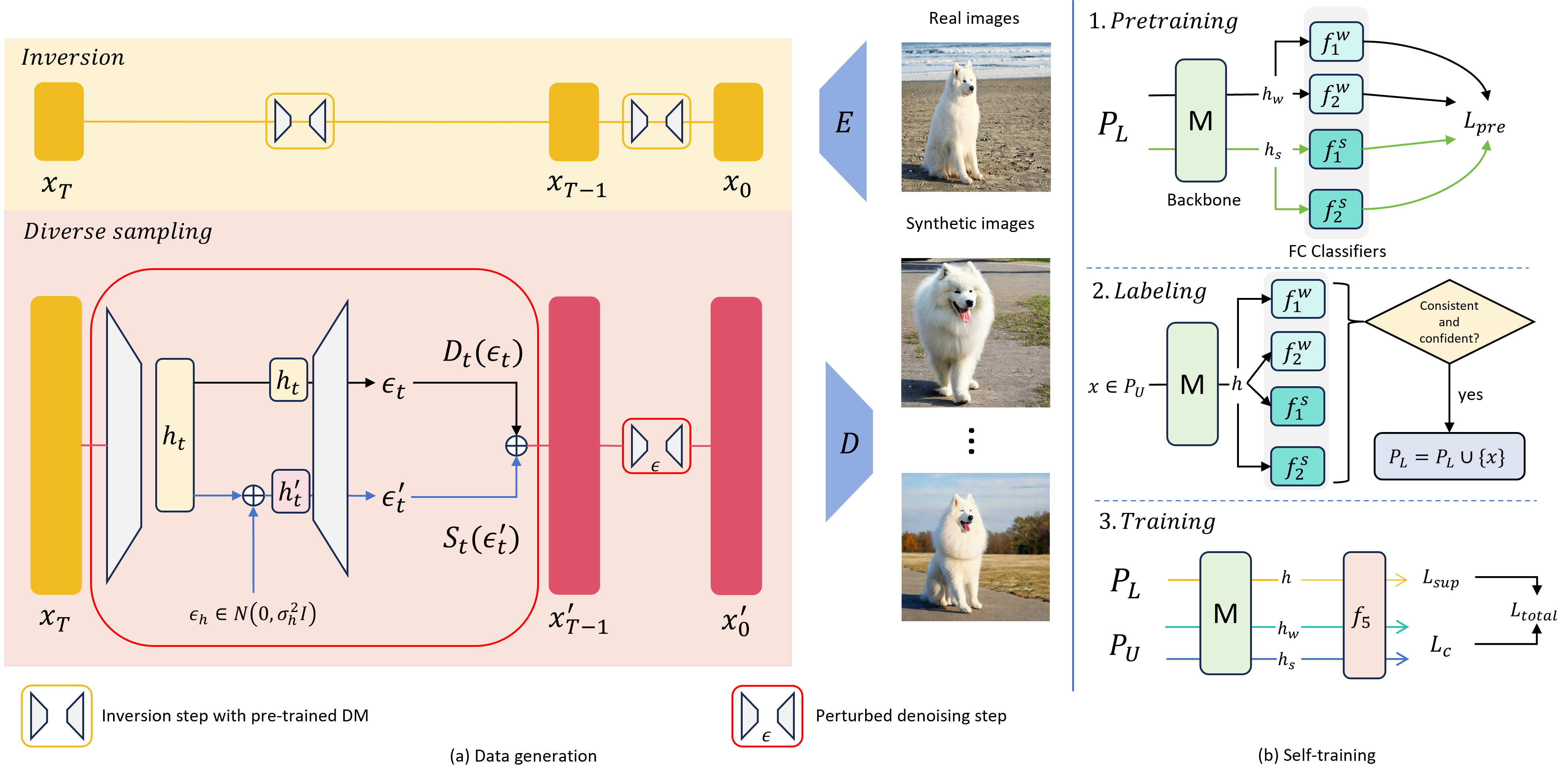
DreamDA generates synthetic images for dataset expansion and present a self-training approach to effectively learn from synthetic images. To generate diverse synthetic images that adhere to the target training data distribution, each image in the target training dataset is treated as a seed, and Diverse variations of the seed images are generated by:
The requirements can be install using conda and our environment.yml file:
conda env create -f environment.yml
Note that accelerate need to be configured with
accelerate config
Datasets can be dowloaded with the following links:
Note that you can extract ImageNet using this script.
We leverage CycleDiffusion as our inversion pipeline. For example, to generate synthetic images for the Oxford-IIIT Pets, run
cd latent_perturbation
bash generate_synthetic_data.sh
In the paper, we train our model using a combined set of synthetic data and the original real data. Before training, curate the combined training dataset by updating paths in cp_real.py accordingly and run:
python cp_real.py
We provide scripts to train with the combined datasets. For example, train_noAMST.sh train a ResNet50 without using AMST. This assumes that the synthetic images have the same label as the seed image.
bash train_noAMST.sh
We will release the scripts for AMST soon.
If you find this project useful for your research, please consider citing:
@article{fu2024dreamda,
  title={DreamDA: Generative Data Augmentation with Diffusion Models},
  author={Fu, Yunxiang and Chen, Chaoqi and Qiao, Yu and Yu, Yizhou},
  journal={arXiv preprint arXiv:2403.12803},
  year={2024}
}
Our implementation is mainly based on pytorch-image-models and CycleDiffusion. We gratefully thank the authors for their wonderful works.
DreamDA: Generative Data Augmentation with Diffusion Models (Official Implementation)
Python
28
6 commits
updated Oct 13, 2024
This is the official repository for DreamDA: Generative Data Augmentation with Diffusion Models. We will release the full code soon.
DreamDA generates synthetic images for dataset expansion and present a self-training approach to effectively learn from synthetic images. To generate diverse synthetic images that adhere to the target training data distribution, each image in the target training dataset is treated as a seed, and Diverse variations of the seed images are generated by:
The requirements can be install using conda and our environment.yml file:
conda env create -f environment.yml
Note that accelerate need to be configured with
accelerate config
Datasets can be dowloaded with the following links:
Note that you can extract ImageNet using this script.
We leverage CycleDiffusion as our inversion pipeline. For example, to generate synthetic images for the Oxford-IIIT Pets, run
cd latent_perturbation
bash generate_synthetic_data.sh
In the paper, we train our model using a combined set of synthetic data and the original real data. Before training, curate the combined training dataset by updating paths in cp_real.py accordingly and run:
python cp_real.py
We provide scripts to train with the combined datasets. For example, train_noAMST.sh train a ResNet50 without using AMST. This assumes that the synthetic images have the same label as the seed image.
bash train_noAMST.sh
We will release the scripts for AMST soon.
If you find this project useful for your research, please consider citing:
@article{fu2024dreamda,
  title={DreamDA: Generative Data Augmentation with Diffusion Models},
  author={Fu, Yunxiang and Chen, Chaoqi and Qiao, Yu and Yu, Yizhou},
  journal={arXiv preprint arXiv:2403.12803},
  year={2024}
}
Our implementation is mainly based on pytorch-image-models and CycleDiffusion. We gratefully thank the authors for their wonderful works.



