
Diffusion for Hybrid Language Model
Paper · Models · Training · Evaluation & Inference




HybridDiffusion is a systematic framework for converting hybrid-attention autoregressive language models into capable diffusion language models. It combines data-efficient transfer, a token-equal clean/noisy training objective, specialized Gated DeltaNet kernels, and a unified serving stack. The same checkpoint supports both AR-Trust verified decoding and Diffusion-Trust parallel denoising.
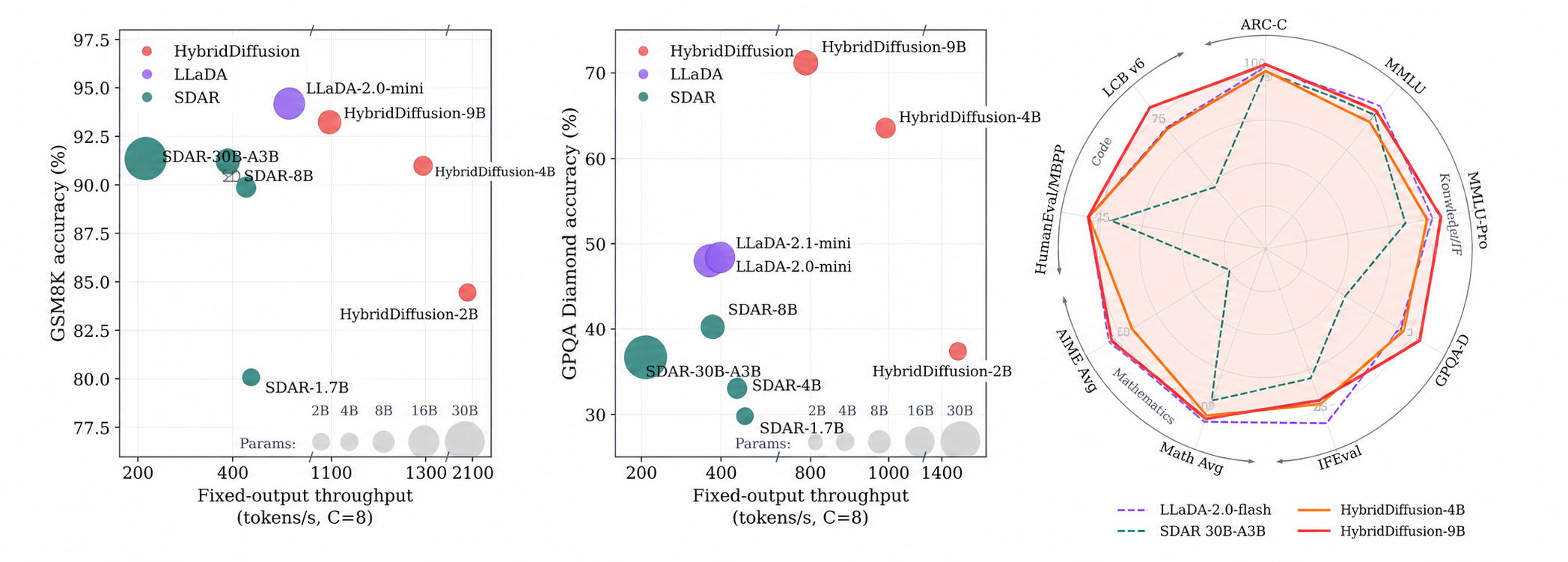
Quality and fixed-output throughput. HybridDiffusion combines strong benchmark performance with high sampling throughput across the 2B, 4B, and 9B scales.
0.4 / 0.4 / 0.2.The released checkpoints use the standard Hugging Face layout and load directly in the bundled evaluation runtime.
| Model | Checkpoint | Base model |
|---|---|---|
| HybridDiffusion-2B | HybridDiffusion-2B | Qwen3.5-2B |
| HybridDiffusion-4B | HybridDiffusion-4B | Qwen3.5-4B |
| HybridDiffusion-9B | HybridDiffusion-9B | Qwen3.5-9B |
Selected AR-Trust results from the paper are shown below. See the paper for the complete comparison and the evaluation guide for both HybridDiffusion decoding modes.
| Model | ARC-C | MMLU-Pro | GPQA-D | IFEval | MATH-500 | AIME-24 | HumanEval | LCB v6 |
|---|---|---|---|---|---|---|---|---|
| HybridDiffusion-2B | 85.07 | 53.57 | 37.37 | 68.95 | 84.40 | 31.11 | 64.02 | 15.43 |
| HybridDiffusion-4B | 93.52 | 71.14 | 63.64 | 73.20 | 94.20 | 58.89 | 93.29 | 41.71 |
| HybridDiffusion-9B | 96.33 | 77.39 | 71.21 | 71.35 | 95.20 | 63.33 | 92.07 | 49.71 |
| Path | Description |
|---|---|
torchtitan/ | TorchTitan-based distributed training runtime |
torchtitan/experiments/qwen3_5/ | HybridDiffusion configurations and Hugging Face/DCP conversion |
torchtitan/models/qwen3_5/ | Qwen3.5 HybridDiffusion model, objective, and kernels |
torchtitan/hf_datasets/ | Packed SFT loading and weighted dataset mixtures |
scripts/ | Environment, data-preparation, and training launchers |
eval/ | AR-Trust, Diffusion-Trust, causal serving, and evaluation |
Training and evaluation use separate uv environments because their pinned runtime stacks differ.
Requirements: Linux, Python 3.11, an NVIDIA CUDA GPU, and
uv. The setup has been validated on H100 GPUs.
bash scripts/setup_envs_models_qwen35.sh \
  --venv /persistent/venvs/hybrid-diffusion-train

source /persistent/venvs/hybrid-diffusion-train/bin/activate
HYBRID_DIFFUSION_CACHE_ROOT=/persistent/hybrid-diffusion-cache \
  bash eval/scripts/setup_eval_env.sh
Serve a released checkpoint in either HybridDiffusion decoding mode:
eval/scripts/serve.sh diffusion yuchen-zhu-zyc/HybridDiffusion-2B

PORT=30001 \
  eval/scripts/serve.sh self-spec yuchen-zhu-zyc/HybridDiffusion-2B
See the evaluation and inference guide for causal serving, decoding configurations, and benchmark commands.
HybridDiffusion training starts from the corresponding Qwen3.5 autoregressive checkpoint. The setup script can download the model while creating the environment:
HF_TOKEN=... bash scripts/setup_envs_models_qwen35.sh \
  --venv /persistent/venvs/hybrid-diffusion-train \
  --model-id Qwen/Qwen3.5-2B \
  --model-dir /persistent/models/Qwen3.5-2B
Convert the Hugging Face checkpoint to TorchTitan DCP:
source /persistent/venvs/hybrid-diffusion-train/bin/activate

python -m torchtitan.experiments.qwen3_5.convert_from_hf \
  --input_dir /persistent/models/Qwen3.5-2B \
  --output_dir /persistent/checkpoints/Qwen3.5-2B-dcp \
  --model_name qwen3_5 \
  --model_flavor 2B
Use the matching model ID and flavor for the 4B and 9B recipes.
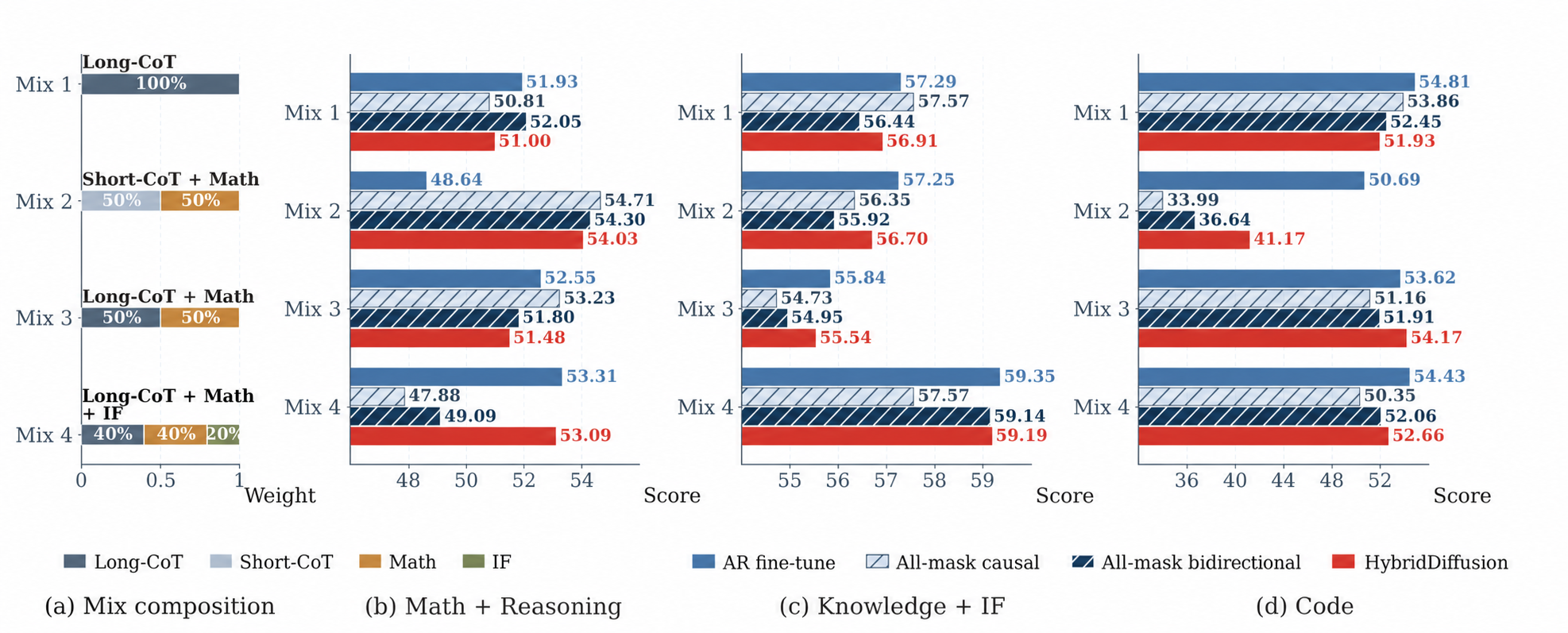
Transfer-data composition. The released recipe combines long-form reasoning, mathematics, and instruction-following data.
The three processed Hugging Face Arrow datasets live below one DATA_ROOT:
| Dataset key | Directory | Weight |
|---|---|---|
nemotron_long_sft_3k | Long-SFT-3K | 0.4 |
nemotron_math_domain | Nemotron-Math-Domain | 0.4 |
nemotron_if_domain_cascade | Nemotron-IF-Domain-Cascade | 0.2 |
The builders normalize conversations and reasoning fields into a shared Arrow schema. Follow the data-preparation guide for source datasets, expected layouts, filtering, and build commands.
export DATA_ROOT=/persistent/data/hybrid_diffusion
| Model | Configuration | Local batch | Global batch | Sequence | Steps | Save interval |
|---|---|---|---|---|---|---|
| 2B | hybrid_diffusion_2b.toml | 8 | 256 | 4,096 | 9,000 | 250 |
| 4B | hybrid_diffusion_4b.toml | 4 | 256 | 4,096 | 9,000 | 100 |
| 9B | hybrid_diffusion_9b.toml | 4 | 256 | 4,096 | 9,000 | 100 |
All three recipes use warmup_steps = 100, block_size = 3,
ar_loss_weight = 1.0, and loss_auto_balance = false. The internal block
size implements logical block size B=4 under the shifted objective.
Run the launcher from an allocated GPU node:
export VENV_PATH=/persistent/venvs/hybrid-diffusion-train
export MODEL_PATH=/persistent/models/Qwen3.5-2B
export DATA_ROOT=/persistent/data/hybrid_diffusion
export INIT_DCP=/persistent/checkpoints/Qwen3.5-2B-dcp
export OUTPUT_DIR=/persistent/outputs/test

GPUS_PER_NODE=8 bash scripts/run_training.sh \
  torchtitan/experiments/qwen3_5/train_configs/hybrid_diffusion_2b.toml \
  --checkpoint.initial-load-path="${INIT_DCP}"
For a multi-node Slurm allocation, the same launcher derives the rendezvous address and node ranks from Slurm:
NNODES="${SLURM_NNODES}" GPUS_PER_NODE=8 \
  bash scripts/run_training.sh \
    torchtitan/experiments/qwen3_5/train_configs/hybrid_diffusion_2b.toml \
    --checkpoint.initial-load-path="${INIT_DCP}"
W&B and TensorBoard are disabled by default. Enable either integration through the launcher environment:
ENABLE_WANDB=1 ENABLE_TENSORBOARD=1 \
WANDB_ENTITY=your-entity WANDB_PROJECT=your-project \
  bash scripts/run_training.sh path/to/config.toml
W&B reads WANDB_API_KEY from the environment and uses its public endpoint.
Reuse the same OUTPUT_DIR and RUN_NAME to resume from the newest compatible
checkpoint.
The bundled SGLang/FlashInfer runtime exposes three interfaces:
| Mode | Behavior |
|---|---|
| AR-Trust | Draft with the noisy stream and verify with clean-stream logits |
| Diffusion-Trust | Commit tokens through confidence-based parallel denoising |
| Causal | Standard left-to-right decoding from the clean stream |
The evaluation guide covers environment installation, model serving, the complete twelve-task evaluation suite, sampling controls, paper results, and the core implementation map.
If you find HybridDiffusion useful, please cite:
@article{zhu2026flare,
  title   = {FLARE: Diffusion for Hybrid Language Model},
  author  = {Yuchen Zhu and Jing Shi and Chongjian Ge and Hao Tan and
             Yiran Xu and Wanrong Zhu and Jason Kuen and Koustava Goswami and
             Rajiv Jain and Yongxin Chen and Molei Tao and Jiuxiang Gu},
  journal = {arXiv preprint arXiv:2606.01774},
  year    = {2026}
}
HybridDiffusion builds on TorchTitan, Qwen3.5, Flash Linear Attention, SGLang, and FlashInfer. We thank their authors and the open-source community.
HybridDiffusion-authored code, modifications, and model checkpoints are licensed under the PolyForm Noncommercial License 1.0.0. The evaluation and inference tree includes the same terms in eval/LICENSE. Third-party and upstream portions retain the terms listed in NOTICE and eval/NOTICE.
317 followers · starred Aug 2026
208 followers · starred Aug 2026
Diffusion for Hybrid Language Model
Paper · Models · Training · Evaluation & Inference
HybridDiffusion is a systematic framework for converting hybrid-attention autoregressive language models into capable diffusion language models. It combines data-efficient transfer, a token-equal clean/noisy training objective, specialized Gated DeltaNet kernels, and a unified serving stack. The same checkpoint supports both AR-Trust verified decoding and Diffusion-Trust parallel denoising.
Quality and fixed-output throughput. HybridDiffusion combines strong benchmark performance with high sampling throughput across the 2B, 4B, and 9B scales.
0.4 / 0.4 / 0.2.The released checkpoints use the standard Hugging Face layout and load directly in the bundled evaluation runtime.
| Model | Checkpoint | Base model |
|---|---|---|
| HybridDiffusion-2B | HybridDiffusion-2B | Qwen3.5-2B |
| HybridDiffusion-4B | HybridDiffusion-4B | Qwen3.5-4B |
| HybridDiffusion-9B | HybridDiffusion-9B | Qwen3.5-9B |
Selected AR-Trust results from the paper are shown below. See the paper for the complete comparison and the evaluation guide for both HybridDiffusion decoding modes.
| Model | ARC-C | MMLU-Pro | GPQA-D | IFEval | MATH-500 | AIME-24 | HumanEval | LCB v6 |
|---|---|---|---|---|---|---|---|---|
| HybridDiffusion-2B | 85.07 | 53.57 | 37.37 | 68.95 | 84.40 | 31.11 | 64.02 | 15.43 |
| HybridDiffusion-4B | 93.52 | 71.14 | 63.64 | 73.20 | 94.20 | 58.89 | 93.29 | 41.71 |
| HybridDiffusion-9B | 96.33 | 77.39 | 71.21 | 71.35 | 95.20 | 63.33 | 92.07 | 49.71 |
| Path | Description |
|---|---|
torchtitan/ | TorchTitan-based distributed training runtime |
torchtitan/experiments/qwen3_5/ | HybridDiffusion configurations and Hugging Face/DCP conversion |
torchtitan/models/qwen3_5/ | Qwen3.5 HybridDiffusion model, objective, and kernels |
torchtitan/hf_datasets/ | Packed SFT loading and weighted dataset mixtures |
scripts/ | Environment, data-preparation, and training launchers |
eval/ | AR-Trust, Diffusion-Trust, causal serving, and evaluation |
Training and evaluation use separate uv environments because their pinned runtime stacks differ.
Requirements: Linux, Python 3.11, an NVIDIA CUDA GPU, and
uv. The setup has been validated on H100 GPUs.
bash scripts/setup_envs_models_qwen35.sh \
  --venv /persistent/venvs/hybrid-diffusion-train

source /persistent/venvs/hybrid-diffusion-train/bin/activate
HYBRID_DIFFUSION_CACHE_ROOT=/persistent/hybrid-diffusion-cache \
  bash eval/scripts/setup_eval_env.sh
Serve a released checkpoint in either HybridDiffusion decoding mode:
eval/scripts/serve.sh diffusion yuchen-zhu-zyc/HybridDiffusion-2B

PORT=30001 \
  eval/scripts/serve.sh self-spec yuchen-zhu-zyc/HybridDiffusion-2B
See the evaluation and inference guide for causal serving, decoding configurations, and benchmark commands.
HybridDiffusion training starts from the corresponding Qwen3.5 autoregressive checkpoint. The setup script can download the model while creating the environment:
HF_TOKEN=... bash scripts/setup_envs_models_qwen35.sh \
  --venv /persistent/venvs/hybrid-diffusion-train \
  --model-id Qwen/Qwen3.5-2B \
  --model-dir /persistent/models/Qwen3.5-2B
Convert the Hugging Face checkpoint to TorchTitan DCP:
source /persistent/venvs/hybrid-diffusion-train/bin/activate

python -m torchtitan.experiments.qwen3_5.convert_from_hf \
  --input_dir /persistent/models/Qwen3.5-2B \
  --output_dir /persistent/checkpoints/Qwen3.5-2B-dcp \
  --model_name qwen3_5 \
  --model_flavor 2B
Use the matching model ID and flavor for the 4B and 9B recipes.
Transfer-data composition. The released recipe combines long-form reasoning, mathematics, and instruction-following data.
The three processed Hugging Face Arrow datasets live below one DATA_ROOT:
| Dataset key | Directory | Weight |
|---|---|---|
nemotron_long_sft_3k | Long-SFT-3K | 0.4 |
nemotron_math_domain | Nemotron-Math-Domain | 0.4 |
nemotron_if_domain_cascade | Nemotron-IF-Domain-Cascade | 0.2 |
The builders normalize conversations and reasoning fields into a shared Arrow schema. Follow the data-preparation guide for source datasets, expected layouts, filtering, and build commands.
export DATA_ROOT=/persistent/data/hybrid_diffusion
| Model | Configuration | Local batch | Global batch | Sequence | Steps | Save interval |
|---|---|---|---|---|---|---|
| 2B | hybrid_diffusion_2b.toml | 8 | 256 | 4,096 | 9,000 | 250 |
| 4B | hybrid_diffusion_4b.toml | 4 | 256 | 4,096 | 9,000 | 100 |
| 9B | hybrid_diffusion_9b.toml | 4 | 256 | 4,096 | 9,000 | 100 |
All three recipes use warmup_steps = 100, block_size = 3,
ar_loss_weight = 1.0, and loss_auto_balance = false. The internal block
size implements logical block size B=4 under the shifted objective.
Run the launcher from an allocated GPU node:
export VENV_PATH=/persistent/venvs/hybrid-diffusion-train
export MODEL_PATH=/persistent/models/Qwen3.5-2B
export DATA_ROOT=/persistent/data/hybrid_diffusion
export INIT_DCP=/persistent/checkpoints/Qwen3.5-2B-dcp
export OUTPUT_DIR=/persistent/outputs/test

GPUS_PER_NODE=8 bash scripts/run_training.sh \
  torchtitan/experiments/qwen3_5/train_configs/hybrid_diffusion_2b.toml \
  --checkpoint.initial-load-path="${INIT_DCP}"
For a multi-node Slurm allocation, the same launcher derives the rendezvous address and node ranks from Slurm:
NNODES="${SLURM_NNODES}" GPUS_PER_NODE=8 \
  bash scripts/run_training.sh \
    torchtitan/experiments/qwen3_5/train_configs/hybrid_diffusion_2b.toml \
    --checkpoint.initial-load-path="${INIT_DCP}"
W&B and TensorBoard are disabled by default. Enable either integration through the launcher environment:
ENABLE_WANDB=1 ENABLE_TENSORBOARD=1 \
WANDB_ENTITY=your-entity WANDB_PROJECT=your-project \
  bash scripts/run_training.sh path/to/config.toml
W&B reads WANDB_API_KEY from the environment and uses its public endpoint.
Reuse the same OUTPUT_DIR and RUN_NAME to resume from the newest compatible
checkpoint.
The bundled SGLang/FlashInfer runtime exposes three interfaces:
| Mode | Behavior |
|---|---|
| AR-Trust | Draft with the noisy stream and verify with clean-stream logits |
| Diffusion-Trust | Commit tokens through confidence-based parallel denoising |
| Causal | Standard left-to-right decoding from the clean stream |
The evaluation guide covers environment installation, model serving, the complete twelve-task evaluation suite, sampling controls, paper results, and the core implementation map.
If you find HybridDiffusion useful, please cite:
@article{zhu2026flare,
  title   = {FLARE: Diffusion for Hybrid Language Model},
  author  = {Yuchen Zhu and Jing Shi and Chongjian Ge and Hao Tan and
             Yiran Xu and Wanrong Zhu and Jason Kuen and Koustava Goswami and
             Rajiv Jain and Yongxin Chen and Molei Tao and Jiuxiang Gu},
  journal = {arXiv preprint arXiv:2606.01774},
  year    = {2026}
}
HybridDiffusion builds on TorchTitan, Qwen3.5, Flash Linear Attention, SGLang, and FlashInfer. We thank their authors and the open-source community.
HybridDiffusion-authored code, modifications, and model checkpoints are licensed under the PolyForm Noncommercial License 1.0.0. The evaluation and inference tree includes the same terms in eval/LICENSE. Third-party and upstream portions retain the terms listed in NOTICE and eval/NOTICE.
317 followers · starred Aug 2026
208 followers · starred Aug 2026



