
[ECCV 2026] One Video, One World: Turning Monocular Video into Physical 4D Scenes
Python
174
17 commits
updated Sep 10, 2026
README




-yellow)
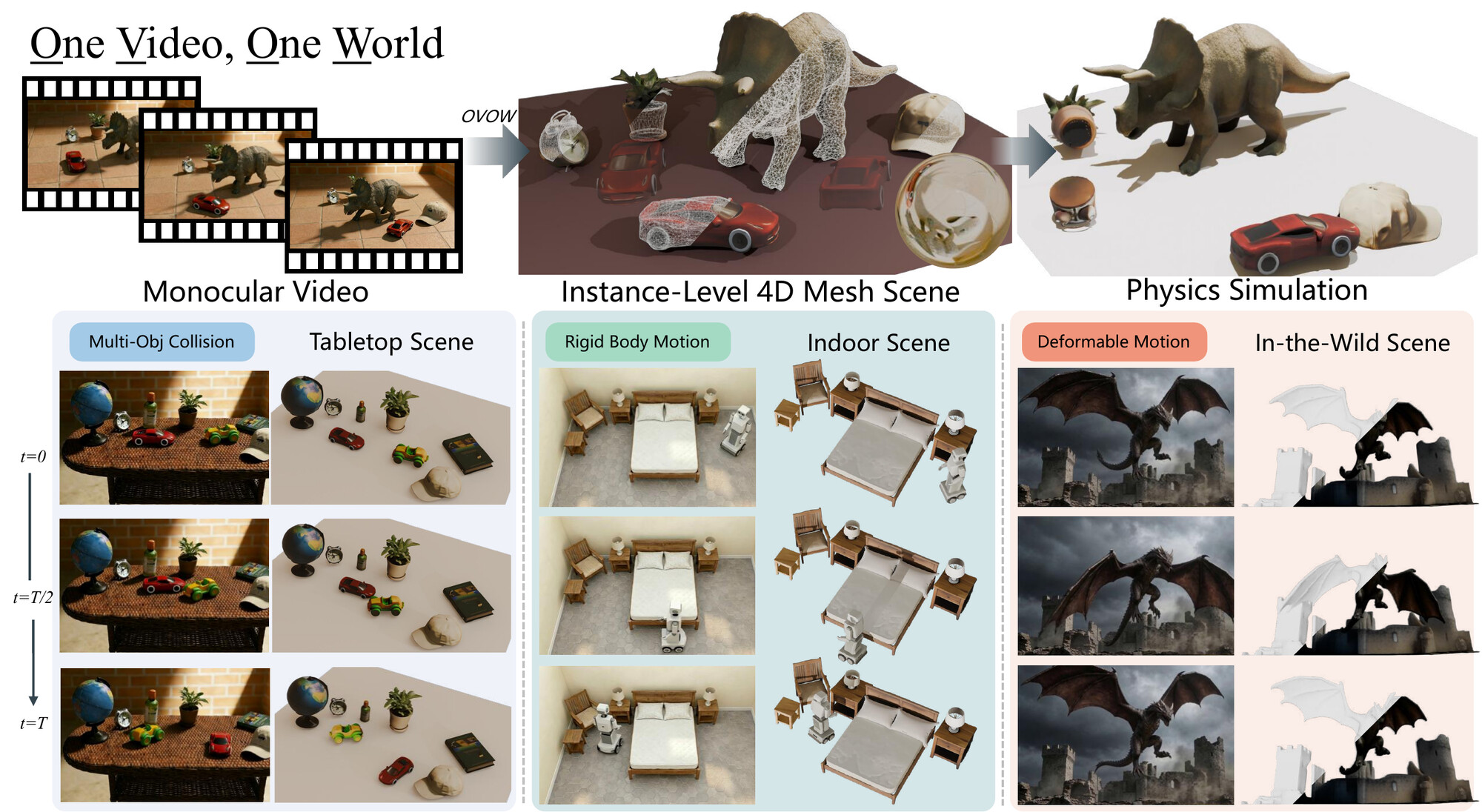
OVOW is the first training-free system that reconstructs instance-level, simulation-ready 4D mesh scenes from a single monocular video (or a single image): per-object 3D meshes + poses + deformation animation, assembled into a full-scene animated GLB with rendered comparison videos. Heavy models (SAM3 / Hi3DGen / FoundationPose / RoMaV2) support resident serving: loaded once for an entire batch.
⚠️ Non-commercial research use only. OVOW's own code is MIT-licensed, but this release bundles third-party components under non-commercial licenses (NVIDIA FoundationPose, CC-BY-NC SpaTrackerV2, CC-BY-NC-SA Motion324, Meta SAM License sam3, etc.). By using it you agree to each component's license — see NOTICE and THIRD_PARTY.md. Consequently, the assembled repository is a source-available research release, not an OSI-approved open-source distribution.
Reproduce (from zero to results)
Prerequisites: Linux + NVIDIA GPU (≥40GB VRAM recommended, driver ≥550) · CUDA Toolkit 12.1+
(with nvcc) · conda · ~120GB disk.
# 0) Clone
git clone https://github.com/SparcAI-Inc/OVOW.git && cd OVOW

# 1) Create the 3 conda envs (installs torch + deps + compiles CUDA extensions;
#    the slowest step, ~30-60 min)
bash environment/create_envs.sh        # prints the 3 interpreter paths to paste into .env

# 2) Machine config
cp .env.example .env                   # ① paste the 3 python paths printed above
                                       # ② set DASHSCOPE_API_KEY, or set QWEN_BACKEND="local" (offline)

# 3) Install blender (hard dependency of the assembly/rendering steps)
sudo apt install -y blender            # or the official portable build → set BLENDER_BIN in .env

# 4) Localize paths (expands the repo's placeholders with your .env; one-shot —
#    to change .env later, `git checkout` the tree first, then rerun)
bash setup.sh

# 5) Download weights (~55GB, fully automatic; SAM3 is a gated HF repo —
#    `huggingface-cli login` and accept its terms on the web page first)
bash download_ckpts.sh

# 6) Reproduce the bundled examples (see below)
bash examples/smoke_test.sh          # single image, short chain, ~3-5 min
bash examples/smoke_test_video.sh    # single video, full 4D chain, ~19-22 min
If a step fails, see Troubleshooting below. For the per-environment
torch/CUDA version table and the manual, step-by-step install commands that
create_envs.sh automates, see environment/README.md.
What "reproduced" means here
The reproduction target is the bundled examples/ — running both of them through to
their artifacts is the bar for a working installation. Both scripts start with a
preflight that names exactly what is missing (Qwen backend / blender / conda
interpreters / SAM3 and Motion324 weights) instead of failing halfway through, and both
end by asserting that the key artifacts exist and are non-empty — a zero exit code alone
does not count as reproduced.
| Script | Input | Steps | Artifacts under outputs/ |
|---|---|---|---|
examples/smoke_test.sh | examples/images/desk_banana.png | 1 2 6 7 14 17 18 (no deform) | smoke/image_pipeline_<ts>/desk_banana/ |
examples/smoke_test_video.sh | examples/videos/instance_000008.mp4 (768×768, 108 frames) | full chain incl. deform | smoke_video/ws/instance_000008_<ts>_<key>/ |
Both assert these three artifacts (.png for the image chain, .mp4 for the video chain):
scene_anim_blender_physics_with_deform.glb                          # final full-scene GLB
fullscene_deform_objseq_white_left_rgb_right_split10_h264.{png,mp4} # white-model vs input
fullscene_deform_objseq_textured_left_rgb_right_split10_h264.{png,mp4} # textured vs input
smoke_test_video.sh also takes a video path, so you can point it at your own clip:
bash examples/smoke_test_video.sh /path/to/your.mp4.
Note that the generative steps do not run with a fixed seed, so meshes and renders differ between runs. The bar is that the chain completes and produces the artifacts above, not bit-identical output.
Usage
# A single image
bash scripts/run_image.sh --image /path/x.png --out ./outputs

# A single video
bash scripts/run_video.sh --name eagle --video /path/eagle.mp4 --out ./outputs

# All videos in a folder (resident serving: models loaded once for the whole batch) — recommended at scale
bash scripts/run_video_batch.sh --video-dir /path/videos --gpu 0 --out ./outputs

# Mixed images+videos, multi-GPU, resumable (100k-scale)
bash scripts/run_batch.sh --in /path/inputs --gpus 0,1,2,3 --out ./outputs
Outputs: videos under <out>/ws/<name>_<timestamp>_<key>/, single images under
<out>/image_pipeline_<timestamp>/<name>/:
scene_anim_blender_physics_with_deform.glb— final full-scene animated GLBfullscene_deform_*_h264.mp4— white-model / textured rendered comparison videos
Benchmark
benchmark/ holds OVOW-Bench, the evaluation toolkit used in the paper. It
scores already-reconstructed scenes and reports Scene-IoU (AABB and OBB),
Object-IoU after Hungarian matching with an object-count penalty, a photometric
loss, and an N-CLIP visual metric. Geometry is compared after the alignment the
protocol specifies; visual metrics use GT-camera renders.
The toolkit ships evaluator code and protocol metadata only — no ground truth,
results, or predictions. The data (OVOW_Bench_Data) is published separately on
Hugging Face. It needs its own conda environment plus Blender and a local CLIP
checkpoint, so it is deliberately kept apart from the three pipeline envs:
conda env create -f benchmark/environment.yml && conda activate ovow-bench
python benchmark/scripts/check_env.py

# unit tests need neither Blender nor CLIP weights
cd benchmark && PYTHONDONTWRITEBYTECODE=1 python -m unittest discover -s tests
Protocol, submission layout, and the full evaluator invocation are documented in benchmark/README.md and benchmark/docs/EVALUATION_PROTOCOL.md.
How it works
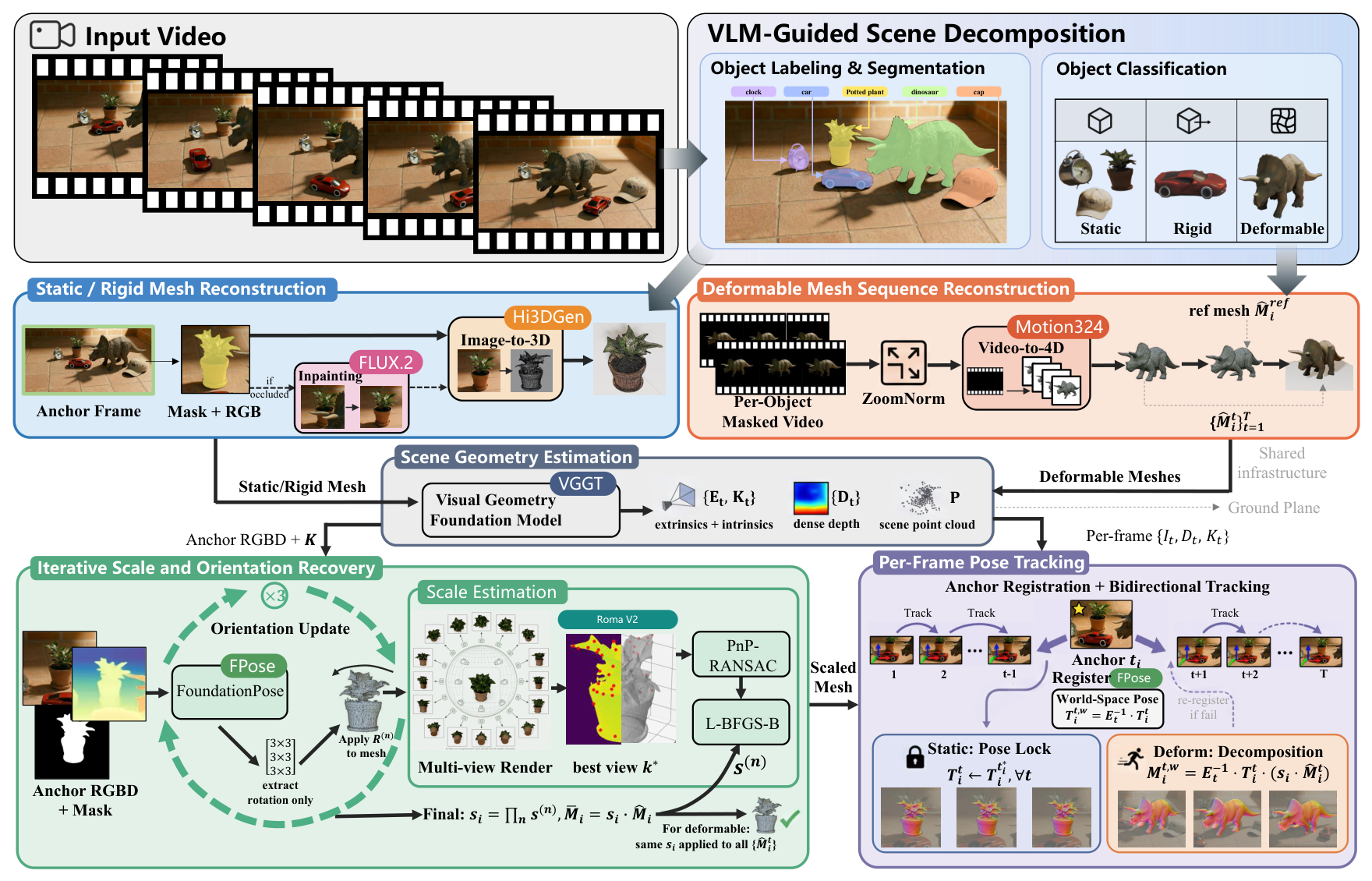
| Stage | What it does | Where it runs |
|---|---|---|
| Labeling | Qwen object labeling + static/rigid/deform classification | DashScope API or local Qwen3-VL |
| Segmentation | SAM3 per-frame masks | sam3 env (resident sam3-server in batch mode) |
| Deformable meshes | Motion324 + Hunyuan | motion env |
| Static/rigid reconstruction | Hi3DGen meshes + FoundationPose poses + RoMaV2 scale recovery | opg env (resident opg-server in batch mode) |
| Deformable poses | frame_track per-frame poses | opg env (same as above) |
| Assembly / rendering | Full-scene GLB export + rendered comparisons | blender |
Pipeline steps
The entry scripts accept an explicit list of step numbers as trailing arguments
(bash scripts/run_video.sh --name eagle --video x.mp4 1 2 3 4 5 6 7 8 10 13 14 17 18).
With no steps given, run_video.sh runs the full chain and run_image.sh runs the
image-only subset. Steps 15/16/19 are optional and off by default. Steps 15 and 19
additionally need components this repository does not ship and you fetch yourself,
one of them under academic-use-only terms — see the optional-components table in
THIRD_PARTY.md before enabling them.
| step | What it does | env / service |
|---|---|---|
| 1 | Qwen object labeling + static/rigid/deform classification | API or local Qwen3-VL |
| 2 | SAM3 per-frame masks | sam3 env (sam3-server in batch mode) |
| 3 | Build deform inputs (object-centered video) | opg (light) |
| 4 | Deformable mesh generation | Motion324 (motion env) |
| 5 | Scan Motion324 outputs → manifest | light |
| 6 | Static/rigid reconstruction (mesh + pose) | opg-server (resident) |
| 7 | Ground-plane fitting | opg (geometry) |
| 8 | Deformable poses (frame_track) | opg-server (resident) |
| 10 | Merge full-scene mesh sequence | blender |
| 13 / 14 | Export full-scene GLB (pre-physics / physics) | blender |
| 17 / 18 | Render white-model / textured comparison videos | blender |
Default reconstruction backbone is uplegacy = legacy/Hi3DGen generation plus the
upgraded pose chain (romav2 matching + zero-iteration scale recovery + all models
resident in-process). It needs RoMaV2 and the Hi3DGen / SpaTrackerV2 / FoundationPose
weights (all covered by step 5 above) and does not need TRELLIS2/CuMesh — those are
only for --recon-backbone trellis2.
Runtime is ~19–22 min per video end-to-end, almost entirely compute (step 6 ~6 min + deform ~9–11 min + rendering); model loading is a one-off ~1–3 min service startup.
Resident serving (batch mode)
run_video_batch.sh and run_batch.sh start and stop opg-server + sam3-server
automatically, each with its own queue — nothing to configure. Heavy models
(SAM3, opg core, RoMaV2, FoundationPose) are then loaded once for the whole batch
instead of once per video; Motion324 + Hunyuan (step 4) still load per video.
Resident serving pays off across many videos — for a single video it is a wash,
so single runs (run_image.sh / run_video.sh) stay in-process by default.
To manage the services manually across several batches:
bash scripts/servers/opg_server.sh  ensure --gpu 0   # ensure = start only if not already running
bash scripts/servers/opg_server.sh  status
bash scripts/servers/opg_server.sh  stop
bash scripts/servers/sam3_server.sh ensure --gpu 0
To make a single run reuse manually started services, export the queues explicitly. The engine treats "queue variable non-empty" as "use the server" and does not health-check it, so exporting a queue with no server running will hang until timeout:
export OPG_SERVER_QUEUE=/tmp/opg_server_main_q SAM3_SERVER_QUEUE=/tmp/sam3_server_q
bash scripts/run_video.sh --name eagle --video /path/eagle.mp4
Key environment variables
All have sensible defaults in configs/paths.sh; override in .env.
| Variable | Effect |
|---|---|
OPG_SERVER_QUEUE / SAM3_SERVER_QUEUE | route step 6/8 and step 2 through the resident services |
OPG_MATCHER=romav2 | use RoMaV2 dense matching for scale recovery |
OPG_SCALE_REFINE_ITERS=0 | zero-iteration scale recovery (~5x faster; converges on the first pass under romav2) |
OPG_ROMAV2_INPROC=1 | keep RoMaV2 resident in-process |
OPG_FP_RESIDENT=1 | keep the FoundationPose predictor as an in-process singleton |
QWEN_BACKEND=local | run step 1 labeling on a local Qwen3-VL instead of the DashScope API |
HF_ENDPOINT=https://hf-mirror.com | mirror for weight downloads |
Troubleshooting
Environment build (step 1) — the most likely thing to need per-platform tuning.
The opg env compiles extensions on the machine (flash-attn / pytorch3d /
FoundationPose). create_envs.sh handles each env independently and can be re-run
per env (bash environment/create_envs.sh opg); the version table and the equivalent
manual commands are in environment/README.md.
nvcc not found→ install CUDA Toolkit 12.1+ and put it onPATH.- arch/ABI mismatch → confirm torch is the cu121 wheel and
nvcc -Vis ≥ 12.1. - flash-attn compiles too slowly or fails → use an official prebuilt wheel matching cu121 + torch 2.4.
No DashScope account (step 2). Set QWEN_BACKEND="local" in .env to run step 1
on a local Qwen3-VL. The image path pulls Qwen/Qwen3-VL-8B-Instruct from HF
automatically; you can also predownload with
masking/download_qwen3_vl_8b_hf_mirror.sh and point at it with --qwen-model /path.
Placeholder expansion is one-shot (step 4). setup.sh runs configure.sh, which
expands @ENGINE_DIR@, @OPG_PY@, @BLENDER_BIN@ and friends into the paths from
your .env. Once expanded the tokens are consumed, so re-running it after editing
.env will not update them. To reconfigure, restore the tree first:
git checkout -- engine/ third_party/ masking/ && bash configure.sh
Weights (step 5).
facebook/sam3is a gated HF repo:huggingface-cli loginand accept its terms on the model page first.- RoMaV2 weights need no download — torch.hub fetches them on first run.
- TRELLIS weights are only needed for
--recon-backbone trellis2:OVOW_DL_TRELLIS2=1 bash download_ckpts.sh(+~20GB). - The script creates two symlinks the engine expects:
engine/checkpoints/OnePoseViaGen → ckpts/OnePoseViaGenandthird_party/sam3/checkpoints/sam3/sam3.pt → ckpts/sam3/sam3.pt.
Runtime errors.
server not ready→ the service is still loading (opg takes ~1–3 min); check the service log in the queue directory.motion manifest missing(step 8) → step 5 did not run; make sure your step list includes5.API key empty→ check thatAPIKEY_FILEexists and containssk-..., or switch to offline labeling withQWEN_BACKEND=local.- Services will not stop →
bash scripts/servers/opg_server.sh stop, orpkill -f opg_server.py.
Citation
If you find OVOW useful for your research, please cite:
@inproceedings{chen2026ovow,
  title     = {One Video, One World: Turning Monocular Video into Physical 4D Scenes},
  author    = {Chen, Junhao and Zhang, Boran and Chen, Mingjin and Zhang, Henghaofan and
               Zhang, Saining and Zhu, Congcong and Zhao, Hao and Huang, Ruqi and
               Li, Zhihao and Wang, Yufei},
  booktitle = {European Conference on Computer Vision (ECCV)},
  year      = {2026}
}
Acknowledgements
OVOW is an orchestration framework built on top of many excellent publicly released research works. We sincerely thank the authors of:
Core engine
- OnePoseviaGen (One View, Many Worlds) — the reconstruction engine of this project; OVOW's name is also a tribute to it.
Works integrated by the engine / depended on by this project
- FoundationPose — 6-DoF object pose estimation & tracking (NVIDIA)
- SpaTrackerV2 / SpatialTrackerV2 — 3D point tracking
- Hunyuan3D-2 — Hi3DGen 3D generation (Tencent Hunyuan)
- TRELLIS — 3D generative representation (Microsoft)
- Depth-Anything-3 (DA3) — monocular depth
- SAM 2 / SAM 3 — segmentation (Meta)
- Motion324 — deformable mesh animation
- RoMaV2 — dense feature matching (scale recovery / PnP correction)
- Amodal3R — occlusion-aware 3D reconstruction
- BundleSDF — pose refinement (NVIDIA)
- UniDepth — metric depth estimation (ETH)
- Qwen3-VL — multimodal labeling (Alibaba)
Per-component licenses and provenance: THIRD_PARTY.md.
License
OVOW-authored code is released under the MIT license (see LICENSE). However, third-party components bundled in this release carry non-commercial licenses, so the assembled repository uses mixed licenses and is for non-commercial research / evaluation use only — see NOTICE and THIRD_PARTY.md.
Similar repos


Languages
Python
68.8%
Jupyter Notebook
24.6%
Shell
2.6%
Cuda
1.5%
HTML
1.2%
C++
1.2%
[ECCV 2026] One Video, One World: Turning Monocular Video into Physical 4D Scenes
Python
174
17 commits
updated Sep 10, 2026
README
OVOW is the first training-free system that reconstructs instance-level, simulation-ready 4D mesh scenes from a single monocular video (or a single image): per-object 3D meshes + poses + deformation animation, assembled into a full-scene animated GLB with rendered comparison videos. Heavy models (SAM3 / Hi3DGen / FoundationPose / RoMaV2) support resident serving: loaded once for an entire batch.
⚠️ Non-commercial research use only. OVOW's own code is MIT-licensed, but this release bundles third-party components under non-commercial licenses (NVIDIA FoundationPose, CC-BY-NC SpaTrackerV2, CC-BY-NC-SA Motion324, Meta SAM License sam3, etc.). By using it you agree to each component's license — see NOTICE and THIRD_PARTY.md. Consequently, the assembled repository is a source-available research release, not an OSI-approved open-source distribution.
Reproduce (from zero to results)
Prerequisites: Linux + NVIDIA GPU (≥40GB VRAM recommended, driver ≥550) · CUDA Toolkit 12.1+
(with nvcc) · conda · ~120GB disk.
# 0) Clone
git clone https://github.com/SparcAI-Inc/OVOW.git && cd OVOW

# 1) Create the 3 conda envs (installs torch + deps + compiles CUDA extensions;
#    the slowest step, ~30-60 min)
bash environment/create_envs.sh        # prints the 3 interpreter paths to paste into .env

# 2) Machine config
cp .env.example .env                   # ① paste the 3 python paths printed above
                                       # ② set DASHSCOPE_API_KEY, or set QWEN_BACKEND="local" (offline)

# 3) Install blender (hard dependency of the assembly/rendering steps)
sudo apt install -y blender            # or the official portable build → set BLENDER_BIN in .env

# 4) Localize paths (expands the repo's placeholders with your .env; one-shot —
#    to change .env later, `git checkout` the tree first, then rerun)
bash setup.sh

# 5) Download weights (~55GB, fully automatic; SAM3 is a gated HF repo —
#    `huggingface-cli login` and accept its terms on the web page first)
bash download_ckpts.sh

# 6) Reproduce the bundled examples (see below)
bash examples/smoke_test.sh          # single image, short chain, ~3-5 min
bash examples/smoke_test_video.sh    # single video, full 4D chain, ~19-22 min
If a step fails, see Troubleshooting below. For the per-environment
torch/CUDA version table and the manual, step-by-step install commands that
create_envs.sh automates, see environment/README.md.
What "reproduced" means here
The reproduction target is the bundled examples/ — running both of them through to
their artifacts is the bar for a working installation. Both scripts start with a
preflight that names exactly what is missing (Qwen backend / blender / conda
interpreters / SAM3 and Motion324 weights) instead of failing halfway through, and both
end by asserting that the key artifacts exist and are non-empty — a zero exit code alone
does not count as reproduced.
| Script | Input | Steps | Artifacts under outputs/ |
|---|---|---|---|
examples/smoke_test.sh | examples/images/desk_banana.png | 1 2 6 7 14 17 18 (no deform) | smoke/image_pipeline_<ts>/desk_banana/ |
examples/smoke_test_video.sh | examples/videos/instance_000008.mp4 (768×768, 108 frames) | full chain incl. deform | smoke_video/ws/instance_000008_<ts>_<key>/ |
Both assert these three artifacts (.png for the image chain, .mp4 for the video chain):
scene_anim_blender_physics_with_deform.glb                          # final full-scene GLB
fullscene_deform_objseq_white_left_rgb_right_split10_h264.{png,mp4} # white-model vs input
fullscene_deform_objseq_textured_left_rgb_right_split10_h264.{png,mp4} # textured vs input
smoke_test_video.sh also takes a video path, so you can point it at your own clip:
bash examples/smoke_test_video.sh /path/to/your.mp4.
Note that the generative steps do not run with a fixed seed, so meshes and renders differ between runs. The bar is that the chain completes and produces the artifacts above, not bit-identical output.
Usage
# A single image
bash scripts/run_image.sh --image /path/x.png --out ./outputs

# A single video
bash scripts/run_video.sh --name eagle --video /path/eagle.mp4 --out ./outputs

# All videos in a folder (resident serving: models loaded once for the whole batch) — recommended at scale
bash scripts/run_video_batch.sh --video-dir /path/videos --gpu 0 --out ./outputs

# Mixed images+videos, multi-GPU, resumable (100k-scale)
bash scripts/run_batch.sh --in /path/inputs --gpus 0,1,2,3 --out ./outputs
Outputs: videos under <out>/ws/<name>_<timestamp>_<key>/, single images under
<out>/image_pipeline_<timestamp>/<name>/:
scene_anim_blender_physics_with_deform.glb— final full-scene animated GLBfullscene_deform_*_h264.mp4— white-model / textured rendered comparison videos
Benchmark
benchmark/ holds OVOW-Bench, the evaluation toolkit used in the paper. It
scores already-reconstructed scenes and reports Scene-IoU (AABB and OBB),
Object-IoU after Hungarian matching with an object-count penalty, a photometric
loss, and an N-CLIP visual metric. Geometry is compared after the alignment the
protocol specifies; visual metrics use GT-camera renders.
The toolkit ships evaluator code and protocol metadata only — no ground truth,
results, or predictions. The data (OVOW_Bench_Data) is published separately on
Hugging Face. It needs its own conda environment plus Blender and a local CLIP
checkpoint, so it is deliberately kept apart from the three pipeline envs:
conda env create -f benchmark/environment.yml && conda activate ovow-bench
python benchmark/scripts/check_env.py

# unit tests need neither Blender nor CLIP weights
cd benchmark && PYTHONDONTWRITEBYTECODE=1 python -m unittest discover -s tests
Protocol, submission layout, and the full evaluator invocation are documented in benchmark/README.md and benchmark/docs/EVALUATION_PROTOCOL.md.
How it works
| Stage | What it does | Where it runs |
|---|---|---|
| Labeling | Qwen object labeling + static/rigid/deform classification | DashScope API or local Qwen3-VL |
| Segmentation | SAM3 per-frame masks | sam3 env (resident sam3-server in batch mode) |
| Deformable meshes | Motion324 + Hunyuan | motion env |
| Static/rigid reconstruction | Hi3DGen meshes + FoundationPose poses + RoMaV2 scale recovery | opg env (resident opg-server in batch mode) |
| Deformable poses | frame_track per-frame poses | opg env (same as above) |
| Assembly / rendering | Full-scene GLB export + rendered comparisons | blender |
Pipeline steps
The entry scripts accept an explicit list of step numbers as trailing arguments
(bash scripts/run_video.sh --name eagle --video x.mp4 1 2 3 4 5 6 7 8 10 13 14 17 18).
With no steps given, run_video.sh runs the full chain and run_image.sh runs the
image-only subset. Steps 15/16/19 are optional and off by default. Steps 15 and 19
additionally need components this repository does not ship and you fetch yourself,
one of them under academic-use-only terms — see the optional-components table in
THIRD_PARTY.md before enabling them.
| step | What it does | env / service |
|---|---|---|
| 1 | Qwen object labeling + static/rigid/deform classification | API or local Qwen3-VL |
| 2 | SAM3 per-frame masks | sam3 env (sam3-server in batch mode) |
| 3 | Build deform inputs (object-centered video) | opg (light) |
| 4 | Deformable mesh generation | Motion324 (motion env) |
| 5 | Scan Motion324 outputs → manifest | light |
| 6 | Static/rigid reconstruction (mesh + pose) | opg-server (resident) |
| 7 | Ground-plane fitting | opg (geometry) |
| 8 | Deformable poses (frame_track) | opg-server (resident) |
| 10 | Merge full-scene mesh sequence | blender |
| 13 / 14 | Export full-scene GLB (pre-physics / physics) | blender |
| 17 / 18 | Render white-model / textured comparison videos | blender |
Default reconstruction backbone is uplegacy = legacy/Hi3DGen generation plus the
upgraded pose chain (romav2 matching + zero-iteration scale recovery + all models
resident in-process). It needs RoMaV2 and the Hi3DGen / SpaTrackerV2 / FoundationPose
weights (all covered by step 5 above) and does not need TRELLIS2/CuMesh — those are
only for --recon-backbone trellis2.
Runtime is ~19–22 min per video end-to-end, almost entirely compute (step 6 ~6 min + deform ~9–11 min + rendering); model loading is a one-off ~1–3 min service startup.
Resident serving (batch mode)
run_video_batch.sh and run_batch.sh start and stop opg-server + sam3-server
automatically, each with its own queue — nothing to configure. Heavy models
(SAM3, opg core, RoMaV2, FoundationPose) are then loaded once for the whole batch
instead of once per video; Motion324 + Hunyuan (step 4) still load per video.
Resident serving pays off across many videos — for a single video it is a wash,
so single runs (run_image.sh / run_video.sh) stay in-process by default.
To manage the services manually across several batches:
bash scripts/servers/opg_server.sh  ensure --gpu 0   # ensure = start only if not already running
bash scripts/servers/opg_server.sh  status
bash scripts/servers/opg_server.sh  stop
bash scripts/servers/sam3_server.sh ensure --gpu 0
To make a single run reuse manually started services, export the queues explicitly. The engine treats "queue variable non-empty" as "use the server" and does not health-check it, so exporting a queue with no server running will hang until timeout:
export OPG_SERVER_QUEUE=/tmp/opg_server_main_q SAM3_SERVER_QUEUE=/tmp/sam3_server_q
bash scripts/run_video.sh --name eagle --video /path/eagle.mp4
Key environment variables
All have sensible defaults in configs/paths.sh; override in .env.
| Variable | Effect |
|---|---|
OPG_SERVER_QUEUE / SAM3_SERVER_QUEUE | route step 6/8 and step 2 through the resident services |
OPG_MATCHER=romav2 | use RoMaV2 dense matching for scale recovery |
OPG_SCALE_REFINE_ITERS=0 | zero-iteration scale recovery (~5x faster; converges on the first pass under romav2) |
OPG_ROMAV2_INPROC=1 | keep RoMaV2 resident in-process |
OPG_FP_RESIDENT=1 | keep the FoundationPose predictor as an in-process singleton |
QWEN_BACKEND=local | run step 1 labeling on a local Qwen3-VL instead of the DashScope API |
HF_ENDPOINT=https://hf-mirror.com | mirror for weight downloads |
Troubleshooting
Environment build (step 1) — the most likely thing to need per-platform tuning.
The opg env compiles extensions on the machine (flash-attn / pytorch3d /
FoundationPose). create_envs.sh handles each env independently and can be re-run
per env (bash environment/create_envs.sh opg); the version table and the equivalent
manual commands are in environment/README.md.
nvcc not found→ install CUDA Toolkit 12.1+ and put it onPATH.- arch/ABI mismatch → confirm torch is the cu121 wheel and
nvcc -Vis ≥ 12.1. - flash-attn compiles too slowly or fails → use an official prebuilt wheel matching cu121 + torch 2.4.
No DashScope account (step 2). Set QWEN_BACKEND="local" in .env to run step 1
on a local Qwen3-VL. The image path pulls Qwen/Qwen3-VL-8B-Instruct from HF
automatically; you can also predownload with
masking/download_qwen3_vl_8b_hf_mirror.sh and point at it with --qwen-model /path.
Placeholder expansion is one-shot (step 4). setup.sh runs configure.sh, which
expands @ENGINE_DIR@, @OPG_PY@, @BLENDER_BIN@ and friends into the paths from
your .env. Once expanded the tokens are consumed, so re-running it after editing
.env will not update them. To reconfigure, restore the tree first:
git checkout -- engine/ third_party/ masking/ && bash configure.sh
Weights (step 5).
facebook/sam3is a gated HF repo:huggingface-cli loginand accept its terms on the model page first.- RoMaV2 weights need no download — torch.hub fetches them on first run.
- TRELLIS weights are only needed for
--recon-backbone trellis2:OVOW_DL_TRELLIS2=1 bash download_ckpts.sh(+~20GB). - The script creates two symlinks the engine expects:
engine/checkpoints/OnePoseViaGen → ckpts/OnePoseViaGenandthird_party/sam3/checkpoints/sam3/sam3.pt → ckpts/sam3/sam3.pt.
Runtime errors.
server not ready→ the service is still loading (opg takes ~1–3 min); check the service log in the queue directory.motion manifest missing(step 8) → step 5 did not run; make sure your step list includes5.API key empty→ check thatAPIKEY_FILEexists and containssk-..., or switch to offline labeling withQWEN_BACKEND=local.- Services will not stop →
bash scripts/servers/opg_server.sh stop, orpkill -f opg_server.py.
Citation
If you find OVOW useful for your research, please cite:
@inproceedings{chen2026ovow,
  title     = {One Video, One World: Turning Monocular Video into Physical 4D Scenes},
  author    = {Chen, Junhao and Zhang, Boran and Chen, Mingjin and Zhang, Henghaofan and
               Zhang, Saining and Zhu, Congcong and Zhao, Hao and Huang, Ruqi and
               Li, Zhihao and Wang, Yufei},
  booktitle = {European Conference on Computer Vision (ECCV)},
  year      = {2026}
}
Acknowledgements
OVOW is an orchestration framework built on top of many excellent publicly released research works. We sincerely thank the authors of:
Core engine
- OnePoseviaGen (One View, Many Worlds) — the reconstruction engine of this project; OVOW's name is also a tribute to it.
Works integrated by the engine / depended on by this project
- FoundationPose — 6-DoF object pose estimation & tracking (NVIDIA)
- SpaTrackerV2 / SpatialTrackerV2 — 3D point tracking
- Hunyuan3D-2 — Hi3DGen 3D generation (Tencent Hunyuan)
- TRELLIS — 3D generative representation (Microsoft)
- Depth-Anything-3 (DA3) — monocular depth
- SAM 2 / SAM 3 — segmentation (Meta)
- Motion324 — deformable mesh animation
- RoMaV2 — dense feature matching (scale recovery / PnP correction)
- Amodal3R — occlusion-aware 3D reconstruction
- BundleSDF — pose refinement (NVIDIA)
- UniDepth — metric depth estimation (ETH)
- Qwen3-VL — multimodal labeling (Alibaba)
Per-component licenses and provenance: THIRD_PARTY.md.
License
OVOW-authored code is released under the MIT license (see LICENSE). However, third-party components bundled in this release carry non-commercial licenses, so the assembled repository uses mixed licenses and is for non-commercial research / evaluation use only — see NOTICE and THIRD_PARTY.md.
Similar repos
Languages
Python
68.8%
Jupyter Notebook
24.6%
Shell
2.6%
Cuda
1.5%
HTML
1.2%
C++
1.2%