
A curated collection of research papers exploring the utilization of LLMs for graph-related tasks.
657
81 commits
updated Mar 21, 2025
README
Awesome-LLMs-in-Graph-tasks
If you like our project, please give us a star ⭐ on GitHub for the latest update.


This is a collection of papers on leveraging Large Language Models in Graph Tasks. It's based on our survey paper: A Survey of Graph Meets Large Language Model: Progress and Future Directions.
We will try to make this list updated frequently. If you found any error or any missed paper, please don't hesitate to open issues or pull requests.
Our survey has been accepted by IJCAI 2024 survey track.
How can LLMs help improve graph-related tasks?
With the help of LLMs, there has been a notable shift in the way we interact with graphs, particularly those containing nodes associated with text attributes. The integration of LLMs with traditional GNNs can be mutually beneficial and enhance graph learning. While GNNs are proficient at capturing structural information, they primarily rely on semantically constrained embeddings as node features, limiting their ability to express the full complexities of the nodes. Incorporating LLMs, GNNs can be enhanced with stronger node features that effectively capture both structural and contextual aspects. On the other hand, LLMs excel at encoding text but often struggle to capture structural information present in graph data. Combining GNNs with LLMs can leverage the robust textual understanding of LLMs while harnessing GNNs' ability to capture structural relationships, leading to more comprehensive and powerful graph learning.
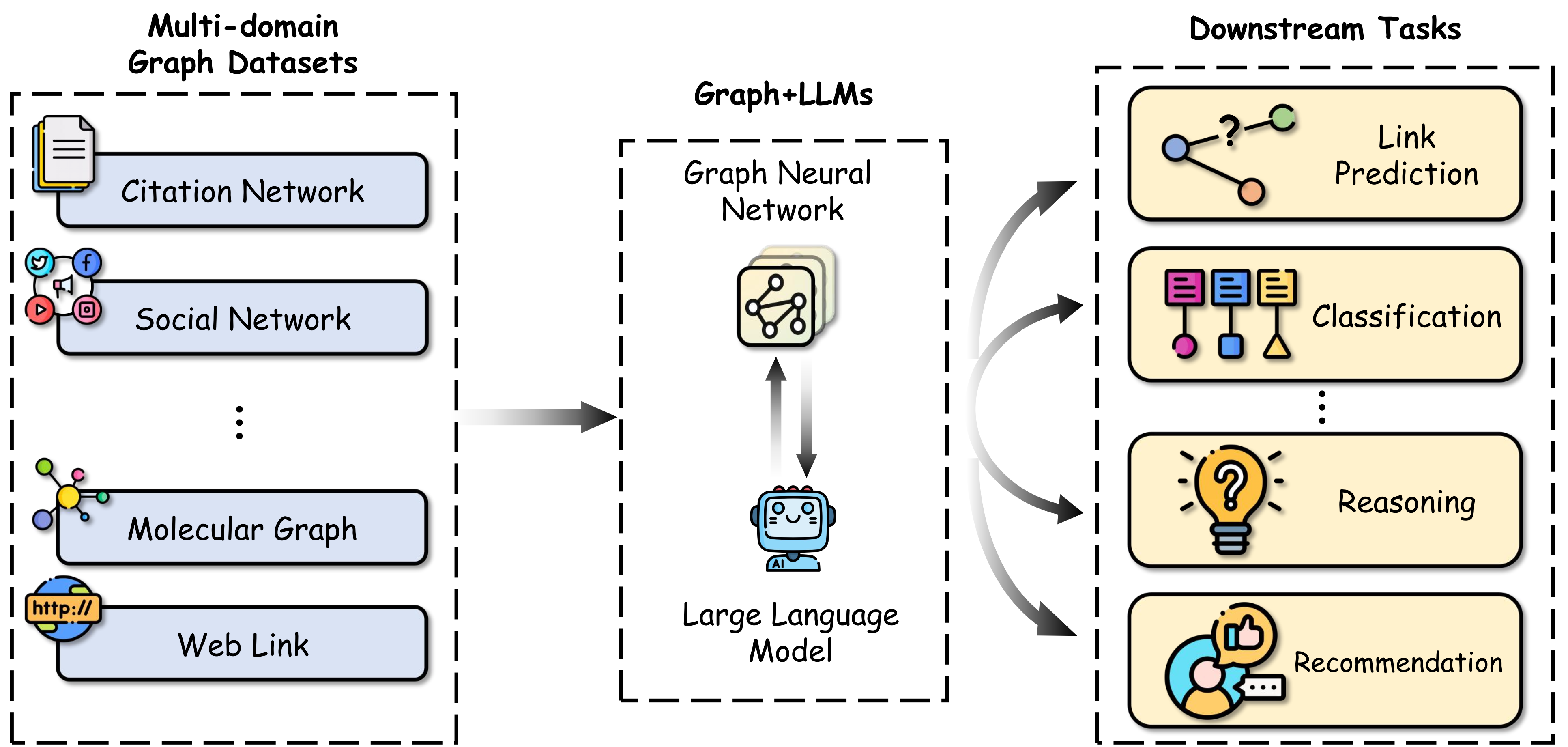
Figure 1. The overview of Graph Meets LLMs.
Summarizations based on proposed taxonomy
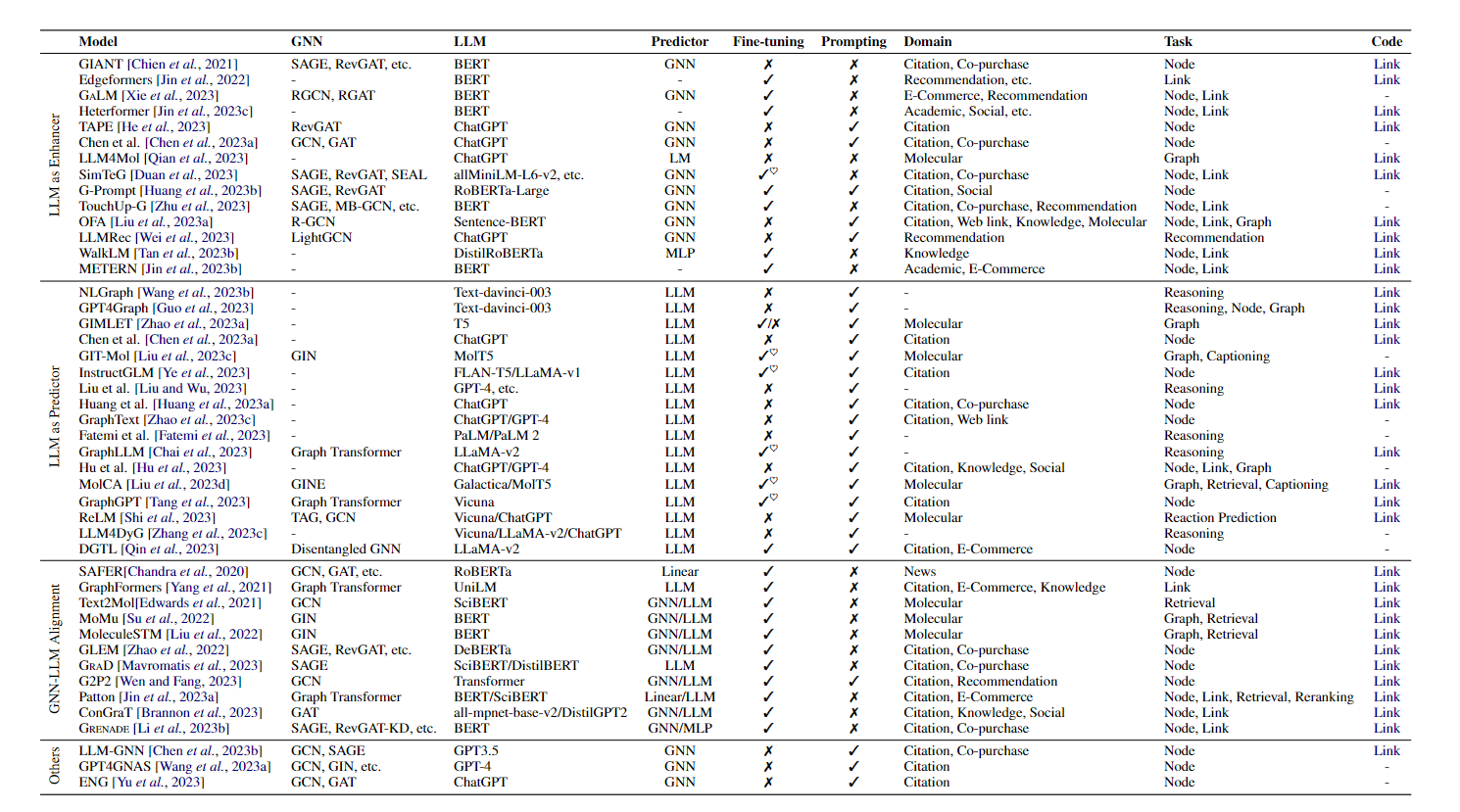
Table 1. A summary of models that leverage LLMs to assist graph-related tasks in literature, ordered by their release time. Fine-tuning denotes whether it is necessary to fine-tune the parameters of LLMs, and ♥ indicates that models employ parameter-efficient fine-tuning (PEFT) strategies, such as LoRA and prefix tuning. Prompting indicates the use of text-formatted prompts in LLMs, done manually or automatically. Acronyms in Task: Node refers to node-level tasks; Link refers to link-level tasks; Graph refers to graph-level tasks; Reasoning refers to Graph Reasoning; Retrieval refers to Graph-Text Retrieval; Captioning refers to Graph Captioning.
Table of Contents
LLM as Enhancer
-
(2022.03) [ICLR' 2022] Node Feature Extraction by Self-Supervised Multi-scale Neighborhood Prediction [Paper | Code]
GIANT
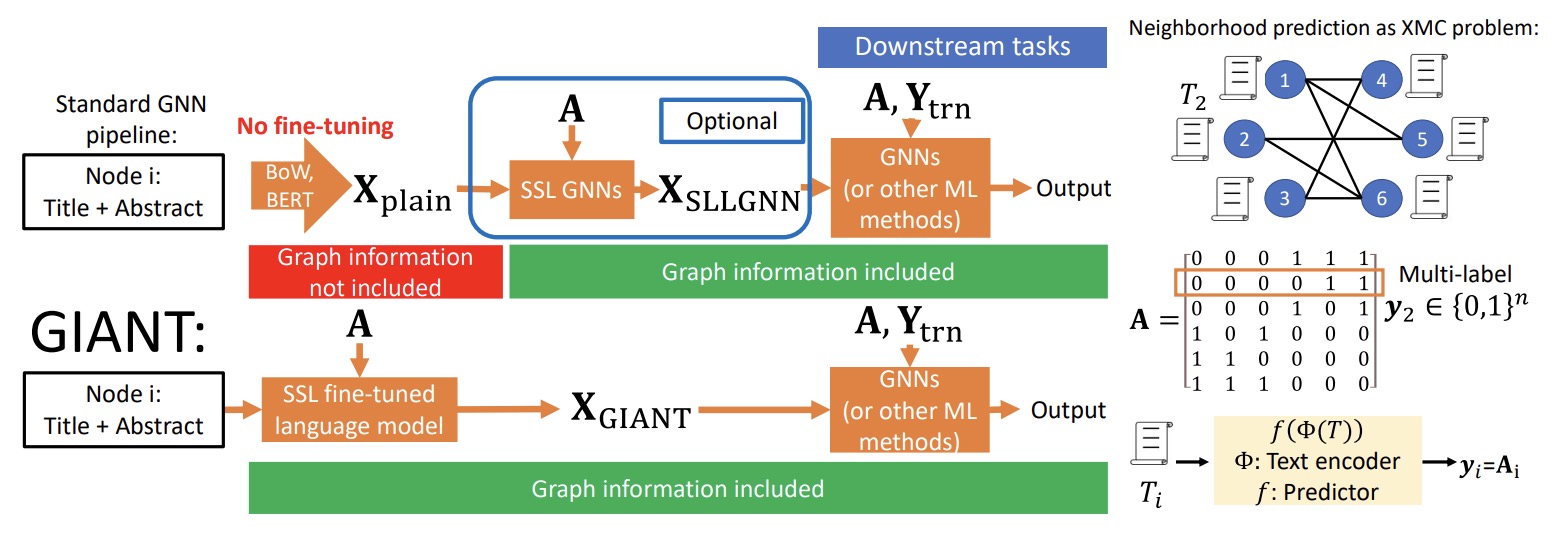
The framework of GIANT.
-
(2023.02) [ICLR' 2023] Edgeformers: Graph-Empowered Transformers for Representation Learning on Textual-Edge Networks [Paper | Code]
Edgeformers
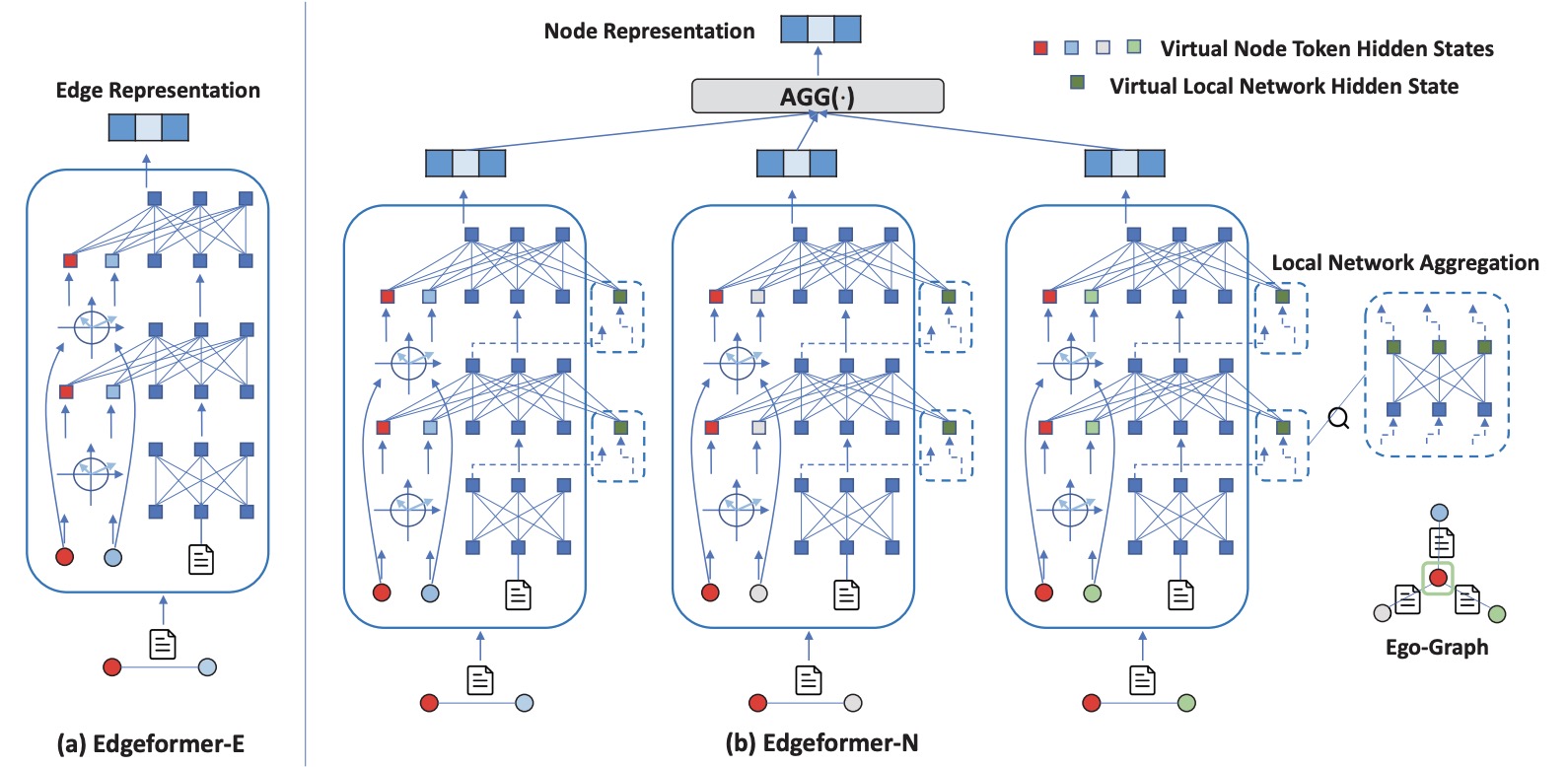
The framework of Edgeformers.
-
(2023.05) [KDD' 2023] Graph-Aware Language Model Pre-Training on a Large Graph Corpus Can Help Multiple Graph Applications [Paper]
GALM
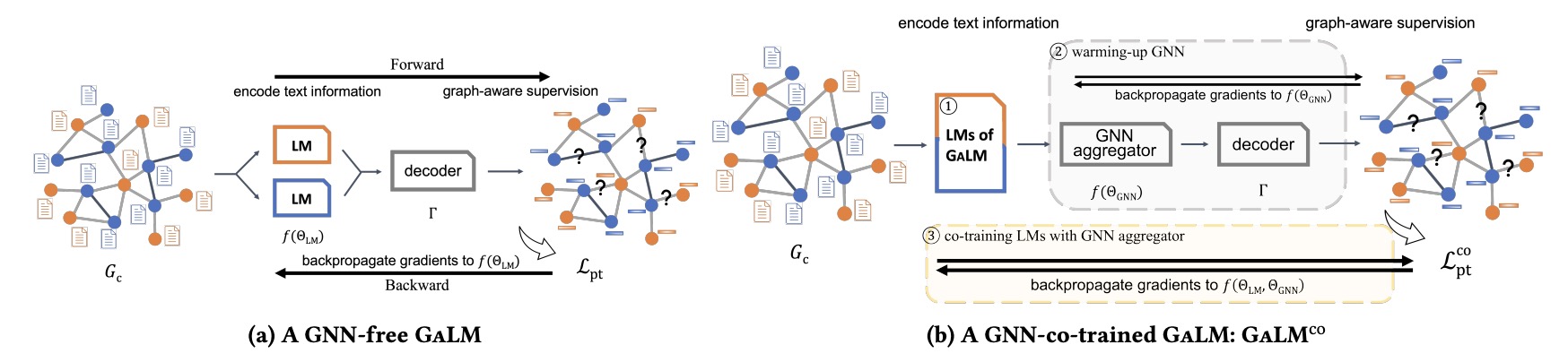
The framework of GALM.
-
(2023.06) [KDD' 2023] Heterformer: Transformer-based Deep Node Representation Learning on Heterogeneous Text-Rich Networks [Paper | Code]
Heterformer
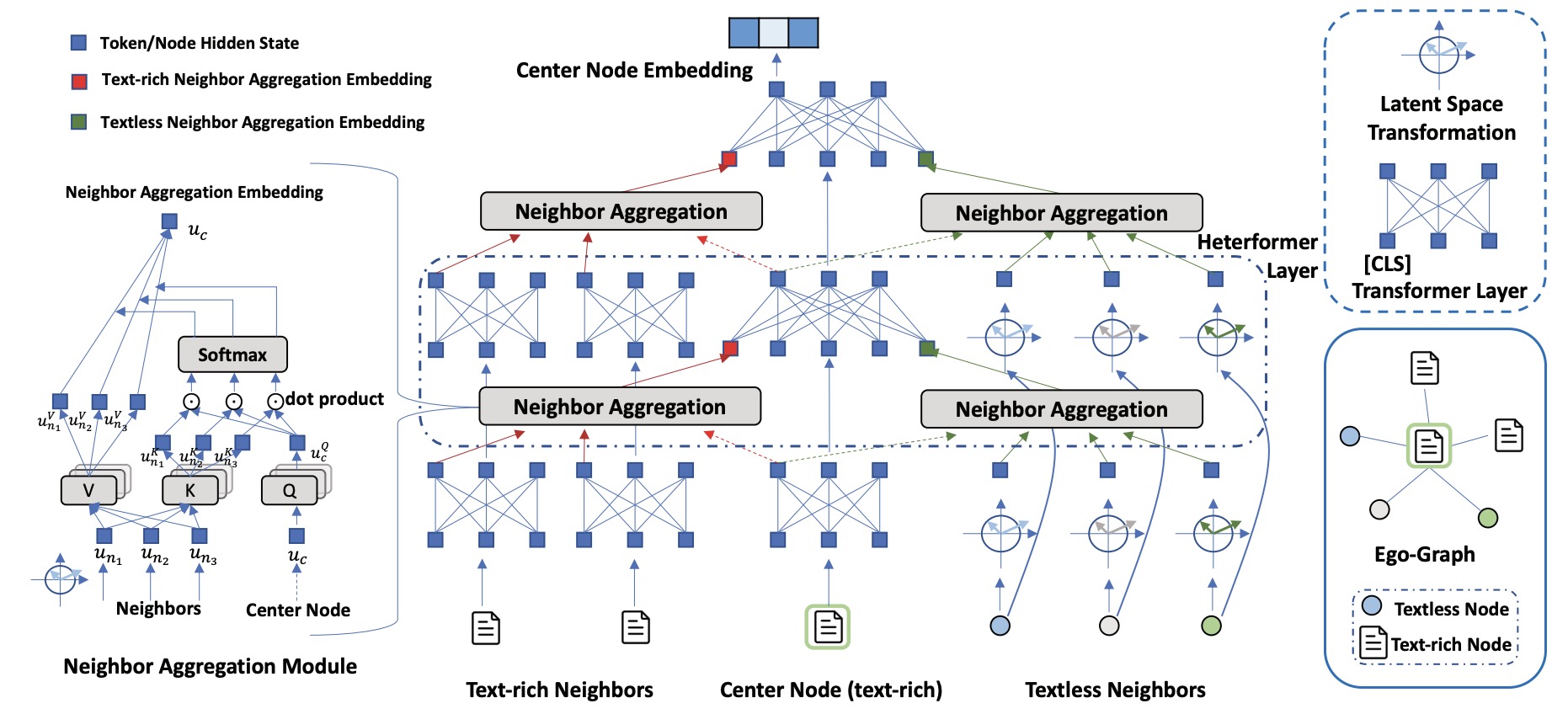
The framework of Heterformer.
-
(2023.05) [ICLR' 2024] Harnessing Explanations: LLM-to-LM Interpreter for Enhanced Text-Attributed Graph Representation Learning [Paper | Code]
TAPE
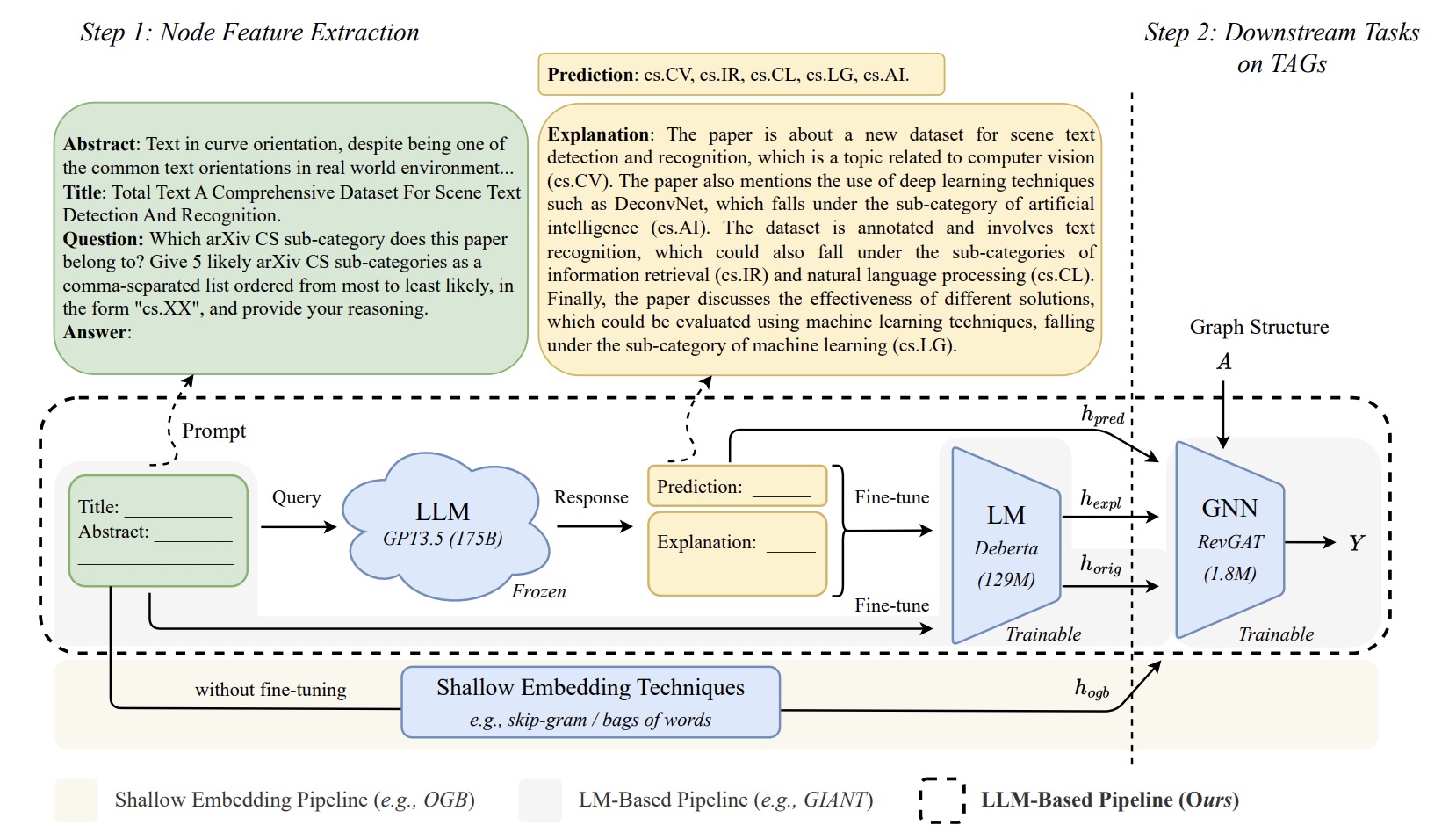
The framework of TAPE.
-
(2023.08) [Arxiv' 2023] Exploring the potential of large language models (llms) in learning on graphs [Paper]
KEA
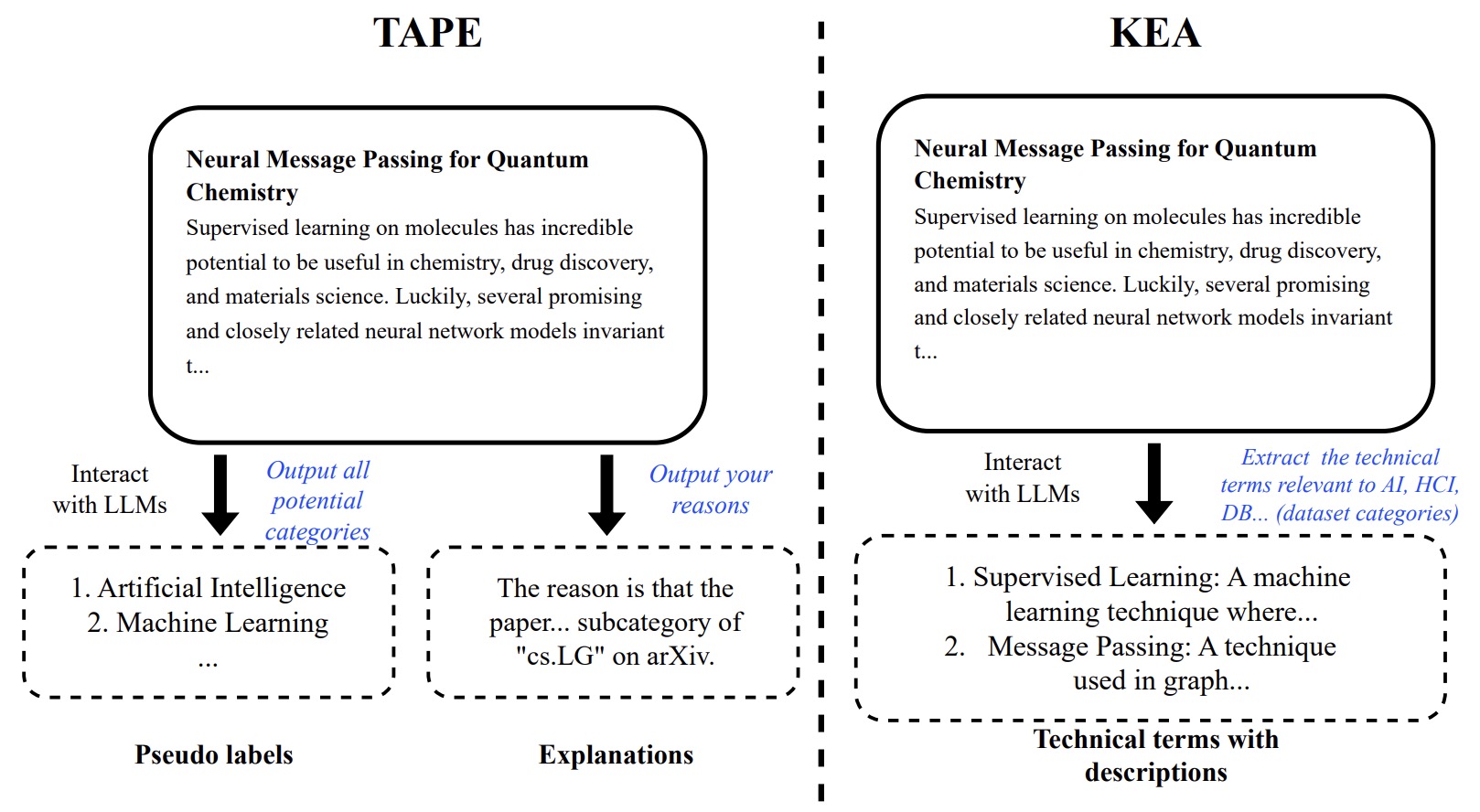
The framework of KEA.
-
(2023.07) [Arxiv' 2023] Can Large Language Models Empower Molecular Property Prediction? [Paper | Code]
LLM4Mol
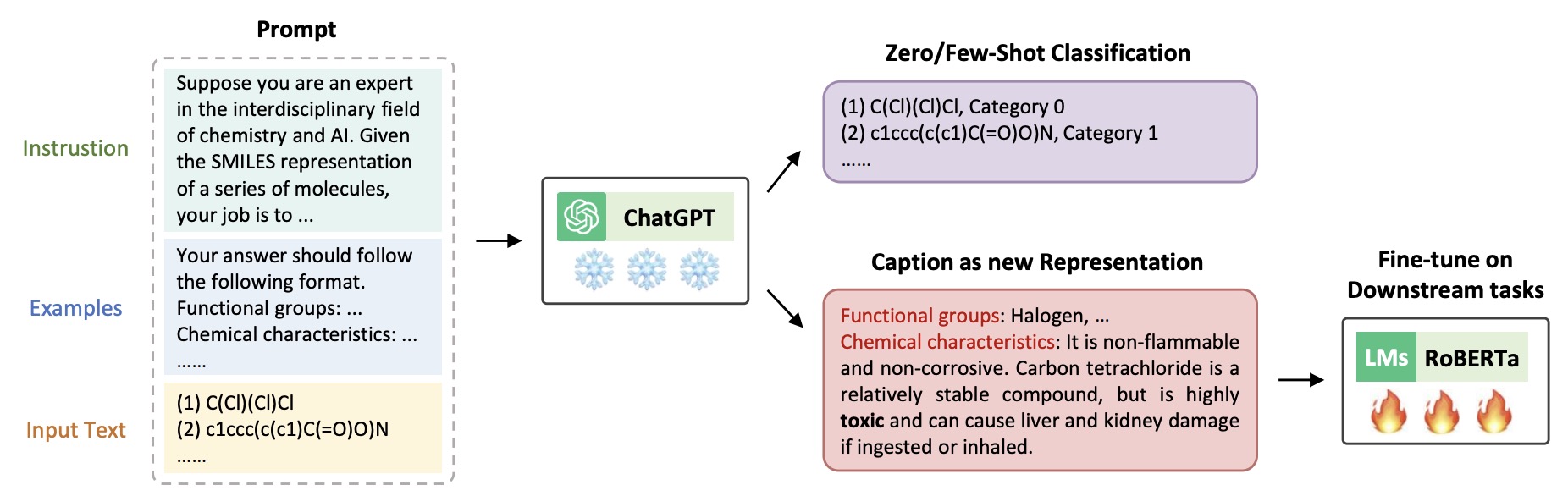
The framework of LLM4Mol.
-
(2023.08) [Arxiv' 2023] Simteg: A frustratingly simple approach improves textual graph learning [Paper | Code]
SimTeG
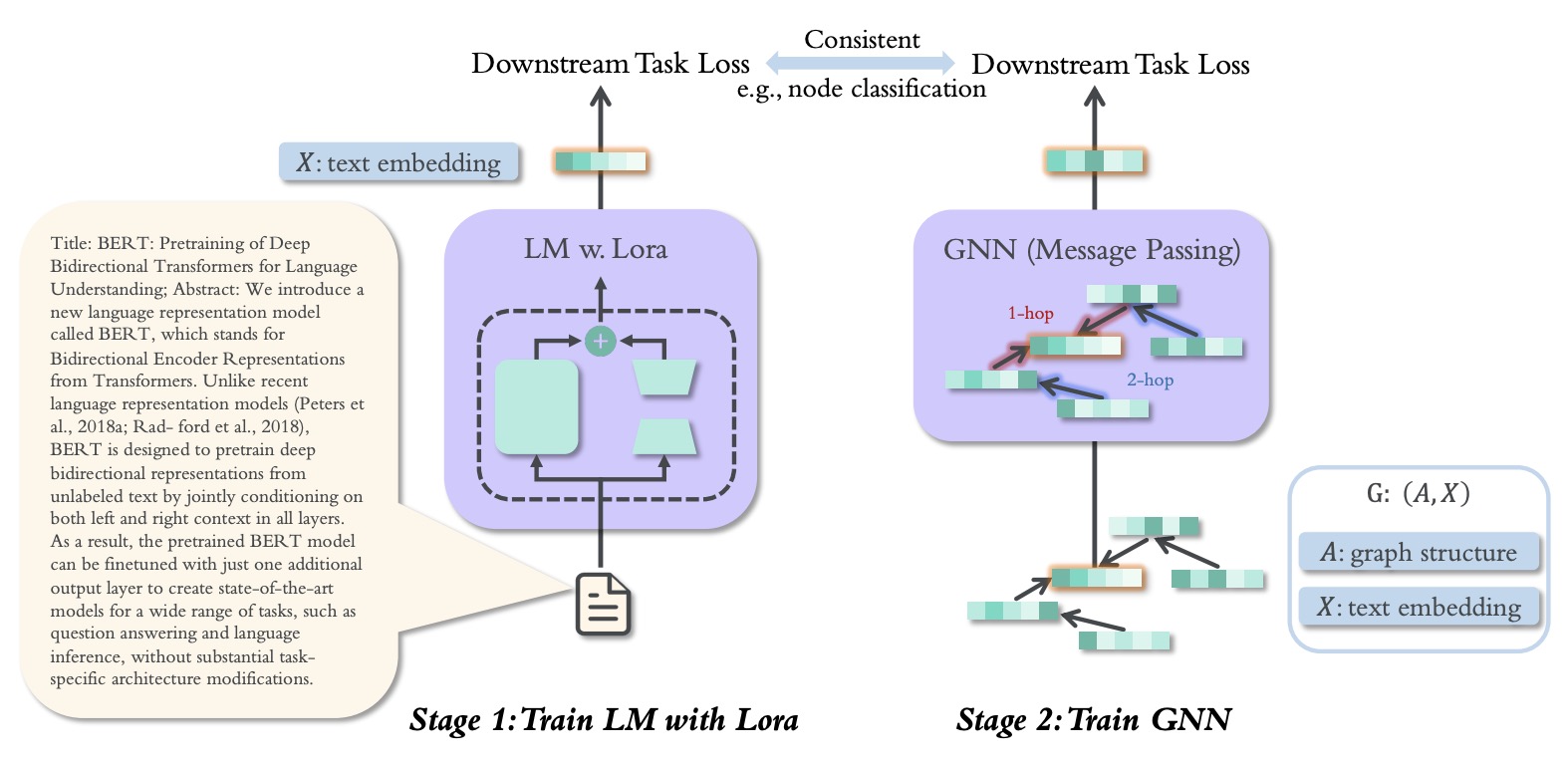
The framework of SimTeG.
-
(2023.09) [Arxiv' 2023] Prompt-based Node Feature Extractor for Few-shot Learning on Text-Attributed Graphs [Paper]
G-Prompt
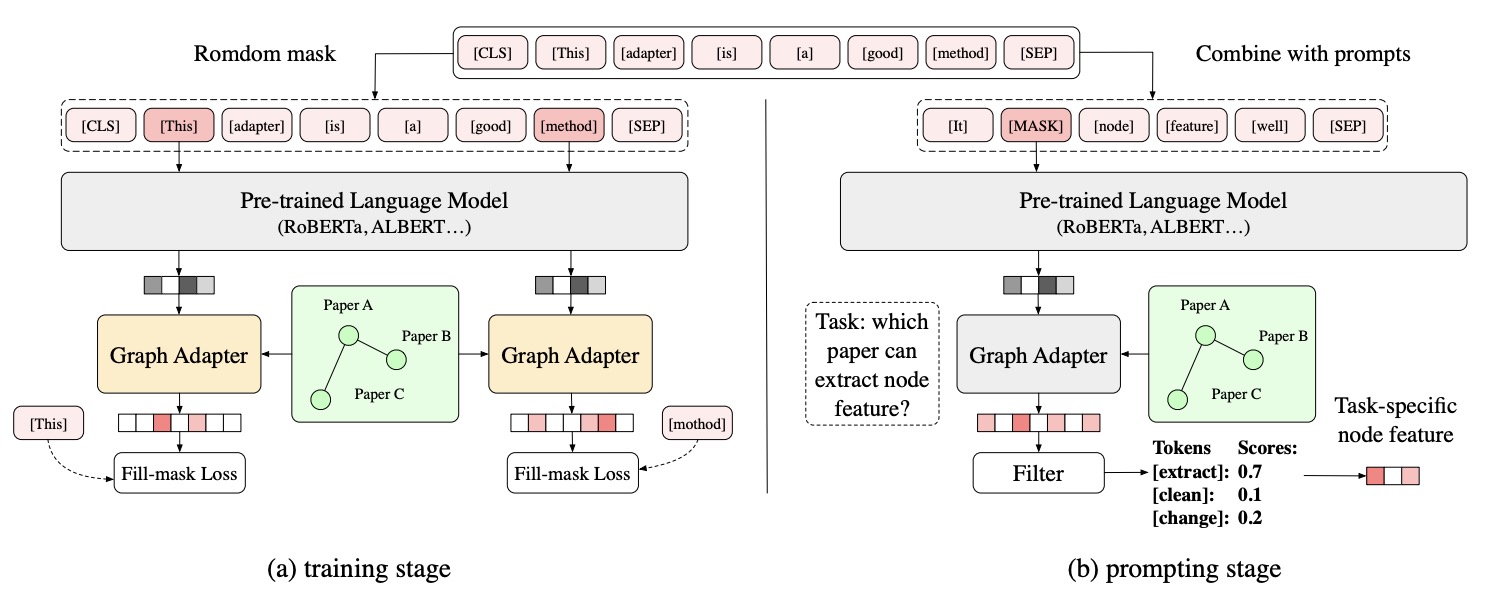
The framework of G-Prompt.
-
(2023.09) [Arxiv' 2023] TouchUp-G: Improving Feature Representation through Graph-Centric Finetuning [Paper]
TouchUp-G
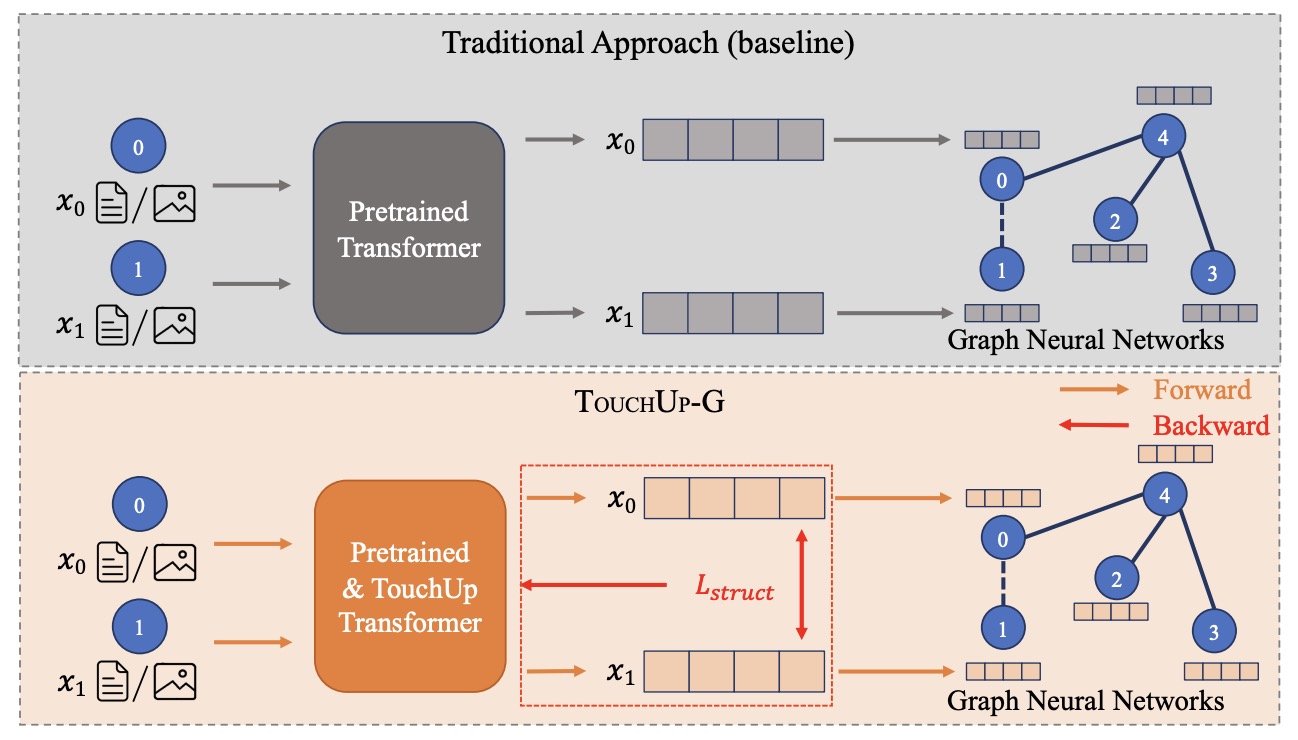
The framework of TouchUp-G.
-
(2023.09) [ICLR' 2024] One for All: Towards Training One Graph Model for All Classification Tasks [Paper | Code]
OFA
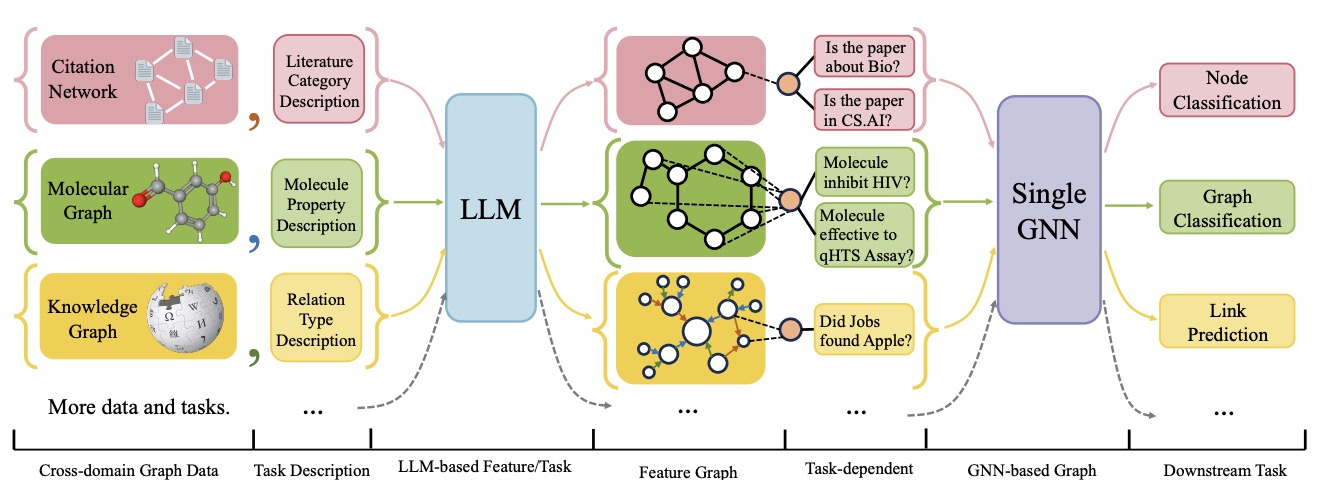
The framework of OFA.
-
(2023.10) [Arxiv' 2023] Learning Multiplex Embeddings on Text-rich Networks with One Text Encoder [Paper | Code]
METERN
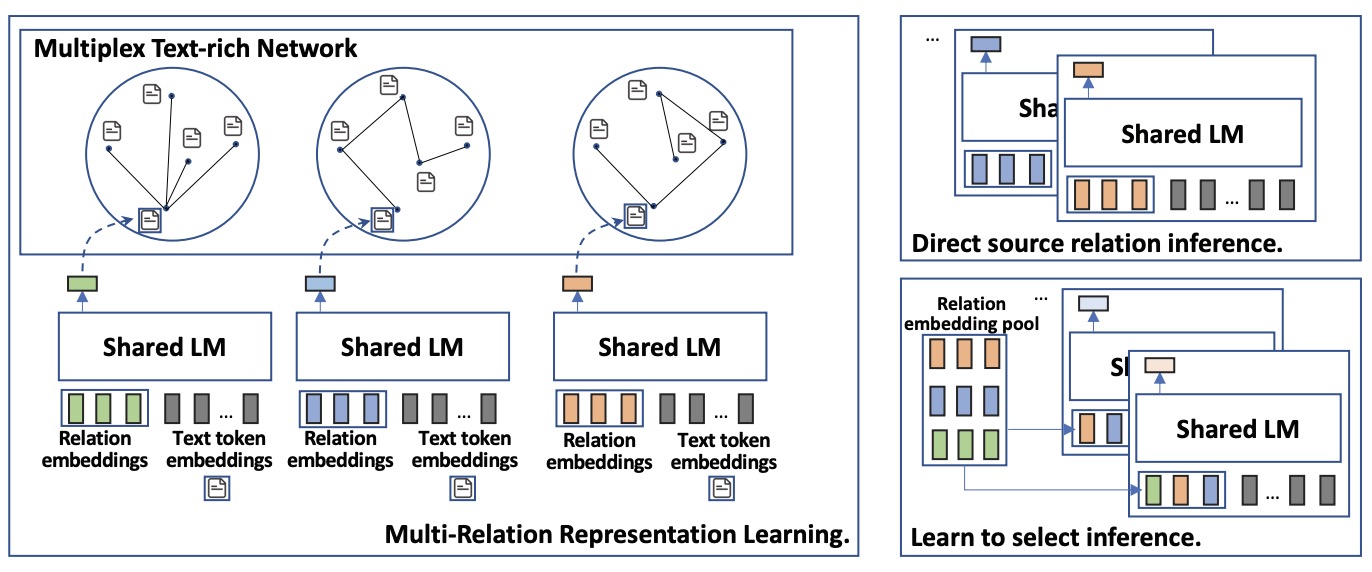
The framework of METERN.
-
(2023.11) [WSDM' 2024] LLMRec: Large Language Models with Graph Augmentation for Recommendation [Paper | Code]
LLMRec

The framework of LLMRec.
-
(2023.11) [NeurIPS' 2023] WalkLM: A Uniform Language Model Fine-tuning Framework for Attributed Graph Embedding [Paper | Code]
WalkLM
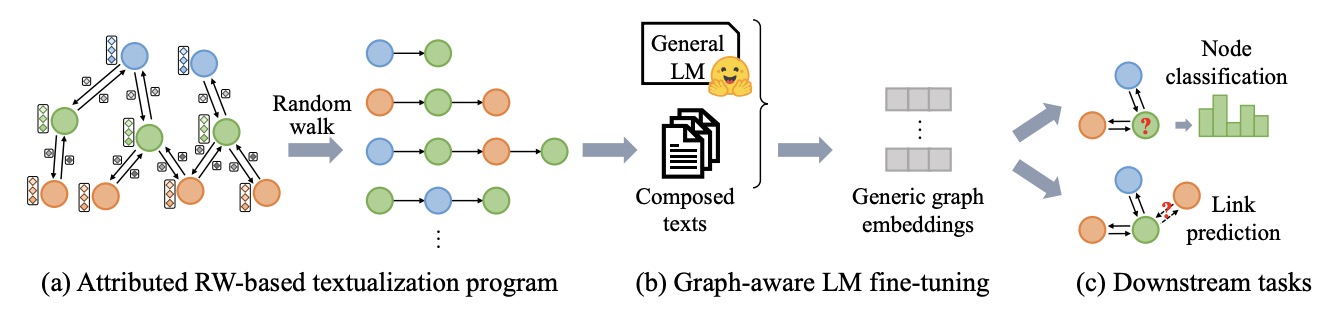
The framework of WalkLM.
-
(2024.01) [IJCAI' 2024] Efficient Tuning and Inference for Large Language Models on Textual Graphs [Paper]
ENGINE
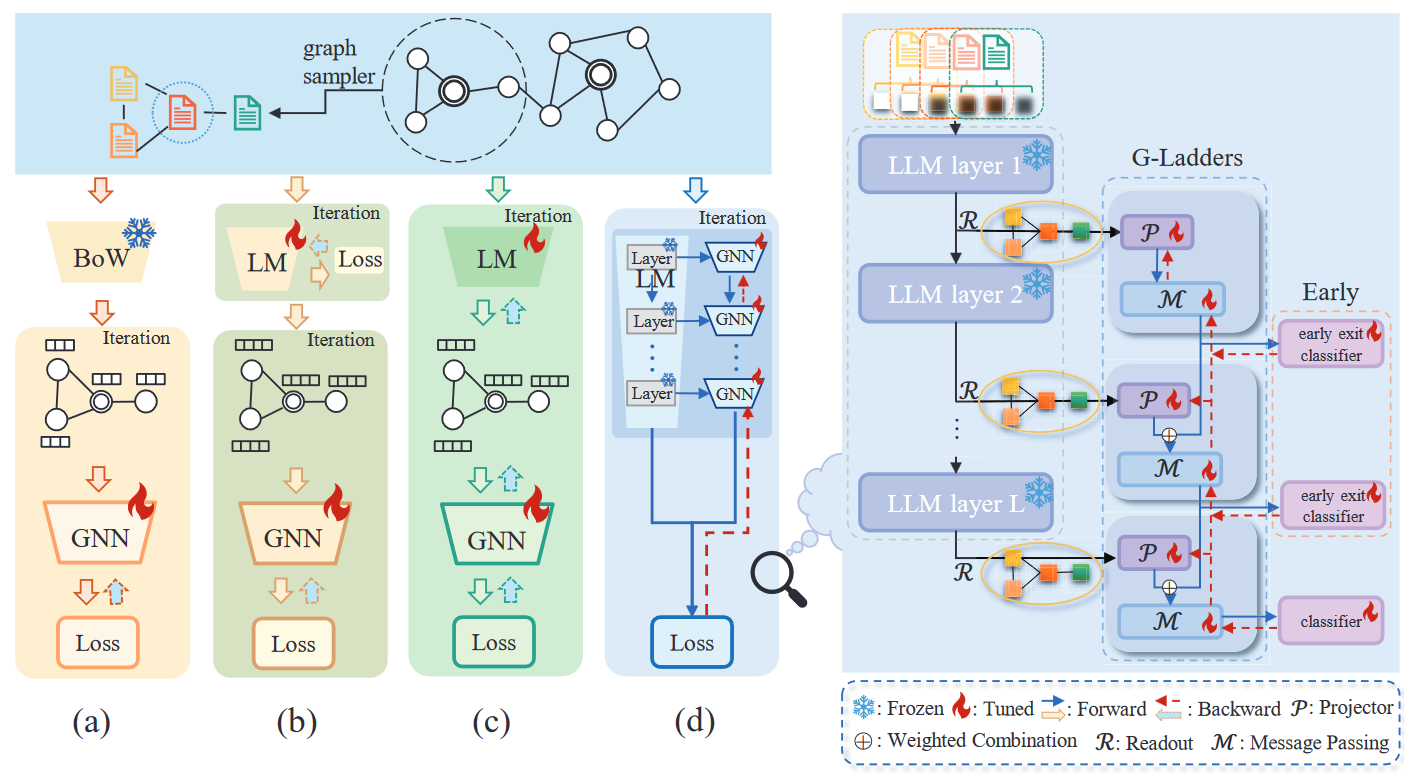
The framework of ENGINE.
-
(2024.02) [KDD' 2024] ZeroG: Investigating Cross-dataset Zero-shot Transferability in Graphs [Paper]
ZeroG
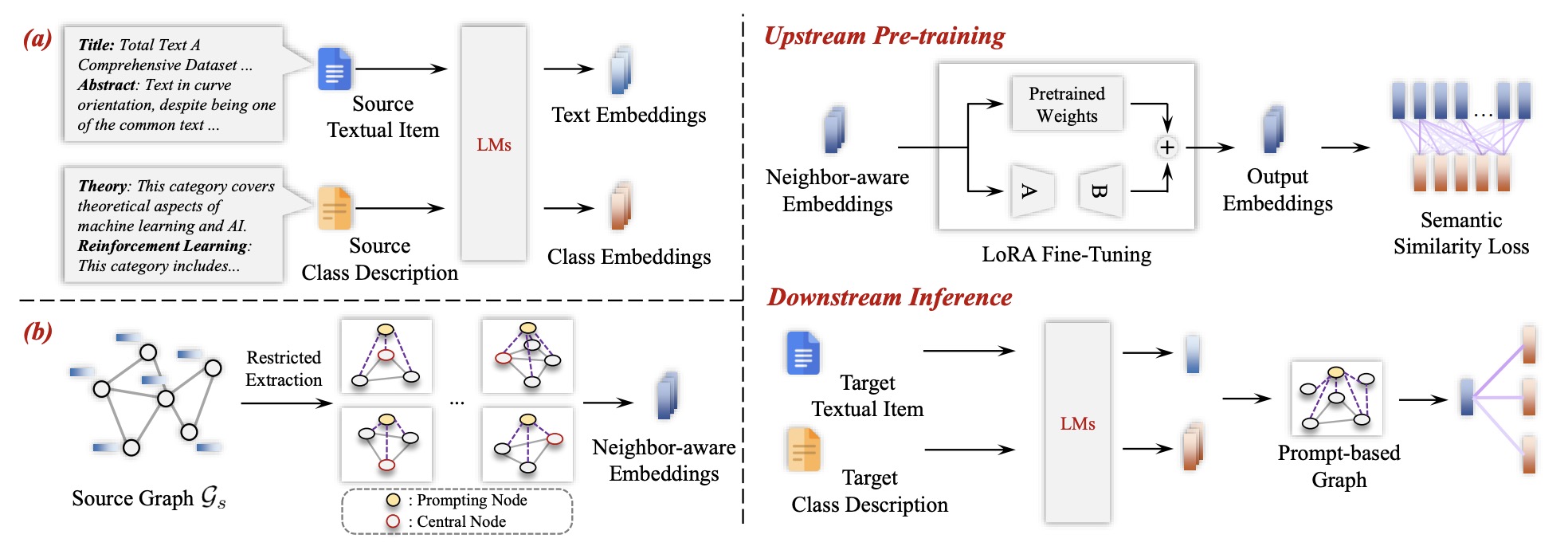
The framework of ZeroG.
-
(2024.02) [Arxiv' 2024] UniGraph: Learning a Cross-Domain Graph Foundation Model From Natural Language [Paper]
UniGraph
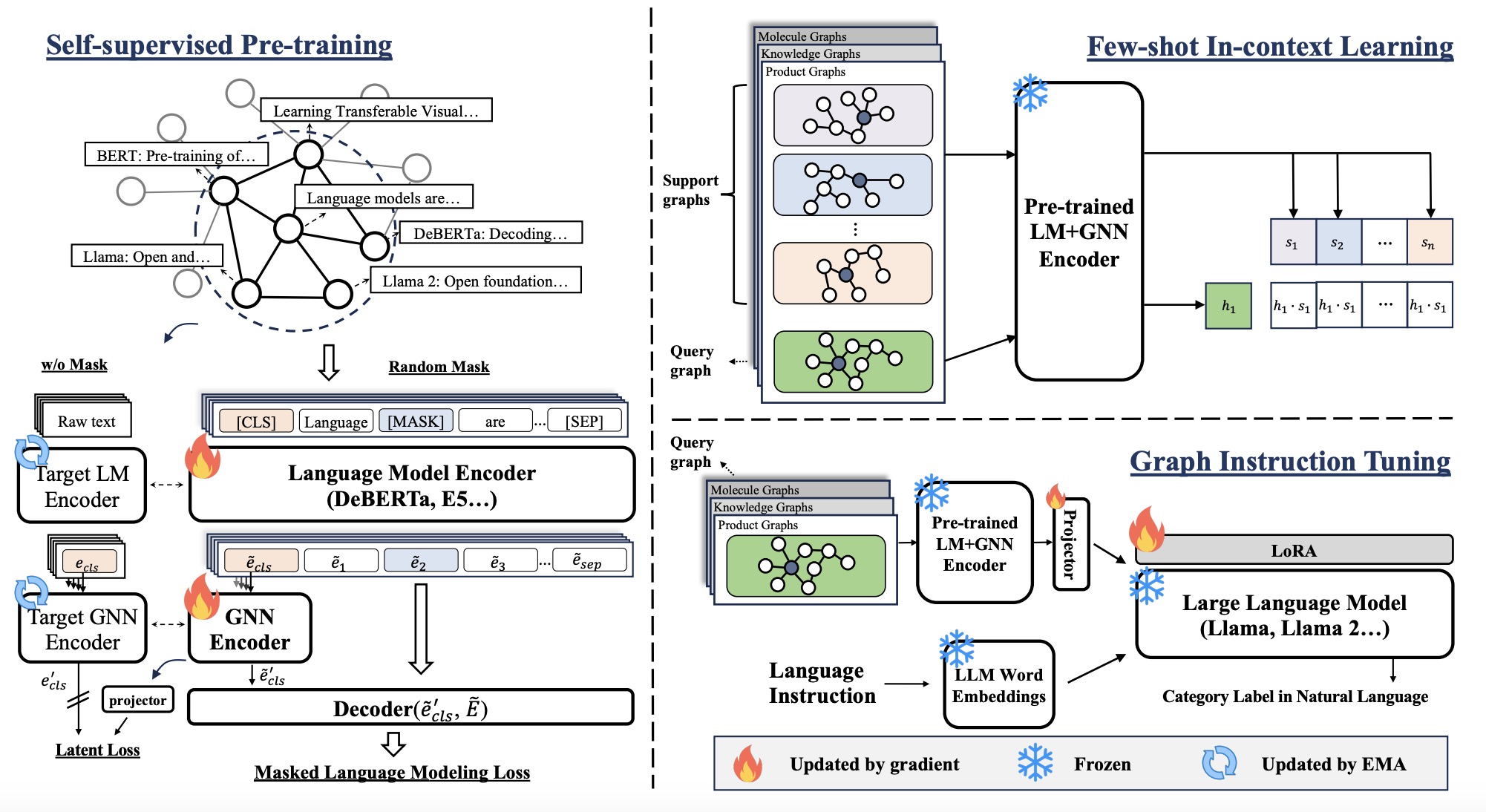
The framework of UniGraph.
-
(2024.02) [CIKM' 2024] Distilling Large Language Models for Text-Attributed Graph Learning [Paper]
Pan, et al.
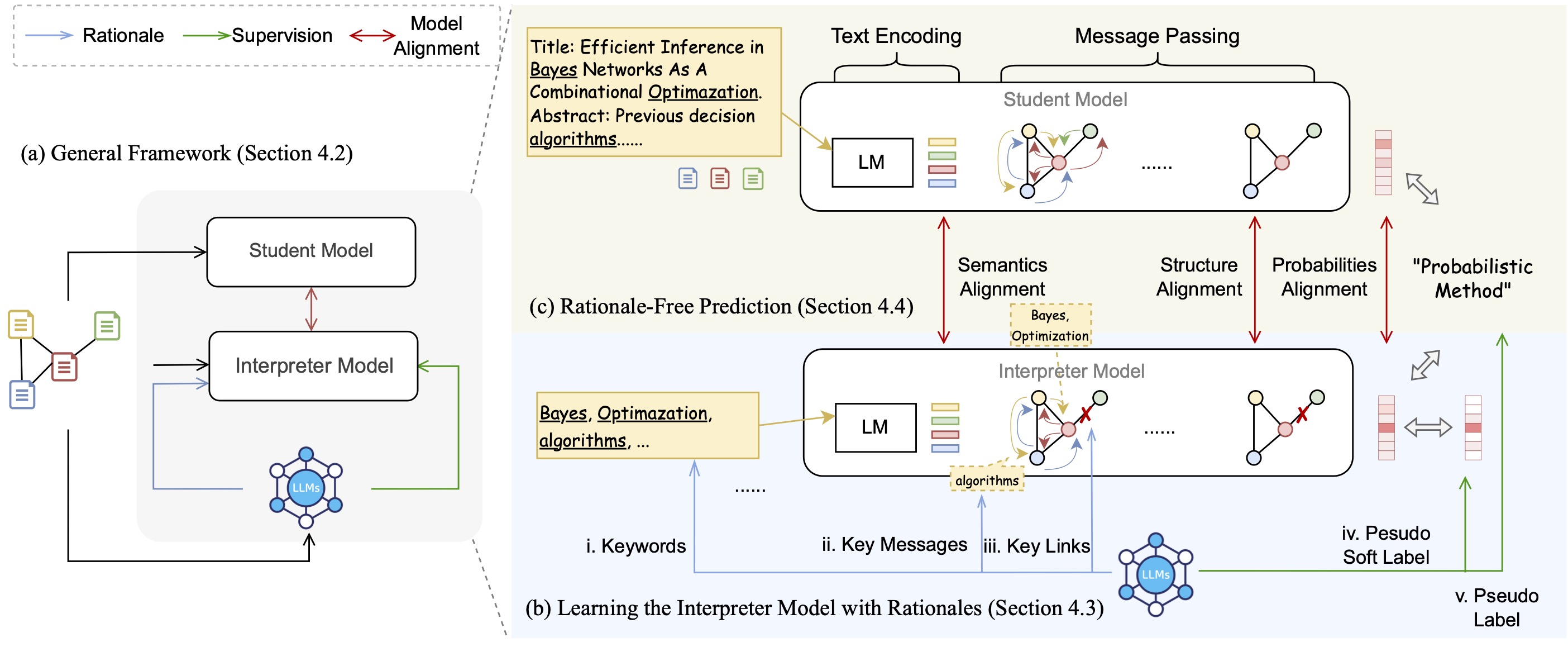
The framework of Pan, et al.
-
(2024.10) [CIKM' 2024] When LLM Meets Hypergraph: A Sociological Analysis on Personality via Online Social Networks [Paper | Code]
Shu, et al.
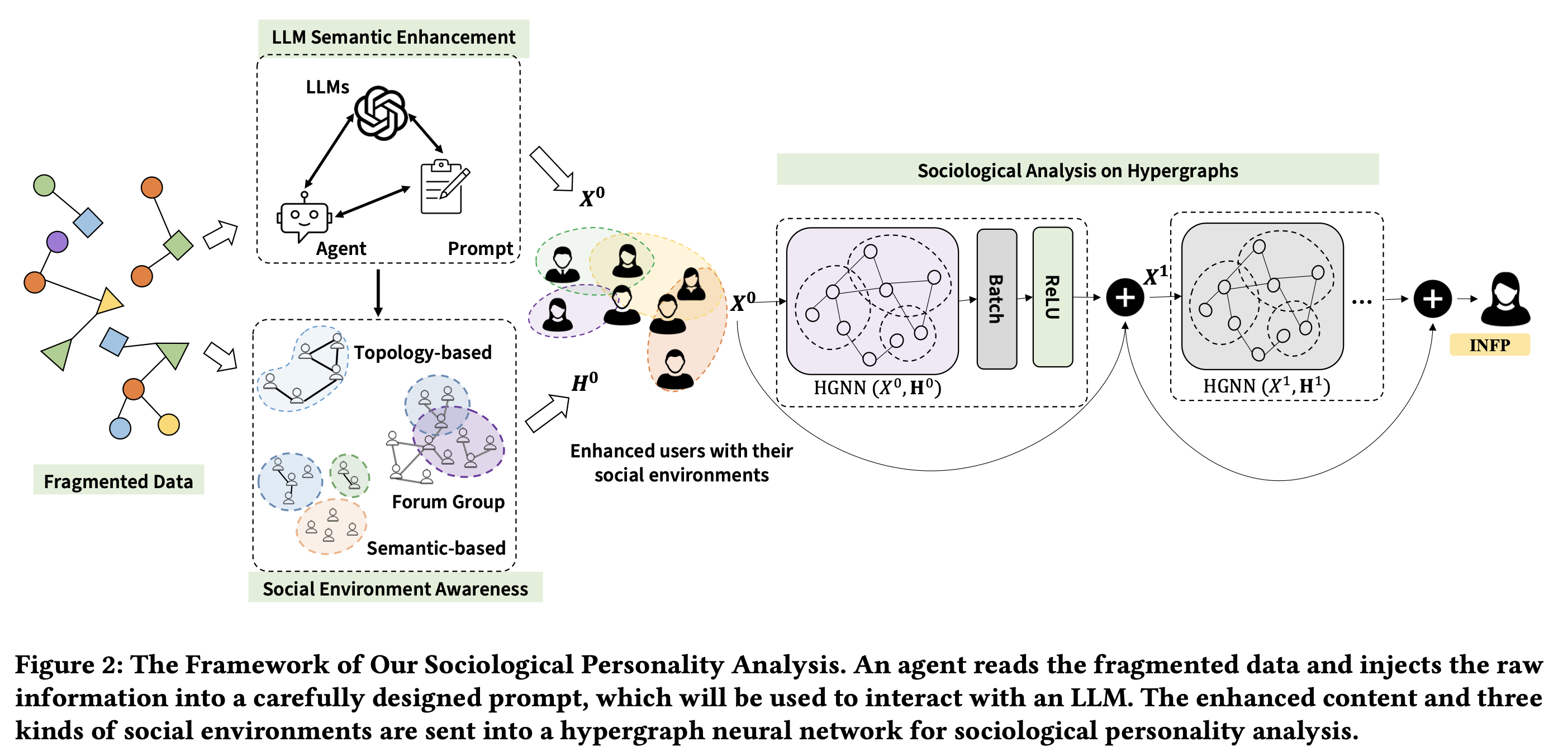
The framework of Shu, et al.
LLM as Predictor
-
(2023.05) [NeurIPS' 2023] Can language models solve graph problems in natural language? [Paper | Code]
NLGraph
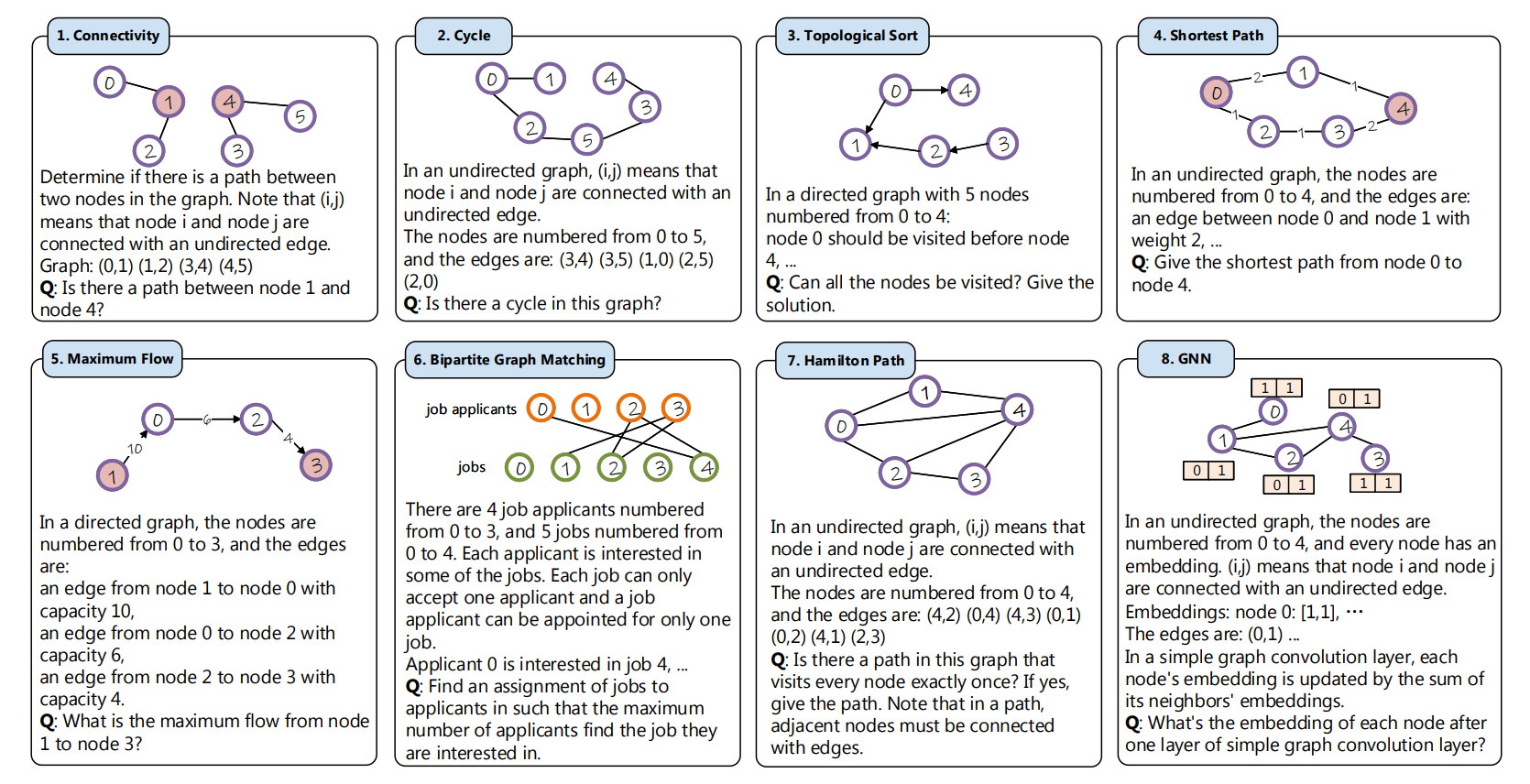
The framework of NLGraph.
-
(2023.05) [Arxiv' 2023] GPT4Graph: Can Large Language Models Understand Graph Structured Data? An Empirical Evaluation and Benchmarking [Paper | Code]
GPT4Graph
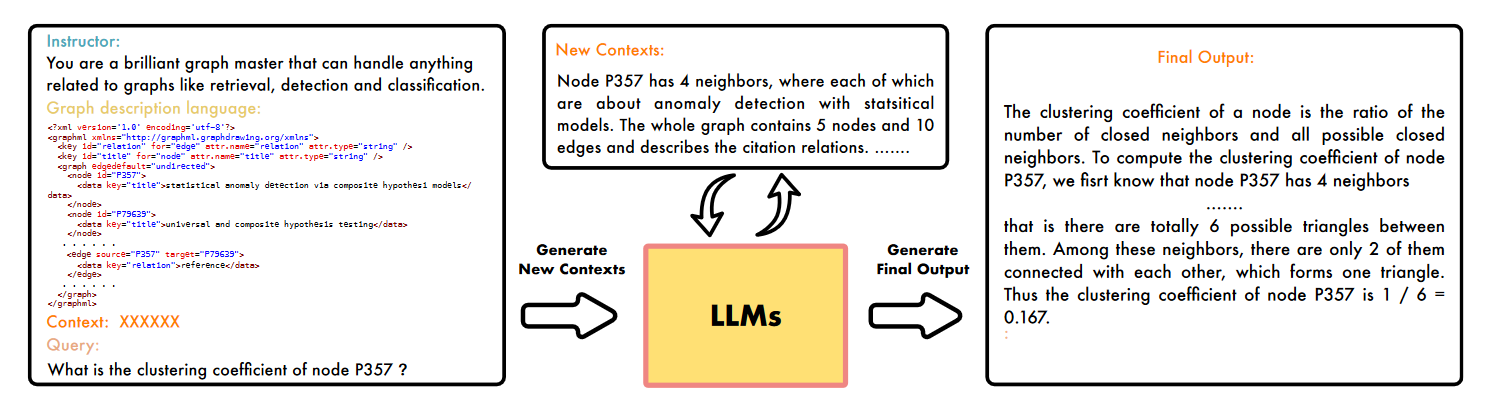
The framework of GPT4Graph.
-
(2023.06) [NeurIPS' 2023] GIMLET: A Unified Graph-Text Model for Instruction-Based Molecule Zero-Shot Learning [Paper | Code]
GIMLET
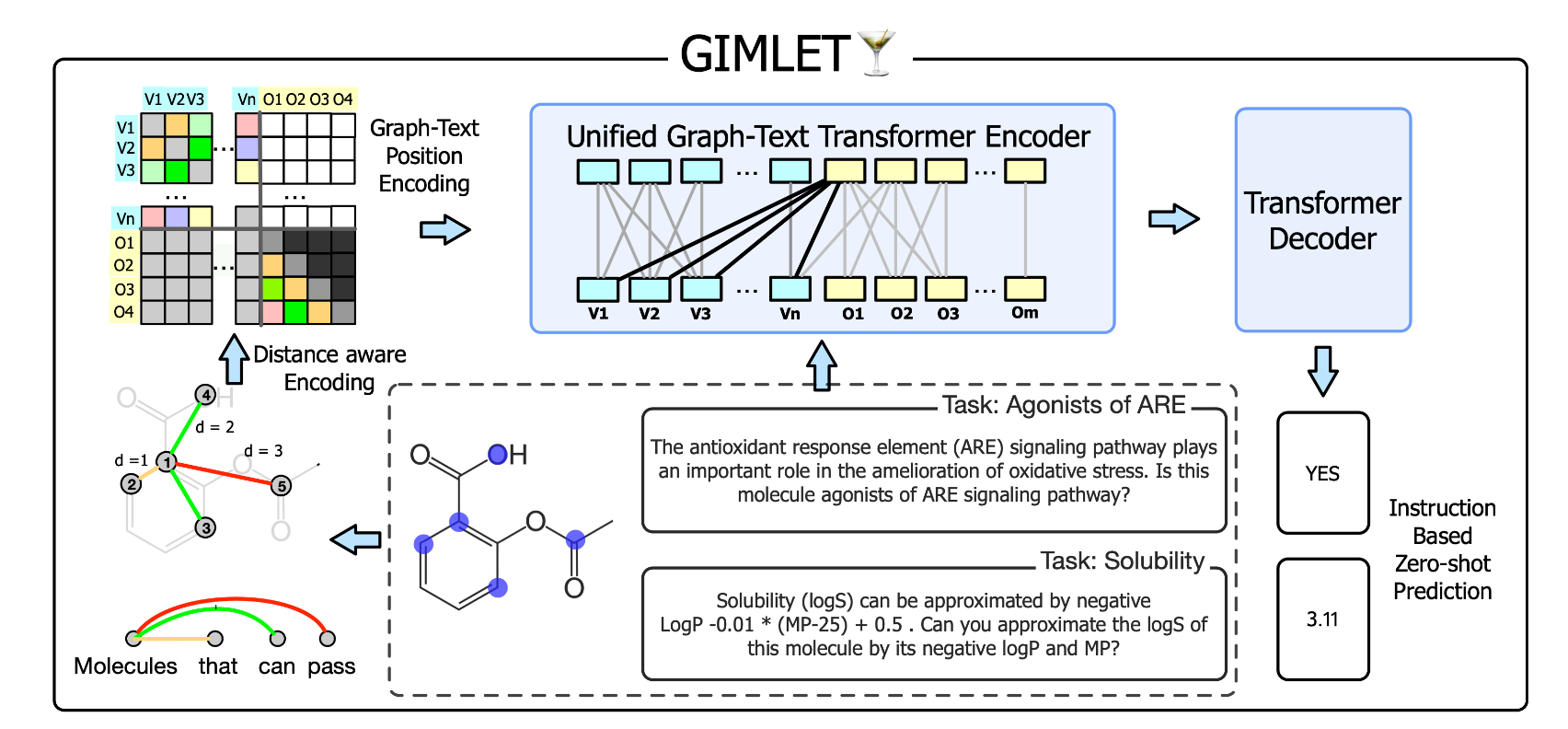
The framework of GIMLET.
-
(2023.07) [Arxiv' 2023] Exploring the Potential of Large Language Models (LLMs) in Learning on Graphs [Paper | Code]
Framework
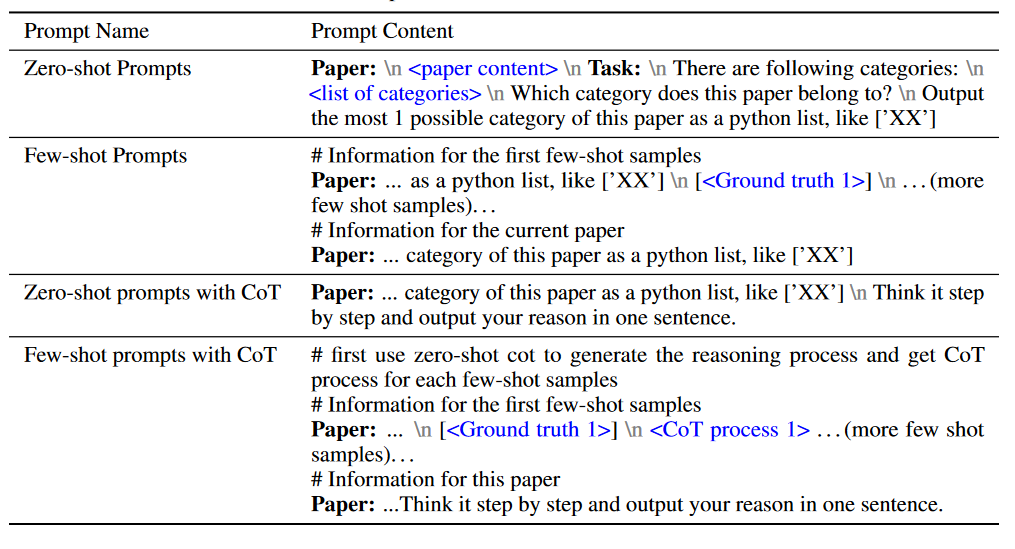
The designed prompts of Chen et al.
-
(2023.08) [Arxiv' 2023] GIT-Mol: A Multi-modal Large Language Model for Molecular Science with Graph, Image, and Text [Paper]
GIT-Mol
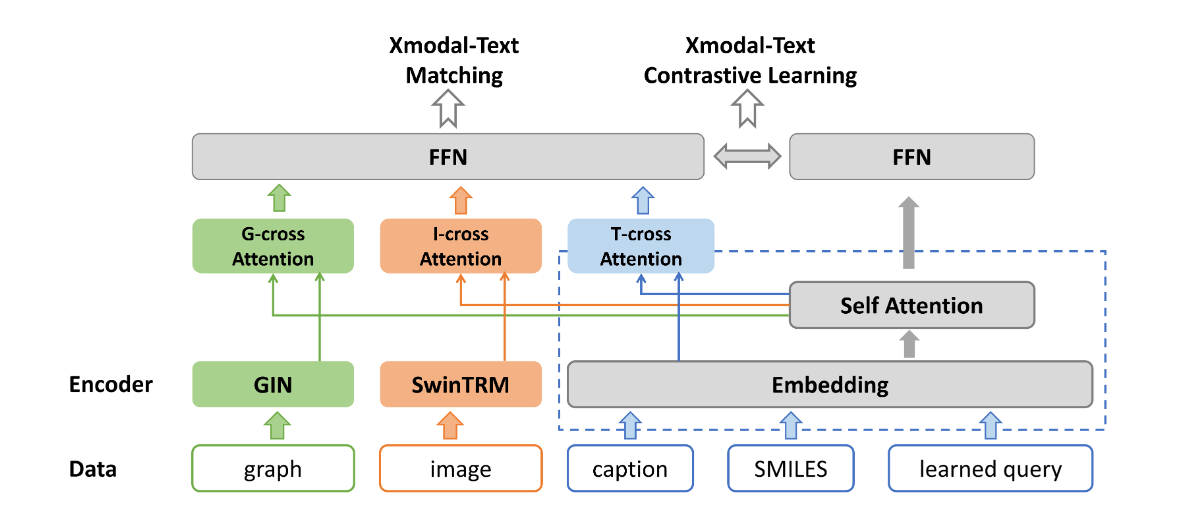
The framework of GIT-Mol.
-
(2023.08) [Arxiv' 2023] Natural Language is All a Graph Needs [Paper | Code]
InstructGLM
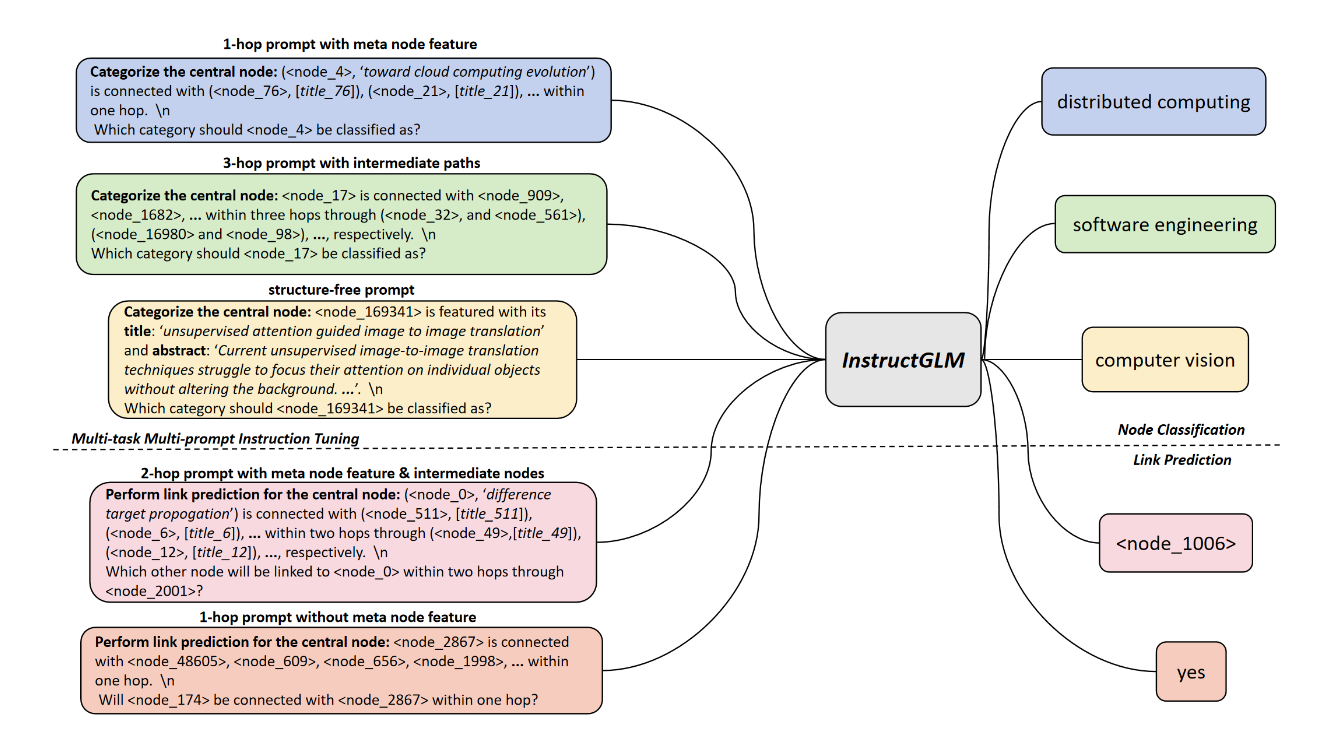
The framework of InstructGLM.
-
(2023.08) [Arxiv' 2023] Evaluating Large Language Models on Graphs: Performance Insights and Comparative Analysis [Paper | Code]
Framework
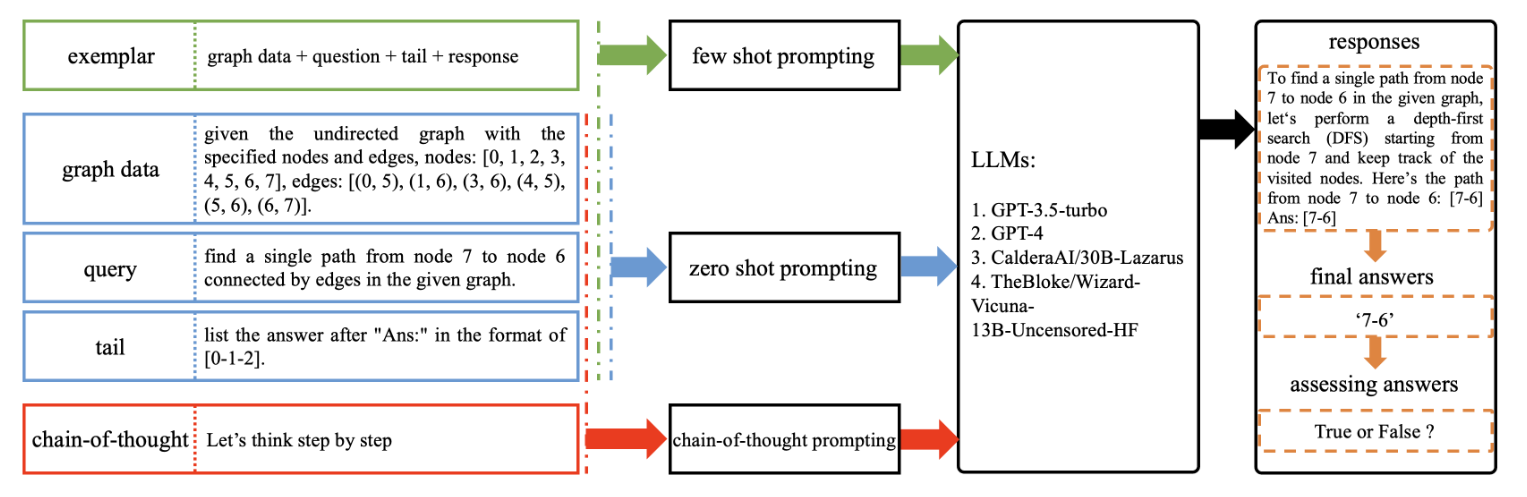
The designed prompts of Liu et al.
-
(2023.09) [Arxiv' 2023] Can LLMs Effectively Leverage Graph Structural Information: When and Why [Paper | Code]
Framework
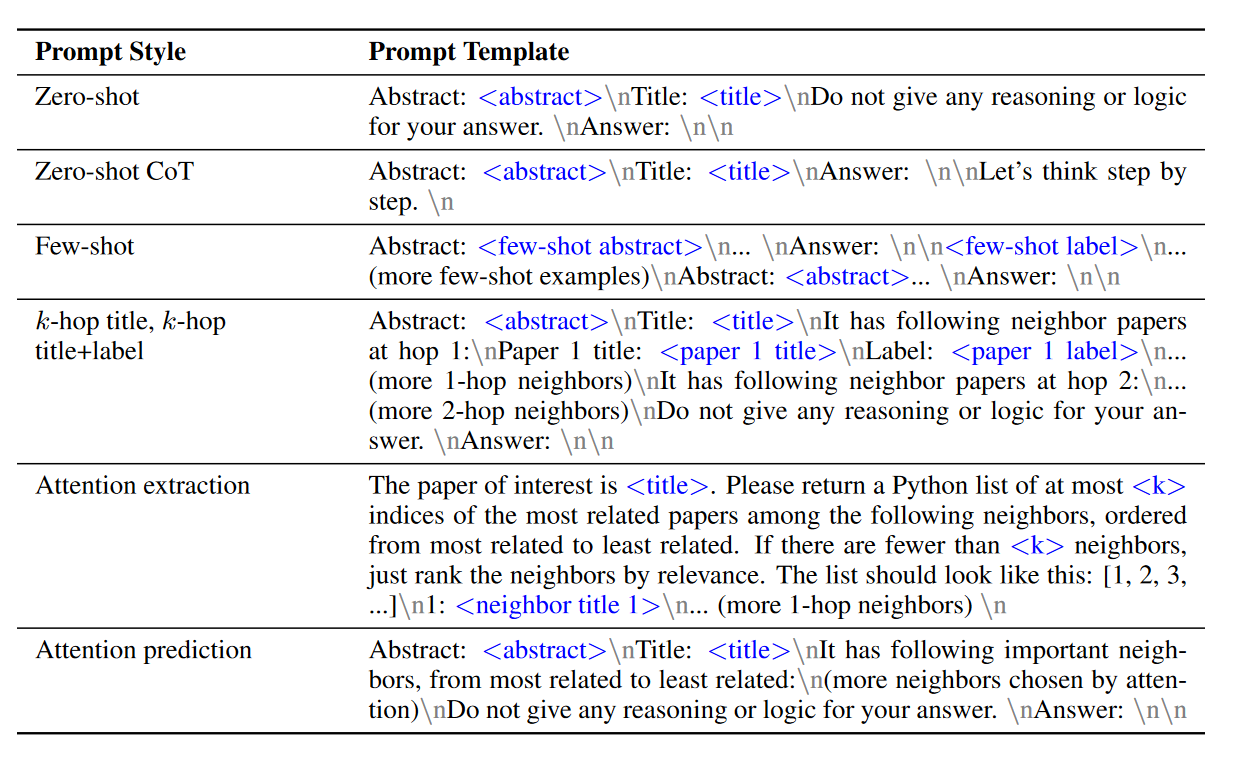
The designed prompts of Huang et al.
-
(2023.10) [Arxiv' 2023] GraphText: Graph Reasoning in Text Space [Paper] | Code]
GraphText
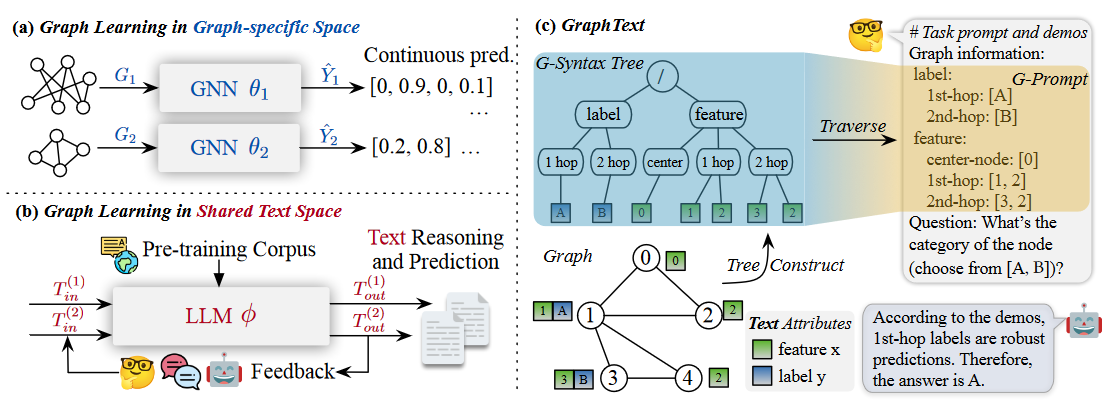
The framework of GraphText.
-
(2023.10) [Arxiv' 2023] Talk like a Graph: Encoding Graphs for Large Language Models [Paper]
Framework
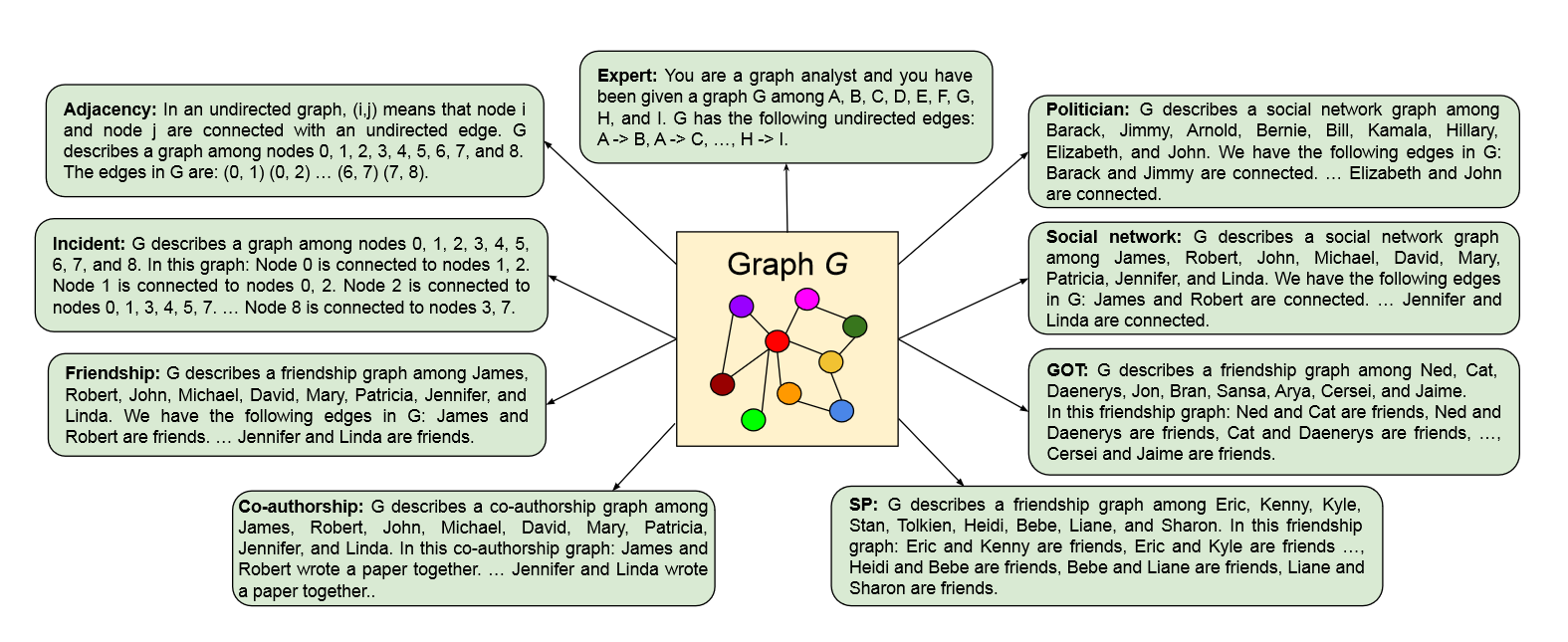
The designed prompts of Fatemi et al.
-
(2023.10) [Arxiv' 2023] GraphLLM: Boosting Graph Reasoning Ability of Large Language Model [Paper | Code]
GraphLLM
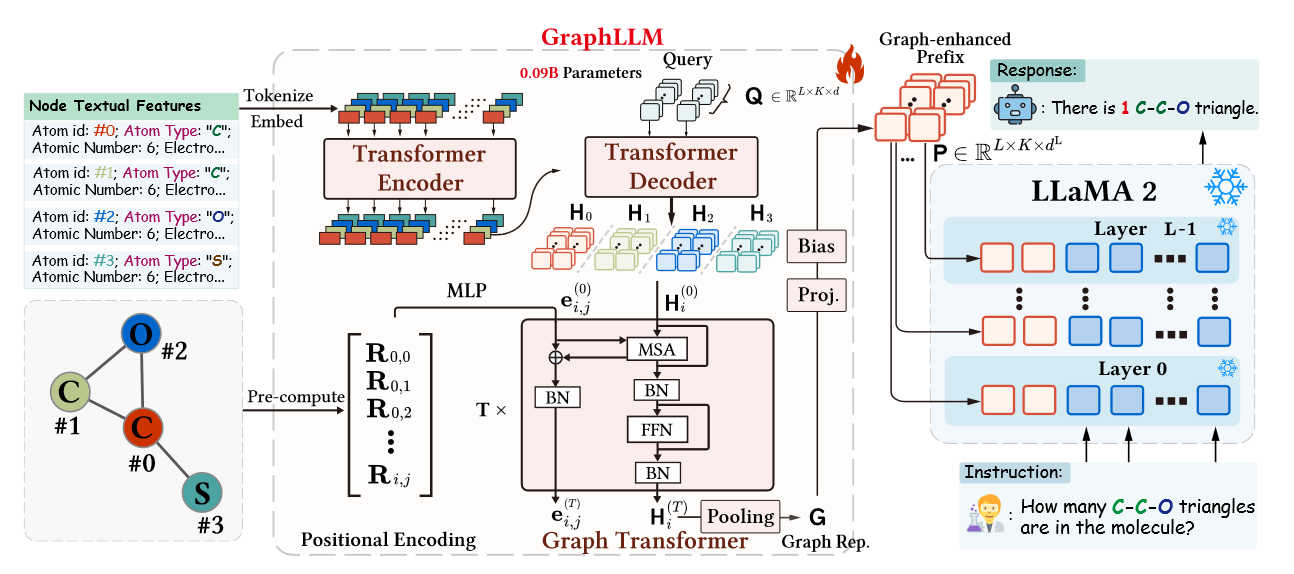
The framework of GraphLLM.
-
(2023.10) [Arxiv' 2023] Beyond Text: A Deep Dive into Large Language Model [Paper]
Framework
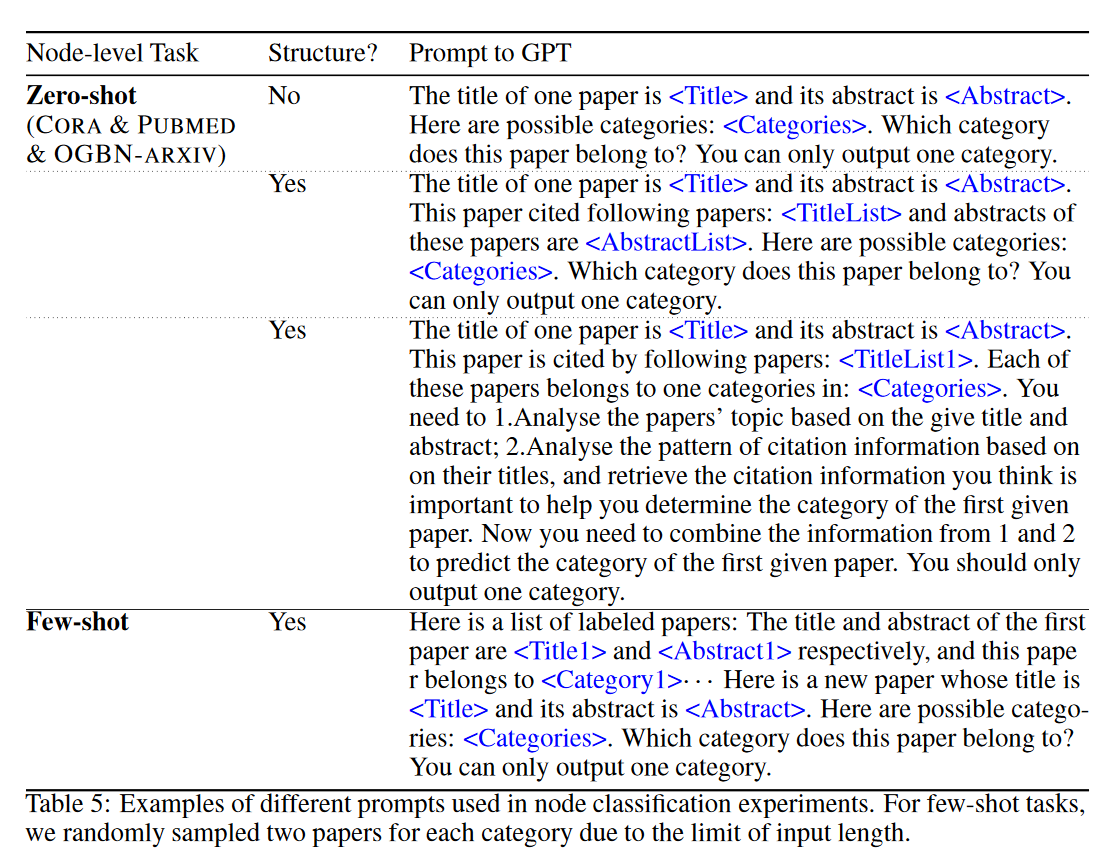
The designed prompts of Hu et al.
-
(2023.10) [EMNLP' 2023] MolCA: Molecular Graph-Language Modeling with Cross-Modal Projector and Uni-Modal Adapter [Paper | Code]
MolCA
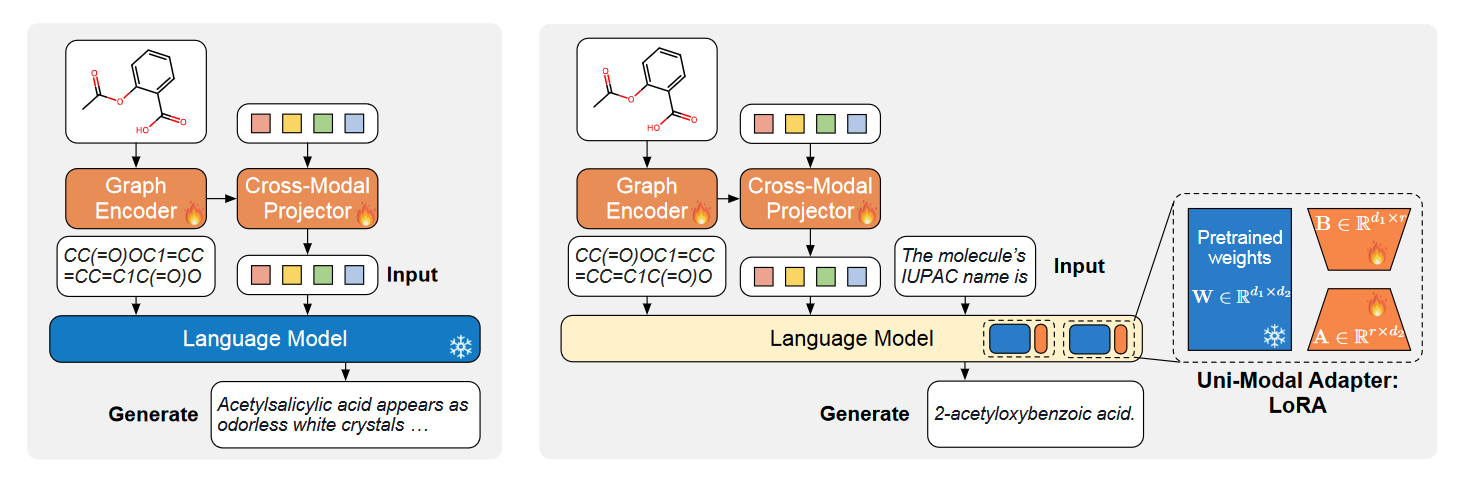
The framework of MolCA.
-
(2023.10) [Arxiv' 2023] GraphGPT: Graph Instruction Tuning for Large Language Models [Paper | Code]
GraphGPT
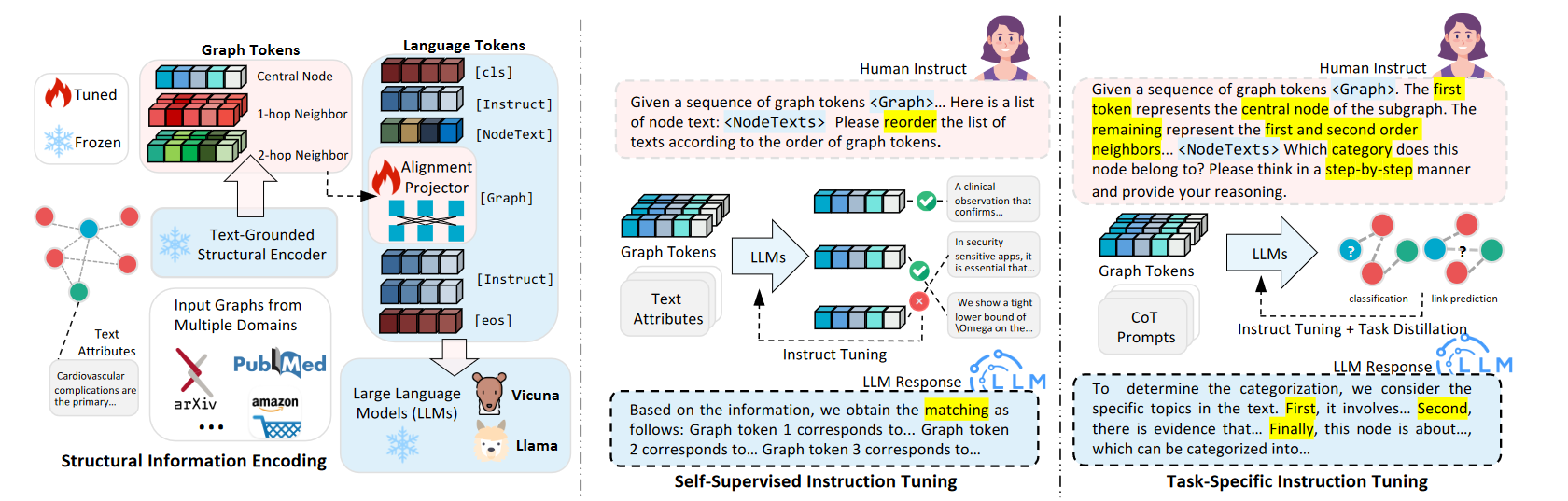
The framework of GraphGPT.
-
(2023.10) [EMNLP' 2023] ReLM: Leveraging Language Models for Enhanced Chemical Reaction Prediction [Paper | Code]
ReLM
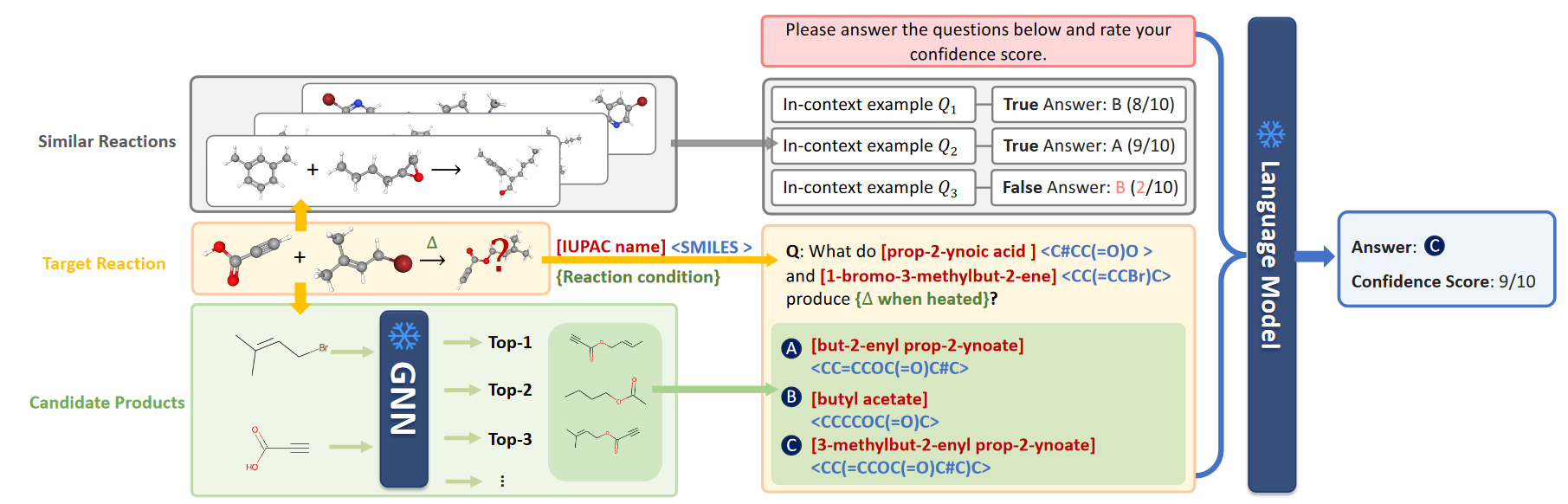
The framework of ReLM.
-
(2023.10) [Arxiv' 2023] LLM4DyG: Can Large Language Models Solve Problems on Dynamic Graphs? [Paper]
LLM4DyG
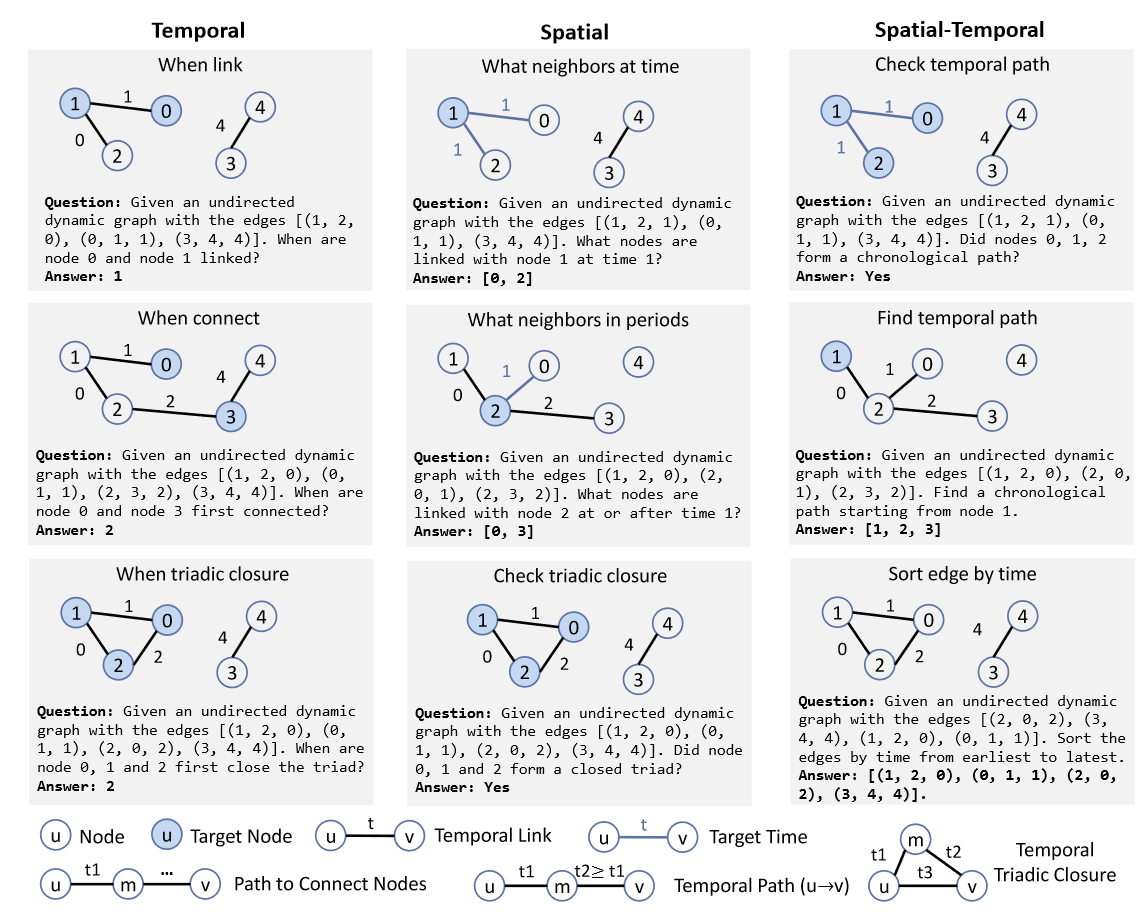
The framework of LLM4DyG.
-
(2023.10) [Arxiv' 2023] Disentangled Representation Learning with Large Language Models for Text-Attributed Graphs [Paper]
DGTL
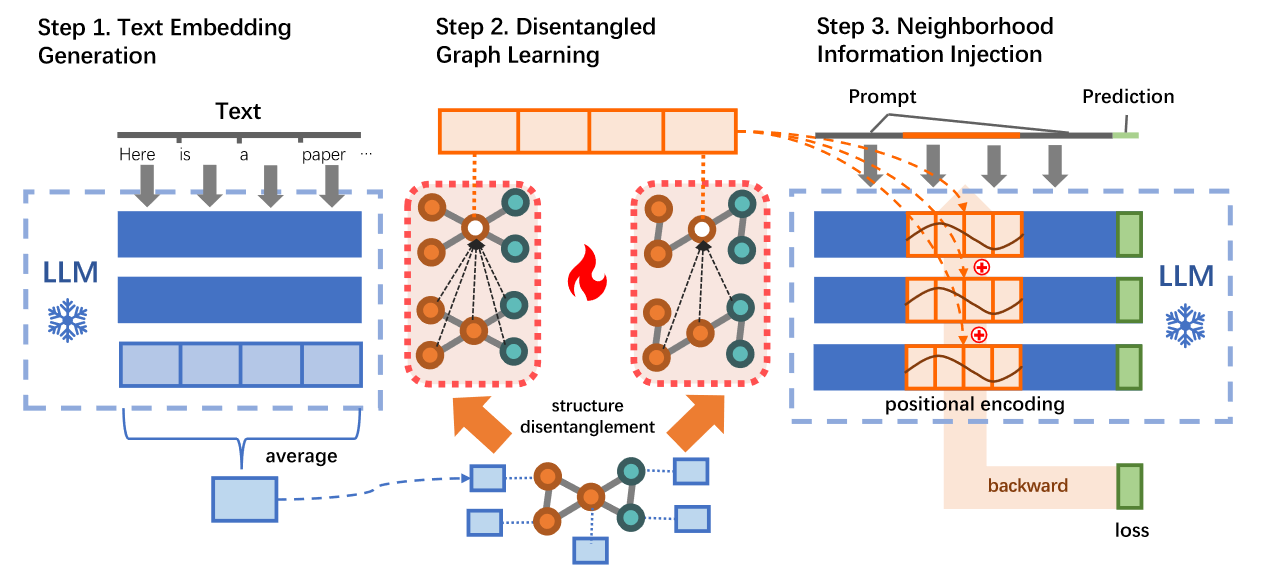
The framework of DGTL.
-
(2023.11) [Arxiv' 2023] Which Modality should I use -- Text, Motif, or Image? : Understanding Graphs with Large Language Models [Paper]
Framework
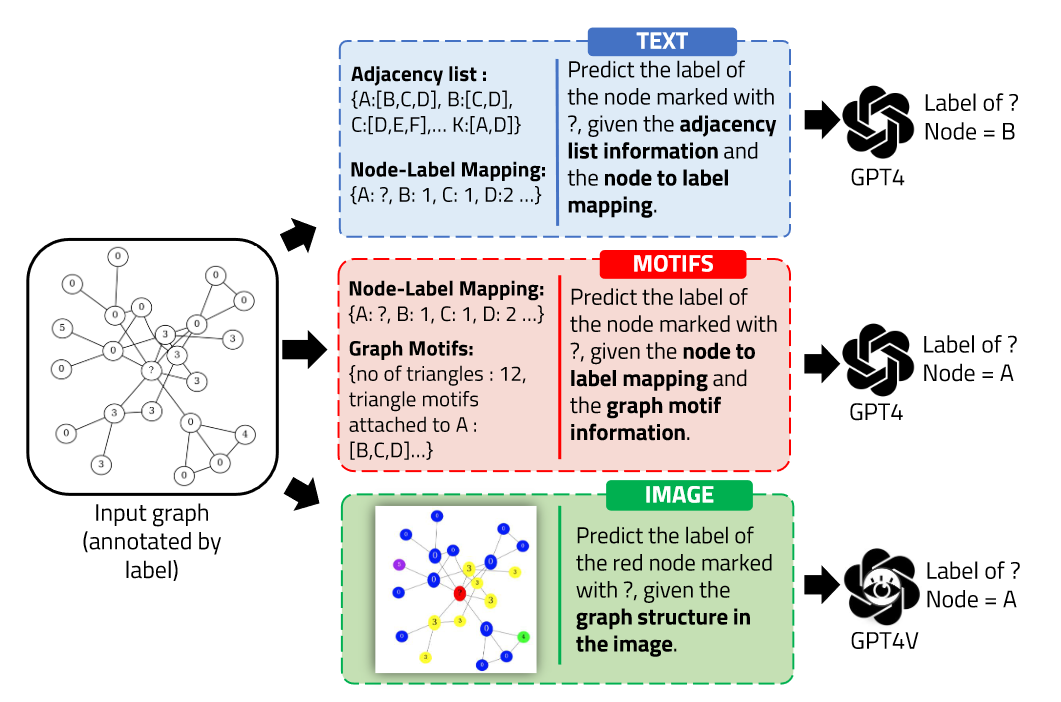
The framework of Das et al.
-
(2023.11) [Arxiv' 2023] InstructMol: Multi-Modal Integration for Building a Versatile and Reliable Molecular Assistant in Drug Discovery [Paper]
InstructMol
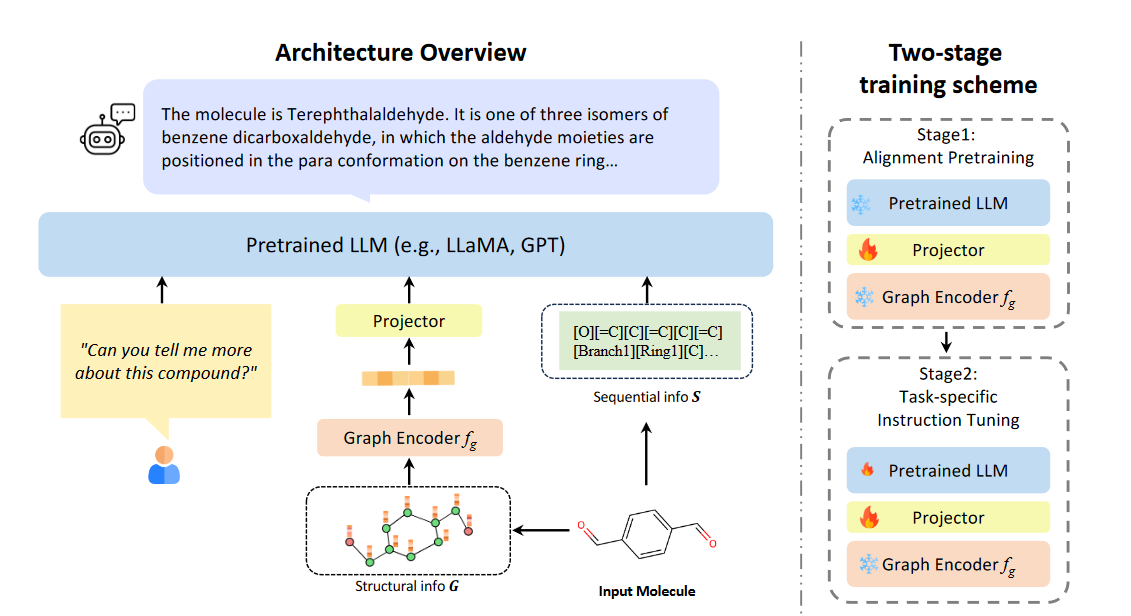
The framework of InstructMol.
-
(2023.12) [Arxiv' 2023] When Graph Data Meets Multimodal: A New Paradigm for Graph Understanding and Reasoning [Paper]
Framework
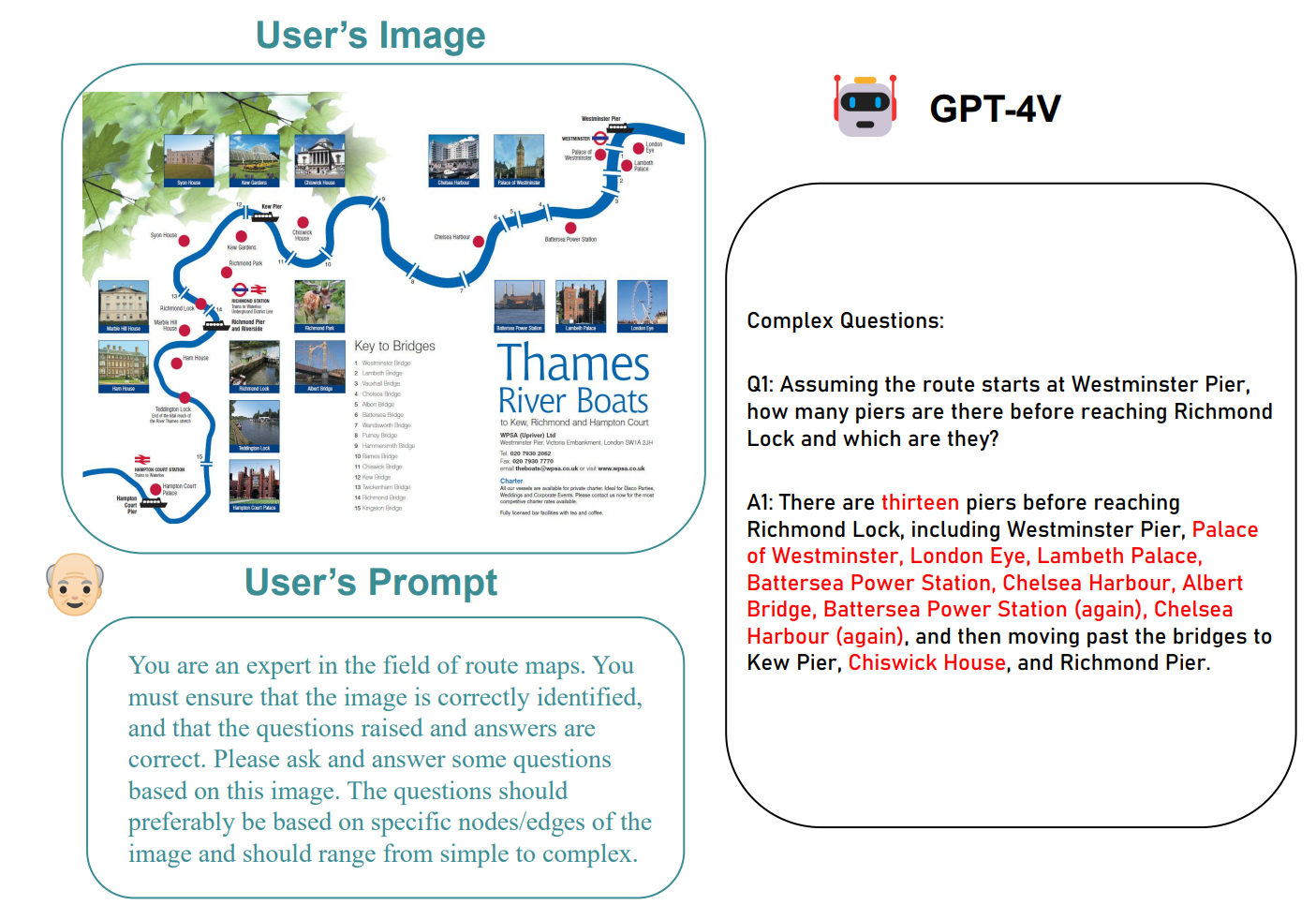
The framework of Ai et al.
-
(2024.02) [Arxiv' 2024] Let Your Graph Do the Talking: Encoding Structured Data for LLMs [Paper]
GraphToken
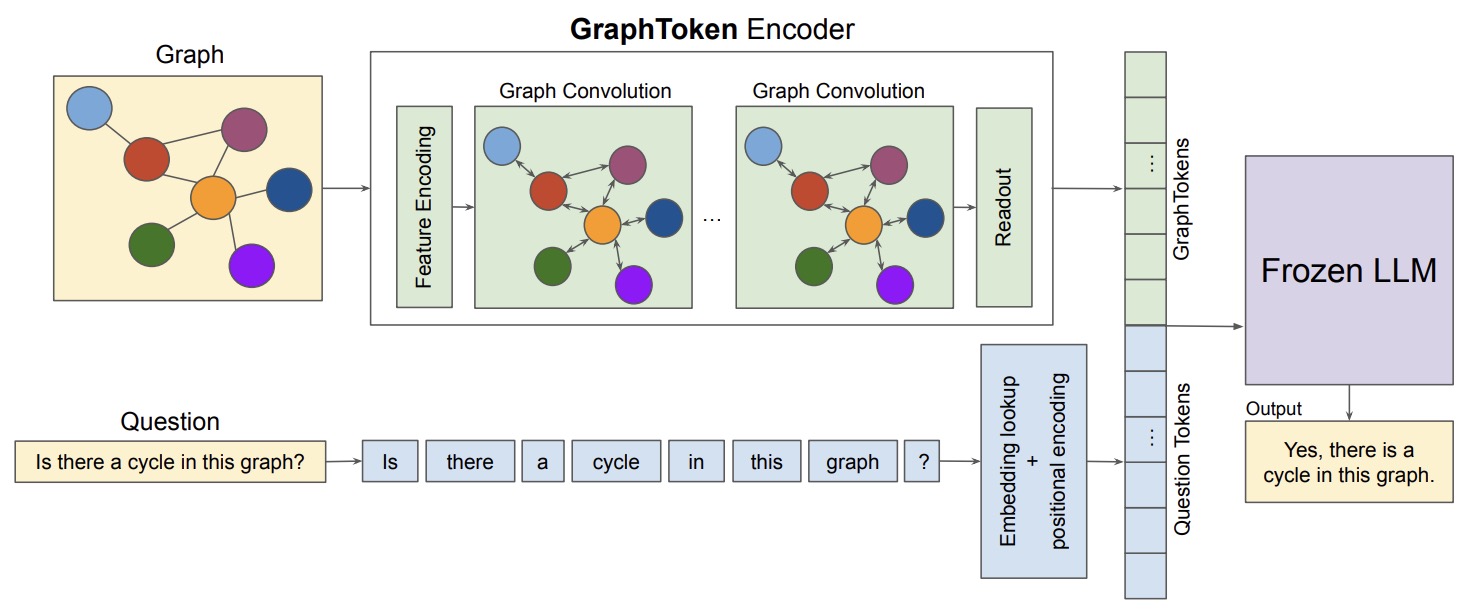
The framework of GraphToken.
-
(2024.02) [Arxiv' 2024] Rendering Graphs for Graph Reasoning in Multimodal Large Language Models [Paper]
GITA
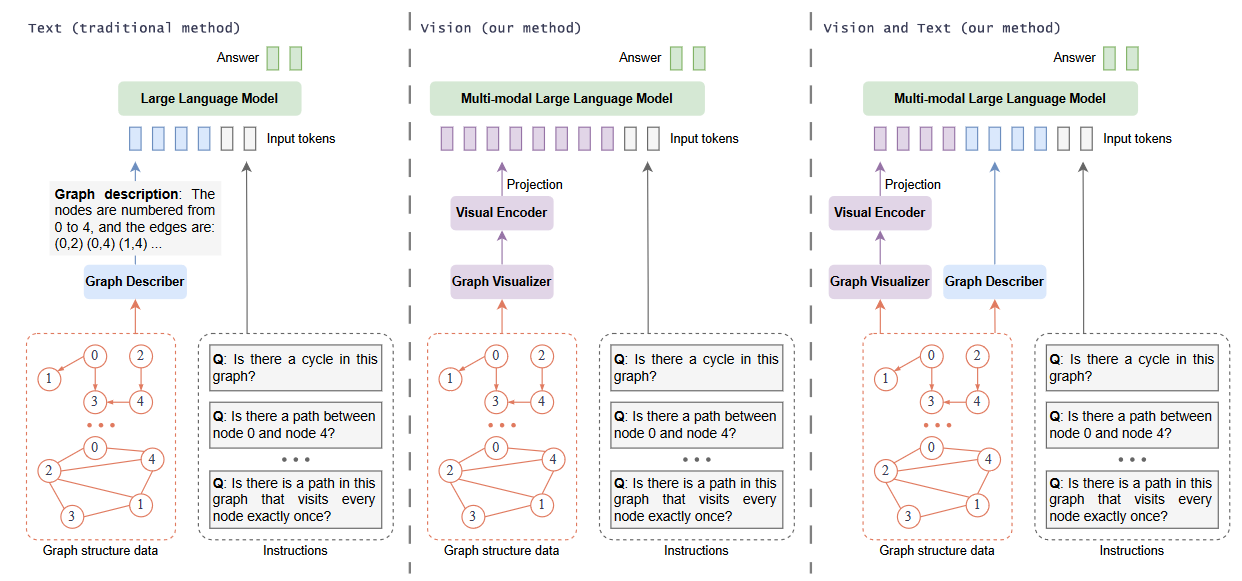
The framework of GITA.
-
(2024.02) [WWW' 2024] GraphTranslator: Aligning Graph Model to Large Language Model for Open-ended Tasks [Paper | Code]
GraphTranslator
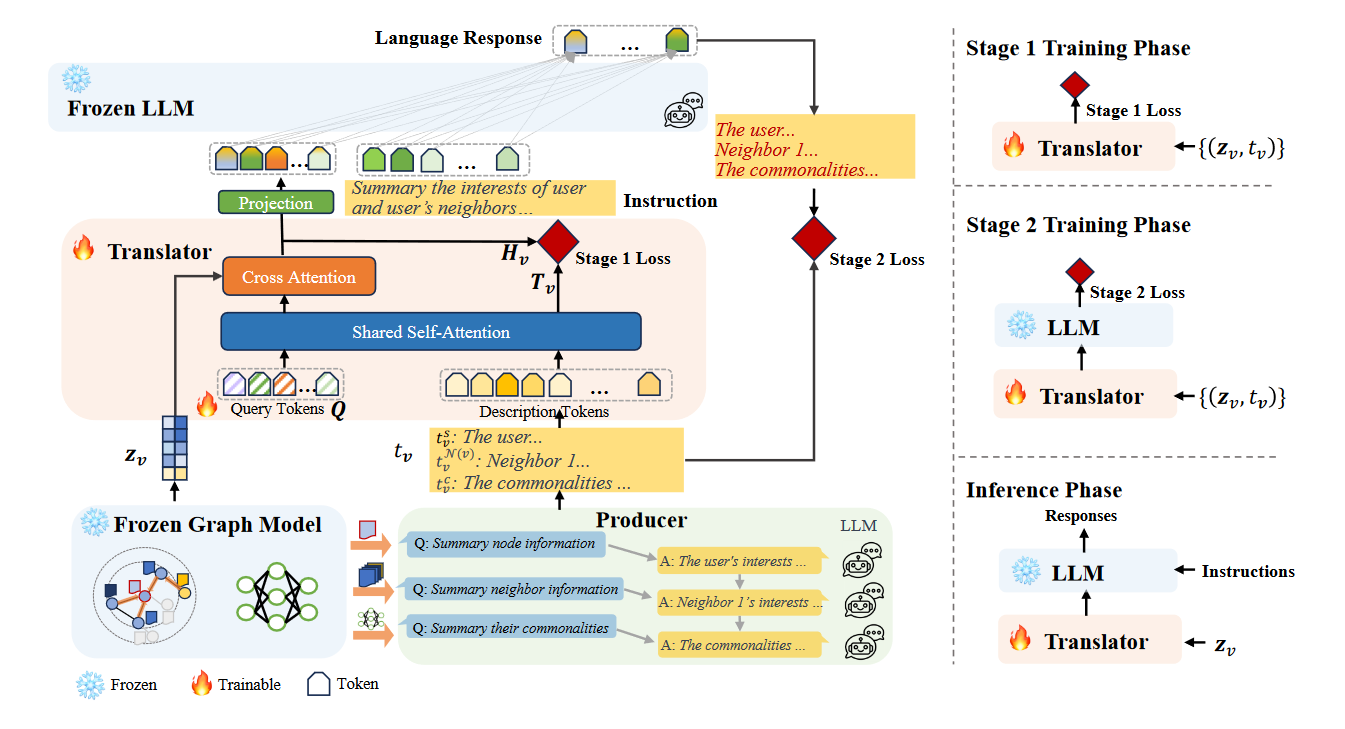
The framework of GraphTranslator.
-
(2024.02) [Arxiv' 2024] InstructGraph: Boosting Large Language Models via Graph-centric Instruction Tuning and Preference Alignment [Paper | Code]
InstructGraph
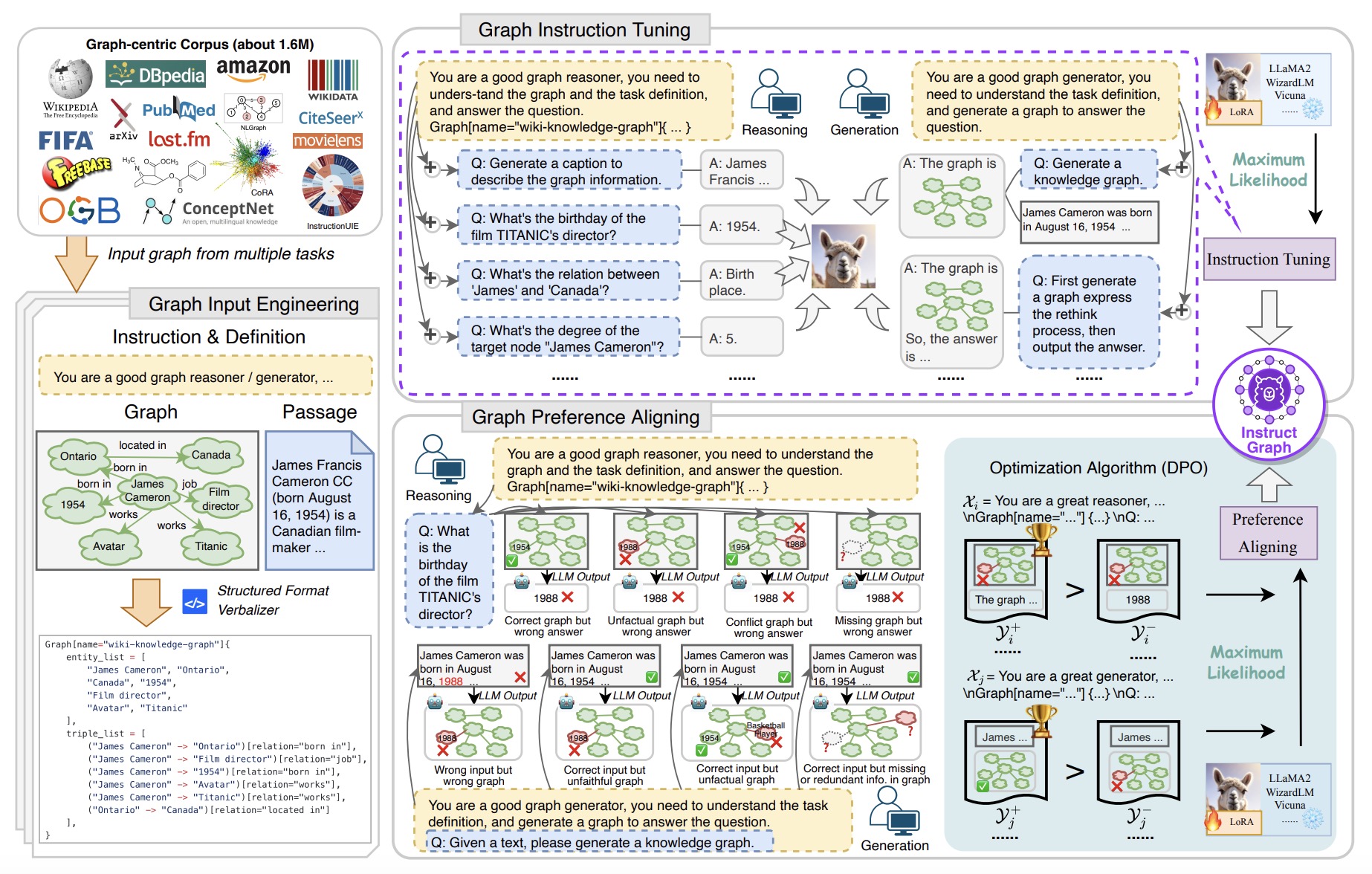
The framework of InstructGraph.
-
(2024.02) [Arxiv' 2024] LLaGA: Large Language and Graph Assistant [Paper | Code]
LLaGA
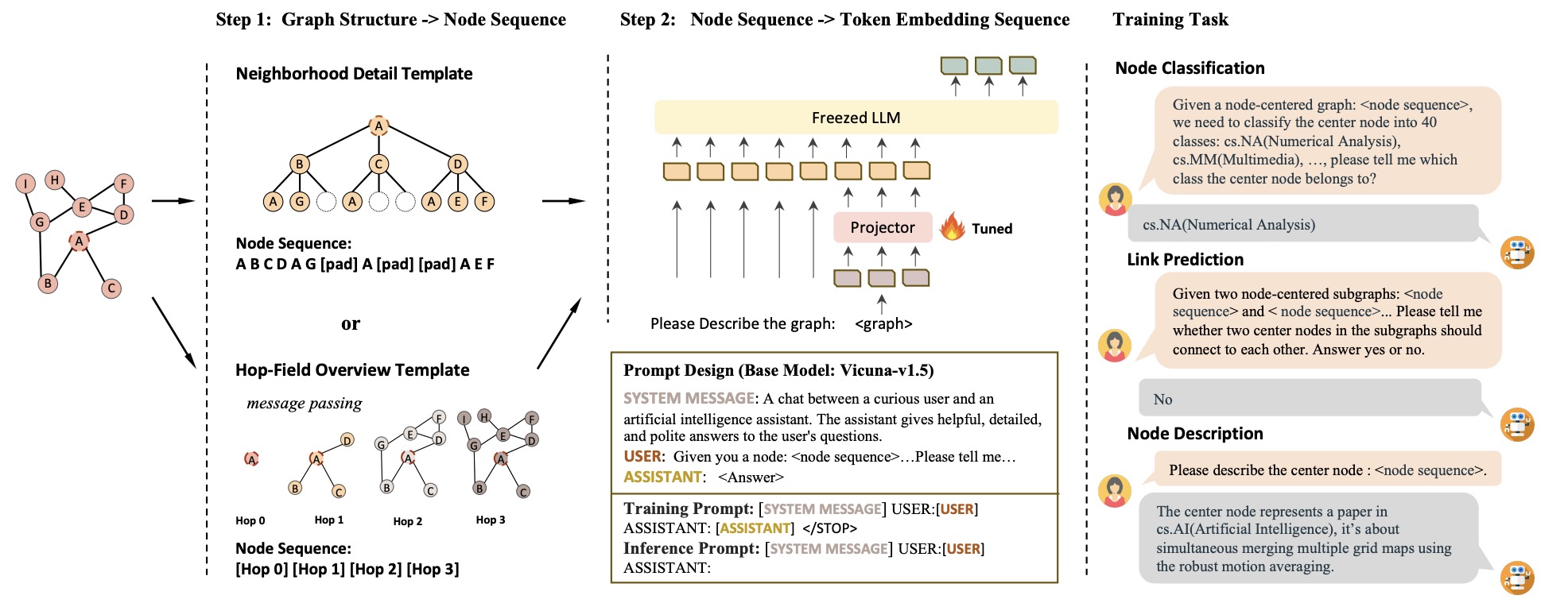
The framework of LLaGA.
-
(2024.02) [WWW' 2024] Can GNN be Good Adapter for LLMs? [Paper]
GraphAdapter
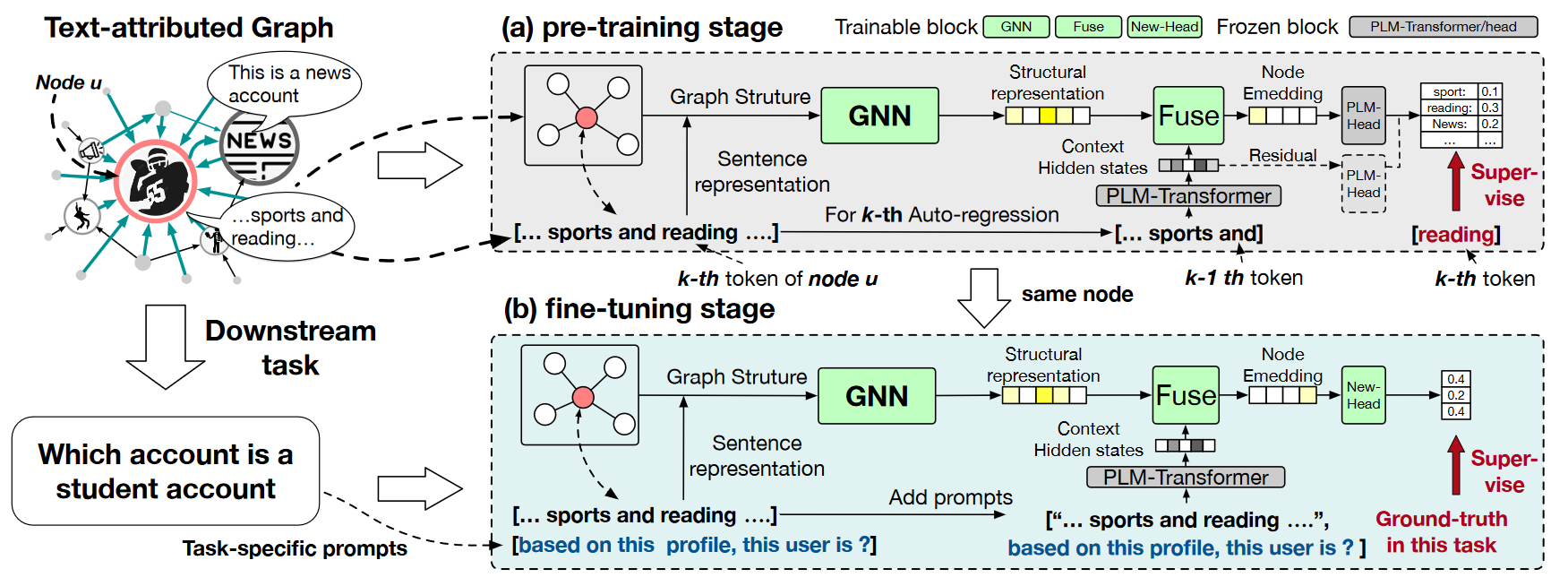
The framework of GraphAdapter.
-
(2024.02) [Arxiv' 2024] HiGPT: Heterogeneous Graph Language Model [Paper | Code]
HiGPT
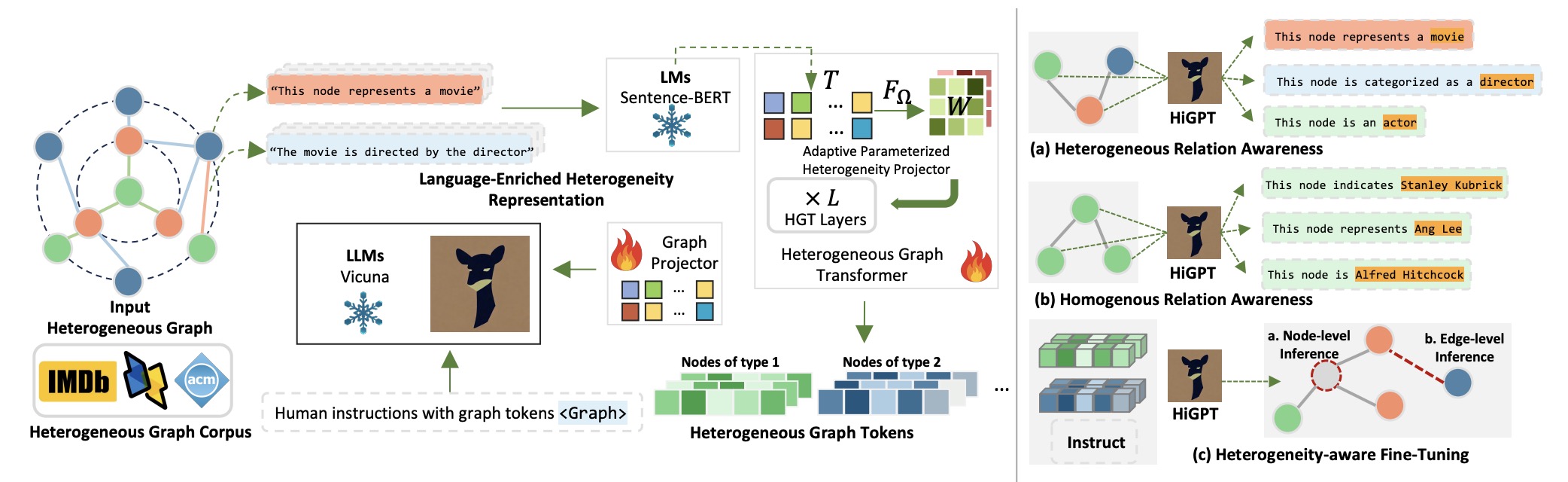
The framework of HiGPT.
-
(2024.02) [Arxiv' 2024] GraphWiz: An Instruction-Following Language Model for Graph Problems [Paper | Code]
GraphWiz
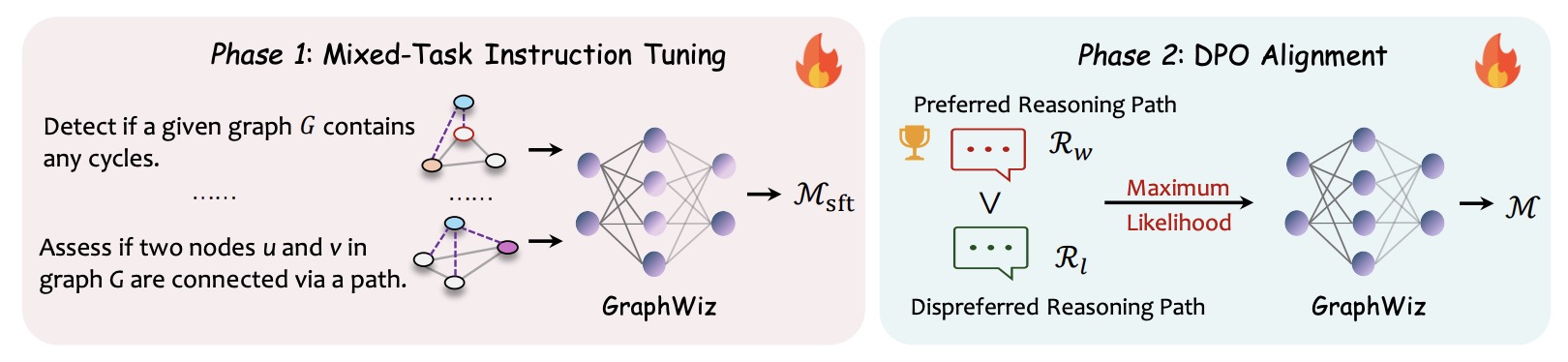
The framework of GraphWiz.
-
(2024.03) [Arxiv' 2024] OpenGraph: Towards Open Graph Foundation Models [Paper | Code]
OpenGraph

The framework of OpenGraph.
-
(2024.07) [Arxiv' 2024] GOFA: A Generative One-For-All Model for Joint Graph Language Modeling [Paper | Code]
GOFA
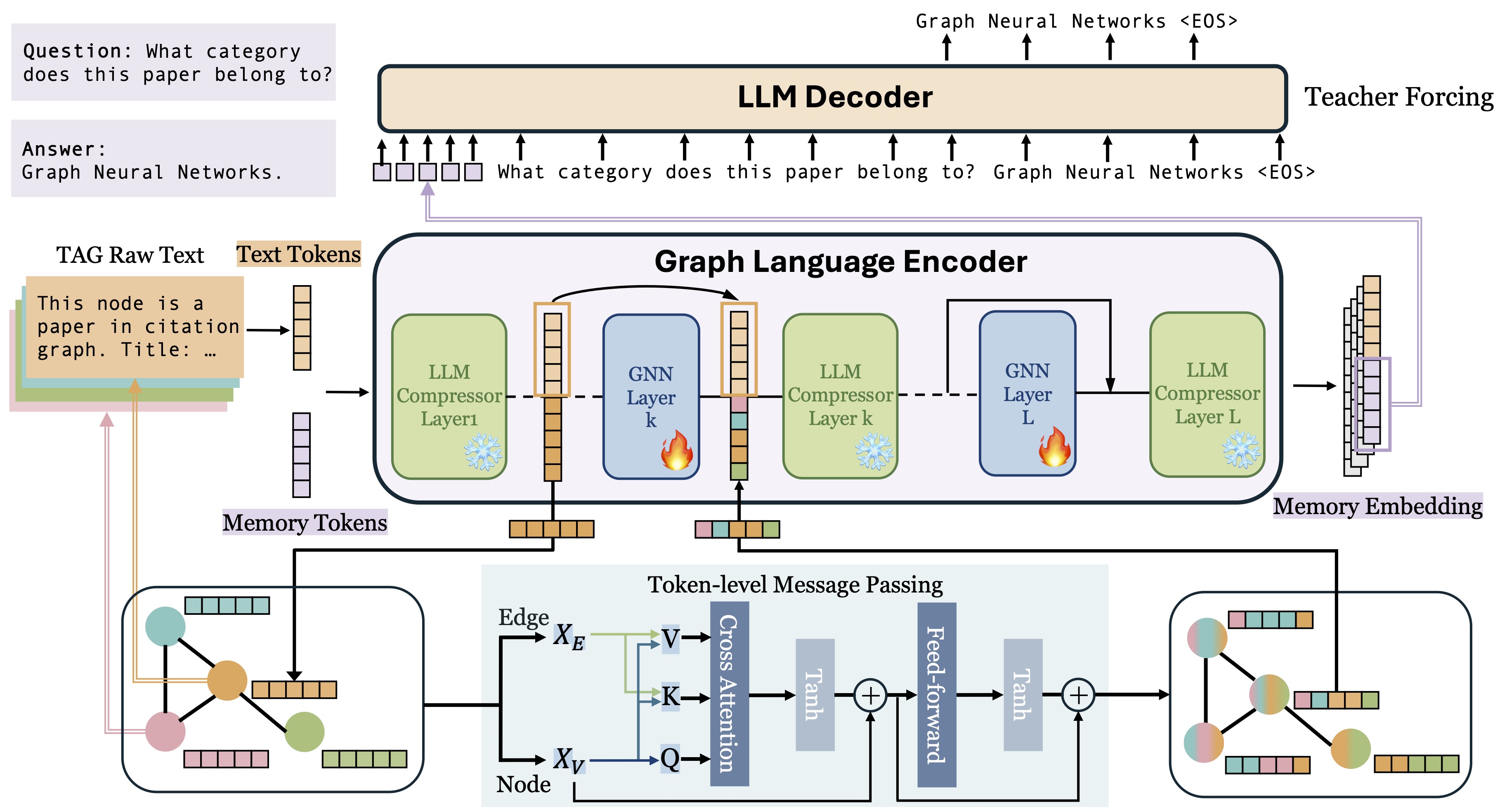
The framework of GOFA.
-
(2024.10) [Arxiv' 2024] Can Graph Descriptive Order Affect Solving Graph Problems with LLMs? [Paper]
GraphDO
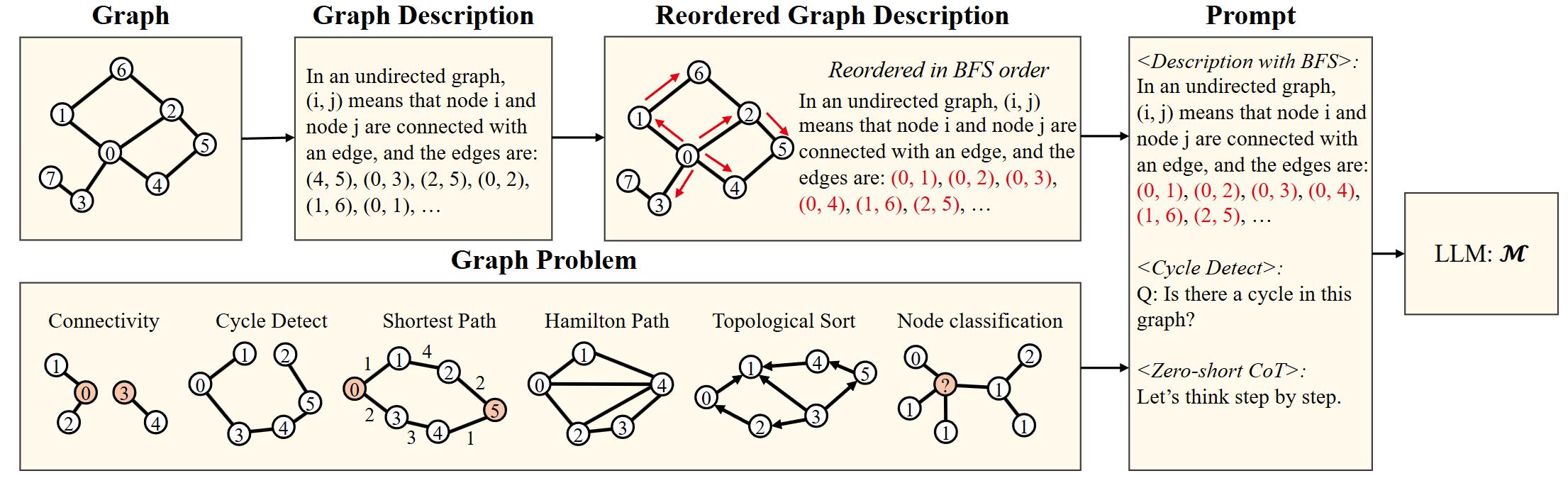
The framework of GraphDO.
GNN-LLM Alignment
- (2020.08) [Arxiv' 2020] Graph-based Modeling of Online Communities for Fake News Detection [Paper | Code]
SAFER
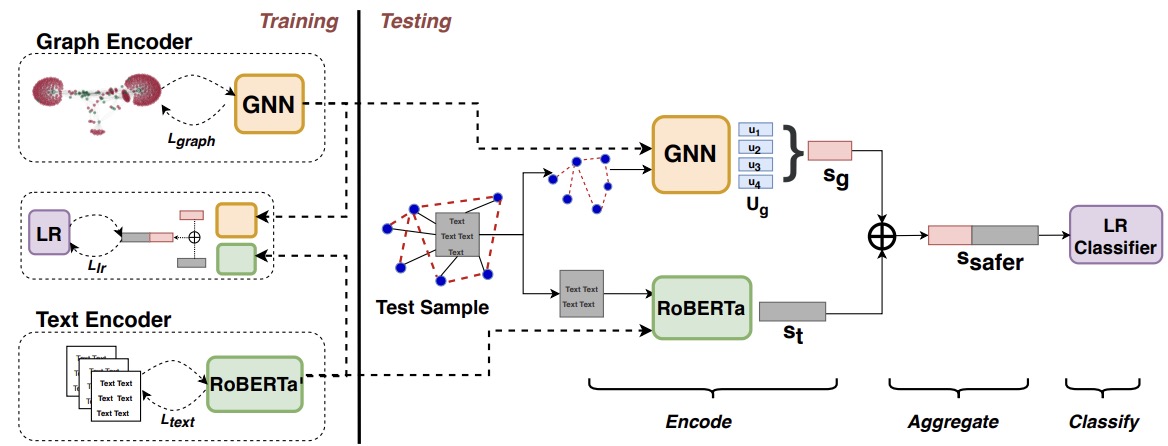
The framework of SAFER.
- (2021.05) [NeurIPS' 2021] GraphFormers: GNN-nested Transformers for Representation Learning on Textual Graph [Paper | Code]
GraphFormers
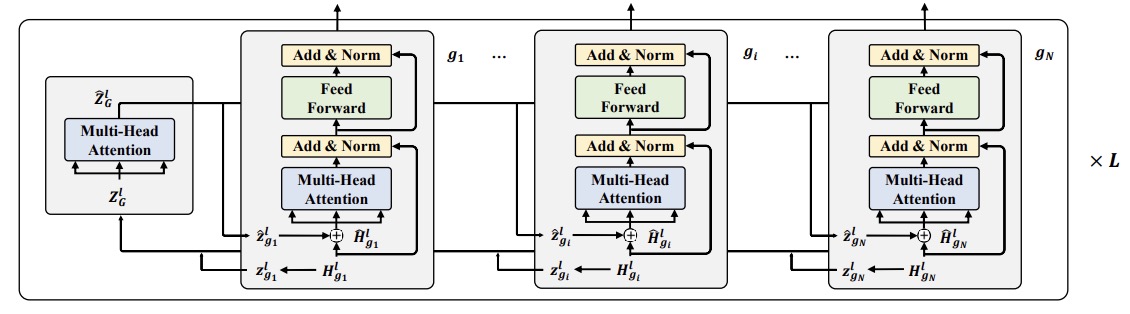
The framework of GraphFormers.
- (2021.11) [EMNLP' 2021] Text2Mol: Cross-Modal Molecule Retrieval with Natural Language Queries
[Paper | Code]
Text2Mol
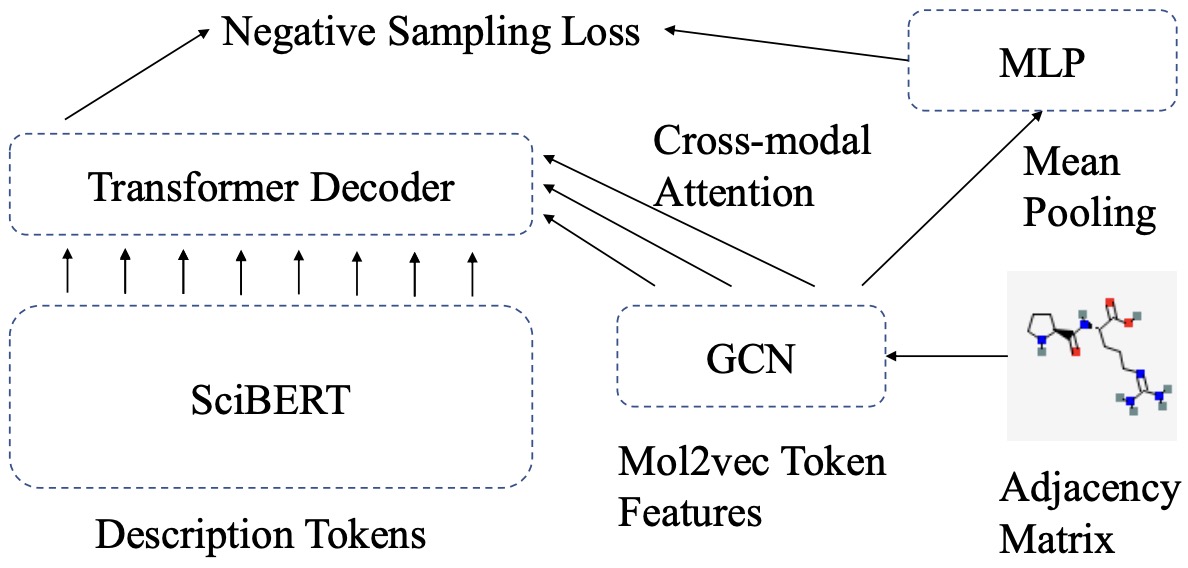
The framework of Text2Mol.
- (2022.07) [ACL' 2023] Hidden Schema Networks
[Paper | Code]
HSN
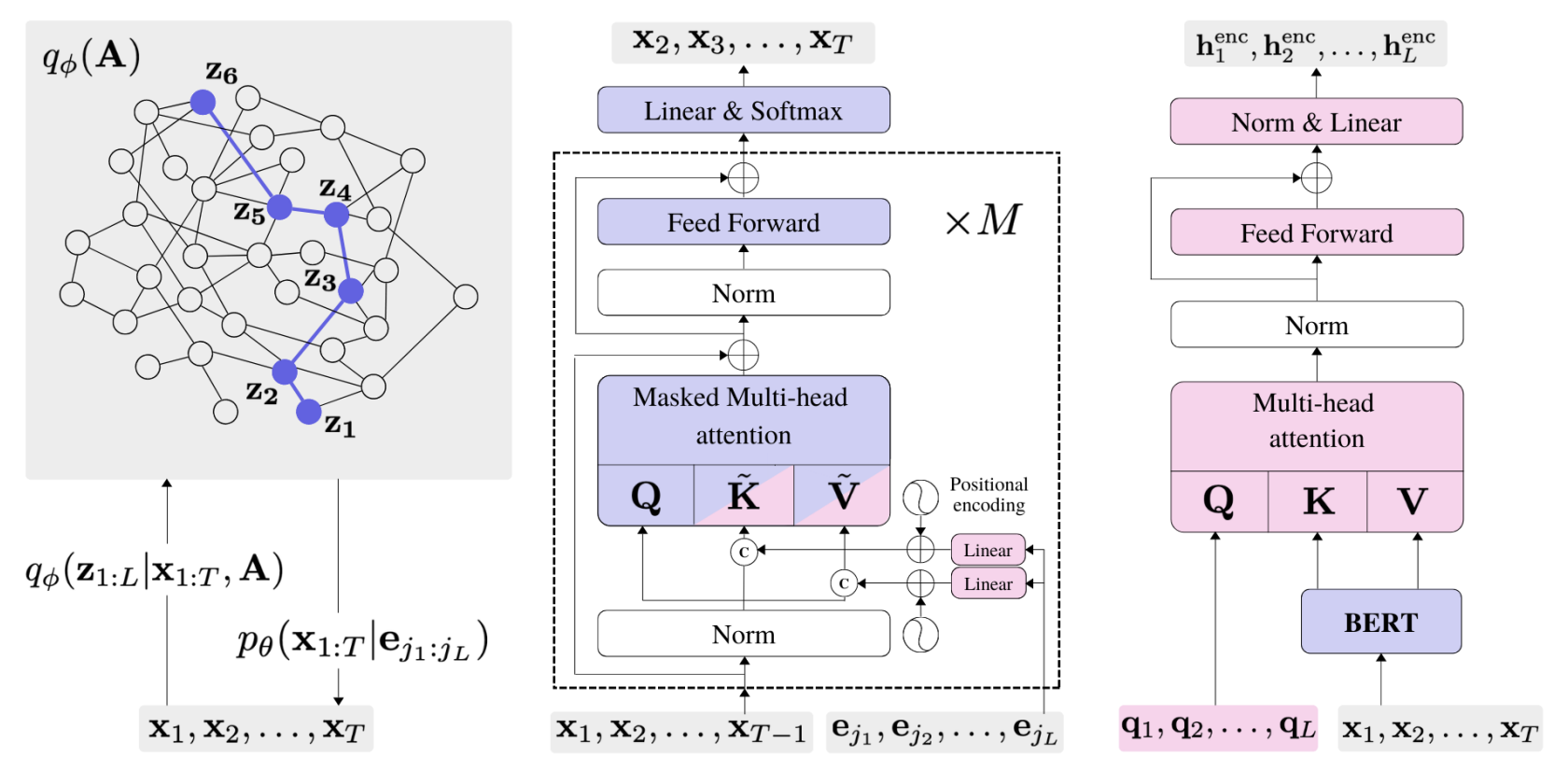
The framework of HSN.
- (2022.09) [Arxiv' 2022] A Molecular Multimodal Foundation Model Associating Molecule Graphs with Natural Language
[Paper | Code]
MoMu
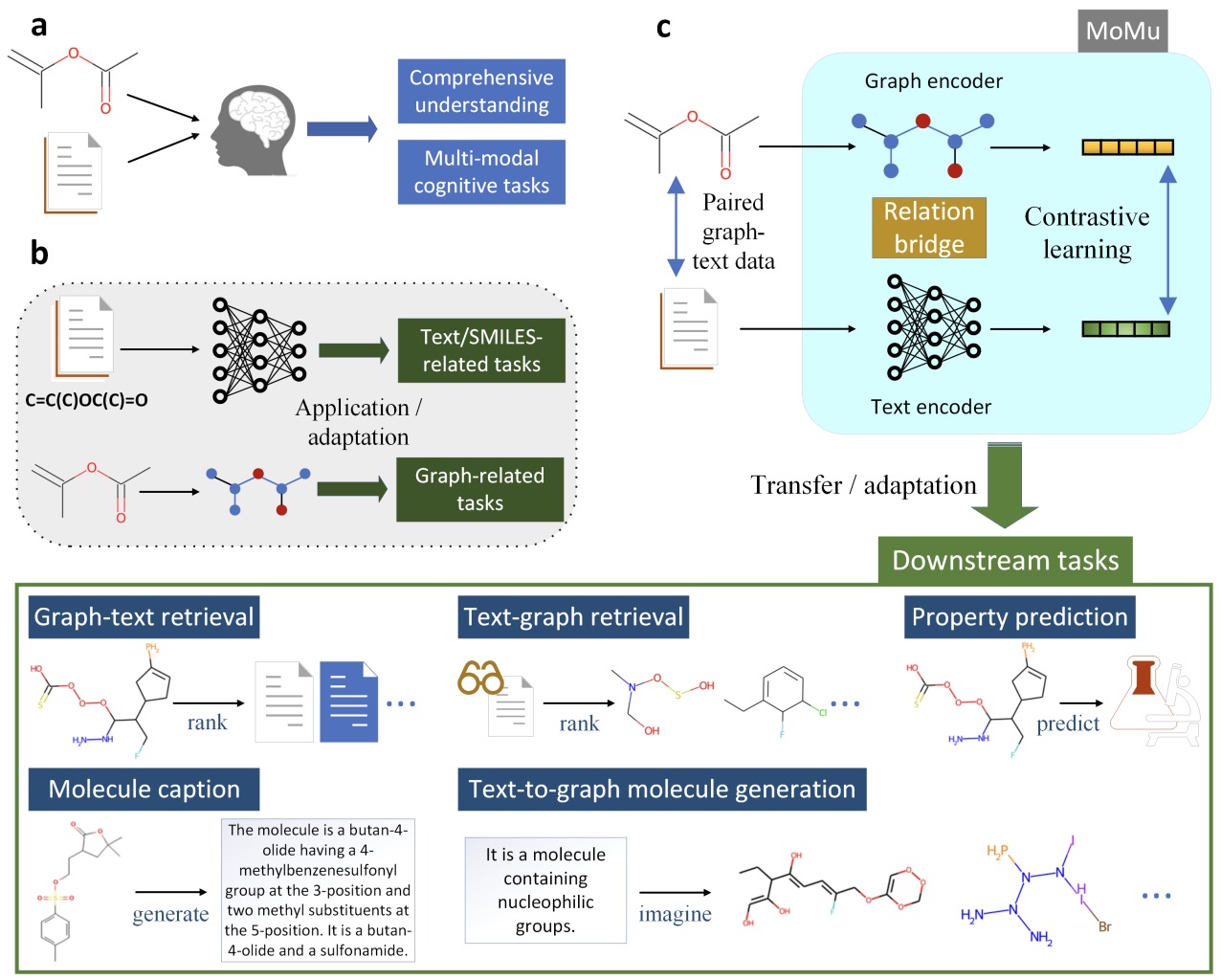
The framework of MoMu.
- (2022.10) [ICLR' 2023] Learning on Large-scale Text-attributed Graphs via Variational Inference
[Paper | Code]
GLEM
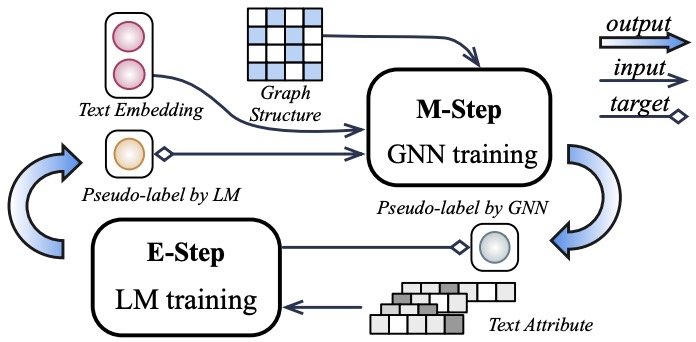
The framework of GLEM.
- (2022.12) [NMI' 2023] Multi-modal Molecule Structure-text Model for Text-based Editing and Retrieval
[Paper | Code]
MoleculeSTM
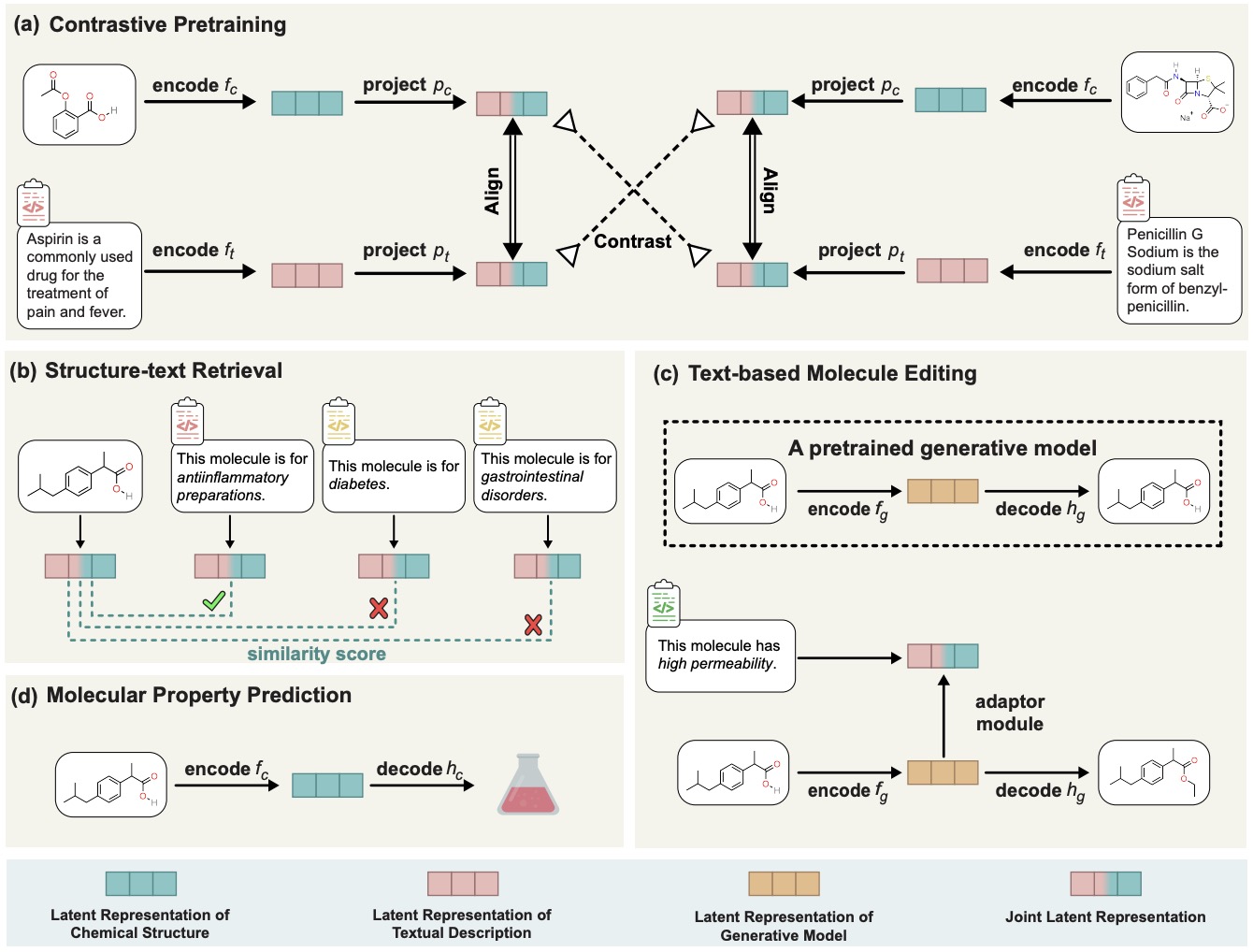
The framework of MoleculeSTM.
- (2023.04) [Arxiv' 2023] Train Your Own GNN Teacher: Graph-Aware Distillation on Textual Graphs
[Paper | Code]
GRAD
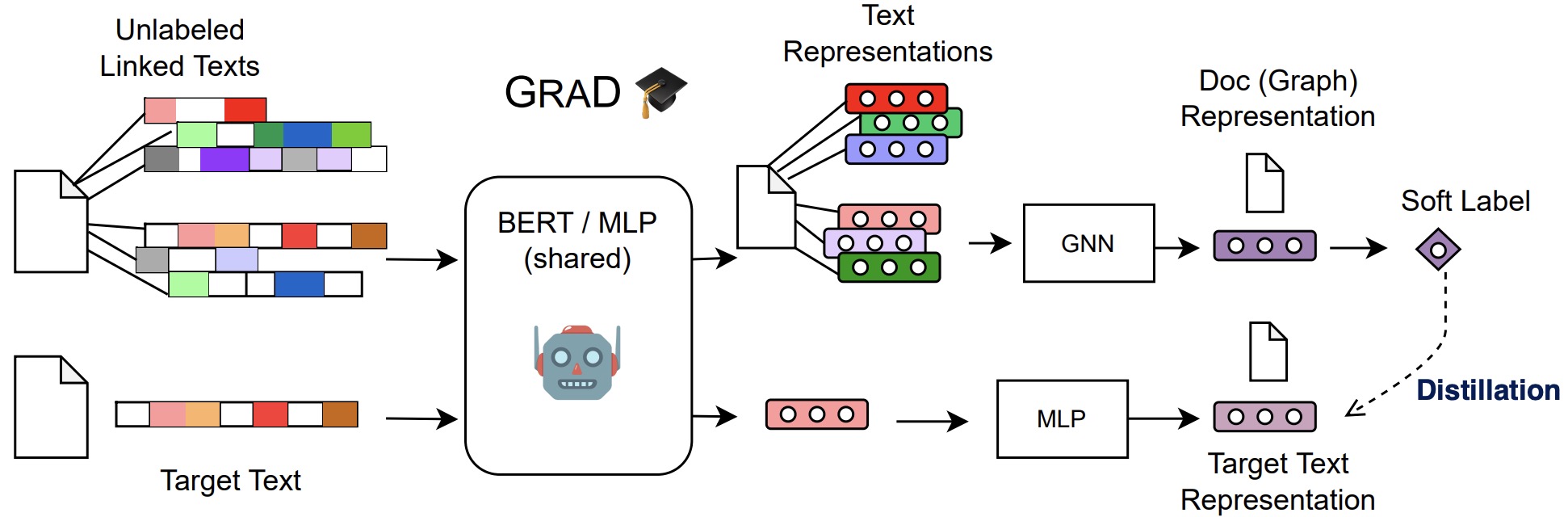
The framework of GRAD.
- (2023.05) [ACL' 2023] PATTON : Language Model Pretraining on Text-Rich Networks
[Paper | Code]
Patton
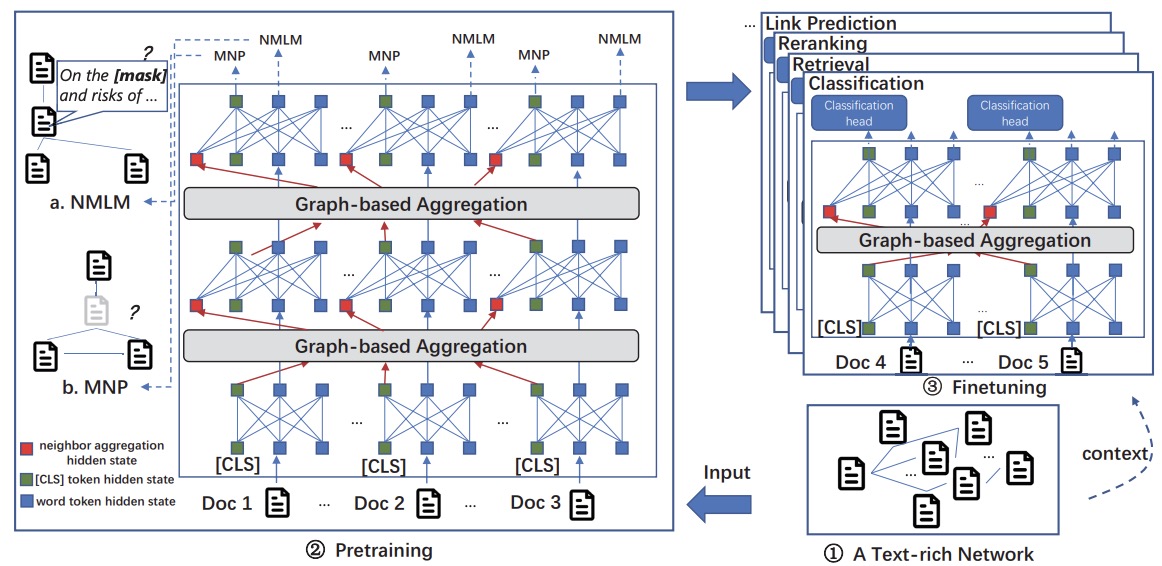
The framework of Patton.
- (2023.05) [Arxiv' 2023] ConGraT: Self-Supervised Contrastive Pretraining for Joint Graph and Text Embeddings
[Paper | Code]
ConGraT
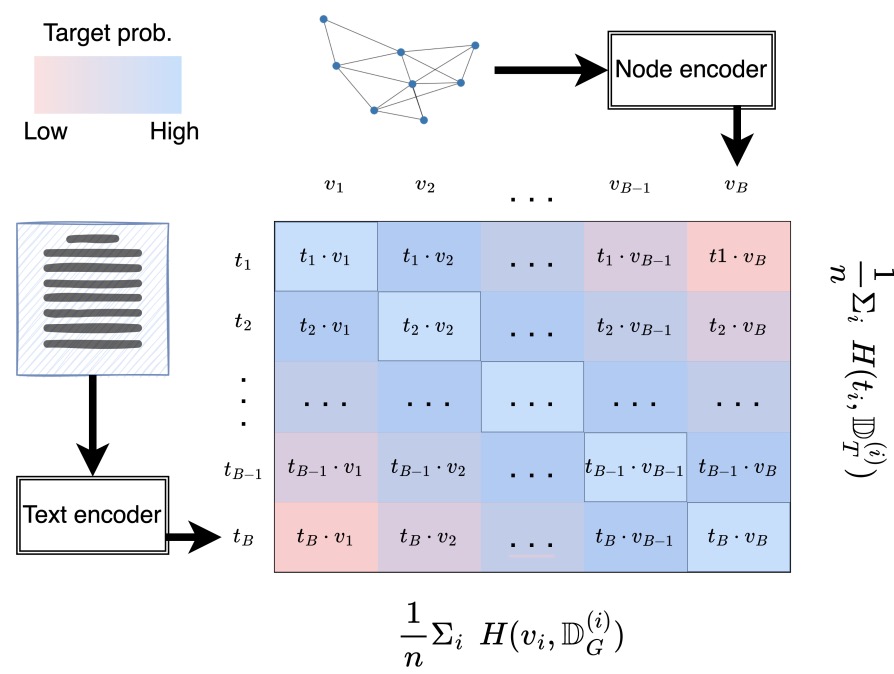
The framework of ConGraT.
- (2023.07) [Arxiv' 2023] Prompt Tuning on Graph-augmented Low-resource Text Classification
[Paper | Code]
G2P2
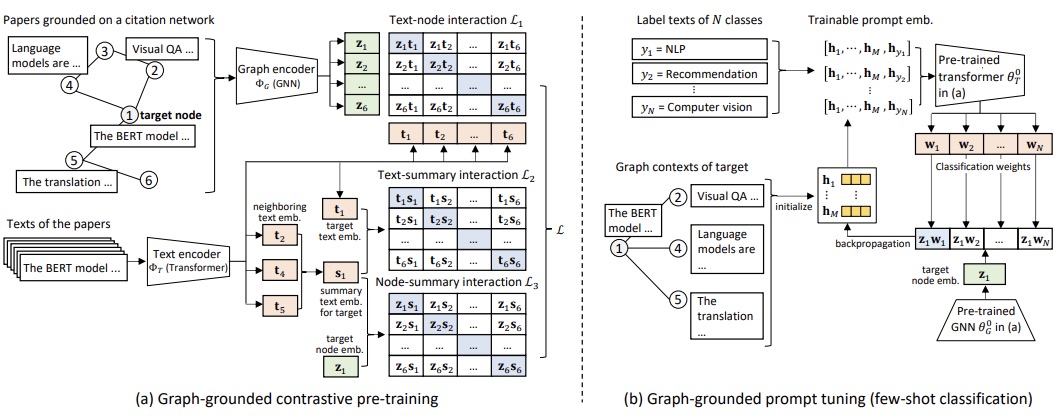
The framework of G2P2.
- (2023.10) [EMNLP' 2023] GRENADE: Graph-Centric Language Model for Self-Supervised Representation Learning on Text-Attributed Graphs
[Paper | Code]
GRENADE
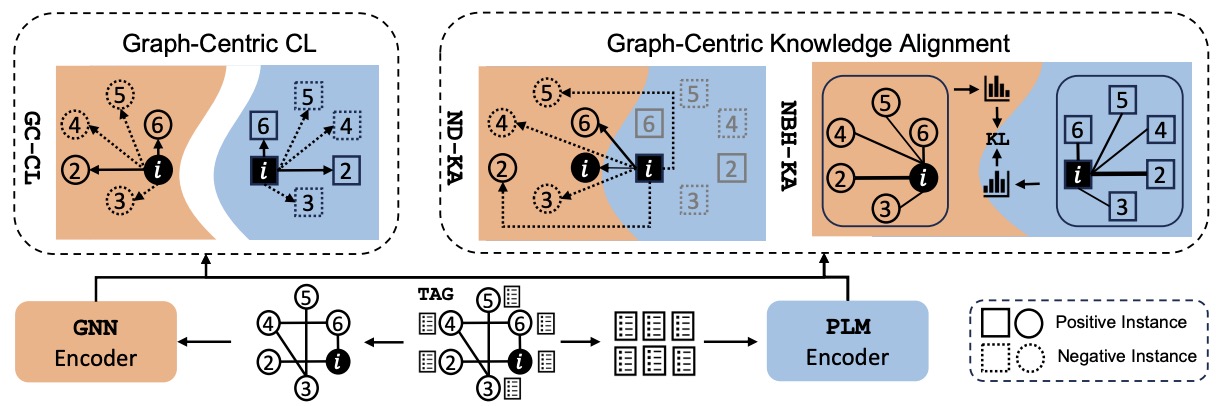
The framework of GRENADE.
- (2023.10) [WWW' 2024] Representation Learning with Large Language Models for Recommendation
[Paper | Code]
RLMRec
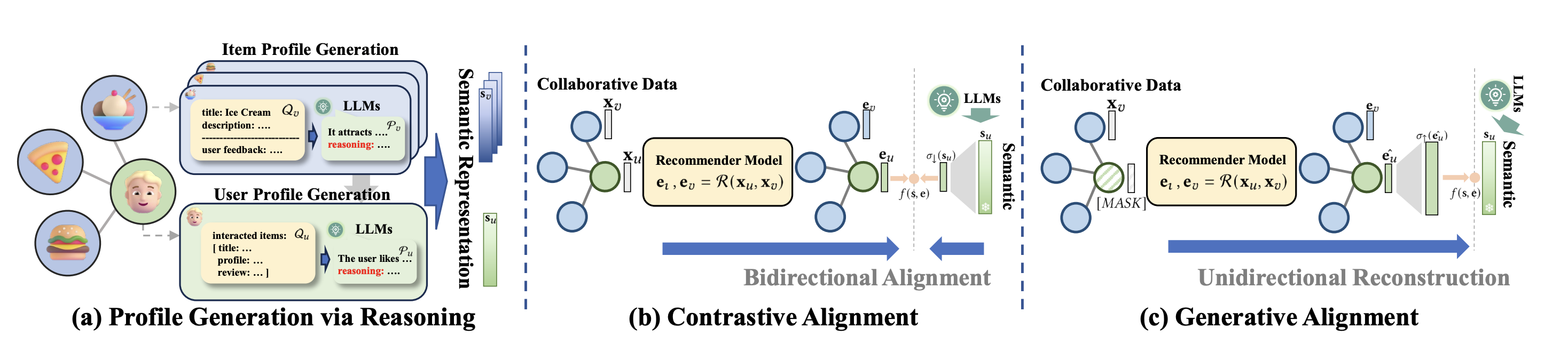
The framework of RLMRec.
- (2023.10) [EMNLP' 2023] Pretraining Language Models with Text-Attributed Heterogeneous Graphs
[Paper | Code]
THLM
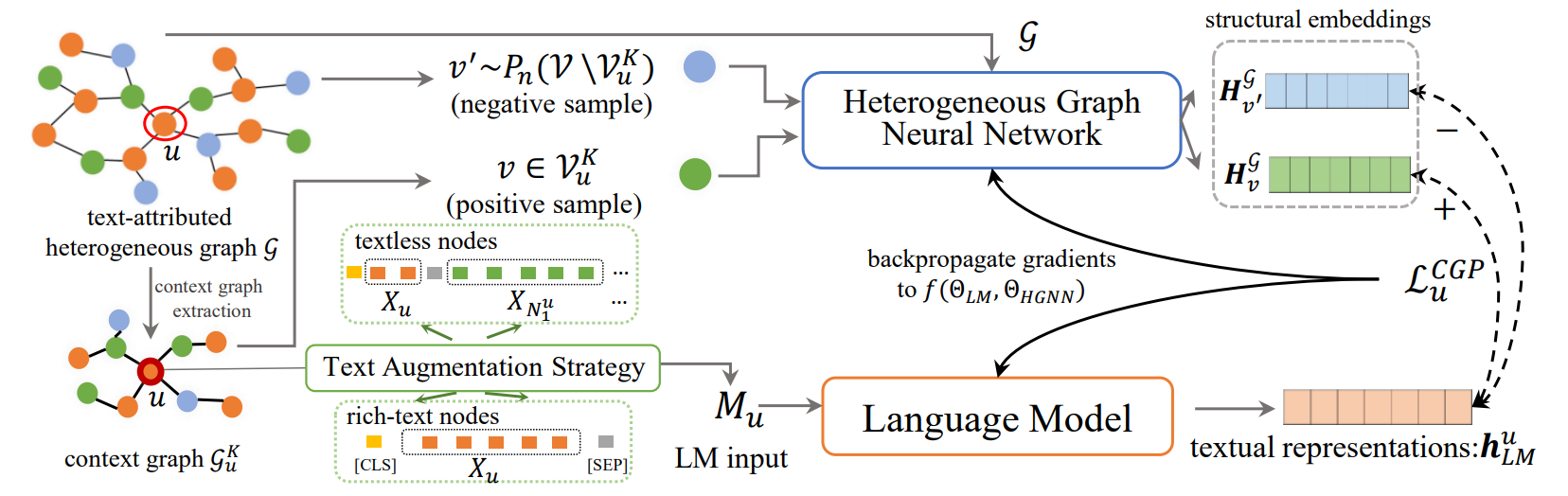
The framework of THLM.
Benchmarks
-
(2025.1) [COLING 2025] GraCoRe: Benchmarking Graph Comprehension and Complex Reasoning in Large Language Models [Paper | Code]
-
(2024.07) [NeurIPS' 2024] GLBench: A Comprehensive Benchmark for Graph with Large Language Models [Paper | Code]
-
(2024.05) [NeurIPS' 2024] TEG-DB: A Comprehensive Dataset and Benchmark of Textual-Edge Graphs [Paper][Code]
Others
LLM as Annotator
-
(2023.10) [ICLR' 2024] Label-free Node Classification on Graphs with Large Language Models (LLMs) [Paper | Code]
LLM-GNN
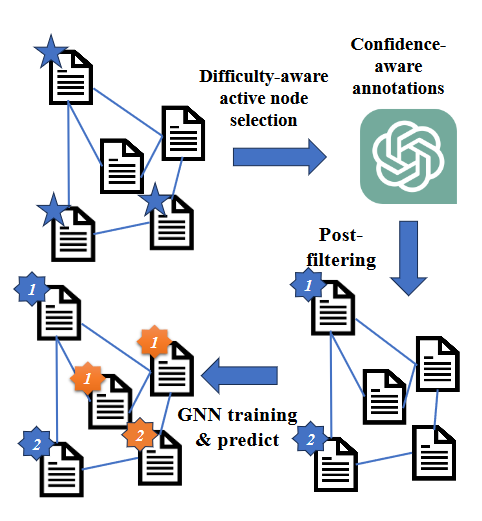
The framework of LLM-GNN.
-
(2024.09) [NeurIPS' 2024] Entity Alignment with Noisy Annotations from Large Language Models [Paper | Code]
LLM4EA
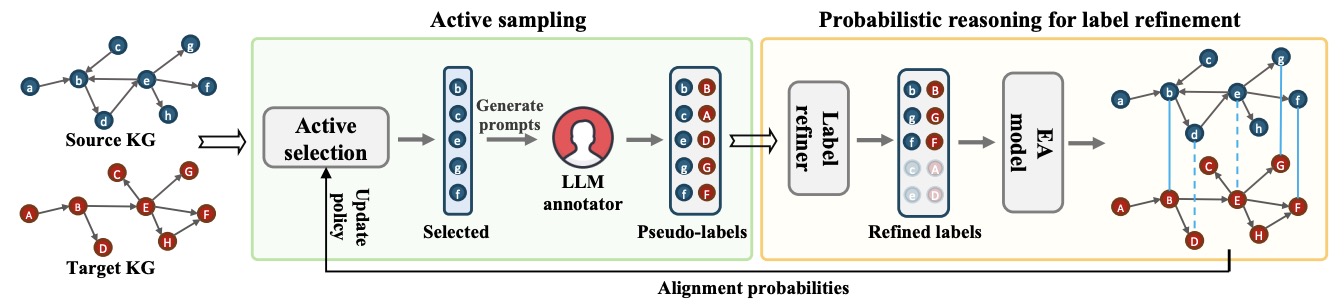
The framework of LLM4EA.
LLM as Controller
- (2023.10) [Arxiv' 2023] Graph Neural Architecture Search with GPT-4 [Paper]
GPT4GNAS
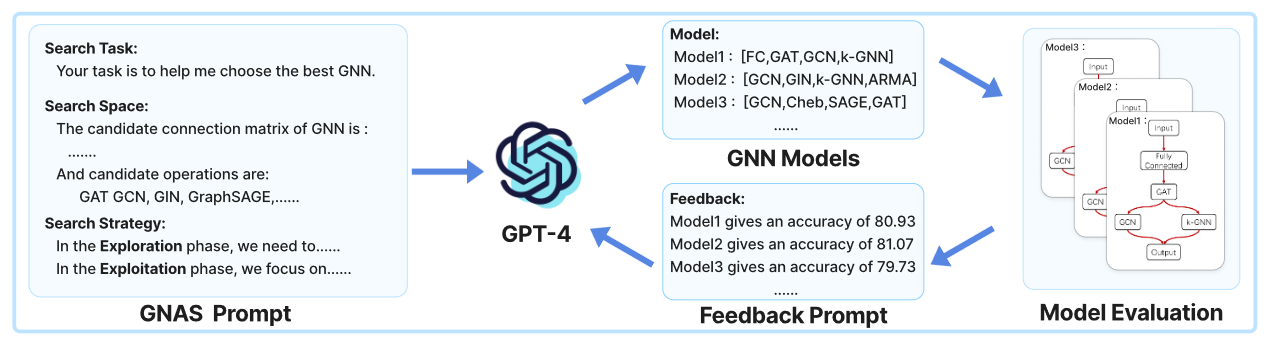
The framework of GPT4GNAS.
LLM as Sample Generator
- (2023.10) [Arxiv' 2023] Empower Text-Attributed Graphs Learning with Large Language Models (LLMs) [Paper]
ENG
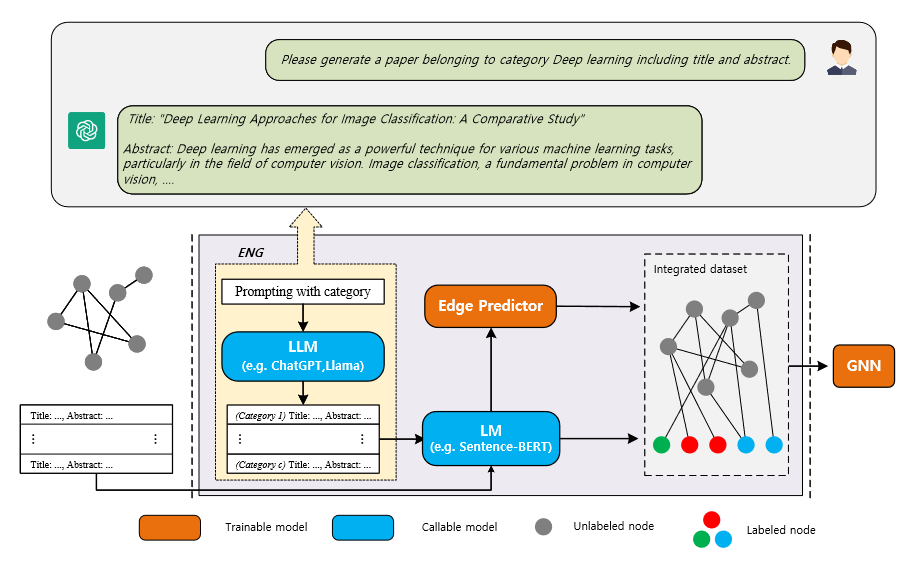
The framework of ENG.
LLM as Similarity Analyzer
- (2023.11) [Arxiv' 2023] Large Language Models as Topological Structure Enhancers for Text-Attributed Graphs [Paper]
Framework
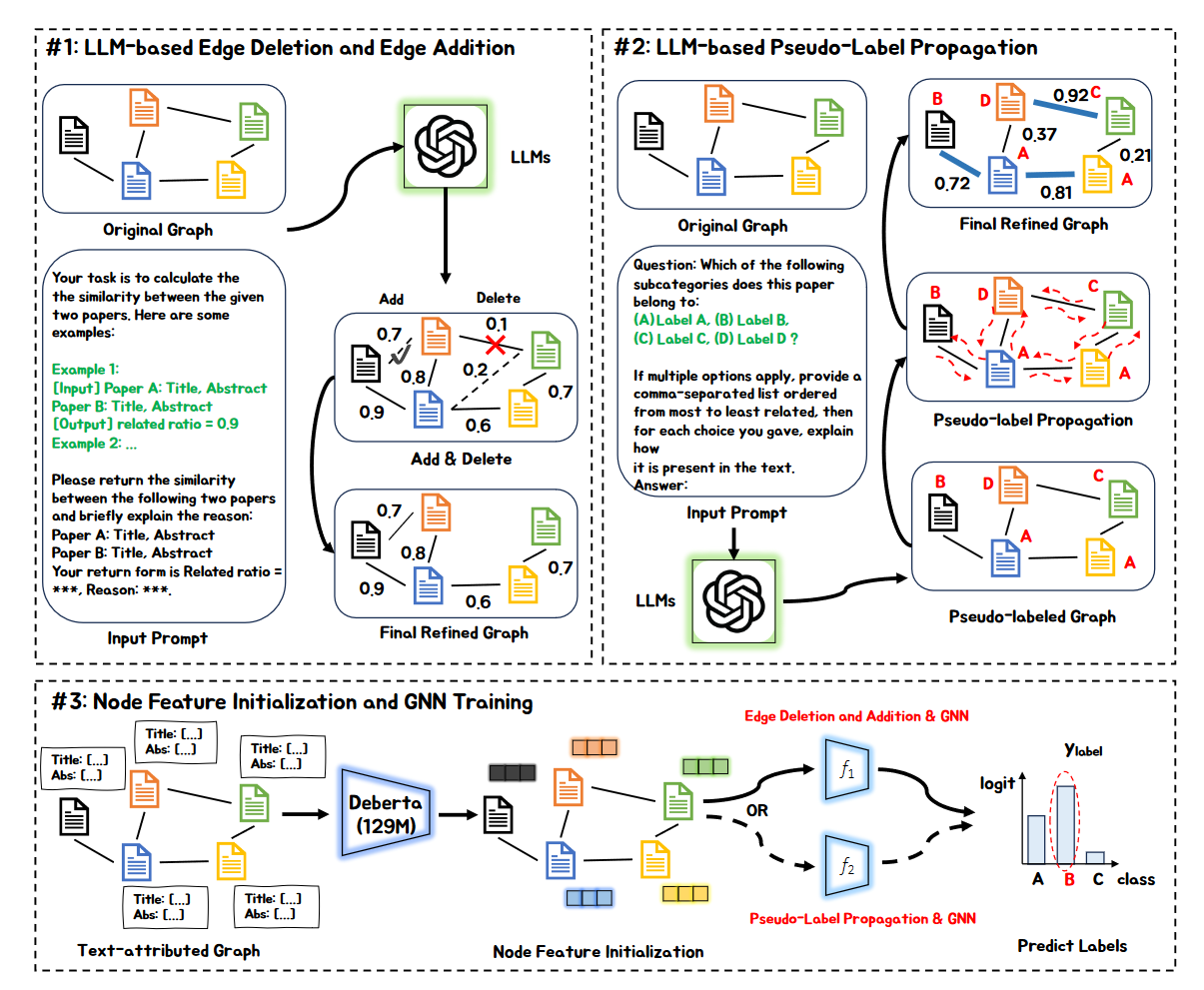
The framework of Sun et al.
LLM for Robustness
-
(2024.05) [Arxiv' 2024] Intruding with Words: Towards Understanding Graph Injection Attacks at the Text Level [Paper]
Lei, et al.
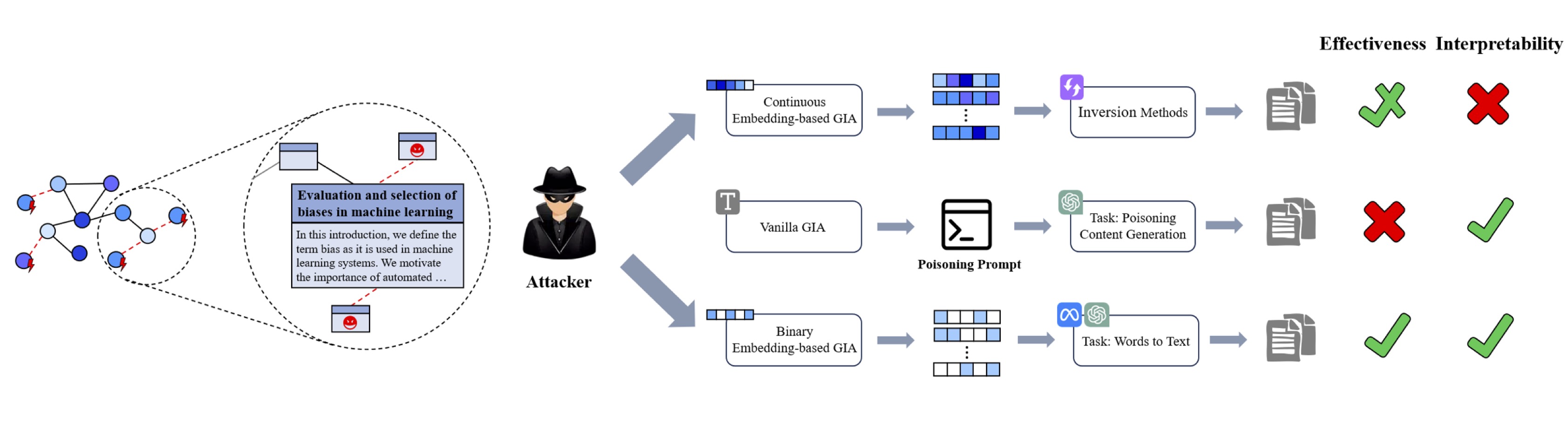
The framework of Lei, et al..
-
(2024.08) [Arxiv' 2024] Can Large Language Models Improve the Adversarial Robustness of Graph Neural Networks? [Paper]
LLM4RGNN
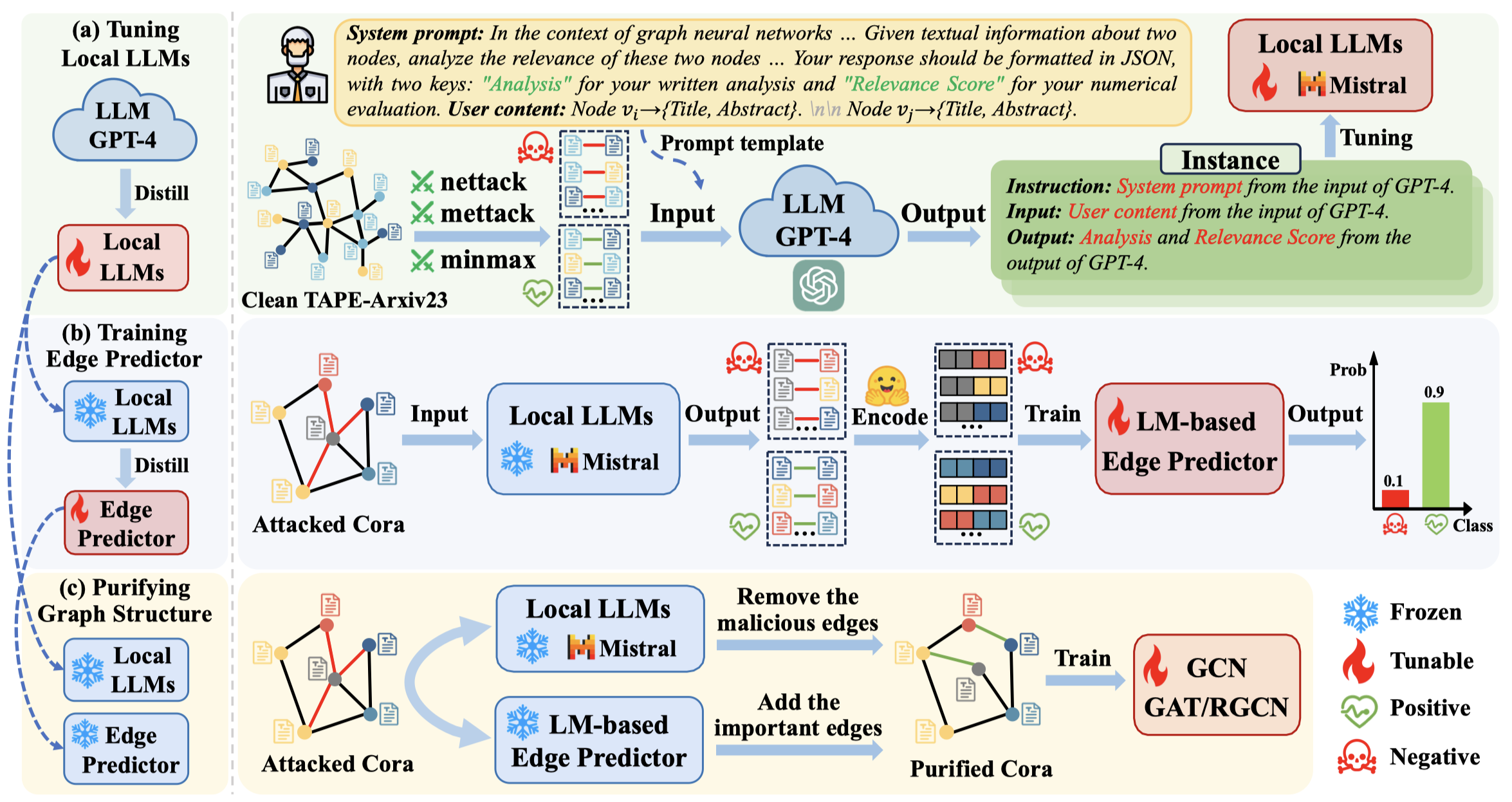
The framework of LLM4RGNN.
LLM for Task Planning
- (2024.05) [NeurIPS' 2024] Can Graph Learning Improve Planning in LLM-based Agents? [Paper | Code]
GNN4TaskPlan
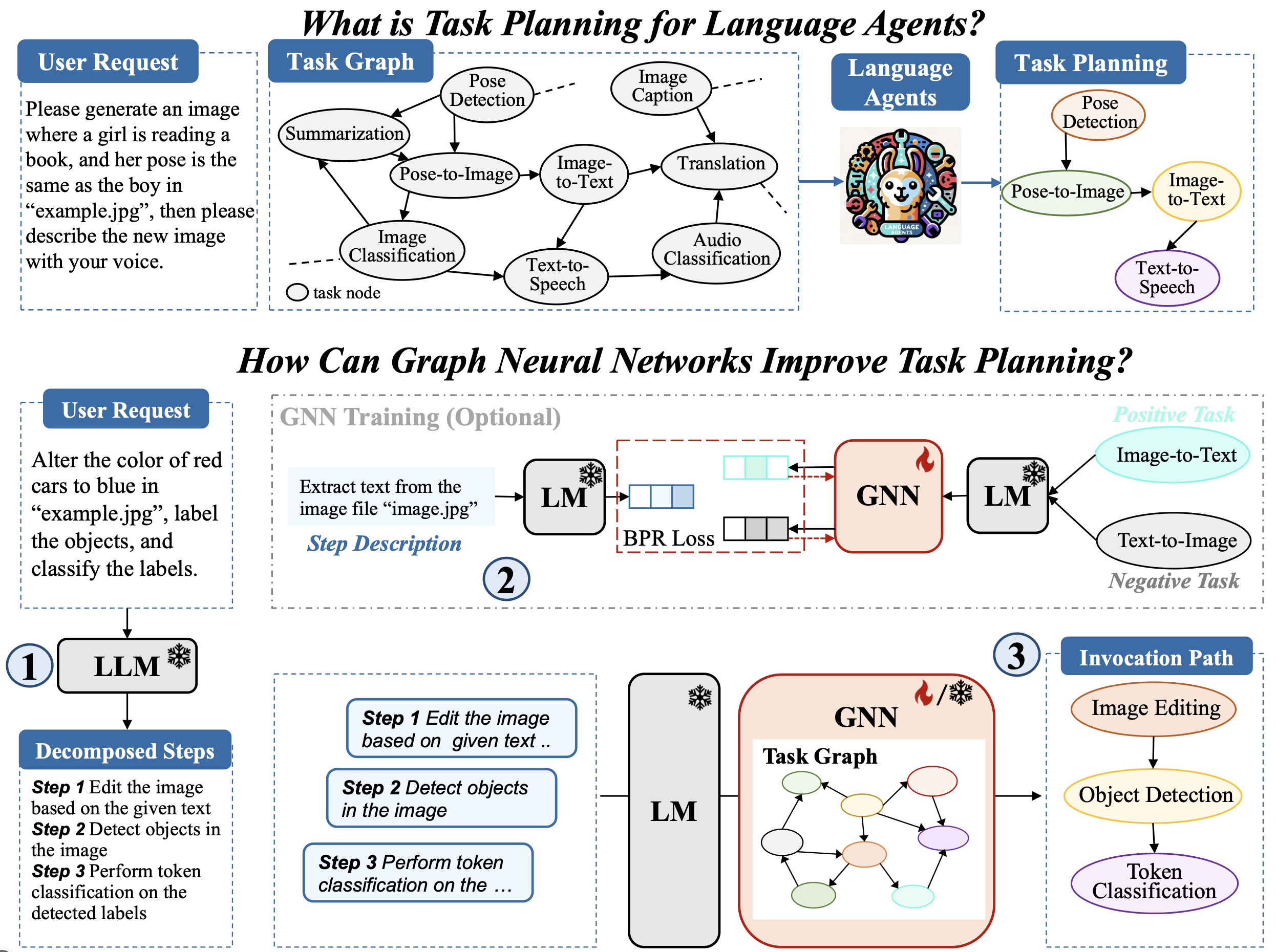
The definition of task planning and the proposed framework.
Other Repos
We note that several repos also summarize papers on the integration of LLMs and graphs. However, we differentiate ourselves by organizing these papers leveraging a new and more granular taxonomy. We recommend researchers to explore some repositories for a comprehensive survey.
-
Awesome-Graph-LLM, created by Xiaoxin He from NUS.
-
Awesome-Large-Graph-Model, created by Ziwei Zhang from THU.
-
Awesome-Language-Model-on-Graphs, created by Bowen Jin from UIUC.
We highly recommend a repository that summarizes the work on Graph Prompt, which is very close to Graph-LLM.
- Awesome-Graph-Prompt, created by Xixi Wu from CUHK.
Contributing
If you have come across relevant resources, feel free to open an issue or submit a pull request.
* (_time_) [conference] **paper_name** [[Paper](link) | [Code](link)]
   <details close>
   <summary>Model name</summary>
   <p align="center"><img width="75%" src="Figures/xxx.jpg" /></p>
   <p align="center"><em>The framework of model name.</em></p>
   </details>
Cite Us
Feel free to cite this work if you find it useful to you!
@article{li2023survey,
  title={A Survey of Graph Meets Large Language Model: Progress and Future Directions},
  author={Li, Yuhan and Li, Zhixun and Wang, Peisong and Li, Jia and Sun, Xiangguo and Cheng, Hong and Yu, Jeffrey Xu},
  journal={arXiv preprint arXiv:2311.12399},
  year={2023}
}
Significant stargazers

65 followers · starred Oct 2024

290 followers · starred Mar 2024
Similar repos


A curated collection of research papers exploring the utilization of LLMs for graph-related tasks.
657
81 commits
updated Mar 21, 2025
README
Awesome-LLMs-in-Graph-tasks
If you like our project, please give us a star ⭐ on GitHub for the latest update.
This is a collection of papers on leveraging Large Language Models in Graph Tasks. It's based on our survey paper: A Survey of Graph Meets Large Language Model: Progress and Future Directions.
We will try to make this list updated frequently. If you found any error or any missed paper, please don't hesitate to open issues or pull requests.
Our survey has been accepted by IJCAI 2024 survey track.
How can LLMs help improve graph-related tasks?
With the help of LLMs, there has been a notable shift in the way we interact with graphs, particularly those containing nodes associated with text attributes. The integration of LLMs with traditional GNNs can be mutually beneficial and enhance graph learning. While GNNs are proficient at capturing structural information, they primarily rely on semantically constrained embeddings as node features, limiting their ability to express the full complexities of the nodes. Incorporating LLMs, GNNs can be enhanced with stronger node features that effectively capture both structural and contextual aspects. On the other hand, LLMs excel at encoding text but often struggle to capture structural information present in graph data. Combining GNNs with LLMs can leverage the robust textual understanding of LLMs while harnessing GNNs' ability to capture structural relationships, leading to more comprehensive and powerful graph learning.
Figure 1. The overview of Graph Meets LLMs.
Summarizations based on proposed taxonomy
Table 1. A summary of models that leverage LLMs to assist graph-related tasks in literature, ordered by their release time. Fine-tuning denotes whether it is necessary to fine-tune the parameters of LLMs, and ♥ indicates that models employ parameter-efficient fine-tuning (PEFT) strategies, such as LoRA and prefix tuning. Prompting indicates the use of text-formatted prompts in LLMs, done manually or automatically. Acronyms in Task: Node refers to node-level tasks; Link refers to link-level tasks; Graph refers to graph-level tasks; Reasoning refers to Graph Reasoning; Retrieval refers to Graph-Text Retrieval; Captioning refers to Graph Captioning.
Table of Contents
LLM as Enhancer
-
(2022.03) [ICLR' 2022] Node Feature Extraction by Self-Supervised Multi-scale Neighborhood Prediction [Paper | Code]
GIANT
The framework of GIANT.
-
(2023.02) [ICLR' 2023] Edgeformers: Graph-Empowered Transformers for Representation Learning on Textual-Edge Networks [Paper | Code]
Edgeformers
The framework of Edgeformers.
-
(2023.05) [KDD' 2023] Graph-Aware Language Model Pre-Training on a Large Graph Corpus Can Help Multiple Graph Applications [Paper]
GALM
The framework of GALM.
-
(2023.06) [KDD' 2023] Heterformer: Transformer-based Deep Node Representation Learning on Heterogeneous Text-Rich Networks [Paper | Code]
Heterformer
The framework of Heterformer.
-
(2023.05) [ICLR' 2024] Harnessing Explanations: LLM-to-LM Interpreter for Enhanced Text-Attributed Graph Representation Learning [Paper | Code]
TAPE
The framework of TAPE.
-
(2023.08) [Arxiv' 2023] Exploring the potential of large language models (llms) in learning on graphs [Paper]
KEA
The framework of KEA.
-
(2023.07) [Arxiv' 2023] Can Large Language Models Empower Molecular Property Prediction? [Paper | Code]
LLM4Mol
The framework of LLM4Mol.
-
(2023.08) [Arxiv' 2023] Simteg: A frustratingly simple approach improves textual graph learning [Paper | Code]
SimTeG
The framework of SimTeG.
-
(2023.09) [Arxiv' 2023] Prompt-based Node Feature Extractor for Few-shot Learning on Text-Attributed Graphs [Paper]
G-Prompt
The framework of G-Prompt.
-
(2023.09) [Arxiv' 2023] TouchUp-G: Improving Feature Representation through Graph-Centric Finetuning [Paper]
TouchUp-G
The framework of TouchUp-G.
-
(2023.09) [ICLR' 2024] One for All: Towards Training One Graph Model for All Classification Tasks [Paper | Code]
OFA
The framework of OFA.
-
(2023.10) [Arxiv' 2023] Learning Multiplex Embeddings on Text-rich Networks with One Text Encoder [Paper | Code]
METERN
The framework of METERN.
-
(2023.11) [WSDM' 2024] LLMRec: Large Language Models with Graph Augmentation for Recommendation [Paper | Code]
LLMRec
The framework of LLMRec.
-
(2023.11) [NeurIPS' 2023] WalkLM: A Uniform Language Model Fine-tuning Framework for Attributed Graph Embedding [Paper | Code]
WalkLM
The framework of WalkLM.
-
(2024.01) [IJCAI' 2024] Efficient Tuning and Inference for Large Language Models on Textual Graphs [Paper]
ENGINE
The framework of ENGINE.
-
(2024.02) [KDD' 2024] ZeroG: Investigating Cross-dataset Zero-shot Transferability in Graphs [Paper]
ZeroG
The framework of ZeroG.
-
(2024.02) [Arxiv' 2024] UniGraph: Learning a Cross-Domain Graph Foundation Model From Natural Language [Paper]
UniGraph
The framework of UniGraph.
-
(2024.02) [CIKM' 2024] Distilling Large Language Models for Text-Attributed Graph Learning [Paper]
Pan, et al.
The framework of Pan, et al.
-
(2024.10) [CIKM' 2024] When LLM Meets Hypergraph: A Sociological Analysis on Personality via Online Social Networks [Paper | Code]
Shu, et al.
The framework of Shu, et al.
LLM as Predictor
-
(2023.05) [NeurIPS' 2023] Can language models solve graph problems in natural language? [Paper | Code]
NLGraph
The framework of NLGraph.
-
(2023.05) [Arxiv' 2023] GPT4Graph: Can Large Language Models Understand Graph Structured Data? An Empirical Evaluation and Benchmarking [Paper | Code]
GPT4Graph
The framework of GPT4Graph.
-
(2023.06) [NeurIPS' 2023] GIMLET: A Unified Graph-Text Model for Instruction-Based Molecule Zero-Shot Learning [Paper | Code]
GIMLET
The framework of GIMLET.
-
(2023.07) [Arxiv' 2023] Exploring the Potential of Large Language Models (LLMs) in Learning on Graphs [Paper | Code]
Framework
The designed prompts of Chen et al.
-
(2023.08) [Arxiv' 2023] GIT-Mol: A Multi-modal Large Language Model for Molecular Science with Graph, Image, and Text [Paper]
GIT-Mol
The framework of GIT-Mol.
-
(2023.08) [Arxiv' 2023] Natural Language is All a Graph Needs [Paper | Code]
InstructGLM
The framework of InstructGLM.
-
(2023.08) [Arxiv' 2023] Evaluating Large Language Models on Graphs: Performance Insights and Comparative Analysis [Paper | Code]
Framework
The designed prompts of Liu et al.
-
(2023.09) [Arxiv' 2023] Can LLMs Effectively Leverage Graph Structural Information: When and Why [Paper | Code]
Framework
The designed prompts of Huang et al.
-
(2023.10) [Arxiv' 2023] GraphText: Graph Reasoning in Text Space [Paper] | Code]
GraphText
The framework of GraphText.
-
(2023.10) [Arxiv' 2023] Talk like a Graph: Encoding Graphs for Large Language Models [Paper]
Framework
The designed prompts of Fatemi et al.
-
(2023.10) [Arxiv' 2023] GraphLLM: Boosting Graph Reasoning Ability of Large Language Model [Paper | Code]
GraphLLM
The framework of GraphLLM.
-
(2023.10) [Arxiv' 2023] Beyond Text: A Deep Dive into Large Language Model [Paper]
Framework
The designed prompts of Hu et al.
-
(2023.10) [EMNLP' 2023] MolCA: Molecular Graph-Language Modeling with Cross-Modal Projector and Uni-Modal Adapter [Paper | Code]
MolCA
The framework of MolCA.
-
(2023.10) [Arxiv' 2023] GraphGPT: Graph Instruction Tuning for Large Language Models [Paper | Code]
GraphGPT
The framework of GraphGPT.
-
(2023.10) [EMNLP' 2023] ReLM: Leveraging Language Models for Enhanced Chemical Reaction Prediction [Paper | Code]
ReLM
The framework of ReLM.
-
(2023.10) [Arxiv' 2023] LLM4DyG: Can Large Language Models Solve Problems on Dynamic Graphs? [Paper]
LLM4DyG
The framework of LLM4DyG.
-
(2023.10) [Arxiv' 2023] Disentangled Representation Learning with Large Language Models for Text-Attributed Graphs [Paper]
DGTL
The framework of DGTL.
-
(2023.11) [Arxiv' 2023] Which Modality should I use -- Text, Motif, or Image? : Understanding Graphs with Large Language Models [Paper]
Framework
The framework of Das et al.
-
(2023.11) [Arxiv' 2023] InstructMol: Multi-Modal Integration for Building a Versatile and Reliable Molecular Assistant in Drug Discovery [Paper]
InstructMol
The framework of InstructMol.
-
(2023.12) [Arxiv' 2023] When Graph Data Meets Multimodal: A New Paradigm for Graph Understanding and Reasoning [Paper]
Framework
The framework of Ai et al.
-
(2024.02) [Arxiv' 2024] Let Your Graph Do the Talking: Encoding Structured Data for LLMs [Paper]
GraphToken
The framework of GraphToken.
-
(2024.02) [Arxiv' 2024] Rendering Graphs for Graph Reasoning in Multimodal Large Language Models [Paper]
GITA
The framework of GITA.
-
(2024.02) [WWW' 2024] GraphTranslator: Aligning Graph Model to Large Language Model for Open-ended Tasks [Paper | Code]
GraphTranslator
The framework of GraphTranslator.
-
(2024.02) [Arxiv' 2024] InstructGraph: Boosting Large Language Models via Graph-centric Instruction Tuning and Preference Alignment [Paper | Code]
InstructGraph
The framework of InstructGraph.
-
(2024.02) [Arxiv' 2024] LLaGA: Large Language and Graph Assistant [Paper | Code]
LLaGA
The framework of LLaGA.
-
(2024.02) [WWW' 2024] Can GNN be Good Adapter for LLMs? [Paper]
GraphAdapter
The framework of GraphAdapter.
-
(2024.02) [Arxiv' 2024] HiGPT: Heterogeneous Graph Language Model [Paper | Code]
HiGPT
The framework of HiGPT.
-
(2024.02) [Arxiv' 2024] GraphWiz: An Instruction-Following Language Model for Graph Problems [Paper | Code]
GraphWiz
The framework of GraphWiz.
-
(2024.03) [Arxiv' 2024] OpenGraph: Towards Open Graph Foundation Models [Paper | Code]
OpenGraph
The framework of OpenGraph.
-
(2024.07) [Arxiv' 2024] GOFA: A Generative One-For-All Model for Joint Graph Language Modeling [Paper | Code]
GOFA
The framework of GOFA.
-
(2024.10) [Arxiv' 2024] Can Graph Descriptive Order Affect Solving Graph Problems with LLMs? [Paper]
GraphDO
The framework of GraphDO.
GNN-LLM Alignment
- (2020.08) [Arxiv' 2020] Graph-based Modeling of Online Communities for Fake News Detection [Paper | Code]
SAFER
The framework of SAFER.
- (2021.05) [NeurIPS' 2021] GraphFormers: GNN-nested Transformers for Representation Learning on Textual Graph [Paper | Code]
GraphFormers
The framework of GraphFormers.
- (2021.11) [EMNLP' 2021] Text2Mol: Cross-Modal Molecule Retrieval with Natural Language Queries
[Paper | Code]
Text2Mol
The framework of Text2Mol.
- (2022.07) [ACL' 2023] Hidden Schema Networks
[Paper | Code]
HSN
The framework of HSN.
- (2022.09) [Arxiv' 2022] A Molecular Multimodal Foundation Model Associating Molecule Graphs with Natural Language
[Paper | Code]
MoMu
The framework of MoMu.
- (2022.10) [ICLR' 2023] Learning on Large-scale Text-attributed Graphs via Variational Inference
[Paper | Code]
GLEM
The framework of GLEM.
- (2022.12) [NMI' 2023] Multi-modal Molecule Structure-text Model for Text-based Editing and Retrieval
[Paper | Code]
MoleculeSTM
The framework of MoleculeSTM.
- (2023.04) [Arxiv' 2023] Train Your Own GNN Teacher: Graph-Aware Distillation on Textual Graphs
[Paper | Code]
GRAD
The framework of GRAD.
- (2023.05) [ACL' 2023] PATTON : Language Model Pretraining on Text-Rich Networks
[Paper | Code]
Patton
The framework of Patton.
- (2023.05) [Arxiv' 2023] ConGraT: Self-Supervised Contrastive Pretraining for Joint Graph and Text Embeddings
[Paper | Code]
ConGraT
The framework of ConGraT.
- (2023.07) [Arxiv' 2023] Prompt Tuning on Graph-augmented Low-resource Text Classification
[Paper | Code]
G2P2
The framework of G2P2.
- (2023.10) [EMNLP' 2023] GRENADE: Graph-Centric Language Model for Self-Supervised Representation Learning on Text-Attributed Graphs
[Paper | Code]
GRENADE
The framework of GRENADE.
- (2023.10) [WWW' 2024] Representation Learning with Large Language Models for Recommendation
[Paper | Code]
RLMRec
The framework of RLMRec.
- (2023.10) [EMNLP' 2023] Pretraining Language Models with Text-Attributed Heterogeneous Graphs
[Paper | Code]
THLM
The framework of THLM.
Benchmarks
-
(2025.1) [COLING 2025] GraCoRe: Benchmarking Graph Comprehension and Complex Reasoning in Large Language Models [Paper | Code]
-
(2024.07) [NeurIPS' 2024] GLBench: A Comprehensive Benchmark for Graph with Large Language Models [Paper | Code]
-
(2024.05) [NeurIPS' 2024] TEG-DB: A Comprehensive Dataset and Benchmark of Textual-Edge Graphs [Paper][Code]
Others
LLM as Annotator
-
(2023.10) [ICLR' 2024] Label-free Node Classification on Graphs with Large Language Models (LLMs) [Paper | Code]
LLM-GNN
The framework of LLM-GNN.
-
(2024.09) [NeurIPS' 2024] Entity Alignment with Noisy Annotations from Large Language Models [Paper | Code]
LLM4EA
The framework of LLM4EA.
LLM as Controller
- (2023.10) [Arxiv' 2023] Graph Neural Architecture Search with GPT-4 [Paper]
GPT4GNAS
The framework of GPT4GNAS.
LLM as Sample Generator
- (2023.10) [Arxiv' 2023] Empower Text-Attributed Graphs Learning with Large Language Models (LLMs) [Paper]
ENG
The framework of ENG.
LLM as Similarity Analyzer
- (2023.11) [Arxiv' 2023] Large Language Models as Topological Structure Enhancers for Text-Attributed Graphs [Paper]
Framework
The framework of Sun et al.
LLM for Robustness
-
(2024.05) [Arxiv' 2024] Intruding with Words: Towards Understanding Graph Injection Attacks at the Text Level [Paper]
Lei, et al.
The framework of Lei, et al..
-
(2024.08) [Arxiv' 2024] Can Large Language Models Improve the Adversarial Robustness of Graph Neural Networks? [Paper]
LLM4RGNN
The framework of LLM4RGNN.
LLM for Task Planning
- (2024.05) [NeurIPS' 2024] Can Graph Learning Improve Planning in LLM-based Agents? [Paper | Code]
GNN4TaskPlan
The definition of task planning and the proposed framework.
Other Repos
We note that several repos also summarize papers on the integration of LLMs and graphs. However, we differentiate ourselves by organizing these papers leveraging a new and more granular taxonomy. We recommend researchers to explore some repositories for a comprehensive survey.
-
Awesome-Graph-LLM, created by Xiaoxin He from NUS.
-
Awesome-Large-Graph-Model, created by Ziwei Zhang from THU.
-
Awesome-Language-Model-on-Graphs, created by Bowen Jin from UIUC.
We highly recommend a repository that summarizes the work on Graph Prompt, which is very close to Graph-LLM.
- Awesome-Graph-Prompt, created by Xixi Wu from CUHK.
Contributing
If you have come across relevant resources, feel free to open an issue or submit a pull request.
* (_time_) [conference] **paper_name** [[Paper](link) | [Code](link)]
   <details close>
   <summary>Model name</summary>
   <p align="center"><img width="75%" src="Figures/xxx.jpg" /></p>
   <p align="center"><em>The framework of model name.</em></p>
   </details>
Cite Us
Feel free to cite this work if you find it useful to you!
@article{li2023survey,
  title={A Survey of Graph Meets Large Language Model: Progress and Future Directions},
  author={Li, Yuhan and Li, Zhixun and Wang, Peisong and Li, Jia and Sun, Xiangguo and Cheng, Hong and Yu, Jeffrey Xu},
  journal={arXiv preprint arXiv:2311.12399},
  year={2023}
}
Similar repos
Significant stargazers
65 followers · starred Oct 2024
290 followers · starred Mar 2024