
Echo-4o: Harnessing Proprietary Models’ Synthetic Images for Improved Image Generation
Jupyter Notebook
506
15 commits
updated Dec 9, 2025
README

 Nano-consistent-150k



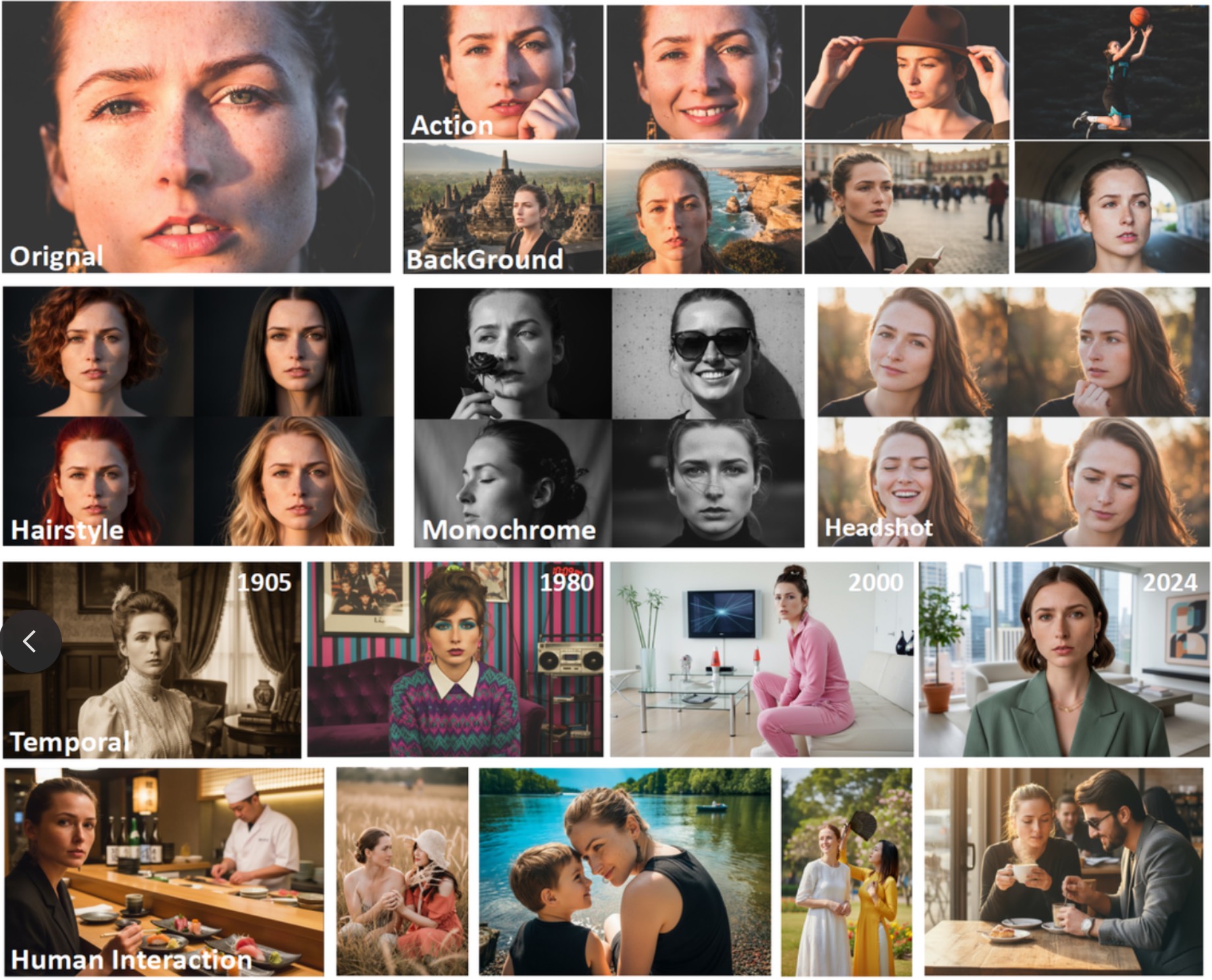
[!TIP] We present Nano-consistent-150k — the first dataset constructed using Nano-Banana that exceeds 150k high-quality samples, uniquely designed to preserve consistent human identity across diverse and complex editing scenarios. A key feature is its remarkable identity consistency: for a single portrait, more than 35 distinct editing outputs are provided across diverse tasks and instructions. By anchoring on consistent human identities, the dataset enables the construction of interleaved data that seamlessly link multiple editing tasks, instructions, and modalities around the same individual.
 Echo: Harnessing Proprietary Models’ Synthetic Images for Improved Image Generation



📰 News
-
[2025.9.18] 🔥 We have released Nano-consistent-150k. — the first dataset constructed using Nano-Banana that exceeds 150k high-quality samples, uniquely designed to preserve consistent human identity across diverse and complex editing scenarios. Check out the [ Blog; Dataset; Awesome; ].
-
[2025.8.13] 🔥 We have released Echo: Harnessing Proprietary Models’ Synthetic Images for Improved Image Generation. Check out the [ Paper; Dataset; Model; Code) ].
🏆 Contributions
- ⁉️ Why use synthetic data instead of real-world data?: We analyze and summarize the advantages of synthetic data over real-world images, highlighting its ability to generate rare scenarios and to provide pure, long-tailed supervision for instruction-following tasks.
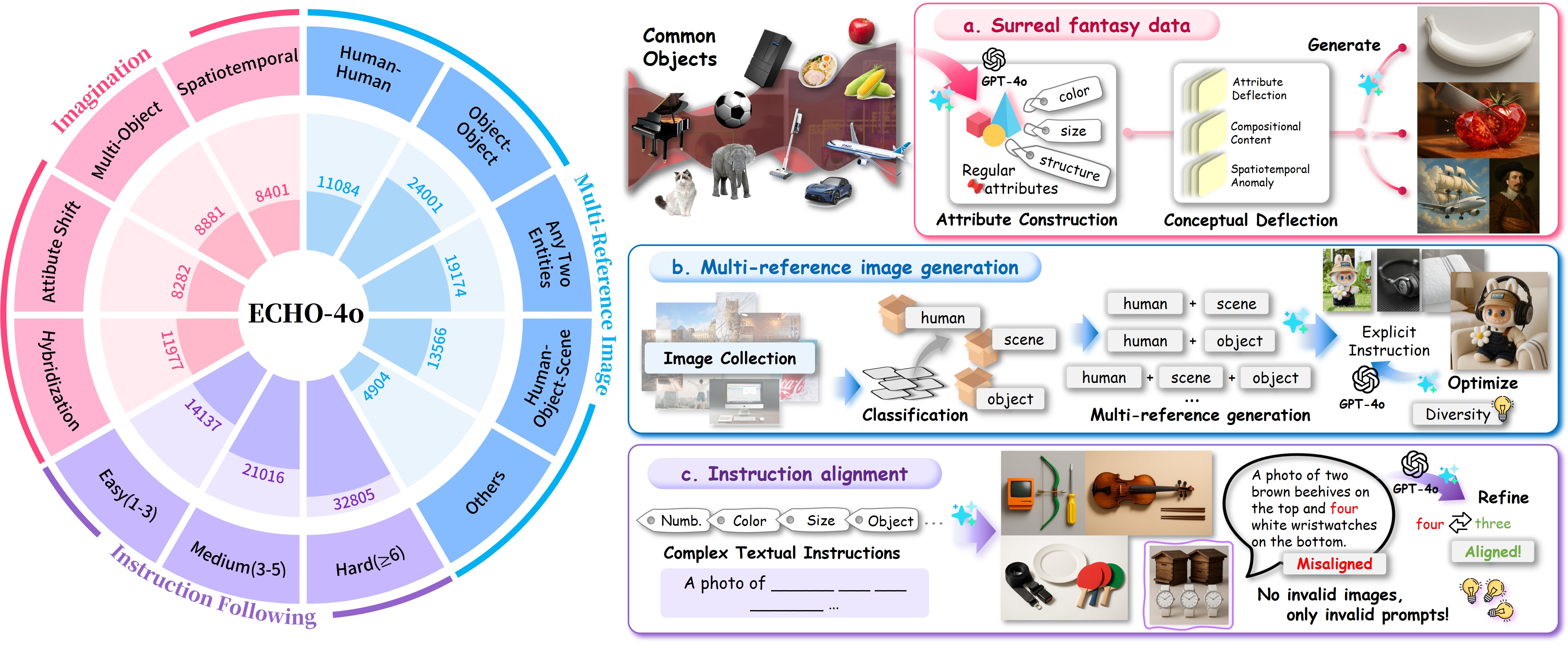
- 🔧 How to generate synthetic data? We curate Echo-4o-Image, a synthetic dataset of ~180K samples generated using GPT-4o. Echo-4o-Image includes 38K surreal fantasy samples, 73K multi-reference image generation samples, and 68K complex instruction-following samples.
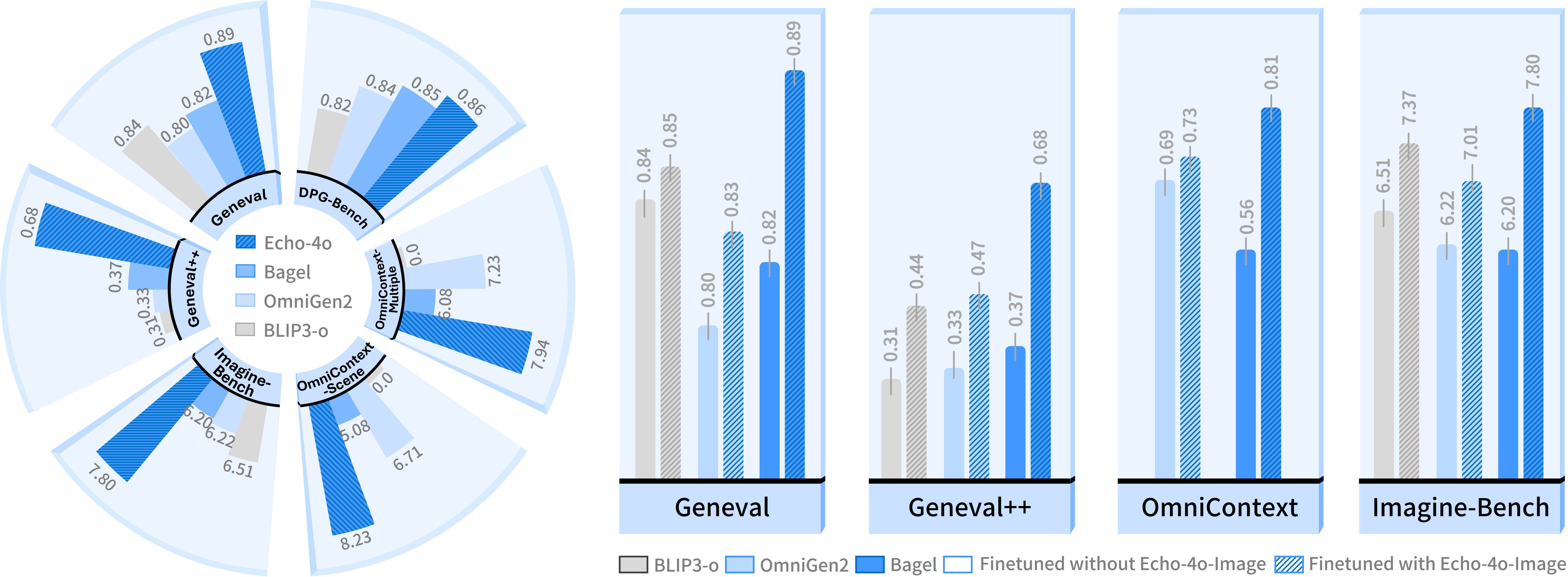
- ✨ Does synthetic data work? We fine-tune the Bagel model on Echo-4o-Image, yielding model Echo-4o, which achieves state-of-the-art performance across multiple benchmarks. Furthermore, Echo-4o-Image consistently enhances other backbone models such as OmniGen2 and BLIP3-o, demonstrating strong transferability.
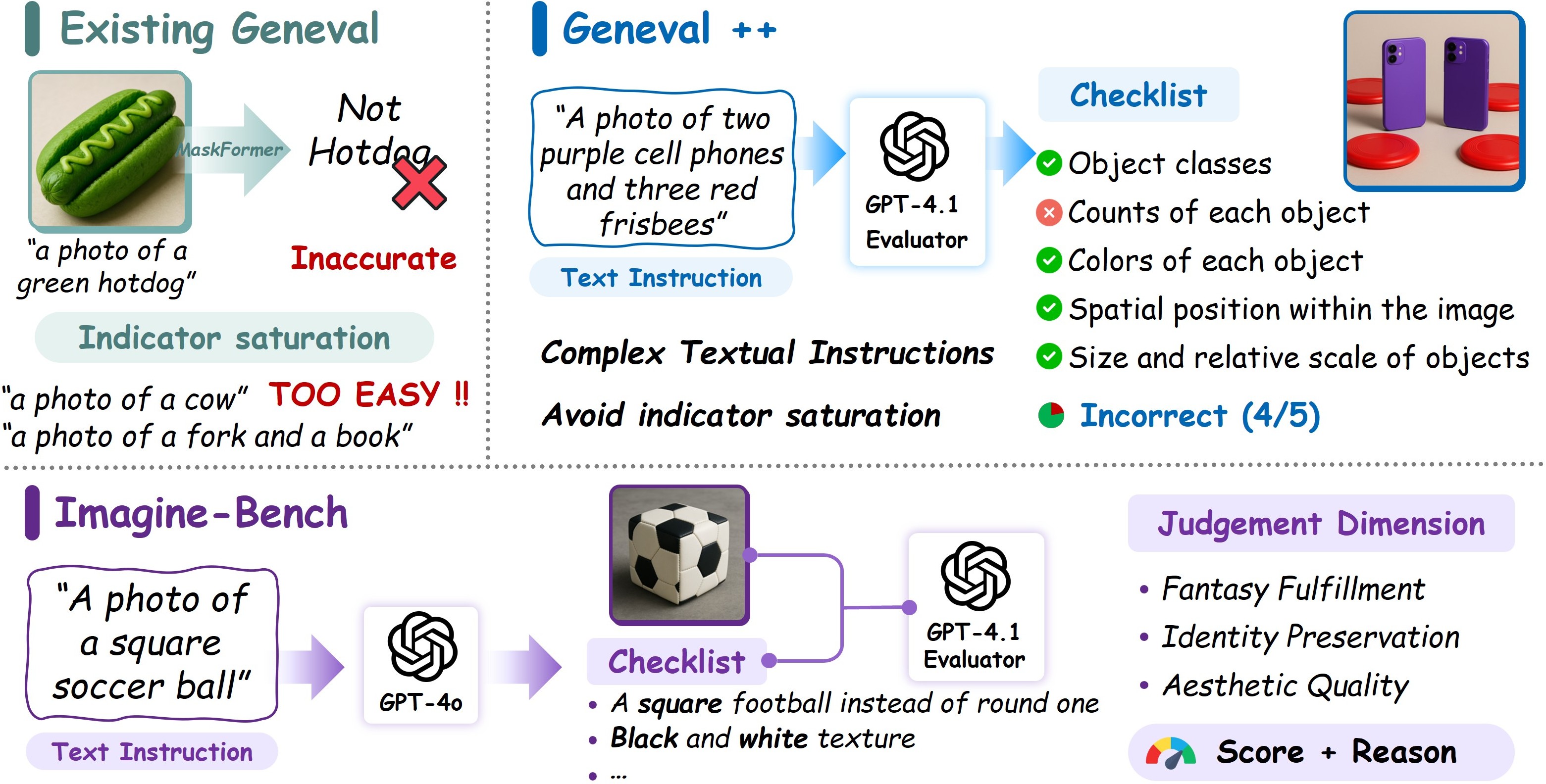
- 📐 How to evaluate performance? We propose two new evaluation benchmarks: Geneval++ increases instruction complexity to alleviate score saturation in text-to-image evaluation. Imagine-Bench targets fantasy tasks and is designed to assess both understanding and generation of imaginative content.
🎨Echo-4o-Image
🔗 Dataset on Hugging Face: Echo-4o-Image
We introduce Echo-4o-Image, a large-scale synthetic dataset distilled from GPT-4o.It contains approximately 179,000 samples spanning three distinct task types: 38K surreal fantasy generation tasks, 73K multi-reference image generation tasks, and 68K complex instruction execution tasks.
For better visualization, we provide an online gallery showcasing representative samples from our dataset: Online Gallery
🤖 Echo-4o
First, prepare your environment by following the setup instructions in the Bagel environments.
Training
Our training code extends Bagel's capabilities to support multi-reference datasets for training.
Data Preparation:
- Follow the same data preparation process as outlined in Bagel's documentation
- Ensure your multi-reference data follows the expected format in our data example here
Training Process:
Our training scripts use the same interface and parameters as Bagel, so you can use the existing training commands and configurations of Bagel without modification.
Inference
Please first download Echo-4o here
-
Text-to-Image Tasks
For standard text-to-image generation, use the same inference process as Bagel:
Refer to the text-to-image generation example here
-
Multi-Reference Tasks
For tasks involving multiple references, refer to the multi-reference example here
📏 GenEval++ & Imagine-Bench
To rigorously evaluate the model’s instruction-following and imaginative generation, we further introduce two novel benchmarks: Geneval++ and Imagine-Bench. Geneval++ incorporates an automated evaluator powered by GPT-4.1 and significantly increases the difficulty and compositional complexity of test instructions, addressing the limitations of scoring saturation and insufficient accuracy found in existing text-to-image evaluations. Imagine-Bench focuses on imaginative generation, offering a comprehensive evaluation of conceptual creativity and visual consistency across three dimensions: fantasy fulfillment, identity preservation, and aesthetic quality.
We provide benchmark guides for GenEval++ and Imagine-Bench. For more details, see EVAL.
❤️ Acknowledgements
We would like to thank the following open-source projects and research works:
😊 We'd love to hear from you—feel free to reach out anytime if you have any questions!
📕 BibTeX
@article{ye2025echo4o,
      title={Echo-4o: Harnessing the Power of GPT-4o Synthetic Images for Improved Image Generation},
      author={Junyan Ye, Dongzhi Jiang, Zihao Wang, Leqi Zhu, Zhenghao Hu, Zilong Huang, Jun He, Zhiyuan Yan, Jinghua Yu, Hongsheng Li, Conghui He, Weijia Li},
      journal={https://arxiv.org/abs/2508.09987},
      year={2025},
}
Contributors


Similar repos


Languages
Jupyter Notebook
76.3%
Python
23.4%
Echo-4o: Harnessing Proprietary Models’ Synthetic Images for Improved Image Generation
Jupyter Notebook
506
15 commits
updated Dec 9, 2025
README
Nano-consistent-150k
[!TIP] We present Nano-consistent-150k — the first dataset constructed using Nano-Banana that exceeds 150k high-quality samples, uniquely designed to preserve consistent human identity across diverse and complex editing scenarios. A key feature is its remarkable identity consistency: for a single portrait, more than 35 distinct editing outputs are provided across diverse tasks and instructions. By anchoring on consistent human identities, the dataset enables the construction of interleaved data that seamlessly link multiple editing tasks, instructions, and modalities around the same individual.
Echo: Harnessing Proprietary Models’ Synthetic Images for Improved Image Generation
📰 News
-
[2025.9.18] 🔥 We have released Nano-consistent-150k. — the first dataset constructed using Nano-Banana that exceeds 150k high-quality samples, uniquely designed to preserve consistent human identity across diverse and complex editing scenarios. Check out the [ Blog; Dataset; Awesome; ].
-
[2025.8.13] 🔥 We have released Echo: Harnessing Proprietary Models’ Synthetic Images for Improved Image Generation. Check out the [ Paper; Dataset; Model; Code) ].
🏆 Contributions
- ⁉️ Why use synthetic data instead of real-world data?: We analyze and summarize the advantages of synthetic data over real-world images, highlighting its ability to generate rare scenarios and to provide pure, long-tailed supervision for instruction-following tasks.
- 🔧 How to generate synthetic data? We curate Echo-4o-Image, a synthetic dataset of ~180K samples generated using GPT-4o. Echo-4o-Image includes 38K surreal fantasy samples, 73K multi-reference image generation samples, and 68K complex instruction-following samples.
- ✨ Does synthetic data work? We fine-tune the Bagel model on Echo-4o-Image, yielding model Echo-4o, which achieves state-of-the-art performance across multiple benchmarks. Furthermore, Echo-4o-Image consistently enhances other backbone models such as OmniGen2 and BLIP3-o, demonstrating strong transferability.
- 📐 How to evaluate performance? We propose two new evaluation benchmarks: Geneval++ increases instruction complexity to alleviate score saturation in text-to-image evaluation. Imagine-Bench targets fantasy tasks and is designed to assess both understanding and generation of imaginative content.
🎨Echo-4o-Image
🔗 Dataset on Hugging Face: Echo-4o-Image
We introduce Echo-4o-Image, a large-scale synthetic dataset distilled from GPT-4o.It contains approximately 179,000 samples spanning three distinct task types: 38K surreal fantasy generation tasks, 73K multi-reference image generation tasks, and 68K complex instruction execution tasks.
For better visualization, we provide an online gallery showcasing representative samples from our dataset: Online Gallery
🤖 Echo-4o
First, prepare your environment by following the setup instructions in the Bagel environments.
Training
Our training code extends Bagel's capabilities to support multi-reference datasets for training.
Data Preparation:
- Follow the same data preparation process as outlined in Bagel's documentation
- Ensure your multi-reference data follows the expected format in our data example here
Training Process:
Our training scripts use the same interface and parameters as Bagel, so you can use the existing training commands and configurations of Bagel without modification.
Inference
Please first download Echo-4o here
-
Text-to-Image Tasks
For standard text-to-image generation, use the same inference process as Bagel:
Refer to the text-to-image generation example here
-
Multi-Reference Tasks
For tasks involving multiple references, refer to the multi-reference example here
📏 GenEval++ & Imagine-Bench
To rigorously evaluate the model’s instruction-following and imaginative generation, we further introduce two novel benchmarks: Geneval++ and Imagine-Bench. Geneval++ incorporates an automated evaluator powered by GPT-4.1 and significantly increases the difficulty and compositional complexity of test instructions, addressing the limitations of scoring saturation and insufficient accuracy found in existing text-to-image evaluations. Imagine-Bench focuses on imaginative generation, offering a comprehensive evaluation of conceptual creativity and visual consistency across three dimensions: fantasy fulfillment, identity preservation, and aesthetic quality.
We provide benchmark guides for GenEval++ and Imagine-Bench. For more details, see EVAL.
❤️ Acknowledgements
We would like to thank the following open-source projects and research works:
😊 We'd love to hear from you—feel free to reach out anytime if you have any questions!
📕 BibTeX
@article{ye2025echo4o,
      title={Echo-4o: Harnessing the Power of GPT-4o Synthetic Images for Improved Image Generation},
      author={Junyan Ye, Dongzhi Jiang, Zihao Wang, Leqi Zhu, Zhenghao Hu, Zilong Huang, Jun He, Zhiyuan Yan, Jinghua Yu, Hongsheng Li, Conghui He, Weijia Li},
      journal={https://arxiv.org/abs/2508.09987},
      year={2025},
}
Similar repos
Contributors
Languages
Jupyter Notebook
76.3%
Python
23.4%