
README




SenseFi: A Benchmark for WiFi CSI Sensing
Introduction
SenseFi is the first open-source benchmark and library for WiFi CSI human sensing, implemented by PyTorch. The state-of-the-art networks, including MLP, CNN, RNN, Transformers, etc, are evaluated on four public datasets across different WiFi CSI platforms. The details are illustrated in our paper SenseFi: A Library and Benchmark on Deep-Learning-Empowered WiFi Human Sensing that has been accepted by Patterns, Cell Press.
@article{yang2023benchmark,
  title={SenseFi: A Library and Benchmark on Deep-Learning-Empowered WiFi Human Sensing},
  author={Yang, Jianfei and Chen, Xinyan and Wang, Dazhuo and Zou, Han and Lu, Chris Xiaoxuan and Sun, Sumei and Xie, Lihua},
  journal={Patterns},
  volume={4},
  number={3},
  publisher={Elsevier},
  year={2023}
}
Requirements
- Install
pytorchandtorchvision(we usepytorch==1.12.0andtorchvision==0.13.0). pip install -r requirements.txt
Note that the project runs perfectly in Linux OS (Ubuntu). If you plan to use Windows to run the codes, you need to modify the all the / to \\ in the code regarding the dataset directory for the CSI data loading.
Run
Download Processed Data
Please download and organize the processed datasets in this structure:
Benchmark
├── Data
    ├── NTU-Fi_HAR
    │   ├── test_amp
    │   ├── train_amp
    ├── NTU-Fi-HumanID
    │   ├── test_amp
    │   ├── train_amp
    ├── UT_HAR
    │   ├── data
    │   ├── label
    ├── Widardata
    │   ├── test
    │   ├── train
We also offer pre-trained weights for all models
Supervised Learning
To run models with supervised learning (train & test):
Run: python run.py --model [model name] --dataset [dataset name]
You can choose [model name] from the model list below
- MLP
- LeNet
- ResNet18
- ResNet50
- ResNet101
- RNN
- GRU
- LSTM
- BiLSTM
- CNN+GRU
- ViT
You can choose [dataset name] from the dataset list below
- UT_HAR_data
- NTU-Fi-HumanID
- NTU-Fi_HAR
- Widar
Example: python run.py --model ResNet18 --dataset NTU-Fi_HAR
Unsupervised Learning
To run models with unsupervised (self-supervised) learning (train on NTU-Fi HAR & test on NTU-Fi HumanID):
Run: python self_supervised.py --model [model name]
You can choose [model name] from the model list below
- MLP
- LeNet
- ResNet18
- ResNet50
- ResNet101
- RNN
- GRU
- LSTM
- BiLSTM
- CNN+GRU
- ViT
Example: python self_supervised.py --model MLP
Method: AutoFi: Towards Automatic WiFi Human Sensing via Geometric Self-Supervised Learning
Model Zoo
MLP
- It consists of 3 fully-connected layers followed by activation functions
LeNet
- self.encoder : It consists of 3 convolutional layers followed by activation functions and Maxpooling layers to learn features
- self.fc : It consists of 2 fully-connected layers followed by activation functions for classification
ResNet
- class Bottleneck : Each bottleneck consists of 3 convolutional layers followed by batch normalization operation and activation functions. And adds resudual connection within the bottleneck
- class Block : Each block consists of 2 convolutional layers followed by batch normalization operation and activation functions. And adds resudual connection within the block
- self.reshape : Reshape the input size into the size of 3 x 32 x 32
- self.fc : It consists of a fully-connected layer
RNN
- self.rnn : A one-layer RNN structure with a hidden dimension of 64
- self.fc : It consists of a fully-connected layer
GRU
- self.gru : A one-layer GRU structure with a hidden dimension of 64
- self.fc : It consists of a fully-connected layer
LSTM
- self.lstm : A one-layer LSTM structure with a hidden dimension of 64
- self.fc : It consists of a fully-connected layer
BiLSTM
- self.lstm : A one-layer bidirectional LSTM structure with a hidden dimension of 64
- self.fc : It consists of a fully-connected layer
CNN+GRU
- self.encoder : It consists of 3 convolutional layers followed by activation functions
- self.gru : A one-layer GRU structure with a hidden dimension of 64
- self.classifier : It consistis a dropout layer followed by a fully-connected layer and an activation function
ViT (Transformers)
- class PatchEmbedding : Divide the 2D inputs into small pieces of equal size. Then concatenate each piece with cls_token and do positional encoding operation
- class ClassificationHead : It consists of a layer-normalization layer followed by a fully-connected layer
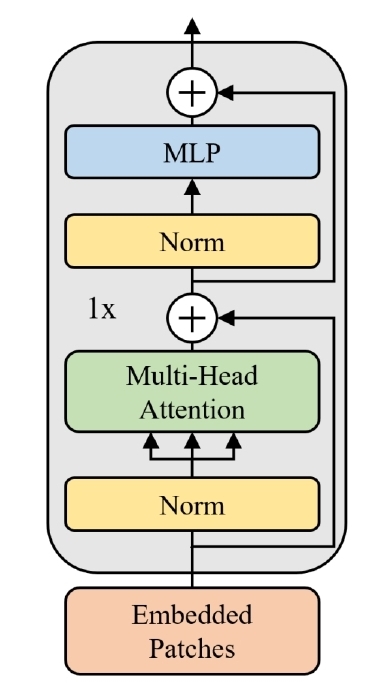
- class TransformerEncoderBlock : It consists of multi-head attention block, residual add block and feed forward block. The structure is shown below:
Dataset
UT-HAR
A Survey on Behavior Recognition Using WiFi Channel State Information [Github]
- CSI size : 1 x 250 x 90
- number of classes : 7
- classes : lie down, fall, walk, pickup, run, sit down, stand up
- train number : 3977
- test number : 996
NTU-HAR
Efficientfi: Towards Large-Scale Lightweight Wifi Sensing via CSI Compression
- CSI size : 3 x 114 x 500
- number of classes : 6
- classes : box, circle, clean, fall, run, walk
- train number : 936
- test number : 264
NTU-HumanID
CAUTION: A Robust WiFi-based Human Authentication System via Few-shot Open-set Gait Recognition
- CSI size : 3 x 114 x 500
- number of classes : 14
- classes : gaits of 14 subjects
- train number : 546
- test number : 294
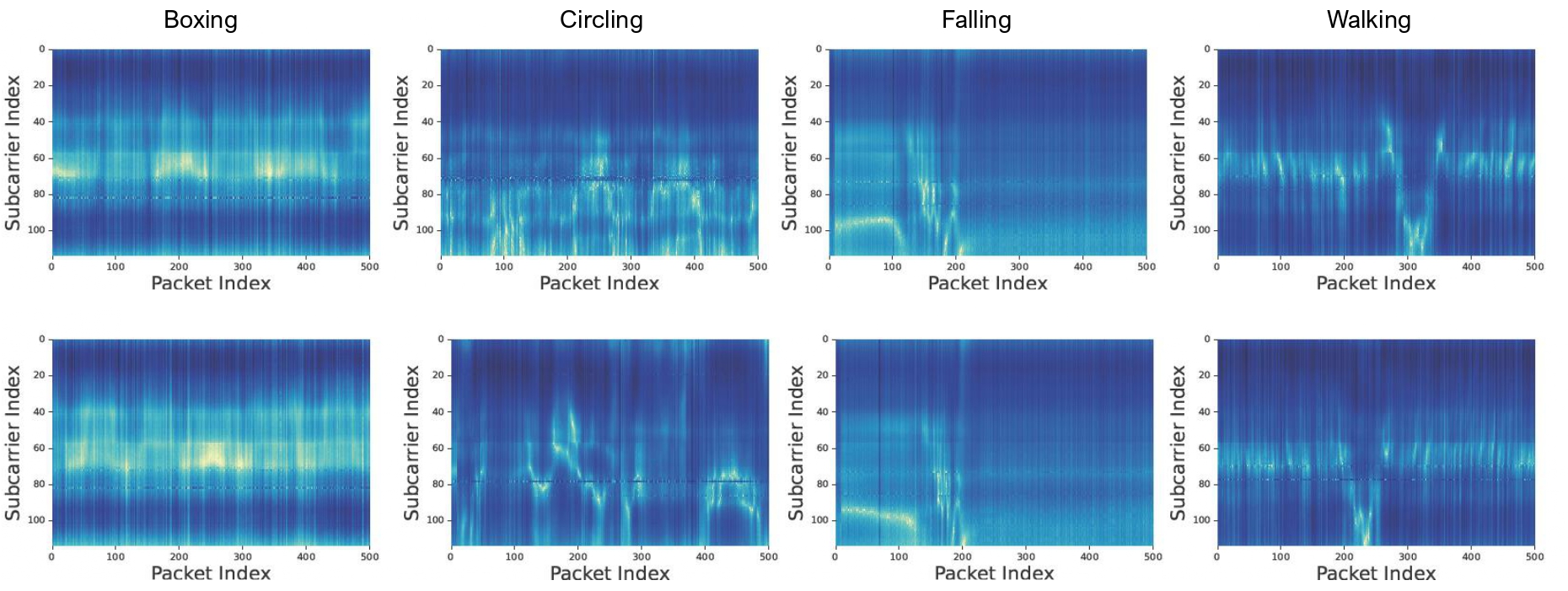
Examples of NTU-Fi data
Widar
Widar3.0: Zero-Effort Cross-Domain Gesture Recognition with Wi-Fi [Project]
- BVP size : 22 x 20 x 20
- number of classes : 22
- classes :
Push&Pull, Sweep, Clap, Slide, Draw-N(H), Draw-O(H),Draw-Rectangle(H),
Draw-Triangle(H), Draw-Zigzag(H), Draw-Zigzag(V), Draw-N(V), Draw-O(V), Draw-1,
Draw-2, Draw-3, Draw-4, Draw-5, Draw-6, Draw-7, Draw-8, Draw-9, Draw-10 - train number : 34926
- test number : 8726
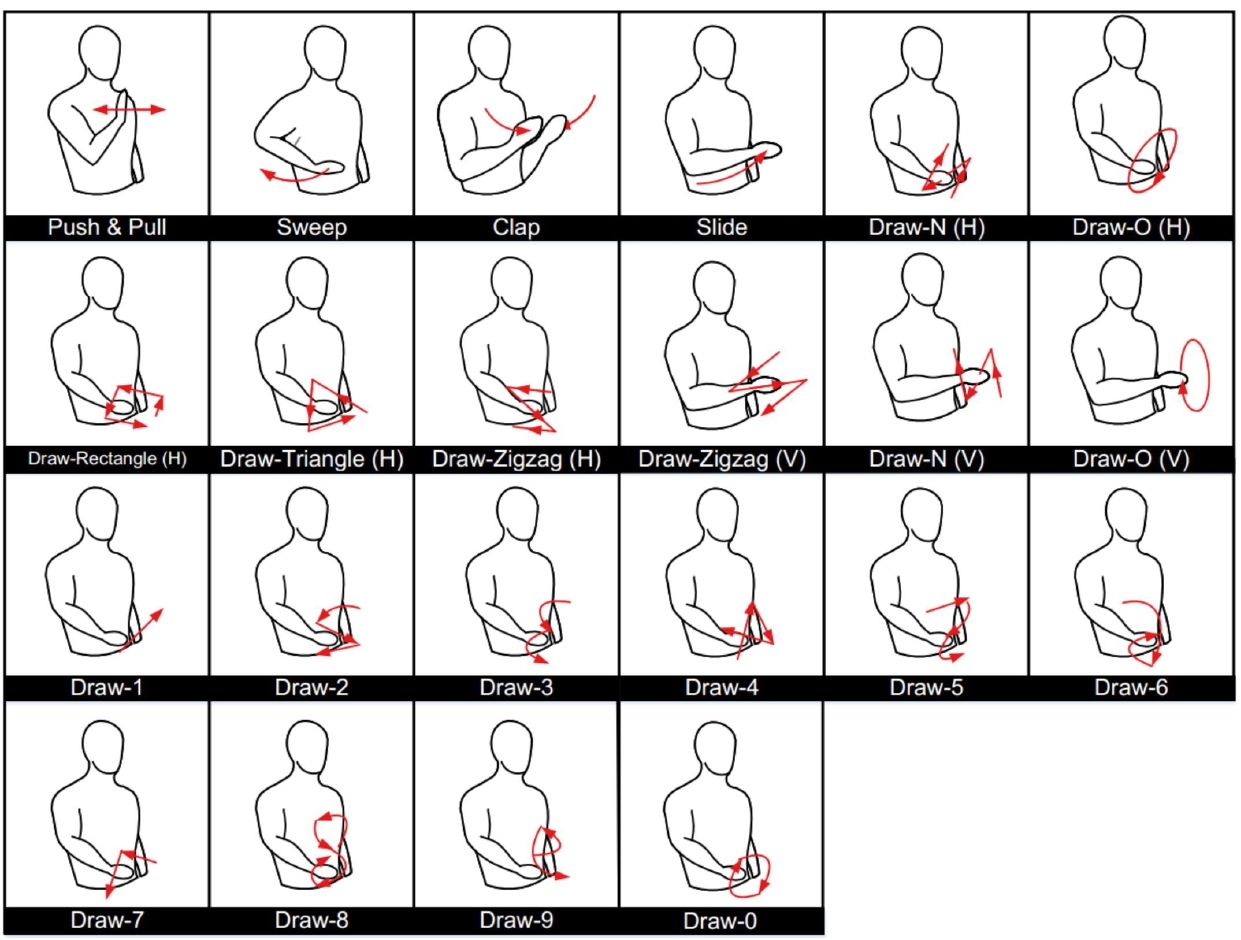
Classes of Widar data
Notice
- Please download and unzip all the datasets with Linux system in order to avoid decoding errors.
- For UT-HAR, the data file is csv format and can be loaded via our code. If you use Excel to open it, it is not readable due to the encoding format derived from the original dataset.
Datasets Reference
@article{yousefi2017survey,
  title={A survey on behavior recognition using WiFi channel state information},
  author={Yousefi, Siamak and Narui, Hirokazu and Dayal, Sankalp and Ermon, Stefano and Valaee, Shahrokh},
  journal={IEEE Communications Magazine},
  volume={55},
  number={10},
  pages={98--104},
  year={2017},
  publisher={IEEE}
}

@article{yang2022autofi,
  title={AutoFi: Towards Automatic WiFi Human Sensing via Geometric Self-Supervised Learning},
  author={Yang, Jianfei and Chen, Xinyan and Zou, Han and Wang, Dazhuo and Xie, Lihua},
  journal={arXiv preprint arXiv:2205.01629},
  year={2022}
}

@article{yang2022efficientfi,
  title={Efficientfi: Towards large-scale lightweight wifi sensing via csi compression},
  author={Yang, Jianfei and Chen, Xinyan and Zou, Han and Wang, Dazhuo and Xu, Qianwen and Xie, Lihua},
  journal={IEEE Internet of Things Journal},
  year={2022},
  publisher={IEEE}
}

@article{wang2022caution,
  title={CAUTION: A Robust WiFi-based Human Authentication System via Few-shot Open-set Gait Recognition},
  author={Wang, Dazhuo and Yang, Jianfei and Cui, Wei and Xie, Lihua and Sun, Sumei},
  journal={IEEE Internet of Things Journal},
  year={2022},
  publisher={IEEE}
}

@article{zhang2021widar3,
  title={Widar3. 0: Zero-effort cross-domain gesture recognition with wi-fi},
  author={Zhang, Yi and Zheng, Yue and Qian, Kun and Zhang, Guidong and Liu, Yunhao and Wu, Chenshu and Yang, Zheng},
  journal={IEEE Transactions on Pattern Analysis and Machine Intelligence},
  year={2021},
  publisher={IEEE}
}


Similar repos


Languages
Python
100.0%
README
SenseFi: A Benchmark for WiFi CSI Sensing
Introduction
SenseFi is the first open-source benchmark and library for WiFi CSI human sensing, implemented by PyTorch. The state-of-the-art networks, including MLP, CNN, RNN, Transformers, etc, are evaluated on four public datasets across different WiFi CSI platforms. The details are illustrated in our paper SenseFi: A Library and Benchmark on Deep-Learning-Empowered WiFi Human Sensing that has been accepted by Patterns, Cell Press.
@article{yang2023benchmark,
  title={SenseFi: A Library and Benchmark on Deep-Learning-Empowered WiFi Human Sensing},
  author={Yang, Jianfei and Chen, Xinyan and Wang, Dazhuo and Zou, Han and Lu, Chris Xiaoxuan and Sun, Sumei and Xie, Lihua},
  journal={Patterns},
  volume={4},
  number={3},
  publisher={Elsevier},
  year={2023}
}
Requirements
- Install
pytorchandtorchvision(we usepytorch==1.12.0andtorchvision==0.13.0). pip install -r requirements.txt
Note that the project runs perfectly in Linux OS (Ubuntu). If you plan to use Windows to run the codes, you need to modify the all the / to \\ in the code regarding the dataset directory for the CSI data loading.
Run
Download Processed Data
Please download and organize the processed datasets in this structure:
Benchmark
├── Data
    ├── NTU-Fi_HAR
    │   ├── test_amp
    │   ├── train_amp
    ├── NTU-Fi-HumanID
    │   ├── test_amp
    │   ├── train_amp
    ├── UT_HAR
    │   ├── data
    │   ├── label
    ├── Widardata
    │   ├── test
    │   ├── train
We also offer pre-trained weights for all models
Supervised Learning
To run models with supervised learning (train & test):
Run: python run.py --model [model name] --dataset [dataset name]
You can choose [model name] from the model list below
- MLP
- LeNet
- ResNet18
- ResNet50
- ResNet101
- RNN
- GRU
- LSTM
- BiLSTM
- CNN+GRU
- ViT
You can choose [dataset name] from the dataset list below
- UT_HAR_data
- NTU-Fi-HumanID
- NTU-Fi_HAR
- Widar
Example: python run.py --model ResNet18 --dataset NTU-Fi_HAR
Unsupervised Learning
To run models with unsupervised (self-supervised) learning (train on NTU-Fi HAR & test on NTU-Fi HumanID):
Run: python self_supervised.py --model [model name]
You can choose [model name] from the model list below
- MLP
- LeNet
- ResNet18
- ResNet50
- ResNet101
- RNN
- GRU
- LSTM
- BiLSTM
- CNN+GRU
- ViT
Example: python self_supervised.py --model MLP
Method: AutoFi: Towards Automatic WiFi Human Sensing via Geometric Self-Supervised Learning
Model Zoo
MLP
- It consists of 3 fully-connected layers followed by activation functions
LeNet
- self.encoder : It consists of 3 convolutional layers followed by activation functions and Maxpooling layers to learn features
- self.fc : It consists of 2 fully-connected layers followed by activation functions for classification
ResNet
- class Bottleneck : Each bottleneck consists of 3 convolutional layers followed by batch normalization operation and activation functions. And adds resudual connection within the bottleneck
- class Block : Each block consists of 2 convolutional layers followed by batch normalization operation and activation functions. And adds resudual connection within the block
- self.reshape : Reshape the input size into the size of 3 x 32 x 32
- self.fc : It consists of a fully-connected layer
RNN
- self.rnn : A one-layer RNN structure with a hidden dimension of 64
- self.fc : It consists of a fully-connected layer
GRU
- self.gru : A one-layer GRU structure with a hidden dimension of 64
- self.fc : It consists of a fully-connected layer
LSTM
- self.lstm : A one-layer LSTM structure with a hidden dimension of 64
- self.fc : It consists of a fully-connected layer
BiLSTM
- self.lstm : A one-layer bidirectional LSTM structure with a hidden dimension of 64
- self.fc : It consists of a fully-connected layer
CNN+GRU
- self.encoder : It consists of 3 convolutional layers followed by activation functions
- self.gru : A one-layer GRU structure with a hidden dimension of 64
- self.classifier : It consistis a dropout layer followed by a fully-connected layer and an activation function
ViT (Transformers)
- class PatchEmbedding : Divide the 2D inputs into small pieces of equal size. Then concatenate each piece with cls_token and do positional encoding operation
- class ClassificationHead : It consists of a layer-normalization layer followed by a fully-connected layer
- class TransformerEncoderBlock : It consists of multi-head attention block, residual add block and feed forward block. The structure is shown below:
Dataset
UT-HAR
A Survey on Behavior Recognition Using WiFi Channel State Information [Github]
- CSI size : 1 x 250 x 90
- number of classes : 7
- classes : lie down, fall, walk, pickup, run, sit down, stand up
- train number : 3977
- test number : 996
NTU-HAR
Efficientfi: Towards Large-Scale Lightweight Wifi Sensing via CSI Compression
- CSI size : 3 x 114 x 500
- number of classes : 6
- classes : box, circle, clean, fall, run, walk
- train number : 936
- test number : 264
NTU-HumanID
CAUTION: A Robust WiFi-based Human Authentication System via Few-shot Open-set Gait Recognition
- CSI size : 3 x 114 x 500
- number of classes : 14
- classes : gaits of 14 subjects
- train number : 546
- test number : 294
Examples of NTU-Fi data
Widar
Widar3.0: Zero-Effort Cross-Domain Gesture Recognition with Wi-Fi [Project]
- BVP size : 22 x 20 x 20
- number of classes : 22
- classes :
Push&Pull, Sweep, Clap, Slide, Draw-N(H), Draw-O(H),Draw-Rectangle(H),
Draw-Triangle(H), Draw-Zigzag(H), Draw-Zigzag(V), Draw-N(V), Draw-O(V), Draw-1,
Draw-2, Draw-3, Draw-4, Draw-5, Draw-6, Draw-7, Draw-8, Draw-9, Draw-10 - train number : 34926
- test number : 8726
Classes of Widar data
Notice
- Please download and unzip all the datasets with Linux system in order to avoid decoding errors.
- For UT-HAR, the data file is csv format and can be loaded via our code. If you use Excel to open it, it is not readable due to the encoding format derived from the original dataset.
Datasets Reference
@article{yousefi2017survey,
  title={A survey on behavior recognition using WiFi channel state information},
  author={Yousefi, Siamak and Narui, Hirokazu and Dayal, Sankalp and Ermon, Stefano and Valaee, Shahrokh},
  journal={IEEE Communications Magazine},
  volume={55},
  number={10},
  pages={98--104},
  year={2017},
  publisher={IEEE}
}

@article{yang2022autofi,
  title={AutoFi: Towards Automatic WiFi Human Sensing via Geometric Self-Supervised Learning},
  author={Yang, Jianfei and Chen, Xinyan and Zou, Han and Wang, Dazhuo and Xie, Lihua},
  journal={arXiv preprint arXiv:2205.01629},
  year={2022}
}

@article{yang2022efficientfi,
  title={Efficientfi: Towards large-scale lightweight wifi sensing via csi compression},
  author={Yang, Jianfei and Chen, Xinyan and Zou, Han and Wang, Dazhuo and Xu, Qianwen and Xie, Lihua},
  journal={IEEE Internet of Things Journal},
  year={2022},
  publisher={IEEE}
}

@article{wang2022caution,
  title={CAUTION: A Robust WiFi-based Human Authentication System via Few-shot Open-set Gait Recognition},
  author={Wang, Dazhuo and Yang, Jianfei and Cui, Wei and Xie, Lihua and Sun, Sumei},
  journal={IEEE Internet of Things Journal},
  year={2022},
  publisher={IEEE}
}

@article{zhang2021widar3,
  title={Widar3. 0: Zero-effort cross-domain gesture recognition with wi-fi},
  author={Zhang, Yi and Zheng, Yue and Qian, Kun and Zhang, Guidong and Liu, Yunhao and Wu, Chenshu and Yang, Zheng},
  journal={IEEE Transactions on Pattern Analysis and Machine Intelligence},
  year={2021},
  publisher={IEEE}
}
Similar repos
Languages
Python
100.0%