
xcfcode/Summarization-Papers

Summarization Papers

TeX

1,004

457 commits

updated Jul 15, 2023

See the code

README

Summarization Papers

Full List

Organized by Xiachong Feng.

Contributor

Yichong Huang, Haozheng Yang, Jiaan Wang

Summarization Learning Route

Summarization Learning Route (with link)
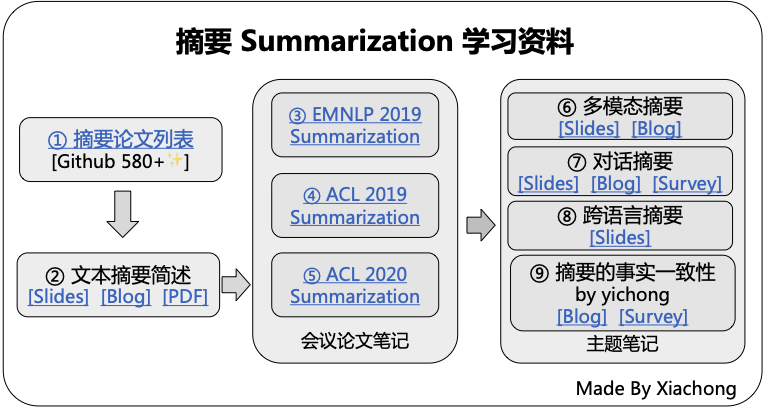
Presentations && Notes

Big Model Era

  1. TempoSum: Evaluating the Temporal Generalization of Abstractive Summarization Chi Seng Cheang, Hou Pong Chan, Derek F. Wong, Xuebo Liu, Zhaocong Li, Yanming Sun, Shudong Liu, Lidia S. Chao `` [pdf] [data]
    [Abs] Recent pre-trained language models (PLMs) achieve promising results in existing abstractive summarization datasets. However, existing summarization benchmarks overlap in time with the standard pre-training corpora and finetuning datasets. Hence, the strong performance of PLMs may rely on the parametric knowledge that is memorized during pre-training and fine-tuning. Moreover, the knowledge memorized by PLMs may quickly become outdated, which affects the generalization performance of PLMs on future data. In this work, we propose TempoSum, a novel benchmark that contains data samples from 2010 to 2022, to understand the temporal generalization ability of abstractive summarization models. Through extensive human evaluation, we show that parametric knowledge stored in summarization models significantly affects the faithfulness of the generated summaries on future data. Moreover, existing faithfulness enhancement methods cannot reliably improve the faithfulness of summarization models on future data. Finally, we discuss several recommendations to the research community on how to evaluate and improve the temporal generalization capability of text summarization models.
  2. RadAdapt: Radiology Report Summarization via Lightweight Domain Adaptation of Large Language Models Dave Van Veen, Cara Van Uden, Maayane Attias, Anuj Pareek, Christian Bluethgen, Malgorzata Polacin, Wah Chiu, Jean-Benoit Delbrouck, Juan Manuel Zambrano Chaves, Curtis P. Langlotz, Akshay S. Chaudhari, John Pauly [pdf]
    [Abs] We systematically investigate lightweight strategies to adapt large language models (LLMs) for the task of radiology report summarization (RRS). Specifically, we focus on domain adaptation via pretraining (on natural language, biomedical text, and clinical text) and via prompting (zero-shot, in-context learning) or parameter-efficient fine-tuning (prefix tuning, LoRA). Our results on the MIMIC-III dataset consistently demonstrate best performance by maximally adapting to the task via pretraining on clinical text and parameter-efficient fine-tuning on RRS examples. Importantly, this method fine-tunes a mere 0.32% of parameters throughout the model, in contrast to end-to-end fine-tuning (100% of parameters). Additionally, we study the effect of in-context examples and out-of-distribution (OOD) training before concluding with a radiologist reader study and qualitative analysis. Our findings highlight the importance of domain adaptation in RRS and provide valuable insights toward developing effective natural language processing solutions for clinical tasks.
  3. ImpressionGPT: An Iterative Optimizing Framework for Radiology Report Summarization with ChatGPT Chong Ma, Zihao Wu, Jiaqi Wang, Shaochen Xu, Yaonai Wei, Zhengliang Liu, Lei Guo, Xiaoyan Cai, Shu Zhang, Tuo Zhang, Dajiang Zhu, Dinggang Shen, Tianming Liu, Xiang Li [pdf]
    [Abs] The 'Impression' section of a radiology report is a critical basis for communication between radiologists and other physicians, and it is typically written by radiologists based on the 'Findings' section. However, writing numerous impressions can be laborious and error-prone for radiologists. Although recent studies have achieved promising results in automatic impression generation using large-scale medical text data for pre-training and fine-tuning pre-trained language models, such models often require substantial amounts of medical text data and have poor generalization performance. While large language models (LLMs) like ChatGPT have shown strong generalization capabilities and performance, their performance in specific domains, such as radiology, remains under-investigated and potentially limited. To address this limitation, we propose ImpressionGPT, which leverages the in-context learning capability of LLMs by constructing dynamic contexts using domain-specific, individualized data. This dynamic prompt approach enables the model to learn contextual knowledge from semantically similar examples from existing data. Additionally, we design an iterative optimization algorithm that performs automatic evaluation on the generated impression results and composes the corresponding instruction prompts to further optimize the model. The proposed ImpressionGPT model achieves state-of-the-art performance on both MIMIC-CXR and OpenI datasets without requiring additional training data or fine-tuning the LLMs. This work presents a paradigm for localizing LLMs that can be applied in a wide range of similar application scenarios, bridging the gap between general-purpose LLMs and the specific language processing needs of various domains.
  4. Extractive Summarization via ChatGPT for Faithful Summary Generation Haopeng Zhang, Xiao Liu, Jiawei Zhang [pdf]
    [Abs] Extractive summarization is a crucial task in natural language processing that aims to condense long documents into shorter versions by directly extracting sentences. The recent introduction of ChatGPT has attracted significant interest in the NLP community due to its remarkable performance on a wide range of downstream tasks. However, concerns regarding factuality and faithfulness have hindered its practical applications for summarization systems. This paper first presents a thorough evaluation of ChatGPT's performance on extractive summarization and compares it with traditional fine-tuning methods on various benchmark datasets. Our experimental analysis reveals that ChatGPT's extractive summarization performance is still inferior to existing supervised systems in terms of ROUGE scores. In addition, we explore the effectiveness of in-context learning and chain-of-thought reasoning for enhancing its performance. Furthermore, we find that applying an extract-then-generate pipeline with ChatGPT yields significant performance improvements over abstractive baselines in terms of summary faithfulness. These observations highlight potential directions for enhancing ChatGPT's capabilities for faithful text summarization tasks using two-stage approaches.
  5. Human-like Summarization Evaluation with ChatGPT Mingqi Gao, Jie Ruan, Renliang Sun, Xunjian Yin, Shiping Yang, Xiaojun Wan [pdf]
    [Abs] Evaluating text summarization is a challenging problem, and existing evaluation metrics are far from satisfactory. In this study, we explored ChatGPT's ability to perform human-like summarization evaluation using four human evaluation methods on five datasets. We found that ChatGPT was able to complete annotations relatively smoothly using Likert scale scoring, pairwise comparison, Pyramid, and binary factuality evaluation. Additionally, it outperformed commonly used automatic evaluation metrics on some datasets. Furthermore, we discussed the impact of different prompts, compared its performance with that of human evaluation, and analyzed the generated explanations and invalid responses.
  6. Cross-Lingual Summarization via ChatGPT Jiaan Wang, Yunlong Liang, Fandong Meng, Zhixu Li, Jianfeng Qu, Jie Zhou [pdf]
    [Abs] Given a document in a source language, cross-lingual summarization (CLS) aims to generate a summary in a different target language. Recently, the emergence of ChatGPT has attracted wide attention from the computational linguistics community. However, it is not yet known the performance of ChatGPT on CLS. In this report, we empirically use various prompts to guide ChatGPT to perform zero-shot CLS from different paradigms (i.e., end-to-end and pipeline), and provide a preliminary evaluation on its generated summaries.We find that ChatGPT originally prefers to produce lengthy summaries with more detailed information. But with the help of an interactive prompt, ChatGPT can balance between informativeness and conciseness, and significantly improve its CLS performance. Experimental results on three widely-used CLS datasets show that ChatGPT outperforms the advanced GPT 3.5 model (i.e., text-davinci-003). In addition, we provide qualitative case studies to show the superiority of ChatGPT on CLS.
  7. Exploring the Limits of ChatGPT for Query or Aspect-based Text Summarization Xianjun Yang, Yan Li, Xinlu Zhang, Haifeng Chen, Wei Cheng [pdf]
    [Abs] Text summarization has been a crucial problem in natural language processing (NLP) for several decades. It aims to condense lengthy documents into shorter versions while retaining the most critical information. Various methods have been proposed for text summarization, including extractive and abstractive summarization. The emergence of large language models (LLMs) like GPT3 and ChatGPT has recently created significant interest in using these models for text summarization tasks. Recent studies \cite{goyal2022news, zhang2023benchmarking} have shown that LLMs-generated news summaries are already on par with humans. However, the performance of LLMs for more practical applications like aspect or query-based summaries is underexplored. To fill this gap, we conducted an evaluation of ChatGPT's performance on four widely used benchmark datasets, encompassing diverse summaries from Reddit posts, news articles, dialogue meetings, and stories. Our experiments reveal that ChatGPT's performance is comparable to traditional fine-tuning methods in terms of Rouge scores. Moreover, we highlight some unique differences between ChatGPT-generated summaries and human references, providing valuable insights into the superpower of ChatGPT for diverse text summarization tasks. Our findings call for new directions in this area, and we plan to conduct further research to systematically examine the characteristics of ChatGPT-generated summaries through extensive human evaluation.
  8. News Summarization and Evaluation in the Era of GPT-3 Tanya Goyal, Junyi Jessy Li, Greg Durrett [pdf] [code]
    [Abs] The recent success of zero- and few-shot prompting with models like GPT-3 has led to a paradigm shift in NLP research. In this paper, we study its impact on text summarization, focusing on the classic benchmark domain of news summarization. First, we investigate how zero-shot GPT-3 compares against fine-tuned models trained on large summarization datasets. We show that not only do humans overwhelmingly prefer GPT-3 summaries, but these also do not suffer from common dataset-specific issues such as poor factuality. Next, we study what this means for evaluation, particularly the role of gold standard test sets. Our experiments show that both reference-based and reference-free automatic metrics, e.g. recently proposed QA- or entailment-based factuality approaches, cannot reliably evaluate zero-shot summaries. Finally, we discuss future research challenges beyond generic summarization, specifically, keyword- and aspect-based summarization, showing how dominant fine-tuning approaches compare to zero-shot prompting. To support further research, we release: (a) a corpus of 10K generated summaries from fine-tuned and zero-shot models across 4 standard summarization benchmarks, (b) 1K human preference judgments and rationales comparing different systems for generic- and keyword-based summarization.
  9. Benchmarking Large Language Models for News Summarization Tianyi Zhang, Faisal Ladhak, Esin Durmus, Percy Liang, Kathleen McKeown, Tatsunori B. Hashimoto [pdf]
    [Abs] Large language models (LLMs) have shown promise for automatic summarization but the reasons behind their successes are poorly understood. By conducting a human evaluation on ten LLMs across different pretraining methods, prompts, and model scales, we make two important observations. First, we find instruction tuning, and not model size, is the key to the LLM's zero-shot summarization capability. Second, existing studies have been limited by low-quality references, leading to underestimates of human performance and lower few-shot and finetuning performance. To better evaluate LLMs, we perform human evaluation over high-quality summaries we collect from freelance writers. Despite major stylistic differences such as the amount of paraphrasing, we find that LMM summaries are judged to be on par with human written summaries.
  10. Is ChatGPT a General-Purpose Natural Language Processing Task Solver? Chengwei Qin, Aston Zhang, Zhuosheng Zhang, Jiaao Chen, Michihiro Yasunaga, Diyi Yang [pdf]
    [Abs] Spurred by advancements in scale, large language models (LLMs) have demonstrated the ability to perform a variety of natural language processing (NLP) tasks zero-shot -- i.e., without adaptation on downstream data. Recently, the debut of ChatGPT has drawn a great deal of attention from the natural language processing (NLP) community due to the fact that it can generate high-quality responses to human input and self-correct previous mistakes based on subsequent conversations. However, it is not yet known whether ChatGPT can serve as a generalist model that can perform many NLP tasks zero-shot. In this work, we empirically analyze the zero-shot learning ability of ChatGPT by evaluating it on 20 popular NLP datasets covering 7 representative task categories. With extensive empirical studies, we demonstrate both the effectiveness and limitations of the current version of ChatGPT. We find that ChatGPT performs well on many tasks favoring reasoning capabilities (e.g., arithmetic reasoning) while it still faces challenges when solving specific tasks such as sequence tagging. We additionally provide in-depth analysis through qualitative case studies.
  11. A Multitask, Multilingual, Multimodal Evaluation of ChatGPT on Reasoning, Hallucination, and Interactivity Yejin Bang, Samuel Cahyawijaya, Nayeon Lee, Wenliang Dai, Dan Su, Bryan Wilie, Holy Lovenia, Ziwei Ji, Tiezheng Yu, Willy Chung, Quyet V. Do, Yan Xu, Pascale Fung `` [pdf]
    [Abs] This paper proposes a framework for quantitatively evaluating interactive LLMs such as ChatGPT using publicly available data sets. We carry out an extensive technical evaluation of ChatGPT using 21 data sets covering 8 different common NLP application tasks. We evaluate the multitask, multilingual and multi-modal aspects of ChatGPT based on these data sets and a newly designed multimodal dataset. We find that ChatGPT outperforms LLMs with zero-shot learning on most tasks and even outperforms fine-tuned models on some tasks. We find that it is better at understanding non-Latin script languages than generating them. It is able to generate multimodal content from textual prompts, via an intermediate code generation step. Moreover, we find that ChatGPT is 64.33% accurate on average in 10 different reasoning categories under logical reasoning, non-textual reasoning, and commonsense reasoning, hence making it an unreliable reasoner. It is, for example, better at deductive than inductive reasoning. ChatGPT suffers from hallucination problems like other LLMs and it generates more extrinsic hallucinations from its parametric memory as it does not have access to an external knowledge base. Finally, the interactive feature of ChatGPT enables human collaboration with the underlying LLM to improve its performance, i.e, 8% ROUGE-1 on summarization and 2% ChrF++ on machine translation, in a multi-turn "prompt engineering" fashion.

Decomposed

  1. Summarization Programs: Interpretable Abstractive Summarization with Neural Modular Trees Swarnadeep Saha, Shiyue Zhang, Peter Hase, Mohit Bansal ICLR 2023 [pdf] [code]
    [Abs] Current abstractive summarization models either suffer from a lack of clear interpretability or provide incomplete rationales by only highlighting parts of the source document. To this end, we propose the Summarization Program (SP), an interpretable modular framework consisting of an (ordered) list of binary trees, each encoding the step-by-step generative process of an abstractive summary sentence from the source document. A Summarization Program contains one root node per summary sentence, and a distinct tree connects each summary sentence (root node) to the document sentences (leaf nodes) from which it is derived, with the connecting nodes containing intermediate generated sentences. Edges represent different modular operations involved in summarization such as sentence fusion, compression, and paraphrasing. We first propose an efficient best-first search method over neural modules, SP-Search that identifies SPs for human summaries by directly optimizing for ROUGE scores. Next, using these programs as automatic supervision, we propose seq2seq models that generate Summarization Programs, which are then executed to obtain final summaries. We demonstrate that SP-Search effectively represents the generative process behind human summaries using modules that are typically faithful to their intended behavior. We also conduct a simulation study to show that Summarization Programs improve the interpretability of summarization models by allowing humans to better simulate model reasoning. Summarization Programs constitute a promising step toward interpretable and modular abstractive summarization, a complex task previously addressed primarily through blackbox end-to-end neural systems. Supporting code available at this https URL

Benchmark

  • Benchmarking Large Language Models for News Summarizatio Tianyi Zhang, Faisal Ladhak, Esin Durmus, Percy Liang, Kathleen McKeown, Tatsunori B. Hashimoto [pdf]
    [Abs] Large language models (LLMs) have shown promise for automatic summarization but the reasons behind their successes are poorly understood. By conducting a human evaluation on ten LLMs across different pretraining methods, prompts, and model scales, we make two important observations. First, we find instruction tuning, and not model size, is the key to the LLM's zero-shot summarization capability. Second, existing studies have been limited by low-quality references, leading to underestimates of human performance and lower few-shot and finetuning performance. To better evaluate LLMs, we perform human evaluation over high-quality summaries we collect from freelance writers. Despite major stylistic differences such as the amount of paraphrasing, we find that LMM summaries are judged to be on par with human written summaries.
  • MuLD: The Multitask Long Document Benchmark G Thomas Hudson, Noura Al Moubayed [pdf] [data]
  • EXPLAINABOARD: An Explainable Leaderboard for NLP Pengfei Liu, Jinlan Fu, Yang Xiao, Weizhe Yuan, Shuaichen Chang, Junqi Dai, Yixin Liu, Zihuiwen Ye, Graham Neubig [pdf] [ExplainaBoard]
  • GLGE: A New General Language Generation Evaluation Benchmark Dayiheng Liu, Yu Yan, Yeyun Gong, Weizhen Qi, Hang Zhang, Jian Jiao, Weizhu Chen, Jie Fu, Linjun Shou, Ming Gong, Pengcheng Wang, Jiusheng Chen, Daxin Jiang, Jiancheng Lv, Ruofei Zhang, Winnie Wu, Ming Zhou, Nan Duan [pdf] [benchmark]

Survey

  1. A Survey on Biomedical Text Summarization with Pre-trained Language Model Qianqian Xie, Zheheng Luo, Benyou Wang, Sophia Ananiadou [pdf] [code]
    [Abs] The exponential growth of biomedical texts such as biomedical literature and electronic health records (EHRs), provides a big challenge for clinicians and researchers to access clinical information efficiently. To address the problem, biomedical text summarization has been proposed to support clinical information retrieval and management, aiming at generating concise summaries that distill key information from single or multiple biomedical documents. In recent years, pre-trained language models (PLMs) have been the de facto standard of various natural language processing tasks in the general domain. Most recently, PLMs have been further investigated in the biomedical field and brought new insights into the biomedical text summarization task. In this paper, we systematically summarize recent advances that explore PLMs for biomedical text summarization, to help understand recent progress, challenges, and future directions. We categorize PLMs-based approaches according to how they utilize PLMs and what PLMs they use. We then review available datasets, recent approaches and evaluation metrics of the task. We finally discuss existing challenges and promising future directions. To facilitate the research community, we line up open resources including available datasets, recent approaches, codes, evaluation metrics, and the leaderboard in a public project: this https URL.
  2. A Survey on Medical Document Summarization Raghav Jain, Anubhav Jangra, Sriparna Saha, Adam Jatowt [pdf]
    [Abs] The internet has had a dramatic effect on the healthcare industry, allowing documents to be saved, shared, and managed digitally. This has made it easier to locate and share important data, improving patient care and providing more opportunities for medical studies. As there is so much data accessible to doctors and patients alike, summarizing it has become increasingly necessary - this has been supported through the introduction of deep learning and transformer-based networks, which have boosted the sector significantly in recent years. This paper gives a comprehensive survey of the current techniques and trends in medical summarization
  3. Taxonomy of Abstractive Dialogue Summarization: Scenarios, Approaches and Future Directions Qi Jia, Siyu Ren, Yizhu Liu, Kenny Q. Zhu [pdf]
    [Abs] Abstractive dialogue summarization is to generate a concise and fluent summary covering the salient information in a dialogue among two or more interlocutors. It has attracted great attention in recent years based on the massive emergence of social communication platforms and an urgent requirement for efficient dialogue information understanding and digestion. Different from news or articles in traditional document summarization, dialogues bring unique characteristics and additional challenges, including different language styles and formats, scattered information, flexible discourse structures and unclear topic boundaries. This survey provides a comprehensive investigation on existing work for abstractive dialogue summarization from scenarios, approaches to evaluations. It categorizes the task into two broad categories according to the type of input dialogues, i.e., open-domain and task-oriented, and presents a taxonomy of existing techniques in three directions, namely, injecting dialogue features, designing auxiliary training tasks and using additional data.A list of datasets under different scenarios and widely-accepted evaluation metrics are summarized for completeness. After that, the trends of scenarios and techniques are summarized, together with deep insights on correlations between extensively exploited features and different scenarios. Based on these analyses, we recommend future directions including more controlled and complicated scenarios, technical innovations and comparisons, publicly available datasets in special domains, etc.
  4. A Survey of Automatic Text Summarization Using Graph Neural Networks Marco Ferdinand Salchner, Adam Jatowt COLING 2022 [pdf]
    [Abs] Although automatic text summarization (ATS) has been researched for several decades, the application of graph neural networks (GNNs) to this task started relatively recently. In this survey we provide an overview on the rapidly evolving approach of using GNNs for the task of automatic text summarization. In particular we provide detailed information on the functionality of GNNs in the context of ATS, and a comprehensive overview of models utilizing this approach.
  5. A Survey on Cross-Lingual Summarization Jiaan Wang, Fandong Meng, Duo Zheng, Yunlong Liang, Zhixu Li, Jianfeng Qu, Jie Zhou TACL 2022 [pdf]
    [Abs] Cross-lingual summarization is the task of generating a summary in one language (e.g., English) for the given document(s) in a different language (e.g., Chinese). Under the globalization background, this task has attracted increasing attention of the computational linguistics community. Nevertheless, there still remains a lack of comprehensive review for this task. Therefore, we present the first systematic critical review on the datasets, approaches, and challenges in this field. Specifically, we carefully organize existing datasets and approaches according to different construction methods and solution paradigms, respectively. For each type of datasets or approaches, we thoroughly introduce and summarize previous efforts and further compare them with each other to provide deeper analyses. In the end, we also discuss promising directions and offer our thoughts to facilitate future research. This survey is for both beginners and experts in cross-lingual summarization, and we hope it will serve as a starting point as well as a source of new ideas for researchers and engineers interested in this area.
  6. An Empirical Survey on Long Document Summarization: Datasets, Models and Metrics uan Yee Koh, Jiaxin Ju, Ming Liu, Shirui Pan ACM Computing Surveys [pdf]
    [Abs] Long documents such as academic articles and business reports have been the standard format to detail out important issues and complicated subjects that require extra attention. An automatic summarization system that can effectively condense long documents into short and concise texts to encapsulate the most important information would thus be significant in aiding the reader's comprehension. Recently, with the advent of neural architectures, significant research efforts have been made to advance automatic text summarization systems, and numerous studies on the challenges of extending these systems to the long document domain have emerged. In this survey, we provide a comprehensive overview of the research on long document summarization and a systematic evaluation across the three principal components of its research setting: benchmark datasets, summarization models, and evaluation metrics. For each component, we organize the literature within the context of long document summarization and conduct an empirical analysis to broaden the perspective on current research progress. The empirical analysis includes a study on the intrinsic characteristics of benchmark datasets, a multi-dimensional analysis of summarization models, and a review of the summarization evaluation metrics. Based on the overall findings, we conclude by proposing possible directions for future exploration in this rapidly growing field.
  7. Multi-document Summarization via Deep Learning Techniques: A Survey Congbo Ma, Wei Emma Zhang, Mingyu Guo, Hu Wang, QUAN Z. Sheng [pdf]
  8. Embedding Knowledge for Document Summarization: A Survey Yutong Qu, Wei Emma Zhang, Jian Yang, Lingfei Wu, Jia Wu, Xindong Wu [pdf]
  9. A Survey on Dialogue Summarization: Recent Advances and New Frontiers Xiachong Feng, Xiaocheng Feng, Bing Qin IJCAI 2022, Survey Track [pdf]
  10. Automatic Text Summarization Methods: A Comprehensive Review Divakar Yadav, Jalpa Desai, Arun Kumar Yadav [pdf]
  11. Faithfulness in Natural Language Generation: A Systematic Survey of Analysis, Evaluation and Optimization Methods Wei Li, Wenhao Wu, Moye Chen, Jiachen Liu, Xinyan Xiao, Hua Wu [pdf]
  12. Recent Advances in Neural Text Generation: A Task-Agnostic Survey Chen Tang, Frank Guerin, Yucheng Li, Chenghua Lin [pdf]
  13. Survey of Hallucination in Natural Language Generation Ziwei Ji, Nayeon Lee, Rita Frieske, Tiezheng Yu, Dan Su, Yan Xu, Etsuko Ishii, Yejin Bang, Andrea Madotto, Pascale Fung [pdf]
  14. A Survey on Retrieval-Augmented Text Generation Huayang Li, Yixuan Su, Deng Cai, Yan Wang, Lemao Liu [pdf]
  15. A Survey of Controllable Text Generation using Transformer-based Pre-trained Language Models Hanqing Zhang, Haolin Song, Shaoyu Li, Ming Zhou, Dawei Song [pdf]
  16. A Survey of Pretrained Language Models Based Text Generation Junyi Li, Tianyi Tang, Wayne Xin Zhao, Jian-Yun Nie, Ji-Rong Wen [pdf]
  17. A Comprehensive Review on Summarizing Financial News Using Deep Learning Saurabh Kamal, Sahil Sharma [pdf]
  18. A Survey on Multi-modal Summarization Anubhav Jangra, Adam Jatowt, Sriparna Saha, Mohammad Hasanuzzaman [pdf]
  19. Pre-train, Prompt, and Predict: A Systematic Survey of Prompting Methods in Natural Language Processing Pengfei Liu, Weizhe Yuan, Jinlan Fu, Zhengbao Jiang, Hiroaki Hayashi, Graham Neubig [pdf]
  20. Pretrained Language Models for Text Generation: A Survey Junyi Li, Tianyi Tang, Wayne Xin Zhao, Ji-Rong Wen IJCAI21 [pdf]
  21. A Survey of Recent Abstract Summarization Techniques Diyah Puspitaningrum ICICT21 [pdf]
  22. A Survey of the State-of-the-Art Models in Neural Abstractive Text Summarization AYESHA AYUB SYED, FORD LUMBAN GAOL, TOKURO MATSUO [pdf]
  23. Automatic summarization of scientific articles: A survey Nouf Ibrahim Altmami, Mohamed El Bachir Menai Journal of King Saud University - Computer and Information Sciences [pdf]
  24. Multi-document Summarization via Deep Learning Techniques: A Survey Congbo Ma, Wei Emma Zhang, Mingyu Guo, Hu Wang, Quan Z. Sheng [pdf]
  25. Deep Learning Based Abstractive Text Summarization: Approaches, Datasets, Evaluation Measures, and Challenges Dima Suleiman, Arafat A. Awajan [pdf]
  26. A Survey of Knowledge-Enhanced Text Generation Wenhao Yu, Chenguang Zhu, Zaitang Li, Zhiting Hu, Qingyun Wang, Heng Ji, Meng Jiang [pdf]
  27. From Standard Summarization to New Tasks and Beyond: Summarization with Manifold Information Shen Gao, Xiuying Chen, Zhaochun Ren, Dongyan Zhao, Rui Yan IJCAI20 [pdf]
  28. Neural Abstractive Text Summarization with Sequence-to-Sequence Models Tian Shi, Yaser Keneshloo, Naren Ramakrishnan, Chandan K. Reddy [pdf]
  29. A Survey on Neural Network-Based Summarization Methods Yue Dong [pdf]
  30. Automated text summarisation and evidence-based medicine: A survey of two domains Abeed Sarker, Diego Molla, Cecile Paris [pdf]
  31. Automatic Keyword Extraction for Text Summarization: A Survey Santosh Kumar Bharti, Korra Sathya Babu [pdf]
  32. Text Summarization Techniques: A Brief Survey Mehdi Allahyari, Seyedamin Pouriyeh, Mehdi Assefi, Saeid Safaei, Elizabeth D. Trippe, Juan B. Gutierrez, Krys Kochut [pdf]
  33. Recent automatic text summarization techniques: a survey Mahak Gambhir, Vishal Gupta [pdf]

Toolkit

  1. Summary Workbench: Unifying Application and Evaluation of Text Summarization Models Shahbaz Syed, Dominik Schwabe, Martin Potthast EMNLP 2022 Demo [pdf] [demo]
    [Abs] This paper presents Summary Workbench, a new tool for developing and evaluating text summarization models. New models and evaluation measures can be easily integrated as Docker-based plugins, allowing to examine the quality of their summaries against any input and to evaluate them using various evaluation measures. Visual analyses combining multiple measures provide insights into the models' strengths and weaknesses. The tool is hosted at \url{this https URL} and also supports local deployment for private resources.
  2. iFacetSum: Coreference-based Interactive Faceted Summarization for Multi-Document Exploration Eran Hirsch, Alon Eirew, Ori Shapira, Avi Caciularu, Arie Cattan, Ori Ernst, Ramakanth Pasunuru, Hadar Ronen, Mohit Bansal, Ido Dagan EMNLP 2021 [pdf] [demo]
  3. SummerTime: Text Summarization Toolkit for Non-experts Ansong Ni, Zhangir Azerbayev, Mutethia Mutuma, Troy Feng, Yusen Zhang, Tao Yu, Ahmed Hassan Awadallah, Dragomir Radev EMNLP 2021 Demo Track [pdf] [Demo]
  4. Summary Explorer: Visualizing the State of the Art in Text Summarization Shahbaz Syed, Tariq Yousef, Khalid Al-Khatib, Stefan Jänicke, Martin Potthast [pdf] [web]
  5. fastnlp/fastSum [code]
  6. Graph4NLP [code] [summarization]
  7. CTRLsum: Towards Generic Controllable Text Summarization [pdf] [code] EMNLP 2022
    [Abs] Current summarization systems yield generic summaries that are disconnected from users’ preferences and expectations. To address this limitation, we present CTRLsum, a generic framework to control generated summaries through a set of keywords. During training keywords are extracted automatically without requiring additional human annotations. At test time CTRLsum features a control function to map control signal to keywords; through engineering the control function, the same trained model is able to be applied to control summaries on various dimensions, while neither affecting the model training process nor the pretrained models. We additionally explore the combination of keywords and text prompts for more control tasks. Experiments demonstrate the effectiveness of CTRLsum on three domains of summarization datasets and five control tasks: (1) entity-centric and (2) length-controllable summarization, (3) contribution summarization on scientific papers, (4) invention purpose summarization on patent filings, and (5) question-guided summarization on news articles. Moreover, when used in a standard, unconstrained summarization setting, CTRLsum is comparable or better than strong pretrained systems.
  8. OpenNMT-py: Open-Source Neural Machine Translation [pdf] [code]
  9. Fairseq: Facebook AI Research Sequence-to-Sequence Toolkit written in Python. [code]
  10. LeafNATS: An Open-Source Toolkit and Live Demo System for Neural Abstractive Text Summarization Tian Shi, Ping Wang, Chandan K. Reddy NAACL19 [pdf] [code]
  11. TransformerSum [code]

Analysis

  1. Human Guided Exploitation of Interpretable Attention Patterns in Summarization and Topic Segmentation Raymond Li, Wen Xiao, Linzi Xing, Lanjun Wang, Gabriel Murray, Giuseppe Carenini EMNLP 2022 [pdf] [code]
    [Abs] The multi-head self-attention mechanism of the transformer model has been thoroughly investigated recently. In one vein of study, researchers are interested in understanding why and how transformers work. In another vein, researchers propose new attention augmentation methods to make transformers more accurate, efficient and interpretable. In this paper, we combine these two lines of research in a human-in-the-loop pipeline to first discover important task-specific attention patterns. Then those patterns are injected, not only to smaller models, but also to the original model. The benefits of our pipeline and discovered patterns are demonstrated in two case studies with extractive summarization and topic segmentation. After discovering interpretable patterns in BERT-based models fine-tuned for the two downstream tasks, experiments indicate that when we inject the patterns into attention heads, the models show considerable improvements in accuracy and efficiency.
  2. Analyzing Multi-Task Learning for Abstractive Text Summarization Frederic Kirstein, Jan Philip Wahle, Terry Ruas, Bela Gipp `` [pdf]
    [Abs] Despite the recent success of multi-task learning and pre-finetuning for natural language understanding, few works have studied the effects of task families on abstractive text summarization. Task families are a form of task grouping during the pre-finetuning stage to learn common skills, such as reading comprehension. To close this gap, we analyze the influence of multi-task learning strategies using task families for the English abstractive text summarization task. We group tasks into one of three strategies, i.e., sequential, simultaneous, and continual multi-task learning, and evaluate trained models through two downstream tasks. We find that certain combinations of task families (e.g., advanced reading comprehension and natural language inference) positively impact downstream performance. Further, we find that choice and combinations of task families influence downstream performance more than the training scheme, supporting the use of task families for abstractive text summarization.
  3. On Decoding Strategies for Neural Text Generators Gian Wiher, Clara Meister, Ryan Cotterell [pdf]
  4. Training Dynamics for Text Summarization Models Tanya Goyal, Jiacheng Xu, Junyi Jessy Li, Greg Durrett [https://arxiv.org/abs/2110.08370]
  5. Does Summary Evaluation Survive Translation to Other Languages? Neslihan Iskender, Oleg Vasilyev, Tim Polzehl, John Bohannon, Sebastian Möller [pdf]
  6. How well do you know your summarization datasets? Priyam Tejaswin, Dhruv Naik, Pengfei Liu Findings of ACL 2021 [pdf] [code]
  7. Dissecting Generation Modes for Abstractive Summarization Models via Ablation and Attribution Jiacheng Xu, Greg Durrett ACL2021 [pdf] [code]
  8. To Point or Not to Point: Understanding How Abstractive Summarizers Paraphrase Text Matt Wilber, William Timkey, Marten Van Schijndel Findings of ACL 2021 [pdf] [code]
  9. What Makes a Good Summary? Reconsidering the Focus of Automatic Summarization Maartje ter Hoeve, Julia Kiseleva, Maarten de Rijke [pdf]
  10. Intrinsic Evaluation of Summarization Datasets Rishi Bommasani, Claire Cardie EMNLP20 [pdf]
  11. Metrics also Disagree in the Low Scoring Range: Revisiting Summarization Evaluation Metrics Manik Bhandari, Pranav Gour, Atabak Ashfaq, Pengfei Liu COLING20 Short [pdf] [code]
  12. At Which Level Should We Extract? An Empirical Analysis on Extractive Document Summarization Qingyu Zhou, Furu Wei, Ming Zhou COLING20 [pdf]
  13. Corpora Evaluation and System Bias detection in Multi Document Summarization Alvin Dey, Tanya Chowdhury, Yash Kumar, Tanmoy Chakraborty Findings of EMNLP [pdf]
  14. Understanding the Extent to which Summarization Evaluation Metrics Measure the Information Quality of Summaries Daniel Deutsch, Dan Roth [pdf] [code]
  15. Understanding Neural Abstractive Summarization Models via Uncertainty Jiacheng Xu, Shrey Desai, Greg Durrett EMNLP20 Short [pdf] [code]
  16. Re-evaluating Evaluation in Text Summarization Manik Bhandari, Pranav Gour, Atabak Ashfaq, Pengfei Liu, Graham Neubig EMNLP20 [pdf] [code]
  17. CDEvalSumm: An Empirical Study of Cross-Dataset Evaluation for Neural Summarization Systems Yiran Chen, Pengfei Liu, Ming Zhong, Zi-Yi Dou, Danqing Wang, Xipeng Qiu, Xuanjing Huang EMNLP20 [pdf] [code]
  18. What Have We Achieved on Text Summarization? Dandan Huang, Leyang Cui, Sen Yang, Guangsheng Bao, Kun Wang, Jun Xie, Yue Zhang EMNLP20 [pdf]
  19. Conditional Neural Generation using Sub-Aspect Functions for Extractive News Summarization Zhengyuan Liu, Ke Shi, Nancy F. Chen Findings of EMNLP20 [pdf]
  20. Extractive Summarization as Text Matching Ming Zhong, Pengfei Liu, Yiran Chen, Danqing Wang, Xipeng Qiu, Xuanjing Huang ACL20 [pdf] [code]
  21. Neural Text Summarization: A Critical Evaluation Wojciech Kryściński, Nitish Shirish Keskar, Bryan McCann, Caiming Xiong, Richard Socher EMNLP19 [pdf]
  22. Earlier Isn’t Always Better:Sub-aspect Analysis on Corpus and System Biases in Summarization Taehee Jung, Dongyeop Kang, Lucas Mentch, Eduard Hovy EMNLP19 [pdf] [code]
  23. A Closer Look at Data Bias in Neural Extractive Summarization Models Ming Zhong, Danqing Wang, Pengfei Liu, Xipeng Qiu, Xuanjing Huang EMNLP19 Workshop [pdf]
  24. Countering the Effects of Lead Bias in News Summarization via Multi-Stage Training and Auxiliary Losses Matt Grenander, Yue Dong, Jackie Chi Kit Cheung, Annie Louis EMNLP19 Short [pdf]
  25. Searching for Effective Neural Extractive Summarization: What Works and What's Next Ming Zhong, Pengfei Liu, Danqing Wang, Xipeng Qiu, Xuanjing Huang ACL19 [pdf] [code]
  26. Content Selection in Deep Learning Models of Summarization Chris Kedzie, Kathleen McKeown, Hal Daumé III EMNLP18 [pdf] [code]

Thesis

  1. Principled Approaches to Automatic Text Summarization Maxime Peyrard [pdf]
  2. Neural Text Summarization and Generation Piji Li [pdf]

Theory

  1. Bayesian Active Summarization Alexios Gidiotis, Grigorios Tsoumakas [pdf]
  2. RefSum: Refactoring Neural Summarization Yixin Liu, Zi-Yi Dou, Pengfei Liu NAACL21 [pdf] [code]
  3. Principled Approaches to Automatic Text Summarization Maxime Peyrard [pdf]
  4. KLearn: Background Knowledge Inference from Summarization Data Maxime Peyrard, Robert West Findings of EMNLP20 [pdf] [code]
  5. A Simple Theoretical Model of Importance for Summarization Maxime Peyrard ACL19 [pdf]
  6. BottleSum: Unsupervised and Self-supervised Sentence Summarization using the Information Bottleneck Principle Peter West, Ari Holtzman, Jan Buys, Yejin Choi EMNLP19 [pdf] [code]

Dataset

IDNameDescriptionPaperConference
1CNN-DailyMailNewsAbstractive Text Summarization using Sequence-to-sequence RNNs and Beyond SIGNLL16
2New York TimesNewsThe New York Times Annotated Corpus
3DUCNewsThe Effects Of Human Variation In DUC Summarization Evaluation
4GigawordNewsA Neural Attention Model For Abstractive Sentence SummarizationEMNLP15
5NewsroomNewsNewsroom: A Dataset of 1.3 Million Summaries with Diverse Extractive StrategiesNAACL18
6XsumNewsDon’t Give Me the Details, Just the Summary! Topic-Aware Convolutional Neural Networks for Extreme SummarizationEMNLP18
7Multi-NewsMulti-document NewsMulti-News: a Large-Scale Multi-Document Summarization Dataset and Abstractive Hierarchical ModelACL19
8SAMSumMulti-party conversationSAMSum Corpus: A Human-annotated Dialogue Dataset for Abstractive SummarizationEMNLP19
9AMIMeetingThe AMI Meeting Corpus: A pre-announcement.
10ICSIMeetingThe ICSI Meeting Corpus
11MSMOMulti-modalMSMO: Multimodal Summarization with Multimodal OutputEMNLP18
12How2Multi-modalHow2: A Large-scale Dataset for Multimodal Language UnderstandingNIPS18
13ScisummNetScientific paperScisummNet: A Large Annotated Corpus and Content-Impact Models for Scientific Paper Summarization with Citation NetworksAAAI19
14PubMed, ArXivScientific paperA Discourse-Aware Attention Model for Abstractive Summarization of Long DocumentsNAACL18
15TALKSUMMScientific paperTALKSUMM: A Dataset and Scalable Annotation Method for Scientific Paper Summarization Based on Conference TalksACL19
16BillSumLegalBillSum: A Corpus for Automatic Summarization of US LegislationEMNLP19
17LCSTSChinese WeiboLCSTS: A Large Scale Chinese Short Text Summarization Dataset EMNLP15
18WikiHowOnline Knowledge BaseWikiHow: A Large Scale Text Summarization Dataset
19Concept-map-based MDS CorpusEducational Multi-documentBringing Structure into Summaries : Crowdsourcing a Benchmark Corpus of Concept MapsEMNLP17
20WikiSumWikipedia Multi-documentGenerating Wikipedia By Summarizing Long SequenceICLR18
21GameWikiSumGame Multi-documentGameWikiSum : a Novel Large Multi-Document Summarization DatasetLREC20
22En2Zh CLS, Zh2En CLSCross-LingualNCLS: Neural Cross-Lingual SummarizationEMNLP19
23Timeline Summarization DatasetBaidu timelineLearning towards Abstractive Timeline Summarization IJCAI19
24Reddit TIFUonline discussionAbstractive Summarization of Reddit Posts with Multi-level Memory NetworksNAACL19
25TripAttReviewAttribute-aware Sequence Network for Review SummarizationEMNLP19
26Reader Comments Summarization CorpusComments-based WeiboAbstractive Text Summarization by Incorporating Reader Comments AAAI19
27BIGPATENTPatentBIGPATENT: A Large-Scale Dataset for Abstractive and Coherent SummarizationACL19
28Curation CorpusNewsCuration Corpus for Abstractive Text Summarisation
29MATINFMulti-taskMATINF: A Jointly Labeled Large-Scale Dataset for Classification, Question Answering and SummarizationACL20
30MLSUMMulti-Lingual Summarization DatasetMLSUM: The Multilingual Summarization CorpusEMNLP20
31Dialogue(Debate)Argumentative Dialogue Summary CorpusUsing Summarization to Discover Argument Facets in Online Idealogical DialogNAACL15
32WCEPNews Multi-documentA Large-Scale Multi-Document Summarization Dataset from the Wikipedia Current Events PortalACL20 Short
33ArgKPArgument-to-key Point MappingFrom Arguments to Key Points: Towards Automatic Argument SummarizationACL20
34CRD3DialogueStorytelling with Dialogue: A Critical Role Dungeons and Dragons Dataset2020
35GazetaRussian newsDataset for Automatic Summarization of Russian News
36MINDEnglish news recommendation, Summarization, Classification, EntityMIND: A Large-scale Dataset for News RecommendationACL20
37public_meetingsfrench meeting(test set)Align then Summarize: Automatic Alignment Methods for Summarization Corpus CreationLREC
38EnronEmailBuilding a Dataset for Summarization and Keyword Extraction from Emails2014
39ColumbiaEmailSummarizing Email Threads2004
40BC3EmailA publicly available annotated corpus for supervised email summarization
41WikiLinguaCross-LingualWikiLingua- A New Benchmark Dataset for Cross-Lingual Abstractive SummarizationFindings of EMNLP20
42LcsPIRTChinese DialogueGlobal Encoding for Long Chinese Text SummarizationTALLIP
43CLTS,CLTS-plusChinese NewsCLTS: A New Chinese Long Text Summarization Dataset CLTS+: A New Chinese Long Text Summarization Dataset with Abstractive SummariesNLPCC20
44VMSMOMulti-modalVMSMO: Learning to Generate Multimodal Summary for Video-based News ArticlesEMNLP20
45Multi-XScienceMulti-documentMulti-XScience: A Large-scale Dataset for Extreme Multi-document Summarization of Scientific ArticlesEMNLP20 short
46SCITLDRScientific DocumentTLDR: Extreme Summarization of Scientific DocumentsFindings of EMNLP20
47scisumm-corpusScientific Document
48QBSUMQuery-Based ChineseQBSUM: a Large-Scale Query-Based Document Summarization Dataset from Real-world ApplicationsComputer Speech & Language
49qMDSQuery-Based Multi-DocumentAQuaMuSe: Automatically Generating Datasets for Query-Based Multi-Document Summarization
50Liputan6IndonesianLiputan6: A Large-scale Indonesian Dataset for Text SummarizationAACL20
51SportsSumSports GameGenerating Sports News from Live Commentary: A Chinese Dataset for Sports Game SummarizationAACL20
52WikiAspAspect-basedWikiAsp: A Dataset for Multi-domain Aspect-based SummarizationTransaction of the ACL
53DebateSumargumentDebateSum:A large-scale argument mining and summarization datasetARGMIN 2020
54Open4BusinessBusinessOpen4Business (O4B): An Open Access Dataset for Summarizing Business DocumentsWorkshop on Dataset Curation and Security-NeurIPS 2020
55OrangeSumFrenchBARThez: a Skilled Pretrained French Sequence-to-Sequence Model
56Medical Conversationmedical conversationSummarizing Medical Conversations via Identifying Important UtterancesCOLING20
57SumTitlesmovie dialogueSumTitles: a Summarization Dataset with Low ExtractivenessCOLING20
58BANSbengali newsBengali Abstractive News Summarization (BANS): A Neural Attention ApproachTCCE-2020
59e-commerceE-commerceOn the Faithfulness for E-commerce Product SummarizationCOLING20
60TWEETSUMTwitterTWEETSUM: Event-oriented Social Summarization DatasetCOLING20
61SPACEOpinionExtractive Opinion Summarization in Quantized Transformer SpacesTACL
62pn-summaryPersianLeveraging ParsBERT and Pretrained mT5 for Persian Abstractive Text Summarizationcsicc2021
63E-commerce1desensitizedDialogueTopic-Oriented Spoken Dialogue Summarization for Customer Service with Saliency-Aware Topic ModelingAAAI21
64E-commerce2desensitizedDialogueUnsupervised Summarization for Chat Logs with Topic-Oriented Ranking and Context-Aware Auto-EncodersAAAI21
65BengaliSummarizationBengaliUnsupervised Abstractive Summarization of Bengali Text DocumentsEACL21
66MediaSumDialogueMediaSum: A Large-scale Media Interview Dataset for Dialogue SummarizationNAACL21
67Healthline and BreastCancermulti-documentNutri-bullets: Summarizing Health Studies by Composing SegmentsAAAI21
68GOVREPORTLong Government reportsEfficient Attentions for Long Document SummarizationNAACL21
69SSNScientific PaperEnhancing Scientific Papers Summarization with Citation GraphAAAI21
70MTSamplesMedicalTowards objectively evaluating the quality of generated medical summaries
71QMSumMeeting, QueryQMSum: A New Benchmark for Query-based Multi-domain Meeting SummarizationNAACL21
72MS2Medical, Multi-DocumentMS2: Multi-Document Summarization of Medical Studies
73SummScreenTelevision SeriesSummScreen: A Dataset for Abstractive Screenplay SummarizationACL 2022
74SciDuetScientific Papers and SlidesD2S: Document-to-Slide Generation Via Query-Based Text SummarizationNAACL21
75MultiHumESMultilingualMultiHumES: Multilingual Humanitarian Dataset for Extractive SummarizationEACL21
76DialSummDialogueDialSumm: A Real-Life Scenario Dialogue Summarization DatasetFindings of ACL21
77BookSumBook, Long-formBookSum: A Collection of Datasets for Long-form Narrative Summarization
78CLESChinese WeiboA Large-Scale Chinese Long-Text Extractive Summarization CorpusICASSP
79FacetSumScientific PaperBringing Structure into Summaries: a Faceted Summarization Dataset for Long Scientific DocumentsACL2021 short
80ConvoSummDialogueConvoSumm: Conversation Summarization Benchmark and Improved Abstractive Summarization with Argument MiningACL2021
81AgreeSumMulti-document with entailment annotationsAgreeSum: Agreement-Oriented Multi-Document SummarizationFindings of ACL2021
82En2DeCross-Lingual En2DeCross-Lingual Abstractive Summarization with Limited Parallel ResourcesACL 2021
83VT-SSumSpokenVT-SSum: A Benchmark Dataset for Video Transcript Segmentation and Summarization
84AESLCEmailThis Email Could Save Your Life: Introducing the Task of Email Subject Line GenerationACL 2019
85XL-SumCross-lingualXL-Sum: Large-Scale Multilingual Abstractive Summarization for 44 LanguagesFindings of ACL2021
86TES 2012-2016TweetTSSuBERT: Tweet Stream Summarization Using BERT
87PENSPersonalized HeadlinePENS: A Dataset and Generic Framework for Personalized News Headline GenerationACL 2021
88XSum Hallucination AnnotationsFactualityOn Faithfulness and Factuality in Abstractive SummarizationACL 2020
89factuality-datasetsFactualityAnnotating and Modeling Fine-grained Factuality in SummarizationNAACL 2021
90frankFactualityUnderstanding Factuality in Abstractive Summarization with FRANK: A Benchmark for Factuality MetricsNAACL 2021
91TRIPODMovieMovie Summarization via Sparse Graph ConstructionAAAI 2021
92AdaptSumLow-ResourceAdaptSum: Towards Low-Resource Domain Adaptation for Abstractive SummarizationNAACL 2021
93PTSProductMulti-Source Pointer Network for Product Title SummarizationCIKM 2018
94RAMDSReader-AwareReader-Aware Multi-Document Summarization: An Enhanced Model and The First DatasetEMNLP 2017 Workshop
95court judgmentcourt judgmentHow to Write Summaries with Patterns? Learning towards Abstractive Summarization through Prototype EditingEMNLP 2019
96ADEGBTSgaze behaviorsA Dataset for Exploring Gaze Behaviors in Text SummarizationACM MMSys'20
97MeQSumMedicalOn the Summarization of Consumer Health QuestionsACL 2019
98OpoSumOpinionSummarizing Opinions: Aspect Extraction Meets Sentiment Prediction and They Are Both Weakly SupervisedEMNLP 2018
99MM-AVSMulti-modalMulti-modal Summarization for Video-containing DocumentsNAACL 2021
100WikiCatSummulti-docGenerating Summaries with Topic Templates and Structured Convolutional DecodersACL 2019
101SDF-TLSTimelineSummarize Dates First: A Paradigm Shift in Timeline SummarizationSIGIR 2021
102RWS-Cit*Automatic generation of related work through summarizing citations2017
103MTLSTimelineMulti-TimeLine Summarization (MTLS): Improving Timeline Summarization by Generating Multiple SummariesACL 2021
104EMAILSUMEmailEmailSum: Abstractive Email Thread SummarizationACL 2021
105WikiSumWikiHowWikiSum: Coherent Summarization Dataset for Efficient Human-EvaluationACL 2021 Short
106SumPubMedPubMed Scientific ArticleSumPubMed: Summarization Dataset of PubMed Scientific ArticlesACL 2021 Student Research Workshop
107MLGSumMulti-lingualContrastive Aligned Joint Learning for Multilingual SummarizationACL 2021 Findings
108SMARTPHONE,COMPUTERProductCUSTOM: Aspect-Oriented Product Summarization for E-Commerce
109CSDSCustomer Service DialogueCSDS: A Fine-grained Chinese Dataset for Customer Service Dialogue SummarizationEMNLP 2021
110persian-datasetpersianARMAN: Pre-training with Semantically Selecting and Reordering of Sentences for Persian Abstractive Summarization
111StreamHoverspoken livestreamStreamHover: Livestream Transcript Summarization and AnnotationEMNLP 2021
112CNewSumNewsCNewSum: A Large-scale Chinese News Summarization Dataset with Human-annotated Adequacy and Deducibility LevelNLPCC 2021
113MiRANewsnews, factualMiRANews: Dataset and Benchmarks for Multi-Resource-Assisted News SummarizationEMNLP 2021 Findings
114HowSummquery multi-docHowSumm: A Multi-Document Summarization Dataset Derived from WikiHow Articles
115SportsSum2.0SportsSportsSum2.0: Generating High-Quality Sports News from Live Text Commentary
116CoCoSumopinion multi-refComparative Opinion Summarization via Collaborative Decoding
117MReDControllableMReD: A Meta-Review Dataset for Controllable Text Generation
118MSˆ2Multi-Document, MedicalMSˆ2: Multi-Document Summarization of Medical StudiesEMNLP 2021
119MassiveSummMassiveSumm: a very large-scale, very multilingual, news summarisation datasetEMNLP 2021
120XWikismultilingualModels and Datasets for Cross-Lingual SummarisationEMNLP 2021
121SUBSUMEIntent, subjectiveSUBSUME: A Dataset for Subjective Summary Extraction from Wikipedia DocumentsEMNLP 2021 newsum
122TLDR9+TLDR9+: A Large Scale Resource for Extreme Summarization of Social Media PostsEMNLP 2021 newsum
12320 MinutenGermanA New Dataset and Efficient Baselines for Document-level Text Simplification in GermanEMNLP 2021 newsum
124WSDmulti-lingualA Novel Wikipedia based Dataset for Monolingual and Cross-Lingual SummarizationEMNLP 2021 newsum
125TEDSummarySpeechAttention-based Multi-hypothesis Fusion for Speech Summarization
126SummaC BenchmarkFactual, NLISummaC: Re-Visiting NLI-based Models for Inconsistency Detection in Summarization
127ForumSumConversationForumSum: A Multi-Speaker Conversation Summarization DatasetEMNLP 2021 Findings
128K-SportsSumSportsKnowledge Enhanced Sports Game SummarizationWSDM 2022
129Test-AmazonOpinion, New test for Amazon reviewsUnsupervised Opinion Summarization as Copycat-Review GenerationACL 2020
130Test-Amazon-YelpOpinion, New test for Amazon(180) and Yelp(300)Few-Shot Learning for Opinion SummarizationEMNLP 2020
131AmaSumOpinionLearning Opinion Summarizers by Selecting Informative ReviewsEMNLP 2021
132CrossSumCross lingualCrossSum: Beyond English-Centric Cross-Lingual Abstractive Text Summarization for 1500+ Language Pairs
133HCSCL-MSDatasetMulti-modalHierarchical Cross-Modality Semantic Correlation Learning Model for Multimodal SummarizationAAAI 2022
134KlexikonGermanKlexikon: A German Dataset for Joint Summarization and Simplification
135TODSumCustomer ServiceTODSum: Task-Oriented Dialogue Summarization with State Tracking
136TWEETSUMMCustomer ServiceTWEETSUMM - A Dialog Summarization Dataset for Customer ServiceFindings of EMNLP 2021
137PeerSumMulti-document, ScientificPeerSum: A Peer Review Dataset for Abstractive Multi-document Summarization
138Celebrity TS, Event TS, Wiki TSTimeline, person, eventFollow the Timeline! Generating Abstractive and Extractive Timeline Summary in Chronological OrderTOSI 2022
139Chart-to-TextchartChart-to-Text: A Large-Scale Benchmark for Chart Summarization
140GovReport-QSLong DocumentHIBRIDS: Attention with Hierarchical Biases for Structure-aware Long Document SummarizationACL 2022
141EntSUMEntityEntSUM: A Data Set for Entity-Centric SummarizationACL 2022
142ALLSIDESFraming BiasNeuS: Neutral Multi-News Summarization for Mitigating Framing BiasACL 2022
143GRAPHELSUMSgraphSummarization with Graphical Elements
144Annotated-Wikilarge-NewselaFactualityEvaluating Factuality in Text SimplificationACL 2022
145WikiMultiCross-lingualWikiMulti: a Corpus for Cross-Lingual Summarization
146WelshIntroducing the Welsh Text Summarisation Dataset and Baseline Systems
147SuMeBiomedicalSuMe: A Dataset Towards Summarizing Biomedical MechanismsLREC 2022
148CiteSumCiteSum: Citation Text-guided Scientific Extreme Summarization and Low-resource Domain Adaptation
148MSAMSumDialogueMSAMSum: Towards Benchmarking Multi-lingual Dialogue SummarizationACL 2022 DialDoc
149SQuALITYLong-DocumentSQuALITY: Building a Long-Document Summarization Dataset the Hard WayEMNLP 2022
150X-SCITLDRX-SCITLDR: Cross-Lingual Extreme Summarization of Scholarly DocumentsJCDL 2022
151NEWTSNewsNEWTS: A Corpus for News Topic-Focused Summarization
152EntSUMEntityEntSUM: A Data Set for Entity-Centric Extractive SummarizationACL 2022
153ASPECTNEWSASPECTNEWS: Aspect-Oriented Summarization of News DocumentsACL 2022
154RNSumCommit LogsRNSum: A Large-Scale Dataset for Automatic Release Note Generation via Commit Logs SummarizationACL 2022
155AnswerSummquery multi-docAnswerSumm: A Manually-Curated Dataset and Pipeline for Answer SummarizationNAACL 2022
156CHQ-SummCHQ-Summ: A Dataset for Consumer Healthcare Question Summarization
157Multi-LexSummulti-docReal-World Summaries of Civil Rights Lawsuits at Multiple Granularities
158DACSACatalan and SpanishDACSA: A large-scale Dataset for Automatic summarization of Catalan and Spanish newspaper ArticlesNAACL 2022
159BigSurveyAcademic Multi-docGenerating a Structured Summary of Numerous Academic Papers: Dataset and MethodIJCAI 2022
160CSLChinese, AcademicCSL: A Large-scale Chinese Scientific Literature DatasetCOLING 2022
161PCC SummariesGermanExtractive Summarisation for German-language Data: A Text-level Approach with Discourse FeaturesCOLING 2022
162LipKeyabstractive summaries, absent keyphrases, and titlesLipKey: A Large-Scale News Dataset for Absent Keyphrases Generation and Abstractive SummarizationCOLING 2022
163PLOSLay summary of biomedical journal articlesMaking Science Simple: Corpora for the Lay Summarisation of Scientific LiteratureEMNLP 2022
164eLifeLay summary of biomedical journal articlesMaking Science Simple: Corpora for the Lay Summarisation of Scientific LiteratureEMNLP 2022
165ECTSumLong Earnings Call TranscriptsECTSum: A New Benchmark Dataset For Bullet Point Summarization of Long Earnings Call TranscriptsEMNLP 2022
166EUR-Lex-SumMulti- and Cross-lingual LegalEUR-Lex-Sum: A Multi- and Cross-lingual Dataset for Long-form Summarization in the Legal DomainEMNLP 2022
167CrisisLTLSumTimelineCrisisLTLSum: A Benchmark for Local Crisis Event Timeline Extraction and Summarization
168LANS(upon request)ArabicLANS: Large-scale Arabic News Summarization Corpus
169MACSUMControllable News DialogueMACSUM: Controllable Summarization with Mixed Attributes
170NarraSumNarrativeNarraSum: A Large-Scale Dataset for Abstractive Narrative SummarizationEMNLP Findings 2022
171LoRaLayLong Scientific VisualLoRaLay: A Multilingual and Multimodal Dataset for Long Range and Layout-Aware SummarizationEACL 2023
172HunSum-1HungarianHunSum-1: an Abstractive Summarization Dataset for Hungarian
173MCLSultimodal Cross-LingualAssist Non-native Viewers: Multimodal Cross-Lingual Summarization for How2 VideosEMNLP 2022
174JDDC 2.1multimodalJDDC 2.1: A Multimodal Chinese Dialogue Dataset with Joint Tasks of Query Rewriting, Response Generation, Discourse Parsing, and SummarizationEMNLP 2022
175CroCoSumCode-switched Cross-lingualCroCoSum: A Benchmark Dataset for Cross-Lingual Code-Switched Summarization
176unarXivescholarlyunarXive: a large scholarly data set with publications’ full-text, annotated in-text citations, and links to metadataScientometrics 2020
177TempoSumTempoSum: Evaluating the Temporal Generalization of Abstractive Summarization
178VCSUMmeetingVCSUM: A Versatile Chinese Meeting Summarization DatasetACL Findings 2023
179MeetingBankmeetingMeetingBank: A Benchmark Dataset for Meeting SummarizationACL 2023

Dialogue

Dataset

  1. MeetingBank: A Benchmark Dataset for Meeting Summarization Yebowen Hu, Timothy Ganter, Hanieh Deilamsalehy, Franck Dernoncourt, Hassan Foroosh, Fei Liu ACL 2023 [pdf] [data]
    [Abs] As the number of recorded meetings increases, it becomes increasingly important to utilize summarization technology to create useful summaries of these recordings. However, there is a crucial lack of annotated meeting corpora for developing this technology, as it can be hard to collect meetings, especially when the topics discussed are confidential. Furthermore, meeting summaries written by experienced writers are scarce, making it hard for abstractive summarizers to produce sensible output without a reliable reference. This lack of annotated corpora has hindered the development of meeting summarization technology. In this paper, we present MeetingBank, a new benchmark dataset of city council meetings over the past decade. MeetingBank is unique among other meeting corpora due to its divide-and-conquer approach, which involves dividing professionally written meeting minutes into shorter passages and aligning them with specific segments of the meeting. This breaks down the process of summarizing a lengthy meeting into smaller, more manageable tasks. The dataset provides a new testbed of various meeting summarization systems and also allows the public to gain insight into how council decisions are made. We make the collection, including meeting video links, transcripts, reference summaries, agenda, and other metadata, publicly available to facilitate the development of better meeting summarization techniques.
  2. ECTSum: A New Benchmark Dataset For Bullet Point Summarization of Long Earnings Call Transcripts Rajdeep Mukherjee, Abhinav Bohra, Akash Banerjee, Soumya Sharma, Manjunath Hegde, Afreen Shaikh, Shivani Shrivastava, Koustuv Dasgupta, Niloy Ganguly, Saptarshi Ghosh, Pawan Goyal EMNLP 2022 [pdf] [data]
    [Abs] Despite tremendous progress in automatic summarization, state-of-the-art methods are predominantly trained to excel in summarizing short newswire articles, or documents with strong layout biases such as scientific articles or government reports. Efficient techniques to summarize financial documents, including facts and figures, have largely been unexplored, majorly due to the unavailability of suitable datasets. In this work, we present ECTSum, a new dataset with transcripts of earnings calls (ECTs), hosted by publicly traded companies, as documents, and short experts-written telegram-style bullet point summaries derived from corresponding Reuters articles. ECTs are long unstructured documents without any prescribed length limit or format. We benchmark our dataset with state-of-the-art summarizers across various metrics evaluating the content quality and factual consistency of the generated summaries. Finally, we present a simple-yet-effective approach, ECT-BPS, to generate a set of bullet points that precisely capture the important facts discussed in the calls.
  3. TODSum: Task-Oriented Dialogue Summarization with State Tracking Lulu Zhao, Fujia Zheng, Keqing He, Weihao Zeng, Yuejie Lei, Huixing Jiang, Wei Wu, Weiran Xu, Jun Guo, Fanyu Meng [pdf]
  4. TWEETSUMM - A Dialog Summarization Dataset for Customer Service Guy Feigenblat, Chulaka Gunasekara, Benjamin Sznajder, Sachindra Joshi, David Konopnicki, Ranit Aharonov Findings of EMNLP 2021 [pdf] [data]
  5. ForumSum: A Multi-Speaker Conversation Summarization Dataset Misha Khalman, Yao Zhao, Mohammad Saleh EMNLP 2021 Findings [pdf] [data]
  6. CSDS: A Fine-grained Chinese Dataset for Customer Service Dialogue Summarization Haitao Lin, Liqun Ma, Junnan Zhu, Lu Xiang, Yu Zhou, Jiajun Zhang, Chengqing Zong EMNLP 2021 [pdf] [data]
  7. EmailSum: Abstractive Email Thread Summarization Shiyue Zhang, Asli Celikyilmaz, Jianfeng Gao, Mohit Bansal ACL 2021 [pdf] [data]
  8. DialSumm: A Real-Life Scenario Dialogue Summarization Dataset Yulong Chen, Yang Liu, Liang Chen, Yue Zhang Findings of ACL21 [pdf] [data]
  9. ConvoSumm: Conversation Summarization Benchmark and Improved Abstractive Summarization with Argument Mining Alexander R. Fabbri, Faiaz Rahman, Imad Rizvi, Borui Wang, Haoran Li, Yashar Mehdad, Dragomir Radev ACL 2021 [pdf] [code]
  10. MediaSum: A Large-scale Media Interview Dataset for Dialogue Summarization Chenguang Zhu, Yang Liu, Jie Mei, Michael Zeng NAACL21 [pdf] [code]
  11. QMSum: A New Benchmark for Query-based Multi-domain Meeting Summarization Ming Zhong, Da Yin, Tao Yu, Ahmad Zaidi, Mutethia Mutuma, Rahul Jha, Ahmed Hassan Awadallah, Asli Celikyilmaz, Yang Liu, Xipeng Qiu, Dragomir Radev NAACL21 [pdf] [data]
  12. Storytelling with Dialogue: A Critical Role Dungeons and Dragons Dataset Revanth Rameshkumar, Peter Bailey ACL20 [pdf] [data]
  13. SumTitles: a Summarization Dataset with Low Extractiveness Valentin Malykh, Konstantin Chernis, Ekaterina Artemova, Irina Piontkovskaya COLING20 [pdf] [code]
  14. Summarizing Medical Conversations via Identifying Important Utterances Yan Song, Yuanhe Tian, Nan Wang, Fei Xia COLING20 [pdf] [code]
  15. GupShup: Summarizing Open-Domain Code-Switched Conversations Laiba Mehnaz, Debanjan Mahata, Rakesh Gosangi, Uma Sushmitha Gunturi, Riya Jain, Gauri Gupta, Amardeep Kumar, Isabelle G. Lee, Anish Acharya, Rajiv Ratn Shah EMNLP 2021 [pdf][code]
  16. SummScreen: A Dataset for Abstractive Screenplay Summarization Mingda Chen, Zewei Chu, Sam Wiseman, Kevin Gimpel ACL 2022 [pdf] [data]
    [Abs] We introduce SummScreen, a summarization dataset comprised of pairs of TV series transcripts and human written recaps. The dataset provides a challenging testbed for abstractive summarization for several reasons. Plot details are often expressed indirectly in character dialogues and may be scattered across the entirety of the transcript. These details must be found and integrated to form the succinct plot descriptions in the recaps. Also, TV scripts contain content that does not directly pertain to the central plot but rather serves to develop characters or provide comic relief. This information is rarely contained in recaps. Since characters are fundamental to TV series, we also propose two entity-centric evaluation metrics. Empirically, we characterize the dataset by evaluating several methods, including neural models and those based on nearest neighbors. An oracle extractive approach outperforms all benchmarked models according to automatic metrics, showing that the neural models are unable to fully exploit the input transcripts. Human evaluation and qualitative analysis reveal that our non-oracle models are competitive with their oracle counterparts in terms of generating faithful plot events and can benefit from better content selectors. Both oracle and non-oracle models generate unfaithful facts, suggesting future research directions.
  17. SAMSum Corpus: A Human-annotated Dialogue Dataset for Abstractive Summarization Bogdan Gliwa, Iwona Mochol, Maciej Biesek, Aleksander Wawer EMNLP19 [pdf] [data]
  18. Dial2Desc: End-to-end Dialogue Description Generation Haojie Pan, Junpei Zhou, Zhou Zhao, Yan Liu, Deng Cai, Min Yang [pdf]
  19. The AMI meeting corpus: A pre-announcement Carletta, Jean and Ashby, Simone and Bourban, Sebastien and Flynn, Mike and Guillemot, Mael and Hain, Thomas and Kadlec, Jaroslav and Karaiskos, Vasilis and Kraaij, Wessel and Kronenthal, Melissa and others [pdf]
  20. The ICSI meeting corpus Janin, Adam and Baron, Don and Edwards, Jane and Ellis, Dan and Gelbart, David and Morgan, Nelson and Peskin, Barbara and Pfau, Thilo and Shriberg, Elizabeth and Stolcke, Andreas and others [pdf]

Email Summarization

  1. Focus on the Action: Learning to Highlight and Summarize Jointly for Email To-Do Items Summarization Kexun Zhang, Jiaao Chen, Diyi Yang Findings of ACL 2022 [pdf]
  2. EmailSum: Abstractive Email Thread Summarization Shiyue Zhang, Asli Celikyilmaz, Jianfeng Gao, Mohit Bansal ACL 2021 [pdf] [data]
  3. Smart To-Do: Automatic Generation of To-Do Items from Emails Sudipto Mukherjee, Subhabrata Mukherjee, Marcello Hasegawa, Ahmed Hassan Awadallah, Ryen White ACL 2020 [pdf] [code] [bib]
  4. Identifying Implicit Quotes for Unsupervised Extractive Summarization of Conversations Ryuji Kano, Yasuhide Miura, Tomoki Taniguchi, Tomoko Ohkuma AACL20 [pdf]
  5. This Email Could Save Your Life: Introducing the Task of Email Subject Line Generation Rui Zhang, Joel Tetreault ACL 2019 [pdf] [data] [bib]
  6. Building a Dataset for Summarization and Keyword Extraction from Emails Vanessa Loza, Shibamouli Lahiri, Rada Mihalcea, Po-Hsiang Lai LREC 2014 [pdf]
  7. A Publicly Available Annotated Corpus for Supervised Email Summarization Jan Ulrich, Gabriel Murray, Giuseppe Carenini AAAI 2008 [pdf]
  8. Summarizing Email Conversations with Clue Words Giuseppe Carenini, Raymond T. Ng, Xiaodong Zhou WWW 2007 [pdf]
  9. Task-focused Summarization of Email Simon H. Corston-Oliver Eric Ringger Michael Gamon Richard Campbell ACL 2004 [pdf]
  10. Summarizing email threads Owen Rambow, Lokesh Shrestha, John Chen, Chirsty Lauridsen NAACL 2004 [pdf] [bib]
  11. Facilitating email thread access by extractive summary generation Ani Nenkova Recent advances in natural language processing III: selected papers from RANLP [pdf]
  12. Summarizing Archived Discussions: A Beginning Paula S. Newman, John C. Blitzer Proceedings of the 8th international conference on Intelligent user interfaces [pdf]
  13. Combining linguistic and machine learning techniques for email summarization Smaranda Muresan, Evelyne Tzoukermann, Judith L. Klavans Proceedings of the ACL 2001 Workshop on Computational Natural Language Learning (ConLL) 2001 [pdf] [bib]

Meeting Summarization

  1. Learning to Rank Utterances for Query-Focused Meeting Summarization Xingxian Liu, Yajing Xu Findings of ACL 2023 [pdf]
    [Abs] Query-focused meeting summarization(QFMS) aims to generate a specific summary for the given query according to the meeting transcripts. Due to the conflict between long meetings and limited input size, previous works mainly adopt extract-then-summarize methods, which use extractors to simulate binary labels or ROUGE scores to extract utterances related to the query and then generate a summary. However, the previous approach fails to fully use the comparison between utterances. To the extractor, comparison orders are more important than specific scores. In this paper, we propose a Ranker-Generator framework. It learns to rank the utterances by comparing them in pairs and learning from the global orders, then uses top utterances as the generator’s input. We show that learning to rank utterances helps to select utterances related to the query effectively, and the summarizer can benefit from it. Experimental results on QMSum show that the proposed model outperforms all existing multi-stage models with fewer parameters.
  2. ExplainMeetSum: A Dataset for Explainable Meeting Summarization Aligned with Human Intent Hyun Kim, Minsoo Cho, Seung-Hoon Na ACL 2023 [pdf] [code]
    [Abs] To enhance the explainability of meeting summarization, we construct a new dataset called “ExplainMeetSum,” an augmented version of QMSum, by newly annotating evidence sentences that faithfully “explain” a summary. Using ExplainMeetSum, we propose a novel multiple extractor guided summarization, namely Multi-DYLE, which extensively generalizes DYLE to enable using a supervised extractor based on human-aligned extractive oracles. We further present an explainability-aware task, named “Explainable Evidence Extraction” (E3), which aims to automatically detect all evidence sentences that support a given summary. Experimental results on the QMSum dataset show that the proposed Multi-DYLE outperforms DYLE with gains of up to 3.13 in the ROUGE-1 score. We further present the initial results on the E3 task, under the settings using separate and joint evaluation metrics.
  3. VCSUM: A Versatile Chinese Meeting Summarization Dataset Han Wu, Mingjie Zhan, Haochen Tan, Zhaohui Hou, Ding Liang, Linqi Song Findings of ACL 2023 [pdf] [data]
    [Abs] Compared to news and chat summarization, the development of meeting summarization is hugely decelerated by the limited data. To this end, we introduce a versatile Chinese meeting summarization dataset, dubbed VCSum, consisting of 239 real-life meetings, with a total duration of over 230 hours. We claim our dataset is versatile because we provide the annotations of topic segmentation, headlines, segmentation summaries, overall meeting summaries, and salient sentences for each meeting transcript. As such, the dataset can adapt to various summarization tasks or methods, including segmentation-based summarization, multi-granularity summarization and retrieval-then-generate summarization. Our analysis confirms the effectiveness and robustness of VCSum. We also provide a set of benchmark models regarding different downstream summarization tasks on VCSum to facilitate further research.
  4. Query-Utterance Attention with Joint modeling for Query-Focused Meeting Summarization Xingxian Liu, Bin Duan, Bo Xiao, Yajing Xu ICASSP 2023 [pdf]
    [Abs] Query-focused meeting summarization (QFMS) aims to generate summaries from meeting transcripts in response to a given query. Previous works typically concatenate the query with meeting transcripts and implicitly model the query relevance only at the token level with attention mechanism. However, due to the dilution of key query-relevant information caused by long meeting transcripts, the original transformer-based model is insufficient to highlight the key parts related to the query. In this paper, we propose a query-aware framework with joint modeling token and utterance based on Query-Utterance Attention. It calculates the utterance-level relevance to the query with a dense retrieval module. Then both token-level query relevance and utterance-level query relevance are combined and incorporated into the generation process with attention mechanism explicitly. We show that the query relevance of different granularities contributes to generating a summary more related to the query. Experimental results on the QMSum dataset show that the proposed model achieves new state-of-the-art performance.
  5. Meeting Decision Tracker: Making Meeting Minutes with De-Contextualized Utterances Shumpei Inoue, Hy Nguyen, Pham Viet Hoang, Tsungwei Liu, Minh-Tien Nguyen AACL-IJCNLP 2022 [pdf] [demo]
    [Abs] Meetings are a universal process to make decisions in business and project collaboration. The capability to automatically itemize the decisions in daily meetings allows for extensive tracking of past discussions. To that end, we developed Meeting Decision Tracker, a prototype system to construct decision items comprising decision utterance detector (DUD) and decision utterance rewriter (DUR). We show that DUR makes a sizable contribution to improving the user experience by dealing with utterance collapse in natural conversation. An introduction video of our system is also available at this https URL.
  6. ESSumm: Extractive Speech Summarization from Untranscribed Meeting Jun Wang Interspeech 2022 [pdf]
    [Abs] In this paper, we propose a novel architecture for direct extractive speech-to-speech summarization, ESSumm, which is an unsupervised model without dependence on intermediate transcribed text. Different from previous methods with text presentation, we are aimed at generating a summary directly from speech without transcription. First, a set of smaller speech segments are extracted based on speech signal's acoustic features. For each candidate speech segment, a distance-based summarization confidence score is designed for latent speech representation measure. Specifically, we leverage the off-the-shelf self-supervised convolutional neural network to extract the deep speech features from raw audio. Our approach automatically predicts the optimal sequence of speech segments that capture the key information with a target summary length. Extensive results on two well-known meeting datasets (AMI and ICSI corpora) show the effectiveness of our direct speech-based method to improve the summarization quality with untranscribed data. We also observe that our unsupervised speech-based method even performs on par with recent transcript-based summarization approaches, where extra speech recognition is required.
  7. Abstractive Meeting Summarization: A Survey Virgile Rennard, Guokan Shang, Julie Hunter, Michalis Vazirgiannis [pdf]
    [Abs] Recent advances in deep learning, and especially the invention of encoder-decoder architectures, has significantly improved the performance of abstractive summarization systems. While the majority of research has focused on written documents, we have observed an increasing interest in the summarization of dialogues and multi-party conversation over the past few years. A system that could reliably transform the audio or transcript of a human conversation into an abridged version that homes in on the most important points of the discussion would be valuable in a wide variety of real-world contexts, from business meetings to medical consultations to customer service calls. This paper focuses on abstractive summarization for multi-party meetings, providing a survey of the challenges, datasets and systems relevant to this task and a discussion of promising directions for future study.
  8. ALIGNMEET: A Comprehensive Tool for Meeting Annotation, Alignment, and Evaluation Peter Polák, Muskaan Singh, Anna Nedoluzhko, Ondřej Bojar LREC 2022 [pdf] [data]
  9. TANet: Thread-Aware Pretraining for Abstractive Conversational Summarization Ze Yang, Liran Wang, Zhoujin Tian, Wei Wu, Zhoujun Li Findings of NAACL 2022 [pdf]
    [Abs] Although pre-trained language models (PLMs) have achieved great success and become a milestone in NLP, abstractive conversational summarization remains a challenging but less studied task. The difficulty lies in two aspects. One is the lack of large-scale conversational summary data. Another is that applying the existing pre-trained models to this task is tricky because of the structural dependence within the conversation and its informal expression, etc. In this work, we first build a large-scale (11M) pretraining dataset called RCSum, based on the multi-person discussions in the Reddit community. We then present TANet, a thread-aware Transformer-based network. Unlike the existing pre-trained models that treat a conversation as a sequence of sentences, we argue that the inherent contextual dependency among the utterances plays an essential role in understanding the entire conversation and thus propose two new techniques to incorporate the structural information into our model. The first is thread-aware attention which is computed by taking into account the contextual dependency within utterances. Second, we apply thread prediction loss to predict the relations between utterances. We evaluate our model on four datasets of real conversations, covering types of meeting transcripts, customer-service records, and forum threads. Experimental results demonstrate that TANet achieves a new state-of-the-art in terms of both automatic evaluation and human judgment.
  10. Summ^N: A Multi-Stage Summarization Framework for Long Input Dialogues and Documents Yusen Zhang, Ansong Ni, Ziming Mao, Chen Henry Wu, Chenguang Zhu, Budhaditya Deb, Ahmed H. Awadallah, Dragomir Radev, Rui Zhang ACL 2022 [pdf] [code]
    [Abs] Text summarization helps readers capture salient information from documents, news, interviews, and meetings. However, most state-of-the-art pretrained language models (LM) are unable to efficiently process long text for many summarization tasks. In this paper, we propose SummN, a simple, flexible, and effective multi-stage framework for input texts that are longer than the maximum context length of typical pretrained LMs. SummN first splits the data samples and generates a coarse summary in multiple stages and then produces the final fine-grained summary based on it. Our framework can process input text of arbitrary length by adjusting the number of stages while keeping the LM input size fixed. Moreover, it can deal with both single-source documents and dialogues, and it can be used on top of different backbone abstractive summarization models. To the best of our knowledge, SummN is the first multi-stage split-then-summarize framework for long input summarization. Our experiments demonstrate that SummN outperforms previous state-of-the-art methods by improving ROUGE scores on three long meeting summarization datasets AMI, ICSI, and QMSum, two long TV series datasets from SummScreen, and a long document summarization dataset GovReport. Our data and code are available at https://github.com/psunlpgroup/Summ-N.
  11. Exploring Neural Models for Query-Focused Summarization Jesse Vig, Alexander R. Fabbri, Wojciech Kryściński [pdf] [code]
  12. Improving Abstractive Dialogue Summarization with Hierarchical Pretraining and Topic Segment MengNan Qi, Hao Liu, YuZhuo Fu, Ting Liu EMNLP 2021 Findings [pdf]
  13. Meeting Summarization with Pre-training and Clustering Methods Andras Huebner, Wei Ji, Xiang Xiao [pdf] [code]
  14. Context or No Context? A preliminary exploration of human-in-the-loop approach for Incremental Temporal Summarization in meetings Nicole Beckage, Shachi H Kumar, Saurav Sahay, Ramesh Manuvinakurike EMNLP 2021| newsum [pdf]
  15. RetrievalSum: A Retrieval Enhanced Framework for Abstractive Summarization Chenxin An, Ming Zhong, Zhichao Geng, Jianqiang Yang, Xipeng Qiu [pdf]
  16. An Exploratory Study on Long Dialogue Summarization: What Works and What's Next Yusen Zhang, Ansong Ni, Tao Yu, Rui Zhang, Chenguang Zhu, Budhaditya Deb, Asli Celikyilmaz, Ahmed Hassan Awadallah, Dragomir Radev Findings of EMNLP 2021 Short [pdf]
  17. DialogLM: Pre-trained Model for Long Dialogue Understanding and Summarization Ming Zhong, Yang Liu, Yichong Xu, Chenguang Zhu, Michael Zeng AAAI 2022 [pdf] [code]
  18. Dynamic Sliding Window for Meeting Summarization Zhengyuan Liu, Nancy F. Chen SummDial@SIGDial 2021 [pdf]
  19. MeetSum: Transforming Meeting Transcript Summarization using Transformers! Nima Sadri, Bohan Zhang, Bihan Liu [pdf]
  20. Incremental temporal summarization in multiparty meetings Ramesh Manuvinakurike, Saurav Sahay, Wenda Chen, Lama Nachman SIGIR 2021 [pdf]
  21. Abstractive Spoken Document Summarization using Hierarchical Model with Multi-stage Attention Diversity Optimization Potsawee Manakul, Mark J. F. Gales, Linlin Wang INTERSPEECH 2020 [pdf] [code]
  22. What are meeting summaries? An analysis of human extractive summaries in meeting corpus Fei Liu, Yang Liu SIGDIAL 2008 [pdf]
  23. Exploring Speaker Characteristics for Meeting Summarization Fei Liu, Yang Liu INTERSPEECH 2010 [pdf]
  24. Automatic meeting summarization and topic detection system Tai-Chia Huang, Chia-Hsuan Hsieh, Hei-Chia Wang [pdf]
  25. A keyphrase based approach to interactive meeting summarization Korbinian Riedhammer, Benoit Favre, Dilek Hakkani-T¨ur 2008 IEEE Spoken Language Technology Workshop [pdf]
  26. A global optimization framework for meeting summarization Dan Gillick, Korbinian Riedhammerm, Benoit Favre, Dilek Hakkani-Tur 2009 IEEE International Conference on Acoustics, Speech and Signal Processing [pdf]
  27. Evaluating the effectiveness of features and sampling in extractive meeting summarization Shasha Xie, Yang Liu, Hui Lin SLT 2008 [pdf]
  28. Abstractive Meeting Summarization Using Dependency Graph Fusion Siddhartha Banerjee, Prasenjit Mitra, Kazunari Sugiyama WWW 2015 [pdf]
  29. Automatic Community Creation for Abstractive Spoken Conversation Summarization Karan Singla, Evgeny Stepanov, Ali Orkan Bayer, Giuseppe Carenini, Giuseppe Riccardi ACL 2017 workshop [pdf] [bib]
  30. Unsupervised Abstractive Meeting Summarization with Multi-Sentence Compression and Budgeted Submodular Maximization Guokan Shang, Wensi Ding, Zekun Zhang, Antoine Jean-Pierre Tixier, Polykarpos Meladianos, Michalis Vazirgiannis, Jean-Pierre Lorré ACL18 [pdf] [code]
  31. Abstractive meeting summarization based on an attentional neural model Nouha Dammak, Yassine BenAyed [pdf]
  32. A Study of Text Summarization Techniques for Generating Meeting Minutes Tu My Doan, Francois Jacquenet, Christine Largeron, Marc Bernard RCIS 2020 [pdf]
  33. Meeting Summarization, A Challenge for Deep Learning Francois Jacquenet, Marc Bernard, Christine Largeron IWANN 2019 [pdf]
  34. Generating Abstractive Summaries from Meeting Transcripts Siddhartha Banerjee, Prasenjit Mitra, Kazunari Sugiyama Proceedings of the 2015 ACM Symposium on Document Engineering, DocEng' 2015 [pdf]
  35. Align then Summarize: Automatic Alignment Methods for Summarization Corpus Creation Paul Tardy, David Janiszek, Yannick Estève, Vincent Nguyen LREC 2020 [pdf] [bib]
  36. Dialogue Discourse-Aware Graph Model and Data Augmentation for Meeting Summarization Xiachong Feng, Xiaocheng Feng, Bing Qin, Xinwei Geng IJCAI21 [pdf] [code]
  37. How Domain Terminology Affects Meeting Summarization Performance Jia Jin Koay, Alexander Roustai, Xiaojin Dai, Dillon Burns, Alec Kerrigan, Fei Liu COLING20 Short [pdf] [code]
  38. How to Interact and Change? Abstractive Dialogue Summarization with Dialogue Act Weight and Topic Change Info Jiasheng Di, Xiao Wei, Zhenyu Zhang KSEM 2020 [pdf] [code]
  39. Abstractive Dialogue Summarization with Sentence-Gated Modeling Optimized by Dialogue Acts Chih-Wen Goo, Yun-Nung Chen SLT18 [pdf] [code]
  40. A Sliding-Window Approach to Automatic Creation of Meeting Minutes Jia Jin Koay, Alexander Roustai, Xiaojin Dai, Fei Liu [pdf]
  41. Hierarchical Learning for Generation with Long Source Sequences Tobias Rohde, Xiaoxia Wu, Yinhan Liu [pdf] [code]
  42. A Hierarchical Network for Abstractive Meeting Summarization with Cross-Domain Pretraining Chenguang Zhu, Ruochen Xu, Michael Zeng, Xuedong Huang Findings of EMNLP20 [pdf] [code] [unofficial-code]
  43. Abstractive Meeting Summarization via Hierarchical Adaptive Segmental Network Learning Zhou Zhao, Haojie Pan, Changjie Fan, Yan Liu, Linlin Li, Min Yang WWW19 [pdf]
  44. Restructuring Conversations using Discourse Relations for Zero-shot Abstractive Dialogue Summarization Prakhar Ganesh, Saket Dingliwal [pdf]
  45. Keep Meeting Summaries on Topic: Abstractive Multi-Modal Meeting Summarization Manling Li, Lingyu Zhang, Heng Ji, Richard J. Radke ACL19 [pdf]
  46. Automatic analysis of multiparty meetings STEVE RENALS [pdf]
  47. A Multimodal Meeting Browser that Implements an Important Utterance Detection Model based on Multimodal Information Fumio Nihei, Yukiko I. Nakano [pdf]
  48. Exploring Methods for Predicting Important Utterances Contributing to Meeting Summarization Fumio Nihei, Yukiko I. Nakano [pdf]
  49. Fusing Verbal and Nonverbal Information for Extractive Meeting Summarization Fumio Nihei, Yukiko I. Nakano, Yutaka Takase GIFT18 [pdf]
  50. Meeting Extracts for Discussion Summarization Based on Multimodal Nonverbal Information Fumio Nihei, Yukiko I. Nakano, Yutaka Takase ICMI16 [pdf]
  51. Extractive Summarization of Meeting Recordings Gabriel Murray, Steve Renals, Jean Carletta [pdf]
  52. Multimodal Summarization of Meeting Recordings Bema Erol, Dar-Shyang Lee, Jonathan Hull ICME 2003 [pdf]
  53. Few-Shot Learning of an Interleaved Text Summarization Model by Pretraining with Synthetic Data Sanjeev Kumar Karn, Francine Chen, Yan-Ying Chen, Ulli Waltinger, Hinrich Schütze EACL21 [pdf]
  54. Leverage Unlabeled Data for Abstractive Speech Summarization with Self-Supervised Learning and Back-Summarization SPECOM 2020 SPECOM 2020 [pdf]
  55. Focused Meeting Summarization via Unsupervised Relation Extraction Lu Wang, Claire Cardie SIGDIAL 2012 [pdf]
  56. QMSum: A New Benchmark for Query-based Multi-domain Meeting Summarization Ming Zhong, Da Yin, Tao Yu, Ahmad Zaidi, Mutethia Mutuma, Rahul Jha, Ahmed Hassan Awadallah, Asli Celikyilmaz, Yang Liu, Xipeng Qiu, Dragomir Radev NAACL21 [pdf] [data]
  57. Domain-Independent Abstract Generation for Focused Meeting Summarization Lu Wang, Claire Cardie ACL 2013 [pdf]
  58. Summarizing Decisions in Spoken Meetings Lu Wang, Claire Cardie ACL 2011 [pdf]
  59. Extracting Decisions from Multi-Party Dialogue Using Directed Graphical Models and Semantic Similarity Trung Bui, Matthew Frampton, John Dowding, Stanley Peters SIGDIAL 2009 [pdf] [bib]
  60. ConvoSumm: Conversation Summarization Benchmark and Improved Abstractive Summarization with Argument Mining Alexander R. Fabbri, Faiaz Rahman, Imad Rizvi, Borui Wang, Haoran Li, Yashar Mehdad, Dragomir Radev ACL2021 [pdf] [code]

Chat Summarization

  1. Dialogue Summarization with Static-Dynamic Structure Fusion Graph ** Shen Gao, Xin Cheng, Mingzhe Li, Xiuying Chen, Jinpeng Li, Dongyan Zhao, Rui Yan [pdf] [code]
    [Abs] Dialogue, the most fundamental and specially privileged arena of language, gains increasing ubiquity across the Web in recent years. Quickly going through the long dialogue context and capturing salient information scattered over the whole dialogue session benefit users in many real-world Web applications such as email thread summarization and meeting minutes draft. Dialogue summarization is a challenging task in that dialogue has dynamic interaction nature and presumably inconsistent information flow among various speakers. Many researchers address this task by modeling dialogue with pre-computed static graph structure using external linguistic toolkits. However, such methods heavily depend on the reliability of external tools and the static graph construction is disjoint with the graph representation learning phase, which makes the graph can’t be dynamically adapted for the downstream summarization task. In this paper, we propose a Static-Dynamic graph-based Dialogue Summarization model (SDDS), which fuses prior knowledge from human expertise and adaptively learns the graph structure in an end-to-end learning fashion. To verify the effectiveness of SDDS, we conduct experiments on three benchmark datasets (SAMSum, MediaSum, and DialogSum) and the results verify the superiority of SDDS.
  2. Mind the Gap! Injecting Commonsense Knowledge for Abstractive Dialogue Summarization Seungone Kim, Se June Joo, Hyungjoo Chae, Chaehyeong Kim, Seung-won Hwang, Jinyoung Yeo COLING 2022 [pdf]
    [Abs] In this paper, we propose to leverage the unique characteristics of dialogues sharing commonsense knowledge across participants, to resolve the difficulties in summarizing them. We present SICK, a framework that uses commonsense inferences as additional context. Compared to previous work that solely relies on the input dialogue, SICK uses an external knowledge model to generate a rich set of commonsense inferences and selects the most probable one with a similarity-based selection method. Built upon SICK, SICK++ utilizes commonsense as supervision, where the task of generating commonsense inferences is added upon summarizing the dialogue in a multi-task learning setting. Experimental results show that with injected commonsense knowledge, our framework generates more informative and consistent summaries than existing methods.
  3. A Finer-grain Universal Dialogue Semantic Structures based Model For Abstractive Dialogue Summarization Yuejie Lei, Fujia Zheng, Yuanmeng Yan, Keqing He, Weiran Xu EMNLP 2021 Findings [pdf] [code]
  4. Capturing Speaker Incorrectness: Speaker-Focused Post-Correction for Abstractive Dialogue Summarization Dongyub Lee, Jungwoo Lim, Taesun Whang, Chanhee Lee, Seungwoo Cho, Mingun Park, Heuiseok Lim EMNLP 2021| newsum [pdf]
  5. Who says like a style of Vitamin: Towards Syntax-Aware DialogueSummarization using Multi-task Learning Seolhwa Lee, Kisu Yang, Chanjun Park, João Sedoc, Heuiseok Lim [pdf]
  6. Controllable Neural Dialogue Summarization with Personal Named Entity Planning Zhengyuan Liu, Nancy F. Chen EMNLP 2021 [pdf]
  7. GupShup: Summarizing Open-Domain Code-Switched Conversations Laiba Mehnaz, Debanjan Mahata, Rakesh Gosangi, Uma Sushmitha Gunturi, Riya Jain, Gauri Gupta, Amardeep Kumar, Isabelle G. Lee, Anish Acharya, Rajiv Ratn Shah EMNLP 2021 [pdf][code]
  8. Topic-Aware Contrastive Learning for Abstractive Dialogue Summarization Junpeng Liu, Yanyan Zou, Hainan Zhang, Hongshen Chen, Zhuoye Ding, Caixia Yuan, Xiaojie Wang EMNLP 2021 Findings [pdf] [code]
  9. Give the Truth: Incorporate Semantic Slot into Abstractive Dialogue Summarization Lulu Zhao, Weihao Zeng, Weiran Xu, Jun Guo EMNLP 2021 Findings [pdf]
  10. Low-Resource Dialogue Summarization with Domain-Agnostic Multi-Source Pretraining Yicheng Zou, Bolin Zhu, Xingwu Hu, Tao Gui, Qi Zhang EMNLP 2021 [pdf] [code]
  11. Enhancing Semantic Understanding with Self-Supervised Methods for Abstractive Dialogue Summarization Hyunjae Lee, Jaewoong Yun, Hyunjin Choi, Seongho Joe, Youngjune L. Gwon Interspeech 2021 [pdf]
  12. Dialogue summarization with supporting utterance flow modeling and fact regularization Wang Chen, Piji Li, Hou PongChan, Irwin King Knowledge-Based Systems [pdf]
  13. Situation-Based Multiparticipant Chat Summarization: a Concept, an Exploration-Annotation Tool and an Example Collection Anna Smirnova, Evgeniy Slobodkin, George Chernishev ACL 2021 Student Research Workshop [pdf] [tool] [data]
  14. Coreference-Aware Dialogue Summarization Zhengyuan Liu, Ke Shi, Nancy F. Chen SIGDIAL 2021 [pdf]
  15. Incorporating Commonsense Knowledge into Abstractive Dialogue Summarization via Heterogeneous Graph Networks Xiachong Feng, Xiaocheng Feng, Bing Qin CCL 2021 [pdf]
  16. Hierarchical Speaker-Aware Sequence-to-Sequence Model for Dialogue Summarization Yuejie Lei, Yuanmeng Yan, Zhiyuan Zeng, Keqing He, Ximing Zhang, Weiran Xu ICASSP21 [pdf]
  17. Summary Grounded Conversation Generation Chulaka Gunasekara, Guy Feigenblat, Benjamin Sznajder, Sachindra Joshi, David Konopnicki Findings of ACL 2021 [pdf]
  18. Controllable Abstractive Dialogue Summarization with Sketch Supervision Chien-Sheng Wu, Linqing Liu, Wenhao Liu, Pontus Stenetorp, Caiming Xiong ACL-Findings 2021 [pdf] [code]
  19. Structure-Aware Abstractive Conversation Summarization via Discourse and Action Graphs Jiaao Chen, Diyi Yang NAACL21 [pdf] [code]
  20. Planning with Learned Entity Prompts for Abstractive Summarization Shashi Narayan, Yao Zhao, Joshua Maynez, Gonçalo Simoes, Ryan McDonald TACL 2021 [pdf]
  21. Improving Abstractive Dialogue Summarization with Graph Structures and Topic Words Lulu Zhao, Weiran Xu, Jun Guo COLING20 [pdf]
  22. Multi-View Sequence-to-Sequence Models with Conversational Structure for Abstractive Dialogue Summarization Jiaao Chen, Diyi Yang EMNLP20 [pdf] [code]
  23. SAMSum Corpus: A Human-annotated Dialogue Dataset for Abstractive Summarization Bogdan Gliwa, Iwona Mochol, Maciej Biesek, Aleksander Wawer EMNLP19 [pdf] [data]

Medical Dialogue Summarization

  1. COSSUM: Towards Conversation-Oriented Structured Summarization for Automatic Medical Insurance Assessment Sheng Xu, Xiaojun Wan, Sen Hu, Mengdi Zhou, Teng Xu, Hongbin Wang, Haitao Mi KDD 2022 [pdf]
    [Abs] In medical insurance industry, a lot of human labor is required to collect information of claimants. Human assessors need to converse with claimants in order to record key information and organize it into a structured summary. With the purpose of helping save human labor, we propose the task of conversation-oriented structured summarization which aims to automatically produce the desired structured summary from a conversation automatically. One major challenge of the task is that the structured summary contains multiple fields of different types. To tackle this problem, we propose a unified approach COSSUM based on prompting to generate the values of all fields simultaneously. By learning all fields together, our approach can capture the inherent relationship between them. Moreover, we propose a specially designed curriculum learning strategy for model training. Both automatic and human evaluations are performed, and the results show the effectiveness of our proposed approach.
  2. Counseling Summarization using Mental Health Knowledge Guided Utterance Filtering Aseem Srivastava, Tharun Suresh, Sarah Peregrine (Grin)Lord, Md. Shad Akhtar, Tanmoy Chakraborty KDD 2022 ADS Track [pdf]
    [Abs] The psychotherapy intervention technique is a multifaceted conversation between a therapist and a patient. Unlike general clinical discussions, psychotherapy's core components (viz. symptoms) are hard to distinguish, thus becoming a complex problem to summarize later. A structured counseling conversation may contain discussions about symptoms, history of mental health issues, or the discovery of the patient's behavior. It may also contain discussion filler words irrelevant to a clinical summary. We refer to these elements of structured psychotherapy as counseling components. In this paper, the aim is mental health counseling summarization to build upon domain knowledge and to help clinicians quickly glean meaning. We create a new dataset after annotating 12.9K utterances of counseling components and reference summaries for each dialogue. Further, we propose ConSum, a novel counseling-component guided summarization model. ConSum undergoes three independent modules. First, to assess the presence of depressive symptoms, it filters utterances utilizing the Patient Health Questionnaire (PHQ-9), while the second and third modules aim to classify counseling components. At last, we propose a problem-specific Mental Health Information Capture (MHIC) evaluation metric for counseling summaries. Our comparative study shows that we improve on performance and generate cohesive, semantic, and coherent summaries. We comprehensively analyze the generated summaries to investigate the capturing of psychotherapy elements. Human and clinical evaluations on the summary show that ConSum generates quality summary. Further, mental health experts validate the clinical acceptability of the ConSum. Lastly, we discuss the uniqueness in mental health counseling summarization in the real world and show evidences of its deployment on an online application with the support of http://mpathic.ai/
  3. Adding more data does not always help: A study in medical conversation summarization with PEGASUS Varun Nair, Namit Katariya, Xavier Amatriain, Ilya Valmianski, Anitha Kannan [pdf]
  4. Leveraging Pretrained Models for Automatic Summarization of Doctor-Patient Conversations Longxiang Zhang, Renato Negrinho, Arindam Ghosh, Vasudevan Jagannathan, Hamid Reza Hassanzadeh, Thomas Schaaf, and Matthew R. Gormley Findings of EMNLP 2021 [pdf]
  5. Medically Aware GPT-3 as a Data Generator for Medical Dialogue Summarization Bharath Chintagunta, Namit Katariya, Xavier Amatriain, Anitha Kannan NAACL | NLPMC 2021 [pdf1] [pdf2]
  6. Generating SOAP Notes from Doctor-Patient Conversations Using Modular Summarization Techniques Kundan Krishna, Sopan Khosla, Jeffrey P. Bigham, Zachary C. Lipton ACL 2021 [pdf] [code]
  7. Summarizing Medical Conversations via Identifying Important Utterances Yan Song, Yuanhe Tian, Nan Wang, Fei Xia COLING 2020 [pdf] [code] [bib]
  8. Dr.Summarize: Global Summarization of Medical Dialogue by Exploiting Local Structures Anirudh Joshi, Namit Katariya, Xavier Amatriain, Anitha Kannan Findings of EMNLP 2020 [pdf] [bib]
  9. Medical Dialogue Summarization for Automated Reporting in Healthcare Sabine Molenaar, Lientje Maas, Verónica Burriel, Fabiano Dalpiaz,Sjaak Brinkkemper Advanced Information Systems Engineering Workshops 2020 [pdf] [bib]
  10. Generating Medical Reports from Patient-Doctor Conversations using Sequence-to-Sequence Models Seppo Enarvi, Marilisa Amoia, Miguel Del-Agua Teba, Brian Delaney, Frank Diehl, Stefan Hahn, Kristina Harris, Liam McGrath, Yue Pan, Joel Pinto, Luca Rubini, Miguel Ruiz, Gagandeep Singh, Fabian Stemmer, Weiyi Sun, Paul Vozila, Thomas Lin, Ranjani Ramamurthy ACL 2020 Short [pdf] [bib]
  11. Automatically Generating Psychiatric Case Notes From Digital Transcripts of Doctor-Patient Conversations Nazmul Kazi, Indika Kahanda NAACL 2019 [pdf] [bib]
  12. Alignment Annotation for Clinic Visit Dialogue to Clinical Note Sentence Language Generation Wen-wai Yim, Meliha Yetisgen, Jenny Huang, Micah Grossman LREC 2020 [pdf] [bib]
  13. Topic-aware Pointer-Generator Networks for Summarizing Spoken Conversations Zhengyuan Liu, Angela Ng, Sheldon Lee, Ai Ti Aw, Nancy F. Chen ASRU 2019 [pdf]

Customer Service Summarization

  1. Other Roles Matter! Enhancing Role-Oriented Dialogue Summarization via Role Interactions Haitao Lin, Junnan Zhu, Lu Xiang, Yu Zhou, Jiajun Zhang, Chengqing Zong ACL 2022 [pdf] [code]
    [Abs] Role-oriented dialogue summarization is to generate summaries for different roles in the dialogue, e.g., merchants and consumers. Existing methods handle this task by summarizing each role’s content separately and thus are prone to ignore the information from other roles. However, we believe that other roles’ content could benefit the quality of summaries, such as the omitted information mentioned by other roles. Therefore, we propose a novel role interaction enhanced method for role-oriented dialogue summarization. It adopts cross attention and decoder self-attention interactions to interactively acquire other roles’ critical information. The cross attention interaction aims to select other roles’ critical dialogue utterances, while the decoder self-attention interaction aims to obtain key information from other roles’ summaries. Experimental results have shown that our proposed method significantly outperforms strong baselines on two public role-oriented dialogue summarization datasets. Extensive analyses have demonstrated that other roles’ content could help generate summaries with more complete semantics and correct topic structures.
  2. An End-to-End Dialogue Summarization System for Sales Calls Abedelkadir Asi, Song Wang, Roy Eisenstadt, Dean Geckt, Yarin Kuper, Yi Mao, Royi Ronen NAACL 2022 [pdf]
  3. Heuristic-based Inter-training to Improve Few-shot Multi-perspective Dialog Summarization Benjamin Sznajder, Chulaka Gunasekara, Guy Lev, Sachin Joshi, Eyal Shnarch, Noam Slonim [pdf]
  4. Dialogue Summaries as Dialogue States (DS2), Template-Guided Summarization for Few-shot Dialogue State Tracking Jamin Shin, Hangyeol Yu, Hyeongdon Moon, Andrea Madotto, Juneyoung Park Findings of ACL 2022 [pdf] [code]
  5. TWEETSUMM - A Dialog Summarization Dataset for Customer Service Guy Feigenblat, Chulaka Gunasekara, Benjamin Sznajder, Sachindra Joshi, David Konopnicki, Ranit Aharonov [pdf] [data]
  6. Extractive Dialogue Summarization Without Annotation Based on Distantly Supervised Machine Reading Comprehension in Customer Service Bing Ma, Haifeng Sun , Jingyu Wang , Qi Qi, and Jianxin Liao TASLP [pdf]
  7. TODSum: Task-Oriented Dialogue Summarization with State Tracking Lulu Zhao, Fujia Zheng, Keqing He, Weihao Zeng, Yuejie Lei, Huixing Jiang, Wei Wu, Weiran Xu, Jun Guo, Fanyu Meng [pdf]
  8. CSDS: A Fine-grained Chinese Dataset for Customer Service Dialogue Summarization Haitao Lin, Liqun Ma, Junnan Zhu, Lu Xiang, Yu Zhou, Jiajun Zhang, Chengqing Zong EMNLP 2021 [pdf] [data]
  9. Distant Supervision based Machine Reading Comprehension for Extractive Summarization in Customer Service Bing Ma, Cao Liu, Jingyu Wang, Shujie Hu, Fan Yang, Xunliang Cai, Guanglu Wan, Jiansong Chen, Jianxin Liao SIGIR 2021 [pdf]
  10. Unsupervised Abstractive Dialogue Summarization for Tete-a-Tetes Xinyuan Zhang, Ruiyi Zhang, Manzil Zaheer, Amr Ahmed AAAI21 [pdf]
  11. Topic-Oriented Spoken Dialogue Summarization for Customer Service with Saliency-Aware Topic Modeling Yicheng Zou, Lujun Zhao, Yangyang Kang, Jun Lin, Minlong Peng, Zhuoren Jiang, Changlong Sun, Qi Zhang, Xuanjing Huang, Xiaozhong Liu AAAI21 [pdf] [code]
  12. Unsupervised Summarization for Chat Logs with Topic-Oriented Ranking and Context-Aware Auto-Encoders Yicheng Zou, Jun Lin, Lujun Zhao, Yangyang Kang, Zhuoren Jiang, Changlong Sun, Qi Zhang, Xuanjing Huang, Xiaozhong Liu AAAI21 [pdf] [code]
  13. Abstractive Dialog Summarization with Semantic Scaffolds Lin Yuan, Zhou Yu [pdf]
  14. Automatic Dialogue Summary Generation for Customer Service Chunyi Liu, Peng Wang, Jiang Xu, Zang Li and Jieping Ye KDD19 [pdf]

Domain Adaption

  1. DIONYSUS: A Pre-trained Model for Low-Resource Dialogue Summarization Yu Li, Baolin Peng, Pengcheng He, Michel Galley, Zhou Yu, Jianfeng Gao [pdf]
    [Abs] Dialogue summarization has recently garnered significant attention due to its wide range of applications. However, existing methods for summarizing dialogues are suboptimal because they do not take into account the inherent structure of dialogue and rely heavily on labeled data, which can lead to poor performance in new domains. In this work, we propose DIONYSUS (dynamic input optimization in pre-training for dialogue summarization), a pre-trained encoder-decoder model for summarizing dialogues in any new domain. To pre-train DIONYSUS, we create two pseudo summaries for each dialogue example: one is produced by a fine-tuned summarization model, and the other is a collection of dialogue turns that convey important information. We then choose one of these pseudo summaries based on the difference in information distribution across different types of dialogues. This selected pseudo summary serves as the objective for pre-training DIONYSUS using a self-supervised approach on a large dialogue corpus. Our experiments show that DIONYSUS outperforms existing methods on six datasets, as demonstrated by its ROUGE scores in zero-shot and few-shot settings.
  2. Domain-Oriented Prefix-Tuning: Towards Efficient and Generalizable Fine-tuning for Zero-Shot Dialogue Summarization Lulu Zhao, Fujia Zheng, Weihao Zeng, Keqing He, Weiran Xu, Huixing Jiang, Wei Wu, Yanan Wu NAACL 2022 [pdf] [code]
  3. AdaptSum: Towards Low-Resource Domain Adaptation for Abstractive Summarization Tiezheng Yu, Zihan Liu, Pascale Fung NAACL21 [pdf] [code]
  4. Domain Adaptation to Summarize Human Conversations Oana Sandu, Giuseppe Carenini, Gabriel Murray, Raymond Ng ACL2010 Workshop [pdf]

Others

  1. Summarizing Community-based Question-Answer Pairs Ting-Yao Hsu, Yoshi Suhara, Xiaolan Wang EMNLP 2022 [pdf] [code]
    [Abs] Community-based Question Answering (CQA), which allows users to acquire their desired information, has increasingly become an essential component of online services in various domains such as E-commerce, travel, and dining. However, an overwhelming number of CQA pairs makes it difficult for users without particular intent to find useful information spread over CQA pairs. To help users quickly digest the key information, we propose the novel CQA summarization task that aims to create a concise summary from CQA pairs. To this end, we first design a multi-stage data annotation process and create a benchmark dataset, COQASUM, based on the Amazon QA corpus. We then compare a collection of extractive and abstractive summarization methods and establish a strong baseline approach DedupLED for the CQA summarization task. Our experiment further confirms two key challenges, sentence-type transfer and deduplication removal, towards the CQA summarization task. Our data and code are publicly available.
  2. Curriculum Prompt Learning with Self-Training for Abstractive Dialogue Summarization Changqun Li, Linlin Wang, Xin Lin, Gerard de Melo, Liang He EMNLP 2022 [pdf]
    [Abs] Succinctly summarizing dialogue is a task of growing interest, but inherent challenges, such as insufficient training data and low information density impede our ability to train abstractive models. In this work, we propose a novel curriculum-based prompt learning method with self-training to address these problems. Specifically, prompts are learned using a curriculum learning strategy that gradually increases the degree of prompt perturbation, thereby improving the dialogue understanding and modeling capabilities of our model. Unlabeled dialogue is incorporated by means of self-training so as to reduce the dependency on labeled data. We further investigate topic-aware prompts to better plan for the generation of summaries. Experiments confirm that our model substantially outperforms strong baselines and achieves new state-of-the-art results on the AMI and ICSI datasets. Human evaluations also show the superiority of our model with regard to the summary generation quality.
  3. STRUDEL: Structured Dialogue Summarization for Dialogue Comprehension Borui Wang, Chengcheng Feng, Arjun Nair, Madelyn Mao, Jai Desai, Asli Celikyilmaz, Haoran Li, Yashar Mehdad, Dragomir Radev EMNLP 2022 [pdf]
    [Abs] Abstractive dialogue summarization has long been viewed as an important standalone task in natural language processing, but no previous work has explored the possibility of whether abstractive dialogue summarization can also be used as a means to boost an NLP system's performance on other important dialogue comprehension tasks. In this paper, we propose a novel type of dialogue summarization task - STRUctured DiaLoguE Summarization - that can help pre-trained language models to better understand dialogues and improve their performance on important dialogue comprehension tasks. We further collect human annotations of STRUDEL summaries over 400 dialogues and introduce a new STRUDEL dialogue comprehension modeling framework that integrates STRUDEL into a graph-neural-network-based dialogue reasoning module over transformer encoder language models to improve their dialogue comprehension abilities. In our empirical experiments on two important downstream dialogue comprehension tasks - dialogue question answering and dialogue response prediction - we show that our STRUDEL dialogue comprehension model can significantly improve the dialogue comprehension performance of transformer encoder language models.
  4. Enhancing Dialogue Summarization with Topic-Aware Global- and Local- Level Centrality Xinnian Liang, Shuangzhi Wu, Chenhao Cui, Jiaqi Bai, Chao Bian, Zhoujun Li EACL 2023 [pdf] [code]
    [Abs] Dialogue summarization aims to condense a given dialogue into a simple and focused summary text. Typically, both the roles' viewpoints and conversational topics change in the dialogue stream. Thus how to effectively handle the shifting topics and select the most salient utterance becomes one of the major challenges of this task. In this paper, we propose a novel topic-aware Global-Local Centrality (GLC) model to help select the salient context from all sub-topics. The centralities are constructed at both the global and local levels. The global one aims to identify vital sub-topics in the dialogue and the local one aims to select the most important context in each sub-topic. Specifically, the GLC collects sub-topic based on the utterance representations. And each utterance is aligned with one sub-topic. Based on the sub-topics, the GLC calculates global- and local-level centralities. Finally, we combine the two to guide the model to capture both salient context and sub-topics when generating summaries. Experimental results show that our model outperforms strong baselines on three public dialogue summarization datasets: CSDS, MC, and SAMSUM. Further analysis demonstrates that our GLC can exactly identify vital contents from sub-topics.
  5. SWING: Balancing Coverage and Faithfulness for Dialogue Summarization Kung-Hsiang Huang, Siffi Singh, Xiaofei Ma, Wei Xiao, Feng Nan, Nicholas Dingwall, William Yang Wang, Kathleen McKeown Findings of EACL 2023 [pdf] [code]
    [Abs] Missing information is a common issue of dialogue summarization where some information in the reference summaries is not covered in the generated summaries. To address this issue, we propose to utilize natural language inference (NLI) models to improve coverage while avoiding introducing factual inconsistencies. Specifically, we use NLI to compute fine-grained training signals to encourage the model to generate content in the reference summaries that have not been covered, as well as to distinguish between factually consistent and inconsistent generated sentences. Experiments on the DialogSum and SAMSum datasets confirm the effectiveness of the proposed approach in balancing coverage and faithfulness, validated with automatic metrics and human evaluations. Additionally, we compute the correlation between commonly used automatic metrics with human judgments in terms of three different dimensions regarding coverage and factual consistency to provide insight into the most suitable metric for evaluating dialogue summaries.
  6. Human-in-the-loop Abstractive Dialogue Summarization Jiaao Chen, Mohan Dodda, Diyi Yang [pdf] Findings of ACL 2023
    [Abs] Abstractive dialogue summarization has received increasing attention recently. Despite the fact that most of the current dialogue summarization systems are trained to maximize the likelihood of human-written summaries and have achieved significant results, there is still a huge gap in generating high-quality summaries as determined by humans, such as coherence and faithfulness, partly due to the misalignment in maximizing a single human-written summary. To this end, we propose to incorporate different levels of human feedback into the training process. This will enable us to guide the models to capture the behaviors humans care about for summaries. Specifically, we ask humans to highlight the salient information to be included in summaries to provide the local feedback, and to make overall comparisons among summaries in terms of coherence, accuracy, coverage, concise and overall quality, as the global feedback. We then combine both local and global feedback to fine-tune the dialog summarization policy with Reinforcement Learning. Experiments conducted on multiple datasets demonstrate the effectiveness and generalization of our methods over the state-of-the-art supervised baselines, especially in terms of human judgments.
  7. ED-FAITH: Evaluating Dialogue Summarization on Faithfulness Sicong Huang, Asli Celikyilmaz, Haoran Li [pdf]
    [Abs] Abstractive summarization models typically generate content unfaithful to the input, thus highlighting the significance of evaluating the faithfulness of generated summaries. Most faithfulness metrics are only evaluated on news domain, can they be transferred to other summarization tasks? In this work, we first present a systematic study of faithfulness metrics for dialogue summarization. We evaluate common faithfulness metrics on dialogue datasets and observe that most metrics correlate poorly with human judgements despite performing well on news datasets. Given these findings, to improve existing metrics’ performance on dialogue summarization, we first finetune on in-domain dataset, then apply unlikelihood training on negative samples, and show that they can successfully improve metric performance on dialogue data. Inspired by the strong zero-shot performance of the T0 language model, we further propose T0-Score – a new metric for faithfulness evaluation, which shows consistent improvement against baseline metrics across multiple domains.
  8. Towards Understanding Omission in Dialogue Summarization Yicheng Zou, Kaitao Song, Xu Tan, Zhongkai Fu, Tao Gui, Qi Zhang, Dongsheng Li `` [pdf]
    [Abs] Dialogue summarization aims to condense the lengthy dialogue into a concise summary, and has recently achieved significant progress. However, the result of existing methods is still far from satisfactory. Previous works indicated that omission is a major factor in affecting the quality of summarization, but few of them have further explored the omission problem, such as how omission affects summarization results and how to detect omission, which is critical for reducing omission and improving summarization quality. Moreover, analyzing and detecting omission relies on summarization datasets with omission labels (i.e., which dialogue utterances are omitted in the summarization), which are not available in the current literature. In this paper, we propose the OLDS dataset, which provides high-quality Omission Labels for Dialogue Summarization. By analyzing this dataset, we find that a large improvement in summarization quality can be achieved by providing ground-truth omission labels for the summarization model to recover omission information, which demonstrates the importance of omission detection for omission mitigation in dialogue summarization. Therefore, we formulate an omission detection task and demonstrate our proposed dataset can support the training and evaluation of this task well. We also call for research action on omission detection based on our proposed datasets. Our dataset and codes are publicly available.
  9. Analyzing and Evaluating Faithfulness in Dialogue Summarization Bin Wang, Chen Zhang, Yan Zhang, Yiming Chen, Haizhou Li EMNLP 2022 [pdf] [code]
    [Abs] Dialogue summarization is abstractive in nature, making it suffer from factual errors. The factual correctness of summaries has the highest priority before practical applications. Many efforts have been made to improve faithfulness in text summarization. However, there is a lack of systematic study on dialogue summarization systems. In this work, we first perform the fine-grained human analysis on the faithfulness of dialogue summaries and observe that over 35% of generated summaries are faithfully inconsistent respective the source dialogues. Furthermore, we present a new model-level faithfulness evaluation method. It examines generation models with multi-choice questions created by rule-based transformations. Experimental results show that our evaluation schema is a strong proxy for the factual correctness of summarization models. The human-annotated faithfulness samples and the evaluation toolkit are released to facilitate future research toward faithful dialogue summarization.
  10. Taxonomy of Abstractive Dialogue Summarization: Scenarios, Approaches and Future Directions Qi Jia, Siyu Ren, Yizhu Liu, Kenny Q. Zhu [pdf]
    [Abs] Abstractive dialogue summarization is to generate a concise and fluent summary covering the salient information in a dialogue among two or more interlocutors. It has attracted great attention in recent years based on the massive emergence of social communication platforms and an urgent requirement for efficient dialogue information understanding and digestion. Different from news or articles in traditional document summarization, dialogues bring unique characteristics and additional challenges, including different language styles and formats, scattered information, flexible discourse structures and unclear topic boundaries. This survey provides a comprehensive investigation on existing work for abstractive dialogue summarization from scenarios, approaches to evaluations. It categorizes the task into two broad categories according to the type of input dialogues, i.e., open-domain and task-oriented, and presents a taxonomy of existing techniques in three directions, namely, injecting dialogue features, designing auxiliary training tasks and using additional data.A list of datasets under different scenarios and widely-accepted evaluation metrics are summarized for completeness. After that, the trends of scenarios and techniques are summarized, together with deep insights on correlations between extensively exploited features and different scenarios. Based on these analyses, we recommend future directions including more controlled and complicated scenarios, technical innovations and comparisons, publicly available datasets in special domains, etc.
  11. Leveraging Non-dialogue Summaries for Dialogue Summarization Seongmin Park, Dongchan Shin, Jihwa Lee Transcript Understanding Workshop at COLING 2022 [pdf]
    [Abs] To mitigate the lack of diverse dialogue summarization datasets in academia, we present methods to utilize non-dialogue summarization data for enhancing dialogue summarization systems. We apply transformations to document summarization data pairs to create training data that better befit dialogue summarization. The suggested transformations also retain desirable properties of non-dialogue datasets, such as improved faithfulness to the source text. We conduct extensive experiments across both English and Korean to verify our approach. Although absolute gains in ROUGE naturally plateau as more dialogue summarization samples are introduced, utilizing non-dialogue data for training significantly improves summarization performance in zero- and few-shot settings and enhances faithfulness across all training regimes.
  12. Improving Abstractive Dialogue Summarization with Speaker-Aware Supervised Contrastive Learning Zhichao Geng, Ming Zhong, Zhangyue Yin, Xipeng Qiu, Xuanjing Huang COLING 2022 [pdf]
    [Abs] Pre-trained models have brought remarkable success on the text summarization task. For dialogue summarization, the subdomain of text summarization, utterances are concatenated to flat text before being processed. As a result, existing summarization systems based on pre-trained models are unable to recognize the unique format of the speaker-utterance pair well in the dialogue. To investigate this issue, we conduct probing tests and manual analysis, and find that the powerful pre-trained model can not identify different speakers well in the conversation, which leads to various factual errors. Moreover, we propose three speaker-aware supervised contrastive learning (SCL) tasks: Token-level SCL, Turn-level SCL, and Global-level SCL. Comprehensive experiments demonstrate that our methods achieve significant performance improvement on two mainstream dialogue summarization datasets. According to detailed human evaluations, pre-trained models equipped with SCL tasks effectively generate summaries with better factual consistency.
  13. View Dialogue in 2D: A Two-stream Model in Time-speaker Perspective for Dialogue Summarization and beyond Keli Xie, Dongchen He, Jiaxin Zhuang, Siyuan Lu, Zhongfeng Wang COLING 2022 [pdf] [code]
    [Abs] Existing works on dialogue summarization often follow the common practice in document summarization and view the dialogue, which comprises utterances of different speakers, as a single utterance stream ordered by time. However, this single-stream approach without specific attention to the speaker-centered points has limitations in fully understanding the dialogue. To better capture the dialogue information, we propose a 2D view of dialogue based on a time-speaker perspective, where the time and speaker streams of dialogue can be obtained as strengthened input. Based on this 2D view, we present an effective two-stream model called ATM to combine the two streams. Extensive experiments on various summarization datasets demonstrate that ATM significantly surpasses other models regarding diverse metrics and beats the state-of-the-art models on the QMSum dataset in ROUGE scores. Besides, ATM achieves great improvements in summary faithfulness and human evaluation. Moreover, results on machine reading comprehension datasets show the generalization ability of the proposed methods and shed light on other dialogue-based tasks. Our code will be publicly available online.
  14. Summarizing Dialogues with Negative Cues Junpeng Liu, Yanyan Zou, Yuxuan Xi, Shengjie Li, Mian Ma, Zhuoye Ding COLING 2022 [pdf]
    [Abs] Abstractive dialogue summarization aims to convert a long dialogue content into its short form where the salient information is preserved while the redundant pieces are ignored. Different from the well-structured text, such as news and scientific articles, dialogues often consist of utterances coming from two or more interlocutors, where the conversations are often informal, verbose, and repetitive, sprinkled with false-starts, backchanneling, reconfirmations, hesitations, speaker interruptions and the salient information is often scattered across the whole chat. The above properties of conversations make it difficult to directly concentrate on scattered outstanding utterances and thus present new challenges of summarizing dialogues. In this work, rather than directly forcing a summarization system to merely pay more attention to the salient pieces, we propose to explicitly have the model perceive the redundant parts of an input dialogue history during the training phase. To be specific, we design two strategies to construct examples without salient pieces as negative cues. Then, the sequence-to-sequence likelihood loss is cooperated with the unlikelihood objective to drive the model to focus less on the unimportant information and also pay more attention to the salient pieces. Extensive experiments on the benchmark dataset demonstrate that our simple method significantly outperforms the baselines with regard to both semantic matching and factual consistent based metrics. The human evaluation also proves the performance gains.
  15. ClidSum: A Benchmark Dataset for Cross-Lingual Dialogue Summarization Jiaan Wang, Fandong Meng, Ziyao Lu, Duo Zheng, Zhixu Li, Jianfeng Qu, Jie Zhou EMNLP 2022 [pdf] [code]
    [Abs] We present ClidSum, a benchmark dataset for building cross-lingual summarization systems on dialogue documents. It consists of 67k+ dialogue documents from two subsets (i.e., SAMSum and MediaSum) and 112k+ annotated summaries in different target languages. Based on the proposed ClidSum, we introduce two benchmark settings for supervised and semi-supervised scenarios, respectively. We then build various baseline systems in different paradigms (pipeline and end-to-end) and conduct extensive experiments on ClidSum to provide deeper analyses. Furthermore, we propose mDialBART which extends mBART-50 (a multi-lingual BART) via further pre-training. The multiple objectives used in the further pre-training stage help the pre-trained model capture the structural characteristics as well as important content in dialogues and the transformation from source to the target language. Experimental results show the superiority of mDialBART, as an end-to-end model, outperforms strong pipeline models on ClidSum. Finally, we discuss specific challenges that current approaches faced with this task and give multiple promising directions for future research.
  16. A Focused Study on Sequence Length for Dialogue Summarization Bin Wang, Chen Zhang, Chengwei Wei, Haizhou Li [pdf]
    [Abs] Output length is critical to dialogue summarization systems. The dialogue summary length is determined by multiple factors, including dialogue complexity, summary objective, and personal preferences. In this work, we approach dialogue summary length from three perspectives. First, we analyze the length differences between existing models' outputs and the corresponding human references and find that summarization models tend to produce more verbose summaries due to their pretraining objectives. Second, we identify salient features for summary length prediction by comparing different model settings. Third, we experiment with a length-aware summarizer and show notable improvement on existing models if summary length can be well incorporated. Analysis and experiments are conducted on popular DialogSum and SAMSum datasets to validate our findings.
  17. DialogSum Challenge: Results of the Dialogue Summarization Shared Task Yulong Chen, Naihao Deng, Yang Liu, Yue Zhang [pdf]
    [Abs] We report the results of DialogSum Challenge, the shared task on summarizing real-life scenario dialogues at INLG 2022. Four teams participate in this shared task and three submit their system reports, exploring different methods to improve the performance of dialogue summarization. Although there is a great improvement over the baseline models regarding automatic evaluation metrics, such as Rouge scores, we find that there is a salient gap between model generated outputs and human annotated summaries by human evaluation from multiple aspects. These findings demonstrate the difficulty of dialogue summarization and suggest that more fine-grained evaluatuion metrics are in need.
  18. Effectiveness of French Language Models on Abstractive Dialogue Summarization Task Yongxin Zhou, François Portet, Fabien Ringeval LREC 2022 [pdf]
    [Abs] Pre-trained language models have established the state-of-the-art on various natural language processing tasks, including dialogue summarization, which allows the reader to quickly access key information from long conversations in meetings, interviews or phone calls. However, such dialogues are still difficult to handle with current models because the spontaneity of the language involves expressions that are rarely present in the corpora used for pre-training the language models. Moreover, the vast majority of the work accomplished in this field has been focused on English. In this work, we present a study on the summarization of spontaneous oral dialogues in French using several language specific pre-trained models: BARThez, and BelGPT-2, as well as multilingual pre-trained models: mBART, mBARThez, and mT5. Experiments were performed on the DECODA (Call Center) dialogue corpus whose task is to generate abstractive synopses from call center conversations between a caller and one or several agents depending on the situation. Results show that the BARThez models offer the best performance far above the previous state-of-the-art on DECODA. We further discuss the limits of such pre-trained models and the challenges that must be addressed for summarizing spontaneous dialogues.
  19. Data Augmentation for Low-Resource Dialogue Summarization Yongtai Liu, Joshua Maynez, Gonçalo Simões, Shashi Narayan Findings of NAACL 2022 [pdf]
    [Abs] We present DADS, a novel Data Augmentation technique for low-resource Dialogue Summarization. Our method generates synthetic examples by replacing sections of text from both the input dialogue and summary while preserving the augmented summary to correspond to a viable summary for the augmented dialogue. We utilize pretrained language models that produce highly likely dialogue alternatives while still being free to generate diverse alternatives. We applied our data augmentation method to the SAMSum dataset in low resource scenarios, mimicking real world problems such as chat, thread, and meeting summarization where large scale supervised datasets with human-written summaries are scarce. Through both automatic and human evaluations, we show that DADS shows strong improvements for low resource scenarios while generating topically diverse summaries without introducing additional hallucinations to the summaries.
  20. An End-to-End Dialogue Summarization System for Sales Calls Abedelkadir Asi, Song Wang, Roy Eisenstadt, Dean Geckt, Yarin Kuper, Yi Mao, Royi Ronen NAACL 2022 Industry Track [pdf]
    [Abs] Summarizing sales calls is a routine task performed manually by salespeople. We present a production system which combines generative models fine-tuned for customer-agent setting, with a human-in-the-loop user experience for an interactive summary curation process. We address challenging aspects of dialogue summarization task in a real-world setting including long input dialogues, content validation, lack of labeled data and quality evaluation. We show how GPT-3 can be leveraged as an offline data labeler to handle training data scarcity and accommodate privacy constraints in an industrial setting. Experiments show significant improvements by our models in tackling the summarization and content validation tasks on public datasets.
  21. Few-shot fine-tuning SOTA summarization models for medical dialogues David Fraile Navarro, Mark Dras, Shlomo Berkovsky NAACL 2022 Student Research Workshop [pdf] [code]
    [Abs] Abstractive summarization of medical dialogues presents a challenge for standard training approaches, given the paucity of suitable datasets. We explore the performance of state-of-the-art models with zero-shot and few-shot learning strategies and measure the impact of pretraining with general domain and dialogue-specific text on the summarization performance.
  22. DialSummEval: Revisiting Summarization Evaluation for Dialogues Mingqi Gao, Xiaojun Wan NAACL 2022 [pdf] [code]
    [Abs] Dialogue summarization is receiving increasing attention from researchers due to its extraordinary difficulty and unique application value. We observe that current dialogue summarization models have flaws that may not be well exposed by frequently used metrics such as ROUGE. In our paper, we re-evaluate 18 categories of metrics in terms of four dimensions: coherence, consistency, fluency and relevance, as well as a unified human evaluation of various models for the first time. Some noteworthy trends which are different from the conventional summarization tasks are identified. We will release DialSummEval, a multi-faceted dataset of human judgments containing the outputs of 14 models on SAMSum.
  23. Domain-Oriented Prefix-Tuning: Towards Efficient and Generalizable Fine-tuning for Zero-Shot Dialogue Summarization Lulu Zhao, Fujia Zheng, Weihao Zeng, Keqing He, Weiran Xu, Huixing Jiang, Wei Wu, Yanan Wu NAACL 2022 [pdf] [code]
    [Abs] The most advanced abstractive dialogue summarizers lack generalization ability on new domains and the existing researches for domain adaptation in summarization generally rely on large-scale pre-trainings. To explore the lightweight fine-tuning methods for domain adaptation of dialogue summarization, in this paper, we propose an efficient and generalizable Domain-Oriented Prefix-tuning model, which utilizes a domain word initialized prefix module to alleviate domain entanglement and adopts discrete prompts to guide the model to focus on key contents of dialogues and enhance model generalization. We conduct zero-shot experiments and build domain adaptation benchmarks on two multi-domain dialogue summarization datasets, TODSum and QMSum. Adequate experiments and qualitative analysis prove the effectiveness of our methods.
  24. From spoken dialogue to formal summary: An utterance rewriting for dialogue summarization Yue Fang, Hainan Zhang, Hongshen Chen, Zhuoye Ding, Bo Long, Yanyan Lan, Yanquan Zhou NAACL 2022 [pdf]
    [Abs] Due to the dialogue characteristics of unstructured contexts and multi-parties with first-person perspective, many successful text summarization works have failed when dealing with dialogue summarization. In dialogue summarization task, the input dialogue is usually spoken style with ellipsis and co-references but the output summaries are more formal and complete. Therefore, the dialogue summarization model should be able to complete the ellipsis content and co-reference information and then produce a suitable summary accordingly. However, the current state-of-the-art models pay more attention on the topic or structure of summary, rather than the consistency of dialogue summary with its input dialogue context, which may suffer from the personal and logical inconsistency problem. In this paper, we propose a new model, named ReWriteSum, to tackle this problem. Firstly, an utterance rewriter is conducted to complete the ellipsis content of dialogue content and then obtain the rewriting utterances. Then, the co-reference data augmentation mechanism is utilized to replace the referential person name with its specific name to enhance the personal information. Finally, the rewriting utterances and the co-reference replacement data are used in the standard BART model. Experimental results on both SAMSum and DialSum datasets show that our ReWriteSum significantly outperforms baseline models, in terms of both metric-based and human evaluations. Further analysis on multi-speakers also shows that ReWriteSum can obtain relatively higher improvement with more speakers, validating the correctness and property of ReWriteSum.
  25. Unsupervised Abstractive Dialogue Summarization with Word Graphs and POV Conversion Seongmin Park, Jihwa Lee WIT Workshop @ ACL2022 [pdf] [code]
  26. MSAMSum: Towards Benchmarking Multi-lingual Dialogue Summarization Xiachong Feng, Xiaocheng Feng, Bing Qin ACL 2022 DialDoc Workshop [pdf] [data]
  27. The Cross-lingual Conversation Summarization Challenge Yulong Chen, Ming Zhong, Xuefeng Bai, Naihao Deng, Jing Li, Xianchao Zhu, Yue Zhang [pdf]
  28. Post-Training Dialogue Summarization using Pseudo-Paraphrasing Qi Jia, Yizhu Liu, Haifeng Tang, Kenny Q. Zhu Findings of NAACL 2022 [pdf] [code]
    [Abs] Previous dialogue summarization techniques adapt large language models pretrained on the narrative text by injecting dialogue-specific features into the models. These features either require additional knowledge to recognize or make the resulting models harder to tune. To bridge the format gap between dialogues and narrative summaries in dialogue summarization tasks, we propose to post-train pretrained language models (PLMs) to rephrase from dialogue to narratives. After that, the model is fine-tuned for dialogue summarization as usual. Comprehensive experiments show that our approach significantly improves vanilla PLMs on dialogue summarization and outperforms other SOTA models by the summary quality and implementation costs.
  29. CONFIT: Toward Faithful Dialogue Summarization with Linguistically-Informed Contrastive Fine-tuning Xiangru Tang, Arjun Nair, Borui Wang, Bingyao Wang, Jai Desai, Aaron Wade, Haoran Li, Asli Celikyilmaz, Yashar Mehdad, Dragomir Radev [pdf]
  30. Are We Summarizing the Right Way? A Survey of Dialogue Summarization Data Sets Don Tuggener, Margot Mieskes, Jan Deriu, Mark Cieliebak EMNLP 2021| newsum [pdf]
  31. Dialogue Inspectional Summarization with Factual Inconsistency Awareness Leilei Gan, Yating Zhang, Kun Kuang, Lin Yuan, Shuo Li, Changlong Sun, Xiaozhong Liu, Fei Wu [pdf]
  32. Do Boat and Ocean Suggest Beach? Dialogue Summarization with External Knowledge Tianqing Fang, Haojie Pan, Hongming Zhang, Yangqiu Song, Kun Xu, Dong Yu AKBC 2021 [pdf] [code]
  33. Prompt scoring system for dialogue summarization using GPT3 Prodan, George; Pelican, Elena [pdf]
  34. Simple Conversational Data Augmentation for Semi-supervised Abstractive Dialogue SummarizationJiaao Jiaao Chen, Diyi Yang EMNLP 2021 [pdf] [code]
  35. A Bag of Tricks for Dialogue Summarization Muhammad Khalifa, Miguel Ballesteros, Kathleen McKeown EMNLP 2021 Short [pdf]
  36. Hierarchical Summarization for Longform Spoken Dialog Daniel Li, Thomas Chen, Albert Tung, Lydia Chilton UIST 2021 [pdf]
  37. RepSum: Unsupervised Dialogue Summarization based on Replacement Strategy Xiyan Fu, Yating Zhang, Tianyi Wang, Xiaozhong Liu, Changlong Sun, Zhenglu Yang ACL 2021 [pdf] [code]
  38. Language Model as an Annotator: Exploring DialoGPT for Dialogue Summarization Xiachong Feng, Xiaocheng Feng, Libo Qin, Bing Qin, Ting Liu ACL 2021 [pdf] [code]
  39. A Two-Phase Approach for Abstractive Podcast Summarization Chujie Zheng, Kunpeng Zhang, Harry Jiannan Wang, Ling Fan TREC 2020 Podcasts Track [pdf]
  40. Hierarchical Learning for Generation with Long Source Sequences Tobias Rohde, Xiaoxia Wu, Yinhan Liu [pdf] [code]
  41. Improving Online Forums Summarization via Unifying Hierarchical Attention Networks with Convolutional Neural Networks Sansiri Tarnpradab, Fereshteh Jafariakinabad, Kien A. Hua [pdf] [code]
  42. Extractive Summarization of Call Transcripts Pratik K. Biswas, Aleksandr Iakubovich [pdf]
  43. Legal Summarization for Multi-role Debate Dialogue via Controversy Focus Mining and Multi-task Learning Xinyu Duan, Yating Zhang, Lin Yuan, Xin Zhou, Xiaozhong Liu, Tianyi Wang, Ruocheng Wang, Qiong Zhang, Changlong Sun, Fei Wu CIKM 2019 [pdf]
  44. Collabot: Personalized Group Chat Summarization Naama Tepper, Anat Hashavit, Maya Barnea, Inbal Ronen, Lior Leiba WSDM 2018 [pdf]
  45. Summarizing Dialogic Arguments from Social Media Amita Misra, Shereen Oraby, Shubhangi Tandon, Sharath TS, Pranav Anand, Marilyn Walker SemDial 2017 [pdf]
  46. The SENSEI Annotated Corpus: Human Summaries of Reader Comment Conversations in On-line News Emma Barker, Monica Lestari Paramita, Ahmet Aker, Emina Kurtic, Mark Hepple, Robert Gaizauskas SIGDIAL 2016 [pdf]
  47. Semantic Similarity Applied to Spoken Dialogue Summarization Iryna Gurevych, Michael Strube COLING 2004 [pdf] [bib] Switchboard dialogues

Long Document

  1. SmartBook: AI-Assisted Situation Report Generation Revanth Gangi Reddy, Yi R. Fung, Qi Zeng, Manling Li, Ziqi Wang, Paul Sullivan, Heng Ji [pdf] [code]
    [Abs] While human evaluation remains best practice for accurately judging the faithfulness of automatically-generated summaries, few solutions exist to address the increased difficulty and workload when evaluating long-form summaries. Through a survey of 162 papers on long-form summarization, we first shed light on current human evaluation practices surrounding long-form summaries. We find that 73% of these papers do not perform any human evaluation on model-generated summaries, while other works face new difficulties that manifest when dealing with long documents (e.g., low inter-annotator agreement). Motivated by our survey, we present LongEval, a set of guidelines for human evaluation of faithfulness in long-form summaries that addresses the following challenges: (1) How can we achieve high inter-annotator agreement on faithfulness scores? (2) How can we minimize annotator workload while maintaining accurate faithfulness scores? and (3) Do humans benefit from automated alignment between summary and source snippets? We deploy LongEval in annotation studies on two long-form summarization datasets in different domains (SQuALITY and PubMed), and we find that switching to a finer granularity of judgment (e.g., clause-level) reduces inter-annotator variance in faithfulness scores (e.g., std-dev from 18.5 to 6.8). We also show that scores from a partial annotation of fine-grained units highly correlates with scores from a full annotation workload (0.89 Kendall's tau using 50% judgments). We release our human judgments, annotation templates, and our software as a Python library for future research.
  2. LongEval: Guidelines for Human Evaluation of Faithfulness in Long-form Summarization Kalpesh Krishna, Erin Bransom, Bailey Kuehl, Mohit Iyyer, Pradeep Dasigi, Arman Cohan, Kyle Lo EACL 2023 [pdf] [code]
    [Abs] While human evaluation remains best practice for accurately judging the faithfulness of automatically-generated summaries, few solutions exist to address the increased difficulty and workload when evaluating long-form summaries. Through a survey of 162 papers on long-form summarization, we first shed light on current human evaluation practices surrounding long-form summaries. We find that 73% of these papers do not perform any human evaluation on model-generated summaries, while other works face new difficulties that manifest when dealing with long documents (e.g., low inter-annotator agreement). Motivated by our survey, we present LongEval, a set of guidelines for human evaluation of faithfulness in long-form summaries that addresses the following challenges: (1) How can we achieve high inter-annotator agreement on faithfulness scores? (2) How can we minimize annotator workload while maintaining accurate faithfulness scores? and (3) Do humans benefit from automated alignment between summary and source snippets? We deploy LongEval in annotation studies on two long-form summarization datasets in different domains (SQuALITY and PubMed), and we find that switching to a finer granularity of judgment (e.g., clause-level) reduces inter-annotator variance in faithfulness scores (e.g., std-dev from 18.5 to 6.8). We also show that scores from a partial annotation of fine-grained units highly correlates with scores from a full annotation workload (0.89 Kendall's tau using 50% judgments). We release our human judgments, annotation templates, and our software as a Python library for future research.
  3. LoRaLay: A Multilingual and Multimodal Dataset for Long Range and Layout-Aware Summarization Laura Nguyen, Thomas Scialom, Benjamin Piwowarski, Jacopo Staiano EACL 2023 [pdf] [code]
    [Abs] Text Summarization is a popular task and an active area of research for the Natural Language Processing community. By definition, it requires to account for long input texts, a characteristic which poses computational challenges for neural models. Moreover, real-world documents come in a variety of complex, visually-rich, layouts. This information is of great relevance, whether to highlight salient content or to encode long-range interactions between textual passages. Yet, all publicly available summarization datasets only provide plain text content. To facilitate research on how to exploit visual/layout information to better capture long-range dependencies in summarization models, we present LoRaLay, a collection of datasets for long-range summarization with accompanying visual/layout information. We extend existing and popular English datasets (arXiv and PubMed) with layout information and propose four novel datasets -- consistently built from scholar resources -- covering French, Spanish, Portuguese, and Korean languages. Further, we propose new baselines merging layout-aware and long-range models -- two orthogonal approaches -- and obtain state-of-the-art results, showing the importance of combining both lines of research.
  4. GoSum: Extractive Summarization of Long Documents by Reinforcement Learning and Graph Organized discourse state Junyi Bian, Xiaodi Huang, Hong Zhou, Shanfeng Zhu [pdf]
    [Abs] Handling long texts with structural information and excluding redundancy between summary sentences are essential in extractive document summarization. In this work, we propose GoSum, a novel reinforcement-learning-based extractive model for long-paper summarization. GoSum encodes states by building a heterogeneous graph from different discourse levels for each input document. We evaluate the model on two datasets of scientific articles summarization: PubMed and arXiv where it outperforms all extractive summarization models and most of the strong abstractive baselines.
  5. Novel Chapter Abstractive Summarization using Spinal Tree Aware Sub-Sentential Content Selection Hardy Hardy, Miguel Ballesteros, Faisal Ladhak, Muhammad Khalifa, Vittorio Castelli, Kathleen McKeown [pdf]
    [Abs] Summarizing novel chapters is a difficult task due to the input length and the fact that sentences that appear in the desired summaries draw content from multiple places throughout the chapter. We present a pipelined extractive-abstractive approach where the extractive step filters the content that is passed to the abstractive component. Extremely lengthy input also results in a highly skewed dataset towards negative instances for extractive summarization; we thus adopt a margin ranking loss for extraction to encourage separation between positive and negative examples. Our extraction component operates at the constituent level; our approach to this problem enriches the text with spinal tree information which provides syntactic context (in the form of constituents) to the extraction model. We show an improvement of 3.71 Rouge-1 points over best results reported in prior work on an existing novel chapter dataset.
  6. How Far are We from Robust Long Abstractive Summarization? Huan Yee Koh, Jiaxin Ju, He Zhang, Ming Liu, Shirui Pan EMNLP 2022 [pdf] [code]
    [Abs] Abstractive summarization has made tremendous progress in recent years. In this work, we perform fine-grained human annotations to evaluate long document abstractive summarization systems (i.e., models and metrics) with the aim of implementing them to generate reliable summaries. For long document abstractive models, we show that the constant strive for state-of-the-art ROUGE results can lead us to generate more relevant summaries but not factual ones. For long document evaluation metrics, human evaluation results show that ROUGE remains the best at evaluating the relevancy of a summary. It also reveals important limitations of factuality metrics in detecting different types of factual errors and the reasons behind the effectiveness of BARTScore. We then suggest promising directions in the endeavor of developing factual consistency metrics. Finally, we release our annotated long document dataset with the hope that it can contribute to the development of metrics across a broader range of summarization settings.
  7. Toward Unifying Text Segmentation and Long Document Summarization Sangwoo Cho, Kaiqiang Song, Xiaoyang Wang, Fei Liu, Dong Yu EMNLP 2022 [pdf] [code]
    [Abs] Text segmentation is important for signaling a document's structure. Without segmenting a long document into topically coherent sections, it is difficult for readers to comprehend the text, let alone find important information. The problem is only exacerbated by a lack of segmentation in transcripts of audio/video recordings. In this paper, we explore the role that section segmentation plays in extractive summarization of written and spoken documents. Our approach learns robust sentence representations by performing summarization and segmentation simultaneously, which is further enhanced by an optimization-based regularizer to promote selection of diverse summary sentences. We conduct experiments on multiple datasets ranging from scientific articles to spoken transcripts to evaluate the model's performance. Our findings suggest that the model can not only achieve state-of-the-art performance on publicly available benchmarks, but demonstrate better cross-genre transferability when equipped with text segmentation. We perform a series of analyses to quantify the impact of section segmentation on summarizing written and spoken documents of substantial length and complexity.
  8. HeterGraphLongSum: Heterogeneous Graph Neural Network with Passage Aggregation for Extractive Long Document Summarization Tuan-Anh Phan, Ngoc-Dung Ngoc Nguyen, Khac-Hoai Nam Bui COLING 2022 [pdf] [code]
    [Abs] Graph Neural Network (GNN)-based models have proven effective in various Natural Language Processing (NLP) tasks in recent years. Specifically, in the case of the Extractive Document Summarization (EDS) task, modeling documents under graph structure is able to analyze the complex relations between semantic units (e.g., word-to-word, word-to-sentence, sentence-to-sentence) and enrich sentence representations via valuable information from their neighbors. However, long-form document summarization using graph-based methods is still an open research issue. The main challenge is to represent long documents in a graph structure in an effective way. In this regard, this paper proposes a new heterogeneous graph neural network (HeterGNN) model to improve the performance of long document summarization (HeterGraphLongSum). Specifically, the main idea is to add the passage nodes into the heterogeneous graph structure of word and sentence nodes for enriching the final representation of sentences. In this regard, HeterGraphLongSum is designed with three types of semantic units such as word, sentence, and passage. Experiments on two benchmark datasets for long documents such as Pubmed and Arxiv indicate promising results of the proposed model for the extractive long document summarization problem. Especially, HeterGraphLongSum is able to achieve state-of-the-art performance without relying on any pre-trained language models (e.g., BERT). The source code is available for further exploitation on the Github.
  9. Multi Graph Neural Network for Extractive Long Document Summarization Xuan-Dung Doan, Le-Minh Nguyen, Khac-Hoai Nam Bui COLING 2022 [pdf] [code]
    [Abs] Heterogeneous Graph Neural Networks (HeterGNN) have been recently introduced as an emergent approach for extracting document summarization (EDS) by exploiting the cross-relations between words and sentences. However, applying HeterGNN for long documents is still an open research issue. One of the main majors is the lacking of inter-sentence connections. In this regard, this paper exploits how to apply HeterGNN for long documents by building a graph on sentence-level nodes (homogeneous graph) and combine with HeterGNN for capturing the semantic information in terms of both inter and intra-sentence connections. Experiments on two benchmark datasets of long documents such as PubMed and ArXiv show that our method is able to achieve state-of-the-art results in this research field.
  10. HEGEL: Hypergraph Transformer for Long Document Summarization Haopeng Zhang, Xiao Liu, Jiawei Zhang EMNLP 2022 [pdf]
    [Abs] Extractive summarization for long documents is challenging due to the extended structured input context. The long-distance sentence dependency hinders cross-sentence relations modeling, the critical step of extractive summarization. This paper proposes HEGEL, a hypergraph neural network for long document summarization by capturing high-order cross-sentence relations. HEGEL updates and learns effective sentence representations with hypergraph transformer layers and fuses different types of sentence dependencies, including latent topics, keywords coreference, and section structure. We validate HEGEL by conducting extensive experiments on two benchmark datasets, and experimental results demonstrate the effectiveness and efficiency of HEGEL.
  11. GRETEL: Graph Contrastive Topic Enhanced Language Model for Long Document Extractive Summarization Qianqian Xie, Jimin Huang, Tulika Saha, Sophia Ananiadou COLING2022 [pdf] [code]
    [Abs] Recently, neural topic models (NTMs) have been incorporated into pre-trained language models (PLMs), to capture the global semantic information for text summarization. However, in these methods, there remain limitations in the way they capture and integrate the global semantic information. In this paper, we propose a novel model, the graph contrastive topic enhanced language model (GRETEL), that incorporates the graph contrastive topic model with the pre-trained language model, to fully leverage both the global and local contextual semantics for long document extractive summarization. To better capture and incorporate the global semantic information into PLMs, the graph contrastive topic model integrates the hierarchical transformer encoder and the graph contrastive learning to fuse the semantic information from the global document context and the gold summary. To this end, GRETEL encourages the model to efficiently extract salient sentences that are topically related to the gold summary, rather than redundant sentences that cover sub-optimal topics. Experimental results on both general domain

Truncated — view the full README on GitHub.

chatgpt
natural-language-processing
nlp
pretrained-language-model
summarization
text-generation

xcfcode/Summarization-Papers

Summarization Papers

TeX

1,004

457 commits

updated Jul 15, 2023

See the code

README

Summarization Papers

Full List

Organized by Xiachong Feng.

Contributor

Yichong Huang, Haozheng Yang, Jiaan Wang

Summarization Learning Route

Summarization Learning Route (with link)
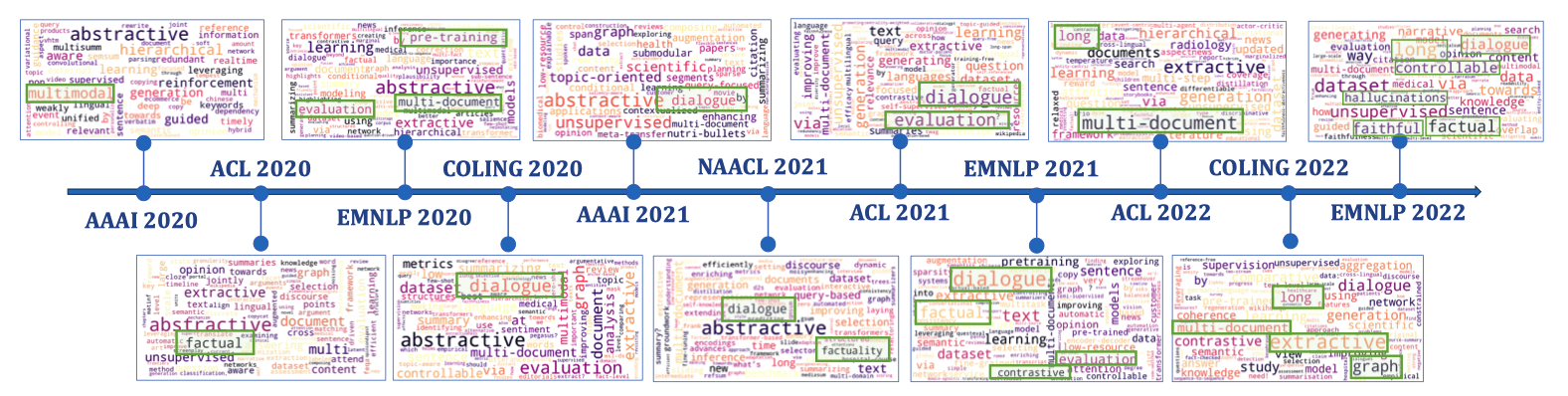
Presentations && Notes

Big Model Era

  1. TempoSum: Evaluating the Temporal Generalization of Abstractive Summarization Chi Seng Cheang, Hou Pong Chan, Derek F. Wong, Xuebo Liu, Zhaocong Li, Yanming Sun, Shudong Liu, Lidia S. Chao `` [pdf] [data]
    [Abs] Recent pre-trained language models (PLMs) achieve promising results in existing abstractive summarization datasets. However, existing summarization benchmarks overlap in time with the standard pre-training corpora and finetuning datasets. Hence, the strong performance of PLMs may rely on the parametric knowledge that is memorized during pre-training and fine-tuning. Moreover, the knowledge memorized by PLMs may quickly become outdated, which affects the generalization performance of PLMs on future data. In this work, we propose TempoSum, a novel benchmark that contains data samples from 2010 to 2022, to understand the temporal generalization ability of abstractive summarization models. Through extensive human evaluation, we show that parametric knowledge stored in summarization models significantly affects the faithfulness of the generated summaries on future data. Moreover, existing faithfulness enhancement methods cannot reliably improve the faithfulness of summarization models on future data. Finally, we discuss several recommendations to the research community on how to evaluate and improve the temporal generalization capability of text summarization models.
  2. RadAdapt: Radiology Report Summarization via Lightweight Domain Adaptation of Large Language Models Dave Van Veen, Cara Van Uden, Maayane Attias, Anuj Pareek, Christian Bluethgen, Malgorzata Polacin, Wah Chiu, Jean-Benoit Delbrouck, Juan Manuel Zambrano Chaves, Curtis P. Langlotz, Akshay S. Chaudhari, John Pauly [pdf]
    [Abs] We systematically investigate lightweight strategies to adapt large language models (LLMs) for the task of radiology report summarization (RRS). Specifically, we focus on domain adaptation via pretraining (on natural language, biomedical text, and clinical text) and via prompting (zero-shot, in-context learning) or parameter-efficient fine-tuning (prefix tuning, LoRA). Our results on the MIMIC-III dataset consistently demonstrate best performance by maximally adapting to the task via pretraining on clinical text and parameter-efficient fine-tuning on RRS examples. Importantly, this method fine-tunes a mere 0.32% of parameters throughout the model, in contrast to end-to-end fine-tuning (100% of parameters). Additionally, we study the effect of in-context examples and out-of-distribution (OOD) training before concluding with a radiologist reader study and qualitative analysis. Our findings highlight the importance of domain adaptation in RRS and provide valuable insights toward developing effective natural language processing solutions for clinical tasks.
  3. ImpressionGPT: An Iterative Optimizing Framework for Radiology Report Summarization with ChatGPT Chong Ma, Zihao Wu, Jiaqi Wang, Shaochen Xu, Yaonai Wei, Zhengliang Liu, Lei Guo, Xiaoyan Cai, Shu Zhang, Tuo Zhang, Dajiang Zhu, Dinggang Shen, Tianming Liu, Xiang Li [pdf]
    [Abs] The 'Impression' section of a radiology report is a critical basis for communication between radiologists and other physicians, and it is typically written by radiologists based on the 'Findings' section. However, writing numerous impressions can be laborious and error-prone for radiologists. Although recent studies have achieved promising results in automatic impression generation using large-scale medical text data for pre-training and fine-tuning pre-trained language models, such models often require substantial amounts of medical text data and have poor generalization performance. While large language models (LLMs) like ChatGPT have shown strong generalization capabilities and performance, their performance in specific domains, such as radiology, remains under-investigated and potentially limited. To address this limitation, we propose ImpressionGPT, which leverages the in-context learning capability of LLMs by constructing dynamic contexts using domain-specific, individualized data. This dynamic prompt approach enables the model to learn contextual knowledge from semantically similar examples from existing data. Additionally, we design an iterative optimization algorithm that performs automatic evaluation on the generated impression results and composes the corresponding instruction prompts to further optimize the model. The proposed ImpressionGPT model achieves state-of-the-art performance on both MIMIC-CXR and OpenI datasets without requiring additional training data or fine-tuning the LLMs. This work presents a paradigm for localizing LLMs that can be applied in a wide range of similar application scenarios, bridging the gap between general-purpose LLMs and the specific language processing needs of various domains.
  4. Extractive Summarization via ChatGPT for Faithful Summary Generation Haopeng Zhang, Xiao Liu, Jiawei Zhang [pdf]
    [Abs] Extractive summarization is a crucial task in natural language processing that aims to condense long documents into shorter versions by directly extracting sentences. The recent introduction of ChatGPT has attracted significant interest in the NLP community due to its remarkable performance on a wide range of downstream tasks. However, concerns regarding factuality and faithfulness have hindered its practical applications for summarization systems. This paper first presents a thorough evaluation of ChatGPT's performance on extractive summarization and compares it with traditional fine-tuning methods on various benchmark datasets. Our experimental analysis reveals that ChatGPT's extractive summarization performance is still inferior to existing supervised systems in terms of ROUGE scores. In addition, we explore the effectiveness of in-context learning and chain-of-thought reasoning for enhancing its performance. Furthermore, we find that applying an extract-then-generate pipeline with ChatGPT yields significant performance improvements over abstractive baselines in terms of summary faithfulness. These observations highlight potential directions for enhancing ChatGPT's capabilities for faithful text summarization tasks using two-stage approaches.
  5. Human-like Summarization Evaluation with ChatGPT Mingqi Gao, Jie Ruan, Renliang Sun, Xunjian Yin, Shiping Yang, Xiaojun Wan [pdf]
    [Abs] Evaluating text summarization is a challenging problem, and existing evaluation metrics are far from satisfactory. In this study, we explored ChatGPT's ability to perform human-like summarization evaluation using four human evaluation methods on five datasets. We found that ChatGPT was able to complete annotations relatively smoothly using Likert scale scoring, pairwise comparison, Pyramid, and binary factuality evaluation. Additionally, it outperformed commonly used automatic evaluation metrics on some datasets. Furthermore, we discussed the impact of different prompts, compared its performance with that of human evaluation, and analyzed the generated explanations and invalid responses.
  6. Cross-Lingual Summarization via ChatGPT Jiaan Wang, Yunlong Liang, Fandong Meng, Zhixu Li, Jianfeng Qu, Jie Zhou [pdf]
    [Abs] Given a document in a source language, cross-lingual summarization (CLS) aims to generate a summary in a different target language. Recently, the emergence of ChatGPT has attracted wide attention from the computational linguistics community. However, it is not yet known the performance of ChatGPT on CLS. In this report, we empirically use various prompts to guide ChatGPT to perform zero-shot CLS from different paradigms (i.e., end-to-end and pipeline), and provide a preliminary evaluation on its generated summaries.We find that ChatGPT originally prefers to produce lengthy summaries with more detailed information. But with the help of an interactive prompt, ChatGPT can balance between informativeness and conciseness, and significantly improve its CLS performance. Experimental results on three widely-used CLS datasets show that ChatGPT outperforms the advanced GPT 3.5 model (i.e., text-davinci-003). In addition, we provide qualitative case studies to show the superiority of ChatGPT on CLS.
  7. Exploring the Limits of ChatGPT for Query or Aspect-based Text Summarization Xianjun Yang, Yan Li, Xinlu Zhang, Haifeng Chen, Wei Cheng [pdf]
    [Abs] Text summarization has been a crucial problem in natural language processing (NLP) for several decades. It aims to condense lengthy documents into shorter versions while retaining the most critical information. Various methods have been proposed for text summarization, including extractive and abstractive summarization. The emergence of large language models (LLMs) like GPT3 and ChatGPT has recently created significant interest in using these models for text summarization tasks. Recent studies \cite{goyal2022news, zhang2023benchmarking} have shown that LLMs-generated news summaries are already on par with humans. However, the performance of LLMs for more practical applications like aspect or query-based summaries is underexplored. To fill this gap, we conducted an evaluation of ChatGPT's performance on four widely used benchmark datasets, encompassing diverse summaries from Reddit posts, news articles, dialogue meetings, and stories. Our experiments reveal that ChatGPT's performance is comparable to traditional fine-tuning methods in terms of Rouge scores. Moreover, we highlight some unique differences between ChatGPT-generated summaries and human references, providing valuable insights into the superpower of ChatGPT for diverse text summarization tasks. Our findings call for new directions in this area, and we plan to conduct further research to systematically examine the characteristics of ChatGPT-generated summaries through extensive human evaluation.
  8. News Summarization and Evaluation in the Era of GPT-3 Tanya Goyal, Junyi Jessy Li, Greg Durrett [pdf] [code]
    [Abs] The recent success of zero- and few-shot prompting with models like GPT-3 has led to a paradigm shift in NLP research. In this paper, we study its impact on text summarization, focusing on the classic benchmark domain of news summarization. First, we investigate how zero-shot GPT-3 compares against fine-tuned models trained on large summarization datasets. We show that not only do humans overwhelmingly prefer GPT-3 summaries, but these also do not suffer from common dataset-specific issues such as poor factuality. Next, we study what this means for evaluation, particularly the role of gold standard test sets. Our experiments show that both reference-based and reference-free automatic metrics, e.g. recently proposed QA- or entailment-based factuality approaches, cannot reliably evaluate zero-shot summaries. Finally, we discuss future research challenges beyond generic summarization, specifically, keyword- and aspect-based summarization, showing how dominant fine-tuning approaches compare to zero-shot prompting. To support further research, we release: (a) a corpus of 10K generated summaries from fine-tuned and zero-shot models across 4 standard summarization benchmarks, (b) 1K human preference judgments and rationales comparing different systems for generic- and keyword-based summarization.
  9. Benchmarking Large Language Models for News Summarization Tianyi Zhang, Faisal Ladhak, Esin Durmus, Percy Liang, Kathleen McKeown, Tatsunori B. Hashimoto [pdf]
    [Abs] Large language models (LLMs) have shown promise for automatic summarization but the reasons behind their successes are poorly understood. By conducting a human evaluation on ten LLMs across different pretraining methods, prompts, and model scales, we make two important observations. First, we find instruction tuning, and not model size, is the key to the LLM's zero-shot summarization capability. Second, existing studies have been limited by low-quality references, leading to underestimates of human performance and lower few-shot and finetuning performance. To better evaluate LLMs, we perform human evaluation over high-quality summaries we collect from freelance writers. Despite major stylistic differences such as the amount of paraphrasing, we find that LMM summaries are judged to be on par with human written summaries.
  10. Is ChatGPT a General-Purpose Natural Language Processing Task Solver? Chengwei Qin, Aston Zhang, Zhuosheng Zhang, Jiaao Chen, Michihiro Yasunaga, Diyi Yang [pdf]
    [Abs] Spurred by advancements in scale, large language models (LLMs) have demonstrated the ability to perform a variety of natural language processing (NLP) tasks zero-shot -- i.e., without adaptation on downstream data. Recently, the debut of ChatGPT has drawn a great deal of attention from the natural language processing (NLP) community due to the fact that it can generate high-quality responses to human input and self-correct previous mistakes based on subsequent conversations. However, it is not yet known whether ChatGPT can serve as a generalist model that can perform many NLP tasks zero-shot. In this work, we empirically analyze the zero-shot learning ability of ChatGPT by evaluating it on 20 popular NLP datasets covering 7 representative task categories. With extensive empirical studies, we demonstrate both the effectiveness and limitations of the current version of ChatGPT. We find that ChatGPT performs well on many tasks favoring reasoning capabilities (e.g., arithmetic reasoning) while it still faces challenges when solving specific tasks such as sequence tagging. We additionally provide in-depth analysis through qualitative case studies.
  11. A Multitask, Multilingual, Multimodal Evaluation of ChatGPT on Reasoning, Hallucination, and Interactivity Yejin Bang, Samuel Cahyawijaya, Nayeon Lee, Wenliang Dai, Dan Su, Bryan Wilie, Holy Lovenia, Ziwei Ji, Tiezheng Yu, Willy Chung, Quyet V. Do, Yan Xu, Pascale Fung `` [pdf]
    [Abs] This paper proposes a framework for quantitatively evaluating interactive LLMs such as ChatGPT using publicly available data sets. We carry out an extensive technical evaluation of ChatGPT using 21 data sets covering 8 different common NLP application tasks. We evaluate the multitask, multilingual and multi-modal aspects of ChatGPT based on these data sets and a newly designed multimodal dataset. We find that ChatGPT outperforms LLMs with zero-shot learning on most tasks and even outperforms fine-tuned models on some tasks. We find that it is better at understanding non-Latin script languages than generating them. It is able to generate multimodal content from textual prompts, via an intermediate code generation step. Moreover, we find that ChatGPT is 64.33% accurate on average in 10 different reasoning categories under logical reasoning, non-textual reasoning, and commonsense reasoning, hence making it an unreliable reasoner. It is, for example, better at deductive than inductive reasoning. ChatGPT suffers from hallucination problems like other LLMs and it generates more extrinsic hallucinations from its parametric memory as it does not have access to an external knowledge base. Finally, the interactive feature of ChatGPT enables human collaboration with the underlying LLM to improve its performance, i.e, 8% ROUGE-1 on summarization and 2% ChrF++ on machine translation, in a multi-turn "prompt engineering" fashion.

Decomposed

  1. Summarization Programs: Interpretable Abstractive Summarization with Neural Modular Trees Swarnadeep Saha, Shiyue Zhang, Peter Hase, Mohit Bansal ICLR 2023 [pdf] [code]
    [Abs] Current abstractive summarization models either suffer from a lack of clear interpretability or provide incomplete rationales by only highlighting parts of the source document. To this end, we propose the Summarization Program (SP), an interpretable modular framework consisting of an (ordered) list of binary trees, each encoding the step-by-step generative process of an abstractive summary sentence from the source document. A Summarization Program contains one root node per summary sentence, and a distinct tree connects each summary sentence (root node) to the document sentences (leaf nodes) from which it is derived, with the connecting nodes containing intermediate generated sentences. Edges represent different modular operations involved in summarization such as sentence fusion, compression, and paraphrasing. We first propose an efficient best-first search method over neural modules, SP-Search that identifies SPs for human summaries by directly optimizing for ROUGE scores. Next, using these programs as automatic supervision, we propose seq2seq models that generate Summarization Programs, which are then executed to obtain final summaries. We demonstrate that SP-Search effectively represents the generative process behind human summaries using modules that are typically faithful to their intended behavior. We also conduct a simulation study to show that Summarization Programs improve the interpretability of summarization models by allowing humans to better simulate model reasoning. Summarization Programs constitute a promising step toward interpretable and modular abstractive summarization, a complex task previously addressed primarily through blackbox end-to-end neural systems. Supporting code available at this https URL

Benchmark

  • Benchmarking Large Language Models for News Summarizatio Tianyi Zhang, Faisal Ladhak, Esin Durmus, Percy Liang, Kathleen McKeown, Tatsunori B. Hashimoto [pdf]
    [Abs] Large language models (LLMs) have shown promise for automatic summarization but the reasons behind their successes are poorly understood. By conducting a human evaluation on ten LLMs across different pretraining methods, prompts, and model scales, we make two important observations. First, we find instruction tuning, and not model size, is the key to the LLM's zero-shot summarization capability. Second, existing studies have been limited by low-quality references, leading to underestimates of human performance and lower few-shot and finetuning performance. To better evaluate LLMs, we perform human evaluation over high-quality summaries we collect from freelance writers. Despite major stylistic differences such as the amount of paraphrasing, we find that LMM summaries are judged to be on par with human written summaries.
  • MuLD: The Multitask Long Document Benchmark G Thomas Hudson, Noura Al Moubayed [pdf] [data]
  • EXPLAINABOARD: An Explainable Leaderboard for NLP Pengfei Liu, Jinlan Fu, Yang Xiao, Weizhe Yuan, Shuaichen Chang, Junqi Dai, Yixin Liu, Zihuiwen Ye, Graham Neubig [pdf] [ExplainaBoard]
  • GLGE: A New General Language Generation Evaluation Benchmark Dayiheng Liu, Yu Yan, Yeyun Gong, Weizhen Qi, Hang Zhang, Jian Jiao, Weizhu Chen, Jie Fu, Linjun Shou, Ming Gong, Pengcheng Wang, Jiusheng Chen, Daxin Jiang, Jiancheng Lv, Ruofei Zhang, Winnie Wu, Ming Zhou, Nan Duan [pdf] [benchmark]

Survey

  1. A Survey on Biomedical Text Summarization with Pre-trained Language Model Qianqian Xie, Zheheng Luo, Benyou Wang, Sophia Ananiadou [pdf] [code]
    [Abs] The exponential growth of biomedical texts such as biomedical literature and electronic health records (EHRs), provides a big challenge for clinicians and researchers to access clinical information efficiently. To address the problem, biomedical text summarization has been proposed to support clinical information retrieval and management, aiming at generating concise summaries that distill key information from single or multiple biomedical documents. In recent years, pre-trained language models (PLMs) have been the de facto standard of various natural language processing tasks in the general domain. Most recently, PLMs have been further investigated in the biomedical field and brought new insights into the biomedical text summarization task. In this paper, we systematically summarize recent advances that explore PLMs for biomedical text summarization, to help understand recent progress, challenges, and future directions. We categorize PLMs-based approaches according to how they utilize PLMs and what PLMs they use. We then review available datasets, recent approaches and evaluation metrics of the task. We finally discuss existing challenges and promising future directions. To facilitate the research community, we line up open resources including available datasets, recent approaches, codes, evaluation metrics, and the leaderboard in a public project: this https URL.
  2. A Survey on Medical Document Summarization Raghav Jain, Anubhav Jangra, Sriparna Saha, Adam Jatowt [pdf]
    [Abs] The internet has had a dramatic effect on the healthcare industry, allowing documents to be saved, shared, and managed digitally. This has made it easier to locate and share important data, improving patient care and providing more opportunities for medical studies. As there is so much data accessible to doctors and patients alike, summarizing it has become increasingly necessary - this has been supported through the introduction of deep learning and transformer-based networks, which have boosted the sector significantly in recent years. This paper gives a comprehensive survey of the current techniques and trends in medical summarization
  3. Taxonomy of Abstractive Dialogue Summarization: Scenarios, Approaches and Future Directions Qi Jia, Siyu Ren, Yizhu Liu, Kenny Q. Zhu [pdf]
    [Abs] Abstractive dialogue summarization is to generate a concise and fluent summary covering the salient information in a dialogue among two or more interlocutors. It has attracted great attention in recent years based on the massive emergence of social communication platforms and an urgent requirement for efficient dialogue information understanding and digestion. Different from news or articles in traditional document summarization, dialogues bring unique characteristics and additional challenges, including different language styles and formats, scattered information, flexible discourse structures and unclear topic boundaries. This survey provides a comprehensive investigation on existing work for abstractive dialogue summarization from scenarios, approaches to evaluations. It categorizes the task into two broad categories according to the type of input dialogues, i.e., open-domain and task-oriented, and presents a taxonomy of existing techniques in three directions, namely, injecting dialogue features, designing auxiliary training tasks and using additional data.A list of datasets under different scenarios and widely-accepted evaluation metrics are summarized for completeness. After that, the trends of scenarios and techniques are summarized, together with deep insights on correlations between extensively exploited features and different scenarios. Based on these analyses, we recommend future directions including more controlled and complicated scenarios, technical innovations and comparisons, publicly available datasets in special domains, etc.
  4. A Survey of Automatic Text Summarization Using Graph Neural Networks Marco Ferdinand Salchner, Adam Jatowt COLING 2022 [pdf]
    [Abs] Although automatic text summarization (ATS) has been researched for several decades, the application of graph neural networks (GNNs) to this task started relatively recently. In this survey we provide an overview on the rapidly evolving approach of using GNNs for the task of automatic text summarization. In particular we provide detailed information on the functionality of GNNs in the context of ATS, and a comprehensive overview of models utilizing this approach.
  5. A Survey on Cross-Lingual Summarization Jiaan Wang, Fandong Meng, Duo Zheng, Yunlong Liang, Zhixu Li, Jianfeng Qu, Jie Zhou TACL 2022 [pdf]
    [Abs] Cross-lingual summarization is the task of generating a summary in one language (e.g., English) for the given document(s) in a different language (e.g., Chinese). Under the globalization background, this task has attracted increasing attention of the computational linguistics community. Nevertheless, there still remains a lack of comprehensive review for this task. Therefore, we present the first systematic critical review on the datasets, approaches, and challenges in this field. Specifically, we carefully organize existing datasets and approaches according to different construction methods and solution paradigms, respectively. For each type of datasets or approaches, we thoroughly introduce and summarize previous efforts and further compare them with each other to provide deeper analyses. In the end, we also discuss promising directions and offer our thoughts to facilitate future research. This survey is for both beginners and experts in cross-lingual summarization, and we hope it will serve as a starting point as well as a source of new ideas for researchers and engineers interested in this area.
  6. An Empirical Survey on Long Document Summarization: Datasets, Models and Metrics uan Yee Koh, Jiaxin Ju, Ming Liu, Shirui Pan ACM Computing Surveys [pdf]
    [Abs] Long documents such as academic articles and business reports have been the standard format to detail out important issues and complicated subjects that require extra attention. An automatic summarization system that can effectively condense long documents into short and concise texts to encapsulate the most important information would thus be significant in aiding the reader's comprehension. Recently, with the advent of neural architectures, significant research efforts have been made to advance automatic text summarization systems, and numerous studies on the challenges of extending these systems to the long document domain have emerged. In this survey, we provide a comprehensive overview of the research on long document summarization and a systematic evaluation across the three principal components of its research setting: benchmark datasets, summarization models, and evaluation metrics. For each component, we organize the literature within the context of long document summarization and conduct an empirical analysis to broaden the perspective on current research progress. The empirical analysis includes a study on the intrinsic characteristics of benchmark datasets, a multi-dimensional analysis of summarization models, and a review of the summarization evaluation metrics. Based on the overall findings, we conclude by proposing possible directions for future exploration in this rapidly growing field.
  7. Multi-document Summarization via Deep Learning Techniques: A Survey Congbo Ma, Wei Emma Zhang, Mingyu Guo, Hu Wang, QUAN Z. Sheng [pdf]
  8. Embedding Knowledge for Document Summarization: A Survey Yutong Qu, Wei Emma Zhang, Jian Yang, Lingfei Wu, Jia Wu, Xindong Wu [pdf]
  9. A Survey on Dialogue Summarization: Recent Advances and New Frontiers Xiachong Feng, Xiaocheng Feng, Bing Qin IJCAI 2022, Survey Track [pdf]
  10. Automatic Text Summarization Methods: A Comprehensive Review Divakar Yadav, Jalpa Desai, Arun Kumar Yadav [pdf]
  11. Faithfulness in Natural Language Generation: A Systematic Survey of Analysis, Evaluation and Optimization Methods Wei Li, Wenhao Wu, Moye Chen, Jiachen Liu, Xinyan Xiao, Hua Wu [pdf]
  12. Recent Advances in Neural Text Generation: A Task-Agnostic Survey Chen Tang, Frank Guerin, Yucheng Li, Chenghua Lin [pdf]
  13. Survey of Hallucination in Natural Language Generation Ziwei Ji, Nayeon Lee, Rita Frieske, Tiezheng Yu, Dan Su, Yan Xu, Etsuko Ishii, Yejin Bang, Andrea Madotto, Pascale Fung [pdf]
  14. A Survey on Retrieval-Augmented Text Generation Huayang Li, Yixuan Su, Deng Cai, Yan Wang, Lemao Liu [pdf]
  15. A Survey of Controllable Text Generation using Transformer-based Pre-trained Language Models Hanqing Zhang, Haolin Song, Shaoyu Li, Ming Zhou, Dawei Song [pdf]
  16. A Survey of Pretrained Language Models Based Text Generation Junyi Li, Tianyi Tang, Wayne Xin Zhao, Jian-Yun Nie, Ji-Rong Wen [pdf]
  17. A Comprehensive Review on Summarizing Financial News Using Deep Learning Saurabh Kamal, Sahil Sharma [pdf]
  18. A Survey on Multi-modal Summarization Anubhav Jangra, Adam Jatowt, Sriparna Saha, Mohammad Hasanuzzaman [pdf]
  19. Pre-train, Prompt, and Predict: A Systematic Survey of Prompting Methods in Natural Language Processing Pengfei Liu, Weizhe Yuan, Jinlan Fu, Zhengbao Jiang, Hiroaki Hayashi, Graham Neubig [pdf]
  20. Pretrained Language Models for Text Generation: A Survey Junyi Li, Tianyi Tang, Wayne Xin Zhao, Ji-Rong Wen IJCAI21 [pdf]
  21. A Survey of Recent Abstract Summarization Techniques Diyah Puspitaningrum ICICT21 [pdf]
  22. A Survey of the State-of-the-Art Models in Neural Abstractive Text Summarization AYESHA AYUB SYED, FORD LUMBAN GAOL, TOKURO MATSUO [pdf]
  23. Automatic summarization of scientific articles: A survey Nouf Ibrahim Altmami, Mohamed El Bachir Menai Journal of King Saud University - Computer and Information Sciences [pdf]
  24. Multi-document Summarization via Deep Learning Techniques: A Survey Congbo Ma, Wei Emma Zhang, Mingyu Guo, Hu Wang, Quan Z. Sheng [pdf]
  25. Deep Learning Based Abstractive Text Summarization: Approaches, Datasets, Evaluation Measures, and Challenges Dima Suleiman, Arafat A. Awajan [pdf]
  26. A Survey of Knowledge-Enhanced Text Generation Wenhao Yu, Chenguang Zhu, Zaitang Li, Zhiting Hu, Qingyun Wang, Heng Ji, Meng Jiang [pdf]
  27. From Standard Summarization to New Tasks and Beyond: Summarization with Manifold Information Shen Gao, Xiuying Chen, Zhaochun Ren, Dongyan Zhao, Rui Yan IJCAI20 [pdf]
  28. Neural Abstractive Text Summarization with Sequence-to-Sequence Models Tian Shi, Yaser Keneshloo, Naren Ramakrishnan, Chandan K. Reddy [pdf]
  29. A Survey on Neural Network-Based Summarization Methods Yue Dong [pdf]
  30. Automated text summarisation and evidence-based medicine: A survey of two domains Abeed Sarker, Diego Molla, Cecile Paris [pdf]
  31. Automatic Keyword Extraction for Text Summarization: A Survey Santosh Kumar Bharti, Korra Sathya Babu [pdf]
  32. Text Summarization Techniques: A Brief Survey Mehdi Allahyari, Seyedamin Pouriyeh, Mehdi Assefi, Saeid Safaei, Elizabeth D. Trippe, Juan B. Gutierrez, Krys Kochut [pdf]
  33. Recent automatic text summarization techniques: a survey Mahak Gambhir, Vishal Gupta [pdf]

Toolkit

  1. Summary Workbench: Unifying Application and Evaluation of Text Summarization Models Shahbaz Syed, Dominik Schwabe, Martin Potthast EMNLP 2022 Demo [pdf] [demo]
    [Abs] This paper presents Summary Workbench, a new tool for developing and evaluating text summarization models. New models and evaluation measures can be easily integrated as Docker-based plugins, allowing to examine the quality of their summaries against any input and to evaluate them using various evaluation measures. Visual analyses combining multiple measures provide insights into the models' strengths and weaknesses. The tool is hosted at \url{this https URL} and also supports local deployment for private resources.
  2. iFacetSum: Coreference-based Interactive Faceted Summarization for Multi-Document Exploration Eran Hirsch, Alon Eirew, Ori Shapira, Avi Caciularu, Arie Cattan, Ori Ernst, Ramakanth Pasunuru, Hadar Ronen, Mohit Bansal, Ido Dagan EMNLP 2021 [pdf] [demo]
  3. SummerTime: Text Summarization Toolkit for Non-experts Ansong Ni, Zhangir Azerbayev, Mutethia Mutuma, Troy Feng, Yusen Zhang, Tao Yu, Ahmed Hassan Awadallah, Dragomir Radev EMNLP 2021 Demo Track [pdf] [Demo]
  4. Summary Explorer: Visualizing the State of the Art in Text Summarization Shahbaz Syed, Tariq Yousef, Khalid Al-Khatib, Stefan Jänicke, Martin Potthast [pdf] [web]
  5. fastnlp/fastSum [code]
  6. Graph4NLP [code] [summarization]
  7. CTRLsum: Towards Generic Controllable Text Summarization [pdf] [code] EMNLP 2022
    [Abs] Current summarization systems yield generic summaries that are disconnected from users’ preferences and expectations. To address this limitation, we present CTRLsum, a generic framework to control generated summaries through a set of keywords. During training keywords are extracted automatically without requiring additional human annotations. At test time CTRLsum features a control function to map control signal to keywords; through engineering the control function, the same trained model is able to be applied to control summaries on various dimensions, while neither affecting the model training process nor the pretrained models. We additionally explore the combination of keywords and text prompts for more control tasks. Experiments demonstrate the effectiveness of CTRLsum on three domains of summarization datasets and five control tasks: (1) entity-centric and (2) length-controllable summarization, (3) contribution summarization on scientific papers, (4) invention purpose summarization on patent filings, and (5) question-guided summarization on news articles. Moreover, when used in a standard, unconstrained summarization setting, CTRLsum is comparable or better than strong pretrained systems.
  8. OpenNMT-py: Open-Source Neural Machine Translation [pdf] [code]
  9. Fairseq: Facebook AI Research Sequence-to-Sequence Toolkit written in Python. [code]
  10. LeafNATS: An Open-Source Toolkit and Live Demo System for Neural Abstractive Text Summarization Tian Shi, Ping Wang, Chandan K. Reddy NAACL19 [pdf] [code]
  11. TransformerSum [code]

Analysis

  1. Human Guided Exploitation of Interpretable Attention Patterns in Summarization and Topic Segmentation Raymond Li, Wen Xiao, Linzi Xing, Lanjun Wang, Gabriel Murray, Giuseppe Carenini EMNLP 2022 [pdf] [code]
    [Abs] The multi-head self-attention mechanism of the transformer model has been thoroughly investigated recently. In one vein of study, researchers are interested in understanding why and how transformers work. In another vein, researchers propose new attention augmentation methods to make transformers more accurate, efficient and interpretable. In this paper, we combine these two lines of research in a human-in-the-loop pipeline to first discover important task-specific attention patterns. Then those patterns are injected, not only to smaller models, but also to the original model. The benefits of our pipeline and discovered patterns are demonstrated in two case studies with extractive summarization and topic segmentation. After discovering interpretable patterns in BERT-based models fine-tuned for the two downstream tasks, experiments indicate that when we inject the patterns into attention heads, the models show considerable improvements in accuracy and efficiency.
  2. Analyzing Multi-Task Learning for Abstractive Text Summarization Frederic Kirstein, Jan Philip Wahle, Terry Ruas, Bela Gipp `` [pdf]
    [Abs] Despite the recent success of multi-task learning and pre-finetuning for natural language understanding, few works have studied the effects of task families on abstractive text summarization. Task families are a form of task grouping during the pre-finetuning stage to learn common skills, such as reading comprehension. To close this gap, we analyze the influence of multi-task learning strategies using task families for the English abstractive text summarization task. We group tasks into one of three strategies, i.e., sequential, simultaneous, and continual multi-task learning, and evaluate trained models through two downstream tasks. We find that certain combinations of task families (e.g., advanced reading comprehension and natural language inference) positively impact downstream performance. Further, we find that choice and combinations of task families influence downstream performance more than the training scheme, supporting the use of task families for abstractive text summarization.
  3. On Decoding Strategies for Neural Text Generators Gian Wiher, Clara Meister, Ryan Cotterell [pdf]
  4. Training Dynamics for Text Summarization Models Tanya Goyal, Jiacheng Xu, Junyi Jessy Li, Greg Durrett [https://arxiv.org/abs/2110.08370]
  5. Does Summary Evaluation Survive Translation to Other Languages? Neslihan Iskender, Oleg Vasilyev, Tim Polzehl, John Bohannon, Sebastian Möller [pdf]
  6. How well do you know your summarization datasets? Priyam Tejaswin, Dhruv Naik, Pengfei Liu Findings of ACL 2021 [pdf] [code]
  7. Dissecting Generation Modes for Abstractive Summarization Models via Ablation and Attribution Jiacheng Xu, Greg Durrett ACL2021 [pdf] [code]
  8. To Point or Not to Point: Understanding How Abstractive Summarizers Paraphrase Text Matt Wilber, William Timkey, Marten Van Schijndel Findings of ACL 2021 [pdf] [code]
  9. What Makes a Good Summary? Reconsidering the Focus of Automatic Summarization Maartje ter Hoeve, Julia Kiseleva, Maarten de Rijke [pdf]
  10. Intrinsic Evaluation of Summarization Datasets Rishi Bommasani, Claire Cardie EMNLP20 [pdf]
  11. Metrics also Disagree in the Low Scoring Range: Revisiting Summarization Evaluation Metrics Manik Bhandari, Pranav Gour, Atabak Ashfaq, Pengfei Liu COLING20 Short [pdf] [code]
  12. At Which Level Should We Extract? An Empirical Analysis on Extractive Document Summarization Qingyu Zhou, Furu Wei, Ming Zhou COLING20 [pdf]
  13. Corpora Evaluation and System Bias detection in Multi Document Summarization Alvin Dey, Tanya Chowdhury, Yash Kumar, Tanmoy Chakraborty Findings of EMNLP [pdf]
  14. Understanding the Extent to which Summarization Evaluation Metrics Measure the Information Quality of Summaries Daniel Deutsch, Dan Roth [pdf] [code]
  15. Understanding Neural Abstractive Summarization Models via Uncertainty Jiacheng Xu, Shrey Desai, Greg Durrett EMNLP20 Short [pdf] [code]
  16. Re-evaluating Evaluation in Text Summarization Manik Bhandari, Pranav Gour, Atabak Ashfaq, Pengfei Liu, Graham Neubig EMNLP20 [pdf] [code]
  17. CDEvalSumm: An Empirical Study of Cross-Dataset Evaluation for Neural Summarization Systems Yiran Chen, Pengfei Liu, Ming Zhong, Zi-Yi Dou, Danqing Wang, Xipeng Qiu, Xuanjing Huang EMNLP20 [pdf] [code]
  18. What Have We Achieved on Text Summarization? Dandan Huang, Leyang Cui, Sen Yang, Guangsheng Bao, Kun Wang, Jun Xie, Yue Zhang EMNLP20 [pdf]
  19. Conditional Neural Generation using Sub-Aspect Functions for Extractive News Summarization Zhengyuan Liu, Ke Shi, Nancy F. Chen Findings of EMNLP20 [pdf]
  20. Extractive Summarization as Text Matching Ming Zhong, Pengfei Liu, Yiran Chen, Danqing Wang, Xipeng Qiu, Xuanjing Huang ACL20 [pdf] [code]
  21. Neural Text Summarization: A Critical Evaluation Wojciech Kryściński, Nitish Shirish Keskar, Bryan McCann, Caiming Xiong, Richard Socher EMNLP19 [pdf]
  22. Earlier Isn’t Always Better:Sub-aspect Analysis on Corpus and System Biases in Summarization Taehee Jung, Dongyeop Kang, Lucas Mentch, Eduard Hovy EMNLP19 [pdf] [code]
  23. A Closer Look at Data Bias in Neural Extractive Summarization Models Ming Zhong, Danqing Wang, Pengfei Liu, Xipeng Qiu, Xuanjing Huang EMNLP19 Workshop [pdf]
  24. Countering the Effects of Lead Bias in News Summarization via Multi-Stage Training and Auxiliary Losses Matt Grenander, Yue Dong, Jackie Chi Kit Cheung, Annie Louis EMNLP19 Short [pdf]
  25. Searching for Effective Neural Extractive Summarization: What Works and What's Next Ming Zhong, Pengfei Liu, Danqing Wang, Xipeng Qiu, Xuanjing Huang ACL19 [pdf] [code]
  26. Content Selection in Deep Learning Models of Summarization Chris Kedzie, Kathleen McKeown, Hal Daumé III EMNLP18 [pdf] [code]

Thesis

  1. Principled Approaches to Automatic Text Summarization Maxime Peyrard [pdf]
  2. Neural Text Summarization and Generation Piji Li [pdf]

Theory

  1. Bayesian Active Summarization Alexios Gidiotis, Grigorios Tsoumakas [pdf]
  2. RefSum: Refactoring Neural Summarization Yixin Liu, Zi-Yi Dou, Pengfei Liu NAACL21 [pdf] [code]
  3. Principled Approaches to Automatic Text Summarization Maxime Peyrard [pdf]
  4. KLearn: Background Knowledge Inference from Summarization Data Maxime Peyrard, Robert West Findings of EMNLP20 [pdf] [code]
  5. A Simple Theoretical Model of Importance for Summarization Maxime Peyrard ACL19 [pdf]
  6. BottleSum: Unsupervised and Self-supervised Sentence Summarization using the Information Bottleneck Principle Peter West, Ari Holtzman, Jan Buys, Yejin Choi EMNLP19 [pdf] [code]

Dataset

IDNameDescriptionPaperConference
1CNN-DailyMailNewsAbstractive Text Summarization using Sequence-to-sequence RNNs and Beyond SIGNLL16
2New York TimesNewsThe New York Times Annotated Corpus
3DUCNewsThe Effects Of Human Variation In DUC Summarization Evaluation
4GigawordNewsA Neural Attention Model For Abstractive Sentence SummarizationEMNLP15
5NewsroomNewsNewsroom: A Dataset of 1.3 Million Summaries with Diverse Extractive StrategiesNAACL18
6XsumNewsDon’t Give Me the Details, Just the Summary! Topic-Aware Convolutional Neural Networks for Extreme SummarizationEMNLP18
7Multi-NewsMulti-document NewsMulti-News: a Large-Scale Multi-Document Summarization Dataset and Abstractive Hierarchical ModelACL19
8SAMSumMulti-party conversationSAMSum Corpus: A Human-annotated Dialogue Dataset for Abstractive SummarizationEMNLP19
9AMIMeetingThe AMI Meeting Corpus: A pre-announcement.
10ICSIMeetingThe ICSI Meeting Corpus
11MSMOMulti-modalMSMO: Multimodal Summarization with Multimodal OutputEMNLP18
12How2Multi-modalHow2: A Large-scale Dataset for Multimodal Language UnderstandingNIPS18
13ScisummNetScientific paperScisummNet: A Large Annotated Corpus and Content-Impact Models for Scientific Paper Summarization with Citation NetworksAAAI19
14PubMed, ArXivScientific paperA Discourse-Aware Attention Model for Abstractive Summarization of Long DocumentsNAACL18
15TALKSUMMScientific paperTALKSUMM: A Dataset and Scalable Annotation Method for Scientific Paper Summarization Based on Conference TalksACL19
16BillSumLegalBillSum: A Corpus for Automatic Summarization of US LegislationEMNLP19
17LCSTSChinese WeiboLCSTS: A Large Scale Chinese Short Text Summarization Dataset EMNLP15
18WikiHowOnline Knowledge BaseWikiHow: A Large Scale Text Summarization Dataset
19Concept-map-based MDS CorpusEducational Multi-documentBringing Structure into Summaries : Crowdsourcing a Benchmark Corpus of Concept MapsEMNLP17
20WikiSumWikipedia Multi-documentGenerating Wikipedia By Summarizing Long SequenceICLR18
21GameWikiSumGame Multi-documentGameWikiSum : a Novel Large Multi-Document Summarization DatasetLREC20
22En2Zh CLS, Zh2En CLSCross-LingualNCLS: Neural Cross-Lingual SummarizationEMNLP19
23Timeline Summarization DatasetBaidu timelineLearning towards Abstractive Timeline Summarization IJCAI19
24Reddit TIFUonline discussionAbstractive Summarization of Reddit Posts with Multi-level Memory NetworksNAACL19
25TripAttReviewAttribute-aware Sequence Network for Review SummarizationEMNLP19
26Reader Comments Summarization CorpusComments-based WeiboAbstractive Text Summarization by Incorporating Reader Comments AAAI19
27BIGPATENTPatentBIGPATENT: A Large-Scale Dataset for Abstractive and Coherent SummarizationACL19
28Curation CorpusNewsCuration Corpus for Abstractive Text Summarisation
29MATINFMulti-taskMATINF: A Jointly Labeled Large-Scale Dataset for Classification, Question Answering and SummarizationACL20
30MLSUMMulti-Lingual Summarization DatasetMLSUM: The Multilingual Summarization CorpusEMNLP20
31Dialogue(Debate)Argumentative Dialogue Summary CorpusUsing Summarization to Discover Argument Facets in Online Idealogical DialogNAACL15
32WCEPNews Multi-documentA Large-Scale Multi-Document Summarization Dataset from the Wikipedia Current Events PortalACL20 Short
33ArgKPArgument-to-key Point MappingFrom Arguments to Key Points: Towards Automatic Argument SummarizationACL20
34CRD3DialogueStorytelling with Dialogue: A Critical Role Dungeons and Dragons Dataset2020
35GazetaRussian newsDataset for Automatic Summarization of Russian News
36MINDEnglish news recommendation, Summarization, Classification, EntityMIND: A Large-scale Dataset for News RecommendationACL20
37public_meetingsfrench meeting(test set)Align then Summarize: Automatic Alignment Methods for Summarization Corpus CreationLREC
38EnronEmailBuilding a Dataset for Summarization and Keyword Extraction from Emails2014
39ColumbiaEmailSummarizing Email Threads2004
40BC3EmailA publicly available annotated corpus for supervised email summarization
41WikiLinguaCross-LingualWikiLingua- A New Benchmark Dataset for Cross-Lingual Abstractive SummarizationFindings of EMNLP20
42LcsPIRTChinese DialogueGlobal Encoding for Long Chinese Text SummarizationTALLIP
43CLTS,CLTS-plusChinese NewsCLTS: A New Chinese Long Text Summarization Dataset CLTS+: A New Chinese Long Text Summarization Dataset with Abstractive SummariesNLPCC20
44VMSMOMulti-modalVMSMO: Learning to Generate Multimodal Summary for Video-based News ArticlesEMNLP20
45Multi-XScienceMulti-documentMulti-XScience: A Large-scale Dataset for Extreme Multi-document Summarization of Scientific ArticlesEMNLP20 short
46SCITLDRScientific DocumentTLDR: Extreme Summarization of Scientific DocumentsFindings of EMNLP20
47scisumm-corpusScientific Document
48QBSUMQuery-Based ChineseQBSUM: a Large-Scale Query-Based Document Summarization Dataset from Real-world ApplicationsComputer Speech & Language
49qMDSQuery-Based Multi-DocumentAQuaMuSe: Automatically Generating Datasets for Query-Based Multi-Document Summarization
50Liputan6IndonesianLiputan6: A Large-scale Indonesian Dataset for Text SummarizationAACL20
51SportsSumSports GameGenerating Sports News from Live Commentary: A Chinese Dataset for Sports Game SummarizationAACL20
52WikiAspAspect-basedWikiAsp: A Dataset for Multi-domain Aspect-based SummarizationTransaction of the ACL
53DebateSumargumentDebateSum:A large-scale argument mining and summarization datasetARGMIN 2020
54Open4BusinessBusinessOpen4Business (O4B): An Open Access Dataset for Summarizing Business DocumentsWorkshop on Dataset Curation and Security-NeurIPS 2020
55OrangeSumFrenchBARThez: a Skilled Pretrained French Sequence-to-Sequence Model
56Medical Conversationmedical conversationSummarizing Medical Conversations via Identifying Important UtterancesCOLING20
57SumTitlesmovie dialogueSumTitles: a Summarization Dataset with Low ExtractivenessCOLING20
58BANSbengali newsBengali Abstractive News Summarization (BANS): A Neural Attention ApproachTCCE-2020
59e-commerceE-commerceOn the Faithfulness for E-commerce Product SummarizationCOLING20
60TWEETSUMTwitterTWEETSUM: Event-oriented Social Summarization DatasetCOLING20
61SPACEOpinionExtractive Opinion Summarization in Quantized Transformer SpacesTACL
62pn-summaryPersianLeveraging ParsBERT and Pretrained mT5 for Persian Abstractive Text Summarizationcsicc2021
63E-commerce1desensitizedDialogueTopic-Oriented Spoken Dialogue Summarization for Customer Service with Saliency-Aware Topic ModelingAAAI21
64E-commerce2desensitizedDialogueUnsupervised Summarization for Chat Logs with Topic-Oriented Ranking and Context-Aware Auto-EncodersAAAI21
65BengaliSummarizationBengaliUnsupervised Abstractive Summarization of Bengali Text DocumentsEACL21
66MediaSumDialogueMediaSum: A Large-scale Media Interview Dataset for Dialogue SummarizationNAACL21
67Healthline and BreastCancermulti-documentNutri-bullets: Summarizing Health Studies by Composing SegmentsAAAI21
68GOVREPORTLong Government reportsEfficient Attentions for Long Document SummarizationNAACL21
69SSNScientific PaperEnhancing Scientific Papers Summarization with Citation GraphAAAI21
70MTSamplesMedicalTowards objectively evaluating the quality of generated medical summaries
71QMSumMeeting, QueryQMSum: A New Benchmark for Query-based Multi-domain Meeting SummarizationNAACL21
72MS2Medical, Multi-DocumentMS2: Multi-Document Summarization of Medical Studies
73SummScreenTelevision SeriesSummScreen: A Dataset for Abstractive Screenplay SummarizationACL 2022
74SciDuetScientific Papers and SlidesD2S: Document-to-Slide Generation Via Query-Based Text SummarizationNAACL21
75MultiHumESMultilingualMultiHumES: Multilingual Humanitarian Dataset for Extractive SummarizationEACL21
76DialSummDialogueDialSumm: A Real-Life Scenario Dialogue Summarization DatasetFindings of ACL21
77BookSumBook, Long-formBookSum: A Collection of Datasets for Long-form Narrative Summarization
78CLESChinese WeiboA Large-Scale Chinese Long-Text Extractive Summarization CorpusICASSP
79FacetSumScientific PaperBringing Structure into Summaries: a Faceted Summarization Dataset for Long Scientific DocumentsACL2021 short
80ConvoSummDialogueConvoSumm: Conversation Summarization Benchmark and Improved Abstractive Summarization with Argument MiningACL2021
81AgreeSumMulti-document with entailment annotationsAgreeSum: Agreement-Oriented Multi-Document SummarizationFindings of ACL2021
82En2DeCross-Lingual En2DeCross-Lingual Abstractive Summarization with Limited Parallel ResourcesACL 2021
83VT-SSumSpokenVT-SSum: A Benchmark Dataset for Video Transcript Segmentation and Summarization
84AESLCEmailThis Email Could Save Your Life: Introducing the Task of Email Subject Line GenerationACL 2019
85XL-SumCross-lingualXL-Sum: Large-Scale Multilingual Abstractive Summarization for 44 LanguagesFindings of ACL2021
86TES 2012-2016TweetTSSuBERT: Tweet Stream Summarization Using BERT
87PENSPersonalized HeadlinePENS: A Dataset and Generic Framework for Personalized News Headline GenerationACL 2021
88XSum Hallucination AnnotationsFactualityOn Faithfulness and Factuality in Abstractive SummarizationACL 2020
89factuality-datasetsFactualityAnnotating and Modeling Fine-grained Factuality in SummarizationNAACL 2021
90frankFactualityUnderstanding Factuality in Abstractive Summarization with FRANK: A Benchmark for Factuality MetricsNAACL 2021
91TRIPODMovieMovie Summarization via Sparse Graph ConstructionAAAI 2021
92AdaptSumLow-ResourceAdaptSum: Towards Low-Resource Domain Adaptation for Abstractive SummarizationNAACL 2021
93PTSProductMulti-Source Pointer Network for Product Title SummarizationCIKM 2018
94RAMDSReader-AwareReader-Aware Multi-Document Summarization: An Enhanced Model and The First DatasetEMNLP 2017 Workshop
95court judgmentcourt judgmentHow to Write Summaries with Patterns? Learning towards Abstractive Summarization through Prototype EditingEMNLP 2019
96ADEGBTSgaze behaviorsA Dataset for Exploring Gaze Behaviors in Text SummarizationACM MMSys'20
97MeQSumMedicalOn the Summarization of Consumer Health QuestionsACL 2019
98OpoSumOpinionSummarizing Opinions: Aspect Extraction Meets Sentiment Prediction and They Are Both Weakly SupervisedEMNLP 2018
99MM-AVSMulti-modalMulti-modal Summarization for Video-containing DocumentsNAACL 2021
100WikiCatSummulti-docGenerating Summaries with Topic Templates and Structured Convolutional DecodersACL 2019
101SDF-TLSTimelineSummarize Dates First: A Paradigm Shift in Timeline SummarizationSIGIR 2021
102RWS-Cit*Automatic generation of related work through summarizing citations2017
103MTLSTimelineMulti-TimeLine Summarization (MTLS): Improving Timeline Summarization by Generating Multiple SummariesACL 2021
104EMAILSUMEmailEmailSum: Abstractive Email Thread SummarizationACL 2021
105WikiSumWikiHowWikiSum: Coherent Summarization Dataset for Efficient Human-EvaluationACL 2021 Short
106SumPubMedPubMed Scientific ArticleSumPubMed: Summarization Dataset of PubMed Scientific ArticlesACL 2021 Student Research Workshop
107MLGSumMulti-lingualContrastive Aligned Joint Learning for Multilingual SummarizationACL 2021 Findings
108SMARTPHONE,COMPUTERProductCUSTOM: Aspect-Oriented Product Summarization for E-Commerce
109CSDSCustomer Service DialogueCSDS: A Fine-grained Chinese Dataset for Customer Service Dialogue SummarizationEMNLP 2021
110persian-datasetpersianARMAN: Pre-training with Semantically Selecting and Reordering of Sentences for Persian Abstractive Summarization
111StreamHoverspoken livestreamStreamHover: Livestream Transcript Summarization and AnnotationEMNLP 2021
112CNewSumNewsCNewSum: A Large-scale Chinese News Summarization Dataset with Human-annotated Adequacy and Deducibility LevelNLPCC 2021
113MiRANewsnews, factualMiRANews: Dataset and Benchmarks for Multi-Resource-Assisted News SummarizationEMNLP 2021 Findings
114HowSummquery multi-docHowSumm: A Multi-Document Summarization Dataset Derived from WikiHow Articles
115SportsSum2.0SportsSportsSum2.0: Generating High-Quality Sports News from Live Text Commentary
116CoCoSumopinion multi-refComparative Opinion Summarization via Collaborative Decoding
117MReDControllableMReD: A Meta-Review Dataset for Controllable Text Generation
118MSˆ2Multi-Document, MedicalMSˆ2: Multi-Document Summarization of Medical StudiesEMNLP 2021
119MassiveSummMassiveSumm: a very large-scale, very multilingual, news summarisation datasetEMNLP 2021
120XWikismultilingualModels and Datasets for Cross-Lingual SummarisationEMNLP 2021
121SUBSUMEIntent, subjectiveSUBSUME: A Dataset for Subjective Summary Extraction from Wikipedia DocumentsEMNLP 2021 newsum
122TLDR9+TLDR9+: A Large Scale Resource for Extreme Summarization of Social Media PostsEMNLP 2021 newsum
12320 MinutenGermanA New Dataset and Efficient Baselines for Document-level Text Simplification in GermanEMNLP 2021 newsum
124WSDmulti-lingualA Novel Wikipedia based Dataset for Monolingual and Cross-Lingual SummarizationEMNLP 2021 newsum
125TEDSummarySpeechAttention-based Multi-hypothesis Fusion for Speech Summarization
126SummaC BenchmarkFactual, NLISummaC: Re-Visiting NLI-based Models for Inconsistency Detection in Summarization
127ForumSumConversationForumSum: A Multi-Speaker Conversation Summarization DatasetEMNLP 2021 Findings
128K-SportsSumSportsKnowledge Enhanced Sports Game SummarizationWSDM 2022
129Test-AmazonOpinion, New test for Amazon reviewsUnsupervised Opinion Summarization as Copycat-Review GenerationACL 2020
130Test-Amazon-YelpOpinion, New test for Amazon(180) and Yelp(300)Few-Shot Learning for Opinion SummarizationEMNLP 2020
131AmaSumOpinionLearning Opinion Summarizers by Selecting Informative ReviewsEMNLP 2021
132CrossSumCross lingualCrossSum: Beyond English-Centric Cross-Lingual Abstractive Text Summarization for 1500+ Language Pairs
133HCSCL-MSDatasetMulti-modalHierarchical Cross-Modality Semantic Correlation Learning Model for Multimodal SummarizationAAAI 2022
134KlexikonGermanKlexikon: A German Dataset for Joint Summarization and Simplification
135TODSumCustomer ServiceTODSum: Task-Oriented Dialogue Summarization with State Tracking
136TWEETSUMMCustomer ServiceTWEETSUMM - A Dialog Summarization Dataset for Customer ServiceFindings of EMNLP 2021
137PeerSumMulti-document, ScientificPeerSum: A Peer Review Dataset for Abstractive Multi-document Summarization
138Celebrity TS, Event TS, Wiki TSTimeline, person, eventFollow the Timeline! Generating Abstractive and Extractive Timeline Summary in Chronological OrderTOSI 2022
139Chart-to-TextchartChart-to-Text: A Large-Scale Benchmark for Chart Summarization
140GovReport-QSLong DocumentHIBRIDS: Attention with Hierarchical Biases for Structure-aware Long Document SummarizationACL 2022
141EntSUMEntityEntSUM: A Data Set for Entity-Centric SummarizationACL 2022
142ALLSIDESFraming BiasNeuS: Neutral Multi-News Summarization for Mitigating Framing BiasACL 2022
143GRAPHELSUMSgraphSummarization with Graphical Elements
144Annotated-Wikilarge-NewselaFactualityEvaluating Factuality in Text SimplificationACL 2022
145WikiMultiCross-lingualWikiMulti: a Corpus for Cross-Lingual Summarization
146WelshIntroducing the Welsh Text Summarisation Dataset and Baseline Systems
147SuMeBiomedicalSuMe: A Dataset Towards Summarizing Biomedical MechanismsLREC 2022
148CiteSumCiteSum: Citation Text-guided Scientific Extreme Summarization and Low-resource Domain Adaptation
148MSAMSumDialogueMSAMSum: Towards Benchmarking Multi-lingual Dialogue SummarizationACL 2022 DialDoc
149SQuALITYLong-DocumentSQuALITY: Building a Long-Document Summarization Dataset the Hard WayEMNLP 2022
150X-SCITLDRX-SCITLDR: Cross-Lingual Extreme Summarization of Scholarly DocumentsJCDL 2022
151NEWTSNewsNEWTS: A Corpus for News Topic-Focused Summarization
152EntSUMEntityEntSUM: A Data Set for Entity-Centric Extractive SummarizationACL 2022
153ASPECTNEWSASPECTNEWS: Aspect-Oriented Summarization of News DocumentsACL 2022
154RNSumCommit LogsRNSum: A Large-Scale Dataset for Automatic Release Note Generation via Commit Logs SummarizationACL 2022
155AnswerSummquery multi-docAnswerSumm: A Manually-Curated Dataset and Pipeline for Answer SummarizationNAACL 2022
156CHQ-SummCHQ-Summ: A Dataset for Consumer Healthcare Question Summarization
157Multi-LexSummulti-docReal-World Summaries of Civil Rights Lawsuits at Multiple Granularities
158DACSACatalan and SpanishDACSA: A large-scale Dataset for Automatic summarization of Catalan and Spanish newspaper ArticlesNAACL 2022
159BigSurveyAcademic Multi-docGenerating a Structured Summary of Numerous Academic Papers: Dataset and MethodIJCAI 2022
160CSLChinese, AcademicCSL: A Large-scale Chinese Scientific Literature DatasetCOLING 2022
161PCC SummariesGermanExtractive Summarisation for German-language Data: A Text-level Approach with Discourse FeaturesCOLING 2022
162LipKeyabstractive summaries, absent keyphrases, and titlesLipKey: A Large-Scale News Dataset for Absent Keyphrases Generation and Abstractive SummarizationCOLING 2022
163PLOSLay summary of biomedical journal articlesMaking Science Simple: Corpora for the Lay Summarisation of Scientific LiteratureEMNLP 2022
164eLifeLay summary of biomedical journal articlesMaking Science Simple: Corpora for the Lay Summarisation of Scientific LiteratureEMNLP 2022
165ECTSumLong Earnings Call TranscriptsECTSum: A New Benchmark Dataset For Bullet Point Summarization of Long Earnings Call TranscriptsEMNLP 2022
166EUR-Lex-SumMulti- and Cross-lingual LegalEUR-Lex-Sum: A Multi- and Cross-lingual Dataset for Long-form Summarization in the Legal DomainEMNLP 2022
167CrisisLTLSumTimelineCrisisLTLSum: A Benchmark for Local Crisis Event Timeline Extraction and Summarization
168LANS(upon request)ArabicLANS: Large-scale Arabic News Summarization Corpus
169MACSUMControllable News DialogueMACSUM: Controllable Summarization with Mixed Attributes
170NarraSumNarrativeNarraSum: A Large-Scale Dataset for Abstractive Narrative SummarizationEMNLP Findings 2022
171LoRaLayLong Scientific VisualLoRaLay: A Multilingual and Multimodal Dataset for Long Range and Layout-Aware SummarizationEACL 2023
172HunSum-1HungarianHunSum-1: an Abstractive Summarization Dataset for Hungarian
173MCLSultimodal Cross-LingualAssist Non-native Viewers: Multimodal Cross-Lingual Summarization for How2 VideosEMNLP 2022
174JDDC 2.1multimodalJDDC 2.1: A Multimodal Chinese Dialogue Dataset with Joint Tasks of Query Rewriting, Response Generation, Discourse Parsing, and SummarizationEMNLP 2022
175CroCoSumCode-switched Cross-lingualCroCoSum: A Benchmark Dataset for Cross-Lingual Code-Switched Summarization
176unarXivescholarlyunarXive: a large scholarly data set with publications’ full-text, annotated in-text citations, and links to metadataScientometrics 2020
177TempoSumTempoSum: Evaluating the Temporal Generalization of Abstractive Summarization
178VCSUMmeetingVCSUM: A Versatile Chinese Meeting Summarization DatasetACL Findings 2023
179MeetingBankmeetingMeetingBank: A Benchmark Dataset for Meeting SummarizationACL 2023

Dialogue

Dataset

  1. MeetingBank: A Benchmark Dataset for Meeting Summarization Yebowen Hu, Timothy Ganter, Hanieh Deilamsalehy, Franck Dernoncourt, Hassan Foroosh, Fei Liu ACL 2023 [pdf] [data]
    [Abs] As the number of recorded meetings increases, it becomes increasingly important to utilize summarization technology to create useful summaries of these recordings. However, there is a crucial lack of annotated meeting corpora for developing this technology, as it can be hard to collect meetings, especially when the topics discussed are confidential. Furthermore, meeting summaries written by experienced writers are scarce, making it hard for abstractive summarizers to produce sensible output without a reliable reference. This lack of annotated corpora has hindered the development of meeting summarization technology. In this paper, we present MeetingBank, a new benchmark dataset of city council meetings over the past decade. MeetingBank is unique among other meeting corpora due to its divide-and-conquer approach, which involves dividing professionally written meeting minutes into shorter passages and aligning them with specific segments of the meeting. This breaks down the process of summarizing a lengthy meeting into smaller, more manageable tasks. The dataset provides a new testbed of various meeting summarization systems and also allows the public to gain insight into how council decisions are made. We make the collection, including meeting video links, transcripts, reference summaries, agenda, and other metadata, publicly available to facilitate the development of better meeting summarization techniques.
  2. ECTSum: A New Benchmark Dataset For Bullet Point Summarization of Long Earnings Call Transcripts Rajdeep Mukherjee, Abhinav Bohra, Akash Banerjee, Soumya Sharma, Manjunath Hegde, Afreen Shaikh, Shivani Shrivastava, Koustuv Dasgupta, Niloy Ganguly, Saptarshi Ghosh, Pawan Goyal EMNLP 2022 [pdf] [data]
    [Abs] Despite tremendous progress in automatic summarization, state-of-the-art methods are predominantly trained to excel in summarizing short newswire articles, or documents with strong layout biases such as scientific articles or government reports. Efficient techniques to summarize financial documents, including facts and figures, have largely been unexplored, majorly due to the unavailability of suitable datasets. In this work, we present ECTSum, a new dataset with transcripts of earnings calls (ECTs), hosted by publicly traded companies, as documents, and short experts-written telegram-style bullet point summaries derived from corresponding Reuters articles. ECTs are long unstructured documents without any prescribed length limit or format. We benchmark our dataset with state-of-the-art summarizers across various metrics evaluating the content quality and factual consistency of the generated summaries. Finally, we present a simple-yet-effective approach, ECT-BPS, to generate a set of bullet points that precisely capture the important facts discussed in the calls.
  3. TODSum: Task-Oriented Dialogue Summarization with State Tracking Lulu Zhao, Fujia Zheng, Keqing He, Weihao Zeng, Yuejie Lei, Huixing Jiang, Wei Wu, Weiran Xu, Jun Guo, Fanyu Meng [pdf]
  4. TWEETSUMM - A Dialog Summarization Dataset for Customer Service Guy Feigenblat, Chulaka Gunasekara, Benjamin Sznajder, Sachindra Joshi, David Konopnicki, Ranit Aharonov Findings of EMNLP 2021 [pdf] [data]
  5. ForumSum: A Multi-Speaker Conversation Summarization Dataset Misha Khalman, Yao Zhao, Mohammad Saleh EMNLP 2021 Findings [pdf] [data]
  6. CSDS: A Fine-grained Chinese Dataset for Customer Service Dialogue Summarization Haitao Lin, Liqun Ma, Junnan Zhu, Lu Xiang, Yu Zhou, Jiajun Zhang, Chengqing Zong EMNLP 2021 [pdf] [data]
  7. EmailSum: Abstractive Email Thread Summarization Shiyue Zhang, Asli Celikyilmaz, Jianfeng Gao, Mohit Bansal ACL 2021 [pdf] [data]
  8. DialSumm: A Real-Life Scenario Dialogue Summarization Dataset Yulong Chen, Yang Liu, Liang Chen, Yue Zhang Findings of ACL21 [pdf] [data]
  9. ConvoSumm: Conversation Summarization Benchmark and Improved Abstractive Summarization with Argument Mining Alexander R. Fabbri, Faiaz Rahman, Imad Rizvi, Borui Wang, Haoran Li, Yashar Mehdad, Dragomir Radev ACL 2021 [pdf] [code]
  10. MediaSum: A Large-scale Media Interview Dataset for Dialogue Summarization Chenguang Zhu, Yang Liu, Jie Mei, Michael Zeng NAACL21 [pdf] [code]
  11. QMSum: A New Benchmark for Query-based Multi-domain Meeting Summarization Ming Zhong, Da Yin, Tao Yu, Ahmad Zaidi, Mutethia Mutuma, Rahul Jha, Ahmed Hassan Awadallah, Asli Celikyilmaz, Yang Liu, Xipeng Qiu, Dragomir Radev NAACL21 [pdf] [data]
  12. Storytelling with Dialogue: A Critical Role Dungeons and Dragons Dataset Revanth Rameshkumar, Peter Bailey ACL20 [pdf] [data]
  13. SumTitles: a Summarization Dataset with Low Extractiveness Valentin Malykh, Konstantin Chernis, Ekaterina Artemova, Irina Piontkovskaya COLING20 [pdf] [code]
  14. Summarizing Medical Conversations via Identifying Important Utterances Yan Song, Yuanhe Tian, Nan Wang, Fei Xia COLING20 [pdf] [code]
  15. GupShup: Summarizing Open-Domain Code-Switched Conversations Laiba Mehnaz, Debanjan Mahata, Rakesh Gosangi, Uma Sushmitha Gunturi, Riya Jain, Gauri Gupta, Amardeep Kumar, Isabelle G. Lee, Anish Acharya, Rajiv Ratn Shah EMNLP 2021 [pdf][code]
  16. SummScreen: A Dataset for Abstractive Screenplay Summarization Mingda Chen, Zewei Chu, Sam Wiseman, Kevin Gimpel ACL 2022 [pdf] [data]
    [Abs] We introduce SummScreen, a summarization dataset comprised of pairs of TV series transcripts and human written recaps. The dataset provides a challenging testbed for abstractive summarization for several reasons. Plot details are often expressed indirectly in character dialogues and may be scattered across the entirety of the transcript. These details must be found and integrated to form the succinct plot descriptions in the recaps. Also, TV scripts contain content that does not directly pertain to the central plot but rather serves to develop characters or provide comic relief. This information is rarely contained in recaps. Since characters are fundamental to TV series, we also propose two entity-centric evaluation metrics. Empirically, we characterize the dataset by evaluating several methods, including neural models and those based on nearest neighbors. An oracle extractive approach outperforms all benchmarked models according to automatic metrics, showing that the neural models are unable to fully exploit the input transcripts. Human evaluation and qualitative analysis reveal that our non-oracle models are competitive with their oracle counterparts in terms of generating faithful plot events and can benefit from better content selectors. Both oracle and non-oracle models generate unfaithful facts, suggesting future research directions.
  17. SAMSum Corpus: A Human-annotated Dialogue Dataset for Abstractive Summarization Bogdan Gliwa, Iwona Mochol, Maciej Biesek, Aleksander Wawer EMNLP19 [pdf] [data]
  18. Dial2Desc: End-to-end Dialogue Description Generation Haojie Pan, Junpei Zhou, Zhou Zhao, Yan Liu, Deng Cai, Min Yang [pdf]
  19. The AMI meeting corpus: A pre-announcement Carletta, Jean and Ashby, Simone and Bourban, Sebastien and Flynn, Mike and Guillemot, Mael and Hain, Thomas and Kadlec, Jaroslav and Karaiskos, Vasilis and Kraaij, Wessel and Kronenthal, Melissa and others [pdf]
  20. The ICSI meeting corpus Janin, Adam and Baron, Don and Edwards, Jane and Ellis, Dan and Gelbart, David and Morgan, Nelson and Peskin, Barbara and Pfau, Thilo and Shriberg, Elizabeth and Stolcke, Andreas and others [pdf]

Email Summarization

  1. Focus on the Action: Learning to Highlight and Summarize Jointly for Email To-Do Items Summarization Kexun Zhang, Jiaao Chen, Diyi Yang Findings of ACL 2022 [pdf]
  2. EmailSum: Abstractive Email Thread Summarization Shiyue Zhang, Asli Celikyilmaz, Jianfeng Gao, Mohit Bansal ACL 2021 [pdf] [data]
  3. Smart To-Do: Automatic Generation of To-Do Items from Emails Sudipto Mukherjee, Subhabrata Mukherjee, Marcello Hasegawa, Ahmed Hassan Awadallah, Ryen White ACL 2020 [pdf] [code] [bib]
  4. Identifying Implicit Quotes for Unsupervised Extractive Summarization of Conversations Ryuji Kano, Yasuhide Miura, Tomoki Taniguchi, Tomoko Ohkuma AACL20 [pdf]
  5. This Email Could Save Your Life: Introducing the Task of Email Subject Line Generation Rui Zhang, Joel Tetreault ACL 2019 [pdf] [data] [bib]
  6. Building a Dataset for Summarization and Keyword Extraction from Emails Vanessa Loza, Shibamouli Lahiri, Rada Mihalcea, Po-Hsiang Lai LREC 2014 [pdf]
  7. A Publicly Available Annotated Corpus for Supervised Email Summarization Jan Ulrich, Gabriel Murray, Giuseppe Carenini AAAI 2008 [pdf]
  8. Summarizing Email Conversations with Clue Words Giuseppe Carenini, Raymond T. Ng, Xiaodong Zhou WWW 2007 [pdf]
  9. Task-focused Summarization of Email Simon H. Corston-Oliver Eric Ringger Michael Gamon Richard Campbell ACL 2004 [pdf]
  10. Summarizing email threads Owen Rambow, Lokesh Shrestha, John Chen, Chirsty Lauridsen NAACL 2004 [pdf] [bib]
  11. Facilitating email thread access by extractive summary generation Ani Nenkova Recent advances in natural language processing III: selected papers from RANLP [pdf]
  12. Summarizing Archived Discussions: A Beginning Paula S. Newman, John C. Blitzer Proceedings of the 8th international conference on Intelligent user interfaces [pdf]
  13. Combining linguistic and machine learning techniques for email summarization Smaranda Muresan, Evelyne Tzoukermann, Judith L. Klavans Proceedings of the ACL 2001 Workshop on Computational Natural Language Learning (ConLL) 2001 [pdf] [bib]

Meeting Summarization

  1. Learning to Rank Utterances for Query-Focused Meeting Summarization Xingxian Liu, Yajing Xu Findings of ACL 2023 [pdf]
    [Abs] Query-focused meeting summarization(QFMS) aims to generate a specific summary for the given query according to the meeting transcripts. Due to the conflict between long meetings and limited input size, previous works mainly adopt extract-then-summarize methods, which use extractors to simulate binary labels or ROUGE scores to extract utterances related to the query and then generate a summary. However, the previous approach fails to fully use the comparison between utterances. To the extractor, comparison orders are more important than specific scores. In this paper, we propose a Ranker-Generator framework. It learns to rank the utterances by comparing them in pairs and learning from the global orders, then uses top utterances as the generator’s input. We show that learning to rank utterances helps to select utterances related to the query effectively, and the summarizer can benefit from it. Experimental results on QMSum show that the proposed model outperforms all existing multi-stage models with fewer parameters.
  2. ExplainMeetSum: A Dataset for Explainable Meeting Summarization Aligned with Human Intent Hyun Kim, Minsoo Cho, Seung-Hoon Na ACL 2023 [pdf] [code]
    [Abs] To enhance the explainability of meeting summarization, we construct a new dataset called “ExplainMeetSum,” an augmented version of QMSum, by newly annotating evidence sentences that faithfully “explain” a summary. Using ExplainMeetSum, we propose a novel multiple extractor guided summarization, namely Multi-DYLE, which extensively generalizes DYLE to enable using a supervised extractor based on human-aligned extractive oracles. We further present an explainability-aware task, named “Explainable Evidence Extraction” (E3), which aims to automatically detect all evidence sentences that support a given summary. Experimental results on the QMSum dataset show that the proposed Multi-DYLE outperforms DYLE with gains of up to 3.13 in the ROUGE-1 score. We further present the initial results on the E3 task, under the settings using separate and joint evaluation metrics.
  3. VCSUM: A Versatile Chinese Meeting Summarization Dataset Han Wu, Mingjie Zhan, Haochen Tan, Zhaohui Hou, Ding Liang, Linqi Song Findings of ACL 2023 [pdf] [data]
    [Abs] Compared to news and chat summarization, the development of meeting summarization is hugely decelerated by the limited data. To this end, we introduce a versatile Chinese meeting summarization dataset, dubbed VCSum, consisting of 239 real-life meetings, with a total duration of over 230 hours. We claim our dataset is versatile because we provide the annotations of topic segmentation, headlines, segmentation summaries, overall meeting summaries, and salient sentences for each meeting transcript. As such, the dataset can adapt to various summarization tasks or methods, including segmentation-based summarization, multi-granularity summarization and retrieval-then-generate summarization. Our analysis confirms the effectiveness and robustness of VCSum. We also provide a set of benchmark models regarding different downstream summarization tasks on VCSum to facilitate further research.
  4. Query-Utterance Attention with Joint modeling for Query-Focused Meeting Summarization Xingxian Liu, Bin Duan, Bo Xiao, Yajing Xu ICASSP 2023 [pdf]
    [Abs] Query-focused meeting summarization (QFMS) aims to generate summaries from meeting transcripts in response to a given query. Previous works typically concatenate the query with meeting transcripts and implicitly model the query relevance only at the token level with attention mechanism. However, due to the dilution of key query-relevant information caused by long meeting transcripts, the original transformer-based model is insufficient to highlight the key parts related to the query. In this paper, we propose a query-aware framework with joint modeling token and utterance based on Query-Utterance Attention. It calculates the utterance-level relevance to the query with a dense retrieval module. Then both token-level query relevance and utterance-level query relevance are combined and incorporated into the generation process with attention mechanism explicitly. We show that the query relevance of different granularities contributes to generating a summary more related to the query. Experimental results on the QMSum dataset show that the proposed model achieves new state-of-the-art performance.
  5. Meeting Decision Tracker: Making Meeting Minutes with De-Contextualized Utterances Shumpei Inoue, Hy Nguyen, Pham Viet Hoang, Tsungwei Liu, Minh-Tien Nguyen AACL-IJCNLP 2022 [pdf] [demo]
    [Abs] Meetings are a universal process to make decisions in business and project collaboration. The capability to automatically itemize the decisions in daily meetings allows for extensive tracking of past discussions. To that end, we developed Meeting Decision Tracker, a prototype system to construct decision items comprising decision utterance detector (DUD) and decision utterance rewriter (DUR). We show that DUR makes a sizable contribution to improving the user experience by dealing with utterance collapse in natural conversation. An introduction video of our system is also available at this https URL.
  6. ESSumm: Extractive Speech Summarization from Untranscribed Meeting Jun Wang Interspeech 2022 [pdf]
    [Abs] In this paper, we propose a novel architecture for direct extractive speech-to-speech summarization, ESSumm, which is an unsupervised model without dependence on intermediate transcribed text. Different from previous methods with text presentation, we are aimed at generating a summary directly from speech without transcription. First, a set of smaller speech segments are extracted based on speech signal's acoustic features. For each candidate speech segment, a distance-based summarization confidence score is designed for latent speech representation measure. Specifically, we leverage the off-the-shelf self-supervised convolutional neural network to extract the deep speech features from raw audio. Our approach automatically predicts the optimal sequence of speech segments that capture the key information with a target summary length. Extensive results on two well-known meeting datasets (AMI and ICSI corpora) show the effectiveness of our direct speech-based method to improve the summarization quality with untranscribed data. We also observe that our unsupervised speech-based method even performs on par with recent transcript-based summarization approaches, where extra speech recognition is required.
  7. Abstractive Meeting Summarization: A Survey Virgile Rennard, Guokan Shang, Julie Hunter, Michalis Vazirgiannis [pdf]
    [Abs] Recent advances in deep learning, and especially the invention of encoder-decoder architectures, has significantly improved the performance of abstractive summarization systems. While the majority of research has focused on written documents, we have observed an increasing interest in the summarization of dialogues and multi-party conversation over the past few years. A system that could reliably transform the audio or transcript of a human conversation into an abridged version that homes in on the most important points of the discussion would be valuable in a wide variety of real-world contexts, from business meetings to medical consultations to customer service calls. This paper focuses on abstractive summarization for multi-party meetings, providing a survey of the challenges, datasets and systems relevant to this task and a discussion of promising directions for future study.
  8. ALIGNMEET: A Comprehensive Tool for Meeting Annotation, Alignment, and Evaluation Peter Polák, Muskaan Singh, Anna Nedoluzhko, Ondřej Bojar LREC 2022 [pdf] [data]
  9. TANet: Thread-Aware Pretraining for Abstractive Conversational Summarization Ze Yang, Liran Wang, Zhoujin Tian, Wei Wu, Zhoujun Li Findings of NAACL 2022 [pdf]
    [Abs] Although pre-trained language models (PLMs) have achieved great success and become a milestone in NLP, abstractive conversational summarization remains a challenging but less studied task. The difficulty lies in two aspects. One is the lack of large-scale conversational summary data. Another is that applying the existing pre-trained models to this task is tricky because of the structural dependence within the conversation and its informal expression, etc. In this work, we first build a large-scale (11M) pretraining dataset called RCSum, based on the multi-person discussions in the Reddit community. We then present TANet, a thread-aware Transformer-based network. Unlike the existing pre-trained models that treat a conversation as a sequence of sentences, we argue that the inherent contextual dependency among the utterances plays an essential role in understanding the entire conversation and thus propose two new techniques to incorporate the structural information into our model. The first is thread-aware attention which is computed by taking into account the contextual dependency within utterances. Second, we apply thread prediction loss to predict the relations between utterances. We evaluate our model on four datasets of real conversations, covering types of meeting transcripts, customer-service records, and forum threads. Experimental results demonstrate that TANet achieves a new state-of-the-art in terms of both automatic evaluation and human judgment.
  10. Summ^N: A Multi-Stage Summarization Framework for Long Input Dialogues and Documents Yusen Zhang, Ansong Ni, Ziming Mao, Chen Henry Wu, Chenguang Zhu, Budhaditya Deb, Ahmed H. Awadallah, Dragomir Radev, Rui Zhang ACL 2022 [pdf] [code]
    [Abs] Text summarization helps readers capture salient information from documents, news, interviews, and meetings. However, most state-of-the-art pretrained language models (LM) are unable to efficiently process long text for many summarization tasks. In this paper, we propose SummN, a simple, flexible, and effective multi-stage framework for input texts that are longer than the maximum context length of typical pretrained LMs. SummN first splits the data samples and generates a coarse summary in multiple stages and then produces the final fine-grained summary based on it. Our framework can process input text of arbitrary length by adjusting the number of stages while keeping the LM input size fixed. Moreover, it can deal with both single-source documents and dialogues, and it can be used on top of different backbone abstractive summarization models. To the best of our knowledge, SummN is the first multi-stage split-then-summarize framework for long input summarization. Our experiments demonstrate that SummN outperforms previous state-of-the-art methods by improving ROUGE scores on three long meeting summarization datasets AMI, ICSI, and QMSum, two long TV series datasets from SummScreen, and a long document summarization dataset GovReport. Our data and code are available at https://github.com/psunlpgroup/Summ-N.
  11. Exploring Neural Models for Query-Focused Summarization Jesse Vig, Alexander R. Fabbri, Wojciech Kryściński [pdf] [code]
  12. Improving Abstractive Dialogue Summarization with Hierarchical Pretraining and Topic Segment MengNan Qi, Hao Liu, YuZhuo Fu, Ting Liu EMNLP 2021 Findings [pdf]
  13. Meeting Summarization with Pre-training and Clustering Methods Andras Huebner, Wei Ji, Xiang Xiao [pdf] [code]
  14. Context or No Context? A preliminary exploration of human-in-the-loop approach for Incremental Temporal Summarization in meetings Nicole Beckage, Shachi H Kumar, Saurav Sahay, Ramesh Manuvinakurike EMNLP 2021| newsum [pdf]
  15. RetrievalSum: A Retrieval Enhanced Framework for Abstractive Summarization Chenxin An, Ming Zhong, Zhichao Geng, Jianqiang Yang, Xipeng Qiu [pdf]
  16. An Exploratory Study on Long Dialogue Summarization: What Works and What's Next Yusen Zhang, Ansong Ni, Tao Yu, Rui Zhang, Chenguang Zhu, Budhaditya Deb, Asli Celikyilmaz, Ahmed Hassan Awadallah, Dragomir Radev Findings of EMNLP 2021 Short [pdf]
  17. DialogLM: Pre-trained Model for Long Dialogue Understanding and Summarization Ming Zhong, Yang Liu, Yichong Xu, Chenguang Zhu, Michael Zeng AAAI 2022 [pdf] [code]
  18. Dynamic Sliding Window for Meeting Summarization Zhengyuan Liu, Nancy F. Chen SummDial@SIGDial 2021 [pdf]
  19. MeetSum: Transforming Meeting Transcript Summarization using Transformers! Nima Sadri, Bohan Zhang, Bihan Liu [pdf]
  20. Incremental temporal summarization in multiparty meetings Ramesh Manuvinakurike, Saurav Sahay, Wenda Chen, Lama Nachman SIGIR 2021 [pdf]
  21. Abstractive Spoken Document Summarization using Hierarchical Model with Multi-stage Attention Diversity Optimization Potsawee Manakul, Mark J. F. Gales, Linlin Wang INTERSPEECH 2020 [pdf] [code]
  22. What are meeting summaries? An analysis of human extractive summaries in meeting corpus Fei Liu, Yang Liu SIGDIAL 2008 [pdf]
  23. Exploring Speaker Characteristics for Meeting Summarization Fei Liu, Yang Liu INTERSPEECH 2010 [pdf]
  24. Automatic meeting summarization and topic detection system Tai-Chia Huang, Chia-Hsuan Hsieh, Hei-Chia Wang [pdf]
  25. A keyphrase based approach to interactive meeting summarization Korbinian Riedhammer, Benoit Favre, Dilek Hakkani-T¨ur 2008 IEEE Spoken Language Technology Workshop [pdf]
  26. A global optimization framework for meeting summarization Dan Gillick, Korbinian Riedhammerm, Benoit Favre, Dilek Hakkani-Tur 2009 IEEE International Conference on Acoustics, Speech and Signal Processing [pdf]
  27. Evaluating the effectiveness of features and sampling in extractive meeting summarization Shasha Xie, Yang Liu, Hui Lin SLT 2008 [pdf]
  28. Abstractive Meeting Summarization Using Dependency Graph Fusion Siddhartha Banerjee, Prasenjit Mitra, Kazunari Sugiyama WWW 2015 [pdf]
  29. Automatic Community Creation for Abstractive Spoken Conversation Summarization Karan Singla, Evgeny Stepanov, Ali Orkan Bayer, Giuseppe Carenini, Giuseppe Riccardi ACL 2017 workshop [pdf] [bib]
  30. Unsupervised Abstractive Meeting Summarization with Multi-Sentence Compression and Budgeted Submodular Maximization Guokan Shang, Wensi Ding, Zekun Zhang, Antoine Jean-Pierre Tixier, Polykarpos Meladianos, Michalis Vazirgiannis, Jean-Pierre Lorré ACL18 [pdf] [code]
  31. Abstractive meeting summarization based on an attentional neural model Nouha Dammak, Yassine BenAyed [pdf]
  32. A Study of Text Summarization Techniques for Generating Meeting Minutes Tu My Doan, Francois Jacquenet, Christine Largeron, Marc Bernard RCIS 2020 [pdf]
  33. Meeting Summarization, A Challenge for Deep Learning Francois Jacquenet, Marc Bernard, Christine Largeron IWANN 2019 [pdf]
  34. Generating Abstractive Summaries from Meeting Transcripts Siddhartha Banerjee, Prasenjit Mitra, Kazunari Sugiyama Proceedings of the 2015 ACM Symposium on Document Engineering, DocEng' 2015 [pdf]
  35. Align then Summarize: Automatic Alignment Methods for Summarization Corpus Creation Paul Tardy, David Janiszek, Yannick Estève, Vincent Nguyen LREC 2020 [pdf] [bib]
  36. Dialogue Discourse-Aware Graph Model and Data Augmentation for Meeting Summarization Xiachong Feng, Xiaocheng Feng, Bing Qin, Xinwei Geng IJCAI21 [pdf] [code]
  37. How Domain Terminology Affects Meeting Summarization Performance Jia Jin Koay, Alexander Roustai, Xiaojin Dai, Dillon Burns, Alec Kerrigan, Fei Liu COLING20 Short [pdf] [code]
  38. How to Interact and Change? Abstractive Dialogue Summarization with Dialogue Act Weight and Topic Change Info Jiasheng Di, Xiao Wei, Zhenyu Zhang KSEM 2020 [pdf] [code]
  39. Abstractive Dialogue Summarization with Sentence-Gated Modeling Optimized by Dialogue Acts Chih-Wen Goo, Yun-Nung Chen SLT18 [pdf] [code]
  40. A Sliding-Window Approach to Automatic Creation of Meeting Minutes Jia Jin Koay, Alexander Roustai, Xiaojin Dai, Fei Liu [pdf]
  41. Hierarchical Learning for Generation with Long Source Sequences Tobias Rohde, Xiaoxia Wu, Yinhan Liu [pdf] [code]
  42. A Hierarchical Network for Abstractive Meeting Summarization with Cross-Domain Pretraining Chenguang Zhu, Ruochen Xu, Michael Zeng, Xuedong Huang Findings of EMNLP20 [pdf] [code] [unofficial-code]
  43. Abstractive Meeting Summarization via Hierarchical Adaptive Segmental Network Learning Zhou Zhao, Haojie Pan, Changjie Fan, Yan Liu, Linlin Li, Min Yang WWW19 [pdf]
  44. Restructuring Conversations using Discourse Relations for Zero-shot Abstractive Dialogue Summarization Prakhar Ganesh, Saket Dingliwal [pdf]
  45. Keep Meeting Summaries on Topic: Abstractive Multi-Modal Meeting Summarization Manling Li, Lingyu Zhang, Heng Ji, Richard J. Radke ACL19 [pdf]
  46. Automatic analysis of multiparty meetings STEVE RENALS [pdf]
  47. A Multimodal Meeting Browser that Implements an Important Utterance Detection Model based on Multimodal Information Fumio Nihei, Yukiko I. Nakano [pdf]
  48. Exploring Methods for Predicting Important Utterances Contributing to Meeting Summarization Fumio Nihei, Yukiko I. Nakano [pdf]
  49. Fusing Verbal and Nonverbal Information for Extractive Meeting Summarization Fumio Nihei, Yukiko I. Nakano, Yutaka Takase GIFT18 [pdf]
  50. Meeting Extracts for Discussion Summarization Based on Multimodal Nonverbal Information Fumio Nihei, Yukiko I. Nakano, Yutaka Takase ICMI16 [pdf]
  51. Extractive Summarization of Meeting Recordings Gabriel Murray, Steve Renals, Jean Carletta [pdf]
  52. Multimodal Summarization of Meeting Recordings Bema Erol, Dar-Shyang Lee, Jonathan Hull ICME 2003 [pdf]
  53. Few-Shot Learning of an Interleaved Text Summarization Model by Pretraining with Synthetic Data Sanjeev Kumar Karn, Francine Chen, Yan-Ying Chen, Ulli Waltinger, Hinrich Schütze EACL21 [pdf]
  54. Leverage Unlabeled Data for Abstractive Speech Summarization with Self-Supervised Learning and Back-Summarization SPECOM 2020 SPECOM 2020 [pdf]
  55. Focused Meeting Summarization via Unsupervised Relation Extraction Lu Wang, Claire Cardie SIGDIAL 2012 [pdf]
  56. QMSum: A New Benchmark for Query-based Multi-domain Meeting Summarization Ming Zhong, Da Yin, Tao Yu, Ahmad Zaidi, Mutethia Mutuma, Rahul Jha, Ahmed Hassan Awadallah, Asli Celikyilmaz, Yang Liu, Xipeng Qiu, Dragomir Radev NAACL21 [pdf] [data]
  57. Domain-Independent Abstract Generation for Focused Meeting Summarization Lu Wang, Claire Cardie ACL 2013 [pdf]
  58. Summarizing Decisions in Spoken Meetings Lu Wang, Claire Cardie ACL 2011 [pdf]
  59. Extracting Decisions from Multi-Party Dialogue Using Directed Graphical Models and Semantic Similarity Trung Bui, Matthew Frampton, John Dowding, Stanley Peters SIGDIAL 2009 [pdf] [bib]
  60. ConvoSumm: Conversation Summarization Benchmark and Improved Abstractive Summarization with Argument Mining Alexander R. Fabbri, Faiaz Rahman, Imad Rizvi, Borui Wang, Haoran Li, Yashar Mehdad, Dragomir Radev ACL2021 [pdf] [code]

Chat Summarization

  1. Dialogue Summarization with Static-Dynamic Structure Fusion Graph ** Shen Gao, Xin Cheng, Mingzhe Li, Xiuying Chen, Jinpeng Li, Dongyan Zhao, Rui Yan [pdf] [code]
    [Abs] Dialogue, the most fundamental and specially privileged arena of language, gains increasing ubiquity across the Web in recent years. Quickly going through the long dialogue context and capturing salient information scattered over the whole dialogue session benefit users in many real-world Web applications such as email thread summarization and meeting minutes draft. Dialogue summarization is a challenging task in that dialogue has dynamic interaction nature and presumably inconsistent information flow among various speakers. Many researchers address this task by modeling dialogue with pre-computed static graph structure using external linguistic toolkits. However, such methods heavily depend on the reliability of external tools and the static graph construction is disjoint with the graph representation learning phase, which makes the graph can’t be dynamically adapted for the downstream summarization task. In this paper, we propose a Static-Dynamic graph-based Dialogue Summarization model (SDDS), which fuses prior knowledge from human expertise and adaptively learns the graph structure in an end-to-end learning fashion. To verify the effectiveness of SDDS, we conduct experiments on three benchmark datasets (SAMSum, MediaSum, and DialogSum) and the results verify the superiority of SDDS.
  2. Mind the Gap! Injecting Commonsense Knowledge for Abstractive Dialogue Summarization Seungone Kim, Se June Joo, Hyungjoo Chae, Chaehyeong Kim, Seung-won Hwang, Jinyoung Yeo COLING 2022 [pdf]
    [Abs] In this paper, we propose to leverage the unique characteristics of dialogues sharing commonsense knowledge across participants, to resolve the difficulties in summarizing them. We present SICK, a framework that uses commonsense inferences as additional context. Compared to previous work that solely relies on the input dialogue, SICK uses an external knowledge model to generate a rich set of commonsense inferences and selects the most probable one with a similarity-based selection method. Built upon SICK, SICK++ utilizes commonsense as supervision, where the task of generating commonsense inferences is added upon summarizing the dialogue in a multi-task learning setting. Experimental results show that with injected commonsense knowledge, our framework generates more informative and consistent summaries than existing methods.
  3. A Finer-grain Universal Dialogue Semantic Structures based Model For Abstractive Dialogue Summarization Yuejie Lei, Fujia Zheng, Yuanmeng Yan, Keqing He, Weiran Xu EMNLP 2021 Findings [pdf] [code]
  4. Capturing Speaker Incorrectness: Speaker-Focused Post-Correction for Abstractive Dialogue Summarization Dongyub Lee, Jungwoo Lim, Taesun Whang, Chanhee Lee, Seungwoo Cho, Mingun Park, Heuiseok Lim EMNLP 2021| newsum [pdf]
  5. Who says like a style of Vitamin: Towards Syntax-Aware DialogueSummarization using Multi-task Learning Seolhwa Lee, Kisu Yang, Chanjun Park, João Sedoc, Heuiseok Lim [pdf]
  6. Controllable Neural Dialogue Summarization with Personal Named Entity Planning Zhengyuan Liu, Nancy F. Chen EMNLP 2021 [pdf]
  7. GupShup: Summarizing Open-Domain Code-Switched Conversations Laiba Mehnaz, Debanjan Mahata, Rakesh Gosangi, Uma Sushmitha Gunturi, Riya Jain, Gauri Gupta, Amardeep Kumar, Isabelle G. Lee, Anish Acharya, Rajiv Ratn Shah EMNLP 2021 [pdf][code]
  8. Topic-Aware Contrastive Learning for Abstractive Dialogue Summarization Junpeng Liu, Yanyan Zou, Hainan Zhang, Hongshen Chen, Zhuoye Ding, Caixia Yuan, Xiaojie Wang EMNLP 2021 Findings [pdf] [code]
  9. Give the Truth: Incorporate Semantic Slot into Abstractive Dialogue Summarization Lulu Zhao, Weihao Zeng, Weiran Xu, Jun Guo EMNLP 2021 Findings [pdf]
  10. Low-Resource Dialogue Summarization with Domain-Agnostic Multi-Source Pretraining Yicheng Zou, Bolin Zhu, Xingwu Hu, Tao Gui, Qi Zhang EMNLP 2021 [pdf] [code]
  11. Enhancing Semantic Understanding with Self-Supervised Methods for Abstractive Dialogue Summarization Hyunjae Lee, Jaewoong Yun, Hyunjin Choi, Seongho Joe, Youngjune L. Gwon Interspeech 2021 [pdf]
  12. Dialogue summarization with supporting utterance flow modeling and fact regularization Wang Chen, Piji Li, Hou PongChan, Irwin King Knowledge-Based Systems [pdf]
  13. Situation-Based Multiparticipant Chat Summarization: a Concept, an Exploration-Annotation Tool and an Example Collection Anna Smirnova, Evgeniy Slobodkin, George Chernishev ACL 2021 Student Research Workshop [pdf] [tool] [data]
  14. Coreference-Aware Dialogue Summarization Zhengyuan Liu, Ke Shi, Nancy F. Chen SIGDIAL 2021 [pdf]
  15. Incorporating Commonsense Knowledge into Abstractive Dialogue Summarization via Heterogeneous Graph Networks Xiachong Feng, Xiaocheng Feng, Bing Qin CCL 2021 [pdf]
  16. Hierarchical Speaker-Aware Sequence-to-Sequence Model for Dialogue Summarization Yuejie Lei, Yuanmeng Yan, Zhiyuan Zeng, Keqing He, Ximing Zhang, Weiran Xu ICASSP21 [pdf]
  17. Summary Grounded Conversation Generation Chulaka Gunasekara, Guy Feigenblat, Benjamin Sznajder, Sachindra Joshi, David Konopnicki Findings of ACL 2021 [pdf]
  18. Controllable Abstractive Dialogue Summarization with Sketch Supervision Chien-Sheng Wu, Linqing Liu, Wenhao Liu, Pontus Stenetorp, Caiming Xiong ACL-Findings 2021 [pdf] [code]
  19. Structure-Aware Abstractive Conversation Summarization via Discourse and Action Graphs Jiaao Chen, Diyi Yang NAACL21 [pdf] [code]
  20. Planning with Learned Entity Prompts for Abstractive Summarization Shashi Narayan, Yao Zhao, Joshua Maynez, Gonçalo Simoes, Ryan McDonald TACL 2021 [pdf]
  21. Improving Abstractive Dialogue Summarization with Graph Structures and Topic Words Lulu Zhao, Weiran Xu, Jun Guo COLING20 [pdf]
  22. Multi-View Sequence-to-Sequence Models with Conversational Structure for Abstractive Dialogue Summarization Jiaao Chen, Diyi Yang EMNLP20 [pdf] [code]
  23. SAMSum Corpus: A Human-annotated Dialogue Dataset for Abstractive Summarization Bogdan Gliwa, Iwona Mochol, Maciej Biesek, Aleksander Wawer EMNLP19 [pdf] [data]

Medical Dialogue Summarization

  1. COSSUM: Towards Conversation-Oriented Structured Summarization for Automatic Medical Insurance Assessment Sheng Xu, Xiaojun Wan, Sen Hu, Mengdi Zhou, Teng Xu, Hongbin Wang, Haitao Mi KDD 2022 [pdf]
    [Abs] In medical insurance industry, a lot of human labor is required to collect information of claimants. Human assessors need to converse with claimants in order to record key information and organize it into a structured summary. With the purpose of helping save human labor, we propose the task of conversation-oriented structured summarization which aims to automatically produce the desired structured summary from a conversation automatically. One major challenge of the task is that the structured summary contains multiple fields of different types. To tackle this problem, we propose a unified approach COSSUM based on prompting to generate the values of all fields simultaneously. By learning all fields together, our approach can capture the inherent relationship between them. Moreover, we propose a specially designed curriculum learning strategy for model training. Both automatic and human evaluations are performed, and the results show the effectiveness of our proposed approach.
  2. Counseling Summarization using Mental Health Knowledge Guided Utterance Filtering Aseem Srivastava, Tharun Suresh, Sarah Peregrine (Grin)Lord, Md. Shad Akhtar, Tanmoy Chakraborty KDD 2022 ADS Track [pdf]
    [Abs] The psychotherapy intervention technique is a multifaceted conversation between a therapist and a patient. Unlike general clinical discussions, psychotherapy's core components (viz. symptoms) are hard to distinguish, thus becoming a complex problem to summarize later. A structured counseling conversation may contain discussions about symptoms, history of mental health issues, or the discovery of the patient's behavior. It may also contain discussion filler words irrelevant to a clinical summary. We refer to these elements of structured psychotherapy as counseling components. In this paper, the aim is mental health counseling summarization to build upon domain knowledge and to help clinicians quickly glean meaning. We create a new dataset after annotating 12.9K utterances of counseling components and reference summaries for each dialogue. Further, we propose ConSum, a novel counseling-component guided summarization model. ConSum undergoes three independent modules. First, to assess the presence of depressive symptoms, it filters utterances utilizing the Patient Health Questionnaire (PHQ-9), while the second and third modules aim to classify counseling components. At last, we propose a problem-specific Mental Health Information Capture (MHIC) evaluation metric for counseling summaries. Our comparative study shows that we improve on performance and generate cohesive, semantic, and coherent summaries. We comprehensively analyze the generated summaries to investigate the capturing of psychotherapy elements. Human and clinical evaluations on the summary show that ConSum generates quality summary. Further, mental health experts validate the clinical acceptability of the ConSum. Lastly, we discuss the uniqueness in mental health counseling summarization in the real world and show evidences of its deployment on an online application with the support of http://mpathic.ai/
  3. Adding more data does not always help: A study in medical conversation summarization with PEGASUS Varun Nair, Namit Katariya, Xavier Amatriain, Ilya Valmianski, Anitha Kannan [pdf]
  4. Leveraging Pretrained Models for Automatic Summarization of Doctor-Patient Conversations Longxiang Zhang, Renato Negrinho, Arindam Ghosh, Vasudevan Jagannathan, Hamid Reza Hassanzadeh, Thomas Schaaf, and Matthew R. Gormley Findings of EMNLP 2021 [pdf]
  5. Medically Aware GPT-3 as a Data Generator for Medical Dialogue Summarization Bharath Chintagunta, Namit Katariya, Xavier Amatriain, Anitha Kannan NAACL | NLPMC 2021 [pdf1] [pdf2]
  6. Generating SOAP Notes from Doctor-Patient Conversations Using Modular Summarization Techniques Kundan Krishna, Sopan Khosla, Jeffrey P. Bigham, Zachary C. Lipton ACL 2021 [pdf] [code]
  7. Summarizing Medical Conversations via Identifying Important Utterances Yan Song, Yuanhe Tian, Nan Wang, Fei Xia COLING 2020 [pdf] [code] [bib]
  8. Dr.Summarize: Global Summarization of Medical Dialogue by Exploiting Local Structures Anirudh Joshi, Namit Katariya, Xavier Amatriain, Anitha Kannan Findings of EMNLP 2020 [pdf] [bib]
  9. Medical Dialogue Summarization for Automated Reporting in Healthcare Sabine Molenaar, Lientje Maas, Verónica Burriel, Fabiano Dalpiaz,Sjaak Brinkkemper Advanced Information Systems Engineering Workshops 2020 [pdf] [bib]
  10. Generating Medical Reports from Patient-Doctor Conversations using Sequence-to-Sequence Models Seppo Enarvi, Marilisa Amoia, Miguel Del-Agua Teba, Brian Delaney, Frank Diehl, Stefan Hahn, Kristina Harris, Liam McGrath, Yue Pan, Joel Pinto, Luca Rubini, Miguel Ruiz, Gagandeep Singh, Fabian Stemmer, Weiyi Sun, Paul Vozila, Thomas Lin, Ranjani Ramamurthy ACL 2020 Short [pdf] [bib]
  11. Automatically Generating Psychiatric Case Notes From Digital Transcripts of Doctor-Patient Conversations Nazmul Kazi, Indika Kahanda NAACL 2019 [pdf] [bib]
  12. Alignment Annotation for Clinic Visit Dialogue to Clinical Note Sentence Language Generation Wen-wai Yim, Meliha Yetisgen, Jenny Huang, Micah Grossman LREC 2020 [pdf] [bib]
  13. Topic-aware Pointer-Generator Networks for Summarizing Spoken Conversations Zhengyuan Liu, Angela Ng, Sheldon Lee, Ai Ti Aw, Nancy F. Chen ASRU 2019 [pdf]

Customer Service Summarization

  1. Other Roles Matter! Enhancing Role-Oriented Dialogue Summarization via Role Interactions Haitao Lin, Junnan Zhu, Lu Xiang, Yu Zhou, Jiajun Zhang, Chengqing Zong ACL 2022 [pdf] [code]
    [Abs] Role-oriented dialogue summarization is to generate summaries for different roles in the dialogue, e.g., merchants and consumers. Existing methods handle this task by summarizing each role’s content separately and thus are prone to ignore the information from other roles. However, we believe that other roles’ content could benefit the quality of summaries, such as the omitted information mentioned by other roles. Therefore, we propose a novel role interaction enhanced method for role-oriented dialogue summarization. It adopts cross attention and decoder self-attention interactions to interactively acquire other roles’ critical information. The cross attention interaction aims to select other roles’ critical dialogue utterances, while the decoder self-attention interaction aims to obtain key information from other roles’ summaries. Experimental results have shown that our proposed method significantly outperforms strong baselines on two public role-oriented dialogue summarization datasets. Extensive analyses have demonstrated that other roles’ content could help generate summaries with more complete semantics and correct topic structures.
  2. An End-to-End Dialogue Summarization System for Sales Calls Abedelkadir Asi, Song Wang, Roy Eisenstadt, Dean Geckt, Yarin Kuper, Yi Mao, Royi Ronen NAACL 2022 [pdf]
  3. Heuristic-based Inter-training to Improve Few-shot Multi-perspective Dialog Summarization Benjamin Sznajder, Chulaka Gunasekara, Guy Lev, Sachin Joshi, Eyal Shnarch, Noam Slonim [pdf]
  4. Dialogue Summaries as Dialogue States (DS2), Template-Guided Summarization for Few-shot Dialogue State Tracking Jamin Shin, Hangyeol Yu, Hyeongdon Moon, Andrea Madotto, Juneyoung Park Findings of ACL 2022 [pdf] [code]
  5. TWEETSUMM - A Dialog Summarization Dataset for Customer Service Guy Feigenblat, Chulaka Gunasekara, Benjamin Sznajder, Sachindra Joshi, David Konopnicki, Ranit Aharonov [pdf] [data]
  6. Extractive Dialogue Summarization Without Annotation Based on Distantly Supervised Machine Reading Comprehension in Customer Service Bing Ma, Haifeng Sun , Jingyu Wang , Qi Qi, and Jianxin Liao TASLP [pdf]
  7. TODSum: Task-Oriented Dialogue Summarization with State Tracking Lulu Zhao, Fujia Zheng, Keqing He, Weihao Zeng, Yuejie Lei, Huixing Jiang, Wei Wu, Weiran Xu, Jun Guo, Fanyu Meng [pdf]
  8. CSDS: A Fine-grained Chinese Dataset for Customer Service Dialogue Summarization Haitao Lin, Liqun Ma, Junnan Zhu, Lu Xiang, Yu Zhou, Jiajun Zhang, Chengqing Zong EMNLP 2021 [pdf] [data]
  9. Distant Supervision based Machine Reading Comprehension for Extractive Summarization in Customer Service Bing Ma, Cao Liu, Jingyu Wang, Shujie Hu, Fan Yang, Xunliang Cai, Guanglu Wan, Jiansong Chen, Jianxin Liao SIGIR 2021 [pdf]
  10. Unsupervised Abstractive Dialogue Summarization for Tete-a-Tetes Xinyuan Zhang, Ruiyi Zhang, Manzil Zaheer, Amr Ahmed AAAI21 [pdf]
  11. Topic-Oriented Spoken Dialogue Summarization for Customer Service with Saliency-Aware Topic Modeling Yicheng Zou, Lujun Zhao, Yangyang Kang, Jun Lin, Minlong Peng, Zhuoren Jiang, Changlong Sun, Qi Zhang, Xuanjing Huang, Xiaozhong Liu AAAI21 [pdf] [code]
  12. Unsupervised Summarization for Chat Logs with Topic-Oriented Ranking and Context-Aware Auto-Encoders Yicheng Zou, Jun Lin, Lujun Zhao, Yangyang Kang, Zhuoren Jiang, Changlong Sun, Qi Zhang, Xuanjing Huang, Xiaozhong Liu AAAI21 [pdf] [code]
  13. Abstractive Dialog Summarization with Semantic Scaffolds Lin Yuan, Zhou Yu [pdf]
  14. Automatic Dialogue Summary Generation for Customer Service Chunyi Liu, Peng Wang, Jiang Xu, Zang Li and Jieping Ye KDD19 [pdf]

Domain Adaption

  1. DIONYSUS: A Pre-trained Model for Low-Resource Dialogue Summarization Yu Li, Baolin Peng, Pengcheng He, Michel Galley, Zhou Yu, Jianfeng Gao [pdf]
    [Abs] Dialogue summarization has recently garnered significant attention due to its wide range of applications. However, existing methods for summarizing dialogues are suboptimal because they do not take into account the inherent structure of dialogue and rely heavily on labeled data, which can lead to poor performance in new domains. In this work, we propose DIONYSUS (dynamic input optimization in pre-training for dialogue summarization), a pre-trained encoder-decoder model for summarizing dialogues in any new domain. To pre-train DIONYSUS, we create two pseudo summaries for each dialogue example: one is produced by a fine-tuned summarization model, and the other is a collection of dialogue turns that convey important information. We then choose one of these pseudo summaries based on the difference in information distribution across different types of dialogues. This selected pseudo summary serves as the objective for pre-training DIONYSUS using a self-supervised approach on a large dialogue corpus. Our experiments show that DIONYSUS outperforms existing methods on six datasets, as demonstrated by its ROUGE scores in zero-shot and few-shot settings.
  2. Domain-Oriented Prefix-Tuning: Towards Efficient and Generalizable Fine-tuning for Zero-Shot Dialogue Summarization Lulu Zhao, Fujia Zheng, Weihao Zeng, Keqing He, Weiran Xu, Huixing Jiang, Wei Wu, Yanan Wu NAACL 2022 [pdf] [code]
  3. AdaptSum: Towards Low-Resource Domain Adaptation for Abstractive Summarization Tiezheng Yu, Zihan Liu, Pascale Fung NAACL21 [pdf] [code]
  4. Domain Adaptation to Summarize Human Conversations Oana Sandu, Giuseppe Carenini, Gabriel Murray, Raymond Ng ACL2010 Workshop [pdf]

Others

  1. Summarizing Community-based Question-Answer Pairs Ting-Yao Hsu, Yoshi Suhara, Xiaolan Wang EMNLP 2022 [pdf] [code]
    [Abs] Community-based Question Answering (CQA), which allows users to acquire their desired information, has increasingly become an essential component of online services in various domains such as E-commerce, travel, and dining. However, an overwhelming number of CQA pairs makes it difficult for users without particular intent to find useful information spread over CQA pairs. To help users quickly digest the key information, we propose the novel CQA summarization task that aims to create a concise summary from CQA pairs. To this end, we first design a multi-stage data annotation process and create a benchmark dataset, COQASUM, based on the Amazon QA corpus. We then compare a collection of extractive and abstractive summarization methods and establish a strong baseline approach DedupLED for the CQA summarization task. Our experiment further confirms two key challenges, sentence-type transfer and deduplication removal, towards the CQA summarization task. Our data and code are publicly available.
  2. Curriculum Prompt Learning with Self-Training for Abstractive Dialogue Summarization Changqun Li, Linlin Wang, Xin Lin, Gerard de Melo, Liang He EMNLP 2022 [pdf]
    [Abs] Succinctly summarizing dialogue is a task of growing interest, but inherent challenges, such as insufficient training data and low information density impede our ability to train abstractive models. In this work, we propose a novel curriculum-based prompt learning method with self-training to address these problems. Specifically, prompts are learned using a curriculum learning strategy that gradually increases the degree of prompt perturbation, thereby improving the dialogue understanding and modeling capabilities of our model. Unlabeled dialogue is incorporated by means of self-training so as to reduce the dependency on labeled data. We further investigate topic-aware prompts to better plan for the generation of summaries. Experiments confirm that our model substantially outperforms strong baselines and achieves new state-of-the-art results on the AMI and ICSI datasets. Human evaluations also show the superiority of our model with regard to the summary generation quality.
  3. STRUDEL: Structured Dialogue Summarization for Dialogue Comprehension Borui Wang, Chengcheng Feng, Arjun Nair, Madelyn Mao, Jai Desai, Asli Celikyilmaz, Haoran Li, Yashar Mehdad, Dragomir Radev EMNLP 2022 [pdf]
    [Abs] Abstractive dialogue summarization has long been viewed as an important standalone task in natural language processing, but no previous work has explored the possibility of whether abstractive dialogue summarization can also be used as a means to boost an NLP system's performance on other important dialogue comprehension tasks. In this paper, we propose a novel type of dialogue summarization task - STRUctured DiaLoguE Summarization - that can help pre-trained language models to better understand dialogues and improve their performance on important dialogue comprehension tasks. We further collect human annotations of STRUDEL summaries over 400 dialogues and introduce a new STRUDEL dialogue comprehension modeling framework that integrates STRUDEL into a graph-neural-network-based dialogue reasoning module over transformer encoder language models to improve their dialogue comprehension abilities. In our empirical experiments on two important downstream dialogue comprehension tasks - dialogue question answering and dialogue response prediction - we show that our STRUDEL dialogue comprehension model can significantly improve the dialogue comprehension performance of transformer encoder language models.
  4. Enhancing Dialogue Summarization with Topic-Aware Global- and Local- Level Centrality Xinnian Liang, Shuangzhi Wu, Chenhao Cui, Jiaqi Bai, Chao Bian, Zhoujun Li EACL 2023 [pdf] [code]
    [Abs] Dialogue summarization aims to condense a given dialogue into a simple and focused summary text. Typically, both the roles' viewpoints and conversational topics change in the dialogue stream. Thus how to effectively handle the shifting topics and select the most salient utterance becomes one of the major challenges of this task. In this paper, we propose a novel topic-aware Global-Local Centrality (GLC) model to help select the salient context from all sub-topics. The centralities are constructed at both the global and local levels. The global one aims to identify vital sub-topics in the dialogue and the local one aims to select the most important context in each sub-topic. Specifically, the GLC collects sub-topic based on the utterance representations. And each utterance is aligned with one sub-topic. Based on the sub-topics, the GLC calculates global- and local-level centralities. Finally, we combine the two to guide the model to capture both salient context and sub-topics when generating summaries. Experimental results show that our model outperforms strong baselines on three public dialogue summarization datasets: CSDS, MC, and SAMSUM. Further analysis demonstrates that our GLC can exactly identify vital contents from sub-topics.
  5. SWING: Balancing Coverage and Faithfulness for Dialogue Summarization Kung-Hsiang Huang, Siffi Singh, Xiaofei Ma, Wei Xiao, Feng Nan, Nicholas Dingwall, William Yang Wang, Kathleen McKeown Findings of EACL 2023 [pdf] [code]
    [Abs] Missing information is a common issue of dialogue summarization where some information in the reference summaries is not covered in the generated summaries. To address this issue, we propose to utilize natural language inference (NLI) models to improve coverage while avoiding introducing factual inconsistencies. Specifically, we use NLI to compute fine-grained training signals to encourage the model to generate content in the reference summaries that have not been covered, as well as to distinguish between factually consistent and inconsistent generated sentences. Experiments on the DialogSum and SAMSum datasets confirm the effectiveness of the proposed approach in balancing coverage and faithfulness, validated with automatic metrics and human evaluations. Additionally, we compute the correlation between commonly used automatic metrics with human judgments in terms of three different dimensions regarding coverage and factual consistency to provide insight into the most suitable metric for evaluating dialogue summaries.
  6. Human-in-the-loop Abstractive Dialogue Summarization Jiaao Chen, Mohan Dodda, Diyi Yang [pdf] Findings of ACL 2023
    [Abs] Abstractive dialogue summarization has received increasing attention recently. Despite the fact that most of the current dialogue summarization systems are trained to maximize the likelihood of human-written summaries and have achieved significant results, there is still a huge gap in generating high-quality summaries as determined by humans, such as coherence and faithfulness, partly due to the misalignment in maximizing a single human-written summary. To this end, we propose to incorporate different levels of human feedback into the training process. This will enable us to guide the models to capture the behaviors humans care about for summaries. Specifically, we ask humans to highlight the salient information to be included in summaries to provide the local feedback, and to make overall comparisons among summaries in terms of coherence, accuracy, coverage, concise and overall quality, as the global feedback. We then combine both local and global feedback to fine-tune the dialog summarization policy with Reinforcement Learning. Experiments conducted on multiple datasets demonstrate the effectiveness and generalization of our methods over the state-of-the-art supervised baselines, especially in terms of human judgments.
  7. ED-FAITH: Evaluating Dialogue Summarization on Faithfulness Sicong Huang, Asli Celikyilmaz, Haoran Li [pdf]
    [Abs] Abstractive summarization models typically generate content unfaithful to the input, thus highlighting the significance of evaluating the faithfulness of generated summaries. Most faithfulness metrics are only evaluated on news domain, can they be transferred to other summarization tasks? In this work, we first present a systematic study of faithfulness metrics for dialogue summarization. We evaluate common faithfulness metrics on dialogue datasets and observe that most metrics correlate poorly with human judgements despite performing well on news datasets. Given these findings, to improve existing metrics’ performance on dialogue summarization, we first finetune on in-domain dataset, then apply unlikelihood training on negative samples, and show that they can successfully improve metric performance on dialogue data. Inspired by the strong zero-shot performance of the T0 language model, we further propose T0-Score – a new metric for faithfulness evaluation, which shows consistent improvement against baseline metrics across multiple domains.
  8. Towards Understanding Omission in Dialogue Summarization Yicheng Zou, Kaitao Song, Xu Tan, Zhongkai Fu, Tao Gui, Qi Zhang, Dongsheng Li `` [pdf]
    [Abs] Dialogue summarization aims to condense the lengthy dialogue into a concise summary, and has recently achieved significant progress. However, the result of existing methods is still far from satisfactory. Previous works indicated that omission is a major factor in affecting the quality of summarization, but few of them have further explored the omission problem, such as how omission affects summarization results and how to detect omission, which is critical for reducing omission and improving summarization quality. Moreover, analyzing and detecting omission relies on summarization datasets with omission labels (i.e., which dialogue utterances are omitted in the summarization), which are not available in the current literature. In this paper, we propose the OLDS dataset, which provides high-quality Omission Labels for Dialogue Summarization. By analyzing this dataset, we find that a large improvement in summarization quality can be achieved by providing ground-truth omission labels for the summarization model to recover omission information, which demonstrates the importance of omission detection for omission mitigation in dialogue summarization. Therefore, we formulate an omission detection task and demonstrate our proposed dataset can support the training and evaluation of this task well. We also call for research action on omission detection based on our proposed datasets. Our dataset and codes are publicly available.
  9. Analyzing and Evaluating Faithfulness in Dialogue Summarization Bin Wang, Chen Zhang, Yan Zhang, Yiming Chen, Haizhou Li EMNLP 2022 [pdf] [code]
    [Abs] Dialogue summarization is abstractive in nature, making it suffer from factual errors. The factual correctness of summaries has the highest priority before practical applications. Many efforts have been made to improve faithfulness in text summarization. However, there is a lack of systematic study on dialogue summarization systems. In this work, we first perform the fine-grained human analysis on the faithfulness of dialogue summaries and observe that over 35% of generated summaries are faithfully inconsistent respective the source dialogues. Furthermore, we present a new model-level faithfulness evaluation method. It examines generation models with multi-choice questions created by rule-based transformations. Experimental results show that our evaluation schema is a strong proxy for the factual correctness of summarization models. The human-annotated faithfulness samples and the evaluation toolkit are released to facilitate future research toward faithful dialogue summarization.
  10. Taxonomy of Abstractive Dialogue Summarization: Scenarios, Approaches and Future Directions Qi Jia, Siyu Ren, Yizhu Liu, Kenny Q. Zhu [pdf]
    [Abs] Abstractive dialogue summarization is to generate a concise and fluent summary covering the salient information in a dialogue among two or more interlocutors. It has attracted great attention in recent years based on the massive emergence of social communication platforms and an urgent requirement for efficient dialogue information understanding and digestion. Different from news or articles in traditional document summarization, dialogues bring unique characteristics and additional challenges, including different language styles and formats, scattered information, flexible discourse structures and unclear topic boundaries. This survey provides a comprehensive investigation on existing work for abstractive dialogue summarization from scenarios, approaches to evaluations. It categorizes the task into two broad categories according to the type of input dialogues, i.e., open-domain and task-oriented, and presents a taxonomy of existing techniques in three directions, namely, injecting dialogue features, designing auxiliary training tasks and using additional data.A list of datasets under different scenarios and widely-accepted evaluation metrics are summarized for completeness. After that, the trends of scenarios and techniques are summarized, together with deep insights on correlations between extensively exploited features and different scenarios. Based on these analyses, we recommend future directions including more controlled and complicated scenarios, technical innovations and comparisons, publicly available datasets in special domains, etc.
  11. Leveraging Non-dialogue Summaries for Dialogue Summarization Seongmin Park, Dongchan Shin, Jihwa Lee Transcript Understanding Workshop at COLING 2022 [pdf]
    [Abs] To mitigate the lack of diverse dialogue summarization datasets in academia, we present methods to utilize non-dialogue summarization data for enhancing dialogue summarization systems. We apply transformations to document summarization data pairs to create training data that better befit dialogue summarization. The suggested transformations also retain desirable properties of non-dialogue datasets, such as improved faithfulness to the source text. We conduct extensive experiments across both English and Korean to verify our approach. Although absolute gains in ROUGE naturally plateau as more dialogue summarization samples are introduced, utilizing non-dialogue data for training significantly improves summarization performance in zero- and few-shot settings and enhances faithfulness across all training regimes.
  12. Improving Abstractive Dialogue Summarization with Speaker-Aware Supervised Contrastive Learning Zhichao Geng, Ming Zhong, Zhangyue Yin, Xipeng Qiu, Xuanjing Huang COLING 2022 [pdf]
    [Abs] Pre-trained models have brought remarkable success on the text summarization task. For dialogue summarization, the subdomain of text summarization, utterances are concatenated to flat text before being processed. As a result, existing summarization systems based on pre-trained models are unable to recognize the unique format of the speaker-utterance pair well in the dialogue. To investigate this issue, we conduct probing tests and manual analysis, and find that the powerful pre-trained model can not identify different speakers well in the conversation, which leads to various factual errors. Moreover, we propose three speaker-aware supervised contrastive learning (SCL) tasks: Token-level SCL, Turn-level SCL, and Global-level SCL. Comprehensive experiments demonstrate that our methods achieve significant performance improvement on two mainstream dialogue summarization datasets. According to detailed human evaluations, pre-trained models equipped with SCL tasks effectively generate summaries with better factual consistency.
  13. View Dialogue in 2D: A Two-stream Model in Time-speaker Perspective for Dialogue Summarization and beyond Keli Xie, Dongchen He, Jiaxin Zhuang, Siyuan Lu, Zhongfeng Wang COLING 2022 [pdf] [code]
    [Abs] Existing works on dialogue summarization often follow the common practice in document summarization and view the dialogue, which comprises utterances of different speakers, as a single utterance stream ordered by time. However, this single-stream approach without specific attention to the speaker-centered points has limitations in fully understanding the dialogue. To better capture the dialogue information, we propose a 2D view of dialogue based on a time-speaker perspective, where the time and speaker streams of dialogue can be obtained as strengthened input. Based on this 2D view, we present an effective two-stream model called ATM to combine the two streams. Extensive experiments on various summarization datasets demonstrate that ATM significantly surpasses other models regarding diverse metrics and beats the state-of-the-art models on the QMSum dataset in ROUGE scores. Besides, ATM achieves great improvements in summary faithfulness and human evaluation. Moreover, results on machine reading comprehension datasets show the generalization ability of the proposed methods and shed light on other dialogue-based tasks. Our code will be publicly available online.
  14. Summarizing Dialogues with Negative Cues Junpeng Liu, Yanyan Zou, Yuxuan Xi, Shengjie Li, Mian Ma, Zhuoye Ding COLING 2022 [pdf]
    [Abs] Abstractive dialogue summarization aims to convert a long dialogue content into its short form where the salient information is preserved while the redundant pieces are ignored. Different from the well-structured text, such as news and scientific articles, dialogues often consist of utterances coming from two or more interlocutors, where the conversations are often informal, verbose, and repetitive, sprinkled with false-starts, backchanneling, reconfirmations, hesitations, speaker interruptions and the salient information is often scattered across the whole chat. The above properties of conversations make it difficult to directly concentrate on scattered outstanding utterances and thus present new challenges of summarizing dialogues. In this work, rather than directly forcing a summarization system to merely pay more attention to the salient pieces, we propose to explicitly have the model perceive the redundant parts of an input dialogue history during the training phase. To be specific, we design two strategies to construct examples without salient pieces as negative cues. Then, the sequence-to-sequence likelihood loss is cooperated with the unlikelihood objective to drive the model to focus less on the unimportant information and also pay more attention to the salient pieces. Extensive experiments on the benchmark dataset demonstrate that our simple method significantly outperforms the baselines with regard to both semantic matching and factual consistent based metrics. The human evaluation also proves the performance gains.
  15. ClidSum: A Benchmark Dataset for Cross-Lingual Dialogue Summarization Jiaan Wang, Fandong Meng, Ziyao Lu, Duo Zheng, Zhixu Li, Jianfeng Qu, Jie Zhou EMNLP 2022 [pdf] [code]
    [Abs] We present ClidSum, a benchmark dataset for building cross-lingual summarization systems on dialogue documents. It consists of 67k+ dialogue documents from two subsets (i.e., SAMSum and MediaSum) and 112k+ annotated summaries in different target languages. Based on the proposed ClidSum, we introduce two benchmark settings for supervised and semi-supervised scenarios, respectively. We then build various baseline systems in different paradigms (pipeline and end-to-end) and conduct extensive experiments on ClidSum to provide deeper analyses. Furthermore, we propose mDialBART which extends mBART-50 (a multi-lingual BART) via further pre-training. The multiple objectives used in the further pre-training stage help the pre-trained model capture the structural characteristics as well as important content in dialogues and the transformation from source to the target language. Experimental results show the superiority of mDialBART, as an end-to-end model, outperforms strong pipeline models on ClidSum. Finally, we discuss specific challenges that current approaches faced with this task and give multiple promising directions for future research.
  16. A Focused Study on Sequence Length for Dialogue Summarization Bin Wang, Chen Zhang, Chengwei Wei, Haizhou Li [pdf]
    [Abs] Output length is critical to dialogue summarization systems. The dialogue summary length is determined by multiple factors, including dialogue complexity, summary objective, and personal preferences. In this work, we approach dialogue summary length from three perspectives. First, we analyze the length differences between existing models' outputs and the corresponding human references and find that summarization models tend to produce more verbose summaries due to their pretraining objectives. Second, we identify salient features for summary length prediction by comparing different model settings. Third, we experiment with a length-aware summarizer and show notable improvement on existing models if summary length can be well incorporated. Analysis and experiments are conducted on popular DialogSum and SAMSum datasets to validate our findings.
  17. DialogSum Challenge: Results of the Dialogue Summarization Shared Task Yulong Chen, Naihao Deng, Yang Liu, Yue Zhang [pdf]
    [Abs] We report the results of DialogSum Challenge, the shared task on summarizing real-life scenario dialogues at INLG 2022. Four teams participate in this shared task and three submit their system reports, exploring different methods to improve the performance of dialogue summarization. Although there is a great improvement over the baseline models regarding automatic evaluation metrics, such as Rouge scores, we find that there is a salient gap between model generated outputs and human annotated summaries by human evaluation from multiple aspects. These findings demonstrate the difficulty of dialogue summarization and suggest that more fine-grained evaluatuion metrics are in need.
  18. Effectiveness of French Language Models on Abstractive Dialogue Summarization Task Yongxin Zhou, François Portet, Fabien Ringeval LREC 2022 [pdf]
    [Abs] Pre-trained language models have established the state-of-the-art on various natural language processing tasks, including dialogue summarization, which allows the reader to quickly access key information from long conversations in meetings, interviews or phone calls. However, such dialogues are still difficult to handle with current models because the spontaneity of the language involves expressions that are rarely present in the corpora used for pre-training the language models. Moreover, the vast majority of the work accomplished in this field has been focused on English. In this work, we present a study on the summarization of spontaneous oral dialogues in French using several language specific pre-trained models: BARThez, and BelGPT-2, as well as multilingual pre-trained models: mBART, mBARThez, and mT5. Experiments were performed on the DECODA (Call Center) dialogue corpus whose task is to generate abstractive synopses from call center conversations between a caller and one or several agents depending on the situation. Results show that the BARThez models offer the best performance far above the previous state-of-the-art on DECODA. We further discuss the limits of such pre-trained models and the challenges that must be addressed for summarizing spontaneous dialogues.
  19. Data Augmentation for Low-Resource Dialogue Summarization Yongtai Liu, Joshua Maynez, Gonçalo Simões, Shashi Narayan Findings of NAACL 2022 [pdf]
    [Abs] We present DADS, a novel Data Augmentation technique for low-resource Dialogue Summarization. Our method generates synthetic examples by replacing sections of text from both the input dialogue and summary while preserving the augmented summary to correspond to a viable summary for the augmented dialogue. We utilize pretrained language models that produce highly likely dialogue alternatives while still being free to generate diverse alternatives. We applied our data augmentation method to the SAMSum dataset in low resource scenarios, mimicking real world problems such as chat, thread, and meeting summarization where large scale supervised datasets with human-written summaries are scarce. Through both automatic and human evaluations, we show that DADS shows strong improvements for low resource scenarios while generating topically diverse summaries without introducing additional hallucinations to the summaries.
  20. An End-to-End Dialogue Summarization System for Sales Calls Abedelkadir Asi, Song Wang, Roy Eisenstadt, Dean Geckt, Yarin Kuper, Yi Mao, Royi Ronen NAACL 2022 Industry Track [pdf]
    [Abs] Summarizing sales calls is a routine task performed manually by salespeople. We present a production system which combines generative models fine-tuned for customer-agent setting, with a human-in-the-loop user experience for an interactive summary curation process. We address challenging aspects of dialogue summarization task in a real-world setting including long input dialogues, content validation, lack of labeled data and quality evaluation. We show how GPT-3 can be leveraged as an offline data labeler to handle training data scarcity and accommodate privacy constraints in an industrial setting. Experiments show significant improvements by our models in tackling the summarization and content validation tasks on public datasets.
  21. Few-shot fine-tuning SOTA summarization models for medical dialogues David Fraile Navarro, Mark Dras, Shlomo Berkovsky NAACL 2022 Student Research Workshop [pdf] [code]
    [Abs] Abstractive summarization of medical dialogues presents a challenge for standard training approaches, given the paucity of suitable datasets. We explore the performance of state-of-the-art models with zero-shot and few-shot learning strategies and measure the impact of pretraining with general domain and dialogue-specific text on the summarization performance.
  22. DialSummEval: Revisiting Summarization Evaluation for Dialogues Mingqi Gao, Xiaojun Wan NAACL 2022 [pdf] [code]
    [Abs] Dialogue summarization is receiving increasing attention from researchers due to its extraordinary difficulty and unique application value. We observe that current dialogue summarization models have flaws that may not be well exposed by frequently used metrics such as ROUGE. In our paper, we re-evaluate 18 categories of metrics in terms of four dimensions: coherence, consistency, fluency and relevance, as well as a unified human evaluation of various models for the first time. Some noteworthy trends which are different from the conventional summarization tasks are identified. We will release DialSummEval, a multi-faceted dataset of human judgments containing the outputs of 14 models on SAMSum.
  23. Domain-Oriented Prefix-Tuning: Towards Efficient and Generalizable Fine-tuning for Zero-Shot Dialogue Summarization Lulu Zhao, Fujia Zheng, Weihao Zeng, Keqing He, Weiran Xu, Huixing Jiang, Wei Wu, Yanan Wu NAACL 2022 [pdf] [code]
    [Abs] The most advanced abstractive dialogue summarizers lack generalization ability on new domains and the existing researches for domain adaptation in summarization generally rely on large-scale pre-trainings. To explore the lightweight fine-tuning methods for domain adaptation of dialogue summarization, in this paper, we propose an efficient and generalizable Domain-Oriented Prefix-tuning model, which utilizes a domain word initialized prefix module to alleviate domain entanglement and adopts discrete prompts to guide the model to focus on key contents of dialogues and enhance model generalization. We conduct zero-shot experiments and build domain adaptation benchmarks on two multi-domain dialogue summarization datasets, TODSum and QMSum. Adequate experiments and qualitative analysis prove the effectiveness of our methods.
  24. From spoken dialogue to formal summary: An utterance rewriting for dialogue summarization Yue Fang, Hainan Zhang, Hongshen Chen, Zhuoye Ding, Bo Long, Yanyan Lan, Yanquan Zhou NAACL 2022 [pdf]
    [Abs] Due to the dialogue characteristics of unstructured contexts and multi-parties with first-person perspective, many successful text summarization works have failed when dealing with dialogue summarization. In dialogue summarization task, the input dialogue is usually spoken style with ellipsis and co-references but the output summaries are more formal and complete. Therefore, the dialogue summarization model should be able to complete the ellipsis content and co-reference information and then produce a suitable summary accordingly. However, the current state-of-the-art models pay more attention on the topic or structure of summary, rather than the consistency of dialogue summary with its input dialogue context, which may suffer from the personal and logical inconsistency problem. In this paper, we propose a new model, named ReWriteSum, to tackle this problem. Firstly, an utterance rewriter is conducted to complete the ellipsis content of dialogue content and then obtain the rewriting utterances. Then, the co-reference data augmentation mechanism is utilized to replace the referential person name with its specific name to enhance the personal information. Finally, the rewriting utterances and the co-reference replacement data are used in the standard BART model. Experimental results on both SAMSum and DialSum datasets show that our ReWriteSum significantly outperforms baseline models, in terms of both metric-based and human evaluations. Further analysis on multi-speakers also shows that ReWriteSum can obtain relatively higher improvement with more speakers, validating the correctness and property of ReWriteSum.
  25. Unsupervised Abstractive Dialogue Summarization with Word Graphs and POV Conversion Seongmin Park, Jihwa Lee WIT Workshop @ ACL2022 [pdf] [code]
  26. MSAMSum: Towards Benchmarking Multi-lingual Dialogue Summarization Xiachong Feng, Xiaocheng Feng, Bing Qin ACL 2022 DialDoc Workshop [pdf] [data]
  27. The Cross-lingual Conversation Summarization Challenge Yulong Chen, Ming Zhong, Xuefeng Bai, Naihao Deng, Jing Li, Xianchao Zhu, Yue Zhang [pdf]
  28. Post-Training Dialogue Summarization using Pseudo-Paraphrasing Qi Jia, Yizhu Liu, Haifeng Tang, Kenny Q. Zhu Findings of NAACL 2022 [pdf] [code]
    [Abs] Previous dialogue summarization techniques adapt large language models pretrained on the narrative text by injecting dialogue-specific features into the models. These features either require additional knowledge to recognize or make the resulting models harder to tune. To bridge the format gap between dialogues and narrative summaries in dialogue summarization tasks, we propose to post-train pretrained language models (PLMs) to rephrase from dialogue to narratives. After that, the model is fine-tuned for dialogue summarization as usual. Comprehensive experiments show that our approach significantly improves vanilla PLMs on dialogue summarization and outperforms other SOTA models by the summary quality and implementation costs.
  29. CONFIT: Toward Faithful Dialogue Summarization with Linguistically-Informed Contrastive Fine-tuning Xiangru Tang, Arjun Nair, Borui Wang, Bingyao Wang, Jai Desai, Aaron Wade, Haoran Li, Asli Celikyilmaz, Yashar Mehdad, Dragomir Radev [pdf]
  30. Are We Summarizing the Right Way? A Survey of Dialogue Summarization Data Sets Don Tuggener, Margot Mieskes, Jan Deriu, Mark Cieliebak EMNLP 2021| newsum [pdf]
  31. Dialogue Inspectional Summarization with Factual Inconsistency Awareness Leilei Gan, Yating Zhang, Kun Kuang, Lin Yuan, Shuo Li, Changlong Sun, Xiaozhong Liu, Fei Wu [pdf]
  32. Do Boat and Ocean Suggest Beach? Dialogue Summarization with External Knowledge Tianqing Fang, Haojie Pan, Hongming Zhang, Yangqiu Song, Kun Xu, Dong Yu AKBC 2021 [pdf] [code]
  33. Prompt scoring system for dialogue summarization using GPT3 Prodan, George; Pelican, Elena [pdf]
  34. Simple Conversational Data Augmentation for Semi-supervised Abstractive Dialogue SummarizationJiaao Jiaao Chen, Diyi Yang EMNLP 2021 [pdf] [code]
  35. A Bag of Tricks for Dialogue Summarization Muhammad Khalifa, Miguel Ballesteros, Kathleen McKeown EMNLP 2021 Short [pdf]
  36. Hierarchical Summarization for Longform Spoken Dialog Daniel Li, Thomas Chen, Albert Tung, Lydia Chilton UIST 2021 [pdf]
  37. RepSum: Unsupervised Dialogue Summarization based on Replacement Strategy Xiyan Fu, Yating Zhang, Tianyi Wang, Xiaozhong Liu, Changlong Sun, Zhenglu Yang ACL 2021 [pdf] [code]
  38. Language Model as an Annotator: Exploring DialoGPT for Dialogue Summarization Xiachong Feng, Xiaocheng Feng, Libo Qin, Bing Qin, Ting Liu ACL 2021 [pdf] [code]
  39. A Two-Phase Approach for Abstractive Podcast Summarization Chujie Zheng, Kunpeng Zhang, Harry Jiannan Wang, Ling Fan TREC 2020 Podcasts Track [pdf]
  40. Hierarchical Learning for Generation with Long Source Sequences Tobias Rohde, Xiaoxia Wu, Yinhan Liu [pdf] [code]
  41. Improving Online Forums Summarization via Unifying Hierarchical Attention Networks with Convolutional Neural Networks Sansiri Tarnpradab, Fereshteh Jafariakinabad, Kien A. Hua [pdf] [code]
  42. Extractive Summarization of Call Transcripts Pratik K. Biswas, Aleksandr Iakubovich [pdf]
  43. Legal Summarization for Multi-role Debate Dialogue via Controversy Focus Mining and Multi-task Learning Xinyu Duan, Yating Zhang, Lin Yuan, Xin Zhou, Xiaozhong Liu, Tianyi Wang, Ruocheng Wang, Qiong Zhang, Changlong Sun, Fei Wu CIKM 2019 [pdf]
  44. Collabot: Personalized Group Chat Summarization Naama Tepper, Anat Hashavit, Maya Barnea, Inbal Ronen, Lior Leiba WSDM 2018 [pdf]
  45. Summarizing Dialogic Arguments from Social Media Amita Misra, Shereen Oraby, Shubhangi Tandon, Sharath TS, Pranav Anand, Marilyn Walker SemDial 2017 [pdf]
  46. The SENSEI Annotated Corpus: Human Summaries of Reader Comment Conversations in On-line News Emma Barker, Monica Lestari Paramita, Ahmet Aker, Emina Kurtic, Mark Hepple, Robert Gaizauskas SIGDIAL 2016 [pdf]
  47. Semantic Similarity Applied to Spoken Dialogue Summarization Iryna Gurevych, Michael Strube COLING 2004 [pdf] [bib] Switchboard dialogues

Long Document

  1. SmartBook: AI-Assisted Situation Report Generation Revanth Gangi Reddy, Yi R. Fung, Qi Zeng, Manling Li, Ziqi Wang, Paul Sullivan, Heng Ji [pdf] [code]
    [Abs] While human evaluation remains best practice for accurately judging the faithfulness of automatically-generated summaries, few solutions exist to address the increased difficulty and workload when evaluating long-form summaries. Through a survey of 162 papers on long-form summarization, we first shed light on current human evaluation practices surrounding long-form summaries. We find that 73% of these papers do not perform any human evaluation on model-generated summaries, while other works face new difficulties that manifest when dealing with long documents (e.g., low inter-annotator agreement). Motivated by our survey, we present LongEval, a set of guidelines for human evaluation of faithfulness in long-form summaries that addresses the following challenges: (1) How can we achieve high inter-annotator agreement on faithfulness scores? (2) How can we minimize annotator workload while maintaining accurate faithfulness scores? and (3) Do humans benefit from automated alignment between summary and source snippets? We deploy LongEval in annotation studies on two long-form summarization datasets in different domains (SQuALITY and PubMed), and we find that switching to a finer granularity of judgment (e.g., clause-level) reduces inter-annotator variance in faithfulness scores (e.g., std-dev from 18.5 to 6.8). We also show that scores from a partial annotation of fine-grained units highly correlates with scores from a full annotation workload (0.89 Kendall's tau using 50% judgments). We release our human judgments, annotation templates, and our software as a Python library for future research.
  2. LongEval: Guidelines for Human Evaluation of Faithfulness in Long-form Summarization Kalpesh Krishna, Erin Bransom, Bailey Kuehl, Mohit Iyyer, Pradeep Dasigi, Arman Cohan, Kyle Lo EACL 2023 [pdf] [code]
    [Abs] While human evaluation remains best practice for accurately judging the faithfulness of automatically-generated summaries, few solutions exist to address the increased difficulty and workload when evaluating long-form summaries. Through a survey of 162 papers on long-form summarization, we first shed light on current human evaluation practices surrounding long-form summaries. We find that 73% of these papers do not perform any human evaluation on model-generated summaries, while other works face new difficulties that manifest when dealing with long documents (e.g., low inter-annotator agreement). Motivated by our survey, we present LongEval, a set of guidelines for human evaluation of faithfulness in long-form summaries that addresses the following challenges: (1) How can we achieve high inter-annotator agreement on faithfulness scores? (2) How can we minimize annotator workload while maintaining accurate faithfulness scores? and (3) Do humans benefit from automated alignment between summary and source snippets? We deploy LongEval in annotation studies on two long-form summarization datasets in different domains (SQuALITY and PubMed), and we find that switching to a finer granularity of judgment (e.g., clause-level) reduces inter-annotator variance in faithfulness scores (e.g., std-dev from 18.5 to 6.8). We also show that scores from a partial annotation of fine-grained units highly correlates with scores from a full annotation workload (0.89 Kendall's tau using 50% judgments). We release our human judgments, annotation templates, and our software as a Python library for future research.
  3. LoRaLay: A Multilingual and Multimodal Dataset for Long Range and Layout-Aware Summarization Laura Nguyen, Thomas Scialom, Benjamin Piwowarski, Jacopo Staiano EACL 2023 [pdf] [code]
    [Abs] Text Summarization is a popular task and an active area of research for the Natural Language Processing community. By definition, it requires to account for long input texts, a characteristic which poses computational challenges for neural models. Moreover, real-world documents come in a variety of complex, visually-rich, layouts. This information is of great relevance, whether to highlight salient content or to encode long-range interactions between textual passages. Yet, all publicly available summarization datasets only provide plain text content. To facilitate research on how to exploit visual/layout information to better capture long-range dependencies in summarization models, we present LoRaLay, a collection of datasets for long-range summarization with accompanying visual/layout information. We extend existing and popular English datasets (arXiv and PubMed) with layout information and propose four novel datasets -- consistently built from scholar resources -- covering French, Spanish, Portuguese, and Korean languages. Further, we propose new baselines merging layout-aware and long-range models -- two orthogonal approaches -- and obtain state-of-the-art results, showing the importance of combining both lines of research.
  4. GoSum: Extractive Summarization of Long Documents by Reinforcement Learning and Graph Organized discourse state Junyi Bian, Xiaodi Huang, Hong Zhou, Shanfeng Zhu [pdf]
    [Abs] Handling long texts with structural information and excluding redundancy between summary sentences are essential in extractive document summarization. In this work, we propose GoSum, a novel reinforcement-learning-based extractive model for long-paper summarization. GoSum encodes states by building a heterogeneous graph from different discourse levels for each input document. We evaluate the model on two datasets of scientific articles summarization: PubMed and arXiv where it outperforms all extractive summarization models and most of the strong abstractive baselines.
  5. Novel Chapter Abstractive Summarization using Spinal Tree Aware Sub-Sentential Content Selection Hardy Hardy, Miguel Ballesteros, Faisal Ladhak, Muhammad Khalifa, Vittorio Castelli, Kathleen McKeown [pdf]
    [Abs] Summarizing novel chapters is a difficult task due to the input length and the fact that sentences that appear in the desired summaries draw content from multiple places throughout the chapter. We present a pipelined extractive-abstractive approach where the extractive step filters the content that is passed to the abstractive component. Extremely lengthy input also results in a highly skewed dataset towards negative instances for extractive summarization; we thus adopt a margin ranking loss for extraction to encourage separation between positive and negative examples. Our extraction component operates at the constituent level; our approach to this problem enriches the text with spinal tree information which provides syntactic context (in the form of constituents) to the extraction model. We show an improvement of 3.71 Rouge-1 points over best results reported in prior work on an existing novel chapter dataset.
  6. How Far are We from Robust Long Abstractive Summarization? Huan Yee Koh, Jiaxin Ju, He Zhang, Ming Liu, Shirui Pan EMNLP 2022 [pdf] [code]
    [Abs] Abstractive summarization has made tremendous progress in recent years. In this work, we perform fine-grained human annotations to evaluate long document abstractive summarization systems (i.e., models and metrics) with the aim of implementing them to generate reliable summaries. For long document abstractive models, we show that the constant strive for state-of-the-art ROUGE results can lead us to generate more relevant summaries but not factual ones. For long document evaluation metrics, human evaluation results show that ROUGE remains the best at evaluating the relevancy of a summary. It also reveals important limitations of factuality metrics in detecting different types of factual errors and the reasons behind the effectiveness of BARTScore. We then suggest promising directions in the endeavor of developing factual consistency metrics. Finally, we release our annotated long document dataset with the hope that it can contribute to the development of metrics across a broader range of summarization settings.
  7. Toward Unifying Text Segmentation and Long Document Summarization Sangwoo Cho, Kaiqiang Song, Xiaoyang Wang, Fei Liu, Dong Yu EMNLP 2022 [pdf] [code]
    [Abs] Text segmentation is important for signaling a document's structure. Without segmenting a long document into topically coherent sections, it is difficult for readers to comprehend the text, let alone find important information. The problem is only exacerbated by a lack of segmentation in transcripts of audio/video recordings. In this paper, we explore the role that section segmentation plays in extractive summarization of written and spoken documents. Our approach learns robust sentence representations by performing summarization and segmentation simultaneously, which is further enhanced by an optimization-based regularizer to promote selection of diverse summary sentences. We conduct experiments on multiple datasets ranging from scientific articles to spoken transcripts to evaluate the model's performance. Our findings suggest that the model can not only achieve state-of-the-art performance on publicly available benchmarks, but demonstrate better cross-genre transferability when equipped with text segmentation. We perform a series of analyses to quantify the impact of section segmentation on summarizing written and spoken documents of substantial length and complexity.
  8. HeterGraphLongSum: Heterogeneous Graph Neural Network with Passage Aggregation for Extractive Long Document Summarization Tuan-Anh Phan, Ngoc-Dung Ngoc Nguyen, Khac-Hoai Nam Bui COLING 2022 [pdf] [code]
    [Abs] Graph Neural Network (GNN)-based models have proven effective in various Natural Language Processing (NLP) tasks in recent years. Specifically, in the case of the Extractive Document Summarization (EDS) task, modeling documents under graph structure is able to analyze the complex relations between semantic units (e.g., word-to-word, word-to-sentence, sentence-to-sentence) and enrich sentence representations via valuable information from their neighbors. However, long-form document summarization using graph-based methods is still an open research issue. The main challenge is to represent long documents in a graph structure in an effective way. In this regard, this paper proposes a new heterogeneous graph neural network (HeterGNN) model to improve the performance of long document summarization (HeterGraphLongSum). Specifically, the main idea is to add the passage nodes into the heterogeneous graph structure of word and sentence nodes for enriching the final representation of sentences. In this regard, HeterGraphLongSum is designed with three types of semantic units such as word, sentence, and passage. Experiments on two benchmark datasets for long documents such as Pubmed and Arxiv indicate promising results of the proposed model for the extractive long document summarization problem. Especially, HeterGraphLongSum is able to achieve state-of-the-art performance without relying on any pre-trained language models (e.g., BERT). The source code is available for further exploitation on the Github.
  9. Multi Graph Neural Network for Extractive Long Document Summarization Xuan-Dung Doan, Le-Minh Nguyen, Khac-Hoai Nam Bui COLING 2022 [pdf] [code]
    [Abs] Heterogeneous Graph Neural Networks (HeterGNN) have been recently introduced as an emergent approach for extracting document summarization (EDS) by exploiting the cross-relations between words and sentences. However, applying HeterGNN for long documents is still an open research issue. One of the main majors is the lacking of inter-sentence connections. In this regard, this paper exploits how to apply HeterGNN for long documents by building a graph on sentence-level nodes (homogeneous graph) and combine with HeterGNN for capturing the semantic information in terms of both inter and intra-sentence connections. Experiments on two benchmark datasets of long documents such as PubMed and ArXiv show that our method is able to achieve state-of-the-art results in this research field.
  10. HEGEL: Hypergraph Transformer for Long Document Summarization Haopeng Zhang, Xiao Liu, Jiawei Zhang EMNLP 2022 [pdf]
    [Abs] Extractive summarization for long documents is challenging due to the extended structured input context. The long-distance sentence dependency hinders cross-sentence relations modeling, the critical step of extractive summarization. This paper proposes HEGEL, a hypergraph neural network for long document summarization by capturing high-order cross-sentence relations. HEGEL updates and learns effective sentence representations with hypergraph transformer layers and fuses different types of sentence dependencies, including latent topics, keywords coreference, and section structure. We validate HEGEL by conducting extensive experiments on two benchmark datasets, and experimental results demonstrate the effectiveness and efficiency of HEGEL.
  11. GRETEL: Graph Contrastive Topic Enhanced Language Model for Long Document Extractive Summarization Qianqian Xie, Jimin Huang, Tulika Saha, Sophia Ananiadou COLING2022 [pdf] [code]
    [Abs] Recently, neural topic models (NTMs) have been incorporated into pre-trained language models (PLMs), to capture the global semantic information for text summarization. However, in these methods, there remain limitations in the way they capture and integrate the global semantic information. In this paper, we propose a novel model, the graph contrastive topic enhanced language model (GRETEL), that incorporates the graph contrastive topic model with the pre-trained language model, to fully leverage both the global and local contextual semantics for long document extractive summarization. To better capture and incorporate the global semantic information into PLMs, the graph contrastive topic model integrates the hierarchical transformer encoder and the graph contrastive learning to fuse the semantic information from the global document context and the gold summary. To this end, GRETEL encourages the model to efficiently extract salient sentences that are topically related to the gold summary, rather than redundant sentences that cover sub-optimal topics. Experimental results on both general domain

Truncated — view the full README on GitHub.

chatgpt
natural-language-processing
nlp
pretrained-language-model
summarization
text-generation

Significant stargazers

Weijia Shi

251 followers · starred Apr 2021

Bofeng Huang

117 followers · starred Sep 2022

Libo Qin

848 followers · starred Oct 2020

Tuan Lai

76 followers · starred May 2021



