A privacy-preserving, multi-modal deepfake detection system run at Trusted Execution Environment (TEE), covering image, video, and audio deepfakes, plus a fraud analysis pipeline that transcribes speech, redacts private data, and uses a hybrid risk engine to detect scams accross multiple platforms (web/native app).
Realytic is a multi-modal deepfake and call-fraud detection system that runs in a Trusted Execution Environment (TEE) without storing user's data. It gives users confidence scores and actionable advice instead of a simple real/fake label, and keeps sensitive data out of third-party APIs.
Highlights:
The client (Flutter app on mobile or web) sends media to a FastAPI backend running inside a Trusted Execution Environment (TEE). The backend routes by media type, runs ensemble deepfake models and (for audio) a fraud pipeline, then returns scores and evidence.
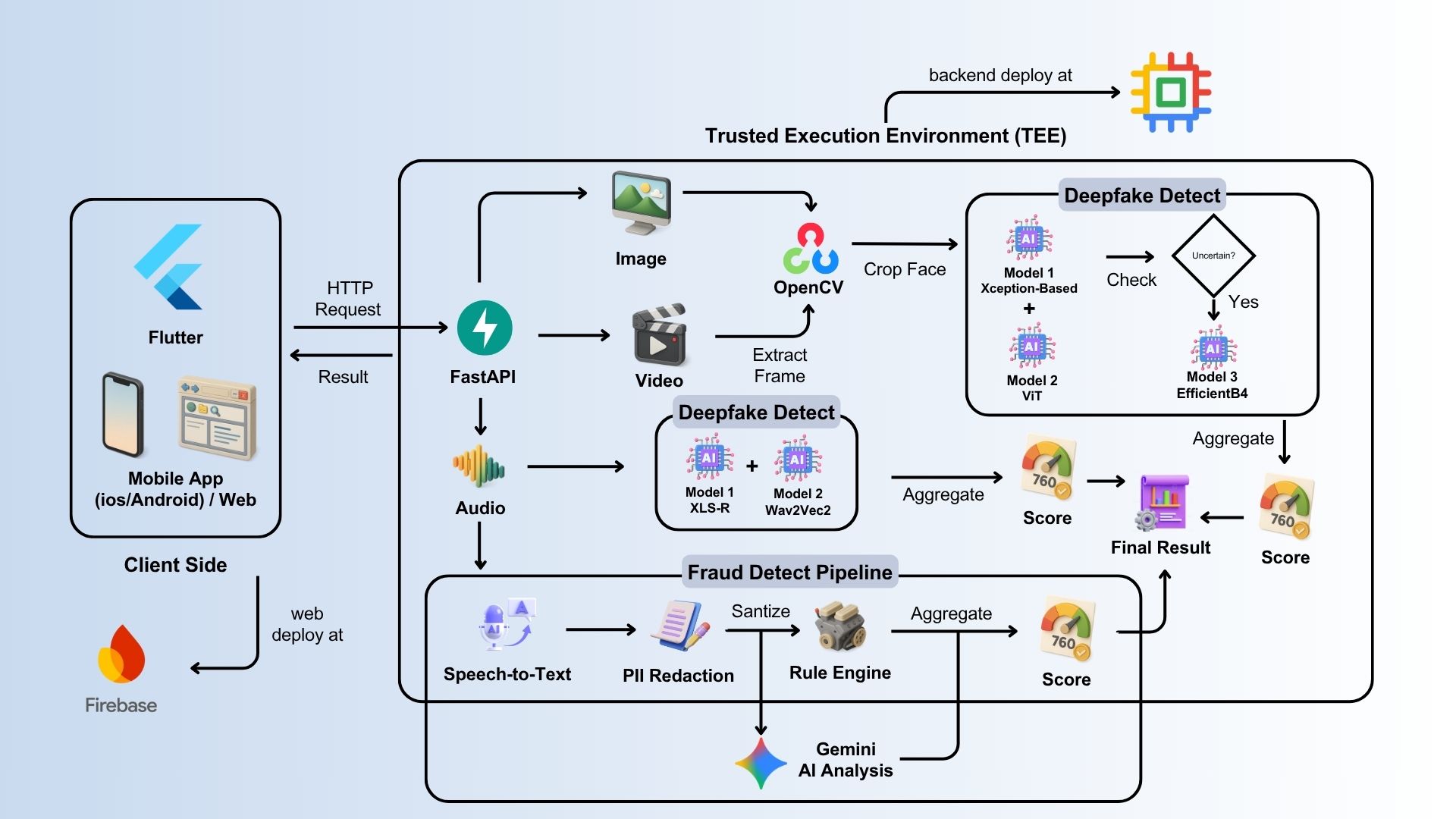
| Layer | Technologies |
|---|---|
| Frontend | Flutter (Dart) — mobile (iOS/Android) and web |
| Backend | FastAPI (Python 3.x), Uvicorn |
| Visual deepfake | OpenCV (face detection/crop), PyTorch — FaceForge (Xception), ViT (Vision Transformer), EfficientNet-B4 (tiebreaker) |
| Audio deepfake | PyTorch — Wav2Vec2, XLS-R; 16 kHz mono; soundfile / PyAV for decoding |
| Fraud pipeline | Whisper (local STT), custom PII filter (typed redaction), rule engine (bilingual EN/MY), playbook matcher (token overlap), Google Gemini (LLM) |
| Deployment | Backend on confidential VM (TEE) |
| Web link: https://realitic-app.web.app Can test the backend api via: http://35.198.241.242:8000/docs |
If you are cloning this repository, follow these steps to run the project locally.
.env file with GEMINI_API_KEY for the call fraud pipeline.git clone https://github.com/TisuPaper/vhack.git
cd vhack
# Create and activate a virtual environment
python3 -m venv venv
source venv/bin/activate  # On Windows use: venv\Scripts\activate

# Install dependencies (ensure PyTorch is also installed based on your system)
cd app
pip install -r requirements-fraud.txt
pip install fastapi uvicorn python-multipart torch torchvision torchaudio timm opencv-python Pillow

# Run the backend server
uvicorn main:app --reload --host 0.0.0.0 --port 8000
The backend will be available at http://localhost:8000 and the API docs at http://localhost:8000/docs.
# Open a new terminal
cd frontend

# Install Flutter dependencies
flutter pub get

# Run the flutter app (e.g., in Chrome for testing)
flutter run -d chrome
┌─────────────────────────────────────────────────────────────────┐
│                        FastAPI Backend                          │
│                                                                 │
│  POST /predict          → Image deepfake detection             │
│  POST /predict-video    → Video deepfake detection             │
│  POST /predict-audio    → Audio deepfake detection             │
│  POST /analyze-fraud    → Call fraud analysis pipeline         │
└─────────────────────────────────────────────────────────────────┘
| Capability | Models | Approach |
|---|---|---|
| Image deepfake | FaceForge (XceptionNet) + ViT + EfficientNet-B4 | Logit-stacking ensemble + fallback tiebreaker |
| Video deepfake | Same 3 models, frame-sampled | Per-frame ensemble, video-level aggregation |
| Audio deepfake | CNN-LSTM + TCN + TCN-LSTM | Chunk-based majority vote |
| Call fraud | Whisper STT + PII filter + Rules + Playbooks + Gemini | Hybrid risk engine (3 signals → final score) |
| Model | Architecture | Role |
|---|---|---|
| Champion | FaceForge (XceptionNet) | Strong on reals and common fakes |
| Challenger | ViT (fine-tuned FF++ two-stage) | Balanced across forgery types |
| Fallback | EfficientNet-B4 (fine-tuned Celeb-DF) | Tiebreaker for uncertain cases |
Stage 1 — Primary (logit stacking):
z = 0.25 × logit(champion_p_fake) + 1.0 × logit(challenger_p_fake) + 2.5
final_p_fake = sigmoid(z)
Stage 2 — Fallback tiebreaker (only when uncertain):
When 0.35 ≤ final_p_fake ≤ 0.65, the Fallback model is blended in:
z = 0.25×logit(champ) + 1.0×logit(chall) + 0.5×logit(fallback) + 2.5
Why two stages? On Celeb-DF fakes, Champion+Challenger often land in 0.35–0.65. EfficientNet (trained on Celeb-DF) confidently identifies these as fake — breaking the tie correctly.
final_p_fake | Verdict | Band |
|---|---|---|
| < 0.20 | REAL | HIGH |
| [0.20, 0.35) | REAL | MEDIUM |
| [0.35, 0.65] | UNCERTAIN | LOW |
| (0.65, 0.80] | FAKE | MEDIUM |
| > 0.80 | FAKE | HIGH |
mean(final_p_fake).UNCERTAIN.Detects AI-synthesised or cloned voices using three independently-trained models operating on raw audio waveforms.
| Model | Architecture | Description |
|---|---|---|
| CNN-LSTM | Convolutional + LSTM | Captures local patterns and temporal sequences |
| TCN | Temporal Convolutional Network | Dilated causal convolutions for long-range context |
| TCN-LSTM | TCN + LSTM hybrid | Combines both temporal approaches |
All three models are trained on 16 kHz mono audio and classify 2-second chunks as Real or Fake.
Audio file
    → decode (soundfile / PyAV fallback for WebM, MP3, etc.)
    → resample to 16 kHz mono
    → split into 2-second chunks (max 10 chunks, evenly spaced)
    → each model scores each chunk independently
    → chunk-level majority vote → per-model prediction
    → ensemble: majority vote across 3 models → final verdict
.wav · .mp3 · .ogg · .flac · .m4a · .webm · .aac
POST /predict-audio){
"request_id": "uuid",
"media_type": "audio",
"verdict": "FAKE",
"confidence_band": "HIGH",
"final_p_fake": 0.87,
"uncertain": false,
"decision_path": "majority_vote",
"reasons": ["models_agree", "high_confidence"],
"advice": {
"why": "Strong signs of manipulation detected — all models agree with high confidence",
"next_steps": ["Don't share OTP or bank info", "Verify identity via an official channel"]
},
"models": [
{"name": "CNN-LSTM", "p_fake": 0.91, "verdict": "FAKE", "chunks": 5},
{"name": "TCN", "p_fake": 0.84, "verdict": "FAKE", "chunks": 5},
{"name": "TCN-LSTM", "p_fake": 0.85, "verdict": "FAKE", "chunks": 5}
],
"ensemble_summary": {"voted_fake": 3, "voted_real": 0, "total": 3},
"privacy": {"stored_media": false},
"timing_ms": {"total": 340}
}
Detects phone scams and social engineering attacks from call audio. Combines three independent signals into a single hybrid risk score — no single point of failure.
Privacy-first design: Audio is transcribed locally (Whisper, no cloud STT). Sensitive data is redacted before any LLM call. Only the sanitised transcript is sent to Gemini.
Audio
  │
  ▼
[1] Speech-to-Text (Whisper, local)
  │   → transcript_raw
  │
  ▼
[2] PII Firewall (typed redaction, offline)
  │   → replaces phone/email/OTP/card/NRIC/name → [PHONE], [OTP], etc.
  │   → transcript_filtered  +  redacted[]
  │
  ├──[3a] Rule Engine (offline, deterministic)
  │         → matches 10 rule categories, produces rule_score (0–100)
  │         → extracts evidence quotes
  │
  ├──[3b] Playbook Matching (offline, RAG-lite)
  │         → token overlap vs 8 known scam scripts
  │         → returns similarity scores + matched phrases
  │
  └──[3c] Gemini Analysis (LLM)
            → classifies scam_type, extracts indicators + evidence
            → returns risk_score, confidence, recommendation
  │
  ▼
[4] Hybrid Risk Engine
      final_risk_score = 0.35×rule_score + 0.20×playbook_score + 0.45×gemini_score
      → final_risk_level: low / medium / high
      → merged evidence from all 3 sources
1. PII Firewall with typed placeholders
Instead of a generic [REDACTED], each sensitive item is labelled by type so Gemini retains analytical context:
| Detected | Replaced with |
|---|---|
| Phone number | [PHONE] |
| Email address | [EMAIL] |
| OTP / verification code | [OTP] |
| Card number | [CARD] |
| Malaysia IC / NRIC | [NRIC] |
| Name disclosure | [NAME] |
| Password / passcode | [PASSWORD] |
| Bank account | [ACCOUNT] |
Overlapping patterns are merged (no double-replacement). Malaysian-specific formats (NRIC, +60 phones, Malay phrases) are covered.
2. Rule-based heuristics (offline, zero-latency)
10 rule categories with weighted scoring:
| Rule | Weight | Detects |
|---|---|---|
otp_request | 35 | "Give me the OTP / verification code" |
urgent_transfer | 30 | "Transfer now / segera pindah" |
impersonation | 25 | Bank Negara / PDRM / MCMC callers |
remote_access | 25 | AnyDesk / TeamViewer requests |
data_harvest | 20 | IC/MyKad/passport data requests |
lottery_scam | 20 | Prize/lucky draw announcements |
investment_scam | 20 | Guaranteed returns / crypto |
parcel_scam | 15 | Detained package / customs fee |
pressure_tactics | 15 | Arrest warrant / secrecy demands |
loan_scam | 15 | Upfront fee / instant loan |
Rules are bilingual (English + Malay) and run entirely on-device — no API call, near-instant.
3. Scam Playbook Matching (RAG-lite, offline)
Token overlap similarity against 8 known scam script templates (current):
4. Gemini LLM Reasoning
Receives the PII-filtered transcript + rule context. Returns:
scam_type (enum: phishing / impersonation / investment / etc.)risk_score 0–100confidence 0.0–1.0indicators (list of detected fraud signals)evidence (quoted snippets with reasons)recommendation (one actionable sentence)5. Hybrid Risk Score
final_risk_score = 0.35 × rule_score
                 + 0.20 × playbook_score
                 + 0.45 × gemini_score
| Score | Risk Level |
|---|---|
| 0–34 | low |
| 35–64 | medium |
| 65–100 | high |
POST /analyze-fraud){
"request_id": "uuid",
"transcript_raw": "Give me your OTP right now, this is Bank Negara officer calling.",
"transcript_filtered": "Give me your [OTP] right now, this is [NAME] officer calling.",
"redacted": [
{"original": "OTP", "label": "OTP"},
{"original": "Bank Negara officer", "label": "NAME"}
],
"risk_level": "high",
"risk_score": 82,
"scam_type": "impersonation",
"signals": {
"rule_score": 60,
"matched_rules": ["otp_request", "impersonation"],
"playbook_matches": [
{"scam_type": "phishing", "label": "OTP / Credential Phishing", "similarity": 0.45, "matched_phrases": ["Give me the OTP"]},
{"scam_type": "impersonation", "label": "Police / Bank Impersonation", "similarity": 0.30, "matched_phrases": ["Bank Negara"]}
],
"gemini": {
"risk_level": "high",
"risk_score": 95,
"confidence": 0.92,
"scam_type": "impersonation",
"summary": "Caller impersonates a Bank Negara officer and requests OTP.",
"indicators": ["Authority impersonation", "OTP harvesting", "Urgency"],
"recommendation": "Hang up immediately — Bank Negara never calls to request OTPs."
}
},
"evidence": [
{"quote": "Give me your OTP right now", "reason": "Requests OTP or verification code"},
{"quote": "Bank Negara officer calling", "reason": "Impersonates authority (bank/police/government)"}
],
"privacy": {"stored_media": false},
"timing_ms": {"total": 2100}
}
Realytic includes an end-to-end admin dashboard and backend pipeline designed to continuously retrain its deepfake detection models based on newly vetted user data.
True (Real) or False (Fake).POST /predict — Image deepfake{
"request_id": "uuid",
"media_type": "image",
"verdict": "FAKE",
"confidence_band": "HIGH",
"final_p_fake": 0.91,
"uncertain": false,
"decision_path": "primary_ensemble",
"reasons": ["models_agree", "high_confidence"],
"signals": {
"face_found": true,
"face_bbox": {"x": 0.12, "y": 0.08, "w": 0.45, "h": 0.60},
"quality_warning": null,
"disagreement": 0.08
},
"models": [
{"name": "FaceForge-Xception", "role": "champion", "p_fake": 0.94, "used": true},
{"name": "ViT-FF++TwoStage", "role": "challenger", "p_fake": 0.86, "used": true},
{"name": "EffNetB4-CelebDF", "role": "fallback", "p_fake": 0.77, "used": false}
],
"privacy": {"stored_media": false},
"timing_ms": {"total": 620}
}
decision_path: primary_ensemble · tiebreaker_used · low_quality
reasons tags: no_face_detected · low_resolution · small_face · models_agree · models_disagree · borderline_score · high_confidence · tiebreaker_used
POST /predict-video — Video deepfake{
"request_id": "uuid",
"media_type": "video",
"verdict": "UNCERTAIN",
"confidence_band": "LOW",
"final_p_fake": 0.55,
"uncertain": true,
"sampling": {"frames_used": 10, "strategy": "middle_80_even"},
"video_stats": {
"mean_p_fake": 0.55,
"median_p_fake": 0.52,
"variance": 0.08,
"uncertain_frame_rate": 0.40,
"confident_fake_frames": 2
},
"decision_path": "tiebreaker_used",
"reasons": ["borderline_score", "models_disagree", "tiebreaker_used"],
"models_summary": {"champion_avg": 0.10, "challenger_avg": 0.48, "fallback_avg": 0.70},
"top_suspicious_frames": [
{"t_sec": 12.4, "p_fake": 0.84},
{"t_sec": 18.0, "p_fake": 0.79}
],
"privacy": {"stored_media": false},
"timing_ms": {"total": 4200}
}
Additional reasons for video: high_variance · low_face_rate · consistent_prediction
POST /predict-audio — Audio deepfakeSee Section 7 for full response schema.
POST /analyze-fraud — Call fraudSee Section 8 for full response schema.
[PHONE], [OTP], [NRIC]) before any LLM call; merge overlapping spans; keep evidence and scam analysis useful without exposing real identifiers.Team 3004 — Lim Fang Yee, Lee Wai Yee
A privacy-preserving, multi-modal deepfake detection system run at Trusted Execution Environment (TEE), covering image, video, and audio deepfakes, plus a fraud analysis pipeline that transcribes speech, redacts private data, and uses a hybrid risk engine to detect scams accross multiple platforms (web/native app).
Realytic is a multi-modal deepfake and call-fraud detection system that runs in a Trusted Execution Environment (TEE) without storing user's data. It gives users confidence scores and actionable advice instead of a simple real/fake label, and keeps sensitive data out of third-party APIs.
Highlights:
The client (Flutter app on mobile or web) sends media to a FastAPI backend running inside a Trusted Execution Environment (TEE). The backend routes by media type, runs ensemble deepfake models and (for audio) a fraud pipeline, then returns scores and evidence.
| Layer | Technologies |
|---|---|
| Frontend | Flutter (Dart) — mobile (iOS/Android) and web |
| Backend | FastAPI (Python 3.x), Uvicorn |
| Visual deepfake | OpenCV (face detection/crop), PyTorch — FaceForge (Xception), ViT (Vision Transformer), EfficientNet-B4 (tiebreaker) |
| Audio deepfake | PyTorch — Wav2Vec2, XLS-R; 16 kHz mono; soundfile / PyAV for decoding |
| Fraud pipeline | Whisper (local STT), custom PII filter (typed redaction), rule engine (bilingual EN/MY), playbook matcher (token overlap), Google Gemini (LLM) |
| Deployment | Backend on confidential VM (TEE) |
| Web link: https://realitic-app.web.app Can test the backend api via: http://35.198.241.242:8000/docs |
If you are cloning this repository, follow these steps to run the project locally.
.env file with GEMINI_API_KEY for the call fraud pipeline.git clone https://github.com/TisuPaper/vhack.git
cd vhack
# Create and activate a virtual environment
python3 -m venv venv
source venv/bin/activate  # On Windows use: venv\Scripts\activate

# Install dependencies (ensure PyTorch is also installed based on your system)
cd app
pip install -r requirements-fraud.txt
pip install fastapi uvicorn python-multipart torch torchvision torchaudio timm opencv-python Pillow

# Run the backend server
uvicorn main:app --reload --host 0.0.0.0 --port 8000
The backend will be available at http://localhost:8000 and the API docs at http://localhost:8000/docs.
# Open a new terminal
cd frontend

# Install Flutter dependencies
flutter pub get

# Run the flutter app (e.g., in Chrome for testing)
flutter run -d chrome
┌─────────────────────────────────────────────────────────────────┐
│                        FastAPI Backend                          │
│                                                                 │
│  POST /predict          → Image deepfake detection             │
│  POST /predict-video    → Video deepfake detection             │
│  POST /predict-audio    → Audio deepfake detection             │
│  POST /analyze-fraud    → Call fraud analysis pipeline         │
└─────────────────────────────────────────────────────────────────┘
| Capability | Models | Approach |
|---|---|---|
| Image deepfake | FaceForge (XceptionNet) + ViT + EfficientNet-B4 | Logit-stacking ensemble + fallback tiebreaker |
| Video deepfake | Same 3 models, frame-sampled | Per-frame ensemble, video-level aggregation |
| Audio deepfake | CNN-LSTM + TCN + TCN-LSTM | Chunk-based majority vote |
| Call fraud | Whisper STT + PII filter + Rules + Playbooks + Gemini | Hybrid risk engine (3 signals → final score) |
| Model | Architecture | Role |
|---|---|---|
| Champion | FaceForge (XceptionNet) | Strong on reals and common fakes |
| Challenger | ViT (fine-tuned FF++ two-stage) | Balanced across forgery types |
| Fallback | EfficientNet-B4 (fine-tuned Celeb-DF) | Tiebreaker for uncertain cases |
Stage 1 — Primary (logit stacking):
z = 0.25 × logit(champion_p_fake) + 1.0 × logit(challenger_p_fake) + 2.5
final_p_fake = sigmoid(z)
Stage 2 — Fallback tiebreaker (only when uncertain):
When 0.35 ≤ final_p_fake ≤ 0.65, the Fallback model is blended in:
z = 0.25×logit(champ) + 1.0×logit(chall) + 0.5×logit(fallback) + 2.5
Why two stages? On Celeb-DF fakes, Champion+Challenger often land in 0.35–0.65. EfficientNet (trained on Celeb-DF) confidently identifies these as fake — breaking the tie correctly.
final_p_fake | Verdict | Band |
|---|---|---|
| < 0.20 | REAL | HIGH |
| [0.20, 0.35) | REAL | MEDIUM |
| [0.35, 0.65] | UNCERTAIN | LOW |
| (0.65, 0.80] | FAKE | MEDIUM |
| > 0.80 | FAKE | HIGH |
mean(final_p_fake).UNCERTAIN.Detects AI-synthesised or cloned voices using three independently-trained models operating on raw audio waveforms.
| Model | Architecture | Description |
|---|---|---|
| CNN-LSTM | Convolutional + LSTM | Captures local patterns and temporal sequences |
| TCN | Temporal Convolutional Network | Dilated causal convolutions for long-range context |
| TCN-LSTM | TCN + LSTM hybrid | Combines both temporal approaches |
All three models are trained on 16 kHz mono audio and classify 2-second chunks as Real or Fake.
Audio file
    → decode (soundfile / PyAV fallback for WebM, MP3, etc.)
    → resample to 16 kHz mono
    → split into 2-second chunks (max 10 chunks, evenly spaced)
    → each model scores each chunk independently
    → chunk-level majority vote → per-model prediction
    → ensemble: majority vote across 3 models → final verdict
.wav · .mp3 · .ogg · .flac · .m4a · .webm · .aac
POST /predict-audio){
"request_id": "uuid",
"media_type": "audio",
"verdict": "FAKE",
"confidence_band": "HIGH",
"final_p_fake": 0.87,
"uncertain": false,
"decision_path": "majority_vote",
"reasons": ["models_agree", "high_confidence"],
"advice": {
"why": "Strong signs of manipulation detected — all models agree with high confidence",
"next_steps": ["Don't share OTP or bank info", "Verify identity via an official channel"]
},
"models": [
{"name": "CNN-LSTM", "p_fake": 0.91, "verdict": "FAKE", "chunks": 5},
{"name": "TCN", "p_fake": 0.84, "verdict": "FAKE", "chunks": 5},
{"name": "TCN-LSTM", "p_fake": 0.85, "verdict": "FAKE", "chunks": 5}
],
"ensemble_summary": {"voted_fake": 3, "voted_real": 0, "total": 3},
"privacy": {"stored_media": false},
"timing_ms": {"total": 340}
}
Detects phone scams and social engineering attacks from call audio. Combines three independent signals into a single hybrid risk score — no single point of failure.
Privacy-first design: Audio is transcribed locally (Whisper, no cloud STT). Sensitive data is redacted before any LLM call. Only the sanitised transcript is sent to Gemini.
Audio
  │
  ▼
[1] Speech-to-Text (Whisper, local)
  │   → transcript_raw
  │
  ▼
[2] PII Firewall (typed redaction, offline)
  │   → replaces phone/email/OTP/card/NRIC/name → [PHONE], [OTP], etc.
  │   → transcript_filtered  +  redacted[]
  │
  ├──[3a] Rule Engine (offline, deterministic)
  │         → matches 10 rule categories, produces rule_score (0–100)
  │         → extracts evidence quotes
  │
  ├──[3b] Playbook Matching (offline, RAG-lite)
  │         → token overlap vs 8 known scam scripts
  │         → returns similarity scores + matched phrases
  │
  └──[3c] Gemini Analysis (LLM)
            → classifies scam_type, extracts indicators + evidence
            → returns risk_score, confidence, recommendation
  │
  ▼
[4] Hybrid Risk Engine
      final_risk_score = 0.35×rule_score + 0.20×playbook_score + 0.45×gemini_score
      → final_risk_level: low / medium / high
      → merged evidence from all 3 sources
1. PII Firewall with typed placeholders
Instead of a generic [REDACTED], each sensitive item is labelled by type so Gemini retains analytical context:
| Detected | Replaced with |
|---|---|
| Phone number | [PHONE] |
| Email address | [EMAIL] |
| OTP / verification code | [OTP] |
| Card number | [CARD] |
| Malaysia IC / NRIC | [NRIC] |
| Name disclosure | [NAME] |
| Password / passcode | [PASSWORD] |
| Bank account | [ACCOUNT] |
Overlapping patterns are merged (no double-replacement). Malaysian-specific formats (NRIC, +60 phones, Malay phrases) are covered.
2. Rule-based heuristics (offline, zero-latency)
10 rule categories with weighted scoring:
| Rule | Weight | Detects |
|---|---|---|
otp_request | 35 | "Give me the OTP / verification code" |
urgent_transfer | 30 | "Transfer now / segera pindah" |
impersonation | 25 | Bank Negara / PDRM / MCMC callers |
remote_access | 25 | AnyDesk / TeamViewer requests |
data_harvest | 20 | IC/MyKad/passport data requests |
lottery_scam | 20 | Prize/lucky draw announcements |
investment_scam | 20 | Guaranteed returns / crypto |
parcel_scam | 15 | Detained package / customs fee |
pressure_tactics | 15 | Arrest warrant / secrecy demands |
loan_scam | 15 | Upfront fee / instant loan |
Rules are bilingual (English + Malay) and run entirely on-device — no API call, near-instant.
3. Scam Playbook Matching (RAG-lite, offline)
Token overlap similarity against 8 known scam script templates (current):
4. Gemini LLM Reasoning
Receives the PII-filtered transcript + rule context. Returns:
scam_type (enum: phishing / impersonation / investment / etc.)risk_score 0–100confidence 0.0–1.0indicators (list of detected fraud signals)evidence (quoted snippets with reasons)recommendation (one actionable sentence)5. Hybrid Risk Score
final_risk_score = 0.35 × rule_score
                 + 0.20 × playbook_score
                 + 0.45 × gemini_score
| Score | Risk Level |
|---|---|
| 0–34 | low |
| 35–64 | medium |
| 65–100 | high |
POST /analyze-fraud){
"request_id": "uuid",
"transcript_raw": "Give me your OTP right now, this is Bank Negara officer calling.",
"transcript_filtered": "Give me your [OTP] right now, this is [NAME] officer calling.",
"redacted": [
{"original": "OTP", "label": "OTP"},
{"original": "Bank Negara officer", "label": "NAME"}
],
"risk_level": "high",
"risk_score": 82,
"scam_type": "impersonation",
"signals": {
"rule_score": 60,
"matched_rules": ["otp_request", "impersonation"],
"playbook_matches": [
{"scam_type": "phishing", "label": "OTP / Credential Phishing", "similarity": 0.45, "matched_phrases": ["Give me the OTP"]},
{"scam_type": "impersonation", "label": "Police / Bank Impersonation", "similarity": 0.30, "matched_phrases": ["Bank Negara"]}
],
"gemini": {
"risk_level": "high",
"risk_score": 95,
"confidence": 0.92,
"scam_type": "impersonation",
"summary": "Caller impersonates a Bank Negara officer and requests OTP.",
"indicators": ["Authority impersonation", "OTP harvesting", "Urgency"],
"recommendation": "Hang up immediately — Bank Negara never calls to request OTPs."
}
},
"evidence": [
{"quote": "Give me your OTP right now", "reason": "Requests OTP or verification code"},
{"quote": "Bank Negara officer calling", "reason": "Impersonates authority (bank/police/government)"}
],
"privacy": {"stored_media": false},
"timing_ms": {"total": 2100}
}
Realytic includes an end-to-end admin dashboard and backend pipeline designed to continuously retrain its deepfake detection models based on newly vetted user data.
True (Real) or False (Fake).POST /predict — Image deepfake{
"request_id": "uuid",
"media_type": "image",
"verdict": "FAKE",
"confidence_band": "HIGH",
"final_p_fake": 0.91,
"uncertain": false,
"decision_path": "primary_ensemble",
"reasons": ["models_agree", "high_confidence"],
"signals": {
"face_found": true,
"face_bbox": {"x": 0.12, "y": 0.08, "w": 0.45, "h": 0.60},
"quality_warning": null,
"disagreement": 0.08
},
"models": [
{"name": "FaceForge-Xception", "role": "champion", "p_fake": 0.94, "used": true},
{"name": "ViT-FF++TwoStage", "role": "challenger", "p_fake": 0.86, "used": true},
{"name": "EffNetB4-CelebDF", "role": "fallback", "p_fake": 0.77, "used": false}
],
"privacy": {"stored_media": false},
"timing_ms": {"total": 620}
}
decision_path: primary_ensemble · tiebreaker_used · low_quality
reasons tags: no_face_detected · low_resolution · small_face · models_agree · models_disagree · borderline_score · high_confidence · tiebreaker_used
POST /predict-video — Video deepfake{
"request_id": "uuid",
"media_type": "video",
"verdict": "UNCERTAIN",
"confidence_band": "LOW",
"final_p_fake": 0.55,
"uncertain": true,
"sampling": {"frames_used": 10, "strategy": "middle_80_even"},
"video_stats": {
"mean_p_fake": 0.55,
"median_p_fake": 0.52,
"variance": 0.08,
"uncertain_frame_rate": 0.40,
"confident_fake_frames": 2
},
"decision_path": "tiebreaker_used",
"reasons": ["borderline_score", "models_disagree", "tiebreaker_used"],
"models_summary": {"champion_avg": 0.10, "challenger_avg": 0.48, "fallback_avg": 0.70},
"top_suspicious_frames": [
{"t_sec": 12.4, "p_fake": 0.84},
{"t_sec": 18.0, "p_fake": 0.79}
],
"privacy": {"stored_media": false},
"timing_ms": {"total": 4200}
}
Additional reasons for video: high_variance · low_face_rate · consistent_prediction
POST /predict-audio — Audio deepfakeSee Section 7 for full response schema.
POST /analyze-fraud — Call fraudSee Section 8 for full response schema.
[PHONE], [OTP], [NRIC]) before any LLM call; merge overlapping spans; keep evidence and scam analysis useful without exposing real identifiers.Team 3004 — Lim Fang Yee, Lee Wai Yee



